
 Worksheets
Minerals/Rocks Test Review
Total questions: 80
Worksheet time: 44mins
Rocks and sediment are part of which component of the Earth System?
geosphere
hydrosphere
biosphere
atmosphere
Continental lithosphere __________.
is thicker than oceanic lithosphere
contains more mafic rocks than oceanic lithosphere
is denser than oceanic lithosphere
and oceanic lithosphere have similar compositions, densities, and thicknesses
Fewer than 50 minerals are __________.
found on the Earth
used for industrial purposes
found in the crust
commonly found in rocks
Why are minerals often referred to as the building blocks of Earth?
They determine Earth’s orbit around the Sun.
They are the basic constituents that make up rocks.
They form only in the atmosphere.
They form only from biological processes.
Which of the following would be considered a rock?
a manufactured clay brick
a pile of sand
a chunk of obsidian
an abalone shell
How would you tell if a rock is crystalline?
It contains crystals that have been cemented together.
It does not contain crystals at all.
It contains interlocking crystals.
It contains all one type of crystal.
What is the difference between a rock that is cemented together and a rock that has a crystalline texture?
A rock that is cemented contains rounded grains held by cement, whereas a crystalline rock contains angular grains held by cement.
Crystalline rocks contain minerals, while cemented rocks contain rock fragments, both held together by static forces between grains.
Minerals are held together as interlocking pieces in a crystalline rock, whereas grains are held together by minerals precipitated in pore spaces in a cemented rock.
Minerals are held together as interlocking pieces in a crystalline rock, whereas in a cemented rock the grains do not fit together like puzzle pieces and instead are held together by cement.
Imagine you are holding a rock composed of sand grains cemented together. What subclassification of rock is this?
metamorphic
sedimentary
crystalline
igneous
What type of rock forms from the freezing (solidification) of a molten rock?
metamorphic
crystalline
sedimentary
igneous
Which type of rock is formed by precipitation of minerals from a solution?
metamorphic
glassy
sedimentary
igneous
If a rock is subjected to elevated levels of heat and pressure, a(n) __________ rock will form.
igneous
molten
metamorphic
sedimentary
Composition describes the __________.
degree of compaction and cementation in a rock
arrangement of minerals in a rock
presence of layers in a rock
proportion of chemicals that make up a rock
Which of the following is a reliable characteristic that can be used to classify a rock?
mineral stability
texture
water content
degree of weathering

Refer to the photo of a banded rock with light and dark wavy layers. What do geologists call the layering seen in this photo?
tilted bedding
metamorphic foliation
sedimentary layers
cleavage planes

In the photo showing fresh solidified lava forming a crust while still molten beneath, what type of rock is being formed?
igneous
sedimentary
metamorphic
foliated
Granite forms deep underground from magma that cools very slowly. What type of rock is granite?
igneous
sedimentary
metamorphic
biologic
What type of rock would you expect to form from volcanic activity?
sedimentary
biologic
metamorphic
igneous

The photo shows a cliff with distinct horizontal layers of rock and a person standing at the base. What type of rock is most consistent with the layered appearance?
sedimentary
igneous
metamorphic
crystalline
Which rock type would you most expect to form in a beach environment characterized by deposition of sand and shells?
crystalline
sedimentary
metamorphic
igneous
Which statement best explains how a metamorphic rock forms?
freezing (solidification) from a molten material
recrystallization due to changes in pressure and temperature
solidification of pieces of weathered, preexisting rocks
fast (instant) cooling of a molten material

The photo shows a rock with pronounced foliation and a rock hammer for scale. What type of rock is shown?
clastic
sedimentary
igneous
metamorphic
In which setting are sedimentary rocks most likely forming due to accumulation of sediments?
deep within a mountain range
inside a lava flow on Hawaii
at a mid-ocean ridge
at the bottom of the Mediterranean Sea

A thin-section photomicrograph shows interlocking mineral grains with crystalline textures. What type of texture is most evident?
foliation
crystalline
sedimentary
clastic

To determine crystal identity and orientation in the thin section image labeled 500 µm, what should a geologist do?
subject the sample to a fracture test
examine the sample under polarized light
etch the sample with acid
place the sample in a magnetic field
What can geologists most easily determine by analyzing a thin section of a rock?
whether the rock is molten
what chemical constituents make up the rock
what minerals constitute the rock and how grains connect to one another
the arrangement of atoms
Which instrument is used to examine the surface of a rock chip at extremely high magnification to observe fine-scale textures?
mass spectrometer
petrographic microscope
X-ray diffractometer
scanning electron microscope
Why is a piece of concrete not considered a rock? Choose the best explanation.
It contains minerals so it must be a rock.
It forms naturally from magma.
It is a human-made material composed of cement and aggregates, not a naturally occurring solid aggregate.
It lacks any crystalline components.
Which statement correctly identifies the three major rock groups and how each forms?
Igneous, sedimentary, metamorphic; all form by cooling of magma.
Igneous from crystallized melt; sedimentary from deposited and lithified sediments; metamorphic from alteration of existing rock by heat and pressure.
Igneous from deposition of sand; sedimentary from heat and pressure; metamorphic from melting and cooling.
Sedimentary, clastic, foliated; each forms by recrystallization.
Igneous rocks are formed primarily by which process?
through the freezing or crystallization of a melt
by changing existing rock through the application of heat and pressure
by depositing loose material into layers
by condensation from vapors enriched in mineral-forming components
What is the difference between magma and lava?
magma cools more rapidly than lava
magma is found at the surface, whereas lava is found below the surface
magma is melt underground, whereas lava is melt that has emerged from the surface
There is no difference; the two terms mean the same thing.
The most common minerals within the Earth are __________.
silicates
carbonates
oxides
hydroxides
What is the difference between a mineral and a glass?
Minerals are crystalline; glass is noncrystalline.
Minerals are synthetic; glass is always natural.
Minerals must be metallic; glass must be nonmetallic.
Minerals are liquids; glass is solid.
When a solution becomes oversaturated, new solid particles are said to __________.
precipitate
dissolve
react and produce heat
rapidly expand
Which choice lists atoms and atomic components in order from smallest to largest?
atom, nucleus, proton, electron
electron, proton, nucleus, atom
proton, electron, nucleus, atom
atom, electron, nucleus, proton
The atomic mass of an element approximately equals the number of __________.
electrons
protons plus neutrons
neutrons
protons
Minerals are all naturally occurring solid substances with a definable chemical composition. They must also possess __________.
the ability to be synthesized in the laboratory as well as be found in nature
metallic elements, such as iron, calcium, or magnesium
metallic luster
a fixed crystalline structure (periodic arrangement of atoms and ions)
Crystals that exhibit well-formed faces are referred to as __________.
pristine
anhedral
subhedral
euhedral
In which of the following ways can minerals crystallize?
solidification of a melt (lava/magma)
bonding carbon to oxygen atoms to form organic compounds
gradual liquefaction through superheating
instant solidification to form glass
SiO4 4−, S2−, and CO3 2− are all examples of __________.
organic compounds
silicate minerals
anionic groups
cations
The pattern of atoms in a crystal can be detected using __________.
magnetic resonance imaging (MRI)
X-ray diffraction
thermal ionization mass spectrometry (TIMS)
cathodized axial tomography (CAT)
Diamond and graphite are both polymorphs of __________.
silicon
iron
magnesium
carbon
Which of the following minerals is more commonly known as table salt?
gypsum
feldspar
halite
quartz
Which of the following common minerals is softest?
quartz
calcite
talc
fluorite
The color of a mineral in powdered form is termed __________.
color
specific gravity
luster
streak
The tendency for minerals to break along distinct planar surfaces that have a specific orientation in relation to the crystal structure is called __________.
fracture
cleavage
specific gravity
hardness
Hardness refers to a mineral’s ability to resist __________.
breaking
being scratched
chemically reacting with other substances
weathering
A mineral property defined as the density of the mineral sample divided by the density of water (1.0 g/cm^3) is __________.
mass
specific gravity
luster
streak

The image shows a mineral specimen of pyrite. What is the term for the thin parallel corrugations or stripes shown on its crystal faces?
conchoidal fractures
facets
cleavage planes
striations

The image shows a mineral specimen of quartz. What is the term for the smoothly curving, clamshell-shaped surface on the sample?
conchoidal fractures
facet
cleavage plane
striation

Using the Mohs hardness scale diagram showing minerals from talc (1) to diamond (10), which statement is correct?
Your fingernail can scratch a sample of talc.
Quartz and apatite are about equally hard.
Diamonds are more than seven times as hard as quartz.
A steel knife can scratch quartz.
Calcite (CaCO3) belongs to which mineral class?
silicates
carbonates
oxides
sulfides
Silicate minerals are subdivided into six groups based on the way silica tetrahedra are ________.
bonded to anions
bonded to iron atoms
arranged and bonded
arranged and charged
Which mineral class makes up more than 96 percent of the continental crust?
silicates
carbonates
halides
oxides
Trace amounts of impurity can produce significant differences in ________ among individual crystals of a mineral species.
color
cleavage
luster
streak
Important volatiles in magmas include which pair?
iron-rich minerals, such as pyroxene
quartz and calcite
water and carbon dioxide
coal and graphite
In the discontinuous series of Bowen’s reaction series, the first mineral to crystallize from a mafic melt is ________.
olivine
plagioclase
pyroxene
quartz
The continuous series in Bowen’s reaction series describes the crystallization behavior of which mineral group?
biotite
plagioclase
muscovite
amphibole
During cementation in lithification, which two minerals most commonly precipitate into pore spaces to form cement?
zircon and gypsum
fluorite and dolomite
quartz and calcite
muscovite and feldspar
Broadly, metamorphism involves ________.
the setting of crystals in a melt as it cools
the sorting of grains by size by rivers and waves
the cementation of loose grains and precipitation of new minerals
changes in mineralogy and texture in response to heat and stress
A buried body of shale is subjected to different stress, causing clay minerals to realign and produce slate. This is an example of ________.
diagenesis
erosion
metamorphism
weathering
The formation of metamorphic rock involves all of the following processes EXCEPT ________.
the realignment of minerals so that they develop a preferred orientation
the segregation of minerals into layers of different compositions
the solid-state rearrangement of atoms or ions to create a new assemblage of minerals
complete remelting of the rock, followed by solidification to form a new rock
A ball of ground beef is flattened into a hamburger patty. This illustrates which type of stress?
compression
uniform pressure
shear
tension
Marble and quartzite are nonfoliated metamorphic rocks because ________.
they are never found beneath fault zones or collisional mountain ranges
both are dominated by minerals that produce equant grains
both are dominated by minerals with crystalline structures that cannot be dissolved
dynamothermal metamorphism breaks down their constituent minerals, which are unstable in that environment
Foliated metamorphic rocks possess ________.
leafy plant fossils
a homogenous texture from randomly oriented grains
mineral grains in preferred orientations or patterns of association
minerals precipitated directly from seawater
What is the rock cycle?
the cycle rocks go through when interacting with water
the transformation of one mineral type to another
the transformation of one rock type to another
the cycle rocks undergo when interacting with air
Why does differential weathering occur?
Chemical weathering attacks some layers while physical weathering attacks others.
Cliffs formed by chemical weathering protect the rocks below.
Some rock types do not weather at all, producing cliffs.
Different minerals have different resistances to weathering.

According to the Mohs scale, which everyday object listed can scratch calcite but not orthoclase?
fingernail
copper penny
steel knife
glass plate
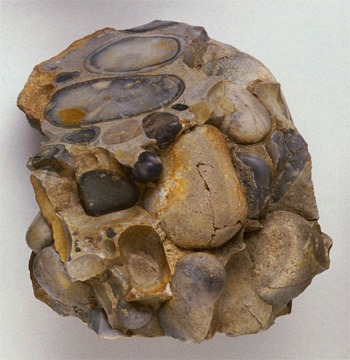

Sandstone is an example of...
Metamorphic
Sedimentary
Igneous

Granite is an example of...
Igneous
Metamorphic
Sedimentary

Marble is an example of...
Igneous
Sedimentary
Metamorphic


Basalt is an example of...
Igneous
Sedimentary
Metamorphic
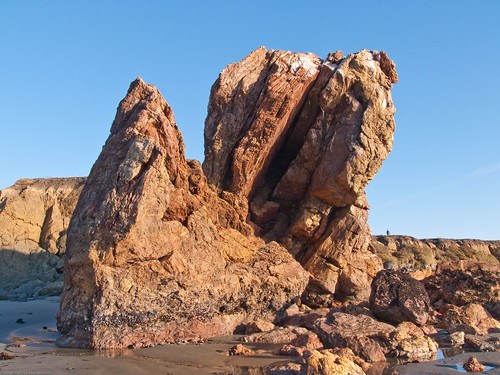
Which type of rock is formed when heat or pressure deep underground changes existing rock?
igneous
metamorphic
sedimentary
marble

Coal is...
an igneous rock.
a sedimentay rock.
a metamorphic rock.

Clastic rocks describe
Metaphoric rock
Sedimentary Rock
Igneous Rock


What type of rock is this?
Sedimentary
Igneous
Metamorphic
Sand

Which rocks are made by heat and pressure?
igneous
sedimentary
metamorphic


