
Font size
 Worksheets
Bonding Quiz
Total questions: 100
Worksheet time: 1hrs 11mins
Which of the following compounds are ionic?
carbon dioxide
copper oxide
calcium oxide
nitrogen oxide
Which of the following compounds are covalent?
carbon dioxide
copper chloride
calcium nitrate
methane CH4
ammonia NH3
What type of bonding is present in methane CH4?
ionic
covalent
metallic
ionic and covalent
What type of bonding is present in ammonia NH3?
ionic
covalent
metallic
ionic and covalent
What type of bonding is present in chlorine Cl2?
ionic
covalent
metallic
ionic and covalent
What type of bonding is present in sodium chloride?
ionic
covalent
metallic
ionic and covalent
What type of bonding is present in sodium?
ionic
covalent
metallic
ionic and covalent
What type of bonding is present in iron?
ionic
covalent
metallic
ionic and covalent
What type of bonding is present in potassium nitrate KNO3?
ionic
covalent
metallic
ionic and covalent
What type of bonding is present in water?
ionic
covalent
metallic
ionic and covalent
What two types of atoms make a covalent bond?
2 non-metals
1 metal and 1 non-metal
2 metals
What type of bond involves the sharing of electrons between atoms?
covalent bond
ionic bond
metallic bond
transfer bond
pairs of electrons are shared between two non-metal atoms.
two non-metal atoms are attracted to each other by opposite charges.
What is it called if there are three pairs of electrons being shared?
Identify the following compound as ionic or covalent: SO2
ionic
covalent
Identify the following compound as ionic or covalent: Ca(OH)2
ionic
covalent
Identify the following compound as ionic or covalent: CH3COOH
ionic
covalent

How many valence electrons are shown in the diagram?
16
7
6
2

Examine the image: How many bonds are formed looking at the model of the compound? And also indetify what type of bond is formed.
2 bonds; covalent
4 bonds; metallic
2 bonds; ionic
4 bonds; covalent
Predict the bond that form between Be and F
Covalent
Ionic
If an atom loses two electrons what charge will it have?
-1
-2
+1
+2
Which particle is responsible for bonding?
Electrons
Protons
Nucleus
Neutrons
Why do elements bond?
To be friends
To create a new element
To become stable
To get bigger


How many valence electrons does Oxygen (O) have?
6
8
15
16


An atom with a different number of electrons than it should have (more or less) is called an ---
isotope
valence electron
ion
octet

Ionic bonds are formed when electrons get
Shared between two atoms
Removed from both atoms
Transferred from one atom to another
Added to both atoms

Ionic bonds typically form between
A metal and a nonmetal
Two nonmetals
Two metals
A metalloid and a metal

Cations _______ electrons, becoming _______ charged.
Gain; positively (+)
Gain; negatively (-)
Lose; positively (+)
Lose; negatively (-)

Write the chemical formula for Na and S (sodium sulfide).
NaS
S2S2
Na2S
NaS2
How many valence electrons are shown in the diagram?
16
7
6
2
Examine the image: How many bonds are formed looking at the model of the compound? And also indetify what type of bond is formed.
2 bonds; covalent
4 bonds; metallic
2 bonds; ionic
4 bonds; covalent
Ionic Bonding is the _________ of electron/s between atoms.
sharing
transfer
loose
gain
a type of covalent bond that shares two pairs of electron
single bond
double bond
triple bond
This refers to the tendency of atoms to prefer to have eight electrons in the valence shell
Octet rule
Valence electron
Electronegativity
Lewis symbol
Electron that is located on the outermost shell
proton
neutron
electron
valence electron
A bond between metal and non metal is called
covalent bond
ionic bond
metallic bond
transfer bond
Predict the bond that form between Be and F
Covalent
Ionic
If an atom loses two electrons what charge will it have?
-1
-2
+1
+2
Which particle is responsible for bonding?
Electrons
Protons
Nucleus
Neutrons
Which element is most likely to form 2 bonds?
Carbon
Fluorine
Nitrogen
Sulfur
Why do elements bond?
To be friends
To create a new element
To become stable
To get bigger
How many valence electrons does Oxygen (O) have?
6
8
15
16
An atom with a different number of electrons than it should have (more or less) is called an ---
isotope
valence electron
ion
octet
Which bonding happens between metals and non-metals?
Ionic bonding
Metallic bonding
Covalent bonding
Which bonding happens between non-metals?
Ionic bonding
Metallic bonding
Covalent bonding
Which bonding happens between metals?
Ionic bonding
Metallic bonding
Covalent bonding
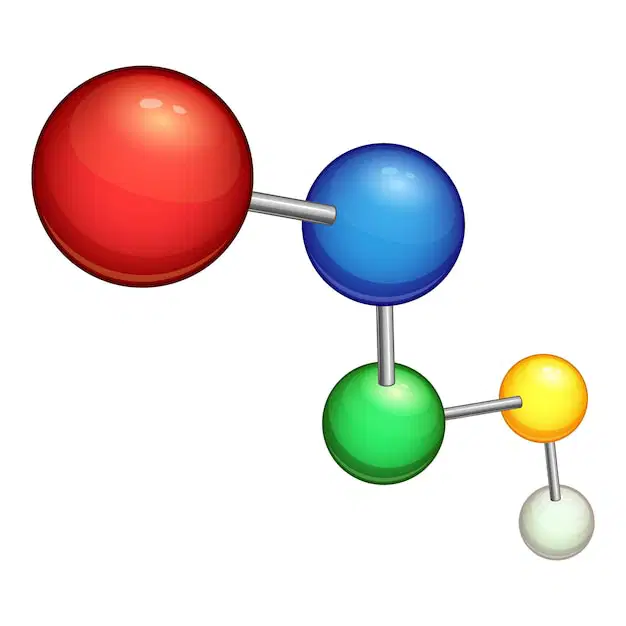
Which bonding is shown in this picture?
Metallic bonding
Covalent bonding
Ionic bonding

Which bonding is shown in this picture?
Covalent bonding
Metallic bonding
Ionic bonding

Which type of bonding is this picture?
Covalent bonding
Metallic bonding
Ionic bonding

Which type of bonding is shown in this picture?
Metallic bonding
Ionic bonding
Covalent bonding
What happens to the electrons in ionic bonding?

They are transferred

They are shared

They are delocalised
What happens to the electrons in metallic bonding?
They are transferred
They are shared
They are delocalised
What happens to the electrons in covalent bonding?
They are transferred
They are shared
They are delocalised

What is this structure of ions attracted together called?
Molecule
Lattice
Atoms
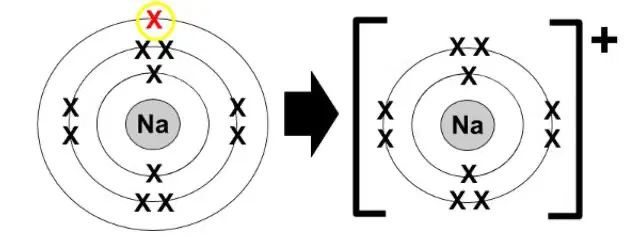
What type of ions do metal atoms make?
Positive because they lose electrons to get a full outer shell
Negative because they gain electrons to get a full outer shell
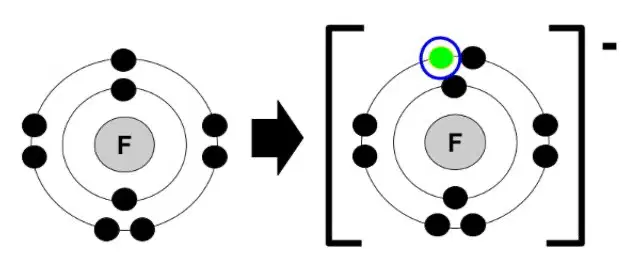
What type of ions do non-metal atoms make?
Positive because they lose electrons to get a full outer shell
Negative because they gain electrons to get a full outer shell
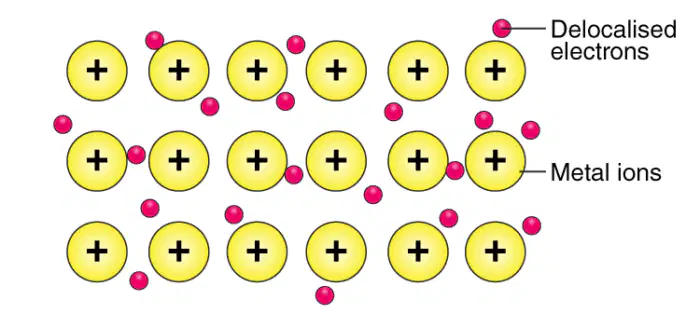
Where do the delocalised electrons come from in metallic bonding?
The outside shell of the metal atom
The inside shell near the nucleus of the metal atom
A ________ is located the outermost shell of an atom.
Proton
Neuton
Valence Electron
Core Electron
Elements bond in order to have _______ electron shells.
Full
Multiple
Moving
Empty

The model of fluorine shown is known as a ____ Model.
Dalton
Rutherford
Thompson
Bohr
Group 18 Elements are known as _________ because they have full valence electron shells and are unreactive.
Alkali Metals
Halogen
Noble Gases
Transition Elements
Which is not an example of a primary bond?
Ionic
London
Covalent
Metallic
Metallic bonds are best described as metal cations in a sea of:
Free Electrons
Photons
Anions
Neutrons
_____ bonding takes place between a metal and a nonmetal.
Covalent
Metallic
Ionic
Hydrogen
A solid material that does not conduct in solid state but does conduct in aqueous state is:
Ionic
Metallic
Molecular
Polymeric
In covalent bonding, electrons are:
Dissociated
Transferred
Freed
Shared
In _______ bonds, electrons are shared unequally.
Metallic
Ionic
Polar Covalent
Pure Covalent
What is the formula of the compound formed between lithium and nitrogen?
LiN2
LiN3
Li3N
Li3N2
Which of the following contains both ionic and covalent bonding?
NaCl
NH4Cl
CCl4
PCl3
An ion X has 8 protons, 8 neutrons and 10 electrons.
An ion Y has 11 protons, 9 neutrons and 10 electrons.
What is the formula of the ionic compound formed by ion X and Y?
XY
X2Y
XY2
X2Y2
Which is correct for all solid ionic compounds?
High volatility
Poor electrical conductivity
Low melting point
Good solubility in water
What is the IUPAC name of NiCO3?
nickel(II) carbonate
nickel carbonate
nickel(I) carbonate
nitrogen(I) carbonate
How does a chlorine atom form the most stable ion?
The atom gains a proton to form positive ion.
The atom loses a proton to form negative ion.
The atom loses an electron to form a positive ion.
The atom gains an electron to form a negative ion.
What is the formula of ammonium phosphate?
(NH3)3PO4
(NH4)3PO4
(NH4)2PO4
(NH3)2PO3
An ionic bond is an (a) attraction between oppositely charged ions.
When sodium reacts with chlorine, billions of sodium and chloride ions form. They form a regular pattern or (a) of alternating positive and negative ions.
Explain why solid sodium chloride does not conduct electricity while aqueous solution of sodium chloride does.
Which compound is an ionic compound here?
NH3
BF3
KCl
SO2
Which from below is not an intramolecular bond?
Ionic
Covalent
Metallic
Dipole
The interaction between molecules is called...
Metallic bond
Intermolecular force
Intramolecular force
Van der Waals force
How many bonds can Carbon make in covalent bond?
1
2
3
4
How many lone pairs does Oxygen have in water molecule?
1
2
3
4
Which compound from below has a dative covalent bond?
SO2
SO3
CO2
CO
How many valence electrons does perchlorate (ClO4-) have?
26
28
30
32
What is the molecular shape of SiF2?
Linear
Bent
Tetrahedral
Octahedral
Which molecule from below is tetrahedral-shaped?
SF4
XeF4
CF4
H2O
How many domains does a compound with trigonal-bipyramidal shape has?
2
4
5
6

