
 Worksheets
Earth's Natural Resources: ELSS
Total questions: 144
Worksheet time: 1hrs 12mins
Which term describes a useful source of material or energy that comes from nature, such as fresh water?
Natural resource
Nonrenewable resource
Ore
Petroleum
Which resources can be replenished naturally within a human time scale when used responsibly? Select all that apply.
Renewable resources
Nonrenewable resources
Geothermal energy
Petroleum
Which term refers to resources that exist in limited amounts and cannot be replaced quickly once used?
Sustainable resources
Renewable resources
Nonrenewable resources
Geothermal resources
What does the word sustainable most closely mean in the context of natural resources?
Used in a way that maintains the resource over time
Used as fast as possible to meet demand
Existing only underground
Requiring human-made materials to produce
Which option best matches the definition: a liquid fossil fuel commonly refined into gasoline and other products?
Geothermal energy
Soil
Petroleum
Ore
Geothermal energy is best described as energy that comes from which source?
The heat within Earth
The movement of ocean waves
Sunlight captured by solar panels
Organic matter decomposing in landfills
Which term names the loose material covering Earth’s surface that supports plant growth and includes minerals and organic matter?
Ore
Soil
Petroleum
Nonrenewable resource
Ore is best defined as which of the following?
Unprocessed soil rich in organic matter
A naturally occurring rock or mineral from which a useful metal can be extracted
A renewable energy source from Earth’s interior
A nonrenewable liquid fuel found in underground reservoirs
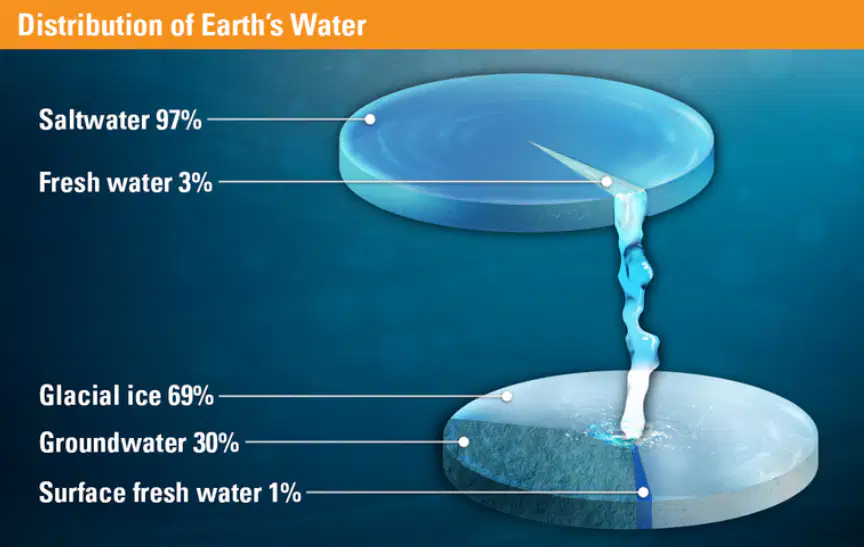
Based on the visual labeled “Distribution of Earth’s Water,” which statement best describes the availability of fresh water for human use?
Fresh water makes up most of Earth’s water, so it is widely available for people.
Only about 3% of Earth’s water is fresh water, and much of that is locked in glaciers, leaving little available for people.
Groundwater and surface water together account for nearly all of Earth’s water, providing abundant supplies.
Saltwater and fresh water are present in equal amounts, making fresh water easy to obtain.
Which of the following uses of water are described as everyday human needs in the passage? Select all that apply.
Irrigating crops and watering livestock
Producing energy and making products
Household tasks such as drinking and washing
Filling ocean basins to regulate climate
Fresh water that exists as surface water is identified as which type of natural resource, and why?
Nonrenewable, because it is used up faster than it is replenished
Renewable, because it is replenished faster than it is used up or exists in great supply
Limited, because it only comes from groundwater
Exhaustible, because it does not move through Earth’s systems
According to the passage, most of Earth’s groundwater is classified as nonrenewable. What is the main reason for this classification?
Groundwater is constantly moving through the atmosphere and biosphere, making it easy to replace.
Groundwater exists in unlimited amounts everywhere, so it cannot be depleted.
Groundwater is used up faster than it is replenished or it exists in limited supply in many areas.
Groundwater is mostly frozen in glaciers and therefore inaccessible.
Which statement best explains why groundwater distribution varies across regions?
Groundwater is evenly spread because all regions receive the same rainfall.
Differences in rainfall and snowfall lead to faster or slower aquifer replenishment.
Groundwater forms only near coastlines, so interior regions have none.
Human use does not affect groundwater levels in aquifers.
In areas with little precipitation, such as Australia’s interior, what happens to aquifer replenishment?
Replenishment is very slow because less water infiltrates into the ground.
Replenishment is rapid due to high evaporation rates.
Aquifers refill instantly when rivers flow nearby.
Replenishment stops completely regardless of rock type.
According to the text, how do different rock types affect groundwater in an area? (Select all that apply.)
They control how much groundwater can be stored.
They determine how quickly an aquifer can be replenished.
They make groundwater distribution perfectly even worldwide.
They influence the speed at which humans can pump water from wells.
What is a likely consequence when humans remove groundwater faster than it can be replenished?
Aquifers eventually become depleted.
Aquifers maintain a constant level.
Aquifers immediately create new water through chemical reactions.
Aquifers flood surrounding areas to balance levels.
Which statement about the Great Artesian Basin (GAB) is accurate based on the passage?
The GAB refills quickly because it is a shallow aquifer.
Scientists estimate natural refilling of the GAB takes at least 2 million years.
The GAB was discovered after 1950 by oil drillers.
The GAB cannot be used for irrigation.
Why did people begin managing use of water from the Great Artesian Basin in the early 1900s?
They feared the aquifer would flood cities.
They realized the aquifer was being depleted and refilled very slowly.
They discovered it was non-potable saltwater.
They needed to increase its temperature for agriculture.
When a natural resource is used in a way that ensures availability for future generations, its use is described as what?
Nonrenewable
Sustainable
Artificial
Temporary

Based on Figure 1B, what factor mainly determines the locations of Earth’s major groundwater reservoirs?
Amount of rain or snow that falls in an area
Proximity to mountains only
Distance from oceans
Human population density

Which statement about groundwater replenishment is supported by the passage and the map?
Groundwater is generally replenished faster than humans use it.
Groundwater is generally not replenished as fast as humans use it.
Replenishment rates are identical in all climates.
Replenishment depends only on the presence of rivers.
What best distinguishes renewable from nonrenewable fresh water in this context?
Renewable fresh water cannot be found underground, while nonrenewable can.
Renewable fresh water is replenished on human time scales; nonrenewable takes extremely long, such as millions of years.
Renewable fresh water is always cleaner than nonrenewable.
Nonrenewable fresh water is created by dams.
Which action by humans directly changes the distribution of the world’s fresh water supplies?
Reducing groundwater pumping to match recharge rates
Removing groundwater from aquifers faster than replenishment
Ignoring local rock properties when drilling
Only using surface water for irrigation
Which example from the passage illustrates nonrenewable fresh water?
A shallow aquifer that refills each rainy season
A lake fed by annual snowmelt
The Great Artesian Basin, which takes at least 2 million years to refill
A river that floods every spring
Why is infiltration important to groundwater systems?
It allows rain and snow to seep into aquifers, helping replenish them.
It prevents water from entering aquifers so they stay dry.
It creates rock layers that block aquifers.
It makes aquifers flow only toward the ocean.
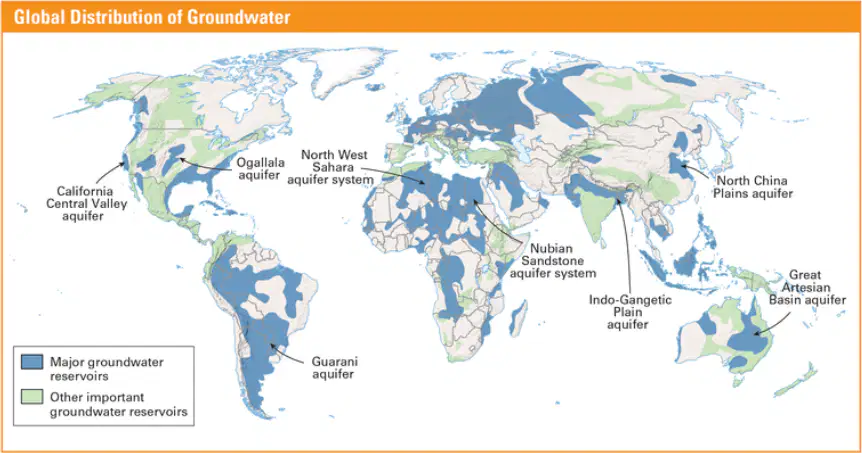
Which region mentioned in the map is identified as a major groundwater reservoir?
Sahara Desert—no aquifers present
Great Artesian Basin in Australia
Pacific Ocean floor aquifer
Amazon River—surface water only
What practice helps keep the Great Artesian Basin a sustainable source of fresh water?
Increasing pumping to meet short-term demand
Taking management measures so use does not exceed very slow natural refilling
Converting it to a reservoir behind a dam
Allowing it to refill by daily rainfall alone
Which step is part of the engineering design process when planning a large structure like the Hoover Dam?
Ignoring constraints to focus on creativity
Defining criteria and constraints before selecting a design
Building immediately without evaluating options
Choosing the most expensive design to ensure quality
Criteria in engineering design are best described as which of the following?
Limits that restrict what the design can do
Measures of what the solution should achieve
Random ideas tried during brainstorming
Extra features added after construction
Constraints in designing the Hoover Dam included all of the following EXCEPT:
Available construction materials and technology
Budget and time limits
Physical geography of the canyon and river
A requirement to look visually artistic from the air
When engineers compared different dam types, which approach reflects sound evaluation?
Selecting the type used most commonly worldwide
Comparing how each type meets the criteria and fits the constraints
Choosing the type that is fastest to build regardless of location
Letting public opinion decide the type
Which statement correctly contrasts criteria and constraints in the Hoover Dam project?
Criteria describe desired performance; constraints set the limits
Criteria set the limits; constraints describe performance
Both criteria and constraints are optional suggestions
Criteria and constraints are the same thing
Which dam type relies on its curved shape to transfer water pressure to solid canyon walls, making it suitable for narrow, rocky sites?
Earth-fill dam
Buttress dam
Arch dam
Run-of-river dam
Why was an arch-gravity dam an effective final choice for the Hoover Dam site?
It combined the arch’s strength with gravity mass to resist water pressure
It used only lightweight materials to reduce cost
It worked best in wide, flat valleys with soft sediments
It required no foundation on bedrock
Select the features that engineers would have considered as criteria for Hoover Dam.
Ability to store large volumes of water for power and supply
Minimal impact on the river’s flow and ecology
Resistance to water pressure and flooding
Location far from bedrock to simplify digging
Which options represent realistic constraints for the Hoover Dam design? Select all that apply.
Maximum budget allowed by the government
Strength and stability of the canyon’s bedrock
Popularity of the dam name among tourists
Construction equipment available at the time
During design, engineers rejected some dam types because they did not meet the site’s constraints. Which rejection reason is most consistent with engineering practice?
A dam type needed a wide valley, but the site was a narrow canyon
A dam type had an unfamiliar name
A dam type looked less impressive in photos
A dam type was used in a different country
What is the main purpose of evaluating multiple designs before building a large project like Hoover Dam?
To avoid creating any constraints at all
To find the design that best satisfies criteria within real-world limits
To delay construction for publicity
To choose the most stylish design
Which pair correctly matches a dam type to a typical site condition?
Arch dam — narrow canyon with strong rock walls
Gravity dam — requires soft, sandy foundations
Earth-fill dam — best for steep rocky canyons
Run-of-river dam — used only in oceans
Which statement best describes one environmental consequence of building large dams like the Hoover Dam?
They eliminate all droughts by creating unlimited rainfall downstream.
They can alter river flow, affecting fish migration and habitats.
They immediately reduce global ocean levels by storing river water.
They make earthquakes more frequent by cooling magma under the river.
Select the effects that communities might experience because of a massive dam project such as the Hoover Dam. Choose all that apply.
Relocation of people from areas that will be flooded by the reservoir
Guaranteed lower electricity bills for every household worldwide
Changes to local economies due to new hydroelectric power and tourism
No change to farming because water supply is always identical upstream and downstream
Petroleum is introduced as a natural resource. Which statement is most accurate about petroleum as an energy source?
It is a fossil fuel that can be refined into products like gasoline and diesel.
It is a renewable resource produced by modern plants within a single season.
It is captured directly from sunlight using solar panels.
It powers turbines only by freezing water in reservoirs.
Which process is most directly related to obtaining energy from petroleum?
Drilling wells to extract crude oil from underground reservoirs
Condensing steam from hot springs into ice
Dam construction to store surface river water
Planting new forests to trap carbon immediately
Which statement best describes how petroleum forms over time?
It crystallizes quickly from dissolved minerals in seawater
It forms when buried remains of ancient marine organisms are transformed by heat and pressure over millions of years
It develops as plants photosynthesize and store energy in their leaves
It is produced by cooling magma beneath Earth’s crust
Petroleum is classified as a nonrenewable resource. What is the main reason for this classification?
It is made from living organisms
It can be replaced by planting more trees
It takes millions of years to form and cannot be replenished on a human timescale
It is found only near volcanoes
Which process is commonly used to bring petroleum to the surface after a well is drilled?
Evaporation from shallow ponds
Pumping liquid from underground reservoirs
Condensing water vapor in the atmosphere
Scraping tar from the ocean floor
Which statement about the global distribution of petroleum is accurate?
Petroleum is evenly spread across all continents
Large reserves are concentrated in certain regions due to geologic history
Only islands have significant petroleum resources
Petroleum exists only where rivers deposit sediment
The Ghawar Oil Field is often cited in discussions of petroleum. What makes it notable?
It is the largest known geothermal plant
It is one of the world’s largest oil fields, located in Saudi Arabia
It is the deepest natural gas well in Antarctica
It is the oldest coal mine in North America
Which factors best explain why some countries rely heavily on petroleum imports?
They have limited domestic petroleum reserves
Their energy demand exceeds local production
They are located on divergent plate boundaries
They experience frequent hurricanes
Which set lists environmental impacts associated with extracting and using petroleum? Select all that apply.
Air pollution from burning fuels
Oil spills that harm marine ecosystems
Increased soil fertility near wells
Greenhouse gas emissions contributing to climate change
Why does burning petroleum contribute to climate change?
It releases large amounts of oxygen into the air
It emits carbon dioxide, a greenhouse gas, into the atmosphere
It removes water vapor from clouds
It increases Earth’s albedo
Which sequence correctly orders the steps from petroleum formation to common use?
Extraction → Formation → Refining → Distribution
Formation → Extraction → Refining → Distribution
Refining → Formation → Distribution → Extraction
Distribution → Extraction → Formation → Refining
Which statement best distinguishes petroleum from renewable energy sources like wind or solar?
Petroleum is generated by Earth’s internal heat
Petroleum requires millions of years to form, while wind and solar are replenished continuously
Petroleum is captured by turbines, while wind and solar are mined
Petroleum produces no emissions when used
Which statement best defines geothermal energy for a science context?
Heat from the Sun captured by solar panels
Heat stored inside Earth that can be used as an energy source
Heat produced by burning fossil fuels deep underground
Heat from wind friction near Earth's surface
The Geysers complex in California is notable in discussions of geothermal energy because it is
a major oil refinery that uses steam for drilling
one of the world’s largest geothermal power plant complexes
the deepest coal mine in North America
a dam that uses falling water to generate electricity
Select the processes involved when a flash steam geothermal plant generates electricity.
Hot water from deep underground flashes into steam as pressure drops
Steam turns a turbine connected to a generator
Coal is burned to increase the temperature of the water
Cooled water is reinjected into the reservoir to sustain the resource
In a typical flash steam geothermal plant, why does underground water change phase when it reaches the surface equipment?
Pressure decreases, causing superheated water to rapidly boil into steam
Temperature increases because of added fuel, turning water to steam
Salt is removed, which makes water evaporate instantly
Wind turbines add kinetic energy that spins water into steam
Which sequence correctly shows how electricity is produced from geothermal energy in a flash steam plant?
Steam condenses first, then heats water, and finally spins a turbine
Superheated water rises, flashes to steam, spins a turbine, and powers a generator
Wind blows across vents, turning blades that generate steam and electricity
Coal is combusted, producing steam that turns a turbine and charges batteries
Choose all statements that accurately describe geothermal power as presented in the lesson.
It relies on Earth's internal heat rather than the Sun
It can generate electricity without burning fuels
It is identical to hydropower because both use water
It often uses reinjection to help maintain the underground reservoir
What makes geothermal power plants different from fossil-fuel power plants when generating electricity?
Geothermal plants primarily burn natural gas to heat water
Geothermal plants use Earth’s internal heat to create steam instead of combustion
Geothermal plants depend on wind to turn turbines
Geothermal plants release more smoke than coal plants
Why is the temperature and pressure of deep groundwater important in geothermal energy production?
They determine how much salt must be removed before use
They control whether water can flash into steam to drive turbines
They decide if the water is safe for drinking
They prevent any need for reinjection
Select the benefits commonly associated with geothermal electricity generation.
Low air emissions compared to burning fossil fuels
Continuous power potential in suitable locations
Requires vast reservoirs of petroleum
Can operate using Earth’s heat regardless of weather
Which component directly converts the kinetic energy of spinning blades into electrical energy in a geothermal plant?
Condenser
Generator
Cooling tower
Drill bit
What role does reinjecting cooled water play in a geothermal system?
It disposes of waste by sending it to the ocean
It maintains pressure and helps sustain the geothermal reservoir
It cleans the turbine blades by washing them
It increases the amount of coal required
A power company plans to build near a known geothermal field. Which factor is most critical for successful flash steam power?
Consistent supply of superheated water under pressure
Strong seasonal winds to turn turbines
Large coal deposits for backup heating
High, year-round solar radiation
Geothermal energy is most concentrated where heat flows upward near Earth’s interior. According to the section, where does most geothermal energy occur?
Along convergent and divergent plate boundaries
In the middle of large continental plates far from edges
Only beneath tropical rainforests near the equator
Under shallow ocean shelves away from any tectonic activity
Which statement best explains why geothermal energy is considered a renewable resource?
It forms quickly from ancient plant remains trapped in rock layers
It relies on Earth’s internal heat, which is continuously produced and can be tapped again
It depends on copper-rich fluids that cool and solidify into ore
It is stored in soil and can be replenished in a few decades
The Pacific Ring of Fire is famous for volcanoes and earthquakes. Based on the section’s ideas, why would the Ring of Fire also be a promising region for geothermal energy?
It has thick, stable crust with little movement
It lies along active plate boundaries where heat and magma are close to the surface
It contains vast petroleum deposits from ancient marine organisms
It has the world’s largest evergreen forests that trap heat
Which combination of features usually indicates a good location for geothermal power plants? Select all that apply.
Recent volcanic activity with hot rocks near the surface
Areas far from any tectonic plate boundaries
Regions with frequent earthquakes related to plate movement
Places where soil takes millions of years to form
Choose the statement that contrasts geothermal energy with petroleum in terms of renewability.
Both are nonrenewable because they take millions of years to form
Geothermal is renewable because it taps ongoing internal heat, while petroleum is nonrenewable formed from ancient organic matter
Geothermal and petroleum are equally renewable if used carefully
Petroleum is renewable because it forms from cooling copper-rich fluids
A city plans to use geothermal heating. Which location would likely provide the most reliable heat source?
A region near a convergent boundary with active volcanoes
A flat interior plateau far from any fault lines
A coastal area known for copper mining but little seismic activity
A rainforest region where soil fertility is high
Which statement about the global distribution of geothermal resources is supported by the section?
Geothermal resources are evenly spread across all continents
They cluster in belts that follow tectonic plate boundaries
They occur only under oceans and not on land
They are found mostly in places with large forests
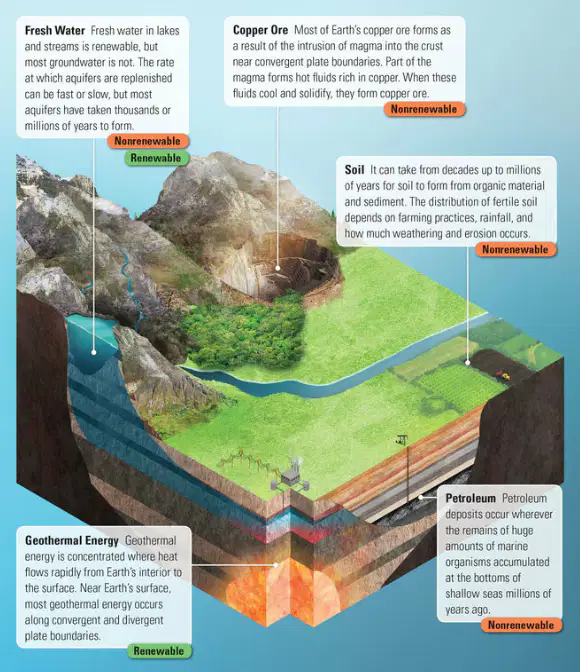
Consider the diagram showing labeled resources (fresh water, copper ore, soil, petroleum, and geothermal energy). Which label correctly marks geothermal energy’s status and typical location?
Nonrenewable; mostly in interior continents
Renewable; concentrated near convergent and divergent plate boundaries
Nonrenewable; found under shallow seas formed millions of years ago
Renewable; produced when copper-rich fluids cool and solidify
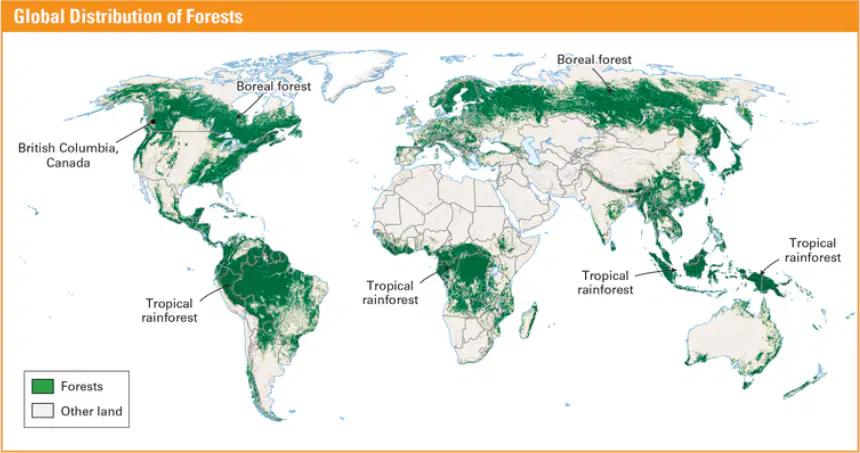
Which factor helps determine where forests grow by influencing soil fertility and plant growth?
Climate conditions
Ocean currents
Earth’s rotation speed
Altitude of airplanes

According to the text, what happens to the distribution of forests when more trees are harvested or planted?
It remains unchanged because forests are fixed
It changes as human activities alter forest areas
It shifts only during volcanic eruptions
It depends only on ocean temperatures
About what percentage of the original forests in the United States were harvested between 1600 and 1920?
10%
50%
90%
100%
Which practice helped keep the amount of forest land in the United States about the same since 1920?
Ignoring logging limits
Better forest management and reforestation
Banning all wood use
Planting only nonnative grasses

Cutting down forests has negative impacts. Which of the following is one consequence mentioned?
Improved air quality
Polluted water and damaged land
Faster tectonic plate movement
Increased rainfall everywhere
Scientists estimate that 12,000 to 15,000 square kilometers of forest are cut down worldwide each year. About how many football fields is this loss per minute?
4 fields per minute
12 fields per minute
24 fields per minute
48 fields per minute
Why are pine trees considered a renewable resource in the context given?
They can regrow within about 15 years after planting
They never need sunlight
They do not require soil nutrients
They live for over 1,000 years
Which statement best explains why cedar and redwood are limited and nonrenewable resources in this context?
They grow very slowly and can take hundreds of years to mature
They are found only in deserts
They cannot be replanted
They require volcanic soil
Canada is highlighted as a leader in sustainable forestry. What action do workers there take for every tree cut down?
Plant one tree to replace it
Plant three trees in its place
Leave the area to regrow naturally
Stop harvesting for ten years
Which options describe sustainable practices that help keep forests a renewable resource? Select all that apply.
Replanting trees after harvesting
Harvesting trees faster than they can regrow
Managing forests to promote growth
Cutting down forests without replacing them
In the lesson summary, which statement correctly classifies soil?
Fertile soil is a renewable resource that quickly reforms
Fertile soil is a nonrenewable resource that can be eroded by human activity
Soil is nonliving and therefore not a resource
All soil forms in the ocean
According to the summary, what can sustainable farming practices do for soil?
Increase erosion of fertile soil
Protect soil resources and reduce degradation
Eliminate the need for water
Make soil form instantly
Which combination of factors does the summary say affects where forests are found?
Climate, soil fertility, and human activity
Latitude, wind speed, and ocean salinity
Moon phases, mountain height, and river speed
Only rainfall amount
Which statement about wood resources is supported by the material?
All types of wood are renewable
Some types of wood are renewable while others are limited and nonrenewable
Wood is never affected by human activity
Wood resources do not depend on growth rate
Which human activity contributes to soil degradation and loss of fertility, and which practice can help counter it?
Overgrazing livestock contributes to degradation
Planting cover crops helps protect soil
Clear-cutting forests improves soil fertility
Leaving fields bare in rainy seasons reduces erosion
Which statement best explains why copper is considered a nonrenewable resource?
It can be grown again after being harvested from mines.
It forms over very long geologic timescales and is finite in the Earth’s crust.
It is produced every year by plants near tectonic boundaries.
It can be replaced quickly by manufacturing more metal in factories.
Copper ore often forms near tectonic plate boundaries. What process most directly links plate boundaries to copper ore formation?
Increased rainfall creates river deposits of copper.
Heat and fluids from volcanic and hydrothermal activity concentrate copper minerals.
Wind erosion exposes surface copper in deserts.
Glaciers grind rocks to release native copper.
Select the impacts that can result from copper mining.
Habitat loss from open-pit excavation
Water pollution from mine tailings and acid drainage
Immediate renewal of copper deposits after extraction
Air pollution from smelting and processing
Which statement describes a benefit of recycling copper?
It increases copper’s crystal hardness.
It reduces the need for new mining and conserves a nonrenewable resource.
It creates more tectonic plate boundaries.
It permanently replaces all mining jobs.
Copper ore deposits are unevenly distributed around the world. What does this imply for countries that need copper?
Every country can mine abundant copper locally.
Countries may rely on trade to obtain copper from regions with deposits.
Copper can be made synthetically anywhere, so distribution does not matter.
Deposits appear everywhere after earthquakes, so supply is always equal.
Which location is most likely to have significant copper ore deposits based on formation processes?
Stable interior plains far from geologic activity
Areas with recent volcanic activity and hydrothermal veins
Coastal beaches composed of sand dunes
Cold polar regions with thick ice sheets
Choose the statements that correctly compare mining copper ore to recycling copper.
Mining copper ore generally uses more energy and disturbs more land than recycling.
Recycling copper helps lower pollution from smelting by reusing metal.
Mining instantly replaces extracted ore through natural processes.
Recycling copper extends the life of a finite resource.
Which outcome is a likely community impact when a new open-pit copper mine is developed?
Increased noise, dust, and truck traffic near the mine site
Immediate growth of new forests inside the pit
Lower risk of water contamination downstream
Guaranteed formation of new copper ore within a decade
Why do scientists connect copper ore deposits with ancient hydrothermal fluids?
Hydrothermal fluids dissolve and transport copper, then precipitate it as ore in fractures and veins.
Fluids prevent copper from entering rocks, leaving no deposits.
Only cold groundwater can create copper deposits.
Hydrothermal fluids remove all metals from volcanic rocks.
Which action best supports sustainable use of copper given that it is nonrenewable?
Expanding surface mines in protected habitats
Leaving mine waste uncovered near rivers
Designing products for reuse and high-rate copper recycling
Increasing smelting temperatures to speed production
Based on the summary of natural resources, which item is classified as a renewable resource because it can be replenished on human time scales?
Petroleum formed over millions of years
Fresh water that is replenished through the water cycle
Copper ore accumulated in ancient deposits
Diamonds formed in kimberlite pipes deep underground
Which set includes only nonrenewable resources as described in the summary? Select all that apply.
Petroleum and copper ore
Soil and fresh water
Geothermal energy and soil
Copper ore and diamonds
In the visual summary, which resource is renewable because its supply is naturally sustained by Earth’s internal heat rather than being consumed?
Geothermal energy
Petroleum
Copper ore
Diamonds
Which statement best explains why petroleum is categorized as nonrenewable in the summary?
It forms quickly from modern plant matter.
It can be replaced by rainfall and rivers.
It requires millions of years to form from ancient organic material.
It is produced continuously by Earth’s internal heat.
According to the classification in the summary, which pair lists one renewable and one nonrenewable resource?
Fresh water and soil
Geothermal energy and petroleum
Copper ore and diamonds
Petroleum and copper ore
Which statement best describes wood as a natural resource?
Wood is a human-made material produced in factories.
Wood is a natural resource obtained from trees in forests.
Wood is a mineral extracted from underground rock layers.
Wood is a liquid resource collected from wells.
Which option explains why wood can be considered renewable under certain conditions?
Trees regrow when forests are managed and replanted.
Wood forms from molten rock that cools quickly.
Wood is created by compressing minerals over millions of years.
Trees cannot regrow after being cut, so wood never renews.
Select all practices that support sustainable forestry.
Replanting trees after harvesting
Protecting habitats and biodiversity
Clear-cutting entire forests without recovery plans
Using selective cutting to reduce ecosystem damage
Which impact is most directly linked to deforestation?
Increased formation of new minerals in the crust
Loss of habitats leading to species endangerment
Immediate rise in ocean salinity worldwide
Creation of more freshwater springs
Which statement distinguishes renewable wood from nonrenewable wood?
Renewable wood comes from trees that regrow within a human time scale, while nonrenewable wood refers to forest loss that cannot recover quickly.
Renewable wood is mined from deep underground, while nonrenewable wood is grown on farms.
Renewable wood is stronger than nonrenewable wood.
Renewable wood is only found in tropical climates, while nonrenewable wood is found in polar regions.
How can sustainable forestry help reduce the effects of deforestation?
By increasing total land use for cities
By maintaining forest cover through replanting and careful harvesting
By replacing forests with mineral mines
By stopping the growth of trees entirely
Which choice best describes the uneven distribution of forests across Earth?
Forests are evenly spaced across all continents.
Forests occur in regions where climate and conditions support tree growth, creating areas of higher and lower concentrations.
Forests only exist near active volcanoes.
Forests are found only along coastlines.
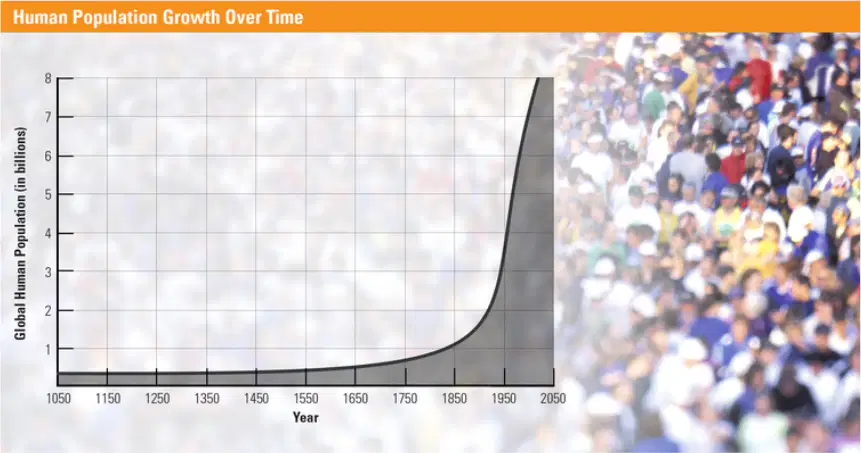
Human population growth can increase demand for wood. Based on the described trend of population growth since 1050, what is the likely effect on wood consumption?
Wood consumption likely decreased sharply as population grew.
Wood consumption likely remained constant regardless of population.
Wood consumption likely increased as more people needed resources.
Wood consumption likely stopped entirely after 2016.
Which practice would most likely keep wood resources renewable for future generations?
Cutting trees faster than they can regrow
Leaving harvested areas bare to create farmland
Balancing harvest with replanting and protecting young trees
Ignoring habitat needs of wildlife
Select the impacts that deforestation can have on Earth's systems.
Loss of biosphere habitat for organisms
Increased risk of species extinction
Immediate increase in total copper reserves
Expansion of cities into natural habitats
Which statement links per capita consumption to forest health?
Higher per capita consumption can increase the demand for wood, potentially stressing forests if harvesting is not sustainable.
Per capita consumption has no relation to wood demand.
Lower per capita consumption always causes deforestation.
Per capita consumption only measures water use, not wood.
A community wants to use local wood for building. Which plan shows sustainable forestry principles?
Harvest all mature trees at once to maximize supply.
Harvest selectively, replant native species, and set aside conservation areas.
Stop all harvesting permanently and import all wood.
Focus only on short-term profits without monitoring forest health.
Which option correctly matches a human activity with a consequence for forests?
Expanding agriculture—can convert forest habitats to fields
Selective cutting—always destroys all habitats
Population decline—increases pressure on forests
Replanting—reduces forest recovery
What is one reason forests are important to living things in the biosphere?
Forests provide habitats that many species rely on to survive.
Forests decrease oxygen levels globally.
Forests exist only to produce minerals for technology.
Forests are unconnected to ecosystems.
Which statement best summarizes the relationship between human population size and the need for sustainable wood use?
As population grows, the need for wood disappears, so sustainability is unnecessary.
Growing populations increase demand for wood products, making sustainable forestry essential to prevent long-term resource loss.
Population size and wood demand are unrelated.
Sustainable forestry only matters when populations are shrinking.
Which statement best explains why some diamonds are called "conflict diamonds"?
They are rare stones formed by volcanic eruptions.
They are diamonds mined and sold to fund wars and violence.
They are synthetic diamonds made in laboratories.
They are stones found only in riverbeds after floods.
According to the passage, what was the main purpose of the Kimberley Process introduced in 2003?
To increase the price of diamonds on the world market
To certify that diamonds sold internationally are not conflict diamonds
To shut down all diamond mines in Africa
To replace natural diamonds with computer-made gemstones
Select the statements that describe challenges that remain even after the Kimberley Process was introduced.
Illegal smuggling continues to move conflict diamonds into markets.
Boycotts can unintentionally harm small, legitimate diamond companies.
Diamonds are no longer used in any technology products.
All consumers refuse to buy diamonds for jewelry.
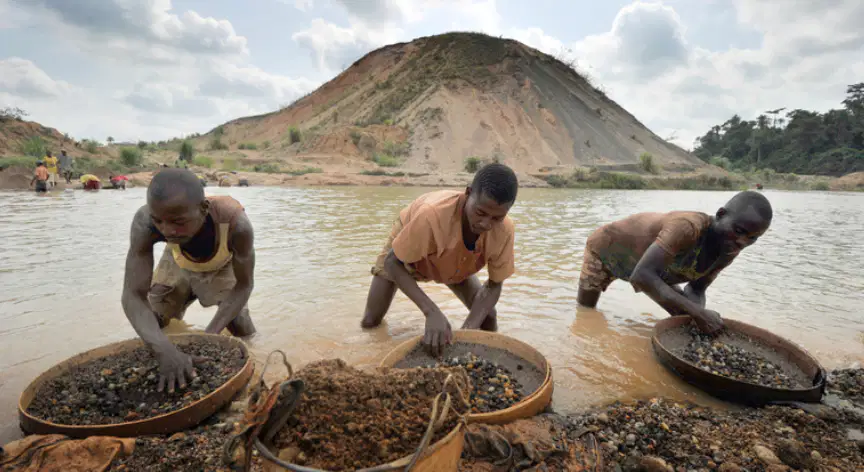
Where do most naturally occurring diamonds mentioned in the passage originate, and how are they commonly found by local workers?
From North America; mined deep underground with drilling rigs
From Africa; panned in rivers for stones carried downstream from weathered kimberlite
From Asia; collected from deserts after sandstorms
From Europe; harvested from forests where trees trap the stones
Why might a complete boycott of diamonds from certain countries create problems, according to the passage?
It causes diamonds to become less durable.
It penalizes small, legitimate companies whose workers depend on diamond income.
It makes computers stop working without diamond parts.
It reduces freshwater supplies used in mining.
Which statement best summarizes the ongoing importance of diamonds as a natural resource?
Demand will end once jewelry trends change.
Diamonds have no uses beyond decoration.
There will likely continue to be a market for diamonds for both jewelry and technology, so global monitoring remains important.
Diamonds are renewable resources that grow back after mining.
Diamonds and graphite are both made of carbon. Which statement best explains why diamonds are much harder than graphite even though they have the same element?
Diamond atoms form strong three-dimensional bonds, while graphite atoms form flat layers with weak bonds between them.
Diamond contains extra oxygen atoms that make it rigid, while graphite is pure carbon.
Graphite atoms are larger than diamond atoms, making graphite softer.
Diamonds have fewer atoms than graphite, so they resist scratching.
Which property is most responsible for a diamond’s ability to scratch almost any other mineral?
Its perfect electrical conductivity
Its extremely high hardness due to a tightly bonded crystal structure
Its ability to dissolve in water
Its bright color caused by impurities
Select the statements that correctly describe diamonds.
Diamonds are crystals made entirely of carbon.
Diamonds commonly form deep in Earth’s mantle under high pressure and temperature.
Most diamonds form in sedimentary rock layers at Earth’s surface.
Some diamonds can be created during powerful asteroid impacts.
How does the crystal structure of diamond differ from the structure of graphite?
Diamond has atoms arranged in a three-dimensional tetrahedral network; graphite has atoms arranged in stacked sheets.
Diamond and graphite both have atoms arranged in flat layers with weak bonds.
Diamond has a random arrangement of atoms; graphite is an orderly crystal.
Diamond atoms are arranged in a cubic pattern while graphite atoms lack any repeating pattern.
Where are natural diamonds most often found before they are mined?
In veins of granite formed by cooling magma
In kimberlite pipes that bring mantle material toward the surface
In limestone caves created by dissolving rock
In sandstone layers deposited by rivers
Which process can bring diamonds formed in the mantle closer to Earth’s surface so they can be discovered?
Slow erosion by wind
Rapid volcanic eruptions that create kimberlite pipes
Formation of metamorphic rocks during mountain building
Evaporation of seawater leaving crystals behind
Choose the properties that scientists and jewelers use to identify diamonds.
Exceptional hardness and ability to scratch other minerals
Distinct crystal shape with four-sided faces meeting at sharp points
High melting point and resistance to chemical weathering
Tendency to crumble easily when pressed
What evidence suggests that some diamonds formed during asteroid impacts rather than deep in the mantle?
Diamonds are often found floating on lakes after storms.
Impact sites can contain tiny diamonds created by intense pressure and temperature during collisions.
Diamonds grow only in ice-rich environments during cold periods.
Asteroid impacts dissolve carbon into oceans, forming diamonds there.
Which statement best describes a common use of diamonds in everyday life?
They are mainly used as fertilizer for crops.
They are frequently set in jewelry like rings and necklaces.
They are typically melted to flavor food.
They are commonly used as building bricks for houses.
Which pair lists two non-jewelry uses of diamonds? Select both that apply.
Cutting and drilling tools in industry
High-speed internet cables for homes
Heat sinks and cutting tips in high-tech devices
Food preservation in refrigerators
Paint for street signs
What is an industrial reason diamonds are valuable for cutting tools?
Diamonds are soft and bend easily.
Diamonds conduct electricity like copper.
Diamonds are extremely hard and can scratch other materials.
Diamonds dissolve in water, cleaning surfaces as they cut.
Which term refers to diamonds mined in war zones and sold to fund armed conflict?
Ethical diamonds
Synthetic diamonds
Conflict diamonds (blood diamonds)
Crown jewels
Choose the statements that describe problems caused by conflict diamonds. Select all that apply.
They can finance violence and civil wars.
They always reduce pollution in rivers.
They may lead to human rights abuses.
They guarantee fair pay for miners.
They can destabilize regions that mine them.
What is the goal of the Kimberley Process?
To grow larger diamonds in laboratories for art projects
To track and certify rough diamonds to prevent trade in conflict diamonds
To teach people how to polish jewelry at home
To replace all diamond mining with gold mining
Which actions are part of combating the trade in conflict diamonds? Select all that apply.
International certification of rough diamonds
Transparent tracking from mine to market
Banning all jewelry sales worldwide
Supporting responsible mining practices
Hiding the origin of diamonds to protect privacy
Why do some companies and governments care about the source of diamonds?
The origin affects whether diamonds contribute to conflict or follow ethical standards.
The origin changes the color of a diamond overnight.
Diamonds from different places melt at room temperature.
Only diamonds from cold climates can be sold legally.
Which statement best compares jewelry diamonds to industrial diamonds?
Jewelry diamonds are valued for beauty; industrial diamonds are valued for hardness and usefulness in tools.
Both types are chosen only for their color and sparkle.
Industrial diamonds are always larger than jewelry diamonds.
Jewelry diamonds are used to power computers.
Select the uses that fit high-tech applications of diamonds. Choose all that apply.
Heat spreaders in electronics
Optical components for lasers
Flavor enhancers in food factories
Protective coatings for cutting microchips
What is one positive impact of efforts like the Kimberley Process on the diamond trade?
They make diamonds dissolve faster.
They help buyers identify diamonds that are not funding conflict.
They ensure diamonds can be used as currency in supermarkets.
They reduce the sparkle of all diamonds.
If a diamond is labeled as conflict-free, what does that label aim to assure the buyer?
The diamond was grown in a garden greenhouse.
The diamond was traded without funding armed conflict and followed ethical safeguards.
The diamond will change shape when heated.
The diamond was mined only by robots.

