
 Worksheets
Semester 1 Makeup activity AICE MS
Total questions: 138
Worksheet time: 2hrs 7mins
Which of the following best describes the difference between continental crust and oceanic crust?
Continental crust is denser and thinner than oceanic crust.
Continental crust is thicker and less dense than oceanic crust.
Oceanic crust is thicker and less dense than continental crust.
Oceanic crust and continental crust have the same density and thickness.
What is the main function of the Earth's mantle in plate tectonics?
It forms the Earth's magnetic field.
It provides a rigid surface for plates to rest on.
It allows plates to move due to convection currents.
It is the source of all ocean water.
Which of the following statements best explains the process of weathering?
The movement of rock particles from one place to another.
The breaking down of rocks into smaller pieces by physical or chemical means.
The settling of particles in a new location.
The formation of new rocks from magma.
Which feature is most likely to form at a divergent plate boundary on the ocean floor?
Ocean trench
Mid-ocean ridge
Volcanic island arc
Fold mountain
What is the primary difference between weathering and erosion?
Weathering involves movement, erosion does not.
Erosion involves breaking down rocks, weathering does not.
Weathering breaks down rocks, erosion moves the particles.
Both processes are identical.
Which factor most directly affects the rate at which sediment is transported by water?
The color of the sediment
The speed of the water
The temperature of the air
The amount of sunlight
Which of the following best describes sedimentation?
The process of rocks breaking down into smaller pieces.
The movement of particles from one place to another.
The settling of particles out of water onto a surface.
The melting of rocks due to heat.
Which of the following is an example of a littoral zone?
Deep ocean trench
Sandy beach
Mid-ocean ridge
Abyssal plain
Which of the following best explains why tidal ranges vary in different locations?
The amount of rainfall in the area
The shape of the coastline and ocean floor
The color of the water
The presence of marine animals
What is the main cause of upwelling in the ocean?
The sinking of warm water
The movement of surface water away from the coast
The melting of polar ice
The evaporation of seawater
Which process is most responsible for the creation of hydrothermal vents on the ocean floor?
Erosion by ocean currents
Seafloor spreading at mid-ocean ridges
Deposition of sediments
Weathering of rocks by wind
Which of the following is a direct result of the global ocean conveyor belt?
Formation of new continents
Distribution of heat and nutrients around the world
Creation of mountain ranges
Increase in volcanic eruptions
Which of the following best describes the El Niño Southern Oscillation (ENSO)?
A cycle of volcanic eruptions in the Pacific Ocean
A periodic change in ocean currents and weather patterns in the Pacific
The movement of tectonic plates in the Atlantic Ocean
The formation of new ocean basins
Which of the following is most likely to increase the rate of erosion along a shoreline?
Decreased wave action
Increased vegetation
Stronger ocean currents
Lower wind speeds
Which statement best explains how particle size affects sediment transport?
Larger particles are transported more easily than smaller ones.
Smaller particles are transported more easily than larger ones.
Particle size has no effect on transport.
Only particles of the same size can be transported together.
Which of the following is an example of hydraulic action, a type of erosion?
Water dissolving minerals in rocks
Water forcing air into cracks in rocks, causing them to break apart
Rocks rubbing against each other and wearing down
Plants breaking apart rocks with their roots
Which type of erosion involves the removal of rock particles by wind, water, or ice carrying them away?
Abrasion
Attrition
Solution
Transportation
Which of the following best describes attrition as a type of erosion?
The dissolving of rocks by acidic water
The breaking down of rocks as they collide with each other
The scraping of rocks by particles carried by water
The freezing and thawing of water in cracks
Which type of erosion is primarily responsible for the chemical breakdown of rocks in coastal environments?
Hydraulic action
Abrasion
Solution
Attrition
Given a coastline with high wave energy and little vegetation, predict the dominant process shaping the littoral zone and justify your answer.
Sedimentation, because waves deposit large amounts of material.
Erosion, because strong waves remove material from the shore.
Weathering, because plants break down rocks.
Deposition, because vegetation traps sediments.
A river carries both sand and clay particles toward the ocean. If the river's speed decreases suddenly, which particles will settle first and why?
Sand, because larger particles settle faster in slower water.
Clay, because smaller particles settle faster.
Both settle at the same rate.
Neither will settle.
Analyze how the processes of weathering, erosion, and sedimentation interact to create a sandy beach ecosystem.
Weathering breaks down rocks, erosion moves particles, and sedimentation deposits sand to form the beach.
Erosion forms rocks, weathering moves them, and sedimentation breaks them down.
Sedimentation breaks down rocks, weathering moves them, and erosion deposits them.
Weathering and erosion both deposit sand directly.
Given a tide table showing two high tides and two low tides of different heights in a 24-hour period, what type of tide is this and what physical factors could cause it?
Diurnal tide; caused by the Earth's tilt.
Mixed semidiurnal tide; caused by the interaction of lunar and solar gravitational forces.
Spring tide; caused by the full moon.
Neap tide; caused by the new moon.
A section of the ocean floor is found to have many hydrothermal vents and a high rate of seafloor spreading. What can you infer about the tectonic activity in this area?
It is a convergent boundary with little volcanic activity.
It is a divergent boundary with significant volcanic and hydrothermal activity.
It is a transform boundary with no hydrothermal vents.
It is a passive margin with no tectonic activity.
If the global ocean conveyor belt were to slow down significantly, what would be a likely consequence for global climate?
Increased volcanic activity worldwide
Disruption of heat distribution, leading to climate changes in various regions
Formation of new ocean basins
No effect on climate
Compare the formation of a rocky shore and a sandy shore in terms of the dominant earth processes involved.
Rocky shores form mainly by sedimentation, sandy shores by weathering.
Rocky shores form by erosion of resistant rocks, sandy shores by deposition of sediments.
Both form by volcanic activity.
Both form by glacial movement.
A coastal area experiences frequent upwelling. Predict the impact on marine life and explain your reasoning.
Decreased marine productivity due to lack of nutrients.
Increased marine productivity due to nutrient-rich waters.
No change in marine life.
Decreased oxygen levels causing fish kills.
Given a graph showing a sudden increase in sea surface temperature in the Pacific Ocean, what global phenomenon might this indicate and what are its possible effects?
El Niño; can cause altered weather patterns worldwide.
Upwelling; can cause decreased fish populations.
Spring tide; can cause flooding.
Seafloor spreading; can cause earthquakes.
A student observes that a river delta is growing rapidly. Which combination of earth processes is most likely responsible for this observation?
High rates of erosion upstream and high rates of sedimentation at the river mouth.
Low rates of weathering and high rates of erosion.
High rates of weathering and low rates of sedimentation.
Low rates of erosion and sedimentation.
If a coastline is protected by a barrier island, how might this affect the processes of erosion and sedimentation on the mainland shore?
Erosion increases and sedimentation decreases.
Erosion decreases and sedimentation increases.
Both erosion and sedimentation increase.
Both erosion and sedimentation decrease.
A tide table shows unusually high high tides and unusually low low tides. What type of tide is this and what causes it?
Neap tide; caused by the sun and moon at right angles.
Spring tide; caused by the sun and moon aligned.
Mixed tide; caused by irregular coastlines.
Diurnal tide; caused by Earth's rotation.
Explain how abiotic factors such as wind and temperature can influence the creation of ocean currents.
Wind and temperature have no effect on ocean currents.
Wind drives surface currents, and temperature differences cause density-driven deep currents.
Only wind affects ocean currents.
Only temperature affects ocean currents.
A region experiences frequent landslides along its coast. Which combination of earth processes is most likely contributing to this phenomenon?
High rates of weathering and erosion
High rates of sedimentation and low erosion
Low weathering and high sedimentation
Low erosion and low weathering
Interpret a tide graph that shows two nearly equal high tides and two nearly equal low tides each day. What type of tide is this and what does it suggest about the location?
Diurnal tide; likely near the equator.
Semidiurnal tide; common on the Atlantic coasts.
Mixed tide; common in the Pacific.
Neap tide; occurs during quarter moons.
35-43.
Answer the questions below after watching the video
What global weather phenomenon is characterized by warmer ocean temperatures influencing weather patterns?
La Niña
El Niño
Monsoon
Polar Vortex
What typically happens to trade winds during El Niño events?
They remain constant
They reverse direction
They strengthen
They weaken
What is the primary direction of trade winds during normal conditions?
East to west
West to east
South to north
North to south
Which region in the US typically experiences flooding during El Niño?
Northeast
Southern United States
Midwest
Rocky Mountains
During which season are the climate impacts of El Niño most noticeable in North America?
Spring
Autumn
Summer
Winter
What is a common effect of La Niña on the Pacific Northwest?
Snowstorms
Drought
Heatwaves
Heavy rains and flooding
What is the effect of stronger trade winds associated with La Niña?
No change in water upwelling
Increased upwelling of cold water
Decreased upwelling of cold water
Increased upwelling of warm water
What does La Niña typically cause in the southern US?
Flooding
Drought
Snowstorms
Cooler temperatures
How do El Niño and La Niña impact global food production?
They can disrupt production
No impact
Decrease production
Increase production
Warm ocean currents create ___________.
Which is the #1 Agent of Erosion in NYS?
Gravity
Rivers
Glaciers
Wind
Which is the force responsible for all of the Agents of Erosion?
Gravity
Rivers
Glaciers
Wind
What is the shape of the particles that are found at the bottom of a cliff?
Round
Angular
Square
Triangular
What is the shape of the particles found in a river?
Round
Angular
Square
Triangular
What location would you be likely to see erosion by a Glacier?
Low Latitude
High Altitude
Equator
Florida
What is the name of the elongated hills that are left behind by a glacier?
Moraines
Erratics
Drumlins
Kettle Lakes
What location is Wind Erosion most dominant?
Arctic
Antarctic
Oceans
Deserts
What is the most common depositional feature found in a desert?
Drumlin
Moraine
Erratic
Sand Dune
What is the name of the triangular shaped mound of sediment that is deposited at the mouth of the river?
Delta
Beach
Barrier Reef
Sand Dune
In a stream bed where does the greatest amount of erosion take place?
Inside Curve
Outside Curve
Middle

This Image represents...
Downwelling
Upwelling
Thermohaline circulation
Rip Current

______ causes surface currents.
The Coriolis Effect
gravity
density differences
wind
The more scientific name of the Global Conveyor Belt is _____.
halinethermal circulation
thermohaline circulation
thermodensity circulation
The __________ is a surface current that flows along the eastern US and brings warm water to Europe.
California Current
Gulf Current
North American Gyre
Arctic Current

Two types of ocean currents are
local and global
sea and land
surface and deep
warm and cold

Temperature and salinity differences in ocean water cause:
Mid-ocean ridges
Deep Currents
Surface Currents
High tide and low tide

Which of the following is not a symbiotic relationship?
Mutualistic
Mantalism
Commensalism
Parasitic
Mutualism occurs when:
two organisms in a relationship were neither benefit
One is not affected, one benefits
one benefits, one is negatively affected
Both organisms benefit from each other
Commensalism occurs when:
two organisms in a relationship were neither benefit
One is not affected, one benefits
one benefits, one is negatively affected
Both organisms benefit from each other
Parasitism occurs when:
two organisms in a relationship were neither benefit
One is not affected, one benefits
one benefits, one is negatively affected
Both organisms benefit from each other
Puffer fish love to eat snails - if puff mcguff was introduced to a river with lots of snails...
he'd eat them all, he'd be invasive
he'd eat one per hour
he'd eat one snail per day
he would be nice to the snails and not eat them
A bar jack following a stingray and feeding on left over scraps...
is a mutualistic relationship
is a parasitic relationship
is a commensalistic relationship
it is not a relationship at all
A decorator crab picks up anemones, and places them on its back and they feed when the crab feeds (he's a messy eater)
it's both parasitic and commensalistic
is a parasitic relationship
is a commensalistic relationship
is a mutualistic relationship
An example of an inherited variation that could increase survival:
highly advanced vision and hearing
staying in the shad during low tide
swimming together as a school
feeding on prey at the oceans surface
An example of an abiotic factor in the ocean is:
amount of fish in the school
temperature
type of food preyed upon
symbiotic relationships
An example of a biotic factor in the ocean is:
type of rocks / sand in the ecosystem
temperature
ocean currents
symbiotic relationships
Blue whale love to eat krill. What type of symbiotic relationship is this?
It's NOT! It's predator-prey!
Mutualism
Commensalism
Parasitism
The angelfish eat brine shrimp. What type of symbiotic relationship is this?
Commensalism
Mutualism
It's NOT! It's predator-prey!
Parasitism
Reef cleaner gobies eat parasites off of groupers gills. What type of symbiotic relationship is this?
Commensalistic
Parasitic
It's NOT! It's a predator-prey relationship!
Mutualism
The leafy sea dragon hides in seaweed since it looks like the seaweed. The seaweed is not harmed. This type of relationship is called:
Predator-prey
Commensalism
Mutualism
Parasitism
Dolphins work together to successfully eat a shoal of sardines. This type of relationship is called:
Predator-prey
Commensalism
Mutualism
Parasitism
Pilot fish follow oceanic white tip sharks and feed on small bits of food the shark leaves behind when it consumes its prey. This type of relationship is called:
Predator-prey
Commensalism
Mutualism
Parasitism
A grouper hides inside of a barrel sponge to avoid detection by sharks. This type of relationship is called:
Predator-prey
Commensalistic
Mutualistic
Parasitistic
The watchman goby and reef shrimp work together to survive on sandy areas near coral reefs. This type of relationship is called:
Predator-prey
Commensalistic
Mutualistic
Parasitistic
Sea urchins eat algae that if not eaten would cover and kill corals. This type of relationship is called:
Predator-prey
Commensalistic
Mutualistic
Parasitistic
The cookie cutter shark jams its sharp teeth into the sides of whales, twists, then swims off with a cook-bite of flesh from the whale. This type of relationship is called:
Predator-prey
Commensalistic
Mutualistic
Parasitistic
Parasitic relationships are different from predator-prey since:
They are the same thing, duh?
Parasitic relationships are more common
The parasite does not always kill the host, it uses it
Predatory-prey relationships are long-term, while parasitic is short-term
An isopod attaches with hooks to a fishes tongue and steals nutrients from the fishes food. This type of relationship is called:
Predator-prey
Commensalistic
Mutualistic
Parasitistic
Invasive species:
have no natural predators in the ecosystem
are parasites
are beneficial to biodiversity
are typically benthic but not sessile
Invasive species have this impact on biodiversity of an ecosystem:
increase it
decrease it
have no impact

Another word for a plant that makes its own food using energy from sunlight…
photosynthesis
producer
heterotroph
carnivore
herbivore

Where does the energy start for all living things & in this food chain?
Plant
Sun
Deer
Wolf
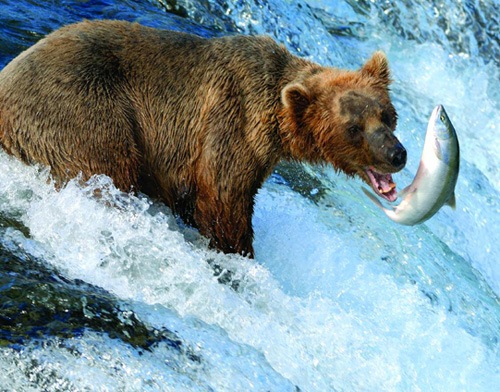
What is the definition of - Herbivore
An organism that obtains energy by eating both plants and animals
The rate at which organic matter is created by producers in an ecosystem
An organism that obtains energy by eating only plants
An organism that obtains energy by eating only animals
What is the definition of - Carnivore
An organism that obtains energy by eating both plants and animals
An organism that feeds on plant and animal remains and other dead matter
An organism that obtains energy by eating only plants
An organism that obtains energy by eating only animals
What is the definition of - Omnivore
An organism that obtains energy by eating both plants and animals
An organism that feeds on plant and animal remains and other dead matter
An organism that obtains energy by eating only plants
Series of steps in an ecosystem in which organisms transfer energy by eating and being eaten.
What is the definition of - Decomposer
An organism that obtains energy by eating both plants and animals
An organism that obtains energy by eating only plants
An organism that breaks down the remains of dead organisms and returns the nutrients back into the soil
Series of steps in an ecosystem in which organisms transfer energy by eating and being eaten.
What do fungi, mushrooms & bacteria do to dead plants and animals?
Leave them there
Decompose them
Wait for other animals to eat them
Move away
What is a scavenger?
A consumer that eats dead animals that have already been killed by other animals; does not recycle nutrients
A carnivore that eats what it kills
Eats plants and meat
Eats plants only
Which is an example of a scavenger?
Mushroom
Fungi
Vulture
Pelican

When the ringed seal is feeding on krill (zooplankton), it is a __________ consumer.
primary
secondary
tertiary
quaternary

How can the orca be a 5th level consumer?
phytoplankton --> krill --> ringed seal --> polar bear--> orca
phytoplankton --> krill --> arctic cod --> orca
phytoplankton --> krill --> arctic cod --> ringed seal --> polar bear--> orca
phytoplankton --> krill --> arctic cod --> polar bear--> orca

Which organism can be considered an herbivore?
phytoplankton
zooplankton
arctic cod
ringed seal

Which organisms in the food web compete with each other for food sources?
krill and arctic cod
polar bear and orca
krill and ringed seal
phytoplankton and zooplankton

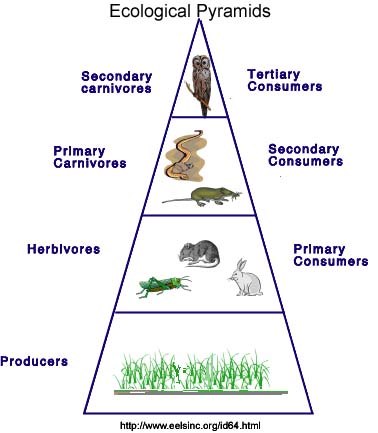


If the producer level starts with 8500 calories, how many would make it to the tertiary level?
850 calories
85 calories
8.5 calories
.85 calories

In this food pyramid, the phytoplankton start with 500 calories of energy. How many calories make it to the shark?
50 calories
5 calories
.5 calories
.05 calories
Tertiary consumers end with 10 calories of energy. How many calories did the producers begin with?
100,000 calories
10,000 calories
1,000 calories
100 calories
The primary consumer receives 400 KJ of energy from the producer. How much energy will the secondary consumer receive?
40 KJ
4000 KJ
400 KJ
4 KJ
The primary consumer receives 400 KJ of energy from the producer. How much energy will the tertiary consumer receive?
40 KJ
4000 KJ
400 KJ
4 KJ
If there is 1000 Kcal available at the producers level, how much energy is available in the primary consumer level?
100 Kcal
10 Kcal
1 Kcal
1000 Kcal
If a secondary consumer receives 145 calories, how much energy was available at the producer level?
145 calories
1,450 calories
14,500 calories
145,000 calories

