
Font size
 Worksheets
Chemistry Ch1 The Atom
Total questions: 106
Worksheet time: 53mins
The concept that matter is composed of tiny, discrete particles is generally attributed to the
Greeks
English
The first subatomic particle discovered was the
electron
photon
Which statement describes the distribution of charge in an atom?
A positively charged nucleus is surrounded by one or more negatively charged electrons.
A positively charged nucleus is surrounded by one or more positively charged electrons.
In the wave-mechanical model of the atom, an orbital is the most probable location of
a neutron.
an electron.
The model of the atom that pictured the atom with electrons stuck randomly throughout the mass of the atom was called the
cannonball model
plum pudding model
planetary model
After bombarding a gold foil sheet with alpha particles, scientists concluded that atoms mainly consist of
empty space
protons
Experimental evidence indicates that the nucleus of an atom
contains most of the mass of the atom
contains a small percentage of the mass of the atom
has no charge
has a negative charge
Which particle has no charge?
neutron
proton
Modern theory pictures an electron as
a wave only
both a particle and a wave
Which statement describes a concept included in the wave-mechanical model of the atom?
Protons are in orbitals outside the nucleus.
Electrons are in orbitals outside the nucleus.
An atom of nickel has a mass of 64 amu. This atom has
28 protons in its nucleus.
64 protons in its nucleus.
Element number 111 is called roentgenium. Which best describes the nucleus of an atom of this element having a mass of 272 amu?
272 protons and 111 neutrons
161 neutrons and 111 protons
The atomic mass of an element is defined as the weighted average mass of that element's
naturally occurring isotopes
radioactive isotopes
Element X has two isotopes.
If 72.0% of the element has an isotopic mass of 84.9 amu and 28.0% has an isotopic mass of 87.0 amu,
the average atomic mass of element X is numerically equal to
(0.720)(84.9) + (0.280)(87.0)
(72.0)(84.9) + (28.0)(87.0)
A neutral atom with 6 electrons and 8 neutrons is an isotope of
carbon
silicon
The average isotopic mass of chlorine is 35.5 amu.
Which mixture of isotopes (shown as percents) produces this mass?
75% Cl-35 and 25% Cl-37
75% C-12 and 25% C-13
The major portion of an atom's mass consists of
neutrons and positrons
neutrons and protons
Which atoms have the same number of neutrons?
H-3 and He-3
H-3 and He-4
Atoms of 16O, 17O and 18O have the same number of
neutrons but a different number of protons
protons but a different number of neutrons
A neutron has approximately the same mass as
a beta particle
a proton
The total number of protons and neutrons in the nuclide 35 17Cl is
52
35
18
17
The nuclides 14 6C and 14 7N are similar in that they both have the same
mass number
atomic number
number of neutrons
What is the nuclear charge of an atom with a mass of 23 and an atomic number of 11?
11+
12+
23+
Compared to the charge and mass of a proton, an electron has
the same charge and the same mass
an opposite charge and a smaller mass
an opposite charge and the same mass
Which of the following statements is correct?
A proton is positively charged; an electron is negatively charged.
A proton is negatively charged; an electron is positively charged.
Which symbols represent atoms that are isotopes of each other?
14C and 14N
16O and 18O
131I and 131I
When electrons in an excited state fall to lower energy levels, energy is
absorbed
released
both released and absorbed
The characteristic bright-line spectrum of an atom is produced when
nuclei undergo fission
nuclei undergo fusion
electrons move from higher to lower energy levels
electrons move from lower to higher energy levels
Which atom in the ground state contains only one completely filled p orbital?
O
He
Be
What is the total number of electrons in the second principal energy level of a calcium atom in the ground state?
2
8
18
The atom of which element in the ground state has two unpaired electrons in the 2p sublevel?
beryllium
carbon
What is the total number of occupied s orbitals in an atom of nickel in the ground state?
2
3
4
Which atom in the ground state has only three electrons in the 3p sublevel?
phosphorus
potassium
argon
What is the total number of occupied principal energy levels in a neutral atom of neon in the ground state?
2
3
4
In an atom of lithium in the ground state, what is the total number of orbitals that contain only one electron?
1
2
3
4
What is the total number of completely filled principal energy levels in an atom of argon in the ground state?
2
3
4
What is the total number of electrons needed to completely fill all the orbitals in an atom’s second principal energy level?
16
8
4
An atom in the excited state can have an electron configuration of
1s2 2s2
1s2 2p1
1s2 2s2 2p5
1s2 2s2 2p6
What is the total number of sublevels in the fourth principal energy level?
1
2
3
4
Which element has atoms in the ground state with a sublevel that is only half filled?
helium
beryllium
nitrogen
neon
Which sublevel contains a total of five orbitals?
s
p
d
f
What is the maximum number of electrons that can occupy the fourth principal energy level of an atom?
6
8
18
32
What is the total number of unpaired electrons in an atom of oxygen in the ground state?
6
2
8
4
Which of the following sublevels has the highest energy?
2p
2s
3p
3s
What is the maximum number of electrons in an orbital of any atom?
1
2
6
10
Which atom in the ground state has three half-filled orbitals?
P
Si
Al
Li
What is the total number of completely filled sublevels found in an atom of krypton in the ground state?
10
8
4
Assuming that the orbitals of nickel fill in the order described in Figure 1-10, what is the total number of sublevels that contain electrons in the third principal energy level of a nickel atom in the ground state?
1
2
3
4
An atom has an electron configuration 1s2 2s2 2p6 3s2 3p5. How many valence electrons are represented in this configuration?
2
3
5
7
Which of the following cannot be decomposed by chemical means?
sodium
ethanol
sucrose
A compound differs from an element in that a compound
is homogeneous
has a definite composition
has a definite melting point
can be decomposed by a chemical reaction
A compound differs from a mixture in that a compound always has a
homogeneous composition
maximum of two elements
minimum of three elements
Most elements are
metals
nonmetals
gases
made in a laboratory
A pure substance that is composed only of identical atoms is classified as
an element
a heterogeneous mixture
a homogeneous mixture
Which is characteristic of all mixtures?
They are homogeneous.
Their compositions are in a definite ratio.
Their compositions may vary.
A heterogeneous material may be
an element
a compound
a pure substance
a mixture
Which of these materials is a mixture?
water
air
methane
Each particle contained in hydrogen gas is made up of two identical hydrogen atoms chemically joined together. Hydrogen gas is
a compound
an element
a homogeneous mixture
Which of the following materials is a pure substance?
air
water
earth
Which statement is an identifying characteristic of a mixture?
A mixture can consist of a single element.
A mixture can be separated by physical means.
A mixture must be homogeneous.
Which substance can be decomposed by a chemical change?
ammonia
aluminum
magnesium
A sample of a material is passed through a filter paper. A white deposit remains on the paper, and a clear liquid passes through.
The clear liquid is then evaporated, leaving a white residue.
What does this show about the nature of the original sample?
It is a heterogeneous mixture containing both an insoluble solid and a dissolved solid.
It is a pure compound that cannot be separated by physical means.
A substance is found to contain only calcium and sulfur.
Which observation would show that the substance is a compound rather than a mixture?
It can be separated by filtration.
The mass ratio of calcium to sulfur is constant in all samples.
Two phases can be seen with the unaided eye.
Hydrogen molecules and oxygen molecules are both present together but are not chemically combined.
What is represented by this description?
a mixture of two elements
a compound of hydrogen and oxygen
a single element, hydrogen
Which statement correctly compares a mixture of iron and oxygen with a compound composed of iron and oxygen?
A mixture has a variable composition and components retain their properties; a compound has a fixed ratio and new properties.
A mixture has a fixed composition; a compound has a variable composition.
Both a mixture and a compound must be homogeneous.
Is a pepperoni pizza homogeneous or heterogeneous?
homogeneous mixture
heterogeneous mixture
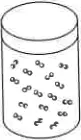
Container A shows particles of two different elements present but not chemically combined. How should the contents of Container A be identified?
only elements
only compounds
a mixture of elements and compounds
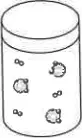
Container B shows identical particles, each made of two different atoms bonded together. How should the contents of Container B be identified?
only elements
only compounds
a mixture of elements and compounds
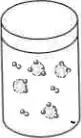
Container C shows both single atoms of an element and molecules made of two different atoms bonded together.
How should the contents of Container C be identified?
only elements
only compounds
a mixture of elements and compounds
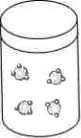
Container D shows two different kinds of molecules distributed uniformly throughout. How should the contents of Container D be identified?
only elements
only compounds
a mixture of elements and compounds
only a single element
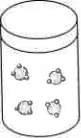
Are the contents of Container D homogeneous or heterogeneous?
homogeneous
heterogeneous
Two samples are analyzed.
One sample is 88.88% oxygen by mass and 11.12% hydrogen. The other is 94.12% oxygen and 5.88% hydrogen.
What conclusion can be made about these samples?
They are the same compound with a constant composition.
They are different compounds; the first is water and the second is hydrogen peroxide.
They are the same mixture of two elements.
The model of the atom that pictured the atom with electrons traveling in circular orbits was called the
planetary model
cannonball model
Which sequence represents a correct order of historical developments leading to the modern model of the atom?
the atom is a hard sphere → most of the atom is empty space → electrons exist in orbitals outside the nucleus
the atom is a hard sphere → electrons exist in orbitals outside the nucleus → most of the atom is empty space
most of the atom is empty space → electrons exist in orbitals outside the nucleus → the atom is a hard sphere
Compared to the entire atom, the nucleus of the atom is
smaller and contains most of the atom's mass
smaller and contains little of the atom's mass
large and contains most of the atom's mass
large and contains little of the atom's mass
In a famous experiment, positively charged particles were aimed at a thin sheet of gold foil.
The results of this experiment were that
most of the particles failed to pass through the foil
a few of the particles were repelled, showing that the gold has a positive core
a few of the particles were repelled, showing that the gold was neutral
Neutral atoms must contain equal numbers of
protons and electrons
protons and neutrons
Which of the following is true of a compound but not a mixture?
A compound contains more than one element.
All the nuclei in a compound contain the same number of protons.
The composition of a compound does not vary.
Compared with an electron, a proton has
more mass and the same charge
more mass and an opposite charge
equal mass and the same charge
The total number of electrons in a neutral atom of any element is always equal to the atom's
number of protons
number of nucleons
All isotopes of neutral atoms of sodium have
11 protons and 12 neutrons
11 protons and 11 electrons
12 protons and 12 electrons
There are three isotopes of hydrogen, H-1, H-2, and H-3. All of these isotopes have
a mass of 2 amu
an atomic number of 1
An atom in the excited state contains
more potential energy than an atom in the ground state
more mass than an atom in the ground state
As an electron moves from the excited state to the ground state, the potential energy of the electron
decreases
increases
becomes zero
Which of the following particles has the smallest mass?
electron
proton
hydrogen atom
An element occurs as a mixture of isotopes. The atomic mass of the element is based upon
the mass of the individual isotopes, only
the relative abundances of the isotopes, only
both the masses and the relative abundances of the individual isotopes
100 g of a clear liquid is evaporated and a few grams of white crystals remain. The original liquid was a
heterogeneous compound
heterogeneous mixture
homogeneous mixture
Two samples of bronze, a uniform material, are analyzed and found to contain different percentages of tin. Based on this information, bronze is likely a
heterogeneous compound
homogeneous mixture
heterogeneous mixture
In the electron cloud model of the atom, an orbital is defined as the most probable
location of an electron
charge of an electron
conductivity of an electron
There are three isotopes of oxygen: O-16, O-17, and O-18. These neutral atoms contain
equal numbers of protons and electrons, but different numbers of neutrons
different numbers of protons, neutrons, and electrons
What is the charge on a particle that contains 9 protons, 10 neutrons, and 9 electrons?
It is neutral.
It has a net charge of 1+.
It has a net charge of 1−.
An element has two isotopes.
90% of the isotopes have a mass number of 20 amu, while 10% have a mass number of 22 amu.
The atomic mass of the element
is closer to 20 amu than to 22 amu
is closer to 22 amu than to 20 amu
If the atomic number of a neutral element is 35, and its nucleus contains 40 neutrons, which of the following is correct?
The atom is bromine, and it has 35 electrons.
The atom is bromine, and it has a mass number of 40.
The atom is zirconium, and it has a mass number of 75.
The atom is zirconium, and it has 40 electrons.
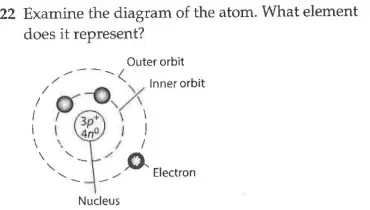
Examine the diagram of the atom.
What element does it represent?
hydrogen
lithium
carbon
An atom of Cl-35 contains
17 protons, 18 neutrons, and 17 electrons
18 protons, 17 neutrons, and 17 electrons
18 protons, 18 neutrons, and 18 electrons
Which must be a mixture of substances?
liquid
gas
solution
What is the number of electrons in a completely filled second shell of an atom?
32
18
8
Explain, in terms of protons and neutrons, why U-235 and U-238 are different isotopes of the element uranium.
They have the same number of protons but different numbers of neutrons.
They have different numbers of electrons only.
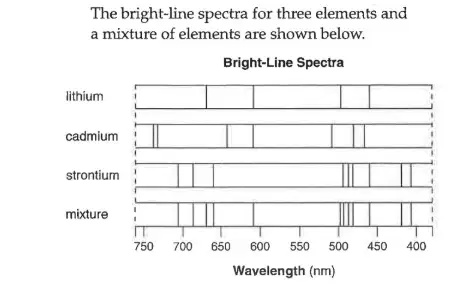
Explain, in terms of both electrons and energy, how the bright line spectrum of an element is produced.
Electrons absorb energy as they move to lower energy levels, producing continuous white light.
Electrons emit energy at specific wavelengths as they return from higher to lower energy levels, producing discrete lines.
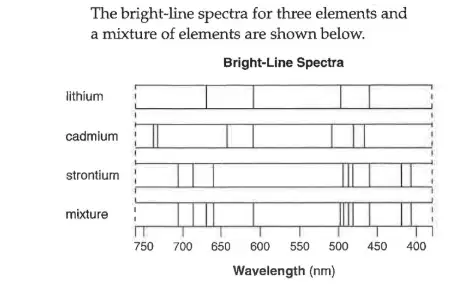
Identify all the elements in the mixture shown in the bright-line spectra.
lithium and strontium
lithium, cadmium, and strontium

State the total number of electrons that would be found in a neutral atom of cadmium.
36
48
64
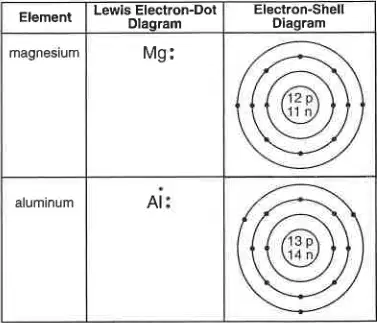
Explain, in terms of protons and electrons,
why both diagrams depict atoms that are considered neutral.
Each atom has more electrons than protons.
Each atom has fewer electrons than protons.
Each atom has an equal number of protons and electrons.
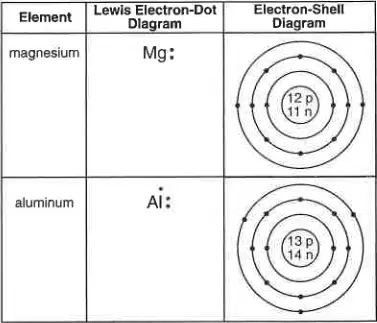
Determine the mass number of the magnesium atom represented by the electron-shell diagram.
22
24
26
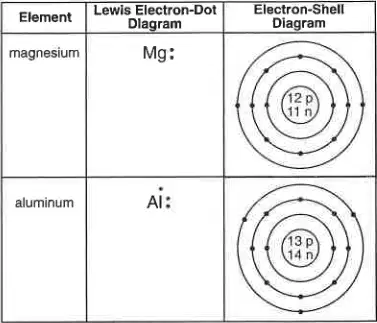
The linear symbol for the ground-state electron configuration of aluminum is Al 2-8-3. Construct a linear symbol for an excited-state configuration of the aluminum atom.
Al 2-7-4
Al 2-8-2-1
Al 2-6-5
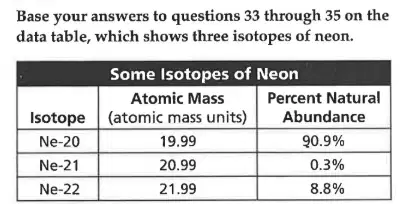
In terms of atomic particles, state one difference between these three isotopes of neon.
They have different numbers of protons.
They have different numbers of neutrons.
They have different numbers of electrons in neutral atoms.
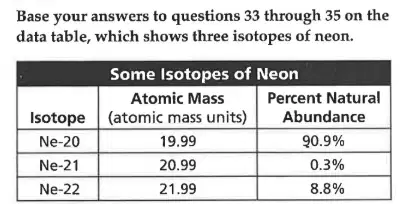
Based on the atomic masses and natural abundances shown for Ne-20 (19.99 amu, 90.9%), Ne-21 (20.99 amu, 0.3%), and Ne-22 (21.99 amu, 8.8%), which numerical setup correctly calculates the average atomic mass of neon?
19.99×90.9 + 20.99×0.3 + 21.99×8.8
(19.99×0.909) + (20.99×0.003) + (21.99×0.088)
(19.99 + 20.99 + 21.99) ÷ 3
(0.909 + 0.003 + 0.088) × 20.99

