
 Worksheets
PHYS 2326 Exam 3 Review
Total questions: 107
Worksheet time: 1hrs 10mins
A coil lies flat on a tabletop in a region where the magnetic field vector points straight up. The magnetic field vanishes suddenly. When viewed from above, what is the direction of the induced current in this coil as the field fades?
counter-clockwise then clockwise
clockwise then counter-clockwise
clockwise
counter-clockwise
There is no current induced in the coil.
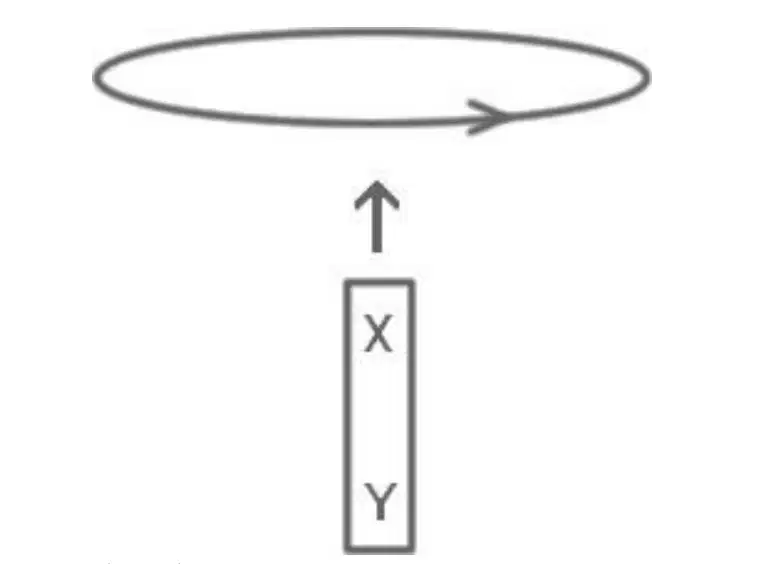
The figure shows a bar magnet moving vertically upward toward a horizontal coil. The poles of the bar magnets are labeled X and Y. As the bar magnet approaches the coil it induces an electric current in the direction indicated on the figure (counter-clockwise as viewed from above). What are the correct polarities of the magnet?
X is a south pole, Y is a north pole
X is a north pole, Y is a south pole
Both X and Y are north poles
Both X and Y are south poles
The polarities of the magnet cannot be determined from the information given
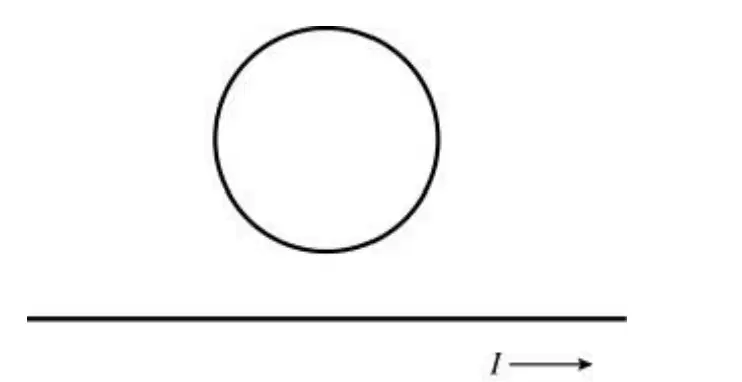
A circular metal ring is situated above a long straight wire, as shown in the figure. The straight wire has a current flowing to the right, and the current is increasing in time at a constant rate. Which statement is true?
There is an induced current in the metal ring, flowing in a clockwise direction
There is an induced current in the metal ring, flowing in a counter-clockwise direction
There is no induced current in the metal ring because the current in the wire is changing at a constant rate
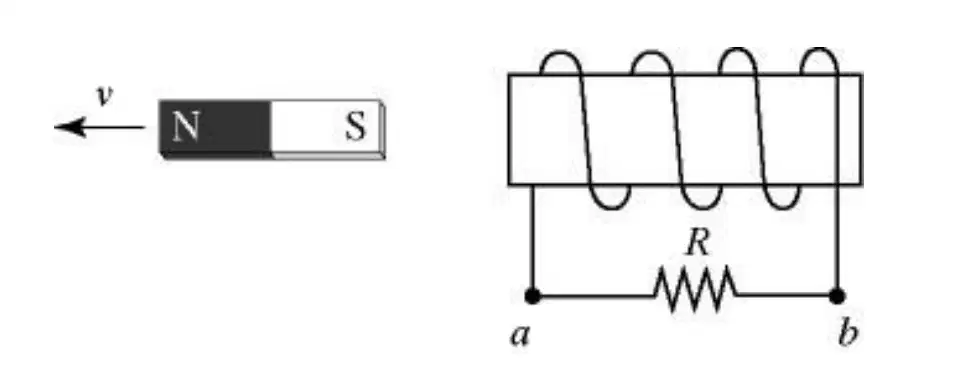
In the figure, a bar magnet moves away from the solenoid. The induced current through the resistor R is
from a to b.
from b to a.
There is no induced current through the resistor
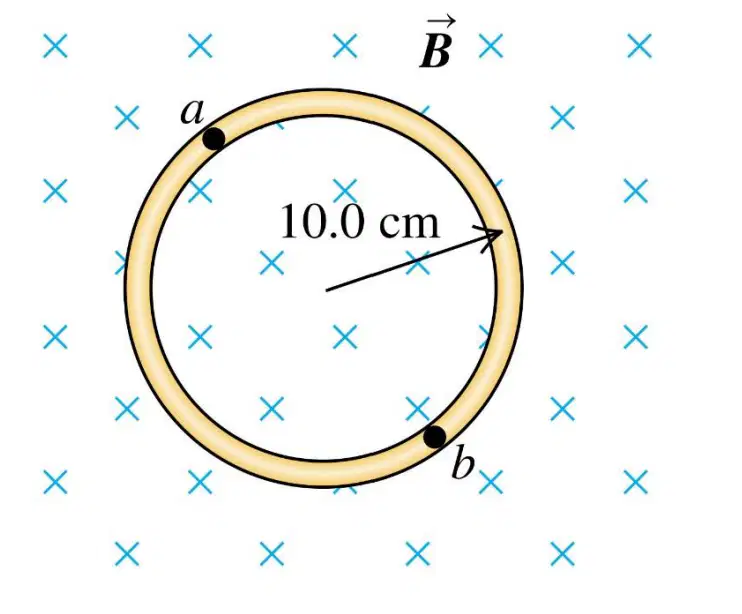
A circular loop of wire is in a region of spatially uniform magnetic field. The magnetic field is directed into the plane of the figure. If the magnetic field magnitude is decreasing,
the induced emf is clockwise.
the induced emf is counterclockwise.
the induced emf is zero
The answer depends on the strength of the field.
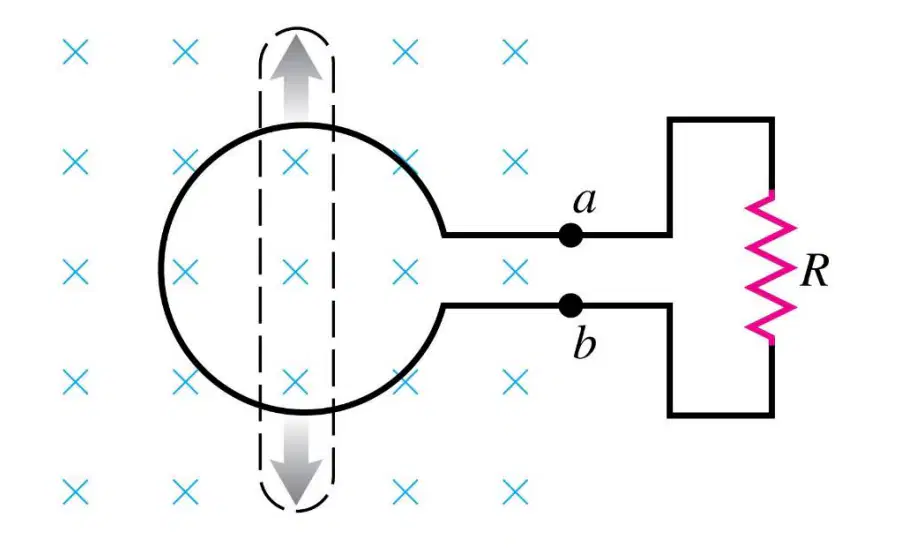
A flexible loop of wire lies in a uniform magnetic field of magnitude B directed into the plane of the picture. The loop is pulled as shown, reducing its area. The induced current
flows downward through resistor R and is proportional to B
flows upward through resistor R and is proportional to B.
flows downward through resistor R and is proportional to B2
flows upward through resistor R and is proportional to B2
none of the above
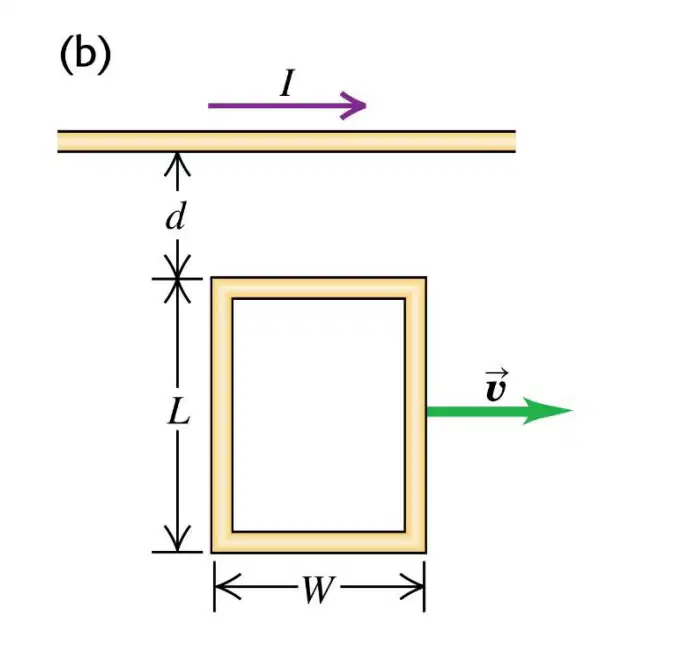
The rectangular loop of wire is being moved to the right at constant velocity. A constant current I flows in the long straight wire in the direction shown. The current induced in the loop is
clockwise and proportional to I
counterclockwise and proportional to I.
clockwise and proportional to I2
counterclockwise and proportional to I2
zero
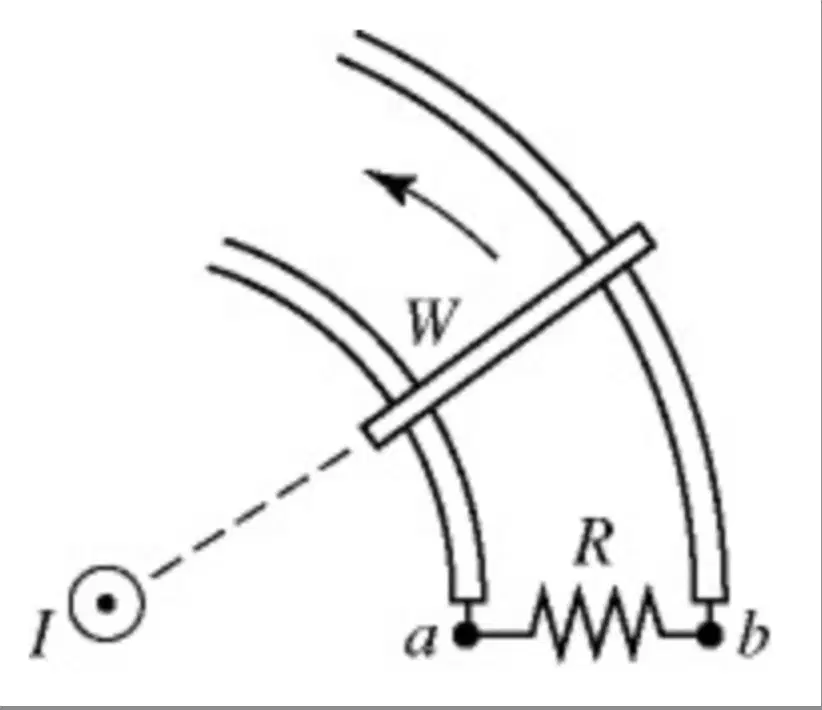
In the figure, a straight wire carries a steady current I perpendicular to the plane of the page. A bar is in contact with a pair of circular rails, and rotates about the straight wire.
The direction of the induced current through the resistor R is
from a to b
from b to a
There is no induced current through the resistor.
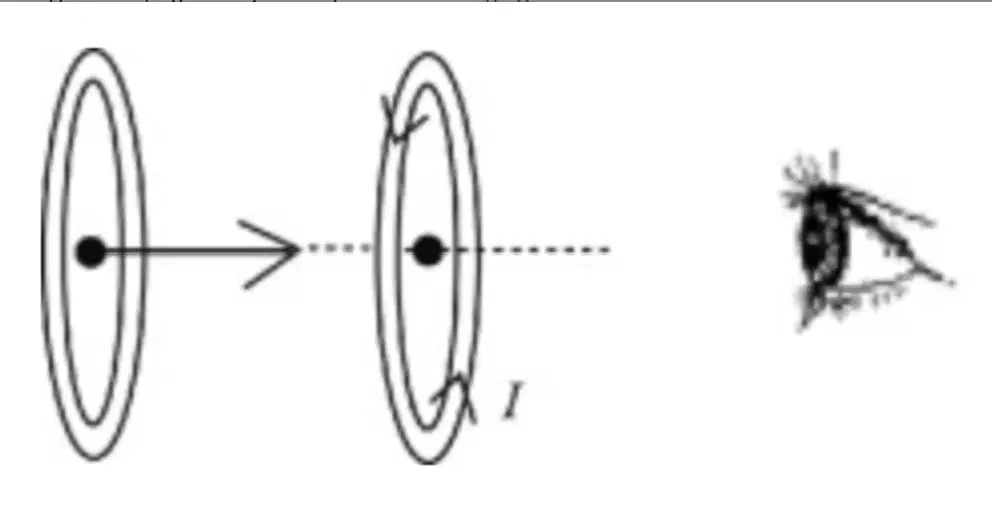
A closed, circular loop has a counter-clockwise current flowing through it as viewed by a person on the right, as shown in the figure.
If a second closed circular loop with the same radius approaches this loop with constant velocity along a common axis as shown, in what direction will a current flow in the approaching loop as viewed by the person on the right?
clockwise
No current will be induced because the velocity of approach is constant
counter-clockwise
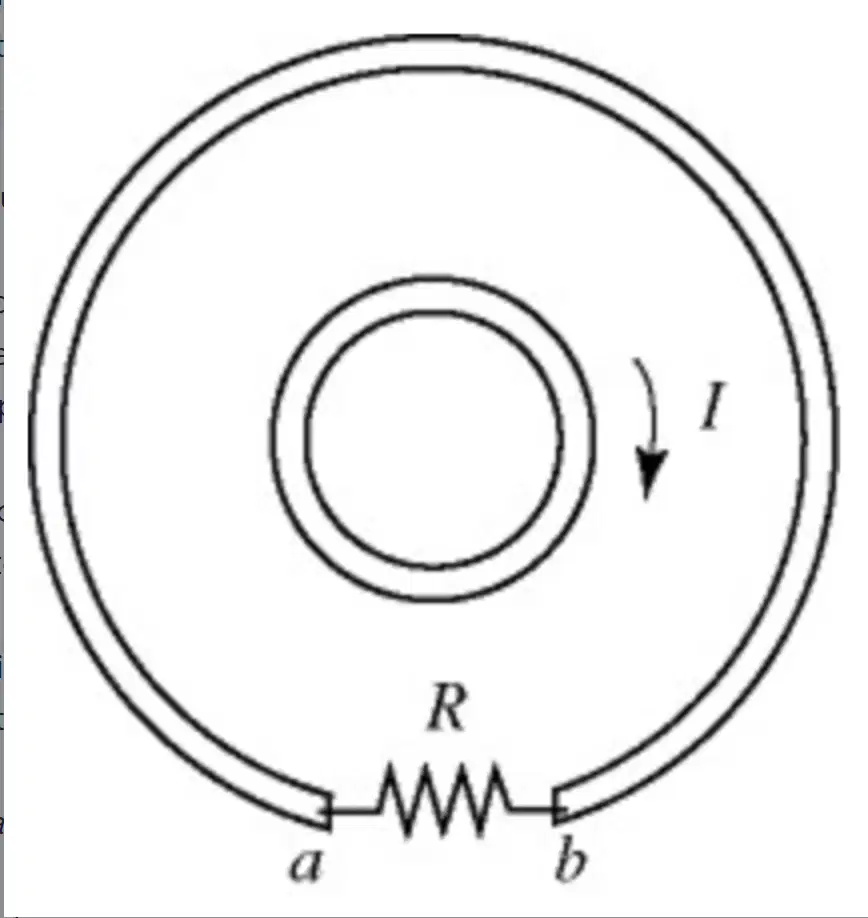
In the figure, the inner loop carries a clockwise current I that is increasing. The resistor R is in the outer loop and both loops are in the same plane.
The induced current through the resistor R is
There is no induced current through the resistor
from a to b.
from b to a
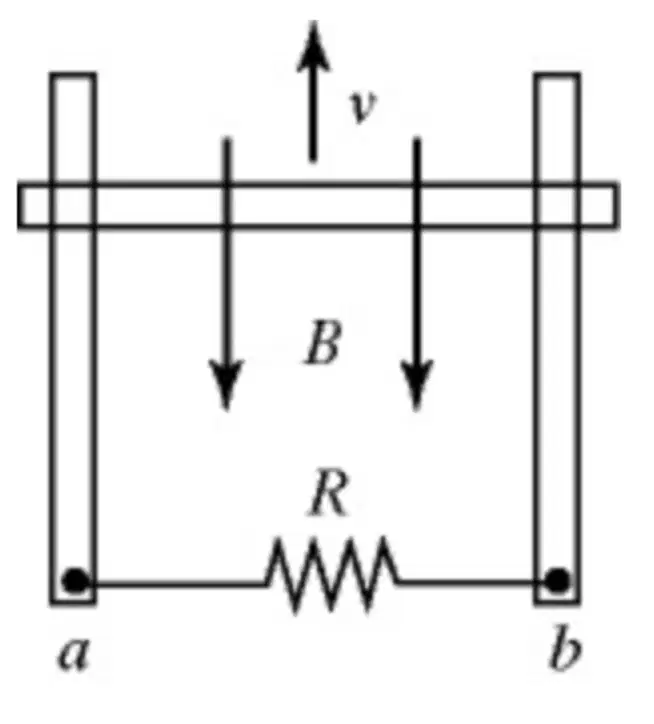
In the figure, a copper bar is in contact with a pair of parallel metal rails and is in motion with velocity . A uniform magnetic field is present pointing downward, as shown. The bar, the rails, and the resistor R are all in the same plane.
The induced current through the resistor R is
from b to a
There is no induced current through the resistor
from a to b
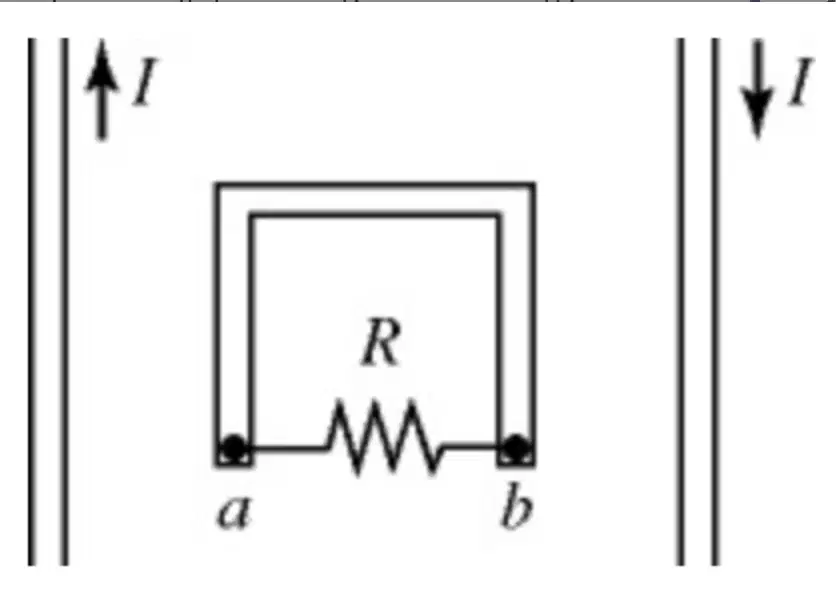
In the figure, two parallel wires carry currents of magnitude I in opposite directions. A rectangular loop is midway between the wires. The current I is decreasing with time.
The induced current through the resistor R is
from b to a
from a to b
There is no induced current through the resistor
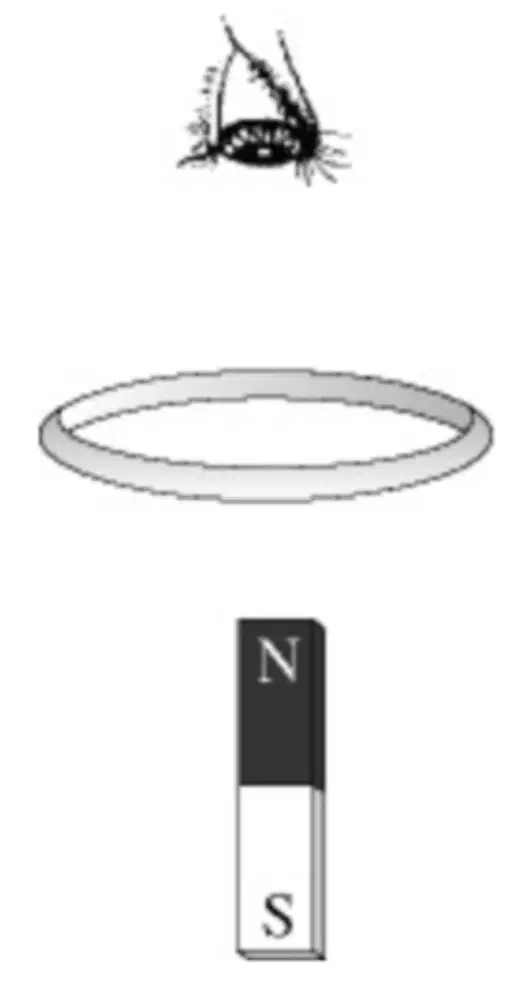
A bar magnet is held vertically with its upper end a little bit below the center of a horizontal metal ring. The upper end of the magnet is its north pole, as shown in the figure. The bar magnet is now dropped. An observer views the ring from above its center.
To this observer, how will the induced current in the ring behave as the magnet falls?
The current will flow clockwise and be increasing.
The current will flow counter-clockwise and be increasing.
The induced current will be zero.
The current will flow clockwise and be decreasing
The current will flow counter-clockwise and be decreasing.
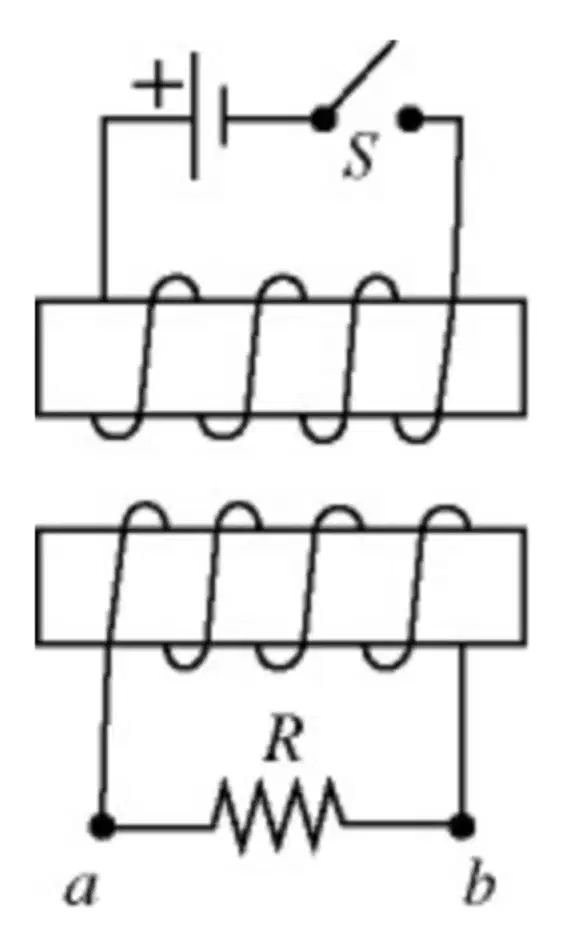
In the figure, two solenoids are side by side. The switch S, initially open, is closed.
The induced current through the resistor R is
from a to b
There is no induced current through the resistor
from b to a
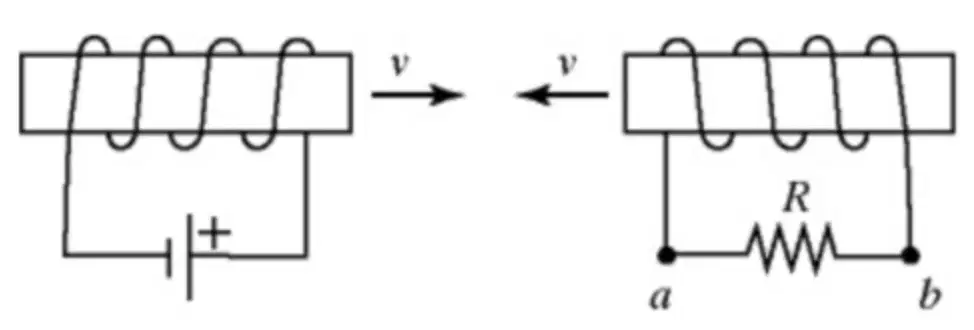
In the figure, two solenoids are approaching each other with speed v as shown.
The induced current through the resistor R is
from b to a
from a to b
There is no induced current through the resistor.
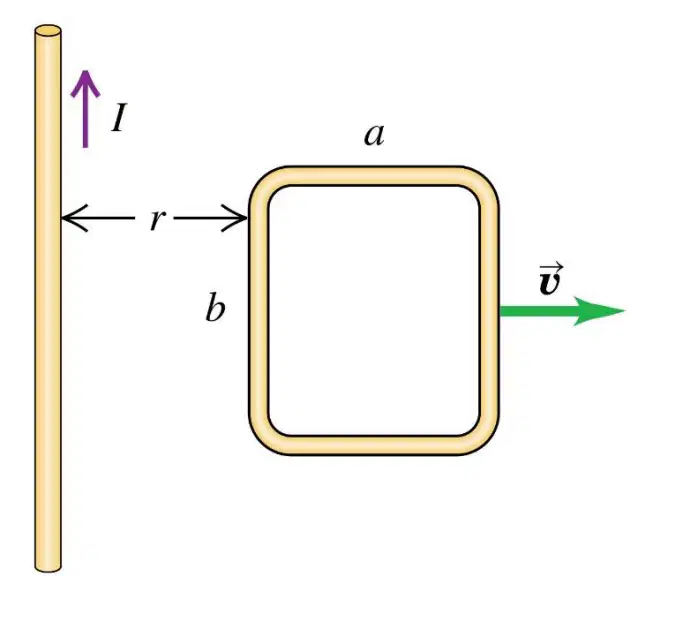
The rectangular loop of wire is being moved to the right at constant velocity. A constant current I flows in the long wire in the direction shown. What are the directions of the magnetic forces on the left-hand (L) and right-hand (R) sides of the loop?
L: to the left; R: to the left
L: to the left; R: to the right
L: to the right; R: to the left
L: to the right; R: to the right
A very long, straight solenoid with a cross-sectional area of 1.98 cm2 is wound with 90.3 turns of wire per centimeter. Starting at t = 0, the current in the solenoid is increasing according to i(t)=(0.169A/s2)t2. A secondary winding of 5.0 turns encircles the solenoid at its center, such that the secondary winding has the same cross-sectional area as the solenoid.
What is the magnitude of the emf induced in the secondary winding at the instant that the current in the solenoid is 3.2 A?
Express your answer with the appropriate units.
(a)
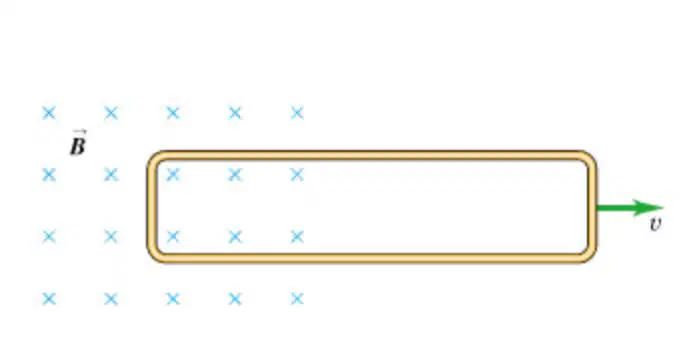
A rectangular loop of wire with dimensions 1.80 cm by 9.00 cm and resistance 0.800 Ω is being pulled to the right out of a region of uniform magnetic field. The magnetic field has magnitude 2.40 T and is directed into the plane of (Figure 1) .
What is the direction of the force that the magnetic field exerts on the loop?
to the right
to the left
upward
downward
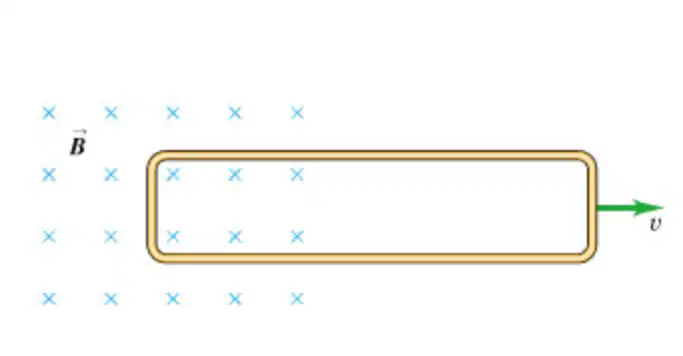
A rectangular loop of wire with dimensions 1.80 cm by 9.00 cm and resistance 0.800 Ω is being pulled to the right out of a region of uniform magnetic field. The magnetic field has magnitude 2.40 T and is directed into the plane of (Figure 1) .
At the instant when the speed of the loop is 3.00 m/s and it is still partially in the field region, what is the magnitude of the force that the magnetic field exerts on the loop?
Express your answer with the appropriate units.
(a)
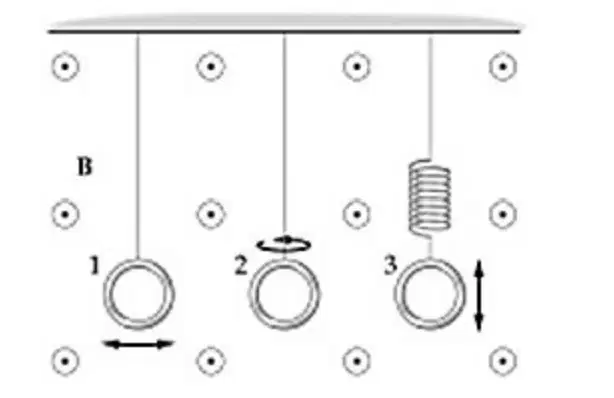
The three loops of wire shown in the figure are all subject to the same uniform magnetic field B⃗ that does not vary with time. Loop 1 oscillates back and forth as the bob in a pendulum, loop 2 rotates about a vertical axis, and loop 3 oscillates up and down at the end of a spring. Which loop, or loops, will have an emf induced in them?
loop 3 only
loop 2 only
loop 1 only
loops 2 and 3
loops 1 and 2
A large magnetic flux change through a coil must induce a greater emf in the coil than a small flux change.
A circular loop of wire lies in the plane of the paper. An increasing magnetic field points out of the paper. What is the direction of the induced current in the loop?
counter-clockwise then clockwise
clockwise
clockwise then counter-clockwise
counter-clockwise
There is no current induced in the loop.

In the figure, a C-shaped conductor is in a uniform magnetic field B, which is increasing. The polarity of the induced emf in terminals X and Y is
X is positive and Y is negative.
X is negative and Y is positive.
X and Y are at the same potential.
A ten-loop coil having an area of 0.23 m2 and a very large resistance is in a 0.047-T uniform magnetic field oriented so that the maximum flux goes through the coil. The coil is then rotated so that the flux through it goes to zero in 0.34 s. What is the magnitude of the average emf induced in the coil during the 0.34 s?
0.32 V
0.0032 V
1.0 V
0.00 V
0.032 V
In a transformer, how many turns are necessary in a 110-V primary if the 24-V secondary has 100 turns?
4
22
240
110
458
The magnetic flux through a coil is given by ΦB=αt−βt3, where α and β are constants.
What are the units of α and β?
Magnetic flux has units of webers (Wb/s), α has units of Wb and β has units of Wb/s3
Magnetic flux has units of webers (Wb), α has units of Wb/s and β has units of Wb/s3
Magnetic flux has units of webers (Wb), α has units of Wb/s and β has units of Wb/s5
Magnetic flux has units of webers (Wb), α has units of Wb/s3 and β has units of Wb/s.
The magnetic flux through a coil is given by ΦB=αt−βt3, where α and β are constants.
If the induced emf is zero at t=0.500s, how is α related to β?
Express your answer in seconds squared.
(a)
The magnetic flux through a coil is given by ΦB=αt−βt3, where α and β are constants.
If the emf at t=0 is -1.60 V, what is the emf at t=0.250s?
Express your answer with the appropriate units.
(a)
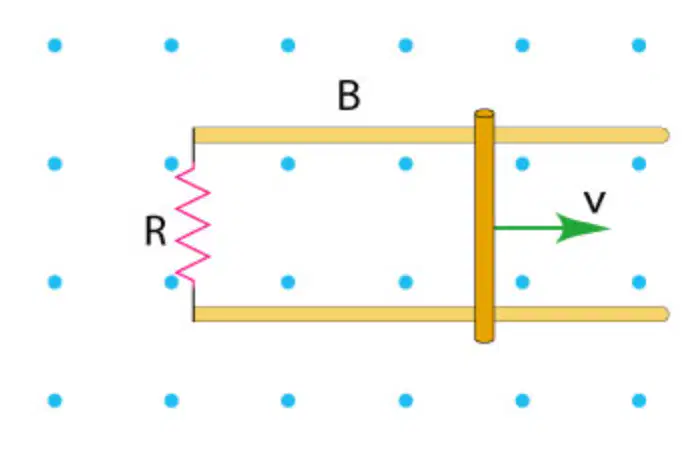
Consider the circuit shown in (Figure 1), with the bar moving to the right with speed v. The bar has length 0.380 m, R = 48.0 Ω, and B = 0.610 T.
Is the induced current in the circuit clockwise or counterclockwise?
clockwise
counterclockwise
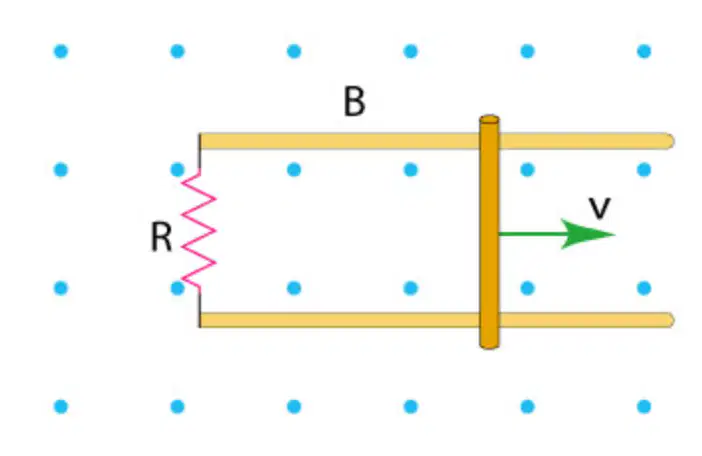
Consider the circuit shown in (Figure 1), with the bar moving to the right with speed v. The bar has length 0.380 m, R = 48.0 Ω, and B = 0.610 T.
At an instant when the resistor is dissipating electrical energy at a rate of 0.920 J/s, what is the speed of the bar?
Express your answer with the appropriate units.
(a)
A uniform magnetic field is applied perpendicular to the plane of a 60-turn circular coil with a radius of 6.0 cm and a resistance of 0.60 Ω. If the magnetic field increases uniformly from 0.20 T to 1.8 T in 0.20 s, what is the magnitude of the emf induced in the coil?
5.4 V
10.8 V
0 V
16 V
2.7 V
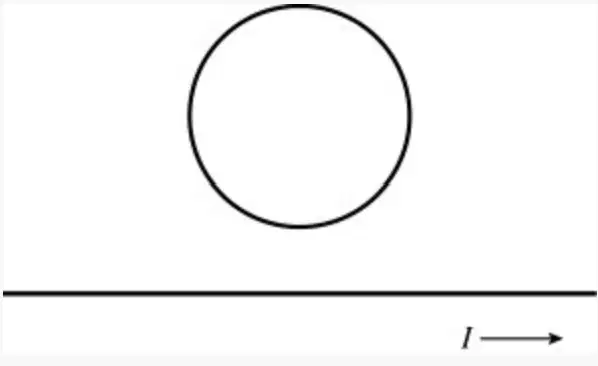
A circular metal ring is situated above a long straight wire, as shown in the figure. The straight wire has a current flowing to the right, and the current is constant in time. Which statement is true?
There is an induced current in the metal ring, flowing in a clockwise direction.
There is an induced current in the metal ring, flowing in a clockwise then counterclockwise direction.
There is no induced current in the metal ring.
There is an induced current in the metal ring, flowing in a counterclockwise direction.
Does the inductance of a solenoid or coil depend on the current?
Yes
No
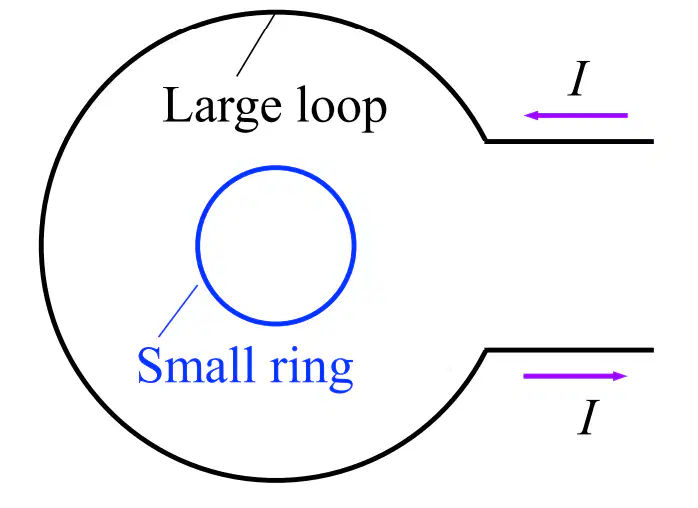
A small, circular ring of wire (shown in blue) is inside a larger loop of wire that carries a current I as shown. The small ring and the larger loop both lie in the same plane. If I increases, the current that flows in the small ring
is clockwise and caused by self-inductance.
is counterclockwise and caused by self-inductance.
is clockwise and caused by mutual inductance.
is counterclockwise and caused by mutual inductance.
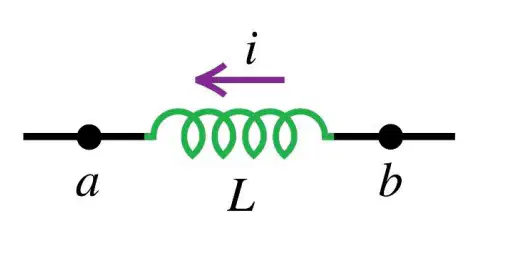
A current i flows through an inductor L in the direction from point b toward point a. There is zero resistance in the wires of the inductor. If the current is decreasing,
the potential is greater at point a than at point b.
the potential is less at point a than at point b
The answer depends on the magnitude of di/dt compared to the magnitude of i
The answer depends on the value of the inductance L
both C. and D. are correct
A steady current flows through an inductor. If the current is doubled while the inductance remains constant, the amount of energy stored in the inductor
increases by a factor of 2
increases by a factor of 2.
increases by a factor of 4.
increases by a factor that depends on the geometry of the inductor.
none of the above
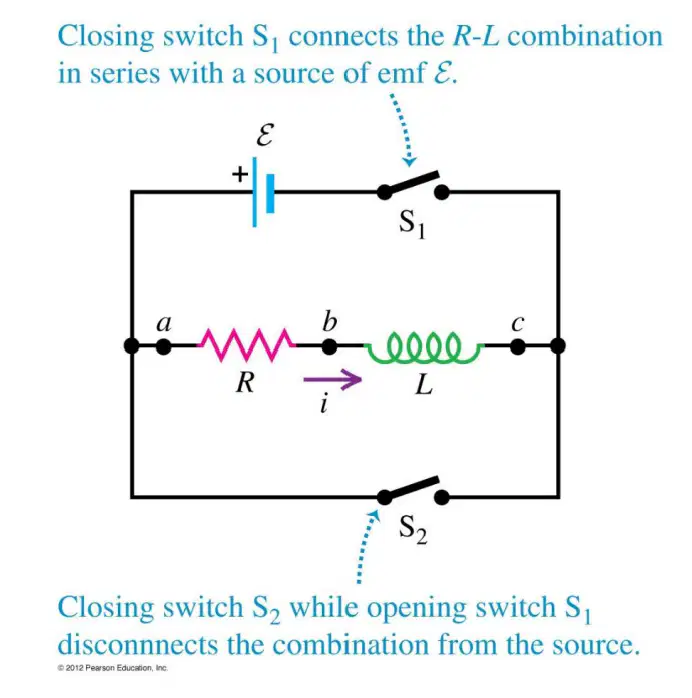
An inductance L and a resistance R are connected to a source of emf as shown. When switch S1 is closed, a current begins to flow. The final value of the current is
directly proportional to RL.
directly proportional to R/L
directly proportional to L/R.
directly proportional to 1/(RL).
independent of L.
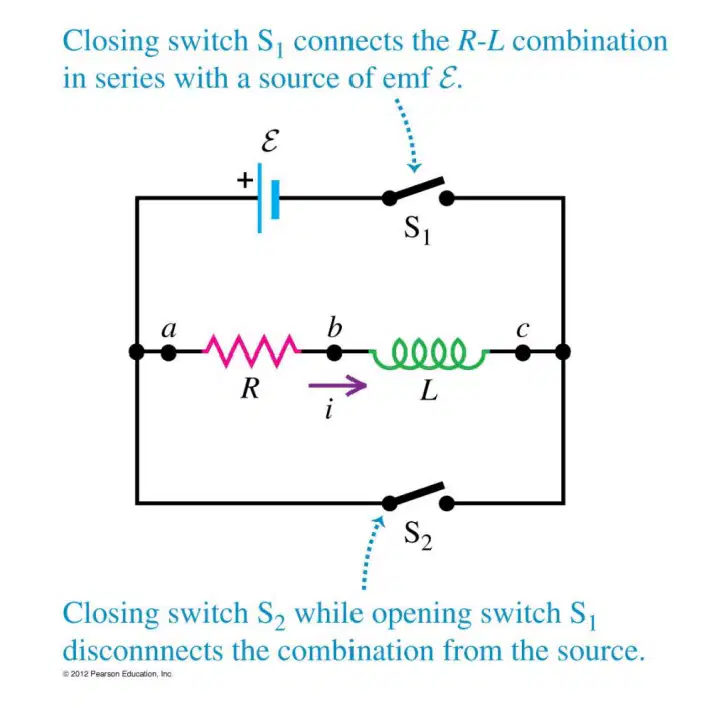
An inductance L and a resistance R are connected to a source of emf as shown. When switch S1 is closed, a current begins to flow. The time required for the current to reach one-half its final value is
directly proportional to RL.
directly proportional to R/L
directly proportional to L/R
directly proportional to 1/(RL)
independent of L
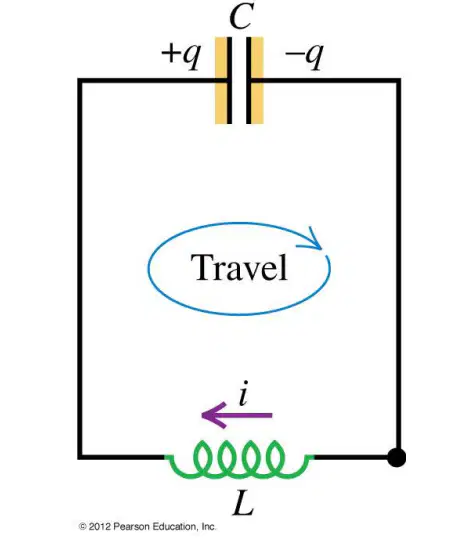
An inductor (inductance L) and a capacitor (capacitance C) are connected as shown. If the values of both L and C are doubled, what happens to the time required for the capacitor charge to oscillate through a complete cycle?
It becomes 4 times longer.
It becomes twice as long
It is unchanged.
It becomes 1/2 as long.
It becomes 1/4 as long
What is the self-inductance of a solenoid 30.0 cm long having 100 turns of wire and a cross-sectional area of 1.00 × 10⁻⁴ m2? (μ0 = 4π × 10-7 T ∙ m/A)
4.19 nH
4.19 pH
4.19 µH
4.19 mH
4.19 H
An inductor has a current I(t) = (0.500 A) cos[(275 s-1 )t] flowing through it. If the maximum emf across the inductor is equal to 0.500 V, what is the self-inductance of the inductor?
4.37 mH
3.64 mH
2.75 mH
0.73 mH
1.43 mH
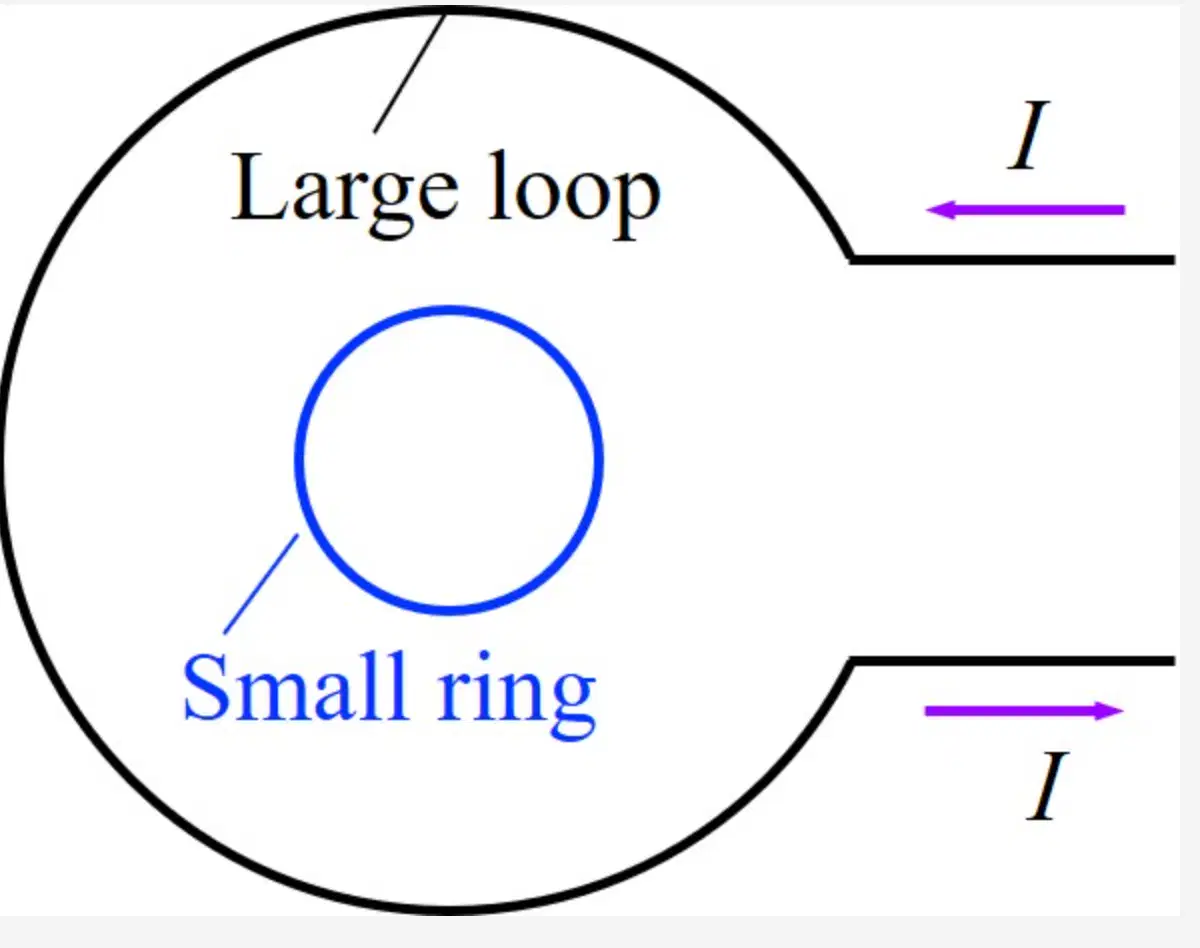
A small, circular ring of wire (shown in blue) is inside a larger loop of wire that carries a current I as shown. The small ring and the larger loop both lie in the same plane. If I decreases, the current that flows in the small ring
is counterclockwise and caused by self-inductance.
is clockwise and caused by self-inductance.
is clockwise and caused by mutual inductance.
is counterclockwise and caused by mutual inductance.

An inductor (inductance L) and a capacitor (capacitance C) are connected as shown. If the values of both L and C are quadrupled, what happens to the time required for the capacitor charge to oscillate through a complete cycle?
It becomes 4 times longer.
It remains the same.
It becomes 2 times longer.
It becomes 1/2 as long.
Your latest invention is a car alarm that produces sound at a particularly annoying frequency of 3.40×10³ Hz. To do this, the car alarm circuitry must produce an alternating electric current of the same frequency. That's why your design includes an inductor and capacitor in series. The maximum voltage across the capacitor is to be 12.0 V. To produce a sufficiently loud sound, the capacitor must store an amount of energy equal to 1.65×10⁻² J.
What value of capacitance should you choose for your car alarm circuit?
Express your answer in farads.
(a)
Your latest invention is a car alarm that produces sound at a particularly annoying frequency of 3.40×10³ Hz. To do this, the car alarm circuitry must produce an alternating electric current of the same frequency. That's why your design includes an inductor and capacitor in series. The maximum voltage across the capacitor is to be 12.0 V. To produce a sufficiently loud sound, the capacitor must store an amount of energy equal to 1.65×10⁻² J.
What value of inductance should you choose for your car alarm circuit?
Express your answer in henries.
(a)
A toroidal solenoid has 560 turns, cross-sectional area 6.00 cm2, and mean radius 4.00 cm.
Calculate the coil's self-inductance.
Express your answer in henries
(a)
A toroidal solenoid has 560 turns, cross-sectional area 6.00 cm2, and mean radius 4.00 cm.
If the current decreases uniformly from 5.00 A to 2.00 A in 3.00 ms, calculate the self-induced emf in the coil.
Express your answer in volts.
(a)
A toroidal solenoid has 560 turns, cross-sectional area 6.00 cm2, and mean radius 4.00 cm.
The current is directed from terminal a of the coil to terminal b. Is the direction of the induced emf from a to b or from b to a?
from a to b
from b to a
At what rate would the current in a 100-mH inductor have to change to induce an emf of 1000 V in the inductor?
10,000 A/s
1 A/s
100 A/s
1000 A/s
10 A/s
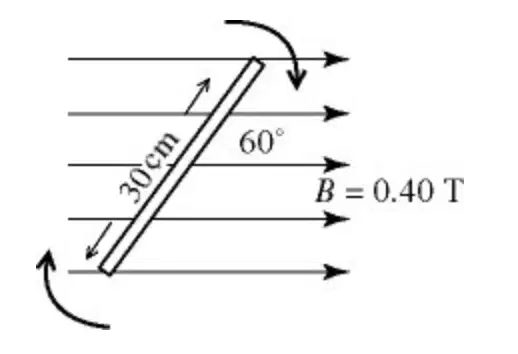
Wire is wound on a square frame, 30 cm by 30 cm, to form a coil of 7 turns. The frame is mounted on a horizontal shaft through its center (perpendicular to the plane of the diagram), as shown in the figure.
The coil is in clockwise rotation, with a period of 0.060 s. A uniform, horizontal, magnetic field of magnitude 0.40 T is present. At a given instant, the plane of the coil forms a 60° angle with the horizontal, as shown. At that instant, what is the magnitude of the emf induced in the coil?
2.1 V
13 V
23 V
3.6 V
26 V
A 96-mH solenoid inductor is wound on a form 0.80 m in length and 0.10 m in diameter. A coil is tightly wound around the solenoid at its center. The coil's resistance is 9.9 ohms. The mutual inductance of the coil and solenoid is 31 μH. At a given instant, the current in the solenoid is 540 mA, and is decreasing at the rate of 2.5 A/s. At the given instant, what is the magnitude of the induced current in the coil? μ0 = 4π × 10−7 T • m/A
11 μA
7.8 μA
13 μA
6.3 μA
9.4 μA
A 45-mH ideal inductor is connected in series with a 60-Ω resistor through an ideal 15-V DC power supply and an open switch. If the switch is closed at time t = 0 s, what is the current 7.0 ms later?
280 mA
650 mA
250 mA
850 mA
550 mA
A series LR circuit contains an emf source of 14 V having no internal resistance, a resistor, a 34 H inductor having no appreciable resistance, and a switch. If the emf across the inductor is 80% of its maximum value 4.0 s after the switch is closed, what is the resistance of the resistor?
14 Ω
1.5 Ω
5.0 Ω
1.9 Ω
A charged capacitor is connected to an ideal inductor. At time t = 0, the charge on the capacitor is equal to 6.00 μC. At time t = 2.00 ms the charge on the capacitor is zero for the first time. What is the amplitude of the current at that same instant?
0.780 mA
1.53 mA
4.71 mA
1.19 mA
2.38 mA
A charged capacitor is connected to an ideal inductor to form an LC circuit with a frequency of oscillation f = 1.6 Hz. At time t = 0 the capacitor is fully charged. At a given instant later the charge on the capacitor is measured to be 3.0 μC and the current in the circuit is equal to 75 μA. What is the maximum charge of the capacitor?
2.0 µC
10 µC
6.0 µC
4.0 µC
8.0 µC
In an LC circuit containing a 40-mH ideal inductor and a 1.2-mF capacitor, the maximum charge on the capacitor is 45 mC during the oscillations. What is the maximum current through the inductor during the oscillations?
6.5 A
42 A
10 A
3.7 A
2.5 A
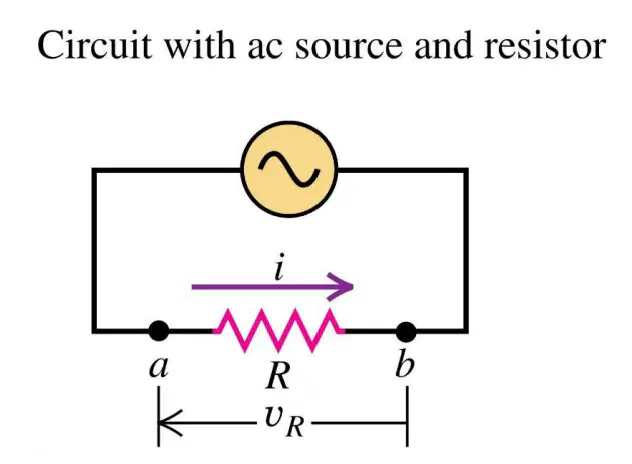
A resistor is connected across an ac source as shown. For this circuit, what is the relationship between the instantaneous current i through the resistor and the instantaneous voltage vab across the resistor?
i is maximum at the same time as vab
i is maximum one-quarter cycle before vab
i is maximum one-quarter cycle after vab
Two of A, B, and C are possible, depending on circumstances.
All three of A, B, and C are possible, depending on circumstances
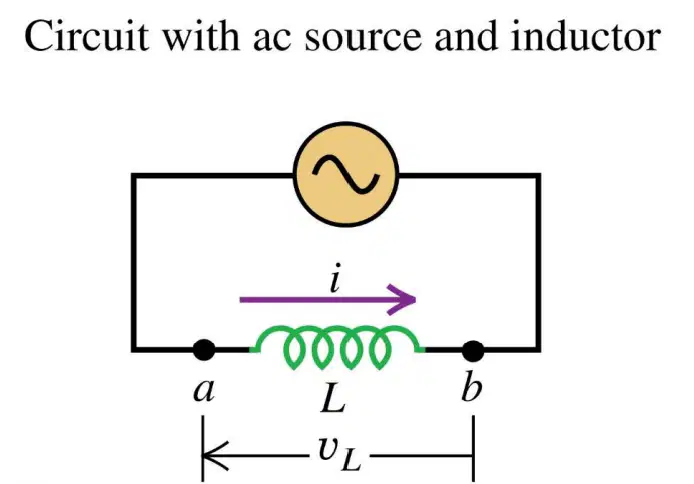
An inductor is connected across an ac source as shown. For this circuit, what is the relationship between the instantaneous current i through the inductor and the instantaneous voltage vab across the inductor?
i is maximum at the same time as vab
i is maximum one-quarter cycle before vab
i is maximum one-quarter cycle after vab
Two of A, B, and C are possible, depending on circumstances.
All three of A, B, and C are possible, depending on circumstances.
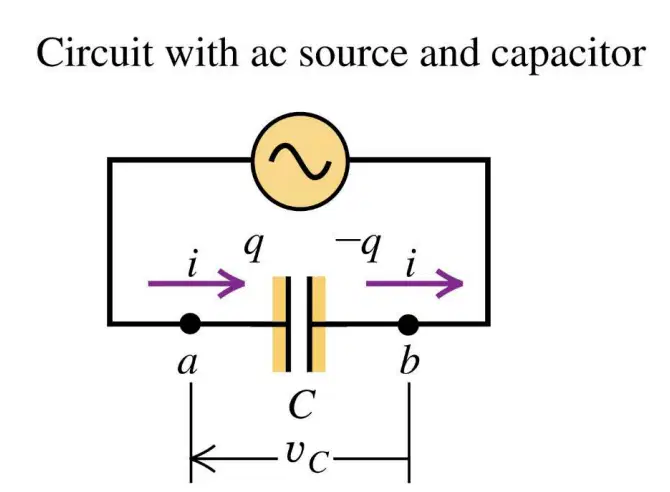
A capacitor is connected across an ac source as shown. For this circuit, what is the relationship between the instantaneous current i through the capacitor and the instantaneous voltage vab across the capacitor?
i is maximum at the same time as vab
i is maximum one-quarter cycle before vab
i is maximum one-quarter cycle after vab
Two of A, B, and C are possible, depending on circumstances
All three of A, B, and C are possible, depending on circumstances
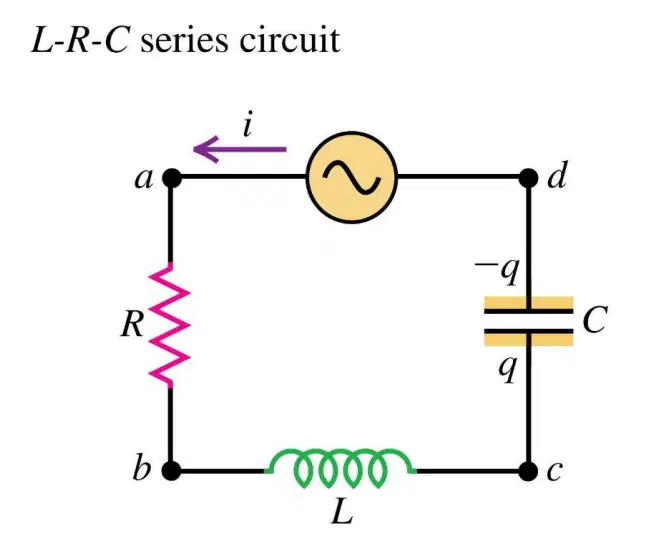
An L-R-C series circuit as shown is operating at its resonant frequency. At this frequency, how are the values of the capacitive reactance XC , the inductive reactance XL , and the resistance R related to each other?
XL = R; XC can have any value
XC = R; XL can have any value
XC = XL ; R can have any value
XC = XL = R
None of the above is correct.
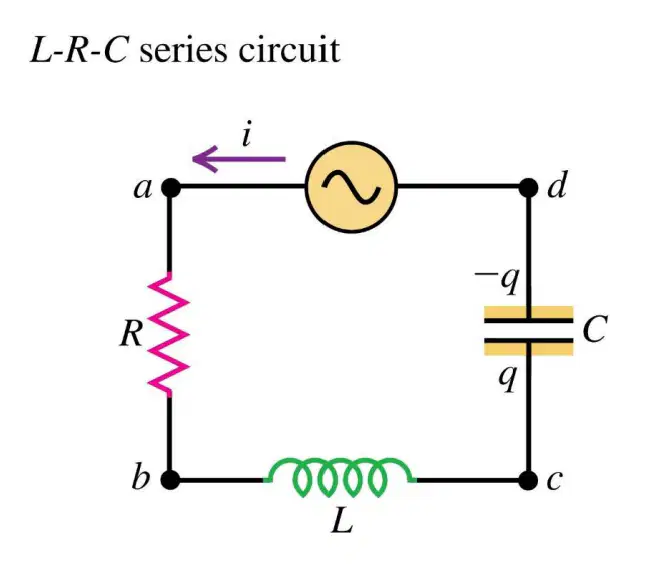
In an L-R-C series circuit as shown, the current has a very small amplitude if the ac source oscillates at a very high frequency. Which circuit element causes this behavior?
the resistor R
the inductor L
the capacitor C
Two of these elements acting together are necessary
Misleading question—the current actually has a very large amplitude if the frequency is very high.
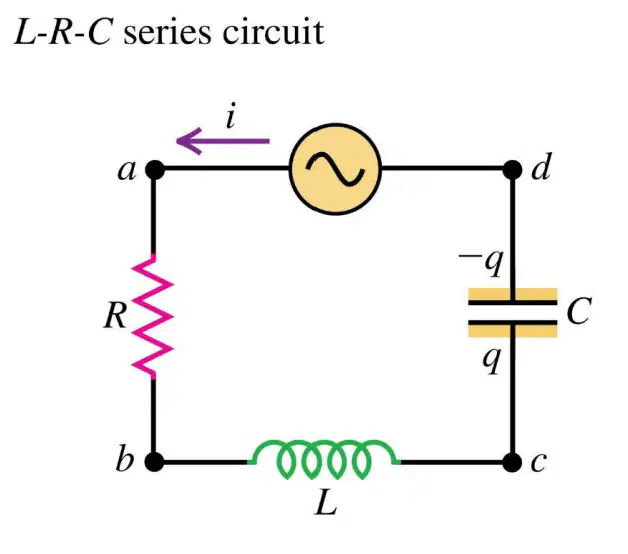
In an L-R-C series circuit as shown, suppose that the angular frequency of the ac source equals the resonance angular frequency. In this case, the circuit impedance
is maximum.
is minimum, but not zero.
is zero
is neither a maximum nor a minimum
could be anything; not enough information is given to decide
In the transformer shown in the drawing, there are more turns in the secondary (N2) than in the primary (N1). In this situation, the voltage amplitude is
greater in the primary than in the secondary.
smaller in the primary than in the secondary
the same in the primary and in the secondary
dependent on the frequency of the ac source
dependent on the precise values of N1 and N2
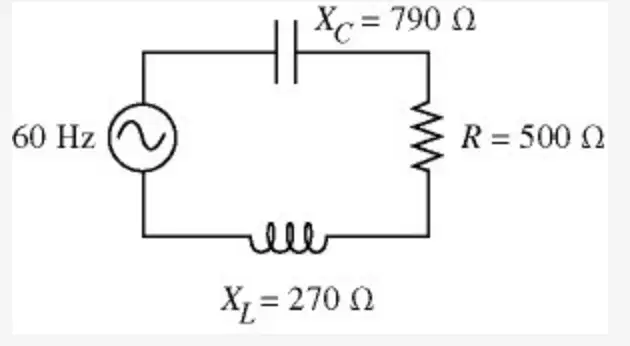
The 60-Hz ac source of the series circuit shown in the figure has a voltage amplitude of 120 V. The capacitive reactance is 790 Ω, the inductive reactance is 270 Ω, and the resistance is 500Ω. What is the inductance of the inductor in the figure below?
720 mH
1440 mH
180 mH
360 mH
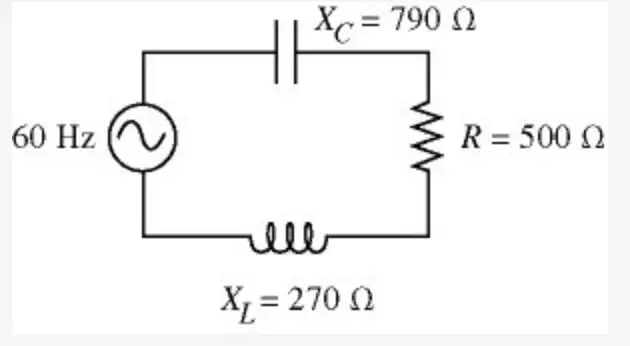
The 60-Hz ac source of the series circuit shown in the figure has a voltage amplitude of 120 V. The capacitive reactance is 790 Ω, the inductive reactance is 270 Ω, and the resistance is 500Ω. What is the impedance of the circuit?
143 ohms
721 ohms
360 ohms
1443 ohms
An ac source of period T and maximum voltage V is connected to a single unknown ideal element that is either a resistor, and inductor, or a capacitor. At time t = 0 the voltage is zero. At time t = T/4 the current in the unknown element is equal to zero, and at time t = T/2 the current is I = -Imax, where Imax is the current amplitude. What is the unknown element?
an inductor or a capacitor
a resistor
an inductor
a capacitor
When an LRC series circuit is at resonance, which one of the following statements about that circuit is accurate? (There may be more than one correct choice.)
Check all that apply.
The impedance has its maximum value.
The reactance due to the inductor and capacitor has its maximum value.
The reactance of the inductor is zero.
The reactance of the capacitor is zero.
The current amplitude is a maximum.
In a series LRC circuit, the frequency at which the circuit is at resonance is f0. If you double the resistance, the inductance, the capacitance, and the voltage amplitude of the ac source, what is the new resonance frequency?
2 f0
f0/4
4 f0
f0/2
f0
The inductor in a radio receiver carries a current of amplitude 200 mA when a voltage of amplitude 2.40 V is across it at a frequency of 1400 kHz. What is the value of the inductance?
1.97 µH
1.36 µH
1.43 µH
9.20 µH
4.42 µH

An ac circuit is shown in the figure. The rms current in the circuit is measured to be 1.8 A. What is the capacitance of the capacitor?
19 μF
21 μF
18 μF
23 μF
24 μF
A series ac circuit consists of an inductor having a reactance of 80 Ω and an inductance of 190 mH, a 40-Ω resistor, a capacitor whose reactance is 100 Ω, and an ac source. The rms current in the circuit is measured to be 2.2 A. What is the rms voltage of the source?
93 V
96 V
98 V
91 V
88 V
A series circuit consists of a 50-Hz ac source, a 50-Ω resistor, a 0.50-H inductor, and a 60-μF capacitor. The rms current in the circuit is measured to be 3.1 A. What is the voltage amplitude of the source?
270 V
220 V
180 V
510 V
160 V
An LRC series circuit consists of an 85.0-Ω resistor, a 14.0-μF capacitor, a 1.50-mH inductor, and a variable frequency ac source of voltage amplitude 13.25 V. At what angular frequency will the inductive reactance be 4.00 times as large as the capacitive reactance?
2.20 × 10⁴ rad/s
1.10 × 10⁴ rad/s
6.90 × 10³ rad/s
3.45 × 10⁴ rad/s
1.38 × 10⁴ rad/s
A 120-V rms voltage at 60.0 Hz is applied across an inductor, a capacitor, and a resistor in series. If the peak current in this circuit is 0.8484 A, what is the impedance of this circuit?
20.4 Ω
100 Ω
120 Ω
200 Ω
141 Ω
The phase angle of an LRC series circuit with an inductive reactance of 200 Ω, a resistor of 200 Ω and a certain capacitor at 1000 Hz is 40.0°. What is the value of the capacitance in this circuit?
1.95 µF
4.95 µF
3.95 µF
5.95 µF
2.95 µF
For an LRC series circuit containing a resistance of 11.0 kΩ a capacitance of 2.0 μF, and an inductance of 24.0 H, what frequency is needed to minimize the impedance?
0.023 kHz
1.7 kHz
10 kHz
0.14 kHz
For an RLC ac circuit, the rms current is 10 A. If the impedance is 12 kΩ when the voltage leads the current by 39°, find the average power of the circuit.
930 kW
93 kW
47 kW
190 kW
A 25.0-mH inductor, a 2.00-μF capacitor, and a certain resistor are connected in series across an ac voltage source at 1000 Hz. If the impedance of this circuit is 200 Ω, what is the resistance of the resistor?
100 Ω
579 Ω
184 Ω
200 Ω
552 Ω
In a vacuum, red light has a wavelength of 700 nm and violet light has a wavelength of 400 nm. This means that in a vacuum, red light
has higher frequency and moves faster than violet light.
has higher frequency and moves slower than violet light
has lower frequency and moves faster than violet light.
has lower frequency and moves slower than violet light
none of the above
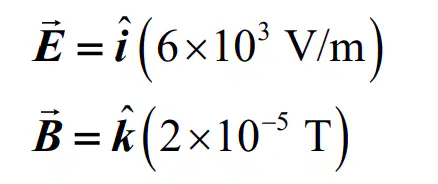
At a certain point in space, the electric and magnetic fields of an electromagnetic wave at a certain instant are given by
This wave is propagating in the
positive x-direction
negative x-direction
positive y-direction
negative y-direction
none of the above
A sinusoidal electromagnetic wave in a vacuum is propagating in the positive z-direction. At a certain point in the wave at a certain instant in time, the electric field points in the negative x-direction. At the same point and at the same instant, the magnetic field points in the
positive y-direction.
negative y-direction.
positive z-direction.
negative z-direction
none of the above
In a sinusoidal electromagnetic wave in a vacuum, the electric field has only an x-component. This component is given by Ex = Emax cos (ky + ωt ) This wave propagates in the
positive z-direction
negative z-direction.
positive y-direction
negative y-direction
none of the above
In a sinusoidal electromagnetic wave in a vacuum, the electric field has only an x-component. This component is given by Ex = Emax cos (ky + ωt ) The magnetic field of this wave
has only an x-component
has only a y-component
has only a z-component.
not enough information given to decide
In a sinusoidal electromagnetic wave in a vacuum, the magnetic energy density
is the same at all points in the wave
is maximum where the electric field has its greatest value.
is maximum where the electric field is zero.
none of the above
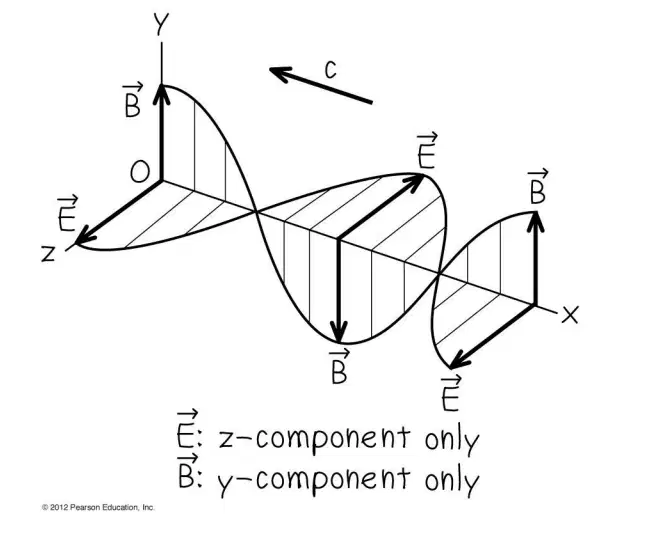
The drawing shows a sinusoidal electromagnetic wave in a vacuum at one instant of time at points between x = 0 and x = λ . At this instant, at which values of x does the instantaneous Poynting vector have its maximum magnitude?
x = 0 and x = λ only
x = λ /4 and x = 3 λ /4 only
x = λ /2 only
x = 0, x = λ /2, and x = λ
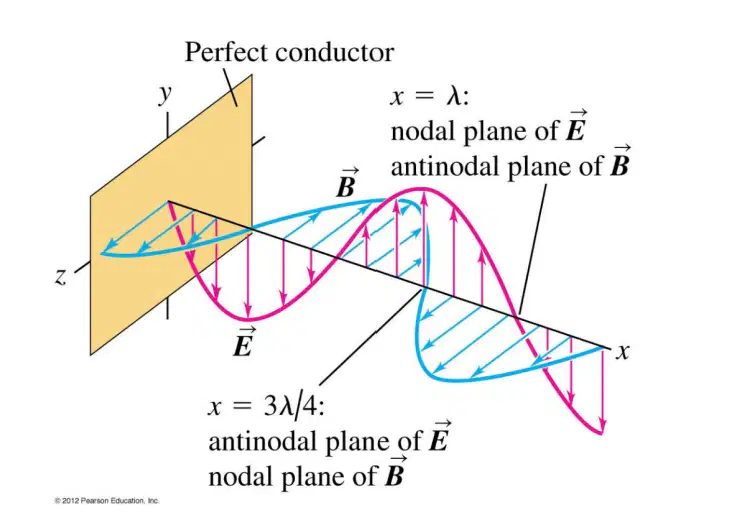
The drawing shows a sinusoidal electromagnetic standing wave. The average Poynting vector in this wave
points along the x-axis
points along the y-axis
points along the z-axis
is zero.
none of the above
Which one of the following lists is a correct representation of electromagnetic waves from longer wavelength to shorter wavelength?
radio waves, infrared, microwaves, UV, visible, X-rays, gamma rays
radio waves, UV, X-rays, microwaves, infrared, visible, gamma rays
radio waves, microwaves, visible, X-rays, infrared, UV, gamma rays
radio waves, microwaves, infrared, visible, UV, X-rays, gamma rays
radio waves, infrared, X-rays, microwaves, UV, visible, gamma rays
In an electromagnetic wave, the electric and magnetic fields are oriented such that they are:
parallel to one another and perpendicular to the direction of wave propagation
parallel to one another and parallel to the direction of wave propagation.
perpendicular to one another and perpendicular to the direction of wave propagation.
perpendicular to one another and parallel to the direction of wave propagation
If the magnetic field of an electromagnetic wave is in the +x-direction and the electric field of the wave is in the +y-direction, the wave is traveling in the:
xy-plane
+z-direction
-z-direction.
-x-direction
-y-direction
An electromagnetic wave is propagating towards the west. At a certain moment the direction of the magnetic field vector associated with this wave points vertically up. The direction of the electric field vector of this wave is:
horizontal and pointing south.
vertical and pointing down.
horizontal and pointing north.
vertical and pointing up.
horizontal and pointing east.
Given that the wavelengths of visible light range from 400 nm to 700 nm, what is the highest frequency of visible light? (c = 3.0 x 10⁸ m/s)
3.1 × 10⁸ Hz
7.5 × 10¹⁴ Hz
2.3 × 10²⁰ Hz
4.3 × 10¹⁴ Hz
5.0 × 10⁸ Hz
The magnitude of the electric field at a point P for a certain electromagnetic wave is 570 N/C. What is the magnitude of the magnetic field for that wave at P? (c = 3.0 x 10⁸ m/s)
2.91 µT
1.90 µT
1.10 µT
1.41 µT
2.41 µT
The magnitude of the magnetic field at point P for a certain electromagnetic wave is 2.12 μT. What is the magnitude of the electric field for that wave at P? (c = 3.0 x 10⁸ m/s)
636 N/C
745 N/C
5.23 µN/C
6.36 µN/C
7.45 µN/C
A planar electromagnetic wave is propagating in the +x direction. At a certain point P and at a given instant, the electric field of the wave is given by E= (0.082 V/m) ĵ. What is the magnetic vector of the wave at the point P at that instant? (c = 3.0 x 10⁸ m/s)
0.27 nT k
-0.27 nT k
0.27 nT ĵ
6.8 nT k
-6.8 nT ĵ
If the magnetic field of an electromagnetic wave is in the +y-direction and the electric field of the wave is in the +z-direction, the wave is traveling in the
-y-direction.
+x-direction.
+xy-direction.
-x-direction.
+z-direction.
A circular loop of wire lies in the plane of the paper. A decreasing magnetic field points out of the paper. What is the direction of the induced current in the loop?
counter-clockwise then clockwise
clockwise then counter-clockwise
There is no current induced in the loop
clockwise
counter-clockwise
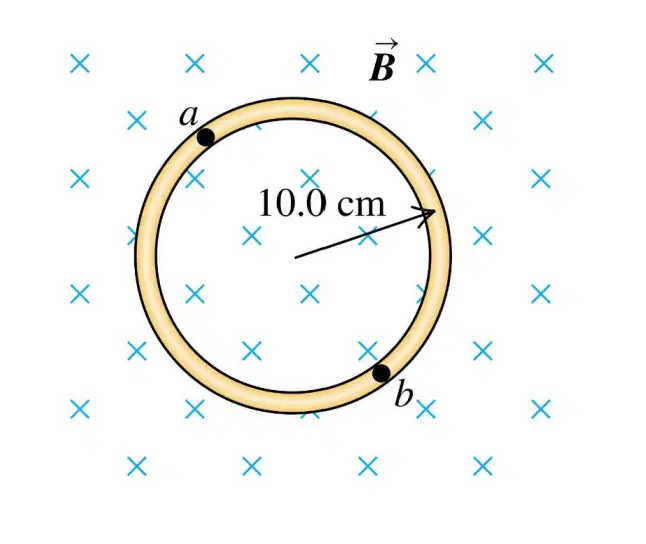
A circular loop of wire is in a region of spatially uniform magnetic field. The magnetic field is directed into the plane of the figure. If the magnetic field magnitude is constant,
the induced emf is clockwise.
the induced emf is counterclockwise.
the induced emf is zero.
The answer depends on the strength of the field.
A circular loop of wire is in a region of spatially uniform magnetic field. The magnetic field is directed into the plane of the figure. If the magnetic field magnitude is increasing
the induced emf is clockwise.
the induced emf is counterclockwise.
the induced emf is zero.
The answer depends on the strength of the field.
A circular loop of wire is in a region of spatially uniform magnetic field. The magnetic field is directed out of the plane of the figure. If the magnetic field magnitude is constant,
the induced emf is clockwise.
the induced emf is counterclockwise.
the induced emf is zero.
The answer depends on the strength of the field.
A circular loop of wire is in a region of spatially uniform magnetic field. The magnetic field is directed out of the plane of the figure. If the magnetic field magnitude is increasing,
the induced emf is clockwise.
the induced emf is counterclockwise.
the induced emf is zero.
The answer depends on the strength of the field.
A circular loop of wire is in a region of spatially uniform magnetic field. The magnetic field is directed out of the plane of the figure. If the magnetic field magnitude is decreasing,
the induced emf is clockwise.
the induced emf is counterclockwise.
the induced emf is zero.
The answer depends on the strength of the field.
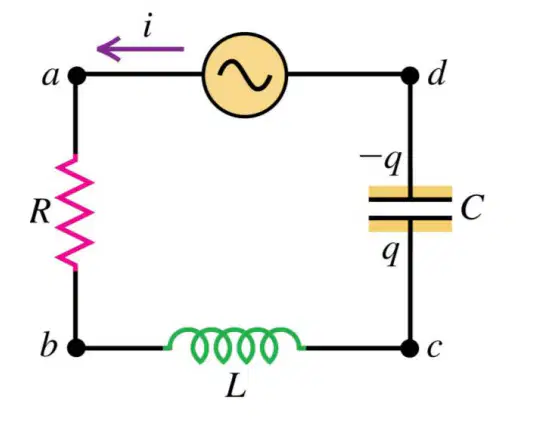
In the series circuit shown, suppose R=300 Ω, L=60 mH, C=0.50 µF, V=50 V, and ω=10,000 rad/s. Find the reactance XL
(a)
In the series circuit shown, suppose R=300 Ω, L=60 mH, C=0.50 µF, V=50 V, and ω=10,000 rad/s. Find the reactance XC
(a)
In the series circuit shown, suppose R=300 Ω, L=60 mH, C=0.50 µF, V=50 V, and ω=10,000 rad/s. Find the impedance Z?
(a)
In the series circuit shown, suppose R=300 Ω, L=60 mH, C=0.50 µF, V=50 V, and ω=10,000 rad/s. Find the current amplitude I?
(a)
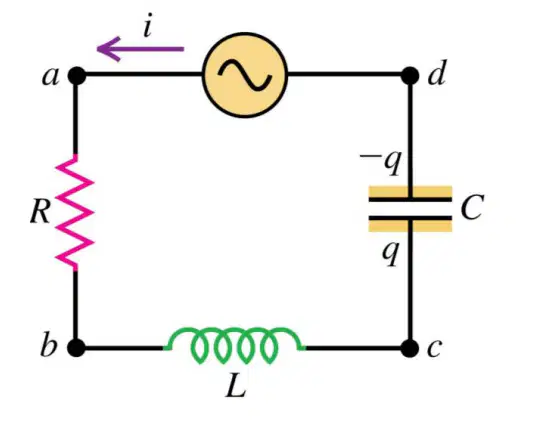
In the series circuit shown, suppose R=300 Ω, L=60 mH, C=0.50 µF, V=50 V, and ω=10,000 rad/s. Find the phase angle (phi) in degrees?
(a)
In the series circuit shown, suppose R=300 Ω, L=60 mH, C=0.50 µF, V=50 V, and ω=10,000 rad/s. Find the voltage amplitude across each circuit element (in order of VR, VL, VC)
(a)

