
 Worksheets
Anatomy Quiz
Total questions: 124
Worksheet time: 2hrs 29mins
Which type of glial cell is primarily responsible for forming the myelin sheath in the Central Nervous System (CNS)
Schwann Cell
Astrocyte
Ependymal Cell
Oligodendrocyte
The area of the brain responsible for understanding spoken and written language (speech comprehension) is primarily
The main visceral control center of the body, regulating temperature, hunger, and thirst, is the
During the depolarization phase of an action potential, the membrane potential rapidly rises due to the influx of which ion?
What is the primary neurotransmitter released by the postganglionic neuron in the parasympathetic division of the ANS?
Which glial cell acts as the primary immune defense of the CNS, monitoring neuron health and phagocytizing foreign material and dead cells?
The descending tracts of the spinal cord are responsible for transmitting what type of information?
Sensory input from the body to the brain
Motor commands from the brain to the effectors
Reflex arc integration
Cerebrospinal fluid circulation
Muscarinic receptors are a type of cholinergic receptor found primarily on the effectors (smooth muscle, glands, etc.) of which division of the nervous system
Damage to the Cerebellum is most likely to result in deficits related to:
Generating language (speech production
Interpreting visual information
Coordinated movement and balance
Regulating thirst and body temperature
In the context of the nervous system, what is the term for a collection of neuron cell bodies found within the Central Nervous System (CNS)
Ganglion
Nerve
tract
Nucleus
The cluster of neuron cell bodies located in the Peripheral Nervous System (PNS) is called
(a)
Multiple Sclerosis (MS) is characterized by the autoimmune destruction of the (a) substance surrounding axons.
The major white matter tract that physically connects the two cerebral hemispheres is the (a) .
A stroke caused by a blockage, such as a blood clot, in a cerebral artery is classified as a(n) (a) stroke.
The neurodegenerative disease characterized by a deficiency of the neurotransmitter dopamine is (a) .
The resting membrane potential of a neuron is typically around +30 mV. (T/F)
True
False
The cerebellum is the brain region primarily responsible for initiating voluntary movement. (T/F)
The Autonomic Nervous System (ANS) controls voluntary effectors like skeletal muscles. (T/F)
A reflex arc is composed of five essential components, starting with the receptor and ending with the effector. (T/F)
true
false
Alzheimer's Disease is associated with abnormal protein deposits known as amyloid plaques and neurofibrillary tangles. (T/F)
False
True
List the five essential components of a reflex arc in the correct physiological order.
What is the fundamental principle that governs how a neuron fires an action potential once the threshold voltage is reached?
Name two clinical signs or symptoms a patient with Parkinson's Disease might exhibit.
Describe the primary function of the blood-brain barrier.
Briefly explain the mechanism by which the GABA neurotransmitter typically inhibits a postsynaptic neuron.
Which structure in the inner ear contains the hair cells (receptors) for hearing?
Organ of Corti
The condition Myopia (nearsightedness) is typically corrected using which type of lens?
Concave
Convex
Prismatic
Cylindrical
The otoliths (ear stones) are calcium carbonate crystals associated with the sense of:
Dynamic equilibrium
Hearing frequency
Static equilibrum
Sound amplitude
Which structure of the eye is often described as the "blind spot" because it lacks photoreceptors?
Which one of the following papillae types on the tongue does not contain taste buds?
The three ossicles of the middle ear, in order from the tympanic membrane inward, are the Malleus, (a) , and Stapes.
(a) is the leading cause of irreversible blindness due to the buildup of pressure that damages the optic nerve.
The specialized receptors responsible for the sense of smell (olfaction) are classified as (a) .
The process by which the lens of the eye changes shape to focus light on the retina is called (a) .
The fluid that fills the bony labyrinth of the inner ear, surrounding the membranous labyrinth, is called (a) .
Rods are the photoreceptor cells responsible for detecting color and providing high-acuity vision. (T/F)
True
The Eustachian (pharyngotympanic) tube connects the inner ear to the nasopharynx to help drain fluid. (T/F)
Tinnitus is the term used for ringing or buzzing in the ears. (T/F)
The sense of smell is closely linked to the limbic system, explaining its strong connection to memory and emotion. (T/F)
True
False
Cataracts are caused by the lens of the eye becoming transparent and clear. (T/F)
Trace the path of sound vibrations from the tympanic membrane to the Organ of Corti, naming the three ossicles in order.
Differentiate between the cause of Conductive Hearing Loss and the cause of Sensorineural Hearing Loss.
List the three major anatomical structures associated with the vestibular system that detect dynamic equilibrium.
Briefly explain the relationship between the cornea and the lens in focusing light onto the retina.
List the five basic taste sensations recognized by gustatory receptors.
Which class of hormones includes cortisol and testosterone and is derived from cholesterol?
Receptors for water-soluble hormones (like insulin) are typically located where on the target cell?
Cytoplasm
Plasma Membrane
Mitochondria
Nucleus
The primary target organ for the hormone glucagon is the
Diabetes Insipidus is an endocrine disorder caused by a deficiency of which hormone?
A patient exhibiting symptoms like weight loss, a rapid heartbeat, and exophthalmos (bulging eyes) likely has:
Graves' disease (hyperthyroidism)
The hormone released by the parathyroid glands that increases blood Ca2+ levels is (a) .
The primary hormone released by the pineal gland that regulates circadian rhythm is (a) .
Type 1 Diabetes Mellitus is an autoimmune disorder that destroys the (a) cells in the pancreas.
(a) is the condition caused by the hypersecretion of cortisol, leading to symptoms like a "moon face" and "buffalo hump."
The adrenal cortex hormone that regulates Na+ and K+ balance in the body is (a) .
The release of most hormones from the anterior pituitary is controlled by releasing or inhibiting hormones secreted by the thalamus. (T/F)
The primary stimulus for the secretion of insulin is a low concentration of glucose in the blood. (T/F)
Gigantism results from the hypersecretion of Growth Hormone (GH) after the growth plates have closed. (T/F)
A tropic hormone is one whose primary function is to target and regulate the secretory action of another endocrine gland. (T/F)
Hypothyroidism can lead to an enlarged thyroid gland known as a goiter. (T/F)
False
True
Describe the main difference between how a steroid hormone and a peptide hormone activate a target cell, including the location of their respective receptors.
A patient presents with extreme fatigue, unintended weight gain, and cold intolerance. What is the most likely endocrine disorder, and what is its basic pathology?
What is a second messenger system, and why is it necessary for the action of most amino-acid-based hormones?
Name two specific steroid hormones that are hypo secreted in a patient with Addison's Disease.
Briefly explain the difference in age of onset between Gigantism and Acromegaly.
The outermost, tough, fibrous membrane layer protecting the brain is the (a) .
A stroke resulting from the rupture of a blood vessel in the brain, leading to bleeding into the tissue, is classified as a(n) (a) stroke.
The diencephalon, which connects the cerebral hemispheres to the brainstem, is primarily composed of the thalamus and the (a) .
In a somatic reflex arc, the (a) is always the effector organ that generates the response.
During the repolarization phase of an action potential, the rapid efflux of (a) ions drives the membrane potential back toward its resting negative value.
The Sympathetic division of the ANS is characterized by short preganglionic fibers and long postganglionic fibers. (T/F)
The Occipital Lobe of the cerebrum contains the primary auditory (hearing) cortex. (T/F)
The amplitude (size) of an action potential varies depending on the strength of the stimulus that triggered it. (T/F)
Cerebrospinal Fluid (CSF) is primarily produced by specialized capillary structures called choroid plexuses within the ventricles of the brain. (T/F)
The Na+/ K+ pump requires ATP to function, actively moving 3 Na+ ions out of the cell for every 2 K+ ions moved into the cell, which helps maintain the resting potential. (T/F)
List the three meningeal layers in order from the outside of the skull/vertebrae inward to the brain/spinal cord.
Describe two major effects the Sympathetic division of the Autonomic Nervous System has on the body during a "fight-or-flight" response. (Focus on effects on the heart and digestion).
Explain the physiological basis of trigeminal neuralgia.
Differentiate between the terms Nerves and Tracts based on their anatomical location.
What are two functions of the Cerebrospinal Fluid (CSF)?
Which component is part of the neural layer of the retina?
Choroid
Ciliary body
Bipolar cells
Sclera
The primary function of the round window in the inner ear is to:
Act as a pressure release valve for fluid in the cochlea.
Support balance by detecting linear motion.
Regulate blood flow in the inner ear.
Facilitate sound transmission to the inner ear.
The sense of Umami is typically triggered by which type of chemical substance?
Acids
Sodium Chloride
Glutamate
Simple sugars
The receptors for rotational (angular) acceleration are located within which structures of the inner ear?
Cochlea
Maculae of the utricle
Organ of Corti
Semicircular Canals
Astigmatism is a visual disorder caused by:
Unequal curvatures of the cornea or lens.
Opacity of the lens.
The photoreceptor responsible for vision in dim light and peripheral vision is the (a) .
The thick, potassium-rich fluid that fills the scala media (cochlear duct) and bathes the hair cells is called (a) .
The transparent outer layer of the eye that performs the majority of light refraction is the (a) .
Presbyopia is a type of farsightedness that typically occurs with age as the (a) stiffens and loses its elasticity.
The receptors located in the maculae of the saccule and utricle that detect the position of the head relative to gravity are known as (a) .
Cones are significantly more numerous than rods in the human retina. (T/F)
The Eustachian (pharyngotympanic) tube connects the middle ear cavity to the nasopharynx. (T/F)
False
Olfactory receptor cells are unique among neurons because they are one of the few types that can undergo replacement (regeneration) throughout adult life. (T/F)
Otitis media is a common infection of the inner ear structures, such as the cochlea and semicircular canals. (T/F)
The fovea centrali provides the sharpest, highest acuity vision because it is densely packed with cones and has minimal scattering of light. (T/F)
Describe the physiological basis of color blindness.
Explain the primary role of the ciliary muscle in the process of visual focusing, specifically when switching from viewing a distant object to a near object.

Scenario: A patient cannot move the muscles on the right side of their face but can still frown and pucker their lips when asked. Where is the most likely location of the nerve damage (e.g., which cranial nerve, and which part of the face)?
Compare and contrast the signal transduction mechanism of GABA (an inhibitory neurotransmitter) and Glutamate (an excitatory neurotransmitter) at the postsynaptic membrane.
Explain the primary difference between Conduction Deafness and Sensorineural Deafness and give a clinical example of each.
Trace the path of light from the environment to the retina, naming three structures it passes through in order.
Describe the mechanism by which the lens of the eye changes shape to focus on near objects. What is this process called?

Feature 1 in this diagram represents the neurotransmitters. Which of the molecules below is NOT a neurotransmitter?
serotonin
acetylcholine
glutamate
cafein
noradrenaline
Match the neurotransmitter with its function: Dopamine
Muscle contraction and movement
Reward-motivated behavior and pleasure
Memory and learning
Regulation of sleep and wakefulness
Match the neurotransmitter with its function: Acetylcholine
Digestion, heart rate, and blood pressure
Muscle movement, memory, and learning
Vision and light sensitivity
Emotions and mood
Match the neurotransmitter with its function: Norepinephrine
Regulates stress response
Enhances memory
Promotes sleep
Regulates heart rate
Which neurotransmitter is primarily involved in the regulation of mood and emotion?
Dopamine
Serotonin
Acetylcholine
GABA
Match the neurotransmitter with its function: Serotonin
Regulating muscle movement
Regulating mood, sleep, appetite, and other functions
Regulating heart rate
Regulating body temperature
Match the neurotransmitter with its function: Glutamate
Excitatory neurotransmitter
Sensory neurotransmitter
Motor neurotransmitter
Inhibitory neurotransmitter
What is the chemical released in the brain causing pleasure and repeated behaviors?
dopamine
GABA
serotonin
adrenaline
Match the neurotransmitter with its function: Gaba
Excitatory neurotransmitter
Motor neurotransmitter
Sensory neurotransmitter
Inhibitory neurotransmitter
Neurotransmitter that provides pain relief?
GABA
Endorphins
Glutamate
Dopamine
Match the neurotransmitter with its function: Oxytocin
Social bonding, trust, and love
Memory and learning
Fight or flight response
Muscle contraction and movement
Match the neurotransmitter with its function: Adrenaline
Vitamin
Antibody
Hormone
Enzyme
Neurotransmitter associated with Alzheimer's Disease?
Dopamine
Acetylcholine
GABA
Glutamate
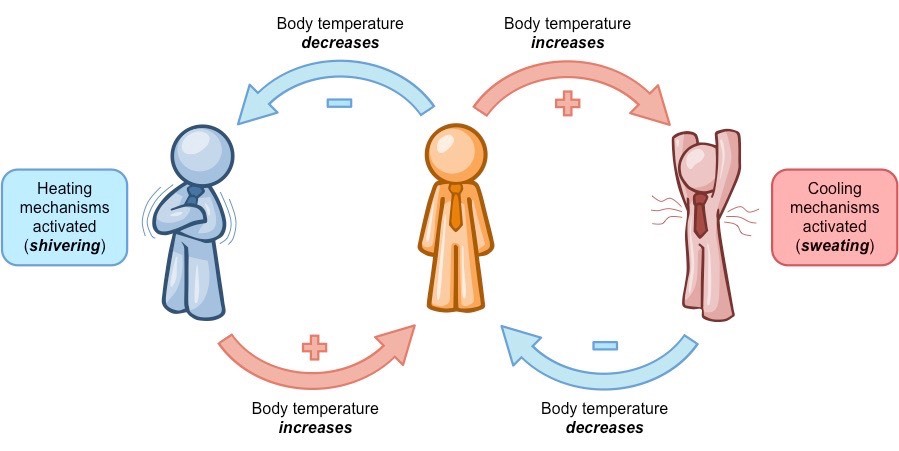
In this body temperature feedback loop, predict what would happen if cooling mechanisms were NOT activated?
The body would not warm up.
The body would not cool down.
Your body would get colder and colder.
Your body would release lots of heat.

The nerves in your fingertips are part of the ___ nervous system
central
peripheral

Nerves are made up of nerve cells called
cardiac cell
neurons

