wayground logo

Free Printable Worksheets

Font size

S
M
L
XL
Worksheets

Bio Midterm

Total questions: 101

Worksheet time: 37hrs 15mins

Name
Class
Date
1.
1. When leaving a movie theater, a person notices that the sidewalk is now wet. If the person assumes it rained during the movie, the person is making
a)
a hypothesis
b)
an inference
c)
an observation
d)
a prediction
2.
2. When designing an experiment, scientists will test a relationship between a “cause” and an “effect.” The “effect,” also represented by what the scientist measures and records, is known as the
a)
dependent variable
b)
constant
c)
independent variable
d)
control group
3.
4. Which is incorrect about hypotheses?
a)
it is a random guess about what will happen
b)
it is a testable prediction
c)
it can be supported
d)
if incorrect, it still has value
4.
5. What part of an experiment serves as a standard for comparison?
a)
Control Group
b)
Hypothesis
c)
Constant
d)
Variables
5.
6. Where does the dependent variable belong on a graph?
a)
X-axis
b)
Y-axis
c)
In the title
d)
In the key
6.
7. All of the following are steps in the scientific method EXCEPT...
a)
observing and recording data
b)
forming a hypothesis
c)
analyzing data
d)
discarding data that doesn't match the hypothesis
7.

12. What is the independent variable in this experiment?

An experiment was designed to investigate the effect of caffeine on the heartbeat of puppies.  Two litters of black Labrador puppies were used.  These puppies were the same age, gender, and size.  Litter A was given caffeine and Litter B was not.  The heartbeat of the puppies was measured every hour for five hours.

a)
puppies with no caffeine
b)
puppies with caffeine
c)
amount of caffeine
d)
heart rate
8.

13. What is the dependent variable in this experiment?

An experiment was designed to investigate the effect of caffeine on the heartbeat of puppies.  Two litters of black Labrador puppies were used.  These puppies were the same age, gender, and size.  Litter A was given caffeine and Litter B was not.  The heartbeat of the puppies was measured every hour for five hours.

a)
puppies with no caffeine
b)
puppies with caffeine
c)
amount of caffeine
d)
heart rate
9.

14. What is the control group in this experiment?

An experiment was designed to investigate the effect of caffeine on the heartbeat of puppies.  Two litters of black Labrador puppies were used.  These puppies were the same age, gender, and size.  Litter A was given caffeine and Litter B was not.  The heartbeat of the puppies was measured every hour for five hours.
a)
puppies with no caffeine
b)
puppies with caffeine
c)
amount of caffeine
d)
heart rate
10.

15. What is the experimental group in this experiment?

An experiment was designed to investigate the effect of caffeine on the heartbeat of puppies.  Two litters of black Labrador puppies were used.  These puppies were the same age, gender, and size.  Litter A was given caffeine and Litter B was not.  The heartbeat of the puppies was measured every hour for five hours.
a)
puppies with no caffeine
b)
puppies with caffeine
c)
amount of caffeine
d)
heart rate
11.

16. Write a hypothesis, in the correct format, for this experiment.

An experiment was designed to investigate the effect of caffeine on the heartbeat of puppies.  Two litters of black Labrador puppies were used.  These puppies were the same age, gender, and size.  Litter A was given caffeine and Litter B was not.  The heartbeat of the puppies was measured every hour for five hours.

4 lines
12.

17. List 2 constants in this experiment.

An experiment was designed to investigate the effect of caffeine on the heartbeat of puppies.  Two litters of black Labrador puppies were used.  These puppies were the same age, gender, and size.  Litter A was given caffeine and Litter B was not.  The heartbeat of the puppies was measured every hour for five hours.
4 lines
13.
9. Make one qualitative observation about the image above.
4 lines
14.
10. Make one quantitative observation about the image above.
4 lines
15.
The macromolecules that make up the majority of the cell membrane’s structure are .
a)
lipids
b)
proteins
c)
enzymes
d)
carbohydrates
16.
Which category of carbon-based molecules includes sugars and starches?
a)
unsaturated fatty acids
b)
phospholipids
c)
proteins
d)
carbohydrates
17.
If available, the body will always digest which macromolecule for energy first?
a)
lipids
b)
proteins
c)
enzymes
d)
carbohydrates
18.
DNA and RNA are categorized as
a)
nucleic acids
b)
lipids
c)
proteins
d)
carbohydrates
19.
2. The naming system created by Linnaeus was known as…
a)
Binomial Nomenclature
b)
Trait Nomenclature
c)
Physical Characteristic Identification
d)
Sight Line Mechanics
20.
3. An organism’s scientific name is made up of its (select 2)…
a)
Phylum
b)
Genus
c)
Order
d)
Species
e)
Class
21.
4. What is the best way to tell if two organisms are of the same species?
a)
Looking at their coloration
b)
Determining if they can reproduce fertile offspring
c)
The sounds they make
d)
Determining where the live
22.
5. Which grouping includes the MOST organisms?
a)
Class
b)
Order
c)
Family
d)
Phylum
23.
7. What is a characteristic of the cells of organisms of the kingdom Animalia?
a)
They have cellulose.
b)
They are unicellular.
c)
They lack cell walls.
d)
They lack organelles.
24.
8. Which organisms can make their own food?
a)
heterotrophs
b)
autotrophs
c)
decomposers
d)
detritovores
25.
9. Which type of cell is simple and lacks a nucleus?
a)
Eukaryotic
b)
Prokaryotic
c)
both are simple and lack nuclei
d)
neither is simple and lack a nucleus
26.
11. The more differences there are between the DNA of two organism’s _________.
a)
the more recent their common ancestor
b)
the farther apart they now live
c)
the more distant their common ancestor
d)
the closer their homologous structures
27.
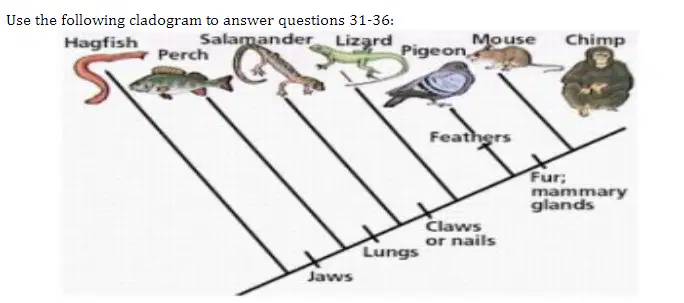
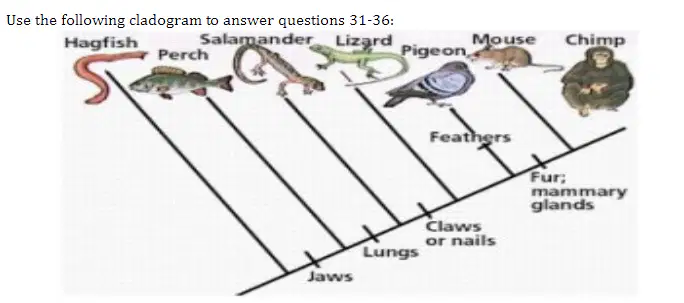
15. Which of the organism(s) on the cladogram do NOT/does NOT have jaws?
a)
Hagfish
b)
Salamanders and Lizards
c)
Pigeon
d)
Salamanders, Lizards, Pigeons, Mice and Chimps
e)
All of them
28.
16. Which two organisms are more distantly related?
a)
the pigeon and the mouse
b)
the mouse and the chimp
c)
the hagfish and pigeon
d)
the salamander and mouse
29.
17. Which of the following are characteristics of life? (Select 4)
a)
Composed of one or more cells
b)
Contain genetic material
c)
Have a metabolism
d)
Ability to respond to stimuli
e)
Can exist without energy
30.
18. Which kingdom is made up of eukaryotic and mobile organisms that must eat other organisms to survive?
a)
Animals
b)
Plants
c)
Fungi
d)
Eubacteria
e)
Archaebacteria
31.
19. Which kingdom is made up of eukaryotic organisms that are all photosynthetic and have cell walls?
a)
Animals
b)
Plants
c)
Fungi
d)
Eubacteria
e)
Archaebacteria
32.
22. Which number represents a common ancestor for A, B, C, D, and E?
a)
1
b)
2
c)
3
d)
4
e)
5
33.
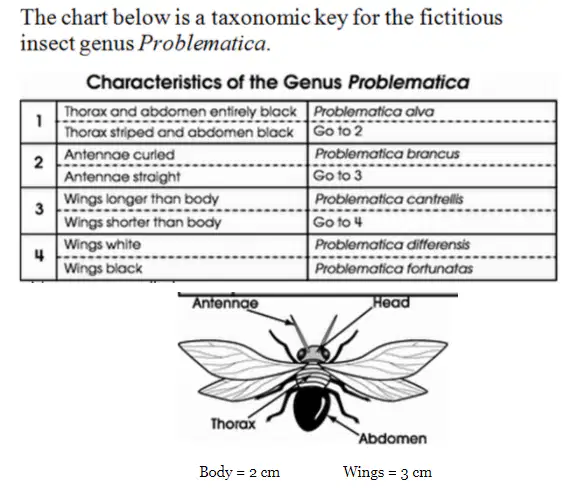
23. Using the dichotomous key below, determine which species of does the insect belong? Note: I cannot underline or italicize scientific names when using Google forms.
a)
Problematica cantrellis
b)
Problematica alva
c)
Problematica brancus
d)
Problematica fortunatas
e)
Problematica differensis
34.
24. Which of the following lists the seven levels of taxonomy in order from LARGEST to smallest?
a)
Kingdom, Phylum, Class, Family, Order, Genus, species
b)
species, Genus, Class, Order, Family, Phylum, Kingdom
c)
species, Genus, Family, Order, Class, Phylum, Kingdom
d)
Kingdom, Phylum, Class, Order, Family, Genus, species
35.
25. Which of the following domain(s) exist? (select all that apply)
a)
Eukarya
b)
Bacteria
c)
Archaea
d)
NONE of these
36.
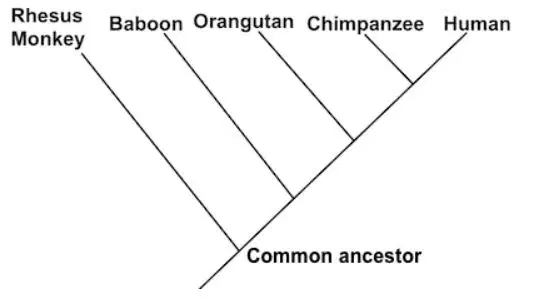
28. Based on the phylogenetic tree above, which statement best describes a relationship between the common ancestor and the other organisms?
a)
Rhesus monkeys have the exact same DNA as the common ancestor.
b)
The common ancestor is more closely related to humans than baboons.
c)
The common ancestor shares DNA with each of the other organisms.
d)
Chimpanzees were the first organisms to evolve from the common ancestor.
37.
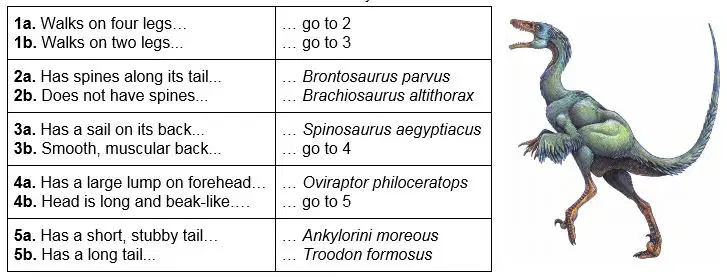
29. Use the dichotomous key to identify each dinosaur.
a)
Spinosaurus aegyptiacus
b)
Oviraptor philoceratops
c)
Ankylorini moreorus
d)
Troodon formosus
38.
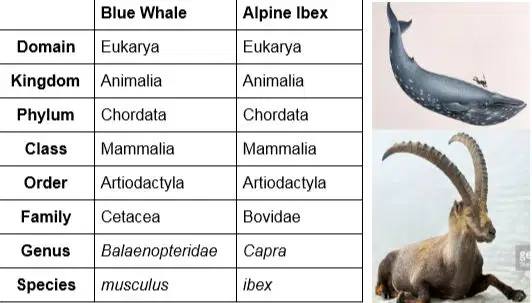
33. Use the table below to answer the questions. Humans are in the order Primates. Who is more related to the alpine ibex - us or the blue whale?
a)
The ibex is more closely related to humans
b)
The ibex is more closely related to the blue whale
c)
Given only this information it cannot be determined.
d)
Given only this information, the ibex is equally related to us and the blue whale.
39.
Which of the following would you NOT find in an animal cell?
a)
chloroplast
b)
centrioles
c)
cell membrane
d)
lysosomes
40.
What type of cellular transport requires a cell to use energy?
a)
facilitated diffusion
b)
osmosis
c)
active transport
d)
diffusion
41.
Which of the following best describes an isotonic solution?
a)
There is more solute outside the cell that inside the cell.
b)
There is less solute outside the cell than inside the cell.
c)
The concentration is equal on both sides of the membrane.
d)
None of the above.
42.
Which process occurs when the cell uses energy to bring something in from outside the cell?
a)
Endocytosis
b)
Exocytosis
c)
Osmosis
d)
Diffusion
43.
The image below shows a white blood cell engulfing a bacterium in order to destroy it. What type of cell transport does this represent?
a)
endocytosis
b)
diffusion
c)
facilitated diffusion
d)
osmosis
e)
molecular pump
44.
The image below shows carbon dioxide (a small, nonpolar molecule) passing through a membrane. What type of cell transport does this represent?
a)
diffusion
b)
facilitated diffusion
c)
osmosis
d)
molecular pump
e)
exocytosis
45.
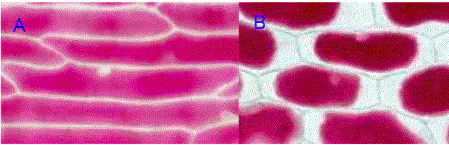
We began with the red onion cells in slide A. After adding salt water, the red onion cells looked like the cell in slide B. What type of cell transport caused this?
a)
osmosis
b)
diffusion
c)
facilitated diffusion
d)
molecular pump
e)
endocytosis
46.
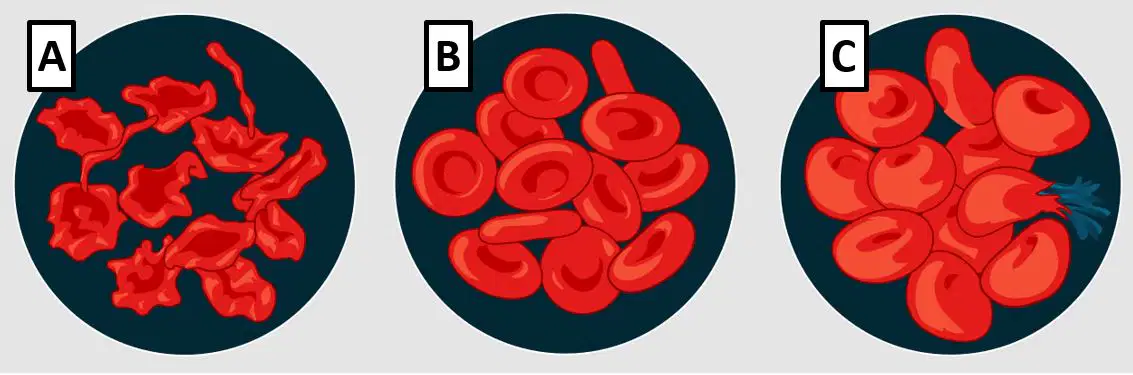
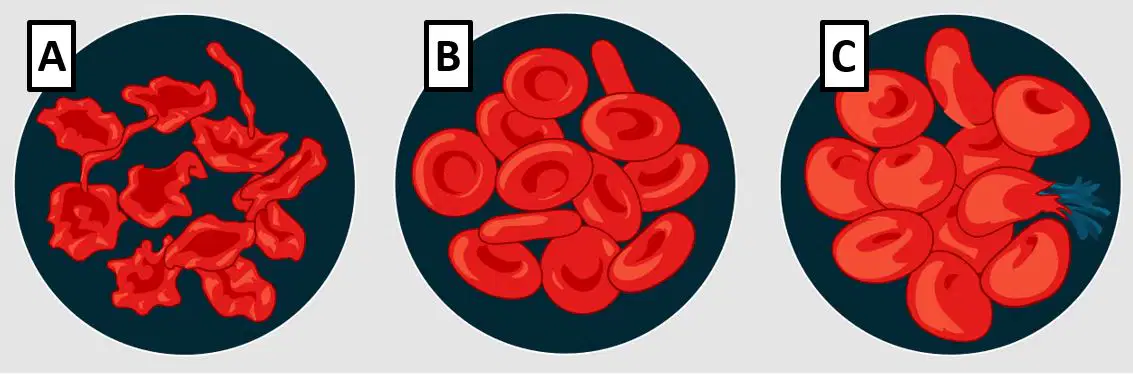
Which image represents cells in a hypotonic solution?
a)
A
b)
B
c)
C
47.
Which image represents cells in an isotonic solution ?
a)
A
b)
B
c)
C
48.
Organize the parts of this body system from most basic to most complex according to levels of organization in a multi-cellular organism.
a)
human being -> central nervous system -> brain -> nerve tissue -> neurons (nerve cell)
b)
neurons (brain cells) -> brain -> nerve tissue -> central nervous system -> human being
c)
neurons (brain cells) -> nerve tissue -> brain -> central nervous system -> human being
d)
nerve tissue -> brain -> neurons (brain cells) -> central nervous system -> human being
49.
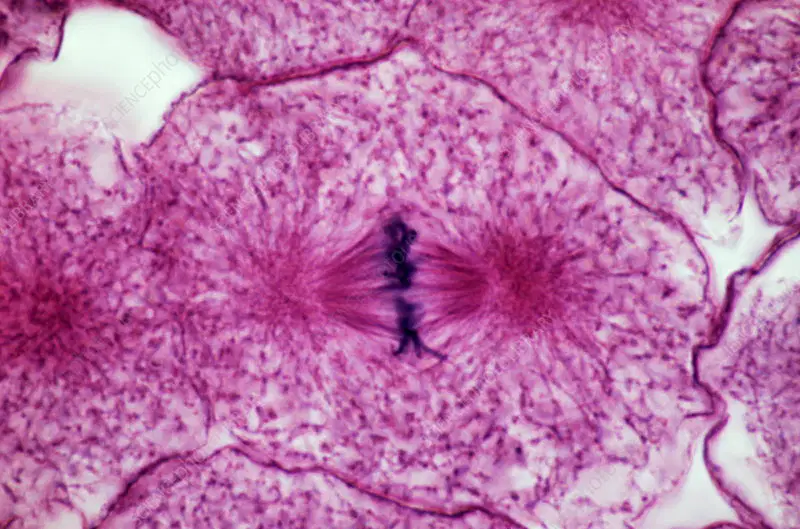
During which phase of mitosis do sister chromatids separate (move AWAY) from each other?
a)
prophase
b)
metaphase
c)
anaphase
d)
telophase
50.
While in the womb, the webbed fingers of the embryo undergo programmed cell death, also known as...
a)
apoptosis
b)
cytokinesis
c)
carcinogen
d)
stem cell
51.
If a cell has 8 chromosomes, how many chromosomes will each daughter cell have after cytokinesis in mitosis?
a)
4
b)
8
c)
16
d)
32
52.
Why is it important for cells of multicellular organisms to undergo mitosis?
a)
mitosis allows for reproduction of male and female gametes
b)
mitosis increases variation within an organism
c)
mitosis produces cells that are different from the original dividing cell
d)
mitosis produces cells that are identical to the original dividing cell
53.
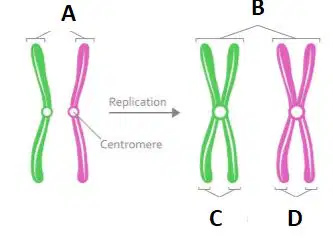
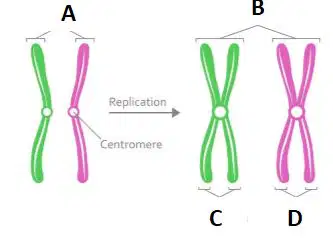
Which letters in the image below should be labeled "homologous chromosomes"? (Select 2)
a)
A
b)
B
c)
C
d)
D
54.
Which letters(s) in the image below should be labeled "sister chromatids"? (Select 2)
a)
A
b)
B
c)
C
d)
D
55.
Which phase of mitosis is occurring in the image below?
a)
Prophase
b)
Metaphase
c)
Anaphase
d)
Telophase
56.
The molecule that an enzyme binds to is known as its…
a)
substrate
b)
monomer
c)
polymer
d)
complementary base
57.
Chemical reactions that absorb more energy than they release are called....
a)
exothermic
b)
catalyzed
c)
endothermic
d)
anabolic
58.
Reactants bind to the enzyme at its…
a)
substrate
b)
product
c)
activation energy
d)
active site
59.
Which process modifies proteins and makes them unable to do their job?
a)
dehydration synthesis
b)
chemosynthesis
c)
denaturation
d)
lysis
60.
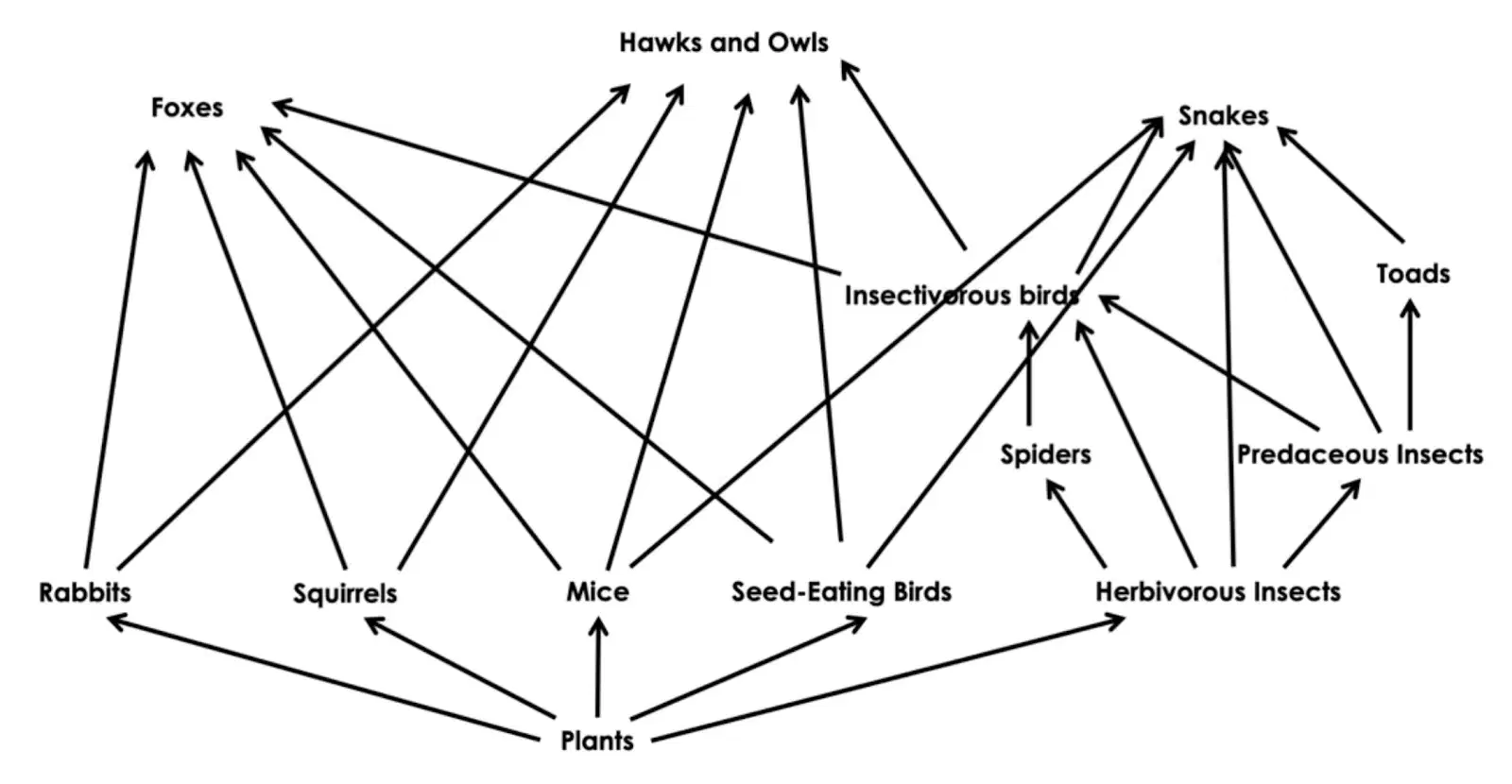
In the food web, the insectivorous bird would be classified as
a)
carnivore
b)
decomposer
c)
herbivore
d)
omnivore
61.
The absence of which of the organisms in the food web would most directly affect the diets of the other organisms shown?
a)
foxes
b)
plants
c)
spiders
d)
toad
62.
In the food web, what would be a direct impact of an increase in the amount of toads in the ecosystem?
a)
an increase in the population of squirrels
b)
an increase in the population of snakes
c)
a decrease in the population of owls
d)
a decrease in the population of rabbits
63.
Organisms that use energy from the sun to make their own food are called
a)
A. detritivores.
b)
B. consumers.
c)
C. omnivores.
d)
D. producers.
64.
What happens to the amount of energy in an energy pyramid as it moves up through the different levels?
a)
A. Energy increases by 10% each level.
b)
B. Energy decreases by 90% each level.
c)
C. Energy decreases by 10% each level.
d)
D. Energy increases by 90% each level.
65.
In food chains, the flow of energy is ALWAYS _________.
a)
A. one-way
b)
B. reversible
c)
C. two-way
d)
D. uncontrolled
66.
Why is the presence of chlorophyll in plants important?
a)
A. It assembles the sugar.
b)
B. It creates ATP to power the process.
c)
C. It captures water to be used in the process.
d)
D. It absorbs the solar energy needed to create the sugar.
67.
Some bacteria are facultative anaerobes, which usually produce ATP by aerobic respiration but are also capable of switching to fermentation when there is a lack of _________ in their environment.
a)
A. water
b)
B. oxygen
c)
C. glucose
d)
D. carbon dioxide
68.
The ultimate/original source of all energy is from .
a)
A. the sun
b)
B. carbohydrates
c)
C. ATP
d)
D. lipids
69.
The direct source for energy to power processes in our body is from .
a)
A. the sun
b)
B. carbohydrates
c)
C. ATP
d)
D. lipids
70.
What will MOST LIKELY happen if a new producer is introduced into a food web?
a)
A. The omnivores will decrease.
b)
B. The herbivores will increase.
c)
C. The carnivores will decrease.
d)
D. The decomposers will decrease.
71.
What organelle does photosynthesis occur in?
a)
ribosome
b)
mitochondria
c)
nucleus
d)
chloroplast
72.
What organelle does cellular respiration occur in?
a)
ribosome
b)
mitochondria
c)
nucleus
d)
chloroplast
73.
What process removes carbon dioxide from the atmosphere?
a)
photosynthesis
b)
cellular respiration
c)
combustion (burning) of fossil fuels
d)
volcanic activity
74.
In an ecosystem, which group of organisms puts a large amount of oxygen into the air?
a)
animals
b)
bacteria
c)
fungi
d)
plants
75.

Plants treated with fertilizer grew 15 cm taller than those without fertilizer.


Quantitative data or qualitative data?

a)

Quantitative

b)

Qualititative

76.

Which of the following is NOT a function of proteins in the cell membrane?

a)

Storing genetic information

b)

Providing structural support

c)

Acting as enzymes

d)

Facilitating transport

77.

Which process describes water moving across a membrane from an area of high concentration to low concentration?

a)

Facilitated diffusion

b)

Active transport

c)

Endocytosis

d)

Osmosis

78.

Which group of organisms is classified as prokaryotes?

a)

Animals

b)

Plants

c)

Eubacteria

d)

Fungi

79.

Which of the following organelles is responsible for producing energy in animal cells?

a)

Mitochondria

b)

Chloroplast

c)

Nucleus

d)

Ribosome

80.

What type of solution causes a cell to swell due to water entering the cell?

a)

None of the above

b)

Hypertonic solution

c)

Isotonic solution

d)

Hypotonic solution

81.

Which macromolecule is primarily responsible for storing genetic information?

a)

Lipids

b)

Carbohydrates

c)

Nucleic acids

d)

Proteins

82.

Which of the following is NOT a characteristic of prokaryotic cells?

a)

They are generally smaller than eukaryotic cells

b)

They have membrane-bound organelles

c)

They lack a nucleus

d)

Their DNA is found in the cytoplasm

83.

Which macromolecule is primarily responsible for storing genetic information?

a)

Carbohydrates

b)

Lipids

c)

Nucleic acids

d)

Proteins

84.

Which organelle is responsible for producing energy in the form of ATP in eukaryotic cells?

a)

Golgi apparatus

b)

Mitochondria

c)

Ribosome

d)

Nucleus

85.

What is the main function of the endoplasmic reticulum in a cell?

a)

Energy production

b)

Protein synthesis and transport

c)

DNA replication

d)

Cell division

86.

Which of the following organelles is found only in plant cells and is responsible for photosynthesis?

a)

Centrosome

b)

Chloroplast

c)

Lysosome

d)

Vacuole

87.

Which of the following is a characteristic of prokaryotic cells?

a)

They are always multicellular

b)

They have a complex internal structure

c)

They lack a nucleus

d)

They contain membrane-bound organelles

88.

Which macromolecule is primarily responsible for storing genetic information?

a)

Carbohydrates

b)

Lipids

c)

Proteins

d)

Nucleic acids

89.

What is the main function of the cell membrane?

a)

To store genetic material

b)

To control the movement of substances in and out of the cell

c)

To synthesize proteins

d)

To produce energy for the cell

90.

Which of the following best describes the function of enzymes in biological systems?

a)

They store genetic information.

b)

They act as structural components in cells.

c)

They speed up chemical reactions by lowering activation energy.

d)

They provide energy for cellular processes.

91.

What happens to an enzyme when it is exposed to extremely high temperatures?

a)

It replicates itself.

b)

It becomes more efficient.

c)

It denatures and loses its function.

d)

It changes into a carbohydrate.

92.

Which statement is true about enzyme specificity?

a)

Each enzyme only works with a specific substrate.

b)

Enzymes are only found in animal cells.

c)

Enzymes are not affected by pH.

d)

Enzymes can bind to any substrate.

93.

Which trophic level is primarily responsible for converting solar energy into chemical energy?

a)

Primary consumers

b)

Producers

c)

Secondary consumers

d)

Decomposers

94.

What happens to the amount of available energy as you move up each trophic level in a food chain?

a)

It stays the same

b)

It increases

c)

It fluctuates randomly

d)

It decreases

95.

Which organism would most likely occupy the highest trophic level in a typical terrestrial ecosystem?

a)

Grass

b)

Wolf

c)

Rabbit

d)

Mushroom

96.

Which of the following best describes a producer in an ecosystem?

a)

An organism that migrates seasonally

b)

An organism that breaks down dead material

c)

An organism that eats other organisms

d)

An organism that makes its own food using sunlight

97.

What is the primary source of energy for most ecosystems?

a)

Rainfall

b)

Wind

c)

Sunlight

d)

Soil nutrients

98.

Which term refers to the role an organism plays in its environment, including how it gets its food and interacts with other organisms?

a)

Habitat

b)

Community

c)

Niche

d)

Population

99.

Which of the following best describes a food web in an ecosystem?

a)

A linear sequence of organisms each feeding on the next

b)

A network of interconnected food chains showing energy flow

c)

A diagram showing the water cycle

d)

A group of organisms living in the same habitat

100.

What is the primary role of decomposers in an ecosystem?

a)

Storing energy

b)

Consuming producers

c)

Breaking down dead organic matter

d)

Producing oxygen

101.

Which factor is considered an abiotic component of an ecosystem?

a)

Mushrooms

b)

Grass

c)

Sunlight

d)

Bacteria