
 Worksheets
untitled
Total questions: 137
Worksheet time: 3hrs 58mins
In Darwin's thinking, the more closely related two different organisms are, the
more similar their habitats are.
less similar their DNA sequences are.
more recently they shared a common ancestor.
less likely they are to have the same genes in common.
more similar they are in size.
Natural selection is based on all of the following except
genetic variation exists within populations.
the best-adapted individuals tend to leave the most offspring.
individuals who survive longer tend to leave more offspring than those who die young.
populations tend to produce more individuals than the environment can support.
individuals adapt to their environments and, thereby, evolve.
Structures as different as human arms, bat wings, and dolphin flippers contain many of the same bones, these bones having developed from very similar embryonic tissues. How do biologists interpret these similarities?
By identifying the bones as being analogous
By the principle of convergent evolution
By proposing that humans, bats, and dolphins share a common ancestor
By looking at where the animals live
Which describes an African butterfly species that exists in two strikingly different color patterns?
artificial selection
directional selection
stabilizing selection
disruptive selection
sexual selection
Fossil evidence indicates that horses have gradually increased in size over geologic time. Which of the following terms best describes this?
artificial selection
directional selection
stabilizing selection
disruptive selection
sexual selection
Most Swiss starlings produce four to five eggs in each clutch. Those producing fewer or more than this have reduced fitness. Which of the following terms best describes this?
artificial selection
directional selection
stabilizing selection
disruptive selection
sexual selection
Males of different species of the fruit fly Drosophila that live in the same parts of the Hawaiian islands have different elaborate courtship rituals that involve fighting other males and stylized movements that attract females. What type of reproductive isolation does this represent?
habitat isolation
temporal isolation
behavioral isolation
gametic isolation
postzygotic barriers
All of the following are examples of events that can prevent breeding between species EXCEPT:
The potential mates experience geographical isolation.
The potential mates experience behavioral isolation.
The potential mates have different courtship rituals.
The potential mates have similar breeding seasons.
The gametes of potential mates have biochemical differences.
All of the following are part of Hardy Weinberg law for populations in equilibirum EXCEPT
Large population
No immigration or emigration
No natural selection
Non random mating
No genetic mutations


Yeast, when put into a glucose solution, will produce a large amount of alcohol and CO2 through which process?
Alcohol Fermentation
Cellular Respiration
Photosynthesis
Lactic Acid Fermentation

Which of the following matches the correct organelle to the process shown in the image?
Mitochondria: Photosynthesis
Mitochondria: Cellular Respiration
Chloroplast: Photosynthesis
Chloroplast: Cellular Respiration
Which BEST describes the overall process of photosynthesis?
Light energy converted into chemical energy
Chemical energy converted into light energy
Light energy converted into heat energy
Molecular energy into kinetic energy
In mitochondria, during the process of cellular respiration, what is the overall product created?
ATP Molecules
Glucose
Acohol
Lactic Acid
Which of the processes below make a larger amount of net ATP molecules overall?
Aerobic Respiration
Anaerobic Respiration
Photosynthesis
Metabolism
Which of the following is a good example of the organic molecules, lipids?
Vegetable oil
Table salt
Sucrose
Egg whites

Enzyme actions rates are effected by factors such as pH and temperature. Which of the following BEST describes an enzyme working at its optimum rate in this diagram?
The enzyme functioning at 15oC
The enzyme functioning at 22oC
The enzyme functioning at 37oC
The enzyme functioning at 50oC
In enzyme reactions, what would happen if you correctly matched an enzyme to its proper substrate?
The reaction would stop immediately
The reaction would be maintained indefinitely
The reaction rate would increase
The reaction rate would decrease
Macromolecules can be broken down into smaller monomers. Which of the following options pairs the complex molecule with its correct monomer?


Which of the following is a role of carbohydrates in animal cells?
synthesizing proteins
developing enzymes
storing energy as glycogen
protecting the cell wall
All organic compounds have which of the following in common?
They contain carbon
They contain nitrogen
They contain water
They contain carbon dioxide
Enzymes are affected by high temperatures and are often denatured. Which BEST describes what happens when an enzyme is denatured?
A very high temperature changes a protein's amino acids.
A very high temperature changes a protein's shape.
A very high temperature adds polymers to a protein.
A very high temperature removes polymers from a protein.
How do enzymes affect reaction rates in living cells?
Change the active site's energy
Slow the speed of reactions
Change the temperature of the reaction
Lowers the activation energy of the reaction
Nucleotides are monomers of which complete macromolecule?
DNA and RNA
Proteins
Fats and Waxes
Sugars and Starches
Lipids fulfill which function in animal cells?
long-term energy storage
cell wall structure
genetic and hereditary information storage
immune system antibody formation
Which of the following best describes the flow of gases into and out of a leaf through stomata, the specialized openings on the bottom of leaves, on a sunny day?
Carbon dioxide moves in; oxygen moves out.
Carbon dioxide and oxygen move in; ozone moves out.
Water vapor and ozone move in; carbon dioxide moves out.
Oxygen moves in; nitrogen moves out.

According to the image, which input molecules are needed to allow the Calvin cycle to take place?
water and oxygen and light
ADP and NADP and water
light and oxygen and carbon dioxide
ATP and NADPH and carbon dioxide
Which equations BEST summarizes the photosynthesis formula?
6CO2+ 6O2→ C6H1206+ 6H2O
6O2+ C6H1206 → 6CO2 + 6H2O
6O2+ 6H2O + 6O2 → C6H1206
6CO2+ 6H2O → C6H1206+ 6O2
Which of the following is true of ATP?
ATP consists of two ADP molecules.
Chlorophyll forms when ATP releases energy.
ATP provides energy for cells.
Used ATP is discarded by the cell as waste.
Which of the following shows the correct sequence of events during Cellular Respiration?
glycolysis → fermentation → Krebs cycle
Krebs cycle → electron transport → glycolysis
glycolysis → Krebs cycle → electron transport
Krebs cycle → glycolysis → electron transport
Which of the following takes place in the cytoplasm of the cell?
glycolysis
electron transport chain
Krebs cycle
ATP Synthesis
What occurs when ATP is converted to ADP?
Energy is stored in bonds.
Energy is released from bonds.
Energy remains in the same.
The cell dies.
An area that contains a large amount of particles is referred to as having a ________________________.
low concentration
high concentration
diffusion
osmosis
Diffusion is the movement of
water from low to high concentration
particles from low to high concentration
water from high to low concentration
particles from high to low concentration
Large molecules and ions (polar molecules) can easily pass through the cell membrane without any help.
true- they pass right through
false- they need a protein channel

Which way would the purple molecules move through the semi permeable membrane if dissolved in water?
From the A side to the B-side
From the B side to the A side
none of the purple molecules would move

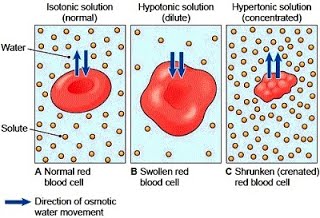
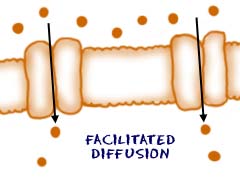
Solutes move with the concentration gradient, therefore no energy is used.
Passive Transport
Active Transport

What category of transport does this image represent?
Passive Transport
Active Transport
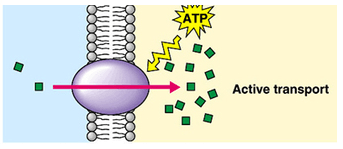
ATP is a form of energy used in...
Passive Transport
Active Transport
When molecules are even on either side of a semipermeable membrane, the solution is considered...
isotonic
hypotonic
hypertonic

Osmosis is... (choose the BEST response)
the movement of water across a membrane
the movement of water across a membrane through either facilitated diffusion or simple/passive diffusion
water moving
cytoplasm
Which type of molecules can move through a cell membrane through simple/passive diffusion?
Very small or non-polar molecules
Large and polar molecules
None
Only CO2 and O2
Which type of cells have cell walls?
Plants
Animals
Both plants and animals
Exoskeletal cells
Both plant and animals cells have mitochondria.
True
False
Which cell type is more complex/evolved?
Prokaryotic
Eukaryotic
Bacteria
Legume
A cell membrane is primarily composed of a...
phospholipid bilayer
lipid layer
lipid bylater
saran wrap and aluminum foil

A phospholipid has 2 parts. What are they called?
Hydrophilic Head, Hydrophobic Tail
Hydrophobic Head, Hydrophilic Tail

A ______________ is composed of a phosphate and glycerol head and 2 fatty acid chain tails.
phospholipid
Carbohydrate
Cholesterol
Protein

It forms a boundary between the inside of the cell and the outside of the cell.
Cell Membrane
Lipid Cleric Layer
Membrane Gate
Protein Receptors

What do viruses need to reproduce?
they need genetic material
They need a host cell
They need bacteria
They need insulin
Which molecule enters Kreb's Cycle?
CO2
Glucose
Acetyl CoA
after strenuous exercise, a muscle cell would contain decreased amounts of ______ and increased amounts of ______ ____
glucose; ATP
ATP; glucose
oxygen; lactic acid
lactic acid; ATP


A signal molecule that binds to a plasma-membrane protein is a
ligand
second messenger
protein kinase
receptor protein


Type of cell signaling where the ligand is produced at a location distant from its target cell(s)
autocrine signaling
juxtracrine signaling
paracrine signaling
endocrine signaling

What is being depicted in the image?
Amplification of the signal molecule
Enzymatic proteins inhibiting process of the signal transduction pathway
Kinase groups adding dimer groups to other enzymes
Diffusion of molecules within the cell due to the signaling molecule
Testosterone does not affect all cells of the body because __________.
testosterone cannot cross the plasma membrane
not all cells have cytoplasmic receptors for testosterone
not all cells in the body have membrane receptors for testosterone
it is a local regulator
it affects only cells that have ion-channel receptors

This is an example of
paracrine signaling
endocrine signaling
autocrine signaling
juxtacrine signaling

Which letter represents the cell surface receptor protein?
A
B
C
D
E
Which letter represents the ligand?
A
B
C
D
E

This is an example of
paracrine signalling
endocrine signalling
autocrine signalling
juxtacrine signalling
What hormone prolongs and intensifies the body's response during stress by increasing heart rate and raising blood glucose?
Epinephrine
Glucocorticoid
Cortisol
ADH
Each of the following numbered processes are involved in signal transduction pathways:
I. Response
II. Amplification
III. Reception
IV. Transduction
Which of the following represents the sequence of events in a typical signal transduction pathway?
I, II, III, IV
III, I, IV, II
II, IV, I, III
III, IV, II, I

A cell is known to respond to a particular signalling molecule. Which of the following must be true of this cell?
It is in the heart muscle.
It is also the site of the production for the signalling molecule.
It contains the receptor for the signalling molecule.
It is incapable of signal transduction.
When epinephrine binds to cardiac muscle cells, it speeds their contraction. When it binds to muscle cells of the small intestine, it inhibits their contraction. Which of the following best accounts for the fact that the same hormone can have different effects on muscle cells.
Cardiac cells have more receptors for epinephrine than do intestinal cells.
Epinephrine circulates to the heart first and thus is in higher concentration around cardiac cells.
The two types of muscle cells have different pathways for epinephrine and thus have different cellular responses.
Cardiac muscle is stronger than intestinal muscle and thus has a stronger response to epinephrine.
Which of the following statements correctly describes one characteristic of the lytic cycle of viral replication?
Viral DNA is incorporated into the host genome.
Many bacterial cells containing viral DNA are produced.
The viral genome replicates without destroying the host.
A large number of phages are released at a time.
Which of the following processes can be effective in preventing the onset of viral infection in humans?
applying antiseptics
taking antibiotics
getting vaccinated
taking vitamins


B Cells differentiate into memory cells and this cell that secretes antibodies?
stem cells
nerve cells
helper cells
plasma cells
The skin, mucous membranes, natural secretions, and natural flora are all part of the
First line of defense
Second line of defense
Third line of defense
What attacks microbes indiscriminately?
The adaptive immune system
The innate immune system
The lymphatic system
The nervous system
If our body encountered an antigen for the first time, what would occur?
B cells would be unable to make antibodies until antigens are presented through macrophage MHCs
Antibodies would not exist until dendritic cells brought pathogens to the lymph nodes
Immunity would be at its highest because antibodies for this specific antigen have not yet been depleted
In order to make up for the deficit in B cell antibody production, helper and cytotoxic T cell production would increase
Infected human cells present antigens or viral proteins on their cell surface through what?
Major histocompatibility complexes
antibodies
T Cell receptors
cytokines
A secondary immune response will be faster when...
The individual has encountered the pathogen already
The individual's macrophages are on high alert
The individual has encountered the pathogen and has memory B cells circulating
Antibodies are produced by T cells
How do T cells differ from B cells?
T cells fight pathogens by killing pathogens directly, while B cells fight pathogens by making antibodies.
T cells only make memory cells, and B cells only make antigens
T cells fight pathogens by making antibodies, while B cells fight pathogens by killing pathogens directly.
T cells can only fight off pathogens the body has encountered once, and B cells can fight off any pathogen the body comes across.

B Cells can create long term cells that will remember antigens on foreign substances
Memory Cells
Plasma Cells
T cells
Helper T cells
Immunity that occurs when a person's own immune system produces antibodies in response to the presence of a pathogen when a person gets sick
Natural Passive Immunity
Natural Active Immunity
Artificial Active Immunity
Immunity in which antibodies are given to a person rather than produced within the person's own body
Artificial Passive Immunity
Natural Passive Immunity
Artificial Active Immunity
Which immunity is present at birth and passed from the mother to the baby through milk and the placenta?
Artificial Active Immunity
Natural Active immunity
Natural passive immunity
Artificial passive immunity
Cell-mediated immunity is a type of acquired immunity. This is the immunity one develops throughout life. Which of the following types of cells are mostly involved in cell-mediated immunity?
T cells
B cells
erythrocytes
neutrophils

