
 Worksheets
AP Chemistry Thermodynamics Test
Total questions: 143
Worksheet time: 7hrs 2mins
Calculate the change in enthalpy ΔH for the following reaction:
2CO + O2 ⟶ 2CO2
Use your heats of formation table from your worksheet
-393.5 kJ/mol
-566.0 kJ/mol
566.0 kJ/mol
-369 kJ/mol
Which one of the following expressions is the correct way to calculate standard enthalpy change for the combustion of propane?
C3H8(g) + 5O2(g) → 3CO2(g) + 4H2O(l)
Use your heats of formation table for reference.
[103.85 + (5 × 286)] – [-393.5 + -285.8]
[-103.85 + 0] + [(3 x -393.5) + (4 x -285.8)]
[-103.85 + 0] – [(3 x -393.5) + (4 x -285.8)]
[(3 x -393.5) + (4 x -285.8)] + [-103.85 + 0]
What is the heat of formation for 6 moles of ethanol? Use your heats of formation table for reference.
-1666.2 kJ/mol
-277.7 kJ/mol
52.3 kJ/mol
Only able to calculate in a reaction
Calculate ΔH using heats of formation for the combustion of methane:
CH4(g) + 2O2(g) → CO2(g) +2H2O(l)
Use your heats of formation table for reference.
-890.25 kJ/mol
-604.45 kJ/mol
-754.15 kJ/mol
No way to tell
What is the difference between calculating ΔH with bond energies versus with heats of formation?
Bond energies are averages based on multiple scenarios of breaking bonds, heats of formation is the energy required to form a specific molecule from its elemental forms.
Heats of formation are averages based on multiple scenarios of breaking bonds, bond energies is the energy required to form a specific molecule from its elemental forms.
Bond energies are calculated using only lewis dot structures, but heats of formation requires a reference table
Heats of formation helps calculate enthalpy, while bond energies helps calculate entropy
What is the heat of formation for 8 moles of ammonia? Use your heats of formation table for reference.
-369.52 kJ/mol
-46.19 kJ/mol
-92.38 kJ/mol
-102.4 kJ/mol

The potential energy diagram of a reaction is shown. Which statement below is correct relating to this reaction?
#1 represents the enthalpy change for this exothermic reaction.
#2 represents the enthalpy change for this endothermic reaction.
#3 represents the enthalpy change for this endothermic reaction.
#4 represents the enthalpy change for this exothermic reaction.

What is the Heat of Reaction ΔH for this reaction?
-200 KJ
200 KJ
400 KJ
-300 KJ
What type of reaction is this?
Exothermic
Endothermic
Energy Producing
No way to tell
The enthalpy change for the reaction
C(s, graphite) + 1⁄2O2(g) --> CO(g) cannot be measured directly since some carbon dioxide is always formed in the reaction.
It can be calculated using Hess’s Law and the enthalpy changes of combustion of graphite and of carbon monoxide.
C(s, graphite) + O2(g) --> CO2 ΔH=-394 kJmol–1
CO(g) + 1⁄2O2(g) --> CO2 ΔH=-283 kJmol–1
The enthalpy change for the reaction of graphite with oxygen to give carbon monoxide is
-677 kJmol–1
-111 kJmol–1
+111 kJmol–1
+677 kJmol–1
The enthalpies of formation of C(s), H2(g) and C4H9OH(l) (in kJmol-1) are as follows
C(s) ∆H=a
H2(g) ∆H=b
C4H9OH(l) ∆H=c
What is the enthalpy change for the reaction shown below?
4C(g) + 5H2(l) + ½O2(g) -> C4H9OH(l)
c – 4a + 5b
4a + 5b - c
2a + 10b - c
2a + 5b + c
You are given these two equations:
2H2 + O2 → 2H2O ∆H = -572 kJ
H2 + O2 → H2O2 ∆H = -188 kJ
How do you calculate the Enthalpy of Reaction?
ΔH = ΔHproducts - ΔHreactants
ΔG = ΔH -TΔS
ΔT = q / mC
E = mc2
Systemsincludes _______.
reactants
products
both reactants and products
None of the above
Change in enthalpy is also called as _______.
Systematic Reaction
Balanced Reaction
Energy of Reaction
Heat of Reaction
Endothermic:_________:__________
Exothermic:_________:__________
positive:warm
negative:cold
positive:warm
negative:warm
positive:cold
negative:cold
positive:cold
negative:warm
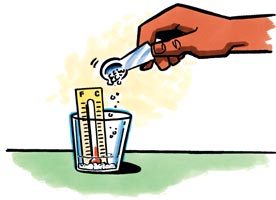
When the solids Ba(OH)2 and NH4SCN are mixed, a solution is produced and the temperature drops. Which statement about the energetics of this reaction is correct?
The reaction is endothermic and ΔH is negative
The reaction is endothermic and ΔH is positive
The reaction is exothermic and ΔH is negative
The reaction is exothermic and ΔH is positive
Which of the following represents an exothermic reaction?


Which has higher entropy?
A. A small pool of water sits in an enclosed glass chamber.
B. An enclosed glass chamber is filled with water vapor.
A
B
Which has higher entropy?
A. A fried egg rests on a plate.
B. A fresh, uncooked egg rests on a plate.
A
B
Which has higher entropy?
A. A car is at rest in a driveway with a full tank of gas.
B. A car drives down the highway with half a tank of gas left.
A
B
Which has higher entropy?
A. A box contains 1 million gas particles, all within the left half of the box.
B. 1 million gas particles are more or less evenly distributed throughout both halves of a box.
A
B
Which has higher entropy?
A. Broken pieces of glass lie on a wet floor.
B. A glass of water sits on top of a table.
A
B
Which has higher entropy?
A. An enclosed space is filled with ash and smoke particles.
B. A pile of logs sits on the floor of an enclosed space.
A
B
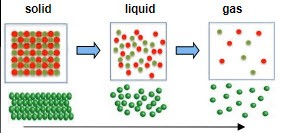
Which of the following is the best example of The Second Law of Thermodynamics?
A bike parked at the top of a hill has stored potential energy
A bike rolling down a hill has kinetic energy
Water flowing over a dam is used to generate electricity
Some of the potential energy stored in gasoline is lost as heat when burned in a car's engine

Which of the following correctly describes the entropy changes of the water molecules and the universe when a sample of water freezes?
A
B
C
D

What information do we need to perform a calculation of Gibbs Free Energy?
Enthalpy of the reaction.
Entropy of the reaction.
The temperature of the reaction in Kelvin.
All of the above are needed.
Your enthalpy is +20 and your entropy is +5. Which temperature will give a spontaneous reaction?
0
4
8
Your enthalpy is high and negative but your entropy is also negative. What type of temperature would you want to get a spontaneous reaction?
low
high
Which combination of ΔH and ΔS NEVER has a spontaneous reaction?
+ΔH and +ΔS
+ΔH and -ΔS
-ΔH and -ΔS
-ΔH and +ΔS
At what temperature would a given reaction become spontaneous if ΔH =+119kJ and ΔS=+263J/K.mol
455 K
-2210 K
382 K
-363 K
6. The formation ½ A2 + 2 B2 + C --> CAB4 has an enthalpy of formation of -104 kJ and a change in entropy of -60.8 J/K at 30 °C. What is the free energy and spontaneity of the reaction?
-85.6 kJ, spontaneous
-18.3 kJ, not spontaneous
+18.3 kJ, spontaneous
+85.6 kJ, not spontaneous
enthalpy is driving force when
exothermic
endothermic
increase in entropy
decrease in entropy
If a reaction occurs, then delta G is
negative
positive
can't tell
0
What are the signs on G, H, and S if a solid is combined with another solid, a gas forms and the temperature drops?
+, +, +
- , - , -
- ,+, +
+ , +, -
Which statement is true regarding the desublimation of gaseous CO2?
ΔH is negative, ΔS is positive, and ΔG is negative at all temperatures.
ΔH is positive, ΔS is negative, and ΔG is positive at all temperatures.
ΔH is positive, ΔS is positive, and ΔG is positive at low temperature and negative at high temperature.
ΔH is negative, ΔS is negative, and ΔG is negative at low temperature and positive at high temperature.
What is the significance of the change in Gibbs free energy (ΔG) for a reaction?
The change in Gibbs free energy for a process is (a) to the (b) of ΔSuniv. Since ΔSuniv is a criterion for (c) , ΔG is also a criterion for (d) (although opposite in sign).
Calculate the change in Gibbs free energy for each set of ΔH°rxn, ΔS°rxn, and T. (Assume that all reactants and products are in their standard states.)
ΔH°rxn = +119 kJ ; ΔS°rxn = −242 J/K ; T = 308K
Express your answer in kilojoules to three significant figures.
ΔG°rxn = (a) KJ
Calculate the change in Gibbs free energy for each set of ΔH°rxn, ΔS°rxn, and T. (Assume that all reactants and products are in their standard states.)
ΔH°rxn = −119 kJ ; ΔS°rxn = +242 J/K ; T = 308 K
Express your answer in kilojoules to three significant figures.
ΔG°rxn = (a) kJ
Calculate the change in Gibbs free energy for each set of ΔH°rxn, ΔS°rxn, and T. (Assume that all reactants and products are in their standard states.)
ΔH°rxn = −119 kJ ; ΔS°rxn = −242 J/K ; T = 308 K
Express your answer in kilojoules to three significant figures.
ΔG°rxn = (a) kJ
Calculate the change in Gibbs free energy for each set of ΔH°rxn, ΔS°rxn, and T. (Assume that all reactants and products are in their standard states.)
ΔH°rxn = −119 kJ ; ΔS°rxn = −242 J/K ; T = 711 K
Express your answer in kilojoules to three significant figures.
ΔG°rxn = (a) kJ
Predict whether each reaction is spontaneous at the temperature indicated.
Drag the appropriate items to their respective bins.
Reaction in part C ΔG = -44.5 kJ
Reaction In part B ΔG = -194 kJ
Reaction in part D ΔG = 53.1 kJ
Reaction in part A ΔG = 194 kJ
What does Gibbs Free Energy tell us?
How much energy is given off by a reaction.
The tendency of a reaction to become "random"
How spontaneous a reaction is.
What information do we need to perform a calculation of Gibbs Free Energy?
Enthalpy of the reaction.
Entropy of the reaction.
The temperature of the reaction in Kelvin.
All of the above are needed.
Which of the following would most likely lead to a spontaneous reaction.
A high negative enthalpy.
A low negative enthalpy.
A high positive enthalpy.
A low positive enthalpy.
What are the best conditions to lead towards a spontaneous reaction?
high negative enthalpy, high temp, high negative entropy
high positive enthalpy, high temp, high negative entropy
high negative enthalpy, low temp, high positive entropy
high negative enthalpy, high temp, high positive entropy.
Your enthalpy is high and negative but your entropy is also negative. What type of temperature would you want to get a spontaneous reaction?
low
high
Your enthalpy is positive and your entropy is positive. What type of temperature would you want to ensure a spontaneous reaction.
very high
very low
Your enthalpy is +20 and your entropy is +5. Which temperature will give a spontaneous reaction?
0
4
8
Your enthalpy is -20 and your entropy is -8. Which temperature will give you a spontaneous reaction?
1
3
5
Which of the following situations demonstrates high entropy?
water freezing
water vaporizing
steam condensing to water
A spontaneous reaction is more profitable to a company.
True
False
Which represents a decrease in entropy?
sublimation of CO2
boiling water
condensation of steam on cold glass
NaCl dissolving in water
The entropy will usually increase when
a molecule is broken into two or more smaller molecules
a reaction occurs that results in an increase in the number of moles of gas
a solid changes to a liquid
all of these
Which sample has the lowest entropy?
HINT - Look at the phase of each chemical....
1 mole of KNO3(l)
1 mole of KNO3(s)
1 mole of H2O(l)
1 mole of H2O(g)
Which phase change represents a decrease in entropy?
solid to liquid
gas to liquid
liquid to gas
solid to gas
Entropy is a measure of
accuracy
precision
the disorder of a system
the attraction of a nucleus for an electron
Given the change of phase:
CO2(g) —> CO2(s)
As CO2(g) changes to CO2(s), the entropy of the system
decreases
increases
remains the same
What is a spontaneous process ?
slow process
fast process
process that needs an external intervention to occur
process that does not need external intervention to occur / keep happening
Given the change of phase:
CO2(g) —> CO2(s)
As CO2(g) changes to CO2(s), the entropy of the system
decreases
increases
remains the same
What information do we need to perform a calculation of Gibbs Free Energy?
Enthalpy of the reaction.
Entropy of the reaction.
The temperature of the reaction in Kelvin.
All of the above are needed.
What does Gibbs Free Energy tell us?
How much energy is given off by a reaction.
The tendency of a reaction to become "random"
How spontaneous a reaction is.
When a reaction is exothermic and the products have more entropy than the reactants, the reaction is;
Spontaneous with a positive ΔG
Spontaneous with a negative ΔG
Non-Spontaneous with a positive ΔG
Non-Spontaneous with a negative ΔG
Which of the following would most likely lead to a spontaneous reaction.
A high negative enthalpy.
A low negative enthalpy.
A high positive enthalpy.
A low positive enthalpy.
Your enthalpy is +20 and your entropy is +5. Which temperature will give a spontaneous reaction?
0
4
8
Your enthalpy is positive and your entropy is positive. What type of temperature would you want to ensure a spontaneous reaction.
very high
very low
Which combination of ΔH and ΔS NEVER has a spontaneous reaction?
+ΔH and +ΔS
+ΔH and -ΔS
-ΔH and -ΔS
-ΔH and +ΔS
Predict the signs of ΔH , ΔS and ΔG for the reaction:
Mg(s) --> Mg(g)
Δ H = - , Δ S = + and Δ G = - (all temperature)
Δ H = + , Δ S = + and Δ G = - (At all temperature)
Δ H = + , Δ S = + and Δ G = - (At low temperature)
Δ H = + , Δ S = + and Δ G = - (At high temperature)
Your enthalpy is high and negative but your entropy is also negative. What type of temperature would you want to get a spontaneous reaction?
low
high
A reactionthat is spontaneous at any temperature has a
-------------- entropy and a ---------------- enthalpy.
positive, positive
positive, negative
negative, negative
negative, positive
Which is correct for the reaction H2O (g) → H2O (l) ?
A. Enthalpy increases and entropy increases.
B. Enthalpy decreases and entropy increases.
C. Enthalpy increases and entropy decreases.
D. Enthalpy decreases and entropy decreases.
A
B
C
D
When the solids Ba(OH)2 and NH4SCN are mixed, a solution is produced and the temperature drops. Which statement about the energetics of this reaction is correct?
The reaction is endothermic and ΔH is negative
The reaction is endothermic and ΔH is positive
The reaction is exothermic and ΔH is negative
The reaction is exothermic and ΔH is positive
The following equation shows the formation of magnesium oxide from magnesium metal. Which statement is correct for this reaction?
2Mg(s) + O2(g) → 2MgO(s) ΔH = -1204 kJ
1204 kJ of energy are released for every mole of magnesium reacted
602 kJ of energy are absorbed for every mole of magnesium oxide formed
602 kJ of energy are released for every mole of oxygen reacted
1204 kJ of energy are released for every two moles of magnesium oxide formed
For the reaction 2H2(g) + O2(g) → 2H2O(g) the bond enthalpies (in kJ/mol) are
H-H = x, O=O = y, O-H = z
Which calculation will give the value, in kJ/mol, of ΔH for the reaction?
2x + y - 2z
4z - 2x - y
2x + y - 4z
2z - 2x - y

Using the table of average bond energies below the image, the ΔH for the reaction in kJ is.....
+ 160 kJ
-63 kJ
- 160 kJ
-217 kJ
Does breaking bonds require energy, release energy, or not involve energy at all?
requires energy to break
releases energy when broken
No energy involved
What kind of energy change happens in the photosynthesis reaction in plant leaves?
Endothermic
Exothermic
No change
Is this equation endo- or exo-thermic?
PCl3 (s) + Cl2 (g) --> PCl5 (s) + energy
endothermic
exothermic
Is this equation endo- or exo-thermic?
2KNO3 (s) + energy --> 2KNO2 (s) + O2
endothermic
exothermic
How can we figure out if an overall reaction is endo- or exo-thermic? It is the difference between _______ and __________.
hot and cold temperatures
energy to break and energy to form bonds.
time to form a bond versus time to break a bond
Q= m c ∆T
The units for specific heat are:

If two objects have different temperatures when they come in contact, heat will flow from the warmer object to the cooler one UNTIL ____________
one reaches a temperature of zero
they both have an equal temperature
one runs out of energy
If the specific heat of water is 4.18 J/g∙°C, how much heat is required to increase the temperature of 1.2 kg of water from 23 °C to 39 °C? (show your work)
-80,256 J
80.256 J
80,256 J
-80.256 J
For a skillet, used for cooking, do you want a high or low specific heat
High, so that it will need more energy to heat up
Low, so that it will change temperature quickly
A piece of metal with a mass of 32.8 g is heated to 100.5°C and dropped into 138.2 g of water at 20.0°C. The final temperature of the system is 30.2°C. What is the specific heat capacity of the metal? (show your work)
What does "q" mean?
A measure of heat energy
A change in heat energy
A measure of kinetic energy
A change in temperature

What is the temperature of the metal cube when thermal equilibrium is achieved between the cube and the liquid?
The specific heat of water is 4.18 J/g°C.
If 980. J of energy is added to 6.20 g of water at 18.0 °C, what is the final temperature of the water?
37.8 °C
-19.8 °C
19.8 °C
55.8 °C
What does "ΔT" mean?
A change in health
A change in heat
A change in height
A change in temperature
Calculate ΔT when a substance goes from 10*C to 75*C
-65*C
75*C
10*C
65*C
Calculate A 50g sample is heated with 500 joules of energy and has a 10*C temperature change. Calculate it’s specific heat.
1 j/g*C
250000 j/g*C
500 j/g*C
10 j/g*C
4180 j of heat energy are added to change the temperature of water by 10*C. How many grams of water are being heated? cwater=4.18 j/g*C
4.18 j/g*C
10000g
174724g
100g
What heat energy is required to raise the temperature of a 1g sample of mercury (cHg=.16 j/g*C) by 100*C?
16j
.0016j
16000j
625 j

What type of reaction is this?
Endothermic
Exothermic
Allergic

What type of reaction is this?
Endothermic
Exothermic
Allergic

What does q stand for?
Heat-Joules
Mass-Grams
Specific Heat-J/g*C
Temperature Change-*C
What does c stand for?
Heat-Joules
Mass-Grams
Specific Heat-J/g*C
Temperature Change-*C
What does ΔT stand for?
Heat-Joules
Mass-Grams
Specific Heat-J/g*C
Temperature Change-*C
What does m stand for?
Heat-Joules
Mass-Grams
Specific Heat-J/g*C
Temperature Change-*C

When two samples of similar mass are subjected to the same heat energy, the sample with the SMALLER specific heat will have a _________ temperature change.
SMALLER
LARGER
EQUAL

