
Font size
 Worksheets
Unit 4 - Chapter G - Molecular Biology
Total questions: 136
Worksheet time: 1hrs 26mins
Which enzyme is primarily responsible for unwinding the DNA double helix during DNA replication?
DNA ligase
Helicase
RNA polymerase
DNA polymerase
What is the main function of mRNA in protein synthesis?
To carry amino acids to the ribosome
To serve as a template for protein synthesis
To unwind the DNA double helix
To splice out introns
During transcription, which molecule is synthesised?
DNA
mRNA
tRNA
Protein
Where does translation occur in the cell?
Nucleus
Ribosome
Mitochondria
Golgi apparatus
What are exons?
Non-coding regions of DNA
Coding regions of DNA that remain in mRNA
Enzymes involved in DNA replication
Proteins that regulate gene expression
Which process removes introns from pre-mRNA?
Replication
Splicing
Translation
Transcription
What is the role of DNA polymerase in DNA replication?
Unwinds the DNA helix
Synthesises new DNA strands
Joins Okazaki fragments
Removes primers
Which of the following best describes an intron?
A sequence that codes for protein
A non-coding sequence removed from pre-mRNA
A ribosomal subunit
A type of tRNA
What is the first step in gene expression?
Translation
Transcription
Replication
Splicing
Which base is found in RNA but not in DNA?
Thymine
Uracil
Adenine
Guanine
What is the function of tRNA during translation?
To carry the genetic code from DNA
To bring amino acids to the ribosome
To synthesise mRNA
To splice out introns
Which of the following is NOT a step in DNA replication?
Unwinding of the double helix
Synthesis of a new strand
Splicing of exons
Formation of Okazaki fragments
What is a codon?
A sequence of three nucleotides in mRNA
A protein that regulates gene expression
A segment of DNA that is removed during splicing
An enzyme involved in replication
Which enzyme synthesises the RNA primer during DNA replication?
DNA polymerase
RNA primase
Ligase
Helicase
What is the main purpose of gene expression regulation?
To ensure all genes are expressed at all times
To control when and how much a gene is expressed
To replicate DNA
To synthesise ribosomes
Which strand of DNA is used as a template during transcription?
Coding strand
Non-coding (template) strand
Both strands
Neither strand
What is the product of translation?
DNA
mRNA
Protein
tRNA
Which of the following is true about Okazaki fragments?
They are synthesised on the leading strand
They are synthesised on the lagging strand
They are found in RNA only
They are exons
What is the role of the promoter region in transcription?
It codes for protein
It signals where transcription should begin
It removes introns
It synthesises tRNA
Which molecule carries the genetic code from the nucleus to the cytoplasm?
DNA
mRNA
tRNA
rRNA
Which of the following is NOT involved in translation?
Ribosome
tRNA
mRNA
DNA polymerase
What is the function of DNA ligase in DNA replication?
Unwinds the DNA helix
Joins Okazaki fragments together
Synthesises RNA primers
Removes introns
Which process converts the information in mRNA into a sequence of amino acids?
Replication
Transcription
Translation
Splicing
Which of the following best describes gene expression?
The process of copying DNA into RNA
The process by which information from a gene is used to synthesise a functional product
The removal of introns from mRNA
The joining of Okazaki fragments
Which of the following is removed from pre-mRNA during processing?
Exons
Introns
Codons
Promoters
What is the start codon for translation in most organisms?
UAA
AUG
UGA
UAG
Which of the following is a mechanism of gene expression regulation?
DNA replication
Transcription factors binding to DNA
Okazaki fragment formation
DNA ligase activity
What is the complementary RNA sequence to the DNA sequence 5'-ATG-3'?
5'-UAC-3'
5'-TAC-3'
5'-AUG-3'
5'-CAT-3'
Which of the following is NOT a function of mRNA?
Carrying genetic information from DNA to ribosomes
Serving as a template for protein synthesis
Bringing amino acids to the ribosome
Containing codons for translation
Which process ensures that only exons remain in the mature mRNA?
Replication
Splicing
Translation
Transcription
Which enzyme is responsible for synthesising the new RNA strand during transcription?
Helicase
DNA polymerase
RNA polymerase
Ligase
What is the function of ribosomes during protein synthesis?
To remove introns from pre-mRNA
To replicate DNA
To join amino acids together to form a protein
To unwind the DNA double helix
Which molecule acts as an adaptor by matching an mRNA codon with the correct amino acid?
mRNA
rRNA
tRNA
DNA
What is the correct order to make a protein?
Protein, DNA, RNA
RNA, DNA, Protein
DNA, RNA, Protein
Protein, RNA, DNA
RNA has what base that is instead of thymine?
guanine
adenine
thymine
uracil
What enzyme does transcription use?
DNA polymerase
ligase
RNA polymerase
helicase
Which RNA carries the message?
mRNA
rRNA
tRNA

Where does transcription take place? Check all that apply.
nucleus of eukaryotes
nucleus of prokaryotes
cytoplasm prokaryotes
smooth ER
What is the building block, monomer, of the biomolecule, Nucleic Acid?


RNA must be edited before it can be used to make Proteins, what happens during this editing process?
A spliceosome cuts out exons, reconnects the introns
A spliceosome cuts out the introns, reconnects the exons
A splicesome pairs nucleotides with the DNA base pairs
The RNA is checked for typos
RNA contains which sugar?
deoxyribose
Ribose
glucose
fructose
Where on the DNA strand does RNA polymerase attach?
Complainer
Enforcer
Promotor site (TATA box)
Polymerator
The______ region lies towards the 3'end of the coding sequence of DNA since the transcript is made ___.
Promoter, 5'-3'
Terminator, 5'-3'
Promotor, 3'-5'
Structural genes, 3'-5'
Removal of noncoding sequences from the pre-RNA is called
Capping
Splicing
Tailing
Spooling
Capping is addition of _____ towards the 5' end of mRNA
Methyl cytosine
the GTP cap
GDP tail
poly - A tail
A poly A tail is added to the mRNA (check both answers that apply)
by accident, the enzyme RNAP is stuck and adds more A's
to provide time for the mRNA to be read in the cytoplasm before it is generated
so that RNA'se enzymes (exonucleases) will cut off A's and leaving the coding sequence in tac longer.
to provide direction out of the nucleus into the cytoplasm
Select the true statement.
The whole DNA antisense strand is transcribed
Both sides of the DNA strands are encoded into mRNA.
The gene section of a DNA antisense strand is transcribed.
The gene section of the double helix is transcribed.
Which statement is true?
A gene is expressed all the time.
All genes in our chromosomes are expressed at the same time frame of life.
A gene is expressed when needed, otherwise it is 'silent'.
All genes are expressed all the time.
The triplet code, codon, that signals the start of a code in mRNA is __.
GGG
AUG
AUU
Did we do this already? yes, yes it is there...in your pogil


What is the correct order to make a protein?
Protein, DNA, RNA
RNA, DNA, Protein
DNA, RNA, Protein
Protein, RNA, DNA
RNA has what base that is instead of thymine?
guanine
adenine
thymine
uracil
What enzyme does transcription use?
DNA polymerase
ligase
RNA polymerase
helicase
Which RNA carries the message?
mRNA
rRNA
tRNA
What happens to mRNA at the end of transcription before it leaves the nucleus?
It is translated into protein.
Introns are removed, and exons are spliced together.
It is degraded by enzymes.
It is converted into DNA.
What is the function of exons in mRNA?
They are noncoding regions.
They are coding regions for proteins.
They are involved in DNA replication.
They are responsible for mRNA degradation.
What is the role of tRNA during the process of translation?
It brings amino acids to the ribosomes.
It carries the genetic code from DNA.
It forms the structure of ribosomes.
It synthesizes mRNA.
Where do matching anticodons on tRNA molecules bind during translation?
P site
E site
A site
mRNA binding site
What happens to tRNA after its amino acid is dropped off?
It moves to the P site.
It moves to the E site and leaves.
It stays in the A site.
It is degraded immediately.
When does the process of translation stop?
When a start codon is reached.
When a stop codon is reached.
When the ribosome is full.
When all tRNA molecules are used.
What happens once the stop codon is reached in protein synthesis?
The amino acid chain is released and folded.
The amino acid chain is destroyed.
The amino acid chain is duplicated.
The amino acid chain is shortened.
What is added to the 3' end of mRNA during editing within the nucleus?
Guanine cap
Poly A tail
Introns
Start codon
Where is mRNA sent after being edited in the nucleus?
Golgi apparatus
Mitochondria
Cytoplasm and ribosome
Nucleus
What is the role of tRNA in the ribosome?
To edit mRNA
To create a stop codon
To read mRNA and create an amino acid strand
To disassemble the ribosome complex
What happens when a stop codon is reached during translation?
mRNA is edited
Ribosome complex disassembles
Start codon is found
Amino acid chain is folded
Where can the amino acid chain be folded after translation?
In the nucleus
In the Golgi apparatus
In the membrane of RER or in the cytoplasm
In the mitochondria
When the mRNA sequence leave the nucleus, what organelle does it travel to?
mitochondria
smooth ER
ribosome
vacuole
What best explains the interaction between tRNA and mRNA during translation?
anticodons on the mRNA line up with complementary codons on the tRNA
anticodons on the tRNA line up with complementary codons on the mRNA
tRNA attach amino acids to the complementary mRNA sequence
mRNA attach amino acids to the complementary tRNA sequence
What does tRNA "transfer"?
amino acids
nucleic acids
nucleotides
AUG
What do amino acids come together to join?
a growing polypeptide chain (protein)
a growing lipid
a growing carbohydrate
a growing nucleic acid
codons are located on __________
mRNA
tRNA
rRNA
snRNA
anti-codons are located on __________
mRNA
tRNA
rRNA
snRNA
How many nucleotides make up a single codon?
3
5
4
1

The following codon is translated into which amino acid?
AUU
Methionine
Isoleucine
Histidine
Arginine

The following codon is translated into which amino acid?
CAU
Methionine
Isoleucine
Histidine
Arginine

The following codon is translated into which amino acid?
UAA
STOP
Phenylalanine
Valine
Aspartic acid


What type of bonds are forming during translation?
Peptide bonds (covalent)
Hydrogen bonds
Acid bonds
ionic bonds
ATG GGA ACT CCA

Which process does this picture show?
Transcription
Translation
Replication
Overall, protein synthesis consists of these steps
DNA synthesis, RNA synthesis and transcription
transcription and translation
DNA synthesis, transcription and translation


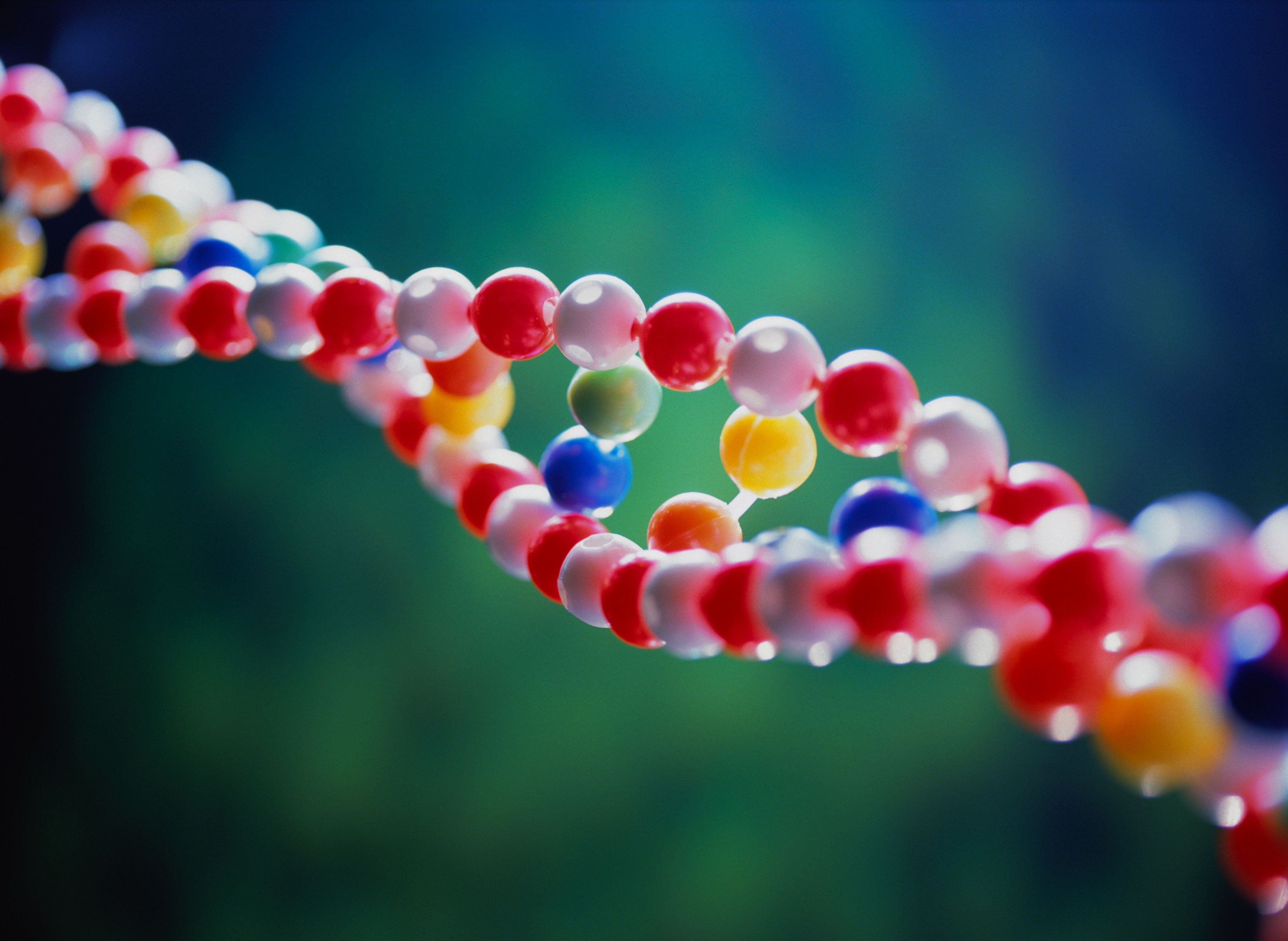

What is a gene?
A bundle (like a hot dog bun) that the DNA is packed into
something inside the nucleus
a section/piece of DNA
all of your DNA
If we think of DNA as a ladder, which parts are the steps of the ladder?
the nitrogen base pairs
the phosphate-sugar backbone
the genes

What does this image represent?
Chromosome
Gene
Nucleus
Nitrogen Bases

When DNA is replicated, the result is
1 old double helix and 1 new
2 double helixes. Each with 1 old and 1 new strand
1 double helix
2 new double helixes
What part of the cell cycle does replication occur?
S phase
Prophase
Metaphase
G1
What are DNA and RNA nucleotides made of?
Sugar, Phosphate, and Nitrogenous Base
Phosphate, Adenine, and Nitrogenous Base
Sugar and Phosphate
Phosphate and Nitrogenous Base

Which of the following best describes a DNA molecule?
It is shaped as a double helix.
It contains ribose sugar.
It is made of amino acids.
It is single-stranded.
Which of the following answers correctly pairs the nitrogenous bases in DNA?
Adenine = Thymine & Cytosine = Guanine
Adenine = Uracil & Cytoplasm = Guanine
Adenine = Cytosine & Uracil = Guanine
Adenine = Cytosine & Thymine = Guanine
Which of the following statements is correct?
DNA and RNA must stay inside the cell nucleus.
DNA stays in the cell nucleus and RNA can leave the nucleus.
RNA stays in the cell nucleus and DNA can leave the nucleus.
DNA and RNA can go into and out of the cell nucleus.
Which sequence of DNA bases would pair with this DNA template strand?
ATG TGA CAG
ATG TGA CAG
TAC ACT GTC
GTA AGT GAC
CAT TCA CTG

In a DNA molecule, the amount of Adenine is always equal to the amount of:
Cytosine.
Guanine.
Thymine.
Uracil.
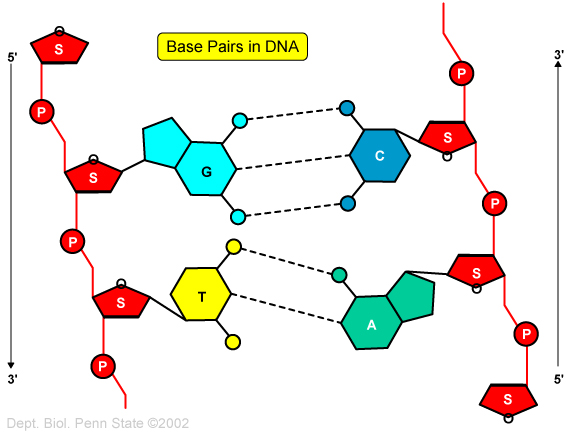
In a DNA molecule, the nitrogenous bases are joined by which type of bond?
Strong covalent bonds
Weak covalent bonds
Strong hydrogen bonds
Weak hydrogen bonds
DNA replication results in two DNA molecules,
each one with two original strands.
each one with two new strands.
each one with one new strand and one original strand.
one with two new strands and the other with two original strands.
What process synthesizes mRNA from DNA?
Translation
Transcription
DNA Replication
What process goes from mRNA to a protein?
Transcription
rRNA
DNA Replication
Translation
What mRNA sequence is made from the following DNA sequence?
GTAGTCA
UATUAGA
ACGACTG
CAUCAGU
CATCAGT
What is the main function of a tRNA molecule?
It carries the instructions to make proteins
It forms part of the ribosomes
It strings together complementary RNA and DNA strands
It brings amino acids from the cytoplasm to the ribosomes
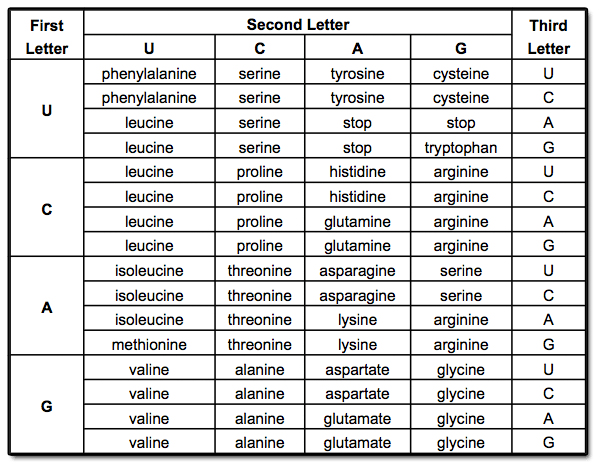
What amino acid is represented by the codon UUA?
Phenylalanine
Tyrosine
Leucine
Stop codon
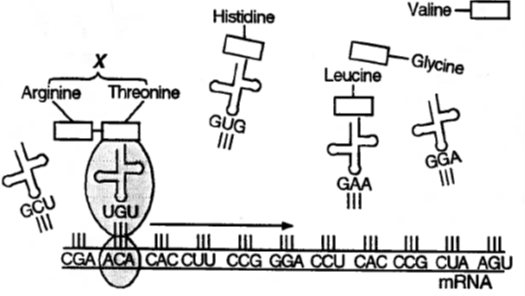
What process is going on in this photo?
Transcription
Translation
DNA Replication
All the above
Where in the cell does translation occur?
Nucleus
Mitochondria
Ribosome
Chloroplast
What is the three-nucleotide sequence on mRNA that codes for a single amino acid?
Anticodon
Codon
Protein
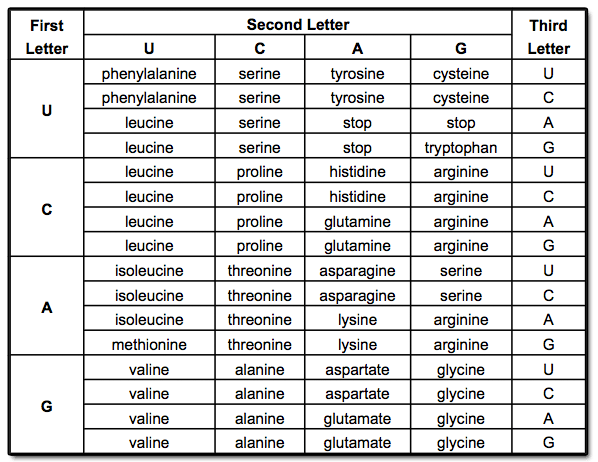
What is the correct amino acid sequence for the mRNA code?
AUG CCA GUA
Met-Pro-Ala
Met-Pro-Val
Tyr-Gly-His
Tyr-Gly-Arg
How many amino acids are coded for by this sequence of nucleotides?
ATG GGA ACT CCA
4
2
6
12
The tremendous variety of proteins is due to the:
different sequences of DNA nucleotides.
millions of possible codons in mRNA.
millions of possible ways that amino acids can be ordered within a protein.
millions of different kinds of tRNA.
Which of the following is added to the 3' end of mRNA during processing?
GTP cap
Exon
Methyl cytosine
Poly-A tail
During translation, what does the anticodon of tRNA pair with?
The promoter region
The ribosomal RNA
The codon on mRNA
The DNA template strand
Which process converts the genetic information in mRNA into a sequence of amino acids?
Replication
Splicing
Transcription
Translation

