
 Worksheets
End of KS3 Quiz
Total questions: 198
Worksheet time: 2hrs 55mins
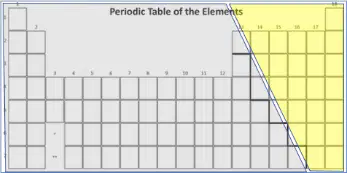
What do we find in the grey section?
non-metals
gases
solids
metals
liquids

What do we find in the yellow section?
liquids
non-metals
gases
metals
solids
What are the two elements that are liquid at room temperature?
Hg & Cl
water & ethanol
Hg & B
Hg & Br
What do we call elements with both metallic and non-metallic properties?
metallies
metallites
metallilbits
metalloids
What does ductile mean?
Will make a ringing sound when struck
Capable of neutralising an acid
Can be bent into shape
Can be drawn into wires
What does malleable mean?
Will make a ringing sound when struck
Can be bent into shape
Can be drawn into wires
Capable of neutralising an acid
What does sonorous mean?
Will make a ringing sound when struck
Can be bent into shape
Can be drawn into wires
Capable of neutralising an acid
What group is Argon in?
Group 7
Group 1
Group 0
Group 4
What group is Potassium in?
Group 7
Group 0
Group 1
Group 4
What group is Iodine in?
Group 4
Group 0
Group 1
Group 7
What group is Caesium in?
Group 7
Group 1
Group 4
Group 0
What group is Astatine in?
Group 1
Group 7
Group 0
Group 4
What group is Xenon in?
Group 4
Group 0
Group 1
Group 7
My elements become progressively more reactive as you move down the group. Which group am I?
Group 1
Group 0
Group 7
Group 4
My elements become progressively less reactive as you move down the group. Which group am I?
Group 1
Group 4
Group 7
Group 0
My elements are generally unreactive. Which group am I?
Group 7
Group 1
Group 4
Group 0
My elements have the lowest boiling points of all the elements. Which group am I?
Group 4
Group 1
Group 7
Group 0
My elements elements have the lowest boiling points of all the elements. Which group am I?
Group 7
Group 4
Group 1
Group 0
Group 1 metals reaction with water and a gas is given off. What is the gas?
Hydrogen
Carbon dioxide
Nitrogen
Oxygen
Elements arranged in columns are called what?
rows
periods
groups
lines
Elements arranged in rows are called what?
rows
periods
lines
The modern periodic table is based on the work of which man?
Dimitri Mendeleev
Albert Einstein
Charlie Marshall
Henry Hover
elements in the same groups have similar what?
properties
colours
homes
Which nutrient is used by your body for growth and repair?
fats
proteins
vitamins and minerals
carbohydrates
Which nutrient does our body use for releasing energy?
carbohydrates
vitamins and minerals
fibre
Proteins
Which nutrient helps prevents constipation
carbohydrates
fibre
fats and oils
proteins
What is the main purpose of the digestive system?
To break down food and absorb nutrients
To pump blood
To see and hear
To breathe
Which organ in the digestive system produces digestive juices to help break down food?
All of the the named organs in this question
Small intestine
Liver
Stomach
What is the name of the tube that carries food from your mouth to your stomach?
Oesophagus / gullet
Trachea
Large intestine
Small intestine
Which of these foods is a good source of calcium, important for strong bones and teeth?
Milk
Popcorn
Chicken
Apples
What is the name of the tiny, finger-like projections in the small intestine that absorb nutrients?
Alveoli
Pores
Taste buds
Villi
Which part of the digestive system absorbs most of the nutrients from digested food?
Stomach
Small intestine
Large intestine
Liver
Which nutrient is essential for the formation of red blood cells and carries oxygen throughout the body?
Calcium
Iron
Vitamin C
Fibre
Where does digestion begin in the human body?
Mouth
Stomach
Large intestine
Small intestine
Order the organs correctly to show which organs food passes through the digestive system. Organs: Mouth; Oesophagus / gullet; Stomach; Small intestine; Large intestine.
Mouth → Oesophagus / gullet → Stomach → Small intestine → Large intestine
Mouth → Trachea → Stomach → Small intestine → Large intestine
Mouth → Stomach → Oesophagus / gullet → Small intestine → Large intestine
Mouth → Oesophagus / gullet → Small intestine → Stomach → Large intestine
Eating the correct amount of nutrients to stay healthy is called eating (a) ______ diet. Choose from the below words: A Balanced; An Unbalanced; A Deficiency; A Boring.
A Balanced
An Unbalanced
A Deficiency
A Boring
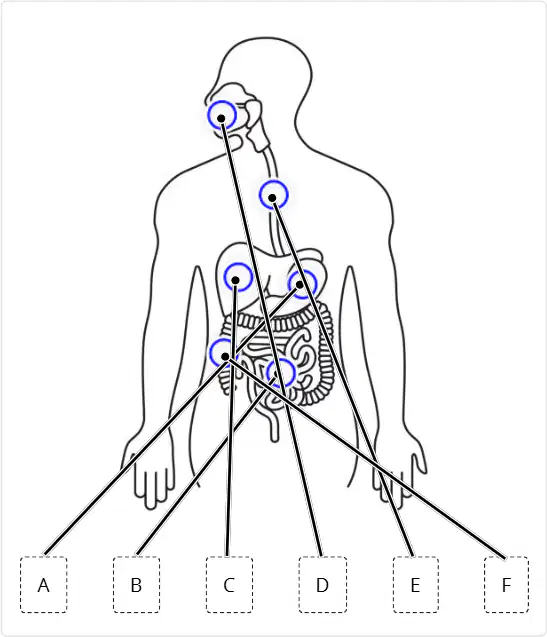
Identify the stomach in the diagram. Choose the correct label from A–F.
A
B
C
D
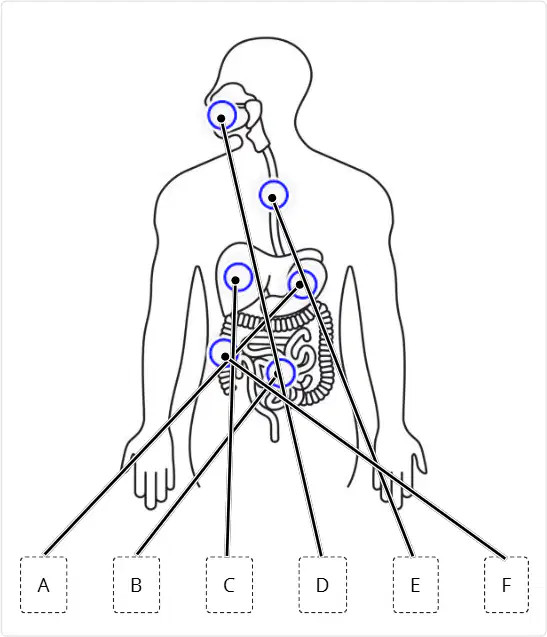
Identify the small intestine in the diagram. Choose the correct label from A–F.
A
B
C
D
What am I? I break down protein into amino acids.
Protease
Carbohydrase
What am I? I break down starch into glucose.
Lipase
Protease
Carbohydrase
What am I? I break down lipids into fatty acids and glycerol
Carbohydrase
Lipase
Protease
Starch is broken down into...
Amino acids
Fatty acids and glycerol
Glucose
Protein is broken down into...
Fatty acids and glycerol
Amino acids
Glucose
Lipids are broken down into...
Glucose
Amino acids
Fatty acids and glycerol
Which of the following tests for starch?
Emulsion
Benedict's
Iodine
Biuret
Which of the following tests for protein?
Iodine
Emulsion
Benedicts
Biuret
Which of the following tests for glucose?
Benedicts
Biuret
Emulsion
Iodine
When starch is present iodine turns...
blue-black
brick red
orange
purple
When protein is present Biuret turns...
brick red
purple
orange
blue-black
When large amounts of glucose is present Benedicts turns...
green
brick-red
blue-black
purple
A negative test for starch will cause Iodine to stay...
black
blue
brick red
orange/red
A negative test for protein will cause Biuret to stay...
black
orange
brick red
blue
A negative test for glucose will cause Benedicts to stay
blue
orange
brick red
black
If you drop iodine solution on bread, it changes to black. What does this show?
Bread contains sugar
Bread contains lipids?
Bread contains starch
Bread contains protein
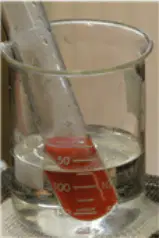
This photo represents a
positive test for starch
negative test for protein
positive test for glucose
negative test for glucose
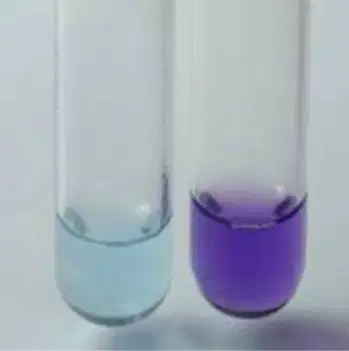
The test tubes in the photo represent a negative and positive result for
Ethanol with fat
Iodine with starch
Benedict's with glucose
Biuret with protein
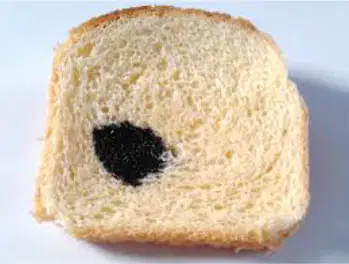
This is a positive result for
protein
carbohydrates
fats and lipids
bread
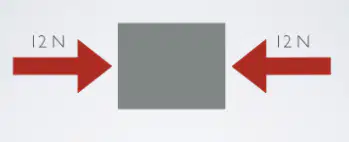
How will this object move? The diagram shows a block with equal forces of 12 N applied from the left and from the right, each pushing toward the block.
It will move to the right.
It will move in both directions.
It won't move.
It will move to the left.
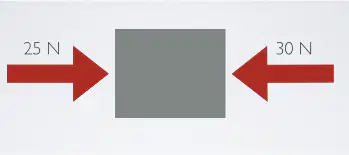
What is the resultant/net force? The diagram shows a block with a 25 N force from the left pointing right and a 30 N force from the right pointing left.
55 N right
30 N left
25 N right
5 N left
A nut can be loosened more easily with
a long spanner because a larger turning effect can be produced.
a short spanner because a larger force can be produced.
a short spanner because a larger turning effect can be produced.
a long spanner because a larger force can be produced.
Jack has a weight of 300 N and sits 2.0 m from the pivot of see-saw. Jill has a weight of 450 N and sits 1.5 m from pivot. Who will move down?
Jill
Jack
Both of them
None of them
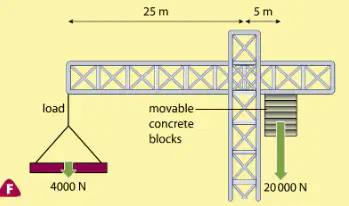
What is the anticlockwise moment acting on this crane? The diagram shows a crane with a 4000 N load at a distance of 25 m on one side of the pivot and movable concrete blocks of 20000 N at 5 m on the other side.
140,000 Nm
120,000 Nm
80,000 Nm
100,000 Nm
The easiest way to open a heavy door is by applying the force
Near the hinges
At the edge of the door far from the hinges
At the top of the door
In the middle of the door
What is the equation for moments?
Moment = force × perpendicular distance from pivot
Moment = force × distance
Moment = mass × velocity
Moment = force × parallel distance from pivot
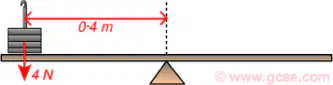
What is the moment acting on the seesaw? The diagram shows a 4 N downward force applied 0.4 m from the pivot.
16 N
4 Nm
1.6 Nm
15 Nm

The diagram shows a beam. Without any weights, the beam balances at its centre. Three weights are hung as shown. At which point does a load of 2 N balance the beam?
B
C
D
A
What is the unit of moment of force?
m
N
Nm
N/m
How do you Calculate Pressure
Force(kg)/Area(m^2)
Area(m2)/Force(N)
Force(N)/Area(m2)
What is pressure?
The amount of force exerted on a surface
The weight of an object
The surface area of an object
If you're walking in snow why would you wear boots instead of high heels?
Because boots have a higher surface area making the pressure less and stopping you from sinking.
Because it's more comfortable
No, high heels are better
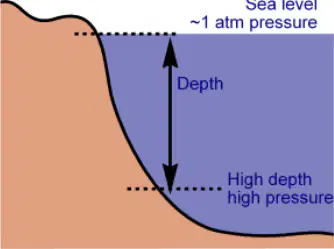
When you increase your depth under water, the water pressure on your body
stays the same
decreases
increases
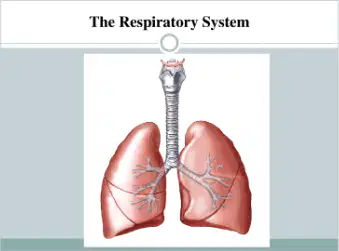
What is the main function of the respiratory system?
to break down food and absorb nutrients
to bring oxygen to the body
to provide oxygen and remove carbon dioxide from the body
to remove oxygen from the body and deliver carbon dioxide
This is a tube about 12 cm long with C-shaped rings of cartilage to keep it open
Pharynx
Nasal cavity
Mouth cavity
Trachea
Muscular structure that helps to expand and contract the lungs, forcing air in and out
Nasal cavity
Diaphragm
Pharynx
Alveoli
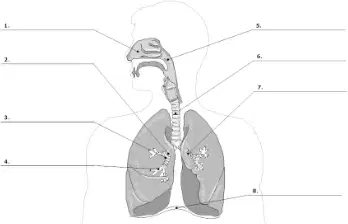
Name the organ labeled #2.
alveoli
lungs
bronchi
trachea
I have a large surface area to increase how much oxygen and carbon dioxide can pass to and from the bloodstream
Alveoli
Trachea
Bronchi
I make up a movable cage to protect the lungs
Diaphragm
Ribs
Intercostal muscles
How does asthma affect the lungs?
Asthma increases the lung capacity
Asthma has no effect on the lungs
Asthma causes inflammation and narrowing of the airways in the lungs, making it difficult to breathe.
Asthma causes the airways to widen in the lungs
A plant with leaves that can be dried and mixed with chemicals to make cigarettes.
Nicotine
Tobacco
Tar
THC
Which are short term effects of alcohol?
hang over
dehydration
dry mouth
all of the above
Which is a long term effect of alcohol?
cirrhosis of the liver
memory loss
liver disease
all of the above
The process by which one or more substances change to produce one or more different substances
Chemical Process
Reactant
Chemical Reaction
A substance produced during a chemical reaction
Product
Properties
Reactant
A substance that takes part in and undergoes change during a reaction
Product
Reactant
Molecule
A change in the shape of an object is an example of ____________.
a chemical change
a physical change
energy
an endothermic change
In a reaction A + B ----> C, reactant A has 5g and product C has 9g. How many grams does reactant B should have?
14g
5g
9g
4g
What do we use limewater to test for?
Heat
Carbon Dioxide
Water
Smoke
Why do we burn a fuel?
To produce carbon dioxide
To have fun
To release energy
To lose energy
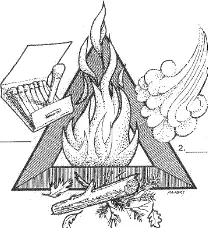
What is essential for a combustion reaction to begin?
Fuel, oxygen and heat
Water and oxygen
Carbon dioxide
Fuel
What are the products of combustion?
Carbon + water
Carbon dioxide + hydrogen
Carbon dioxide + water
Hydrogen + oxygen
What is the term for when a large molecule is broken down into smaller molecules?
Reaction
melting
atom
decomposition
What is this symbol?
Switch
Bulb
Cell
2 cell battery
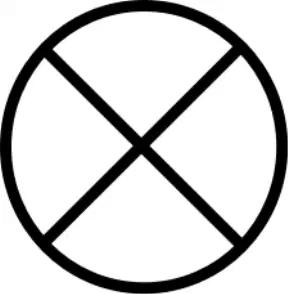
What is this symbol?
Bulb
Cell
Resistor
Switch
If the switch is open in a circuit, then…
…electricity will flow.
…electricity will NOT flow.
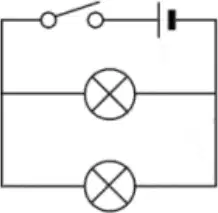
This picture is an example of what kind of circuit?
Complete
Parallel
Series
Broken
In a series circuit…
the current is split between components.
the current is the same everywhere.
the voltage is split between components.
the voltage is the same everywhere.
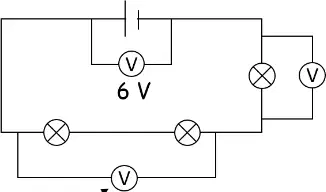
What is the reading on the labelled voltmeter?
0 V
3 V
6 V
12 V
Potential difference is another word for _______.
Voltage
Current
Resistance
Power
What is the unit of Current?
Ohm, Ω
Joule, J
Amp, A
Volt, V
What is the unit of Resistance?
Amp, A
Ohm, Ω
Joule, J
Volt, V

Use the formula shown: resistance (Ω) = potential difference (V) / current (A). What is the resistance of a buzzer which has a potential difference of 12V and a current of 2A ?
4 Ω
10 Ω
6 Ω
14 Ω
A measurement of how fast an object is moving
Acceleration
Velocity
Speed
Vector
What is the speed of an object that travels 60 metres in 4 seconds?
0.067 mph
0.067 m/s
15
15 m/s
Find the speed when a tricycle travels 200 kilometres in 8 hours.
25 km/h
15 km/h
30 km/h
12 km/h
Find the speed of a car after 4 hours it traveled a distance of 284 km.
51 km/h
61 km/h
71 km/h
63 km/h
Calculate the distance you will travel if you will drive for 2 hours at 56 km/h .
110 km
100 km
84 km
112 km
What is a unit of speed?
Metres per second
Metres
Metres per second squared
Seconds
Metre is the SI unit of _____.
length
mass
time
speed
_____ can be measured in metres per second.
speed
time
acceleration
distance

What is speed?
how far you go
how fast you accelerate
how much distance is covered over a period of time
the change in the location of a object
What is the formula to calculate speed?
S = t/d
v = d × t
S = d/t
v = s/t
From "Match the following", classify 50 m/s as which quantity.
Distance
Speed
Time
Velocity
From "Match the following", classify 100 m as which quantity.
Distance
Speed
Time
Velocity
From "Match the following", classify 50 m/s to the West as which quantity.
Distance
Speed
Time
Velocity
From "Match the following", classify 2 s as which quantity.
Distance
Speed
Time
Velocity
What equation do I use to calculate time?
t=s/v
d=t×v
v=d/t
What equation do I use to calculate distance?
s=t×v
s=d/t
d=t×s
Match the following quantities to their correct symbols: Time corresponds to which symbol?
s
v
t
Match the following quantities to their correct symbols: Speed corresponds to which symbol?
s
v
t
Match the following quantities to their correct symbols: Distance corresponds to which symbol?
s
v
t
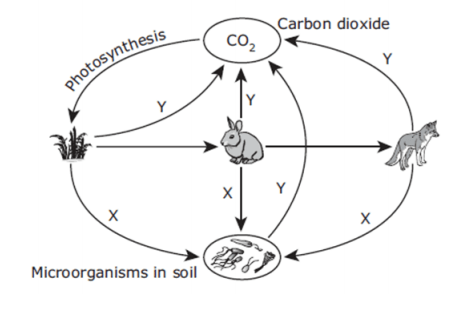
Y : Predation
Y : Decomposition
Y : Nitrogen Fixation
Y : Respiration
How does carbon get from the air into your body?
Transpiration
Photosynthesis
Respiration
Digestion
What is carbon made into in respiration?
Carbon
Glucose
Carbon monoxide
Carbon dioxide
In what form is carbon released into the air during respiration?
Solid carbon
Particulates
Carbon monoxide
Carbon dioxide
Select the organisms that remove carbon dioxide from the air.
Green plants
Algae
Badgers
Insects
What is the name of the process that removes carbon dioxide from the air?
Respiration
Transpiration
Photosynthesis
Combustion
Which of the following base pairings is correct?
T-T, C-A
A-T, C-C
A-T, C-G
C-G, C-C
Of the chromosomes in your cells, how many are sex chromosomes?
1
2
3
4
Our characteristics are controlled by
DNA
genes
chromosomes
parents
DNA is a molecule made up of a combination of how many DNA bases?
1
2
3
4
We inherit our genes from ...
our nucleus.
our parents.
from the food we eat.
What is a long coiled strand of DNA and proteins?
gene
RNA
chromosome
genome
What is a short segment of a DNA strand that codes for our characteristics?
chromosome
DNA
RNA
gene
Where is DNA found in a human cell?
ribosome
nucleus
cell membrane
cytoplasm
How many pairs of chromosomes do human cells contain?
23
46
16
32
DNA is short for
Ribonucleic acid
Deoxyribonucleic acid
Nucleic acid
If you put a North pole and a South pole together the magnets will ...
attract
repel
do nothing




Release Colour
Absorb Colour

a change of an organism over time is
evolution
generation
phenotype
genetic engineering
Mutations are a change in what?
DNA
food
genotype
phenotype
Why are advantageous traits more likely to be passed onto offspring?
Because they are more likely to survive and reproduce.
Because they just are
Because they are pretty
Because they are the cutest
Stephen Hawking

What do you call a characteristic that allows an organism to survive in an environment?
variation
adaptation
selection
overproduction
Which of these is NOT a greenhouse gas?
Carbon Dioxide
Nitrous Oxide
Oxygen Gas
Methane
What is the greenhouse effect?
A natural process where gases trap heat in the atmosphere.
A man-made process where gases trap heat in the atmosphere.
A natural process where the ocean traps heat in the atmosphere.
A man-made process where the ocean traps heat in the atmosphere.

How is the greenhouse effect produced?
When solar energy trespasses the atmosphere.
When some energy is reflected back to earth.
When the green house is burned.
When the sun doesn't emit radiation.
What is Global Warming?
Increasing temperature in Earth's atmosphere
Decreasing temperature in a city
Increasing rain rates in Earth
Decreasing temperature rates
An oxygen debt occurs in muscles when...
more carbon dioxide has been produced
the breathing rate increases
anaerobic respiration has taken place
the pulse rate increases
During oxygen debt, the lactic acid is removed from
Liver
Muscles
Lungs
Heart

O2 is the chemical formula for
Oxygen
Carbon Dioxide
Glucose
Water

After hard exercise, panting allows excess lactic acid to be:
Carried to the liver to be broken down
Broken down to form carbon dioxide and water
Converted into glucose for storage
In terms of energy released from glucose:
Anaerobic respiration releases more tan aerobic respiration
Aerobic respiration releases more than anaerobic respiration.
Aerobic and anaerobic respiration releases about the same amount
Which is the correct equation for anaerobic respiration in humans?
Glucose + Lactic Acid -> Carbon Dioxide + Water
Glucose -> Lactic Acid + Carbon Dioxide
Glucose -> Lactic Acid
Where in the cell do most aerobic respiration reactions happen?
In the nucleus
In the mitochondria
In the cytoplasm
In the cell wall
Why does anaerobic respiration occur during hard exercise?
There may be insufficient oxygen supplied to the muscle cells
Carbon dioxide builds up in the respiring muscle cells
Anaerobic respiration releases more energy from glucose than aerobic respiration.
During exercise, the heart rate increases to:
Supply more lactic acid to the muscles for anaerobic respiration
Supply more oxygen and glucose to the respiring cells
Keep up with the pulse rate
Which is the correct equation for aerobic respiration in humans?
Glucose + Oxygen -> Carbon Dioxide + Water
Glucose + Oxygen -> Carbon Dioxide
Glucose -> Carbon Dioxide + Water
Glucose -> Lactic Acid

