
NEW
Font size
 Worksheets
Endocrine System P1
Total questions: 75
Worksheet time: 38mins
What is the primary focus of Anatomy and Physiology?
Understanding the structure of cells only
Studying how systems work together physically and chemically
Learning about the functions of individual organs
Exploring the genetic makeup of the body
What is the prime purpose of system interaction in the body?
To enhance physical strength
To keep everything in balance for best performance
To increase the speed of chemical reactions
To improve the immune system
What is the prime function of all body systems?
To regulate blood pressure
To keep the cells of the body functioning at their best all the time
To maintain the body's temperature
To support muscle growth
What is the primary function of the endocrine system?
To secrete enzymes for digestion
To coordinate functions between cells through hormones
To transport oxygen in the blood
To regulate the nervous system
Which term describes the endocrine system's role in maintaining a stable internal environment that is dynamic and not static?
Homeostasis
Metabolism
Reproduction
Stress response
Which of the following is NOT a key role of the endocrine system?
Growth and development
Water and caloric balance
Transporting nutrients in the blood
Reproduction and stress responses
How does the endocrine system contribute to metabolism?
By secreting hormones that regulate energy balance
By producing enzymes for digestion
By transporting nutrients to cells
By maintaining oxygen levels in the blood
What are hormones primarily responsible for in the human body?
Transporting oxygen in the blood
Acting as chemical messengers secreted by endocrine glands or tissues into the blood
Breaking down food in the digestive system
Producing energy in cells
Which type of cells do hormones affect in the body?
All cells in the body
Cells with specific receptors, known as target cells
Only cells in the brain
Cells that produce energy
How do hormones travel in the body to reach their target cells?
Through the nervous system
Through the blood
Through the lymphatic system
Through the digestive system
What is a unique characteristic of hormones in terms of their effect on organs or cells?
They only affect nearby organs or cells
They often affect very distant organs or cells
They only affect organs in the digestive system
They only affect organs in the respiratory system
Which type of 'crine' action involves activity within cells, such as the cell growth cycle?
Paracrine
Autocrine
Exocrine
Juxtacrine
What is the primary characteristic of paracrine actions?
Actions within cells
Actions between closely connected or neighboring cells
Glands secreting through ducts
Cell contact interaction causing changes
Which type of gland secretes substances through ducts?
Endocrine
Exocrine
Paracrine
Juxtacrine
What is the role of endocrine glands in the 'crine' group?
They use blood as a carrier
They secrete through ducts
They interact with neighboring cells
They cause cell contact interaction changes
Which 'crine' action involves cell contact interaction causing changes?
Autocrine
Paracrine
Juxtacrine
Exocrine
What is the primary characteristic of exocrine glands?
They release hormones directly into the blood.
They release secretions onto a tissue by ducts.
They are ductless and release secretions into the lymphatic system.
They only function in the brain and heart.
Which of the following is an example of an exocrine gland?
Sweat glands
Adipocytes
Osteoblasts
Brain
What distinguishes endocrine glands from exocrine glands?
Endocrine glands release secretions onto tissues by ducts, while exocrine glands are ductless.
Endocrine glands are ductless and release secretions into the blood, while exocrine glands use ducts.
Endocrine glands only function in the brain and heart, while exocrine glands function in adipocytes.
Endocrine glands release secretions into the lymphatic system, while exocrine glands release secretions into the blood.
Which of the following organs is not typically considered an endocrine gland but can secrete hormones?
Sweat glands
Adipocytes
Salivary glands
Kidneys
What is a shared characteristic of the brain and heart in relation to endocrine function?
They release secretions onto tissues by ducts.
They are ductless and release hormones into the blood.
They are considered exocrine glands.
They do not secrete hormones.
What is the primary purpose of both the endocrine and nervous systems?
External communication
Internal communication
Cellular respiration
Physical movement
Which of the following is a key difference between the nervous system and the endocrine system in terms of communication?
The nervous system uses only chemical messengers, while the endocrine system uses electrical signals.
The nervous system uses chemical and electrical signals, while the endocrine system uses only chemical messengers.
The endocrine system uses chemical and electrical signals, while the nervous system uses only chemical messengers.
Both systems use only electrical signals for communication.
How does the speed of response differ between the nervous system and the endocrine system?
The nervous system is slower to start and stop, while the endocrine system is fast and stops quickly.
The nervous system is fast and stops quickly, while the endocrine system is slower to start and stop.
Both systems respond at the same speed.
The endocrine system is faster than the nervous system.
What is a characteristic of the signaling process in the nervous system compared to the endocrine system?
The nervous system signals specific organs, while hormones travel throughout the body.
Hormones signal specific organs, while the nervous system signals throughout the body.
Both systems signal specific organs only.
Both systems signal throughout the body only.
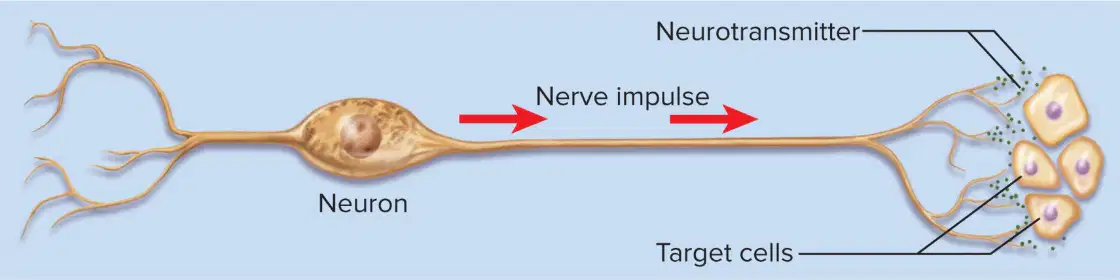
What is the primary method of communication in the nervous system?
Hormones in the bloodstream
Neurotransmitters across synapses
Electrical signals in the bloodstream
Chemical signals in the endocrine cells
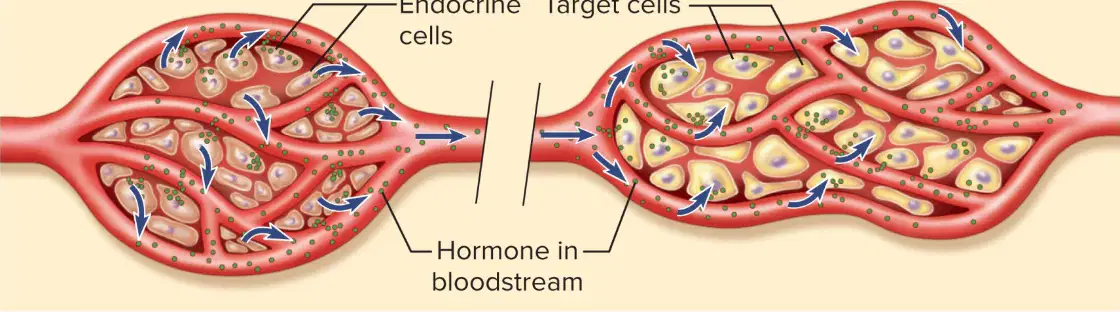
How does the endocrine system communicate with target cells?
By releasing neurotransmitters across synapses
By sending electrical impulses through neurons
By releasing hormones into the bloodstream
By direct physical contact with target cells
Which of the following is a key difference between the nervous and endocrine systems?
The nervous system uses hormones, while the endocrine system uses neurotransmitters.
The nervous system communicates quickly, while the endocrine system communicates more slowly.
The endocrine system targets specific cells, while the nervous system affects the whole body.
The endocrine system uses electrical signals, while the nervous system uses chemical signals.
What is the role of neurotransmitters in the nervous system?
To carry electrical signals through the bloodstream
To transmit signals across synapses to target cells
To release hormones into the bloodstream
To provide energy to neurons
Which of the following chemicals can act as both hormones and neurotransmitters?
Norepinephrine and dopamine
Insulin and glucagon
Serotonin and melatonin
Oxytocin and vasopressin
What are neuroendocrine cells specialized to do?
Produce antibodies
Function in both the nervous and endocrine systems
Regulate blood pressure
Transport oxygen in the bloodstream
Which of the following pairs of substances have similar effects on the liver?
Dopamine and serotonin
Norepinephrine and glucagon
Insulin and adrenaline
Oxytocin and melatonin
Which of the following is a commonality between the nervous and endocrine systems?
Neurons inhibit hormone secretion
Hormones only regulate the endocrine system
Some neurons trigger hormone secretion
The two systems function independently
How do hormones interact with neurons according to the comparison of the nervous and endocrine systems?
Hormones only stimulate neurons
Hormones stimulate or inhibit neurons
Hormones have no effect on neurons
Hormones regulate neurons exclusively
What is the relationship between the nervous and endocrine systems in terms of regulation?
The nervous system regulates the endocrine system only
The endocrine system regulates the nervous system only
The two systems regulate each other
The two systems do not regulate each other
Hormones are classified into three groups based on their structure. Which of the following is NOT one of these groups?
Steroid hormones
Monoamines
Peptide hormones
Carbohydrate hormones
What are steroid hormones synthesized from?
Proteins
Cholesterol
Carbohydrates
Nucleic acids
Which structural feature is shared by steroid hormones?
A single organic ring
Four organic rings with varied side groups
Two organic rings with identical side groups
No organic rings
Which of the following is an example of a steroid hormone?
Insulin
Testosterone
Dopamine
Serotonin
What are monoamines synthesized from?
Fatty acids and glycerol
Tyrosine and tryptophan
Glucose and fructose
Nucleotides and ribose
Which of the following is an example of a monoamine hormone?
Insulin
Thyroxine
Glucagon
Cortisol
What functional group is present in monoamines?
Hydroxyl group (-OH)
Amino group (NH or NH2)
Carboxyl group (-COOH)
Sulfhydryl group (-SH)
What is the length range of peptide hormone chains?
1 to 50 amino acids long
3 to more than 200 amino acids long
10 to 100 amino acids long
5 to 150 amino acids long
At what point are peptide hormones considered proteins?
When they contain 20 amino acids
When they contain 50 amino acids
When they contain 100 amino acids
When they contain 10 amino acids
Which of the following is an example of a small peptide hormone?
Insulin
Oxytocin
Glucagon
Thyroxine
What type of peptide hormones are glycoproteins?
Hormones with carbohydrate groups attached
Hormones with lipid groups attached
Hormones with phosphate groups attached
Hormones with sulfur groups attached
Which of the following is an example of a peptide hormone that is also a protein?
Oxytocin
Insulin
Cortisol
Estrogen
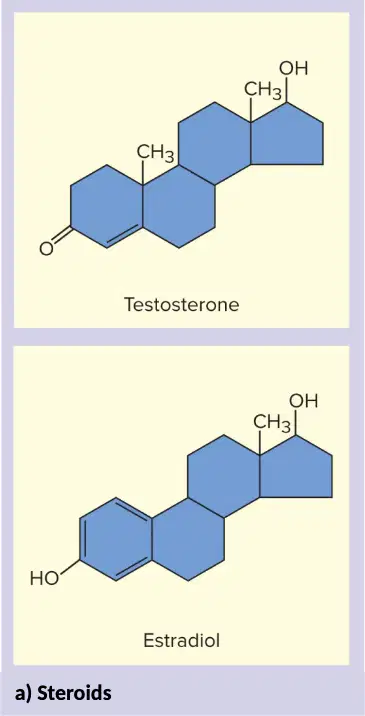
Which of the following hormones is classified as a steroid?
Testosterone
Thyroxine
Oxytocin
Insulin
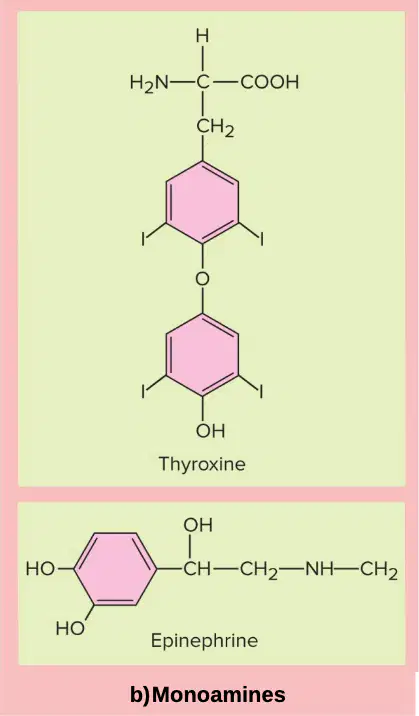
What is the chemical class of Thyroxine?
Steroids
Monoamines
Peptides
Carbohydrates
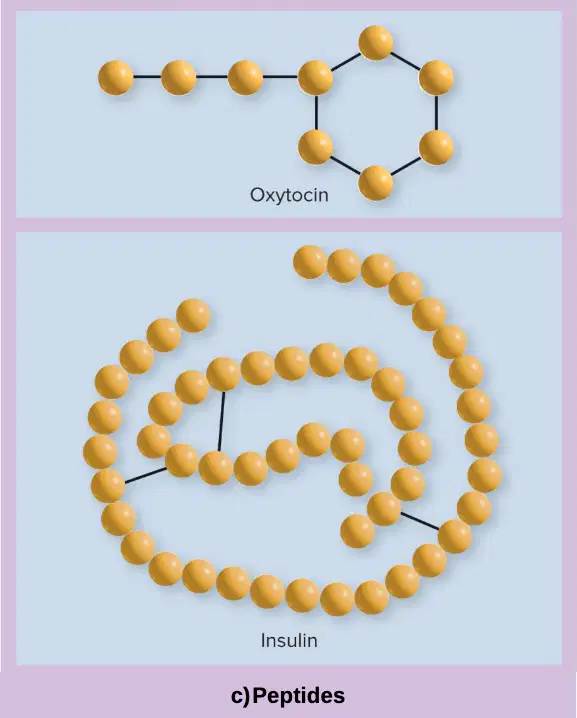
Which hormone is represented by a long chain structure in the diagram?
Oxytocin
Insulin
Estradiol
Epinephrine
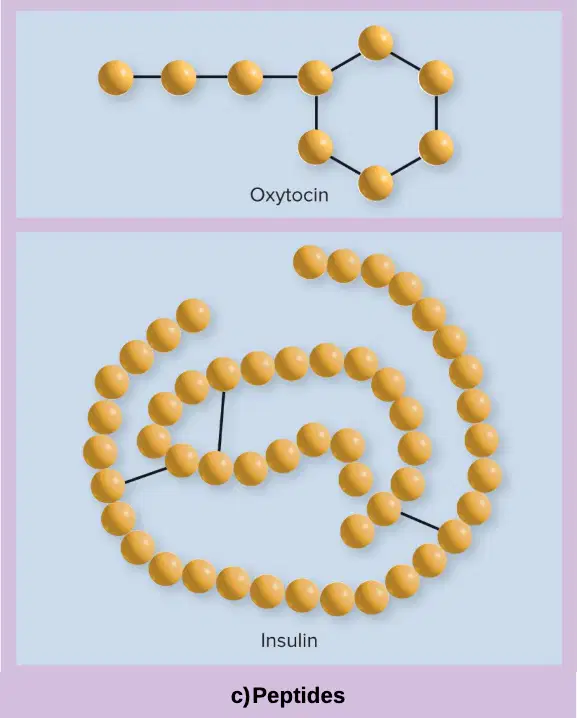
Which of the following hormones is classified as a peptide?
Estradiol
Oxytocin
Epinephrine
Thyroxine
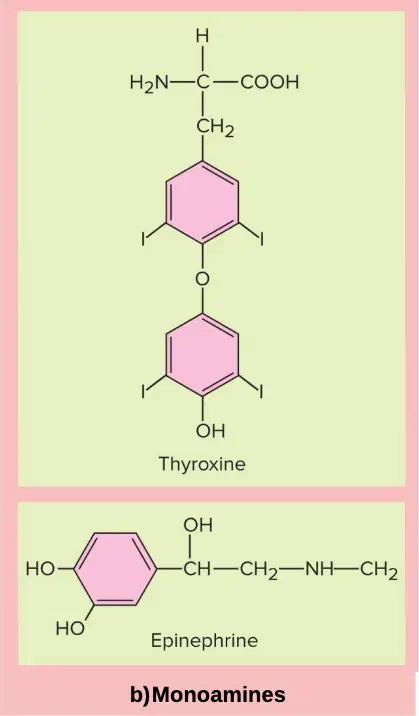
What is the chemical class of Epinephrine?
Steroids
Monoamines
Peptides
Lipids
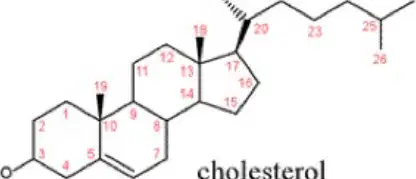
Which molecule serves as the base structure for hormones such as estradiol, testosterone, progesterone, cortisol, and aldosterone?
Cholesterol
Glucose
Amino acids
Fatty acids
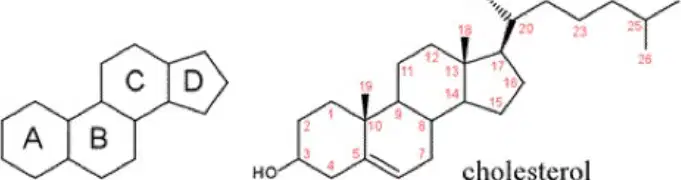
What is the primary structural feature that distinguishes cholesterol from its derivative hormones like estradiol and testosterone?
Presence of hydroxyl groups
Number of carbon atoms
Presence of aromatic rings
Absence of double bonds
Where are hormone receptors located?
Inside target cells or on their plasma membranes
Inside the bloodstream
On the surface of red blood cells
Inside the nucleus of all cells
What analogy is used to describe how a hormone fits into its receptor?
Like a puzzle piece fitting into a puzzle
Like a key fitting into a lock
Like a magnet attracting metal
Like a thread passing through a needle
Which hormone is described as the "key" that fits only in an insulin receptor "lock"?
Glucagon
Insulin
Thyroxine
Cortisol
What happens if a target cell does not have the proper receptors for a hormone?
The hormone binds to other receptor types
The target cell does not respond to the hormone
The hormone is absorbed by the bloodstream
The hormone changes its structure to fit the receptor
What characteristic prevents peptide hormones and most monoamines from passing into the target cell?
They are hydrophobic.
They are hydrophilic.
They lack receptors.
They are lipid-soluble.
Where do peptide hormones bind on the target cell?
Inside the nucleus.
On the cell surface if a receptor is present.
In the cytoplasm.
On the mitochondria.
What is the role of the hormone in the signaling process?
It acts as the second messenger.
It acts as the first messenger.
It activates the receptor directly.
It produces cyclic adenosine monophosphate (cAMP).
What is often produced as the second messenger inside the cell during hormone signaling?
Adenosine triphosphate (ATP).
Cyclic adenosine monophosphate (cAMP).
Guanosine triphosphate (GTP).
Phospholipase C.
What is cyclic AMP (cAMP) made by removing from ATP?
One phosphate
Two phosphates
Three phosphates
Four phosphates
Which of the following is a function of cyclic AMP (cAMP)?
Deactivates cytoplasmic enzymes
Activates or reactivates cytoplasmic enzymes
Inhibits metabolic effects
Prevents gene activation
Which of the following is an example of a metabolic effect caused by cyclic AMP (cAMP)?
Decreases permeability of the plasma membrane
Wakes up certain genes, producing new enzymes
Prevents glucagon from activating metabolic pathways
Stops enzyme production
How does cyclic AMP (cAMP) affect the plasma membrane?
Changes permeability of the plasma membrane
Prevents permeability changes in the plasma membrane
Blocks plasma membrane activity
Deactivates plasma membrane enzymes
Which hormone activates certain metabolic pathways through cyclic AMP (cAMP)?
Insulin
Glucagon
Thyroxine
Cortisol
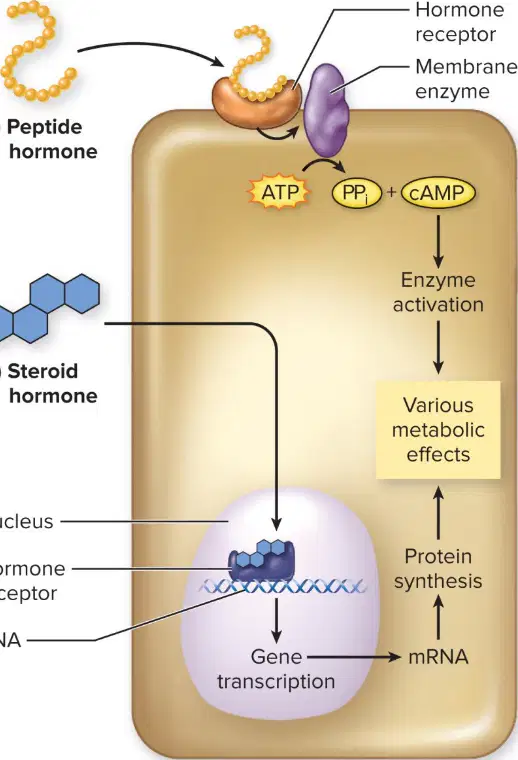
What is the primary difference between the action of peptide hormones and steroid hormones on a target cell?
Peptide hormones bind to DNA directly, while steroid hormones activate enzymes.
Peptide hormones bind to membrane receptors, while steroid hormones enter the nucleus to affect gene transcription.
Peptide hormones enter the nucleus, while steroid hormones bind to membrane receptors.
Peptide hormones activate gene transcription, while steroid hormones activate enzymes.
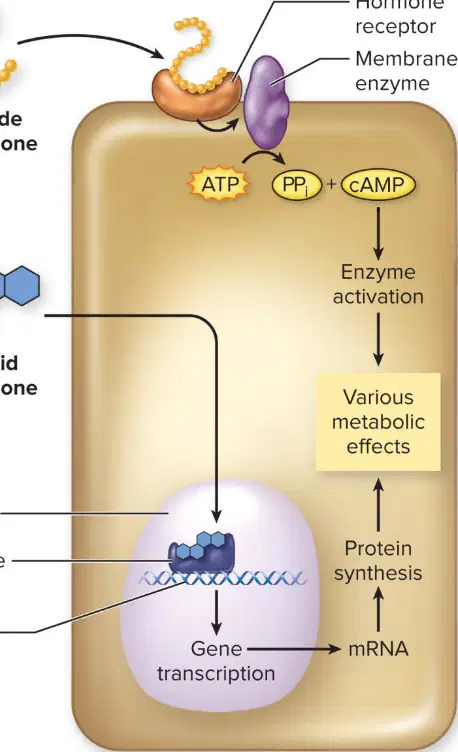
Which molecule is involved in the activation of enzymes as part of the peptide hormone signaling pathway?
DNA
cAMP
mRNA
Steroid hormone
What is the role of mRNA in the action of steroid hormones on a target cell?
mRNA binds to membrane receptors to activate enzymes.
mRNA is produced during gene transcription and directs protein synthesis.
mRNA activates metabolic effects directly.
mRNA is involved in the production of cAMP.
Which of the following is a direct effect of enzyme activation in the peptide hormone signaling pathway?
Gene transcription
Protein synthesis
Various metabolic effects
DNA replication
What characteristic allows steroid hormones to readily cross the plasma membrane into the cell?
They are hydrophilic.
They are hydrophobic.
They are positively charged.
They are negatively charged.
Where do most steroid hormones bind after crossing into the nucleus?
To a receptor associated with the DNA.
To the plasma membrane.
To the cytoplasm.
To the ribosomes.
What is the result of a gene being transcribed due to the action of steroid hormones?
Production of a specific protein.
Breakdown of the plasma membrane.
Formation of new DNA strands.
Increase in cell division.
How does the protein produced by the action of steroid hormones affect the cell?
It alters metabolism in various ways.
It destroys the nucleus.
It inhibits gene transcription.
It increases the size of the cell.

