

8.3.1-Electric Charge & Electric Forces

Presentation
•
Science
•
8th Grade
•
Medium
+21
Standards-aligned

Jessica Freeman
Used 3+ times
FREE Resource
44 Slides • 31 Questions
1

2

3

4

5

6

7
Multiple Choice

8
Multiple Choice

9
Multiple Choice

10
Multiple Choice

11
Multiple Choice

12
Multiple Choice
How would you write a Sulfur that has gained 2 electrons?
S+2
S-2
S+6
S-6
13
Multiple Choice
A Bromine ion gains 1 electron, which of the following is the correct symbol for a Bromine ion?
Br-1
Br+1
Br+7
Br-7
14

15

16

17
Multiple Choice
) When an object has more negative charge than positive charge, the object is called _____.
A) electric discharge
B) magnetic domain
C) electric field
D) electrically charged
18

19
Multiple Choice
An object with equal amounts of positive and negative charge is electrically _____.
A) charged
B) negative
C) neutral
D) positive
20

21

22
Electrons are a part of atoms (makes up stuff) that can move
The sudden movement of charges is the ZAP you feel
The build up of electric charges (electrons) causes objects to produce a force

23
When an objects gains electrons, it becomes more negative
When an object loses electrons, it becomes more positive
If an object has the same amount of positive charges as negative charges, then it will be neutral
24
Objects may pick up electrons to become negative, or lose electrons to become positive. Or, if they have an equal amount of + and -, they are neutral

25
Multiple Choice
If an object gains electrons, it will be...
positively charged
negatively charged
neutral
26
- Charges that are like (both positive, or both negative) will repel - or move away from each other.
- Charges that are different will attract, or move near each other

27
Multiple Choice
Two objects that are both positively charged will
attract each other
repel each other
do nothing
28
Multiple Choice
Two objects that have opposite charges (one positive, one negative) will
attract each other
repel each other
do nothing
29
Multiple Choice

What type of charge does this balloon have?
postive
negative
neutral
30

31

32

33

34
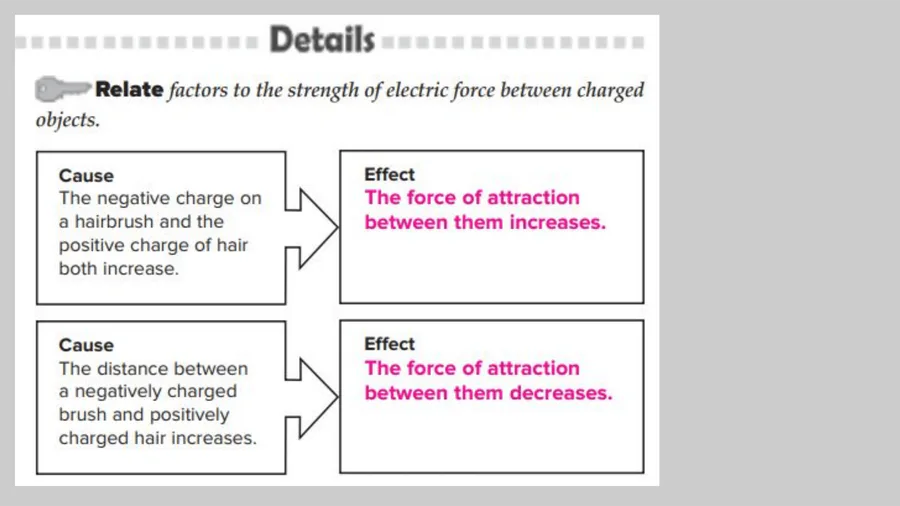
35
and Ways to Charge

36
Have you ever noticed that electrical cords are often made from metal and plastic? Different materials are used because electric charges move through some materials more easily than they move through others. Most materials are either conductors or insulators based on home easily charges move in them.
37
An electrical conductor is a material in which charges can move easily. Most metals are good conductors because their electrons are free to move. Conductors are used to make wires. Copper, aluminum, and mercury are good conductors.

38
An electrical insulator is a material in which charges cannot move easily. Insulators do not conduct charges very well because their electrons cannot flow freely. Insulation around wires are made of insulators. Plastic, rubber, glass, wood, and air are good insulators.

39

40
Multiple Choice
What is the difference between insulators and conductors?
Insulators allow electricity to flow easily and conductors do not.
Conductors allow electricity to flow easily and insulators do not.
Conductors are used only for electricity and insulators are used only for heat.
Insulators are used only for electricity and conductors are used only for heat.
41
Multiple Select
Select the conductors.
copper
wood
air
mercury
rubber
42
Multiple Select
Select the insulators.
aluminum
plastic
glass
steel
diamond
43

44

45

46
Charging by friction happens when electrons are "wiped" from one object to another. If you use a cloth to rub a plastic ruler, electrons move from the cloth to the ruler. The ruler gains electrons and becomes negatively charged. At the same time, the cloth loses electrons and becomes positively charged.

47
Charging by conduction happens when electrons move from one object to another by direct contact. Suppose you touch an uncharged piece of metal with a positively charged glass rod. Electrons from the metal will move to the glass rod. The metal loses electrons and becomes positively charged.

48
Charging by induction happens when charges in an uncharged metal object are rearranged without direct contact with a charged object. Suppose you hold a metal object near a positively charged object. The electrons in the metal are attracted to and move toward the positively charged object. This movement induces an area of negative charge on the surface of the metal.

49
These are not in the correct order. Label each one with an "I" for induction, a "C" for conduction, or a "F" for friction.
(you could also choose to color code them instead)

50
Fill in the Blanks
Type answer...
51
Fill in the Blanks
Type answer...
52
Fill in the Blanks
Type answer...
53
Cut and glue these notes onto
page 95 in your notebook.

54
Multiple Select
Select the two that are true.
Insulators are usually charged by friction.
Conductors are usually charged by friction.
Insulators are usually charged by conduction and induction.
Conductors are usually charged by induction and conduction.
Conduction, induction, and friction are used to charge both conductors and insulators.
55

56

57

58

59

60
Multiple Choice
What do we call it when two objects rub together?
friction
conduction
induction
electroscope
61
Multiple Choice
What is it called when a charged object induces a charge onto a neutral object without direct contact?
friction
conduction
induction
electroscope
62
Multiple Choice
What is it called when electrons are transferred by direct contact?
friction
conduction
induction
electroscope
63

64

65
66

67

68
Multiple Choice
What causes the electric discharge between the body and the sweater?
Magnetic field
Chemical reaction
Exchange of electrons during friction
Static electricity
69
Multiple Choice
What form of energy is released during the electric discharge?
Electrical energy
Thermal energy
Kinetic energy
Potential energy
70
Multiple Choice
What is the result of the energy release during the electric discharge?
Emission of magnetic and gravitational waves
Production of water and air
Creation of solid and liquid
Production of light, heat, and sound
71
Multiple Choice
Why does a crackling sound occur during the electric discharge?
Rapid expansion and contraction of air
Friction between two surfaces
Static electricity buildup
Presence of water vapor in the air
72
Multiple Choice
What is the role of friction in the electric discharge?
Reducing static electricity
Preventing the generation of electricity
Generating static electricity
Attracting electricity from the environment
73
Multiple Choice
How does the electric discharge between the body and the sweater occur?
The electric discharge occurs due to the heat generated between the body and the sweater.
Electrons are transferred from one to the other, causing an imbalance of charge and resulting in an electric discharge.
Protons are transferred from one to the other, causing an imbalance of charge and resulting in an electric discharge.
The body and the sweater repel each other, causing an electric discharge.
74
Multiple Choice
What happens to the energy released during the electric discharge?
It is converted into mechanical energy
It is absorbed by the surrounding materials
It disappears without any effect
It is released in the form of light, heat, and sound.
75
Multiple Choice
What is the significance of the crackling sound during the electric discharge?
The crackling sound is caused by the rapid expansion and contraction of air due to the heat produced by the electric current.
The crackling sound is a sign of impending thunderstorm
The crackling sound is a result of the electric current being too weak
The crackling sound is caused by the presence of tiny insects in the air
Show answer
Auto Play
Slide 1 / 75
SLIDE
Similar Resources on Wayground

75 questions
Recovery: CRM 2.3 Properties and Changes of Matter
Presentation
•
8th Grade
65 questions
Review and Moon
Presentation
•
8th Grade
73 questions
PhySci Final Review 5: Matter
Presentation
•
9th Grade
63 questions
Chemistry Unit Review
Presentation
•
8th Grade
63 questions
Review of Chemistry
Presentation
•
8th Grade
65 questions
Physical Science Bonding
Presentation
•
9th - 10th Grade
64 questions
Energy Transfer
Presentation
•
6th - 9th Grade
68 questions
Unequal Heating of Earth
Presentation
•
6th Grade
Popular Resources on Wayground
10 questions
Safety Day 2026 – Student Review

Quiz
•
9th Grade
21 questions
Continents and Oceans
Quiz
•
6th Grade
20 questions
Parts of Speech
Quiz
•
5th Grade
16 questions
Subject & Predicate
Quiz
•
5th Grade
25 questions
Multiplication Facts
Quiz
•
5th Grade
12 questions
Map Skills
Quiz
•
3rd Grade
22 questions
Continents and Oceans
Quiz
•
5th Grade
15 questions
Rounding Decimals
Quiz
•
5th Grade
Discover more resources for Science
20 questions
Newton's Laws of Motion
Quiz
•
8th Grade
15 questions
potential and kinetic energy
Quiz
•
8th Grade
21 questions
Newton's Laws of Motion
Quiz
•
8th Grade
20 questions
Elements, Compounds and Mixtures
Quiz
•
8th Grade
10 questions
Exploring Chemical and Physical Changes

Interactive video
•
6th - 10th Grade
20 questions
Physical vs Chemical Changes
Quiz
•
8th Grade
20 questions
Conduction, convection, and Radiation Practice
Quiz
•
8th Grade
21 questions
Waves and Wave Properties
Quiz
•
6th - 8th Grade