How the Ottawa Catholic School Board used Wayground Common Assessments to improve literacy scores district-wide

The Ottawa Catholic School Board (OCSB) runs 90 schools across Canada's national capital, serving more than 50,000 students. When their Learning Technologies team went looking for tools that could hold up to a district-wide licence, Wayground made the cut.
Halfway through the 2024-2025 school year, that relationship got more specific. The OCSB team wanted to use Wayground's assessment tool, which had already seen strong classroom adoption across the district, to create and share common literacy assessments with their Grade 3 and Grade 6 teachers. The bigger question was whether the data could scale up, not just to the classroom, but to the school and district level. They came to the right place at the right time: Wayground's Common Assessments tool had just launched, and OCSB jumped in as an early adopter.
Why Wayground Common Assessments
The OCSB wasn't looking to add another tool. They were looking for something that could put actionable data in front of teachers and roll it up to the school and district level at the same time. Geoff Edwards, their Superintendent of Learning Technologies, put it directly:
"At the Ottawa Catholic School Board we were looking for a way to provide common assessments that would allow us to give authentic practice for provincial testing. This approach ensures we have data that is actionable at every tier, from individual classrooms at school sites to the entire Board."
Julian Daher, Coordinator of Learning Technologies, pointed to what made Wayground the right fit technically:
"We chose Wayground at the district level to leverage its automated data-syncing capabilities and adaptive interface, ensuring our EQAO prep mirrors the digital complexity of the actual provincial assessment. By integrating this innovative platform, we provide educators with real-time diagnostic analytics that transform static testing into a responsive, tech-forward learning experience."
For Christina Colasante, a K-6 Literacy Consultant, the priority was specificity.
"The Board goal was to have students complete practice assessments in order to provide instructional next steps for teachers. In order to do this effectively we needed to be able to tag questions with specific skills that were assessed in EQAO — vocabulary, explicit, implicit. Wayground was able to meet all of these requirements."
She went on to describe what that would make possible:
"Ultimately, this targeted approach would transition the assessment data from being a measure of student results to a powerful diagnostic tool for instructional planning and timely professional learning, directly impacting student achievement across the district. For example, if we noticed at the district level that most of the schools were struggling with inferential questions, we may create Board-wide Grade 3 and 6 lessons to support that skill."
Implementing Common Assessments across the district

Nina Carlucci, a K-12 Learning Technologies Consultant with the OCSB, led the early implementation of Common Assessments across the district. From the start, keeping teacher workload in check was the priority:
“When we first started looking at how to handle Common Assessments, we knew we wanted to make sure that it wouldn't just be ‘one more thing’ on a teacher’s plate. We leveraged Wayground because it helps us close the loop—it doesn’t just spit out scores; it gives teachers a clear path for guided practice and next steps, based on the curriculum expectations and standards we provided, both implicit and explicit in reading and specific expectations in writing.”
After the first year, the participation numbers said it plainly:
“Seeing our participation jump from 1,500 to 4,200 students told us everything we needed to know: people are using it because it actually works for them.”
And, in reflecting on how others responded, she shared the following summaries:
- Teachers & Staff: The "buy-in" really happened once they saw the data. It’s been a game-changer to have our literacy team take that info and immediately turn it into classroom-ready resources.
- Principals: They love it because it takes the guesswork out of their School Achievement Plans (SAP). They can finally see exactly where their students are and track those literacy goals with confidence.
- Students: Honestly, they just find it easy. They log in, click the assessment, and they’re good to go. No hurdles, no confusion—just a very user-friendly experience.
While a variety of factors can be attributed to these gains, the year-over-year EQAO results tell a clear story. Comparing Grade 3 and Grade 6 reading and writing scores from 2024, before implementing common assessments, to 2025 results after implementing Wayground, Grade 3 saw a +5 in reading and +2 in writing. In Grade 6, those gains were +5 in reading and +6 in writing.
In considering the first year of implementation and thinking about next steps in 2026 and beyond, Sarah Lawrence, a K-6 Literacy Learning Partner and Elementary Student Success lead with the OCSB, noted:
“Our initial decision to partner with you stemmed from Wayground being the closest available platform to virtually model the online EQAO format. This has proven invaluable in allowing us to tag different literacy skills and, most importantly, obtain real-time data to look for instructional trends and patterns across our system. While we weren't able to fully action that data last year, we are excited to launch Wayground across our system and use the insights to directly guide the creation of targeted PD and teacher resources moving forward.”
When asked about what it has been like working with the Wayground team through this planning and implementation, Lawrence added:
“Your team was exceptionally open to feedback and made timely adjustments, which is crucial for large-scale implementation. Everyone was very friendly and great to work with. Though we initially focused on Grade 3 and Grade 6 EQAO practice, we now clearly see the value and are open to expanding Wayground use to other grades.”
What Teachers, Principals, and Students experienced
The Wayground Common Assessment tool starts with a central team creating an assessment, then sharing it quickly with educators spanning multiple schools and classrooms across the district. Teachers get notified and then assign the Common Assessment to their class. Students get valuable practice, teachers can see data right away, and school administrators get school-level insights at the same time.
Abigail Brownley, a Grade 6 teacher with the OCSB described what that looked like week to week in her classroom:
“I can monitor individual and class-wide growth in real-time, identifying specific strands such as making inferences or identifying main ideas where students might need extra support. Rather than a "cram session" in May, Wayground facilitates a steady, manageable pace of practice. I have seen the growth of my students each week as they complete the practice tests. Early sessions were often met with hesitation. Through consistent weekly use, that friction has disappeared. I have seen students transform from passive readers into active test-takers who know exactly how to use digital tools to highlight evidence and structure their thoughts. Comparing our initial baseline data to our current stats shows an upward trend in accuracy and completion rates. Students who once struggled to articulate an inference are now doing so with confidence and speed.”
Grade 3 teacher Alex De Ciantis shared a similar experience, with an added layer: setting accommodations for students who needed them.
“Wayground has been an invaluable tool in the classroom for my group. Especially with Grade 3 being an EQAO year, being able to simulate EQAO-style questions, while also being able to set accommodations for students has made a huge difference in how we have prepared. It has helped to make studying for various subjects a bit more fun and engaging for the students. I also love the data that you are able to gather from using the platform, which makes it easy to track improvement over time.”
De Ciantis asked his students about their experiences. One student shared:
“I like that we do lots of activities on it and I like it because it helps me understand things more,”
While another student added,
“I like Wayground because it helps you learn a lesson on a computer and it makes it fun because you get to answer questions. I like that it isn't too hard to use.”
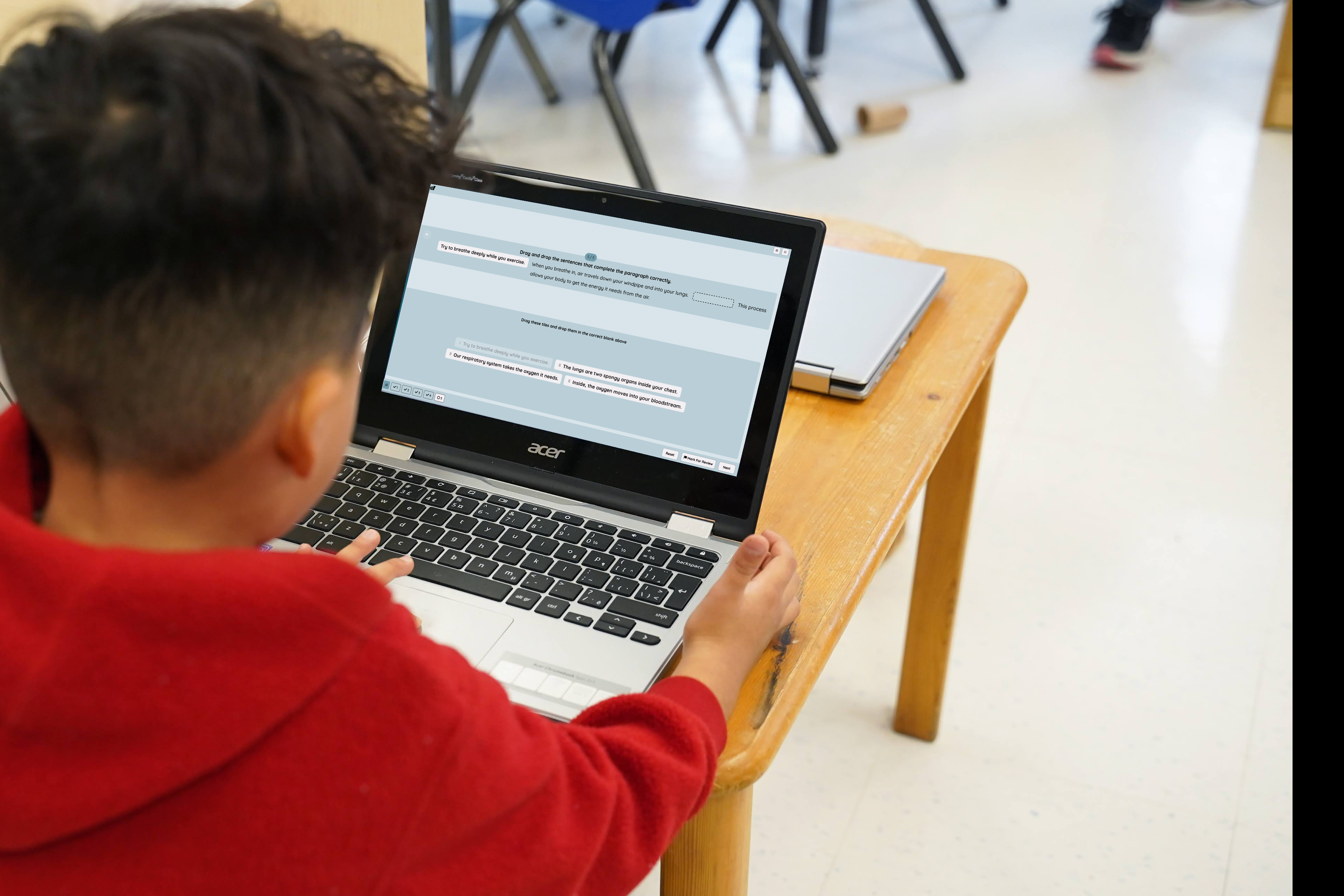
Implementation of new practices and tools can be a challenge in schools. When a central district team does their best to create and share resources but often does not have the bandwidth to be on the ground in every building. When asked to share how implementation of Common Assessments went at St. Rose of Lima School, Vice Principal Marina Summers shared:
“Transitioning to digital assessments can be daunting for educators comfortable with traditional paper-and-pencil methods, yet Wayground has effectively removed the fear of the unknown from EQAO. Wayground has the ability to bridge the gap between tactile and digital learning. By providing students with early, consistent access to the platform before high-stakes EQAO testing, we allow them to build digital fluency through ‘learning by doing.’ As students navigate weekly assessments, their anxiety subsides, enabling them to shift their focus from the mechanics of the interface to curriculum mastery. The platform’s real-time data feedback is a game-changer! It empowers teachers with immediate insights into student progress while providing actionable analytics necessary to drive instructional growth. Wayground hasn't just replaced pencil and paper, it has evolved our approach to student achievement.”
Beyond the classroom experience, the data Wayground Common Assessments generates has shifted how school leaders make instructional decisions. Kim Hutchinson, Principal at St. Clare School, described what that shift looked like for her staff:
“Wayground’s data feature has shifted our instructional approach from guesswork to Targeted Instruction. As a leader, seeing my teachers use real-time data to identify full class and individual gaps is transformative. We have always valued professional judgment, but we now have the evidence to back up our classroom observations. This isn't just about EQAO success; it’s about elevating our everyday teaching practice through an incredibly detailed data hub that provides explicit tags and actionable next steps. This not only assists my teachers in providing next steps, it furthers my students along in the areas they need.”