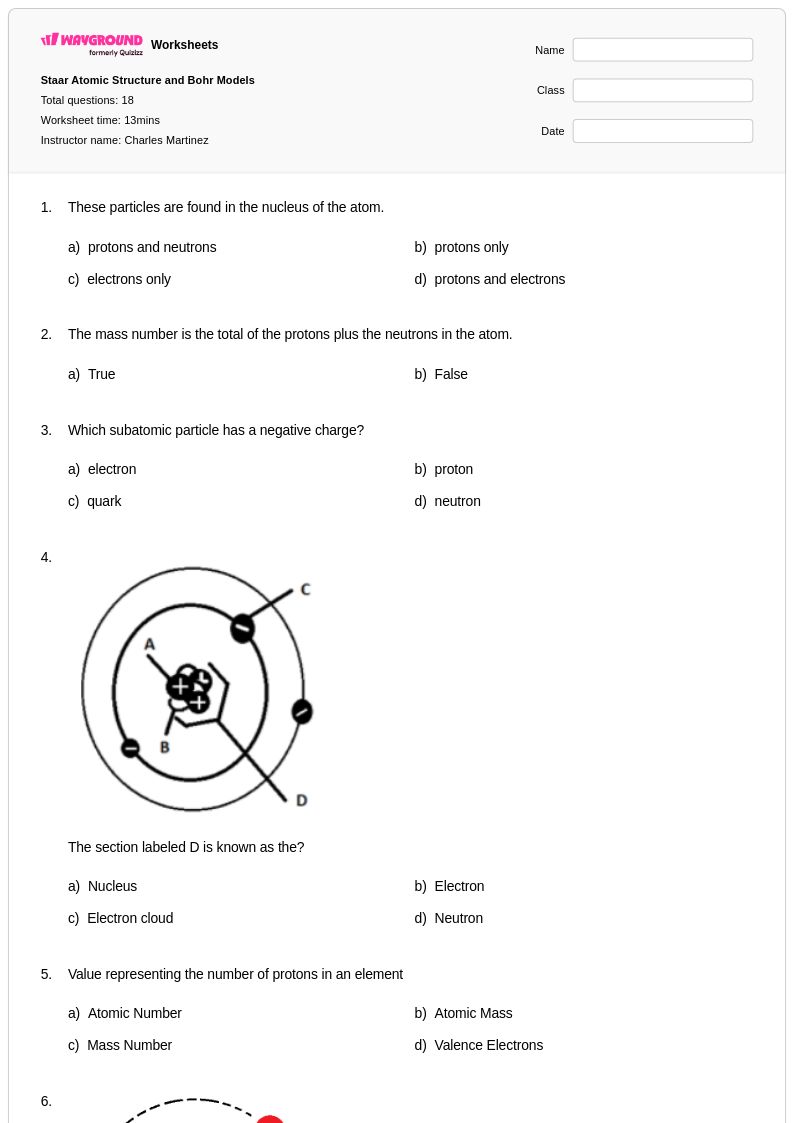
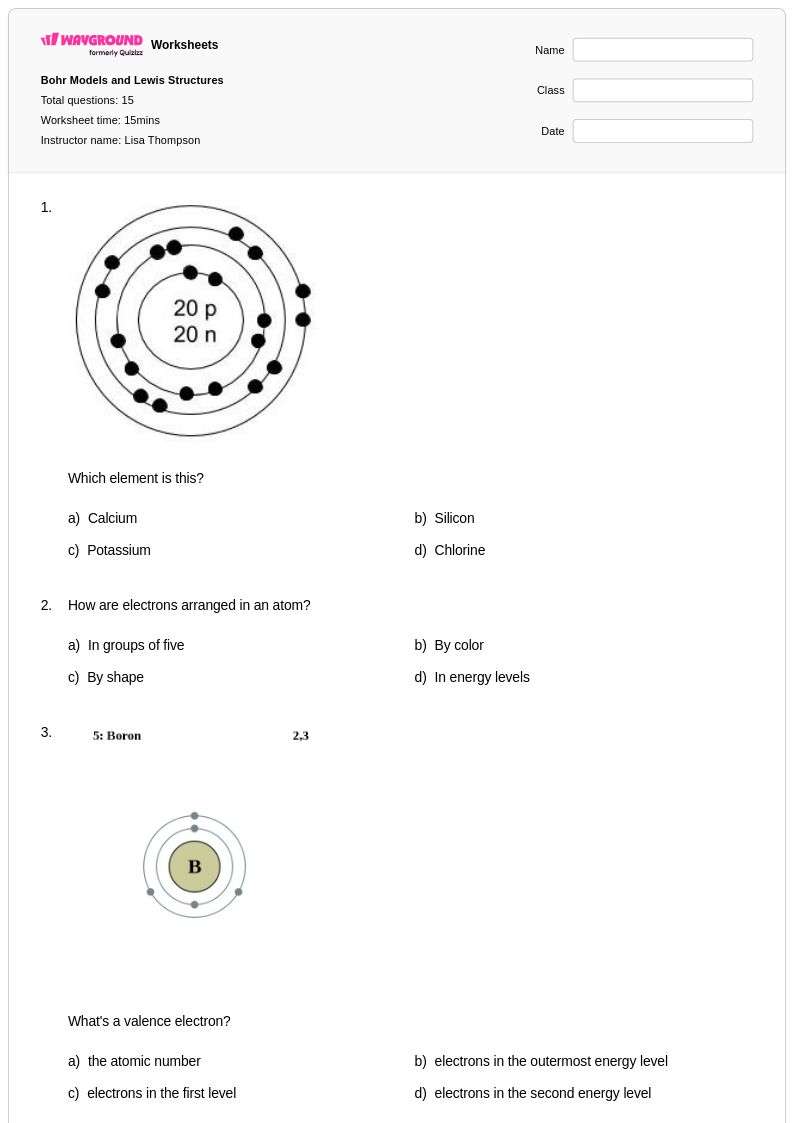
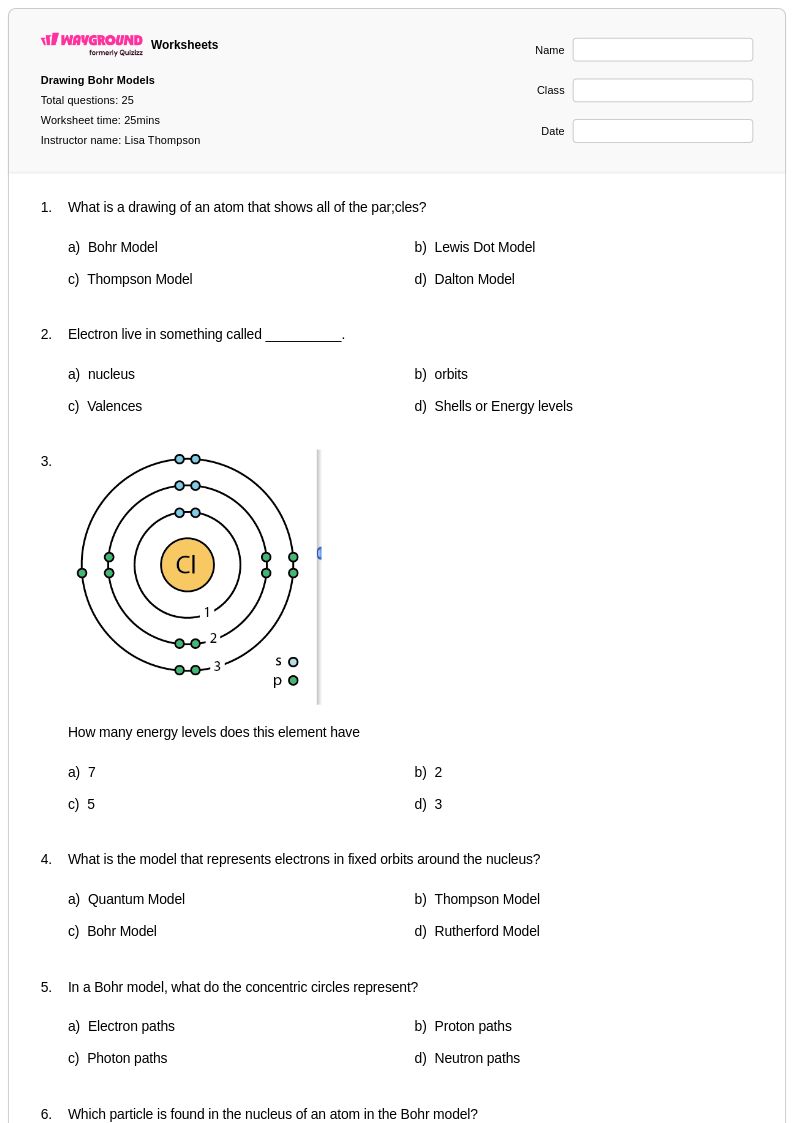
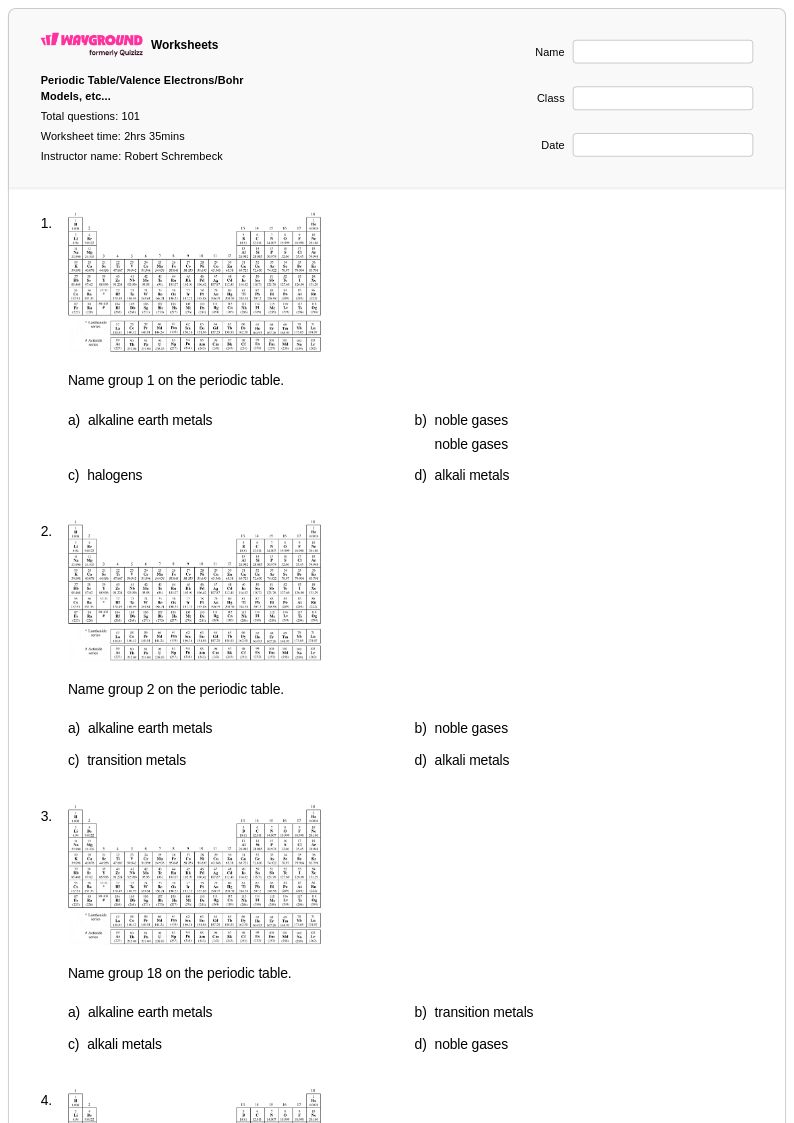
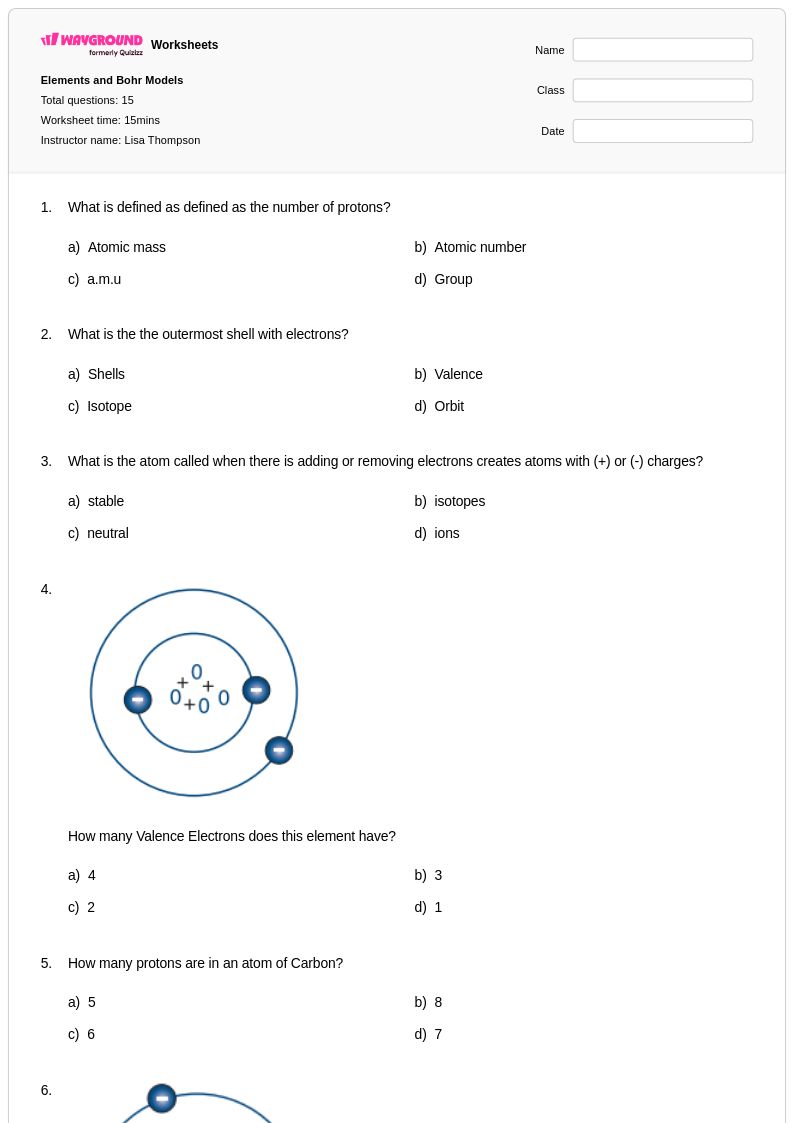
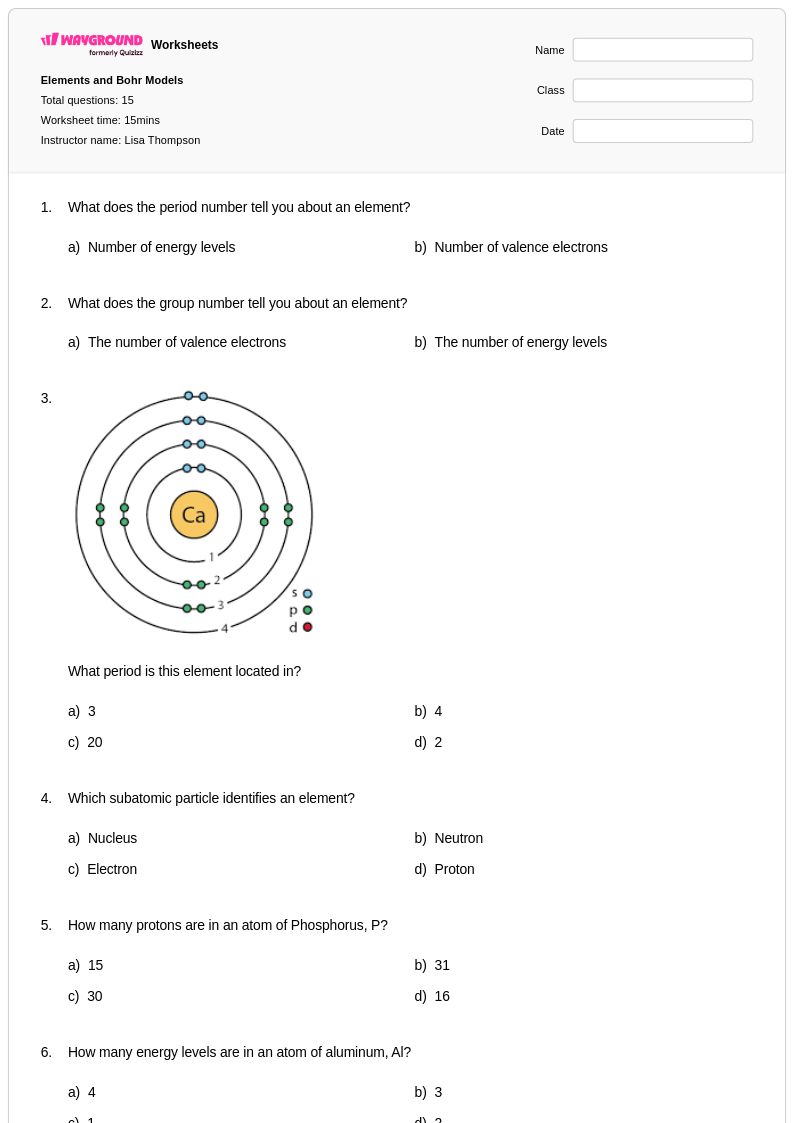
Free Year 9 Bohr Model worksheets and printables from Wayground help students master atomic structure concepts through engaging practice problems and comprehensive answer keys in downloadable PDF format.
Explore printable Bohr Model worksheets for Year 9
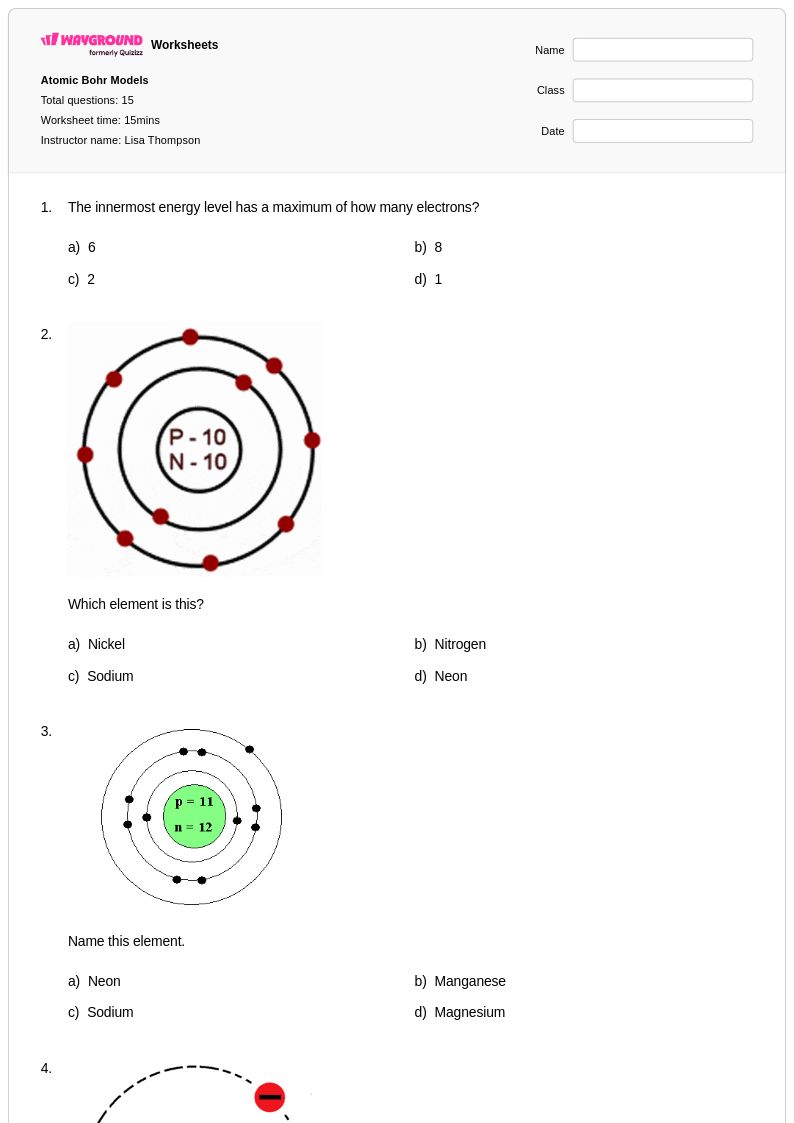
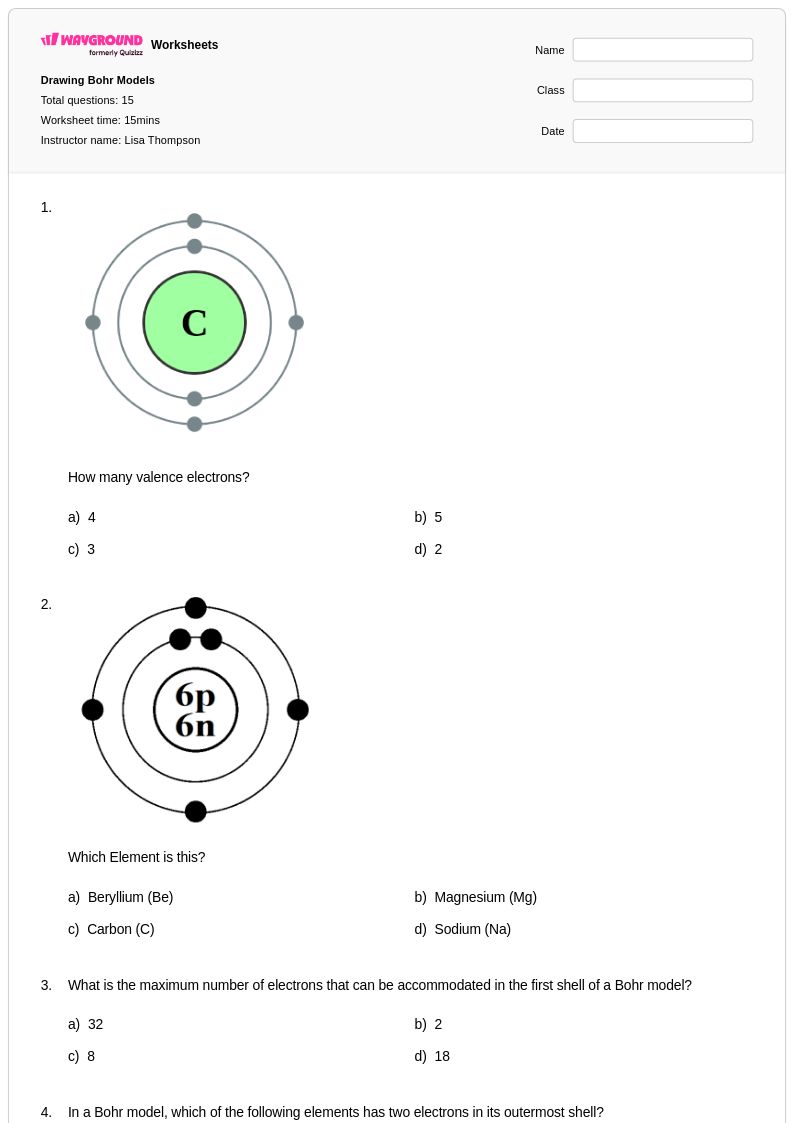
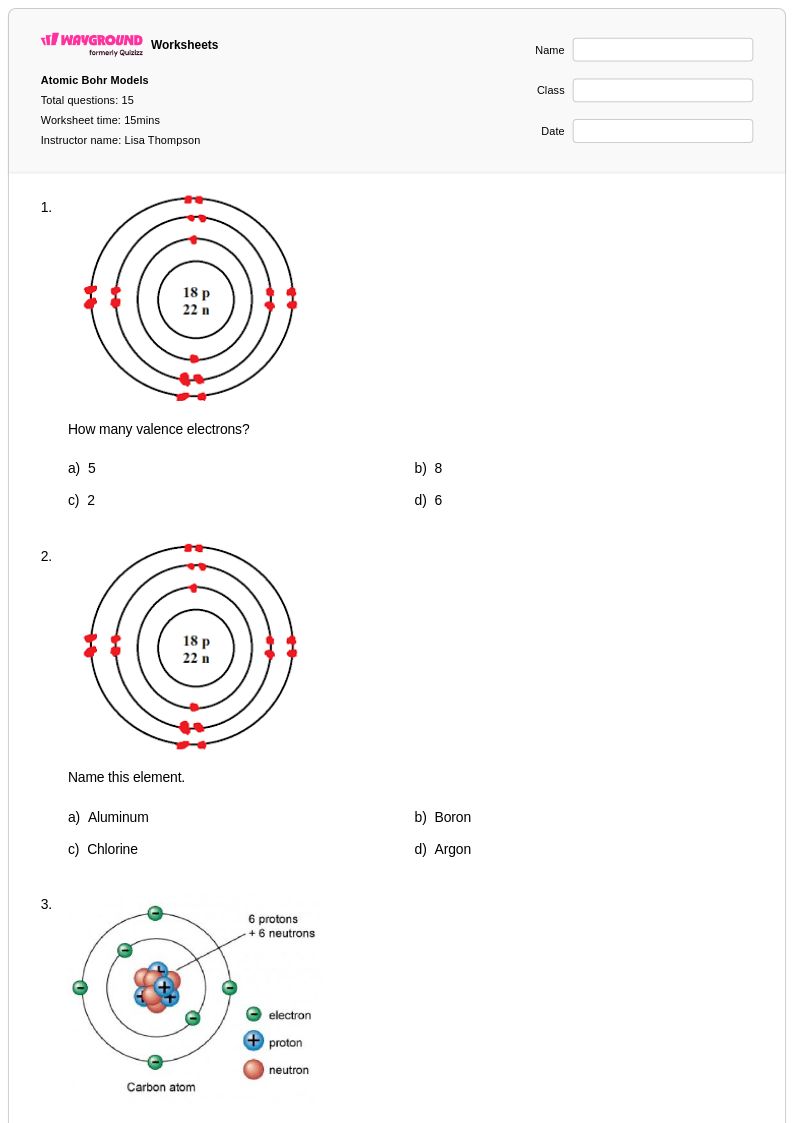
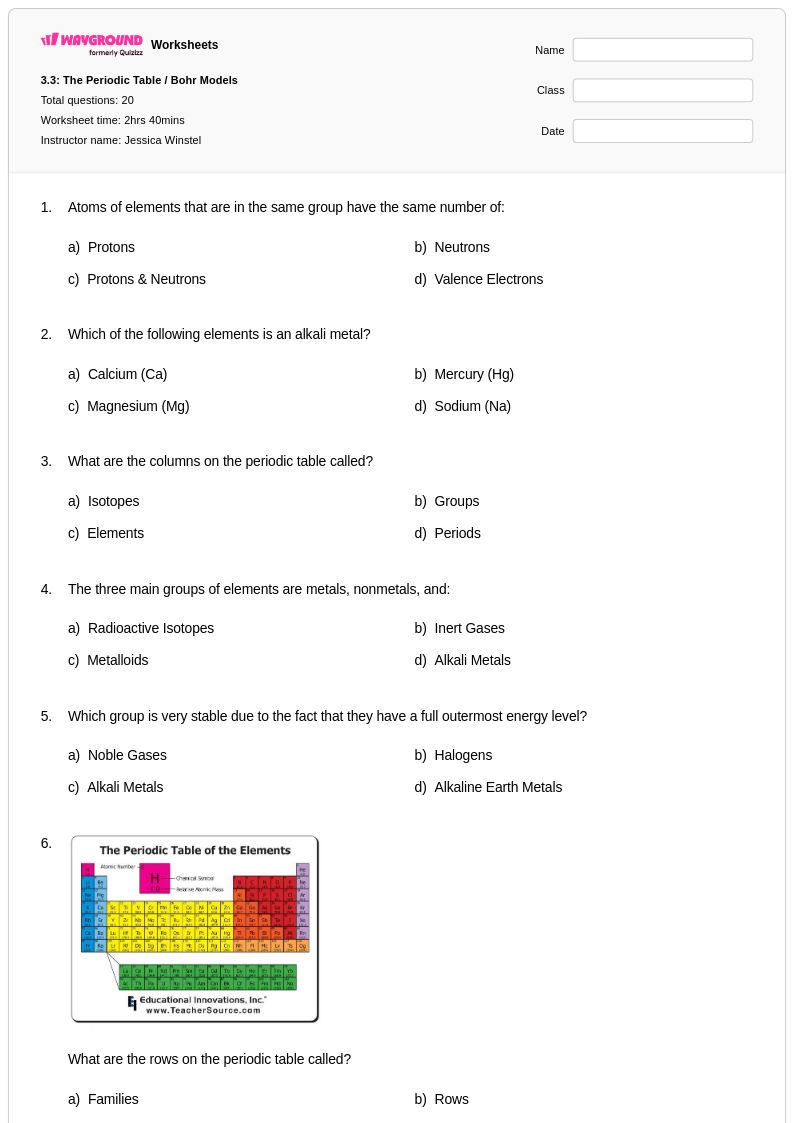
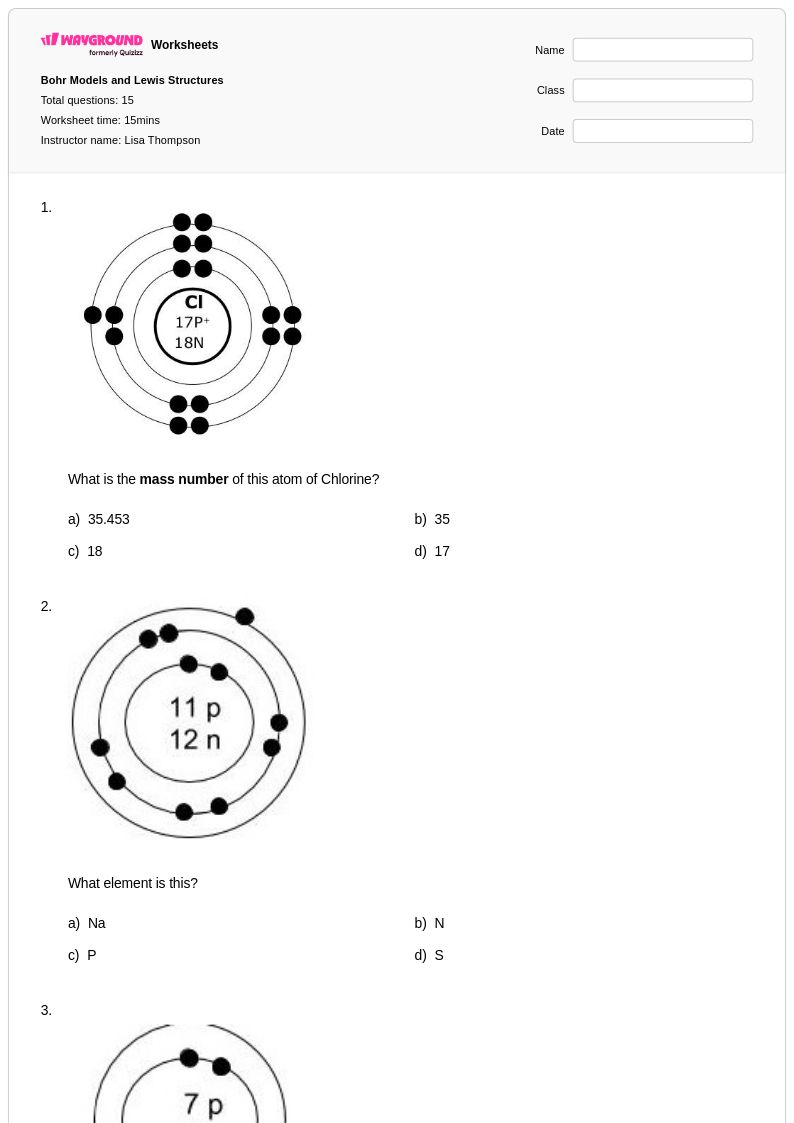
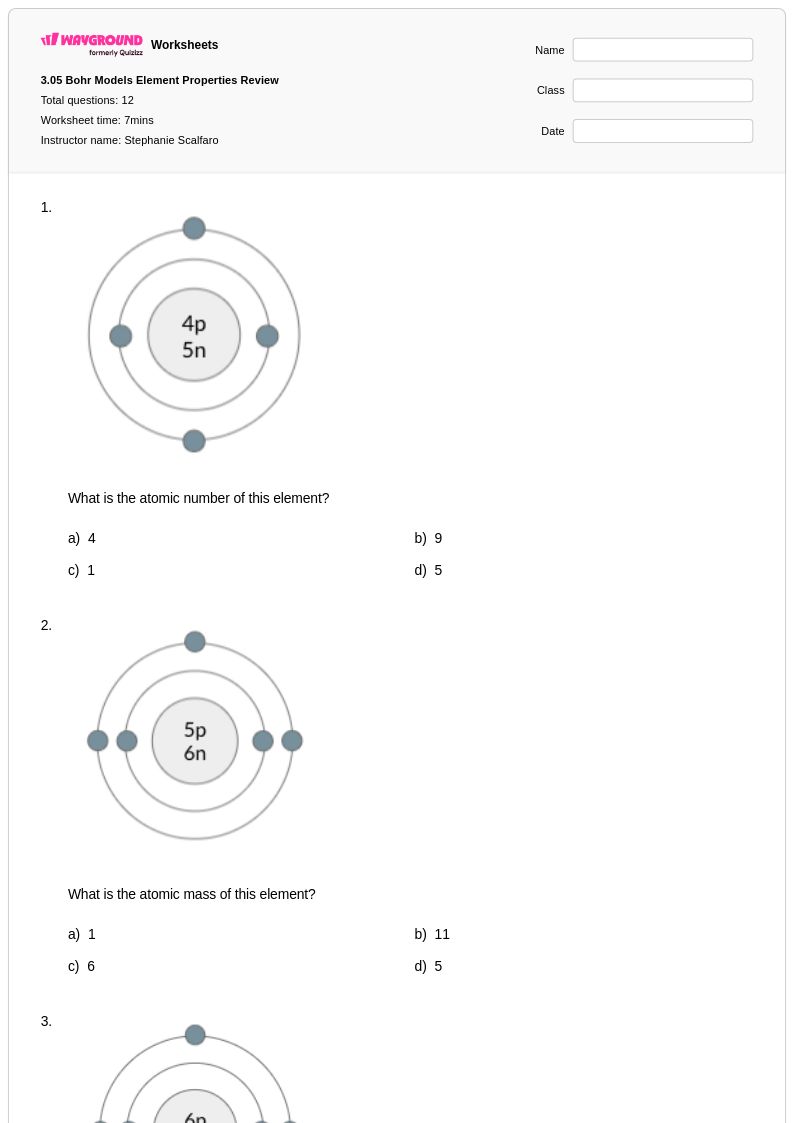
Year 9 Bohr Model worksheets available through Wayground (formerly Quizizz) provide comprehensive practice materials that help students master atomic structure fundamentals and electron configuration concepts. These educational resources strengthen critical chemistry skills including visualizing electron energy levels, calculating electron positions in different orbital shells, and understanding the relationship between atomic number and electron arrangement. Students work through practice problems that reinforce their ability to draw accurate Bohr diagrams for various elements, interpret spectral data, and connect atomic structure to chemical properties. The collection includes detailed answer keys that support independent learning and self-assessment, while printable pdf formats ensure accessibility for both classroom instruction and homework assignments, making these free resources invaluable for building foundational chemistry knowledge.
Wayground (formerly Quizizz) empowers educators with millions of teacher-created Year 9 Bohr Model worksheet collections that feature robust search and filtering capabilities, enabling quick identification of materials aligned with specific curriculum standards and learning objectives. The platform's differentiation tools allow teachers to customize content complexity and modify practice problems to meet diverse student needs, while flexible formatting options provide both printable and digital versions including downloadable pdfs for seamless integration into any instructional environment. These comprehensive features support effective lesson planning by offering immediate access to varied practice exercises, facilitate targeted remediation through focused skill-building activities, and enable enrichment opportunities for advanced learners, ultimately helping chemistry educators create engaging learning experiences that deepen student understanding of atomic structure and electron behavior.
FAQs
How do I teach the Bohr model of the atom to chemistry students?
Start by grounding students in the problem Bohr was solving: why electrons don't spiral into the nucleus and why elements emit light at discrete wavelengths. Introduce the concept of quantized energy levels before moving into electron shell diagrams, so students understand the model as an explanation rather than an arbitrary rule. Visual representations of electron transitions, paired with emission spectra data, help students connect the abstract model to observable phenomena. Building from Rutherford's model to Bohr's and then signposting modern quantum mechanics gives students a coherent historical and conceptual arc.
What practice problems help students master Bohr model concepts?
Effective Bohr model practice includes drawing electron shell diagrams for elements across the first three periods, calculating the energy of photons emitted or absorbed during electron transitions using the Rydberg formula, and identifying the number of electrons in each energy level for a given element. Problems that ask students to predict which spectral lines correspond to specific transitions reinforce the link between energy differences and light wavelength. Mixing diagram-based tasks with calculation problems ensures students develop both visual understanding and mathematical fluency.
What common mistakes do students make when working with Bohr model diagrams?
The most frequent error is misassigning the number of electrons per shell, particularly confusing the maximum capacity of each energy level with the actual electron count for a specific element. Students also commonly conflate the Bohr model with the quantum mechanical model, applying orbital subshell rules where simple shell rules apply. Another persistent mistake is treating electron transitions as random rather than energy-driven, leading to errors in predicting emission versus absorption. Explicitly teaching that electrons move to higher levels by absorbing energy and release energy as photons when dropping to lower levels corrects this misconception directly.
How do I use Bohr model worksheets from Wayground in my classroom?
Wayground's Bohr model worksheets are available as printable PDFs for traditional classroom use and in digital formats for technology-integrated environments, including the option to host them as a live quiz on the Wayground platform. The printable versions work well for guided practice, lab warm-ups, or homework assignments, while the digital format supports self-paced review and immediate feedback. Each worksheet includes a complete answer key, making them suitable for independent student work, peer-checking activities, or teacher-led correction. Wayground also supports student-level accommodations such as read aloud, extended time, and reduced answer choices, which can be applied individually so that all students engage with the content appropriately.
How does the Bohr model connect to emission spectra and what should students understand about that relationship?
The Bohr model explains emission spectra by proposing that electrons occupy discrete energy levels and release a photon of specific energy when they fall from a higher to a lower level, producing a characteristic spectral line for each transition. Each element's unique set of energy levels produces a unique spectral fingerprint, which is why hydrogen's emission spectrum differs from helium's. Students should understand that the color of emitted light corresponds directly to the energy difference between two levels, connecting the mathematical energy calculation to a visible, measurable outcome. This relationship is one of the model's most powerful teaching moments because it ties abstract atomic theory to experimental evidence students can observe.
How can I differentiate Bohr model instruction for students at different ability levels?
For foundational learners, focus on drawing shell diagrams for the first 18 elements using the 2-8-8 rule before introducing any calculations. Intermediate students can practice identifying valence electrons and connecting shell diagrams to periodic table position. Advanced learners can explore the mathematical relationship between energy levels using the Rydberg equation and begin examining where the Bohr model breaks down for multi-electron atoms. On Wayground, teachers can assign accommodations such as reduced answer choices or read aloud to specific students without affecting the experience of the rest of the class, making differentiation manageable within a single digital assignment.