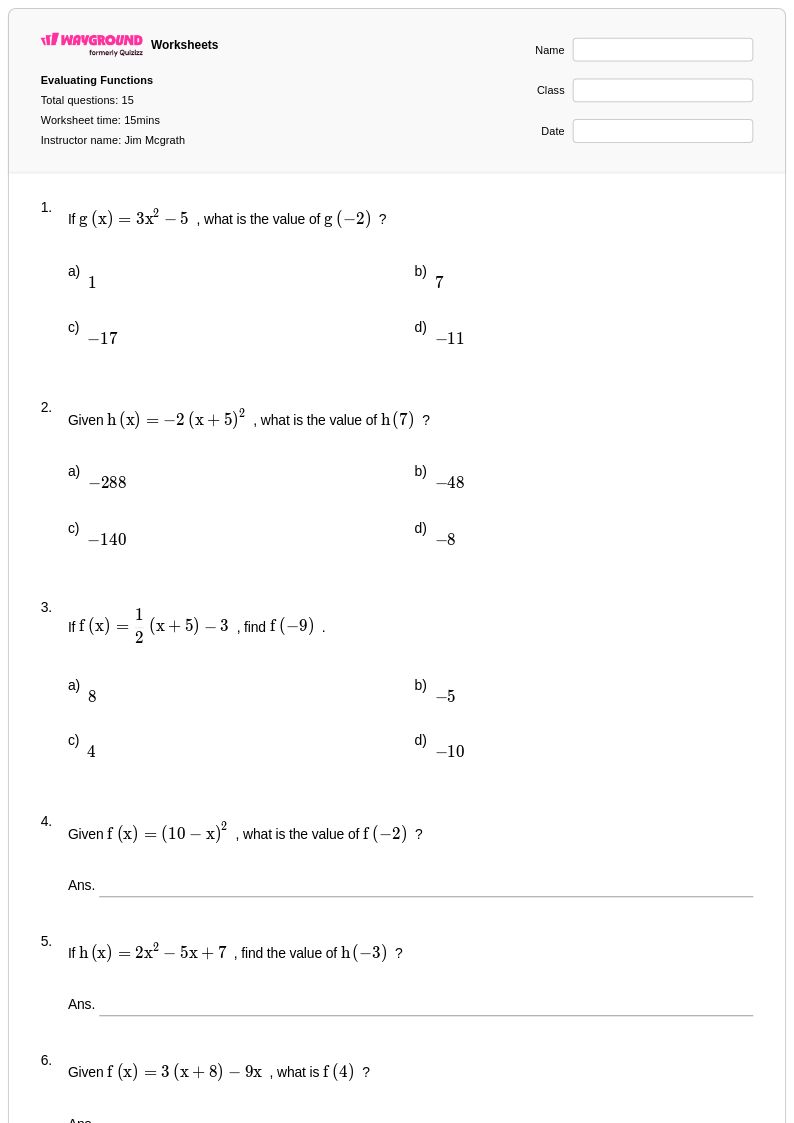
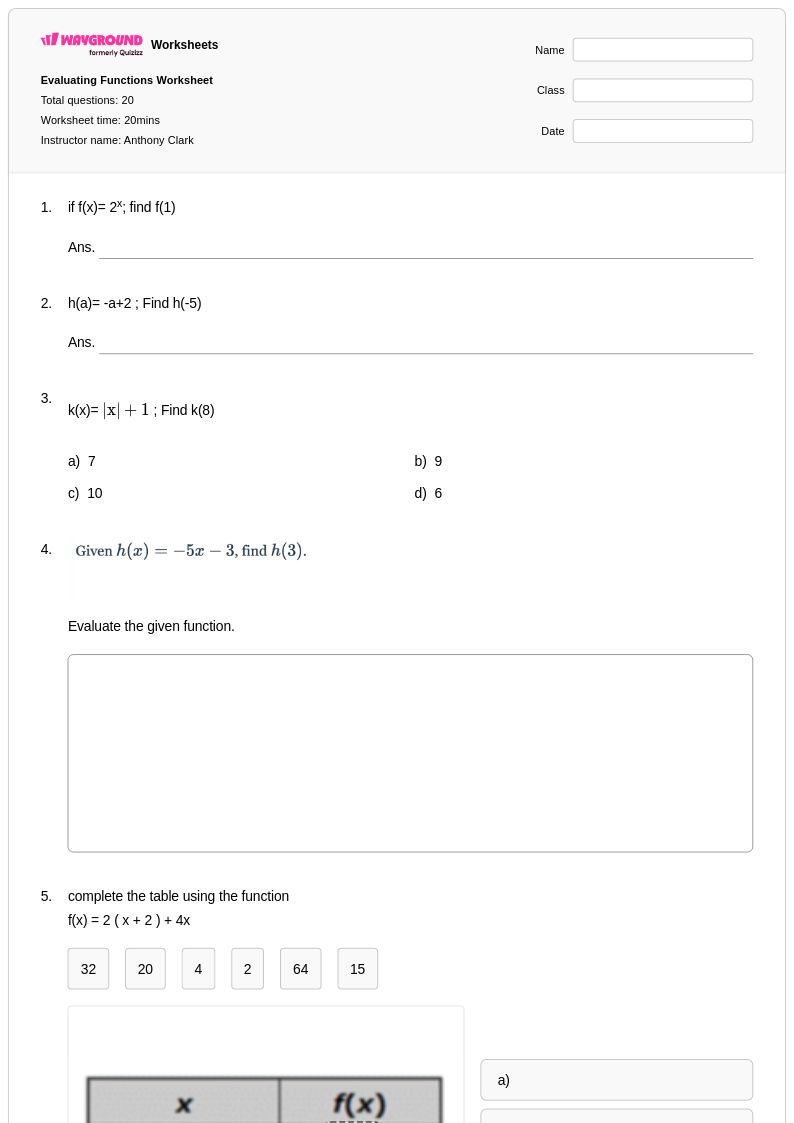
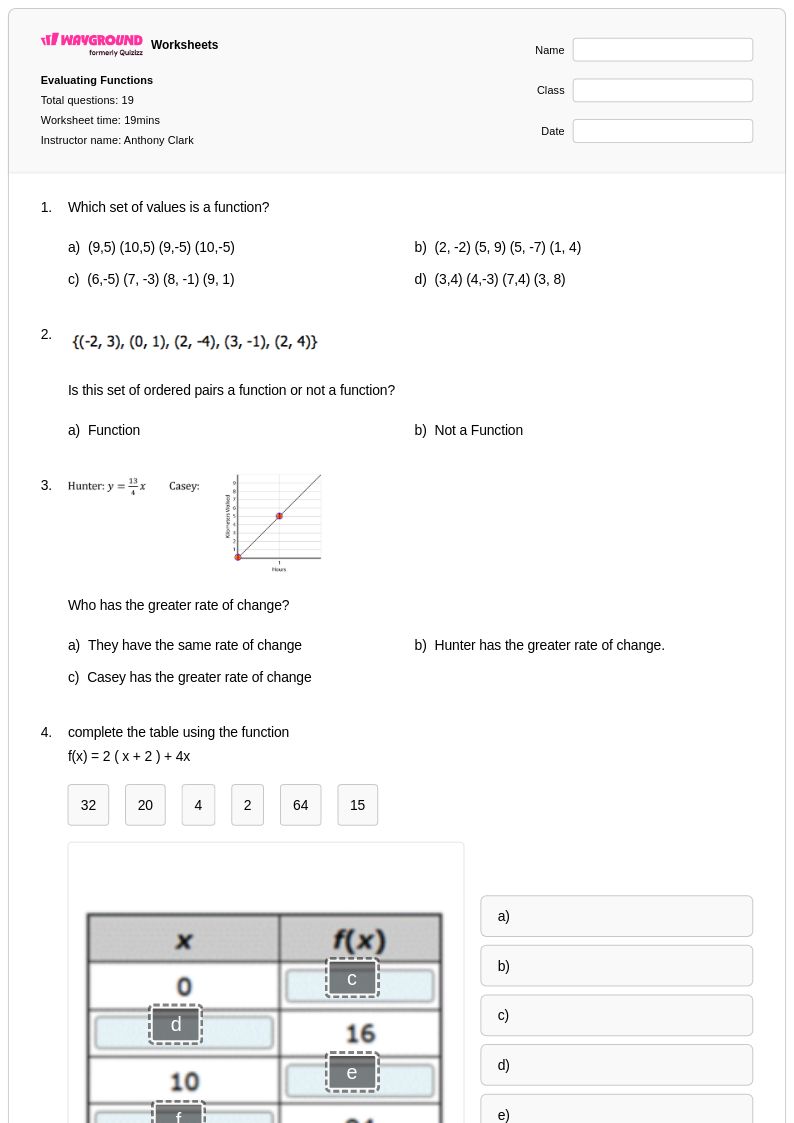
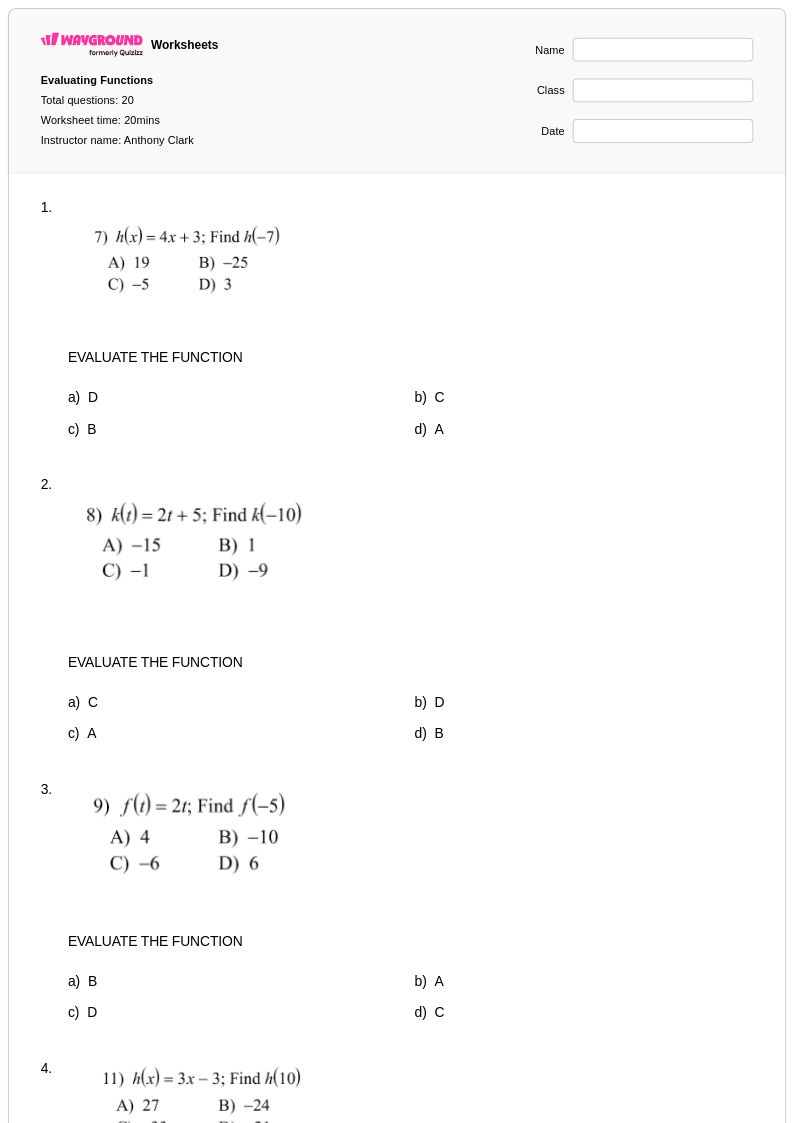
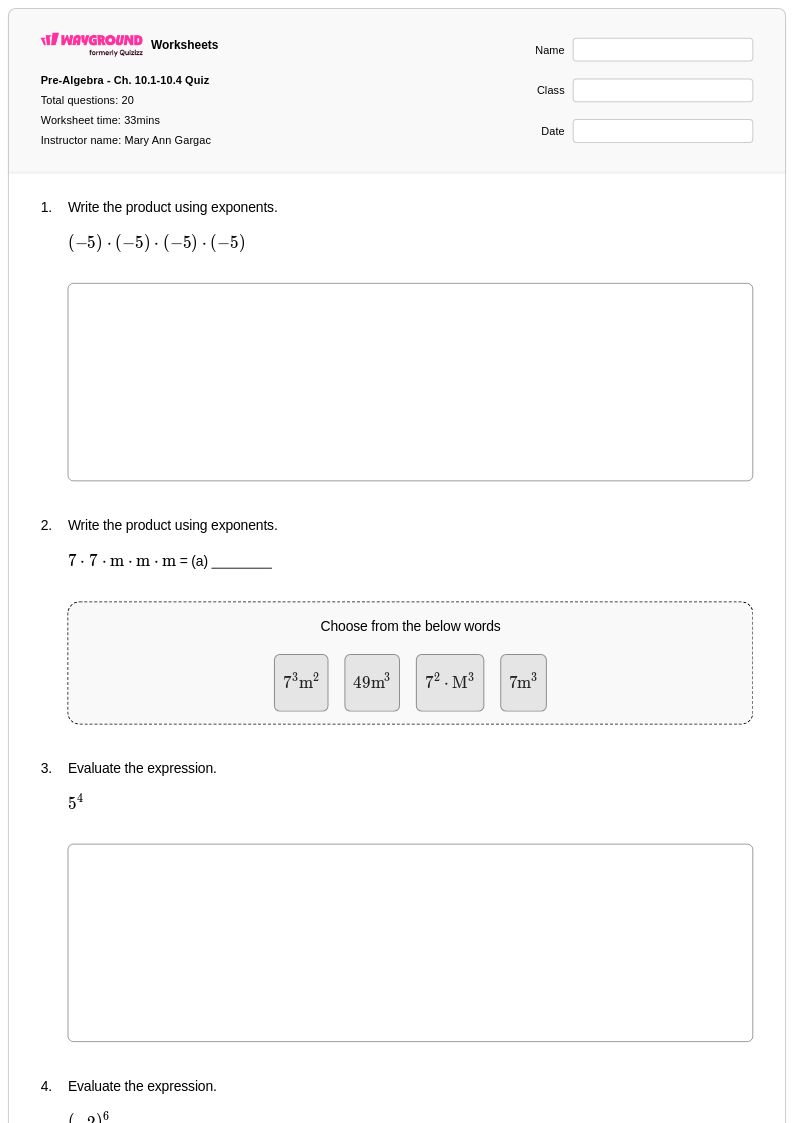
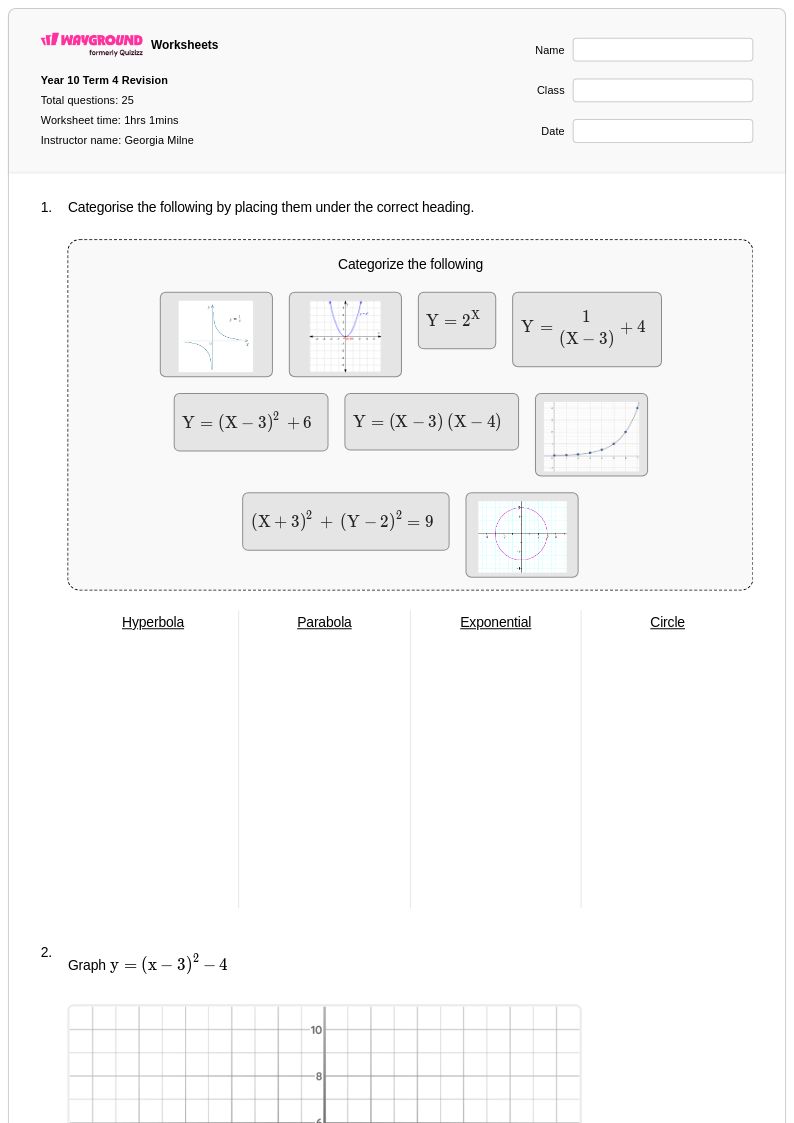
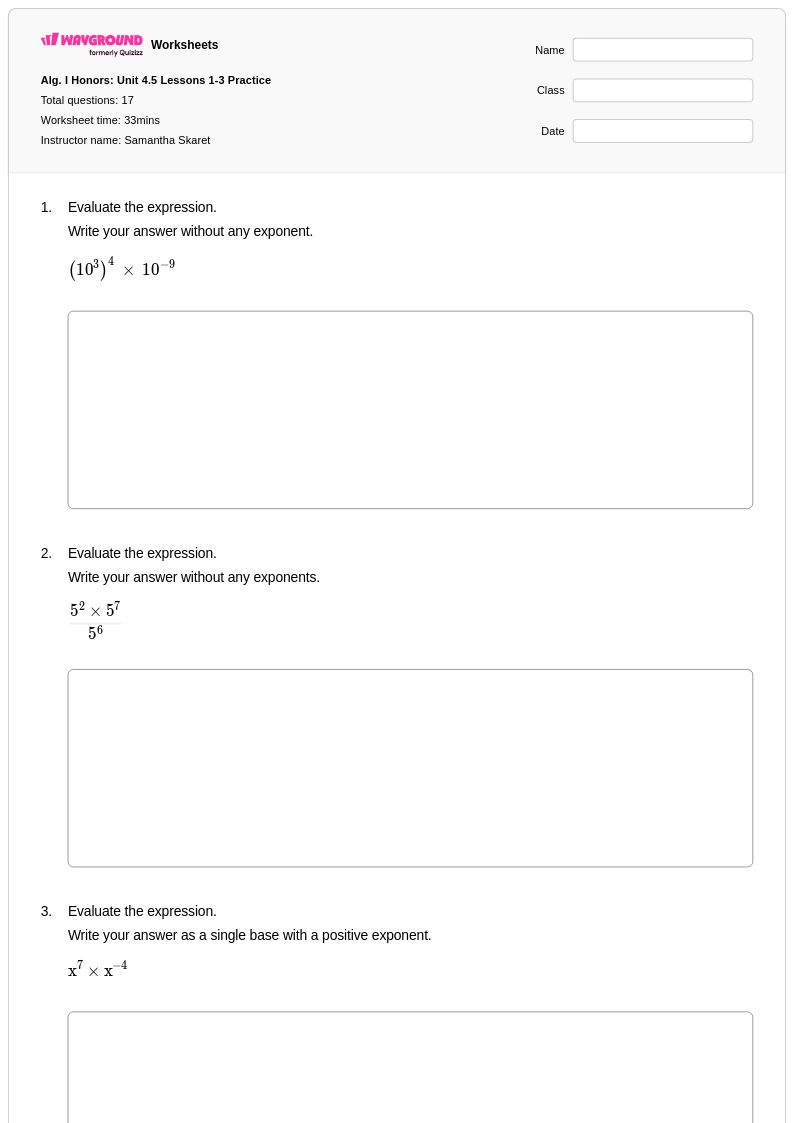
Explore Wayground's free evaluating powers worksheets and printables featuring practice problems with answer keys to help students master exponent calculations and strengthen their mathematical problem-solving skills.
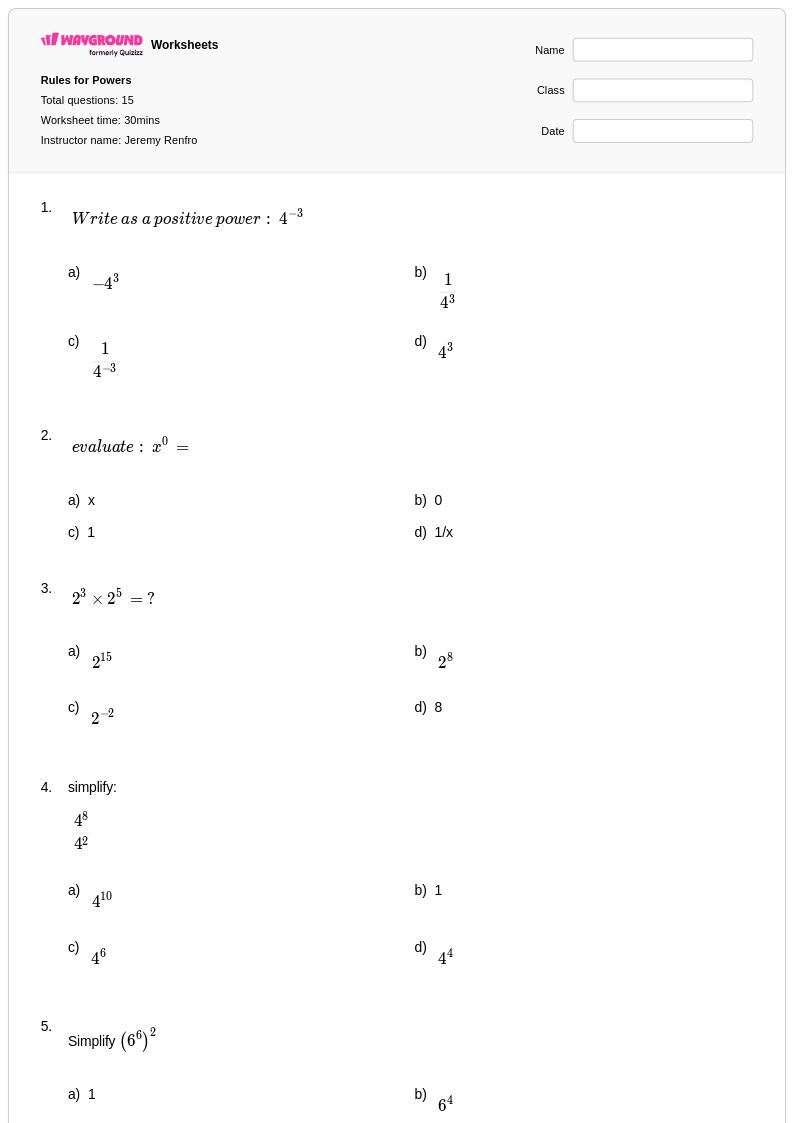
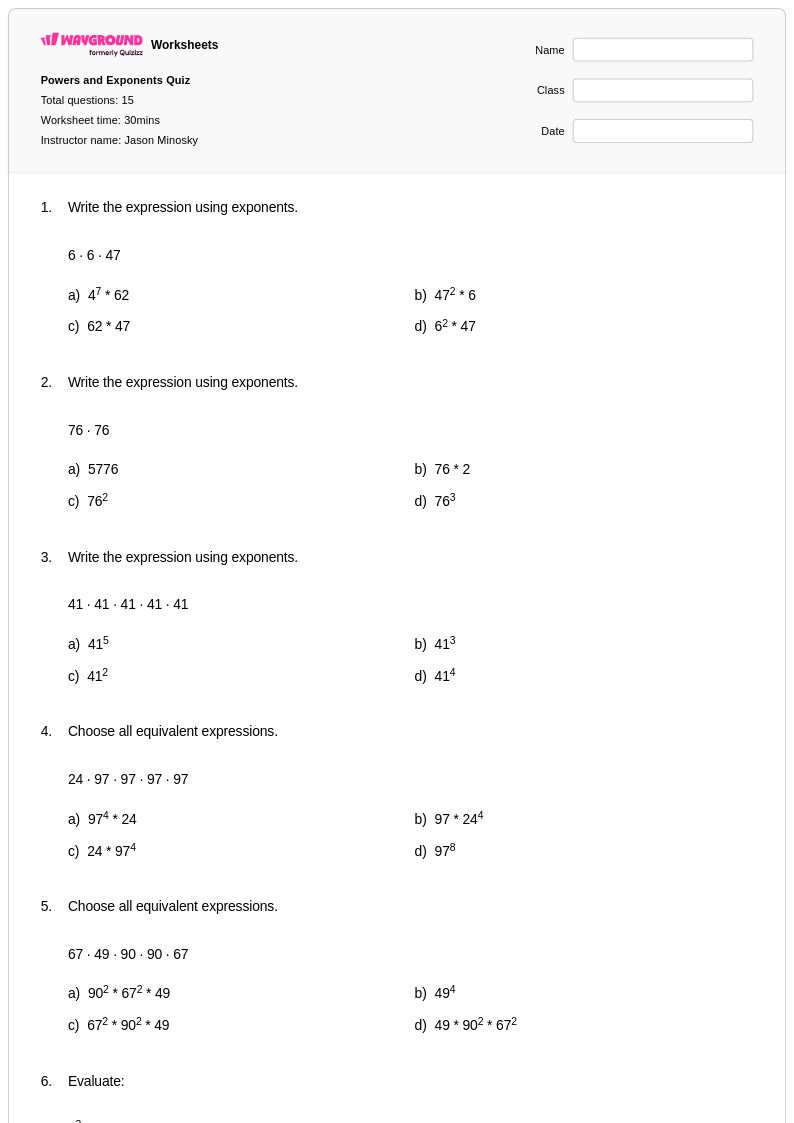
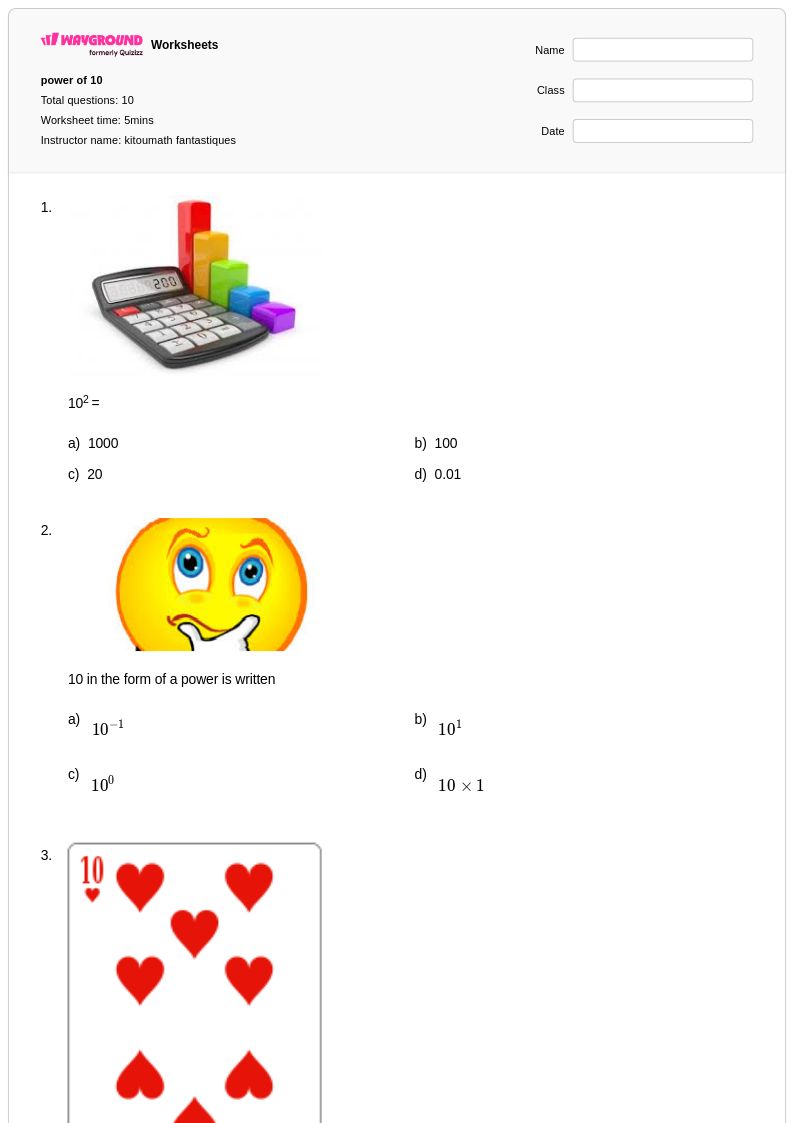
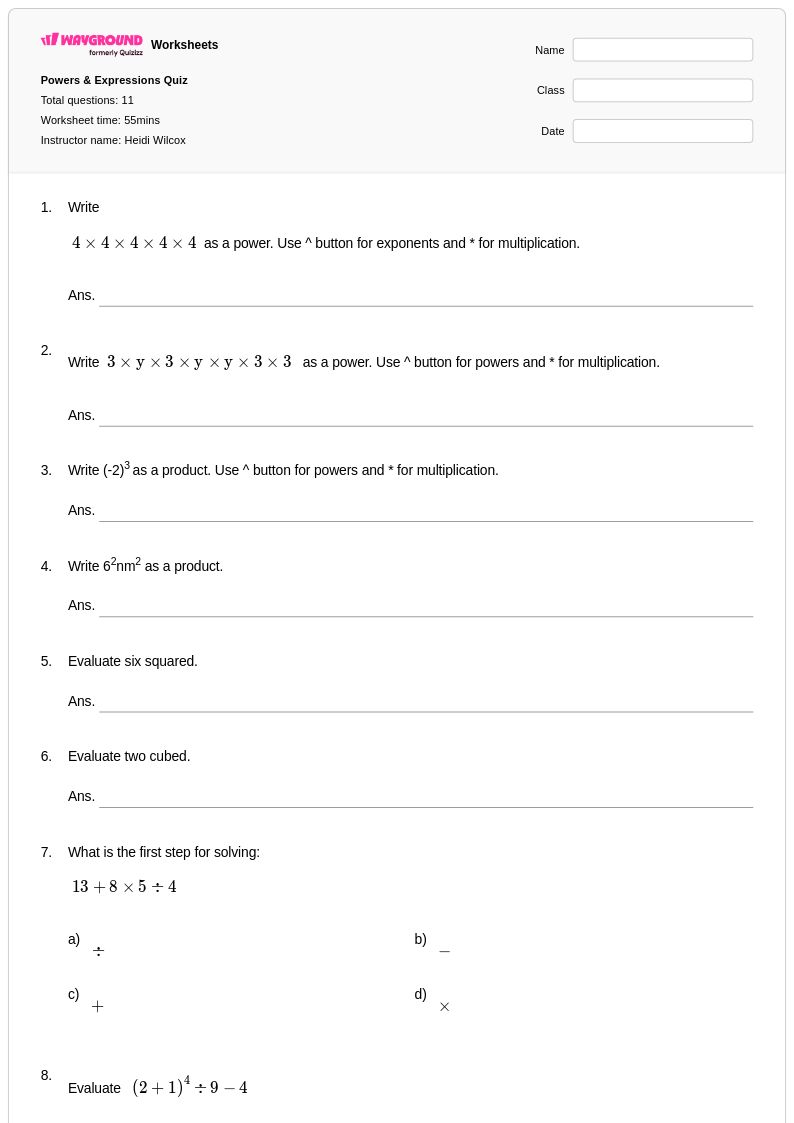
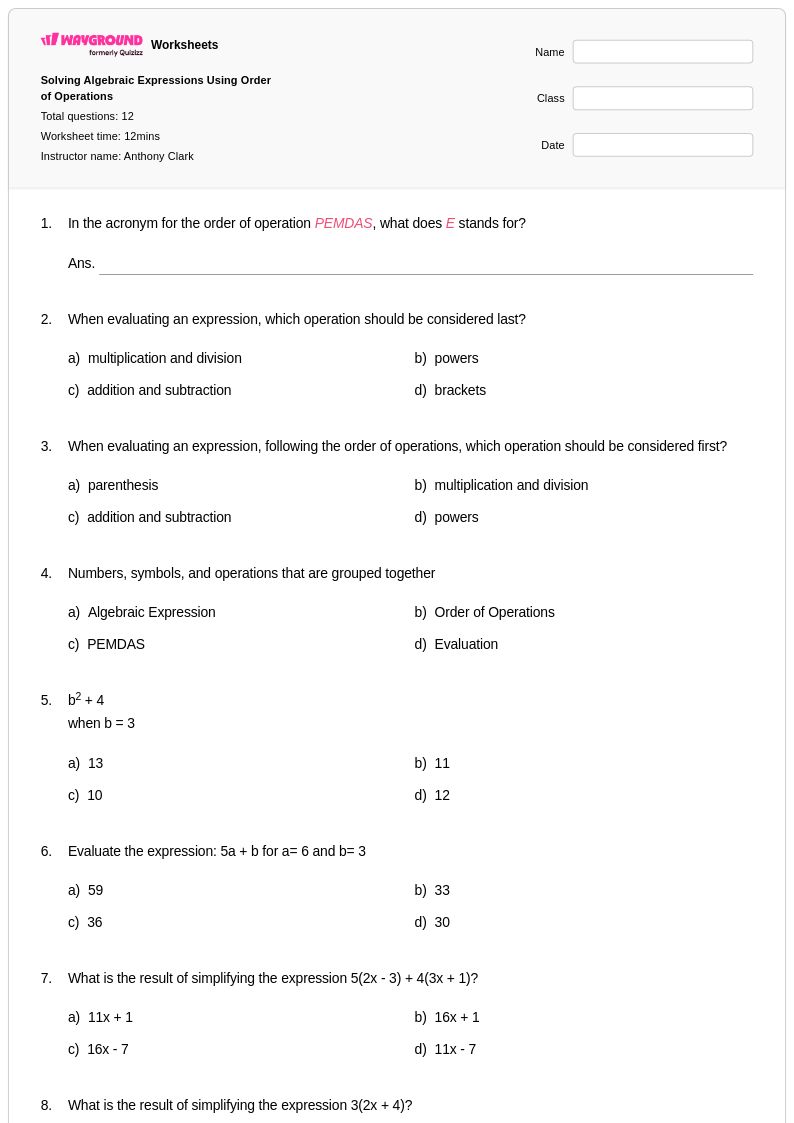
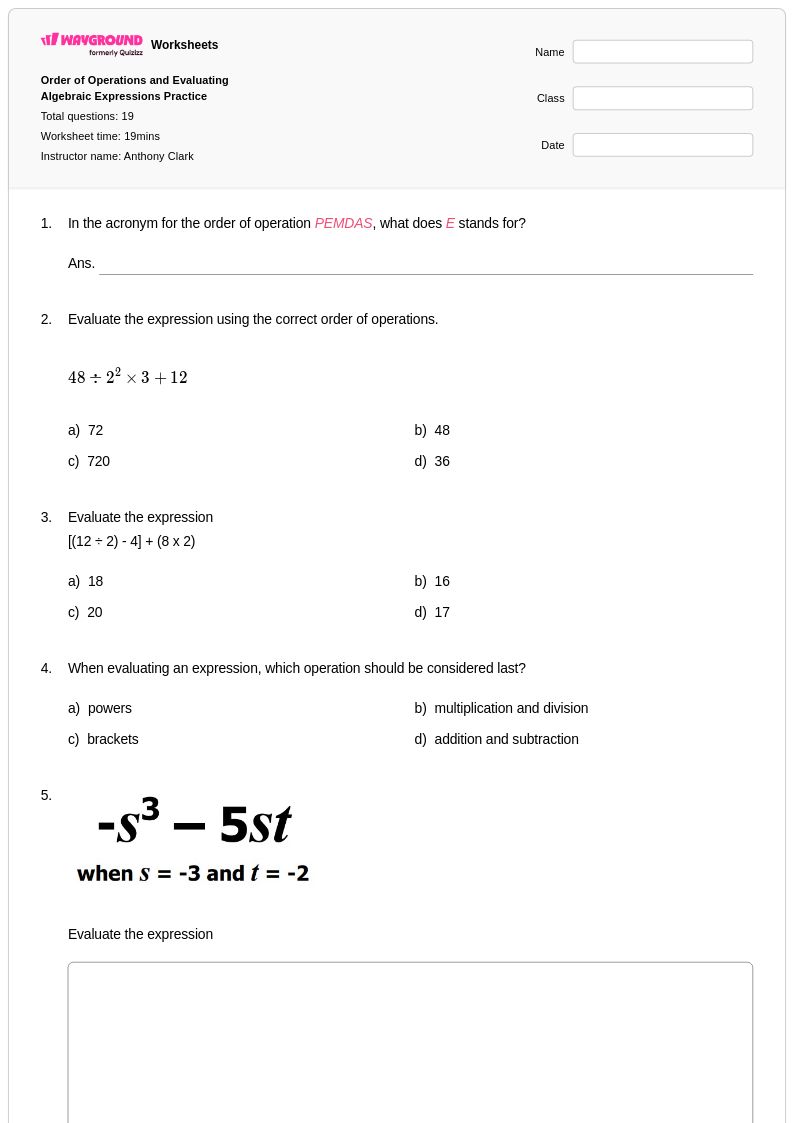
Evaluating powers worksheets available through Wayground (formerly Quizizz) provide comprehensive practice opportunities for students to master this fundamental mathematical skill. These carefully designed resources focus on building proficiency in calculating exponential expressions, understanding base and exponent relationships, and applying the rules of exponents across various mathematical contexts. The worksheets strengthen critical thinking abilities as students learn to evaluate powers with positive and negative bases, work with zero and negative exponents, and solve multi-step problems involving exponential notation. Each printable resource includes detailed practice problems that progress systematically from basic power evaluation to more complex applications, with corresponding answer keys that support both independent study and classroom instruction. These free pdf materials serve as valuable tools for reinforcing number sense concepts while developing computational fluency with exponential expressions.
Wayground (formerly Quizizz) empowers educators with an extensive collection of millions of teacher-created evaluating powers worksheets that streamline lesson planning and enhance mathematical instruction. The platform's robust search and filtering capabilities allow teachers to quickly locate resources that align with specific learning objectives and educational standards, while built-in differentiation tools enable customization for diverse student needs and ability levels. These versatile materials are available in both printable and digital formats, including downloadable pdf versions, making them adaptable for classroom instruction, homework assignments, remediation sessions, and enrichment activities. Teachers can efficiently modify existing worksheets or combine multiple resources to create targeted practice sets that address individual student gaps in understanding exponential concepts, ultimately supporting more effective skill development and mathematical growth across all learners.
FAQs
How do I teach evaluating powers to students who are new to exponents?
Start with the language: a power like 2⁴ means 2 multiplied by itself 4 times, not 2 times 4. That single misconception trips up more students than anything else. Once students can read exponential notation correctly, build from whole-number bases before introducing negative bases or zero exponents. Concrete examples like 10² = 100 and 10³ = 1,000 help students see the pattern before they work abstractly.
What exercises help students practice evaluating powers?
The most effective practice moves in stages: evaluate simple powers with single-digit bases first, then introduce negative bases (where students must track whether the result is positive or negative), then zero and negative exponents. Multi-step problems that embed powers inside larger expressions — requiring correct order of operations — are the best bridge to algebra. Wayground's evaluating powers worksheets are structured to follow this progression, so students build on each layer before the next one is introduced.
What mistakes do students commonly make when evaluating powers?
Three errors come up constantly. First, students multiply the base by the exponent instead of using repeated multiplication — 3⁴ becomes 12 instead of 81. Second, they mishandle negative bases: (-3)² and -3² are not the same, and the parentheses distinction is easy to miss. Third, zero and negative exponents feel counterintuitive — students often write 5⁰ = 0 rather than 1, or treat 2⁻³ as a negative number rather than a fraction.
How do I use Wayground's evaluating powers worksheets in my classroom?
You can run these as a digital quiz hosted on Wayground — students work through the problems on-screen and results come back to you automatically — or download the PDF and print it for paper practice. Every worksheet includes a complete answer key, so independent work and homework are easy to manage. If you go the printable route, the Wayground for Teachers app lets you scan or photograph student submissions to grade them without manual re-entry.
How does Common Core sequence the teaching of exponents and evaluating powers?
Common Core introduces exponential notation in Grade 6, where students learn to read and write expressions like 2⁴ and evaluate them as repeated multiplication. In Grade 7 and 8, the work deepens: students apply exponent rules, work with integer exponents (including zero and negatives), and connect powers to scientific notation. By the time students reach high school, evaluating powers is a prerequisite skill for polynomial operations and exponential functions — so gaps at the notation stage compound quickly.
How can I differentiate evaluating powers practice for mixed-ability classes?
For students who struggle with the mechanics, Wayground's Read Aloud accommodation reads questions aloud, which helps when dense notation is the barrier rather than the math itself. Reduced answer choices lower the cognitive load for students who are still building confidence with exponential expressions. For layout-based accessibility, you can generate an alternate version of the same worksheet with a larger font size or a dyslexia-friendly font — same problems, adjusted presentation — so differentiation doesn't mean creating an entirely separate assignment.