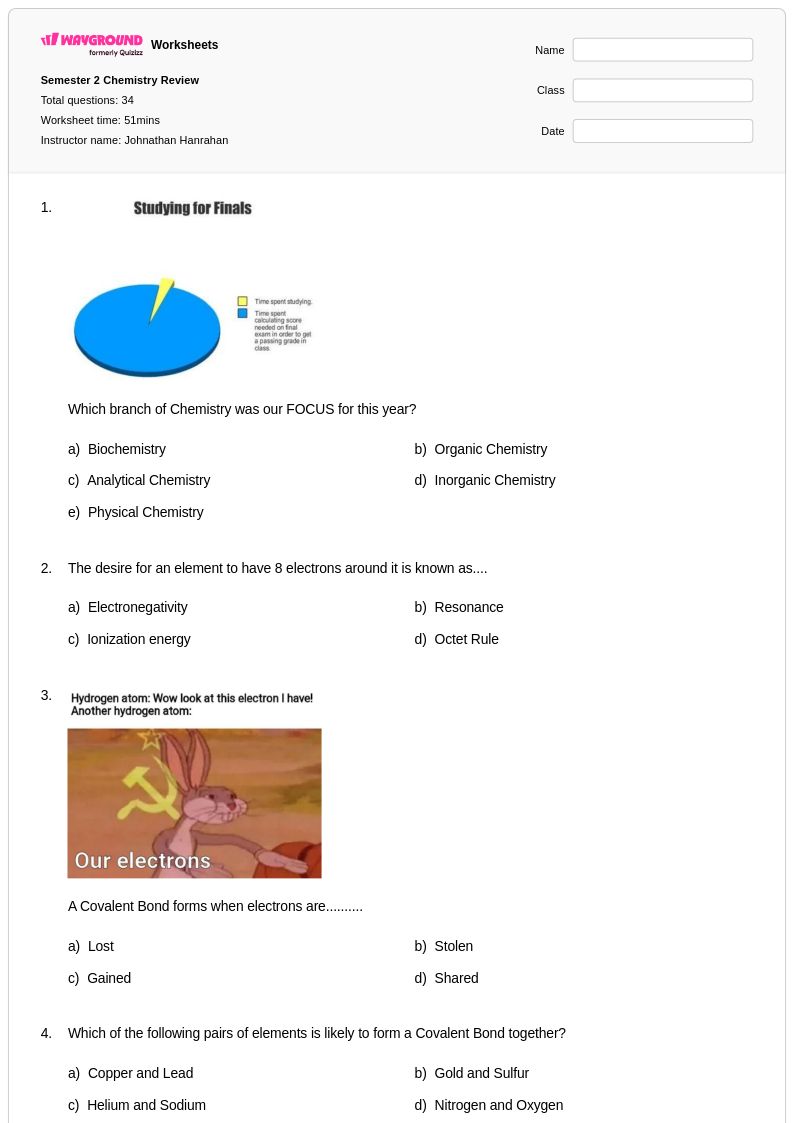
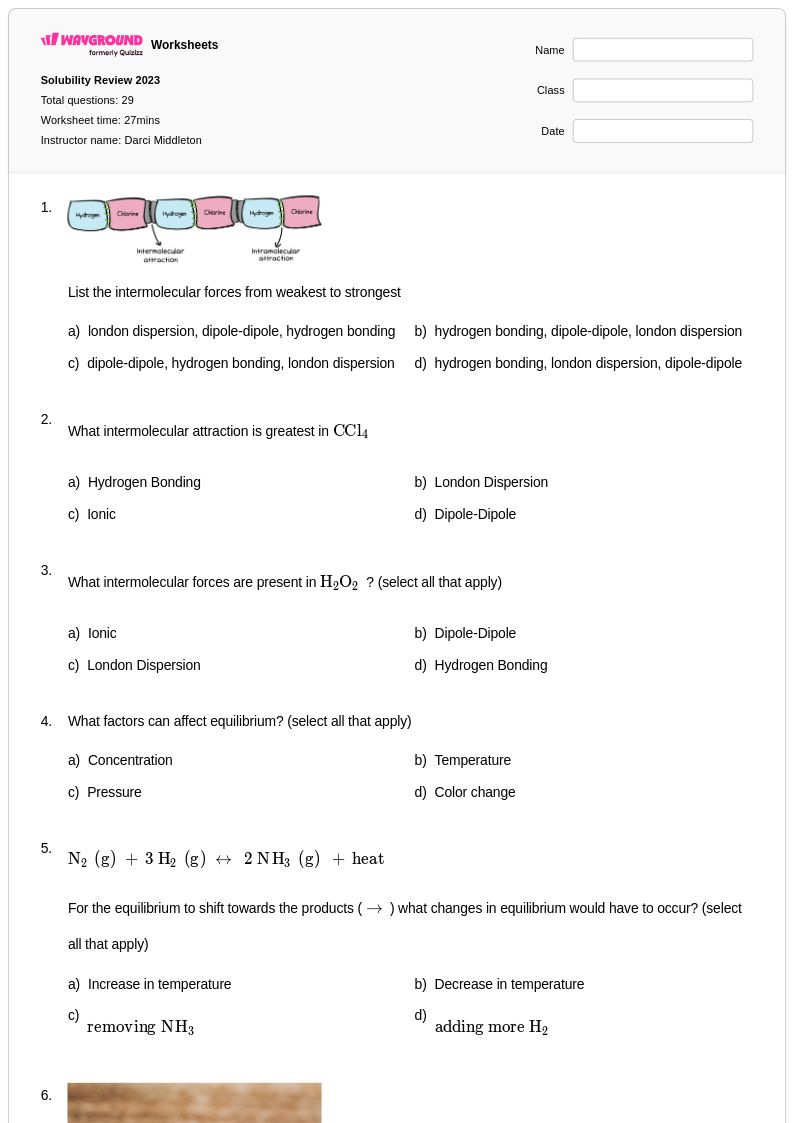
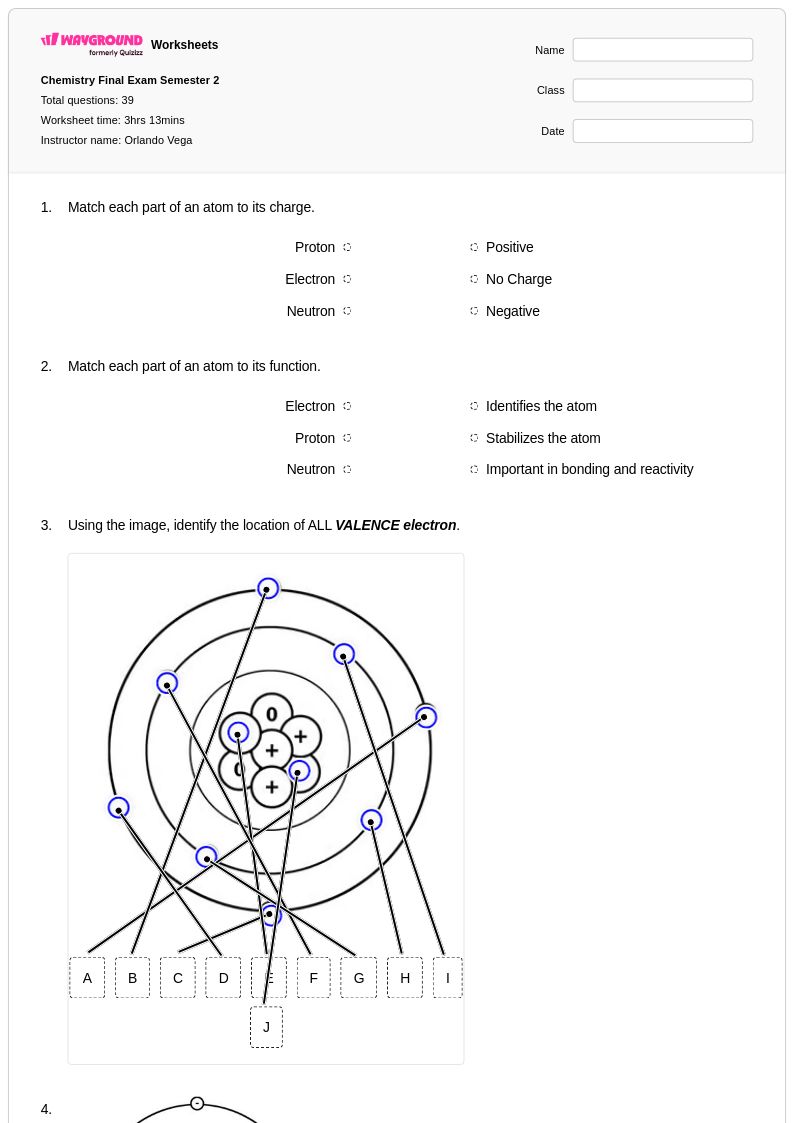
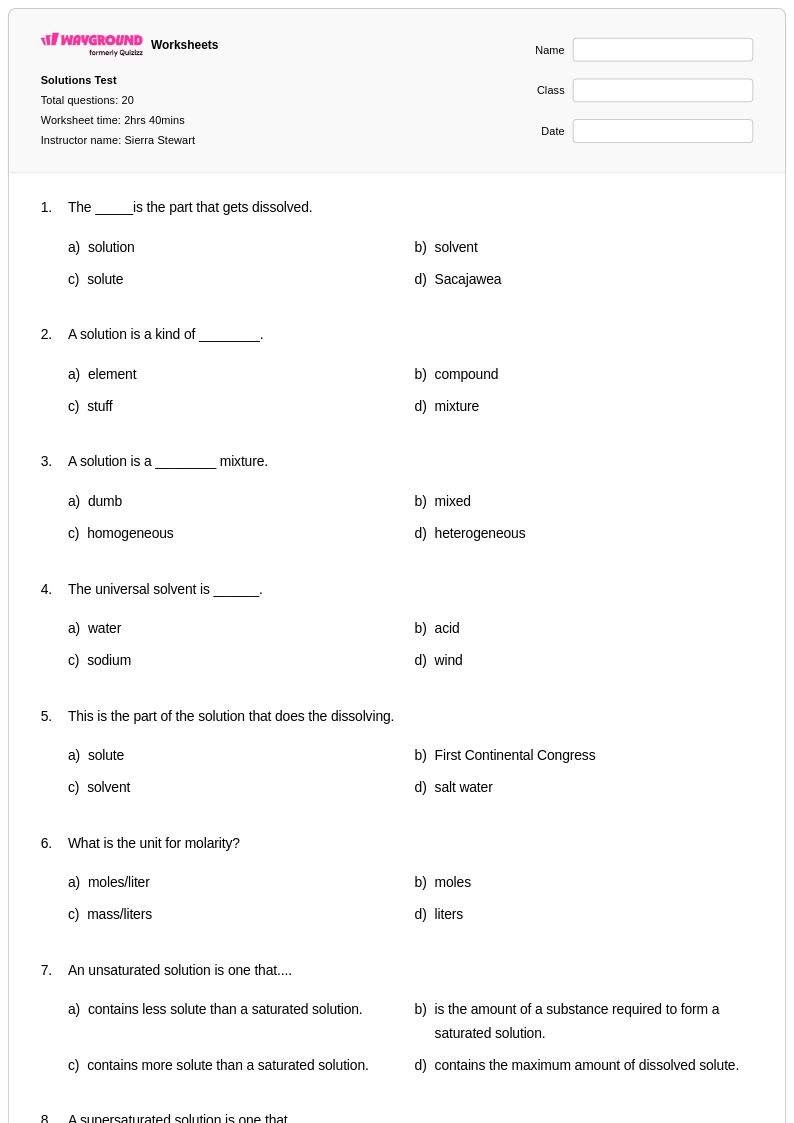
Enhance Year 9 chemistry skills with our comprehensive molarity worksheets featuring free printables, practice problems, and answer keys to help students master solution concentration calculations.
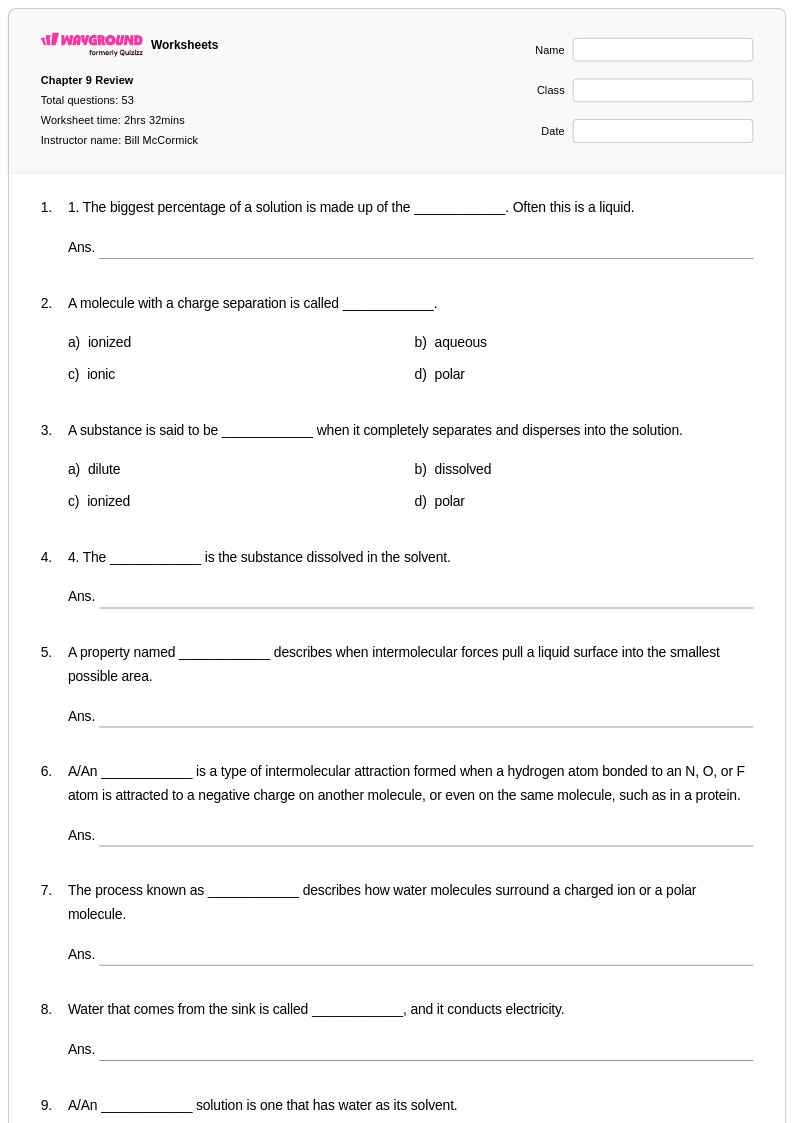
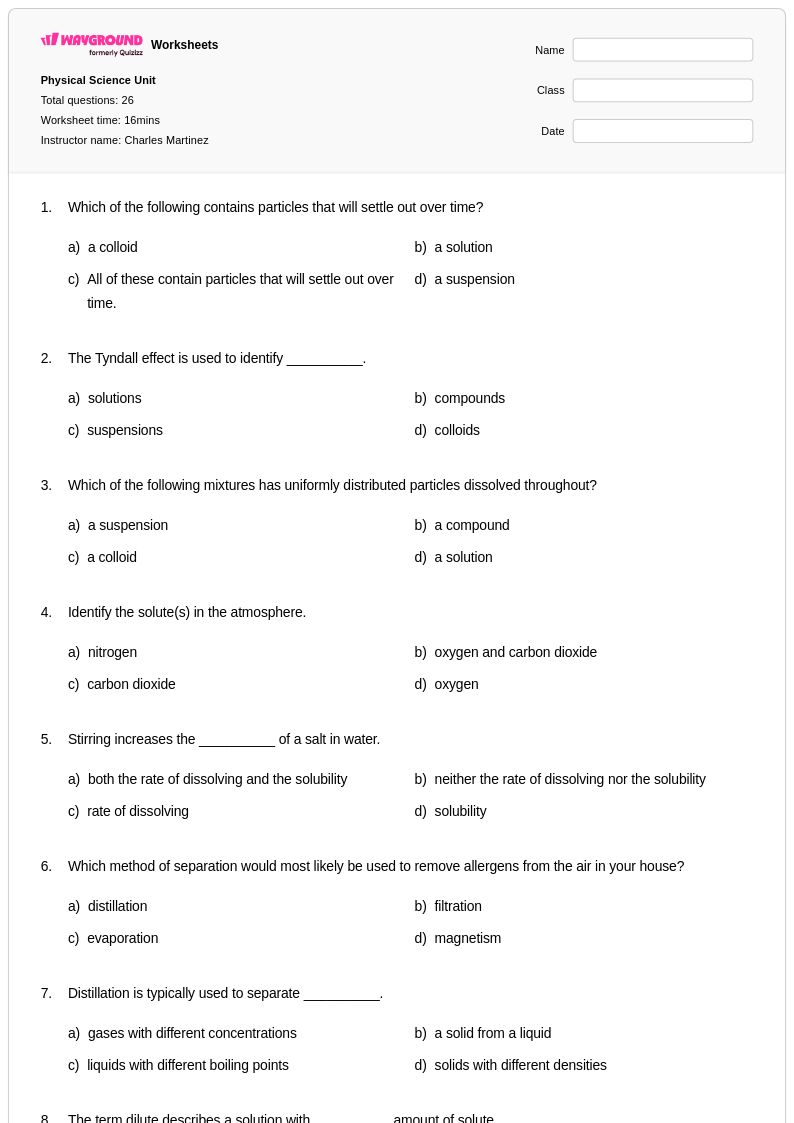
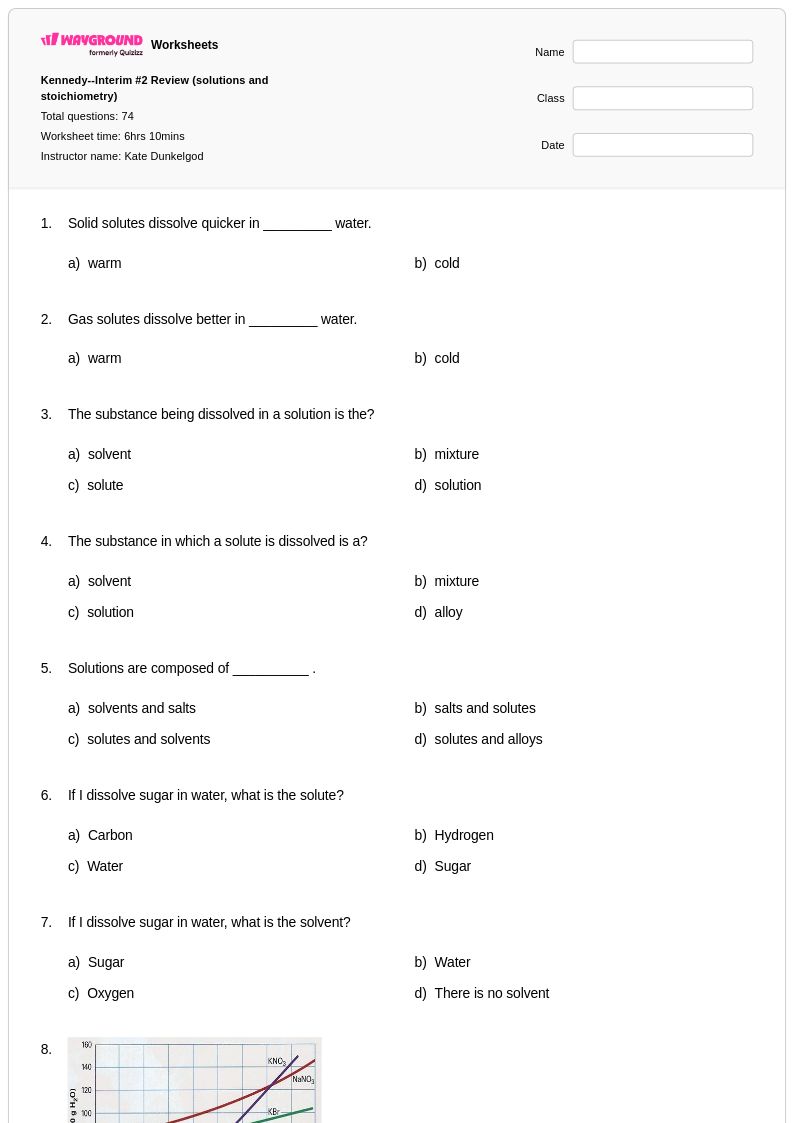
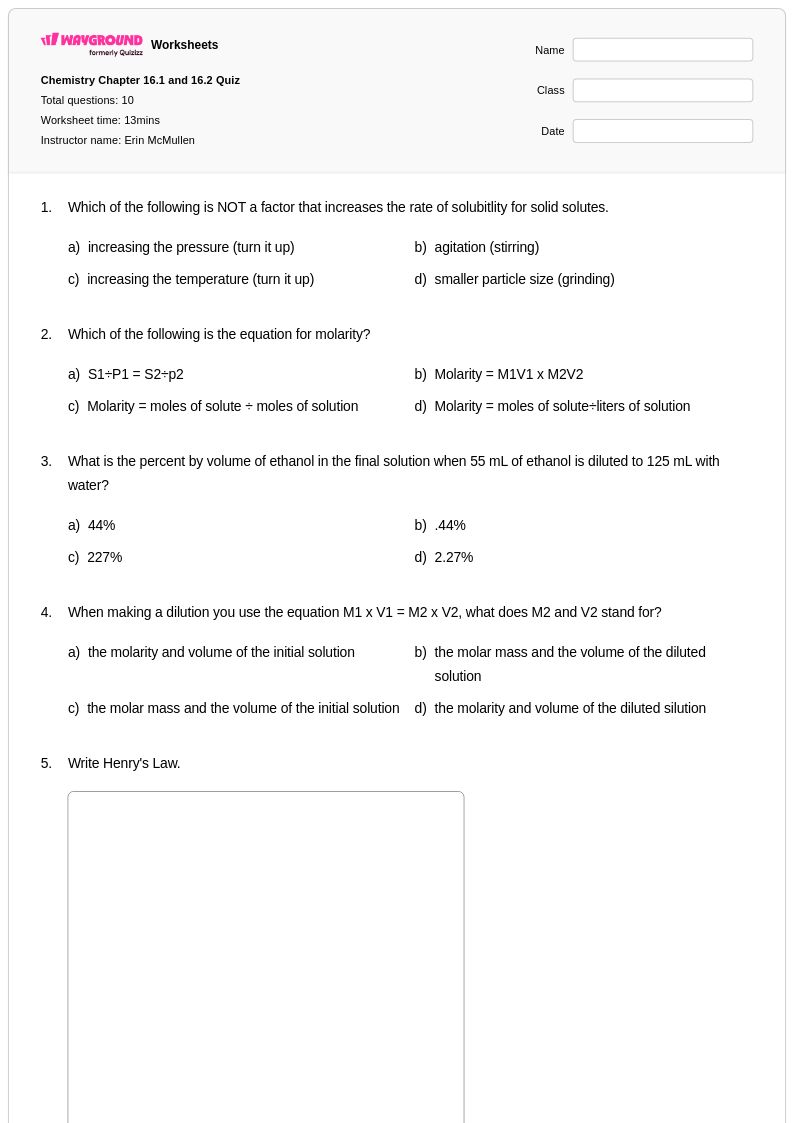
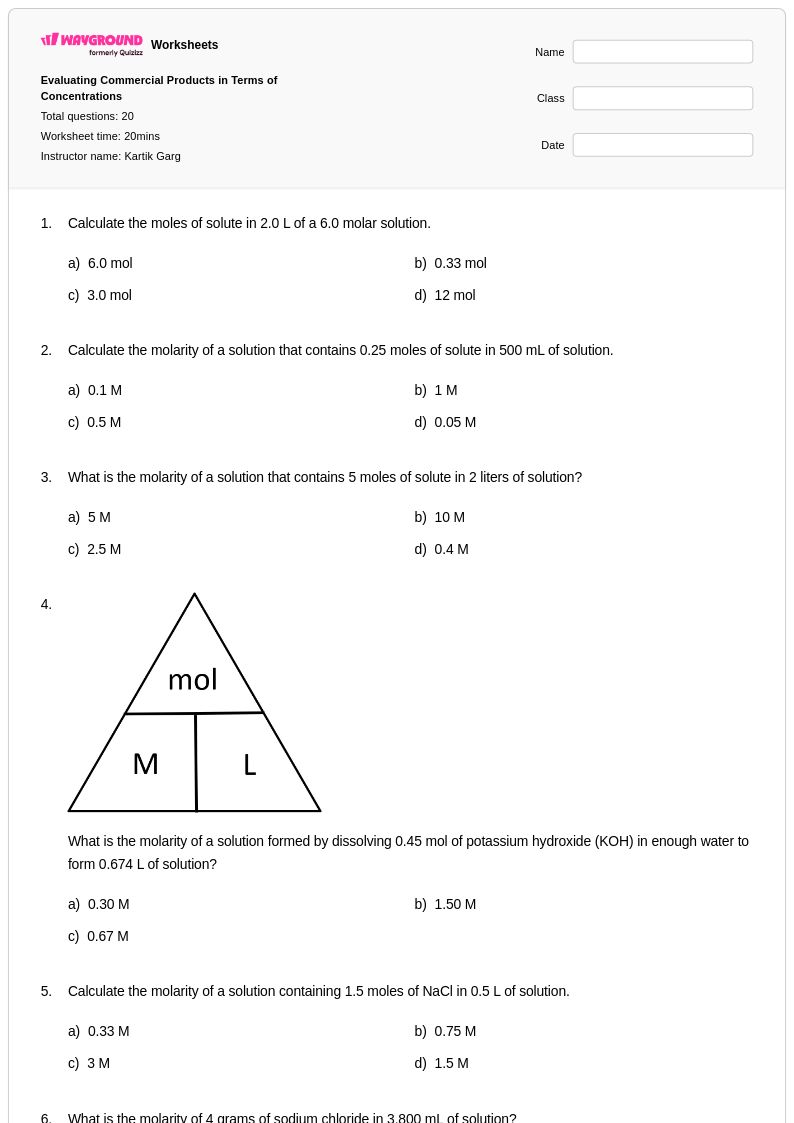
Year 9 molarity worksheets available through Wayground (formerly Quizizz) provide comprehensive practice with solution concentration calculations, a fundamental concept in chemistry that bridges mathematical problem-solving with chemical understanding. These expertly crafted worksheets strengthen students' ability to calculate moles of solute per liter of solution, convert between different concentration units, and apply molarity formulas in real-world chemical scenarios. Each worksheet collection includes detailed practice problems that progress from basic molarity calculations to more complex dilution and solution preparation exercises, complete with answer keys that allow students to verify their work and identify areas needing additional focus. The free printables cover essential skills including determining the number of moles in a given volume of solution, calculating the volume needed to achieve specific concentrations, and solving multi-step problems involving solution mixing and chemical reactions.
Wayground (formerly Quizizz) empowers teachers with millions of educator-created molarity resources that feature robust search and filtering capabilities, enabling quick identification of materials aligned with specific learning objectives and standards. The platform's differentiation tools allow instructors to customize worksheet difficulty levels, accommodating diverse learning needs within Year 9 chemistry classrooms while maintaining focus on core molarity concepts. Teachers can access these materials in both printable pdf formats for traditional classroom distribution and digital versions for online learning environments, providing flexibility for various instructional approaches. These comprehensive worksheet collections support effective lesson planning by offering ready-to-use practice problems for initial instruction, targeted remediation activities for students struggling with concentration calculations, and enrichment materials that challenge advanced learners to apply molarity concepts in complex chemical scenarios.
FAQs
How do I teach molarity to chemistry students?
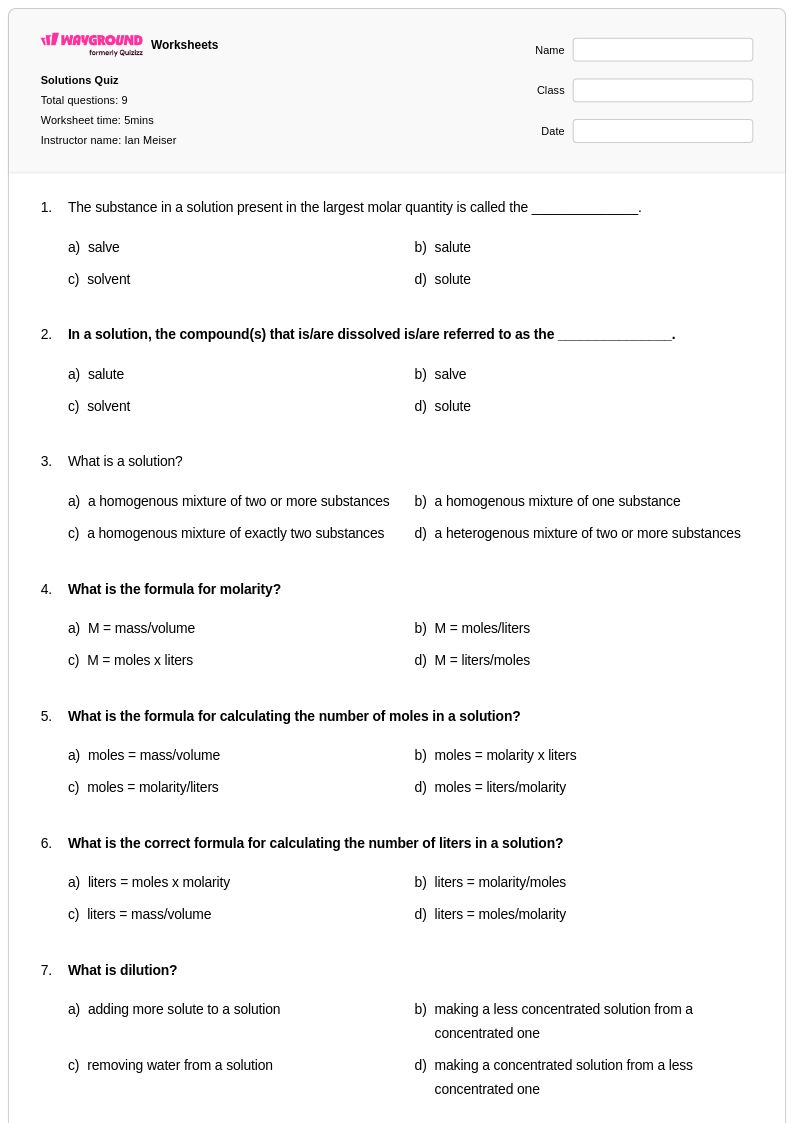
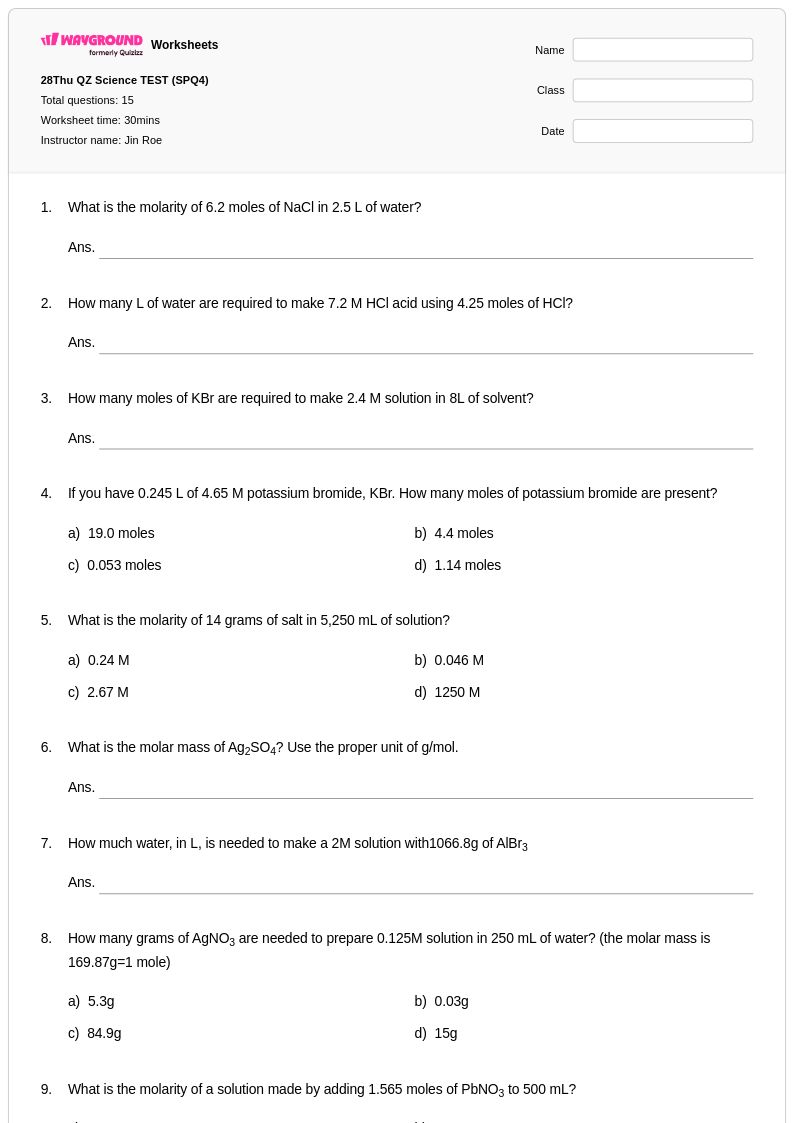
Start by grounding students in the relationship between moles, volume, and concentration before introducing the formula M = n/V. Use concrete examples like dissolving a known mass of NaCl in a measured volume of water so students can physically connect the math to a real solution. From there, progress to dilution problems and stock solution scenarios, which reinforce why molarity matters in actual lab settings. Building from conceptual understanding to calculation fluency is more effective than leading with the formula alone.
What exercises help students practice molarity calculations?
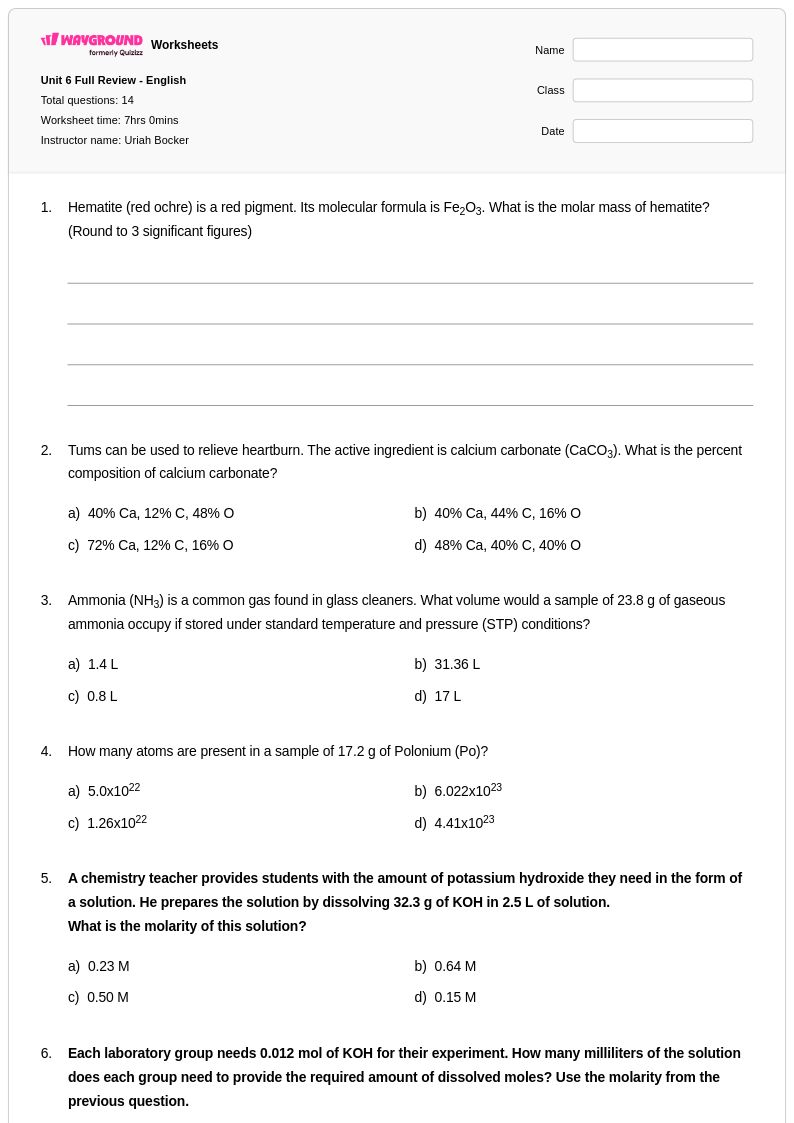
Effective practice problems for molarity move from straightforward M = n/V calculations to multi-step problems involving unit conversion, dilution equations (C1V1 = C2V2), and serial dilutions. Students benefit most from problems that require them to convert grams to moles before calculating concentration, since this reinforces the connection between mass, molar mass, and molarity. Scaffolded worksheets that show step-by-step worked examples before presenting independent practice problems are especially useful for building procedural fluency.
What mistakes do students commonly make when calculating molarity?
The most common error is using mass in grams instead of moles in the M = n/V formula, which requires students to first divide the given mass by the molar mass of the solute. Students also frequently confuse milliliters and liters, leading to answers that are off by a factor of 1,000. In dilution problems, a common misconception is that adding water changes the number of moles of solute rather than just the concentration. Targeted practice that isolates each of these steps helps students identify and correct their own errors.
How can I use molarity worksheets to support students at different skill levels?
Molarity worksheets can be differentiated by problem complexity: struggling students benefit from problems that provide molar mass and walk through unit conversion explicitly, while advanced students can tackle multi-step dilution and stock solution scenarios without scaffolding. On Wayground, teachers can assign individual accommodations such as read aloud support, reduced answer choices, or extended time for students who need them, while the rest of the class receives standard settings. This allows a single worksheet set to serve the full range of learners in a chemistry classroom without requiring separate lesson plans.
How do I use Wayground's molarity worksheets in my classroom?
Wayground's molarity worksheets are available as both printable PDFs and in digital formats, so they can be used for in-class practice, lab preparation, homework, or remote learning. Teachers can host a worksheet as a live quiz on Wayground to track student responses in real time and identify which calculation steps are causing the most difficulty. The included answer keys provide step-by-step solutions, making the worksheets functional for independent study and self-correction as well as teacher-led instruction.
How does molarity relate to laboratory work students will encounter in chemistry?
Molarity is the standard unit of concentration used in virtually all laboratory solution preparation, from preparing buffer solutions in biology to titrations in analytical chemistry. Students who cannot calculate molarity accurately will struggle to prepare reagents correctly, which can compromise experimental results. Practicing dilution problems in particular prepares students for the common lab technique of creating working solutions from concentrated stock solutions, a skill required in both AP Chemistry and college-level lab courses.