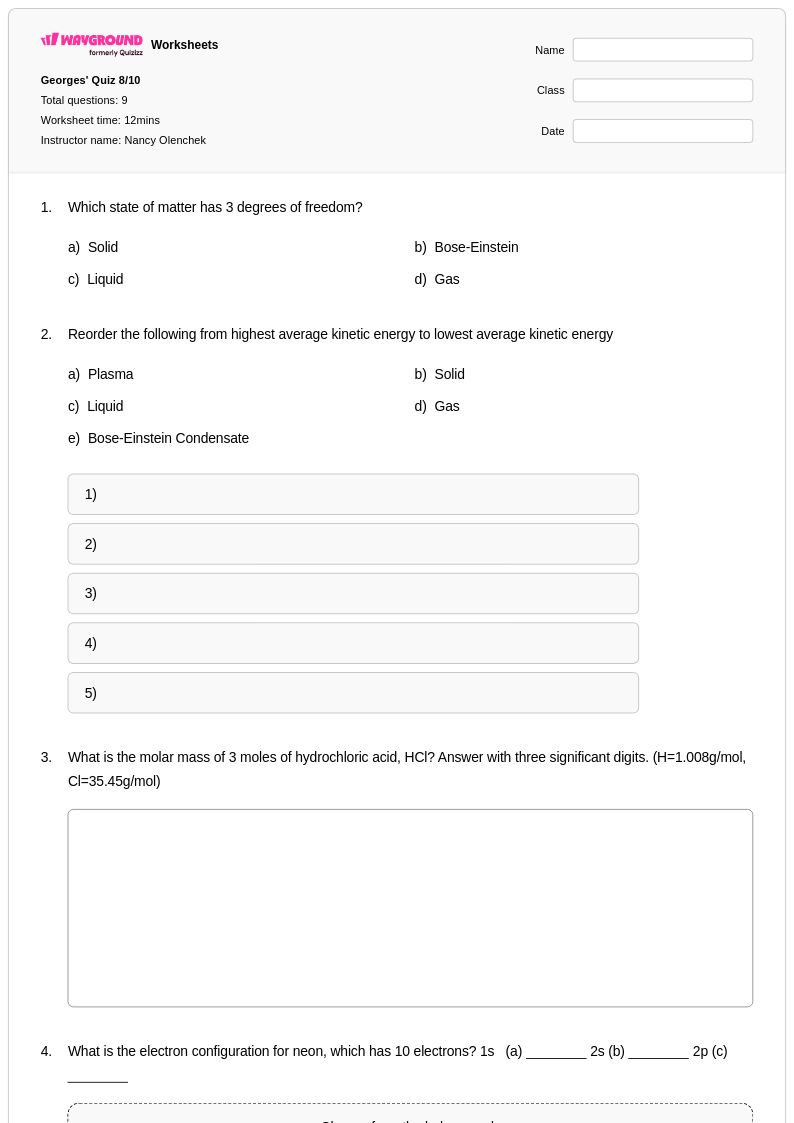
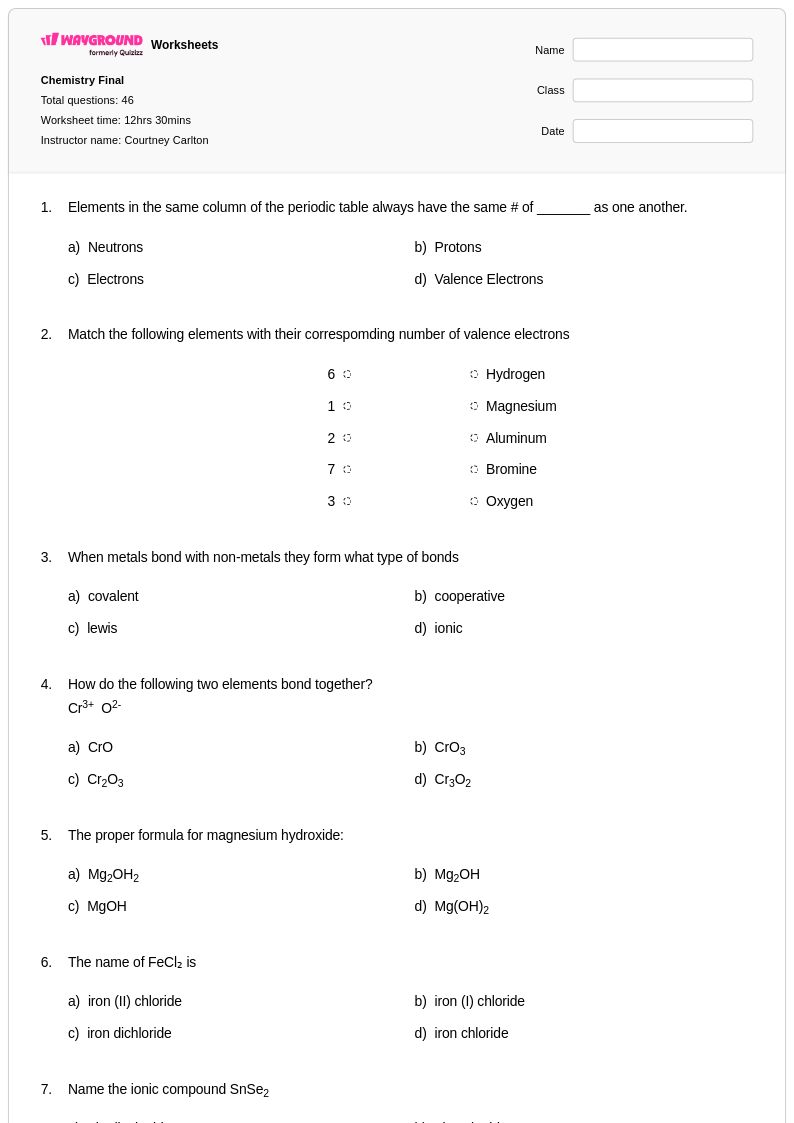
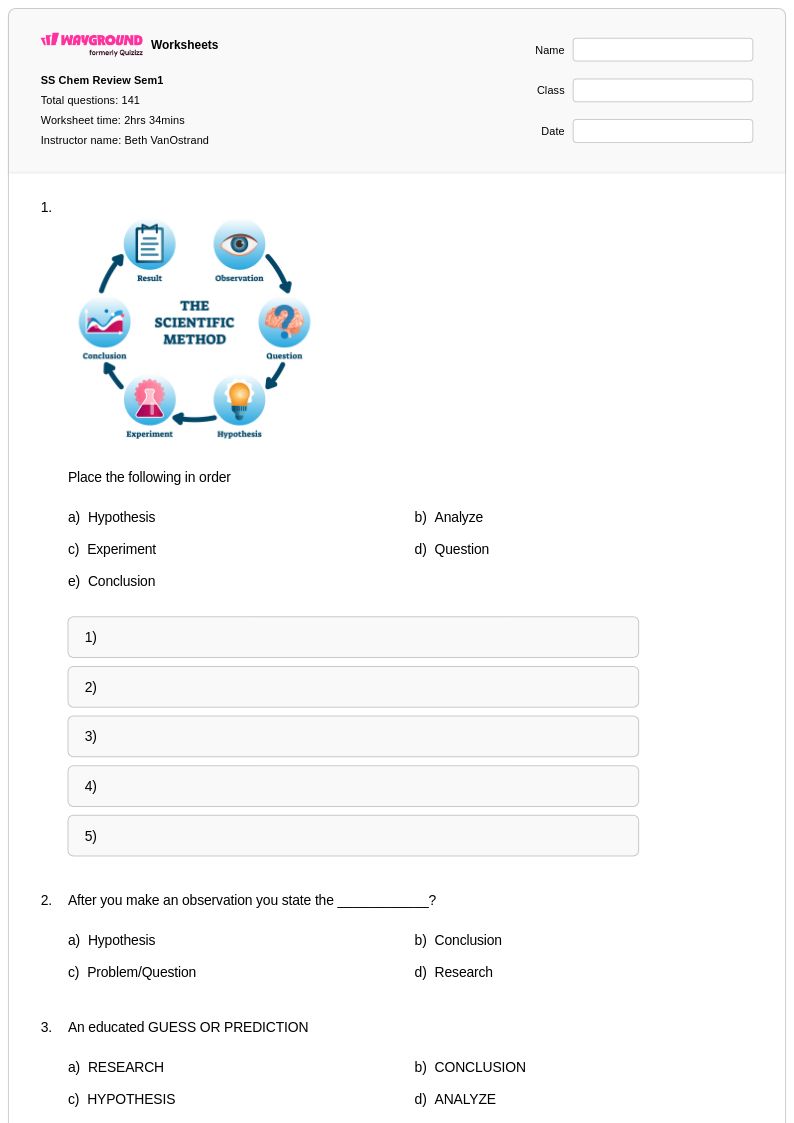
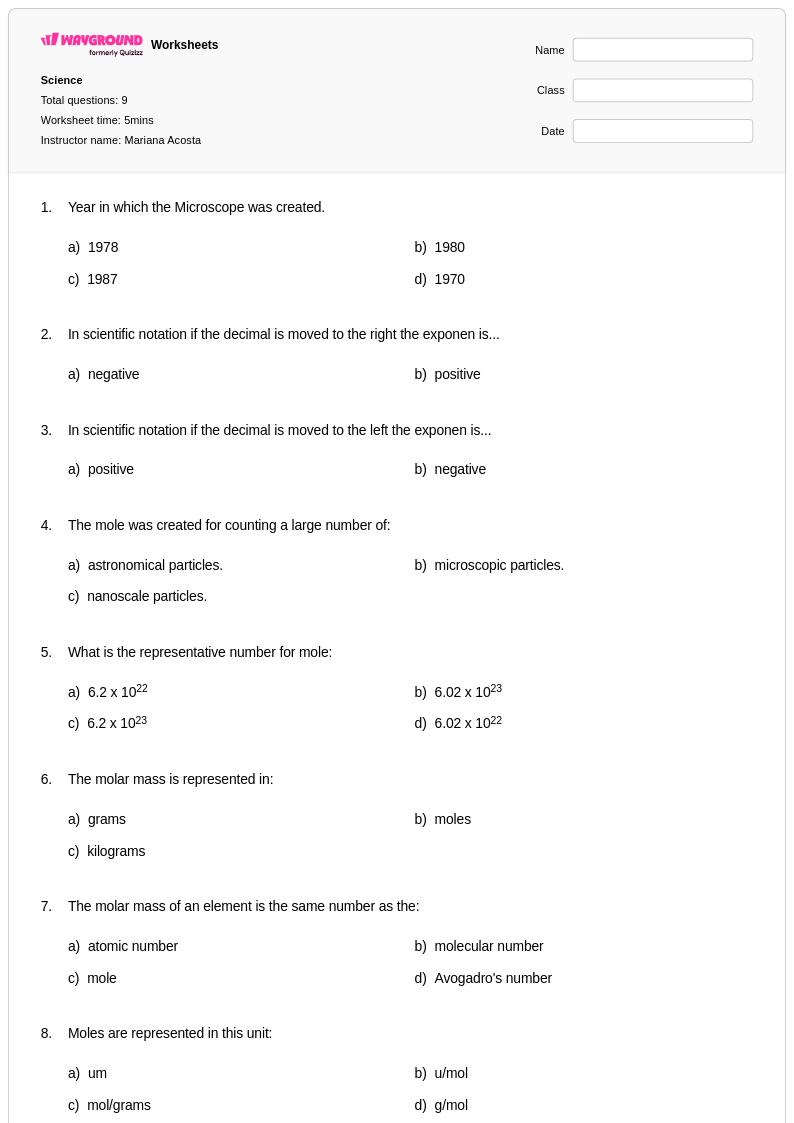
Year 9 moles chemistry worksheets from Wayground help students master stoichiometric calculations and molecular concepts through comprehensive printables, practice problems, and answer keys available as free PDF downloads.
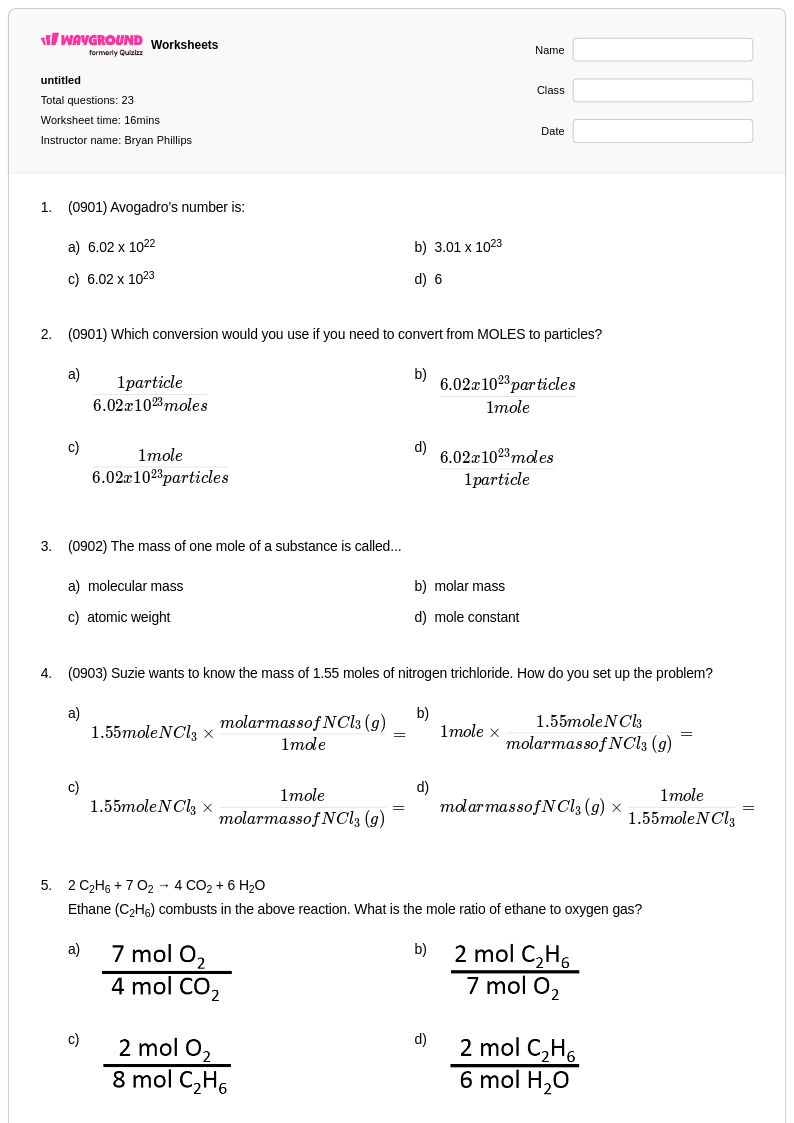
Year 9 moles worksheets available through Wayground (formerly Quizizz) provide comprehensive practice with one of chemistry's most fundamental concepts, helping students master the quantitative relationships that form the foundation of chemical calculations. These expertly designed worksheets guide students through essential skills including converting between moles and particles using Avogadro's number, calculating molar mass from periodic table data, and performing mole-to-mass and mass-to-mole conversions that are crucial for stoichiometry problems. Each worksheet collection includes detailed answer keys that allow students to verify their problem-solving approaches, while the free printables offer structured practice problems ranging from basic conceptual questions to multi-step calculations involving molecular formulas and empirical formulas, ensuring students develop both computational skills and conceptual understanding of the mole as a counting unit in chemistry.
Wayground (formerly Quizizz) empowers chemistry teachers with an extensive library of millions of teacher-created moles worksheets specifically aligned to Year 9 chemistry standards, featuring robust search and filtering capabilities that enable educators to quickly locate resources targeting specific learning objectives such as Avogadro's number applications or molar mass calculations. The platform's differentiation tools allow teachers to customize worksheet difficulty levels and problem types to meet diverse student needs, while the flexibility of both printable pdf formats and digital assignments supports various classroom environments and learning preferences. These comprehensive worksheet collections streamline lesson planning by providing ready-to-use resources for initial instruction, targeted remediation for struggling students, and enrichment activities for advanced learners, while the standards alignment ensures that skill practice directly supports curriculum requirements and prepares students for more complex stoichiometry concepts in advanced chemistry courses.
FAQs
How do I teach the mole concept to chemistry students?
Start by grounding the mole in something tangible — connect Avogadro's number (6.022 × 10²³) to everyday counting units like a dozen or a gross before introducing molar mass. From there, build procedural fluency by walking students through dimensional analysis step-by-step: grams to moles, moles to particles, and back again. Consistent repetition with varied problem types — molecular mass, empirical formulas, and stoichiometric ratios — reinforces the concept across different contexts and prevents students from treating it as a single memorized procedure.
What types of practice problems help students get better at mole calculations?
Students develop the strongest fluency when they practice mole calculations across several interrelated problem types: converting between grams and moles using molar mass, applying Avogadro's number to find the number of particles, and using mole ratios in stoichiometry problems. Empirical and molecular formula problems are also critical because they require students to apply mole reasoning in reverse. Worksheets that sequence these problem types progressively — starting with single-step conversions and building toward multi-step stoichiometric calculations — are most effective for building lasting proficiency.
What mistakes do students commonly make when working with moles?
The most common error is inverting the molar mass conversion factor — dividing when they should multiply, or vice versa — because students confuse which quantity goes in the numerator. A second frequent mistake is using atomic mass instead of molar mass when working with molecular compounds. Students also regularly forget to account for all atoms in a compound when calculating molecular mass, especially in polyatomic ions or hydrates. Targeted practice that forces students to show their dimensional analysis setup, rather than just the final answer, helps surface and correct these errors early.
How can I differentiate mole worksheets for students at different levels?
For students who are struggling, reduce the number of steps per problem and provide a reference sheet with molar mass values and Avogadro's number so the cognitive load stays on the process rather than recall. For advanced learners, introduce multi-step stoichiometry problems that chain several conversions together or incorporate limiting reagent scenarios. On Wayground, teachers can apply accommodations such as reduced answer choices and read-aloud support to individual students, while the rest of the class works with default settings — making it straightforward to run a differentiated session without managing separate assignments.
How do I use moles worksheets on Wayground in my classroom?
Moles worksheets on Wayground are available as printable PDFs for traditional classroom use and in digital formats for technology-integrated environments, including the option to host them as a live quiz directly on the platform. Teachers can assign worksheets for in-class practice, homework, or assessment prep, and each resource includes a complete answer key so students can self-check their work. The platform's search and filtering tools make it easy to find worksheets aligned to specific chemistry standards or targeted to particular skill gaps within the moles unit.
How does the mole concept connect to stoichiometry?
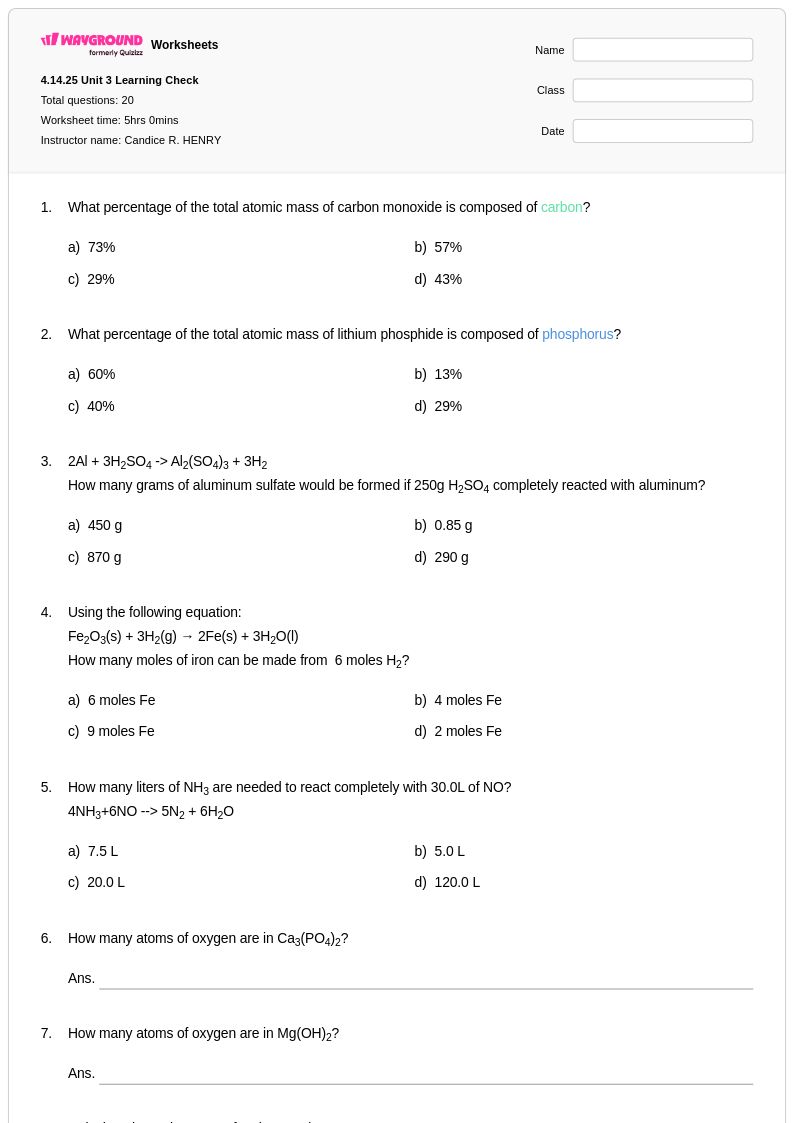
The mole is the bridge between a balanced chemical equation and measurable quantities in the lab. Stoichiometry depends entirely on mole ratios derived from the coefficients in a balanced equation — without a solid understanding of molar conversions, students cannot correctly scale reactions to calculate theoretical yields, determine limiting reagents, or predict product quantities. Teaching mole calculations before introducing stoichiometry is essential because every subsequent stoichiometric problem requires students to move fluently between mass, moles, and particle counts.