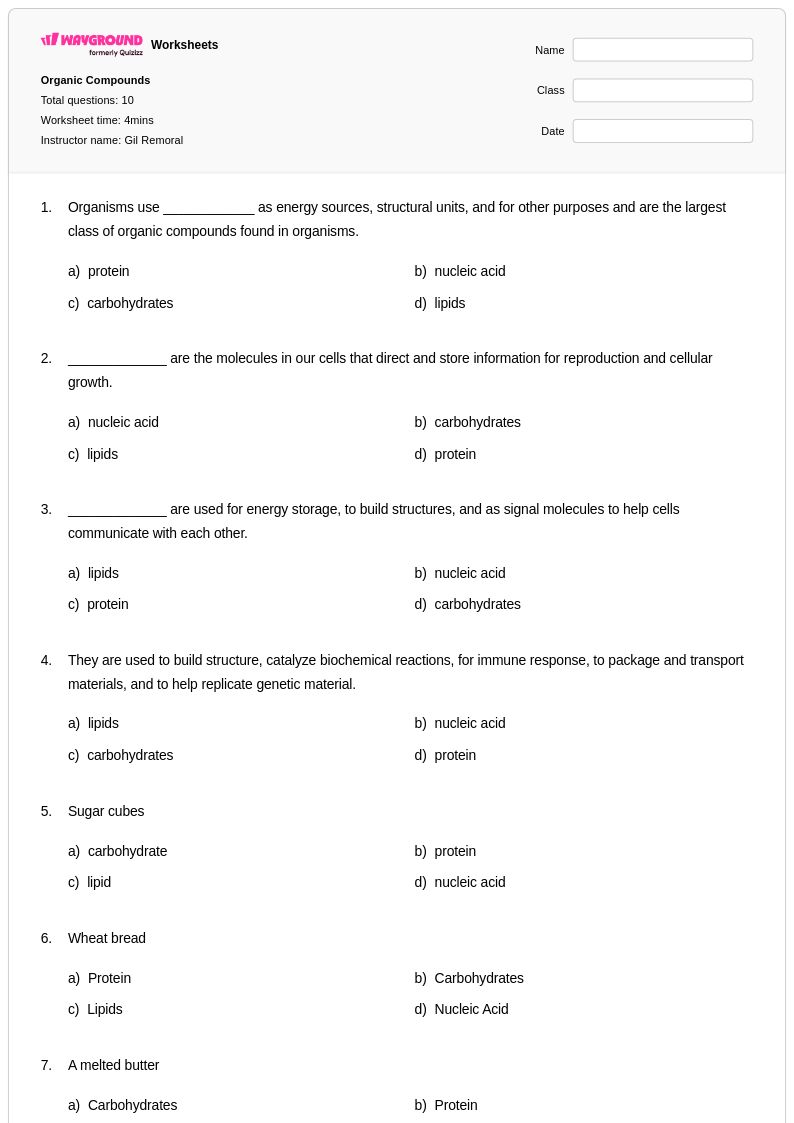
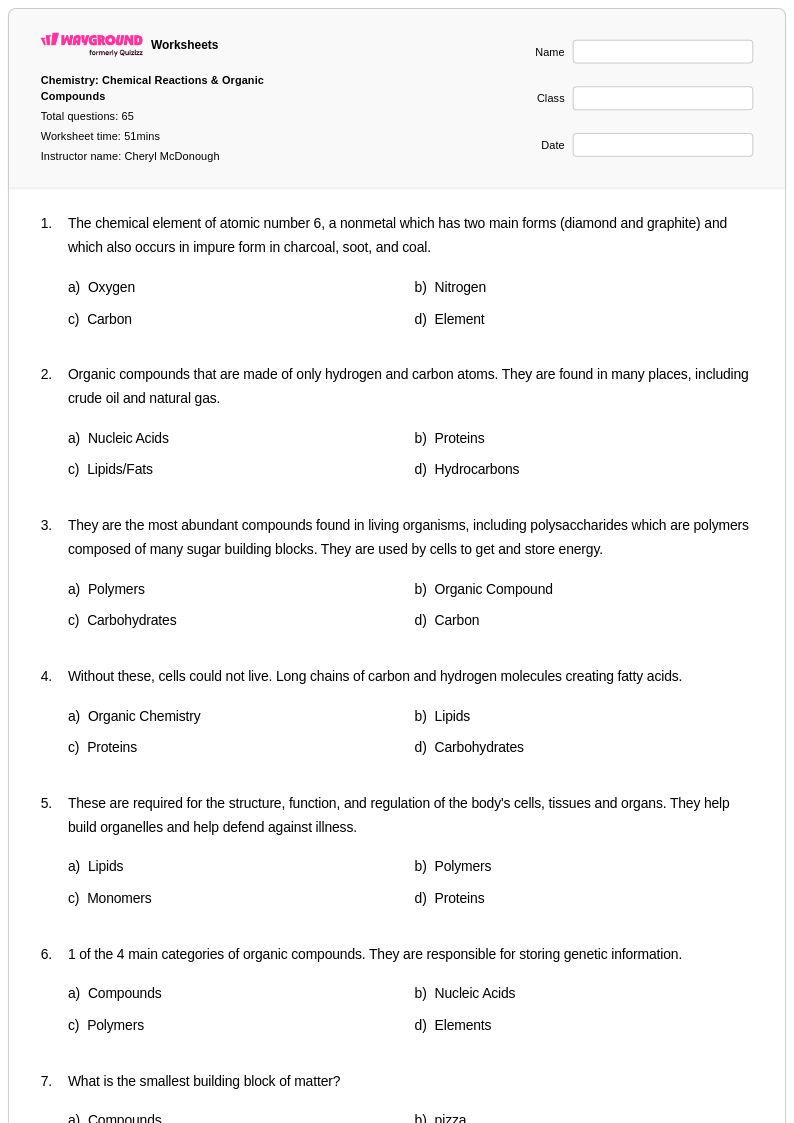
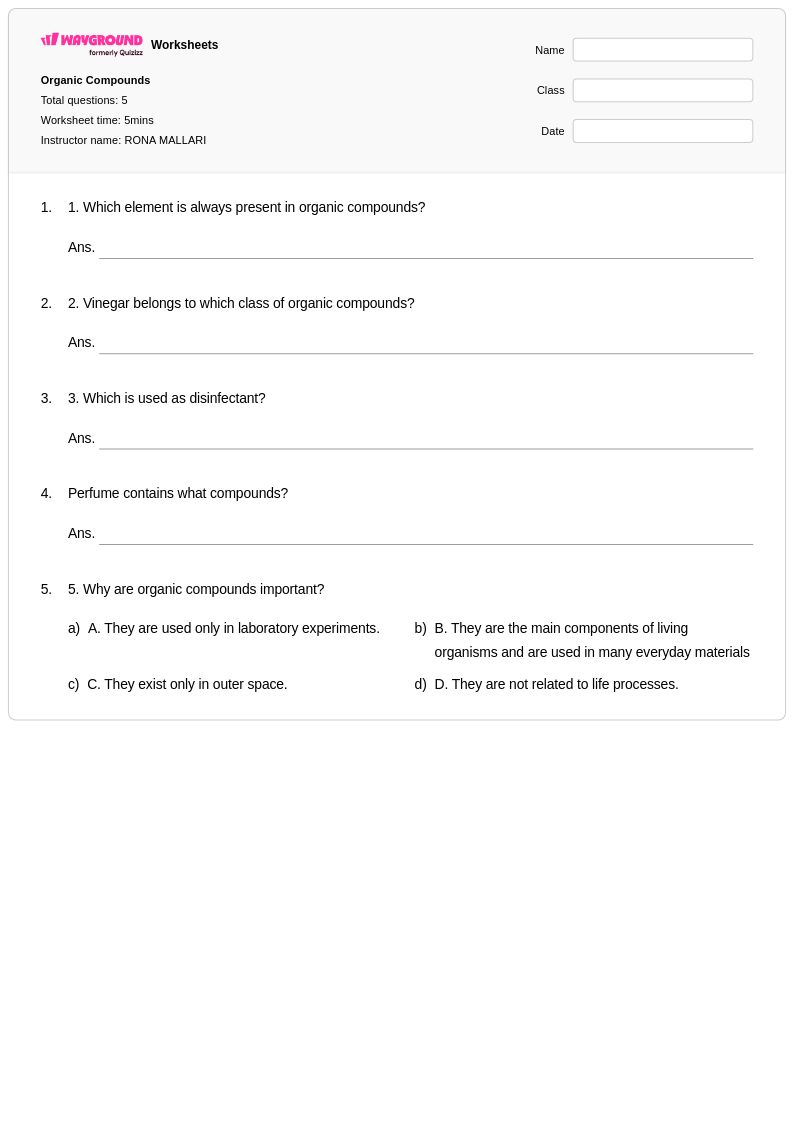
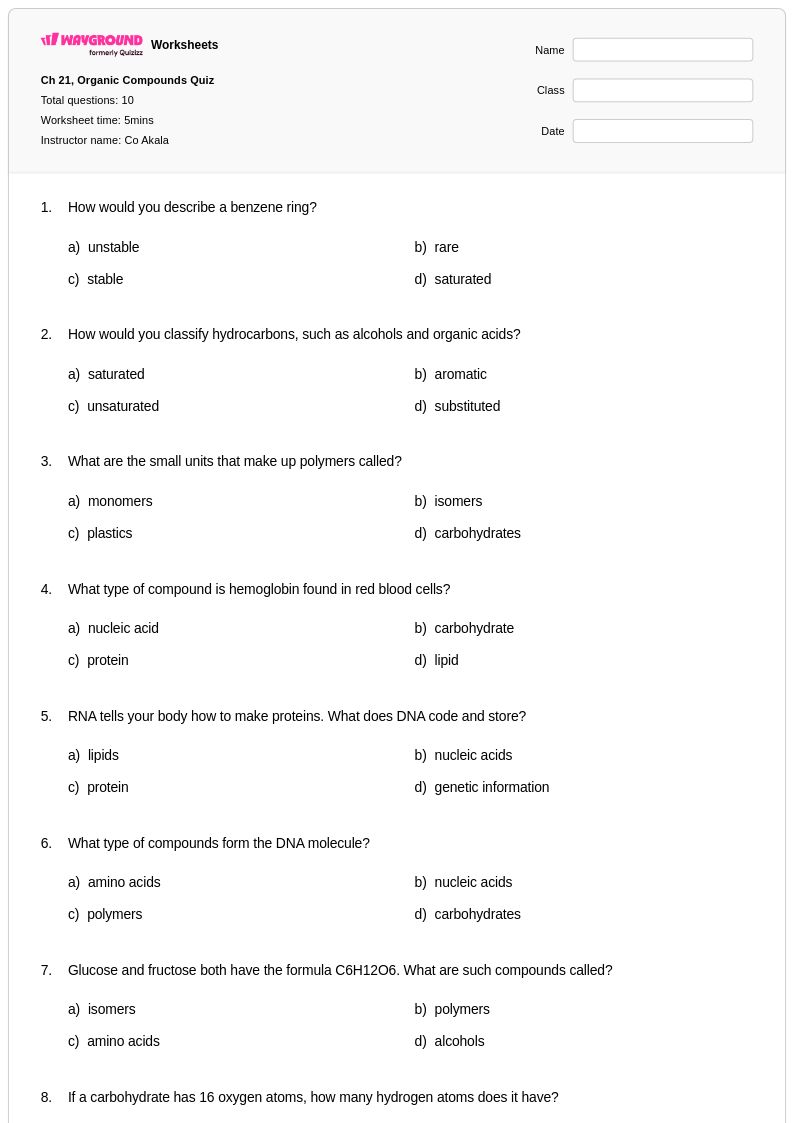
Free Printable Organic Compounds Worksheets for Year 9
Year 9 organic compounds worksheets from Wayground provide comprehensive printables and practice problems with answer keys to help students master the fundamentals of carbon-based molecules and their properties.
Explore printable Organic Compounds worksheets for Year 9
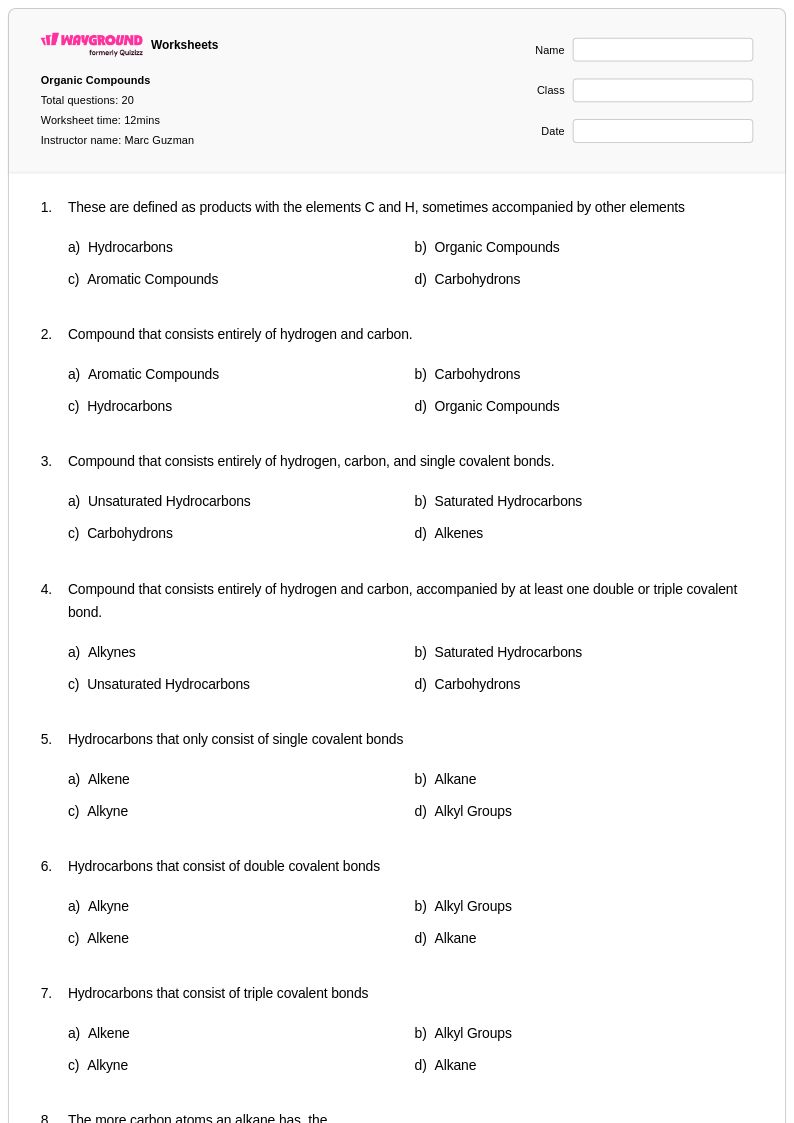
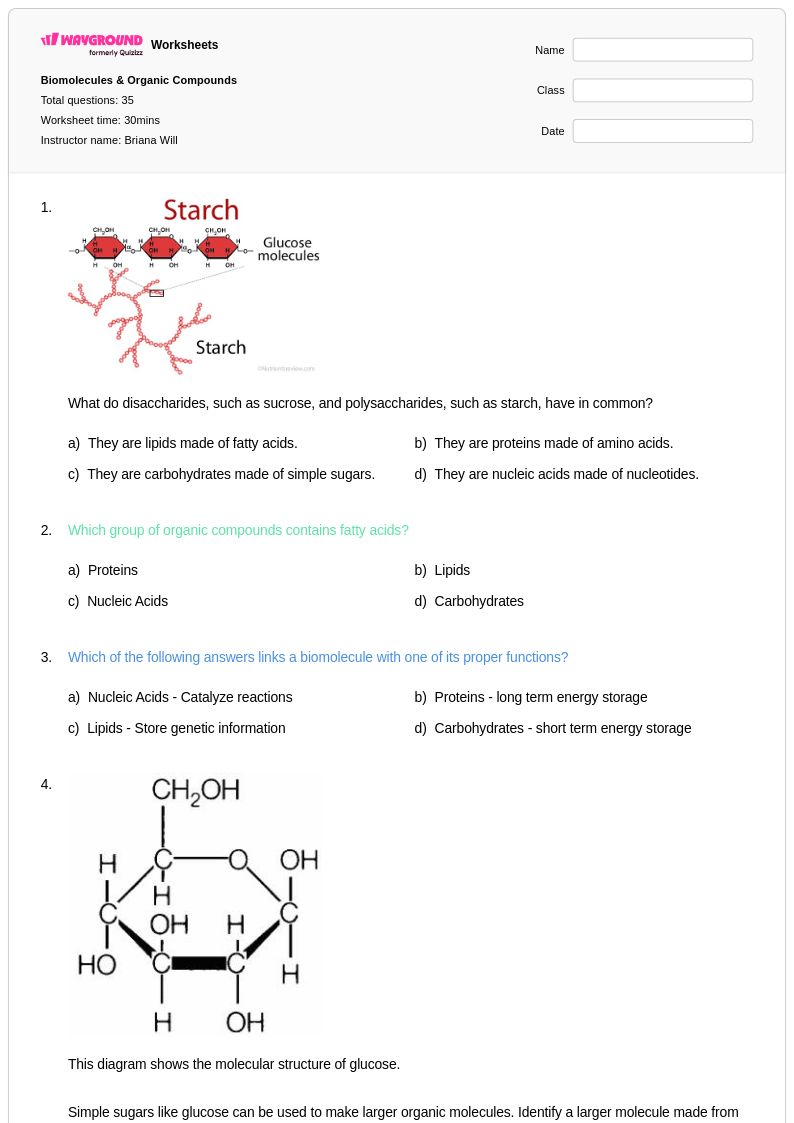
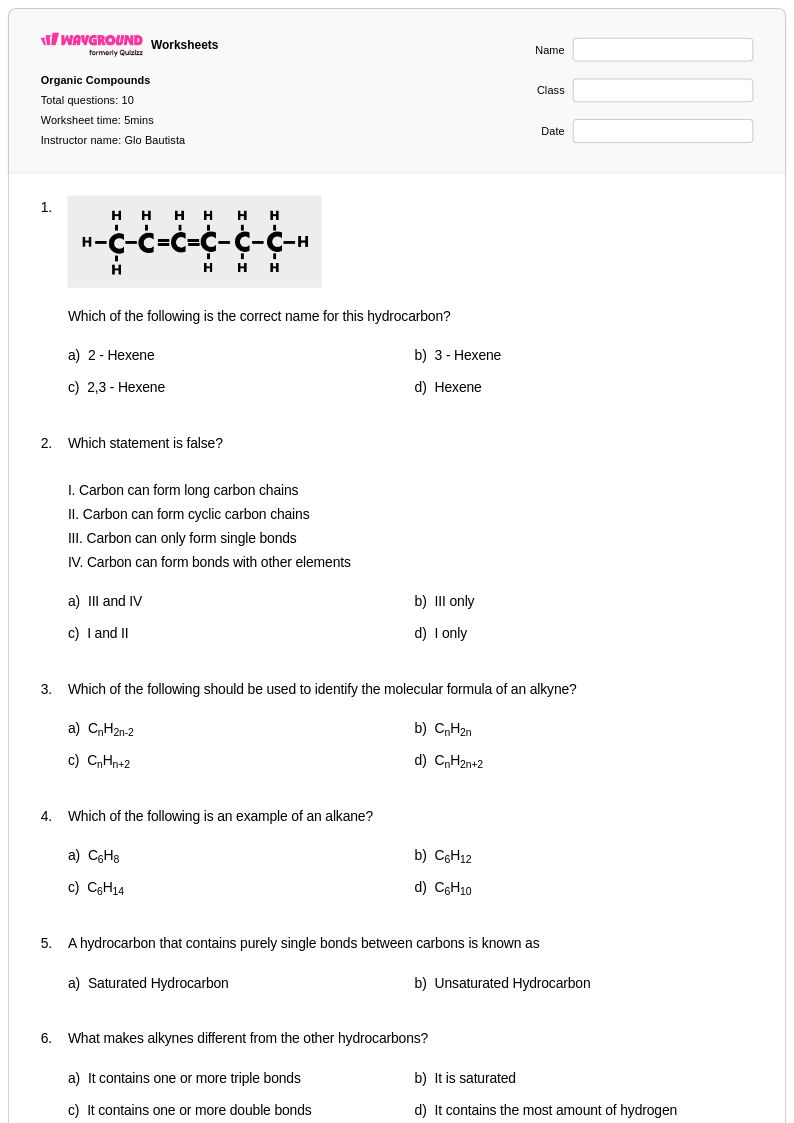
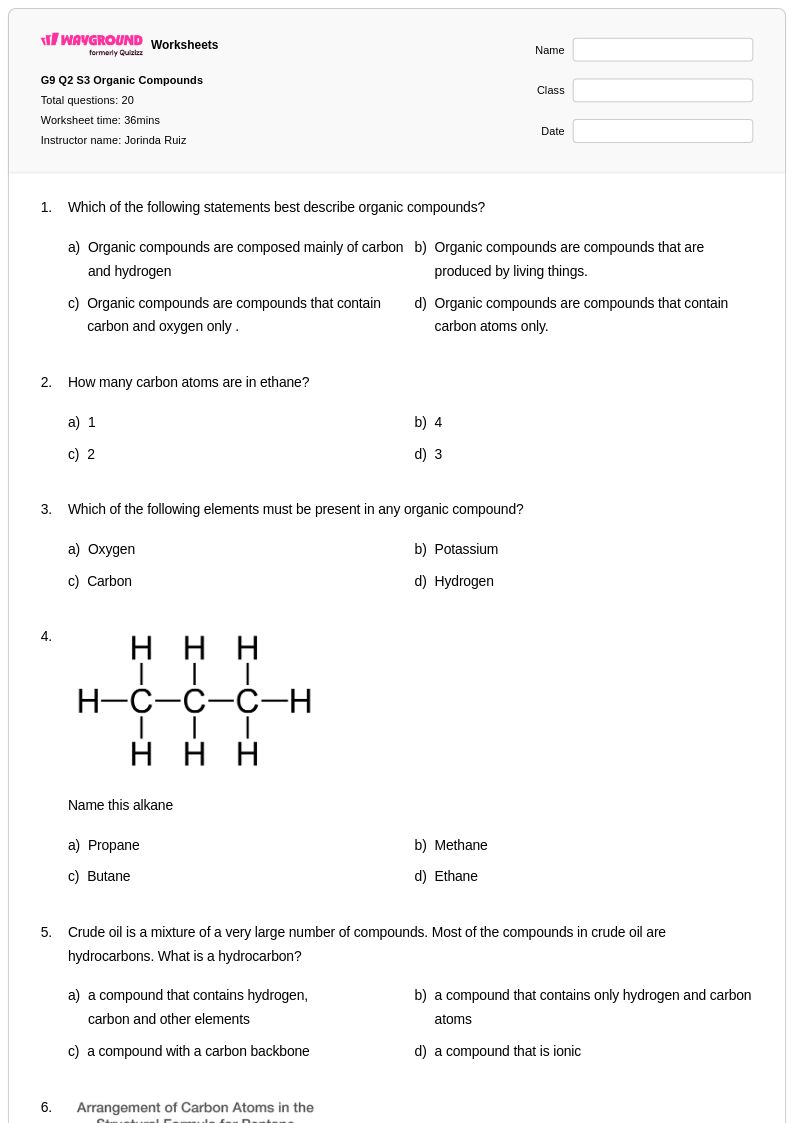
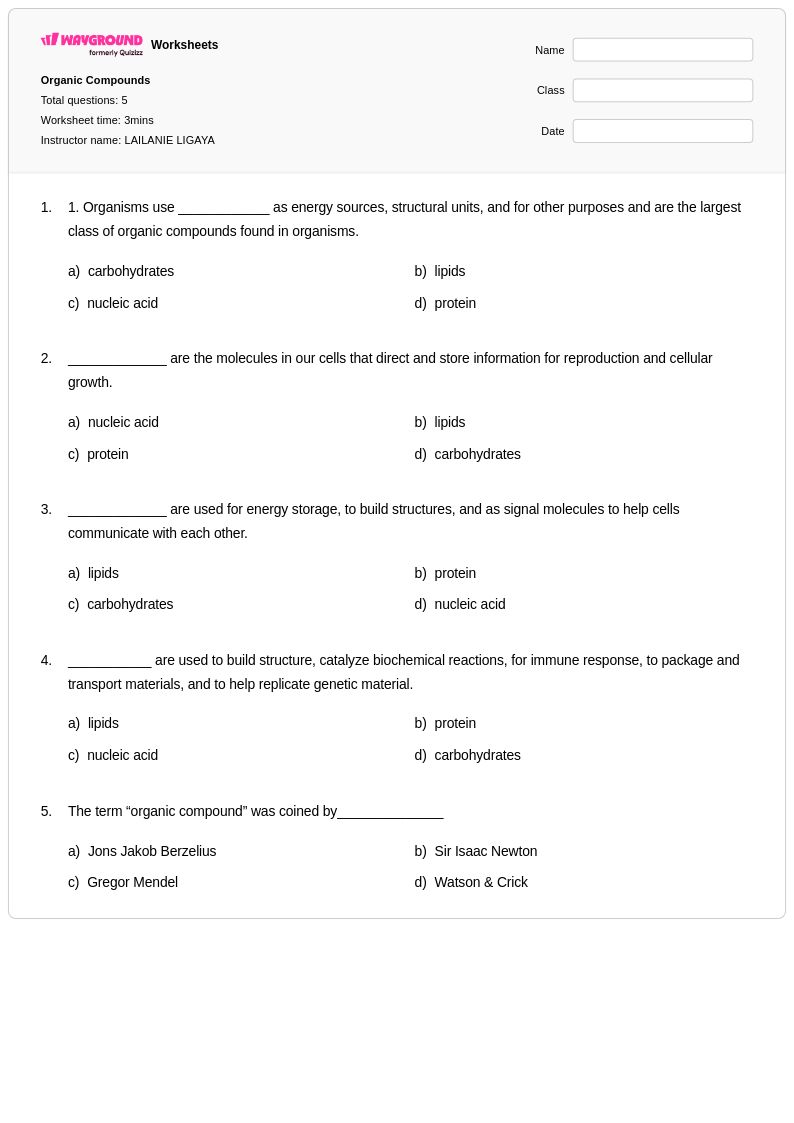
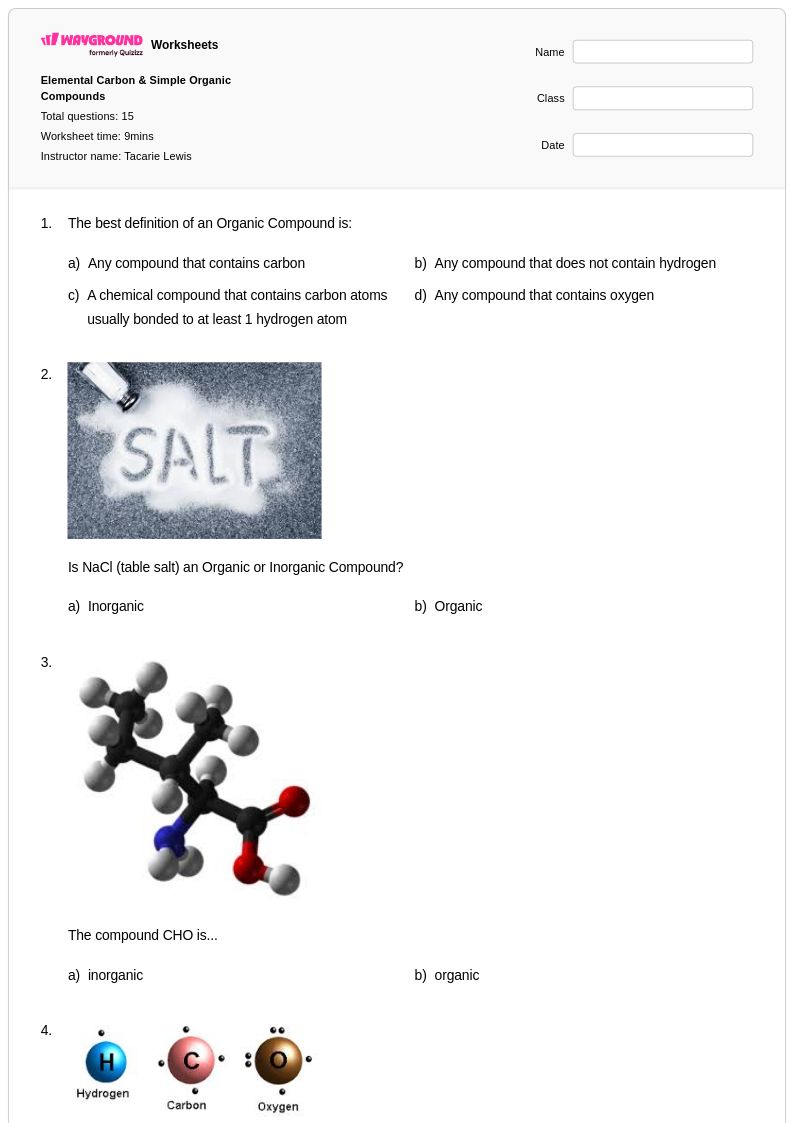
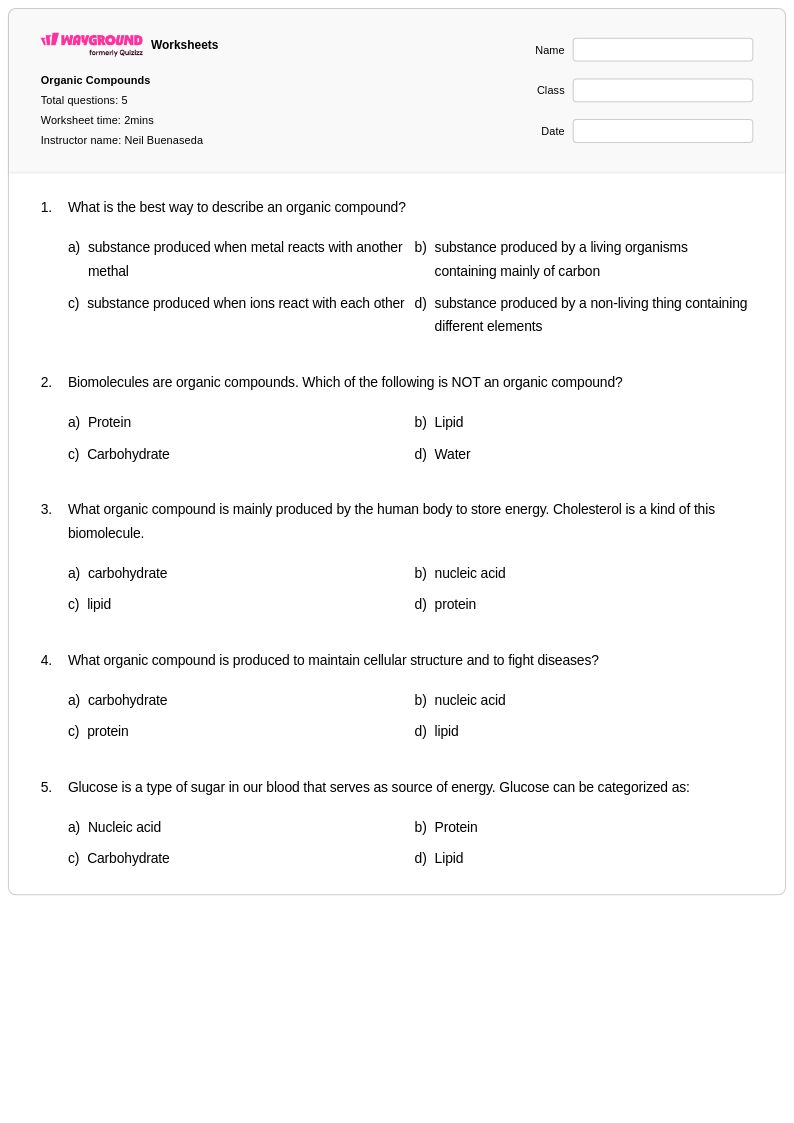
Organic compounds form the foundation of biological systems and synthetic materials, making Year 9 organic chemistry worksheets essential for students beginning their exploration of carbon-based molecular structures. Wayground's comprehensive collection of organic compounds worksheets provides structured practice with hydrocarbon classification, functional group identification, and molecular formula analysis that builds critical thinking skills in chemical reasoning. These educational resources include detailed answer keys that support independent learning, while printable pdf formats ensure accessibility for both classroom instruction and home study. Students engage with practice problems covering alkanes, alkenes, alkynes, and basic functional groups, developing the pattern recognition abilities necessary for understanding how molecular structure determines chemical properties and biological functions.
Wayground's extensive database draws from millions of teacher-created resources specifically designed to support organic chemistry instruction at the Year 9 level, with advanced search and filtering capabilities that allow educators to locate materials aligned with specific curriculum standards and learning objectives. The platform's differentiation tools enable teachers to customize worksheet difficulty and content focus, accommodating diverse learning needs through both digital interactive formats and traditional printable pdf versions. This flexibility proves invaluable for lesson planning, targeted remediation of challenging concepts like isomerism and nomenclature, and enrichment activities that extend learning beyond basic organic compound recognition. Teachers can seamlessly integrate these resources into formative assessments, skill-building practice sessions, and review activities that reinforce the fundamental principles students need before advancing to more complex organic chemistry topics.
FAQs
How do I teach organic compounds to high school chemistry students?
Start by grounding students in carbon's bonding behavior before introducing hydrocarbon families — alkanes, alkenes, alkynes, and aromatics — in sequence from simplest to most complex. Use molecular modeling (physical or digital) alongside Lewis structures and skeletal formulas so students can visualize the relationship between structure and properties. Once students are comfortable with structural representations, introduce IUPAC nomenclature as a systematic naming system, emphasizing that the rules follow predictable logic rather than requiring rote memorization. Connecting each functional group to a real-world compound (e.g., ethanol, acetic acid) helps students build meaningful associations that support retention.
What exercises help students practice identifying and naming organic compounds?
Effective practice for organic compounds includes structural drawing exercises where students convert IUPAC names to skeletal formulas and vice versa, isomer identification tasks that require distinguishing structural and geometric isomers, and functional group classification activities. Naming drills using homologous series (e.g., methane through decane) build procedural fluency with IUPAC conventions before students tackle branched or substituted structures. Reaction mechanism practice — such as completing addition, substitution, or condensation reactions — extends skill work beyond nomenclature into chemical behavior.
What mistakes do students commonly make when learning organic chemistry nomenclature?
The most frequent error is selecting the wrong parent chain — students often choose the longest straight chain visually rather than identifying the longest continuous carbon chain, which can differ when branches are present. Students also commonly misplace or mislabel substituents, forgetting to number from the end closest to the first branch point. Confusing the suffixes for alkenes (-ene) and alkynes (-yne) with the base alkane form (-ane) is another persistent mistake, particularly when students are still building pattern recognition across hydrocarbon families.
How do students often confuse structural isomers with stereoisomers in organic chemistry?
Students frequently conflate structural isomers — which differ in the connectivity of atoms — with stereoisomers, which share the same connectivity but differ in spatial arrangement. A common error is treating cis/trans geometric isomers as if they are simply different structural drawings rather than recognizing they require restricted rotation around a double bond. Clarifying that stereoisomers have identical molecular formulas and bond sequences but different three-dimensional configurations helps students distinguish the two categories. Pairing this explanation with side-by-side structural diagrams and physical models reinforces the conceptual difference.
How can I use organic compounds worksheets in my classroom?
Organic compounds worksheets on Wayground are available as printable PDFs for traditional classroom use and in digital formats for technology-integrated learning environments, including the option to host them as a quiz directly on Wayground. Printable versions work well for structured in-class practice, lab prep, or homework assignments, while digital formats allow for self-paced independent work or formative assessment. All worksheets include detailed answer keys, supporting both teacher-led review and independent student self-assessment. Wayground also offers accommodation tools — such as read aloud, extended time, and reduced answer choices — that can be assigned to individual students without disrupting the rest of the class.
How do I differentiate organic chemistry instruction for students at different skill levels?
For students still building foundational understanding, start with simple straight-chain alkane naming and single functional group identification before introducing branching or multiple functional groups. Advanced students benefit from reaction mechanism analysis, multi-step synthesis problems, and isomer enumeration tasks that require higher-order reasoning. On Wayground, differentiation tools allow teachers to adjust worksheet difficulty and assign accommodations — such as reduced answer choices or extended time — to individual students, so the same session can serve both remediation and enrichment goals simultaneously.