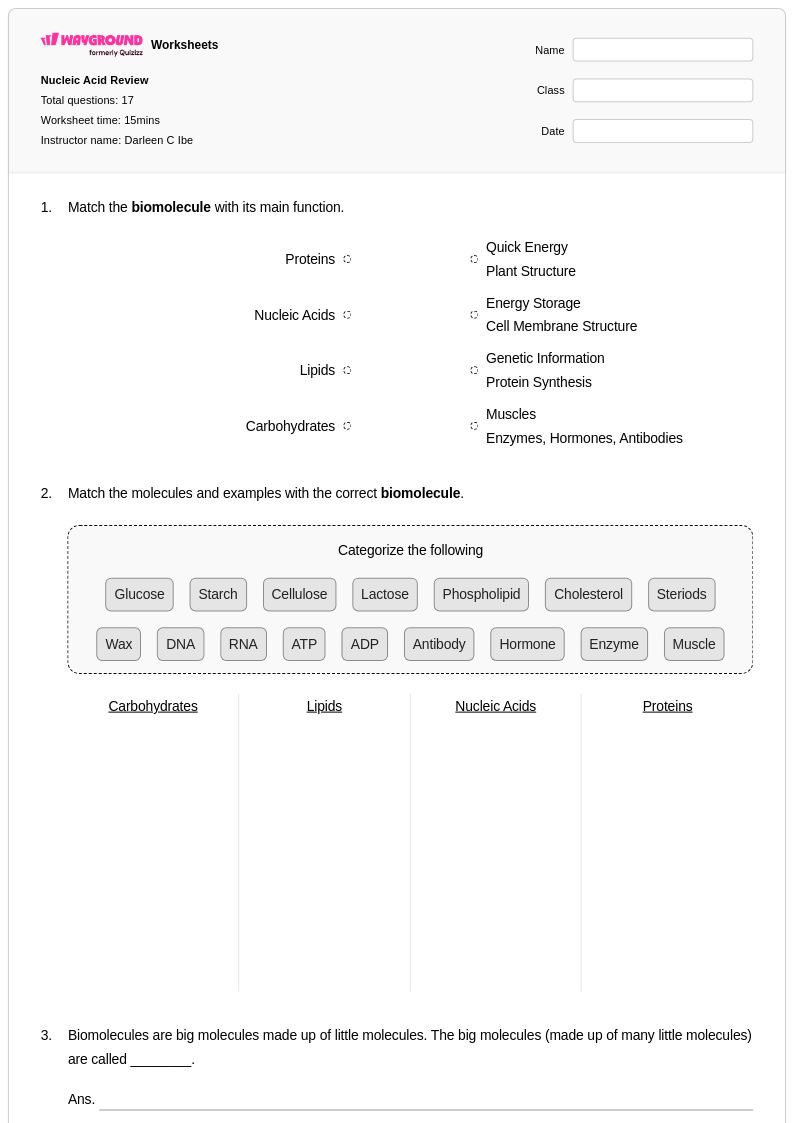
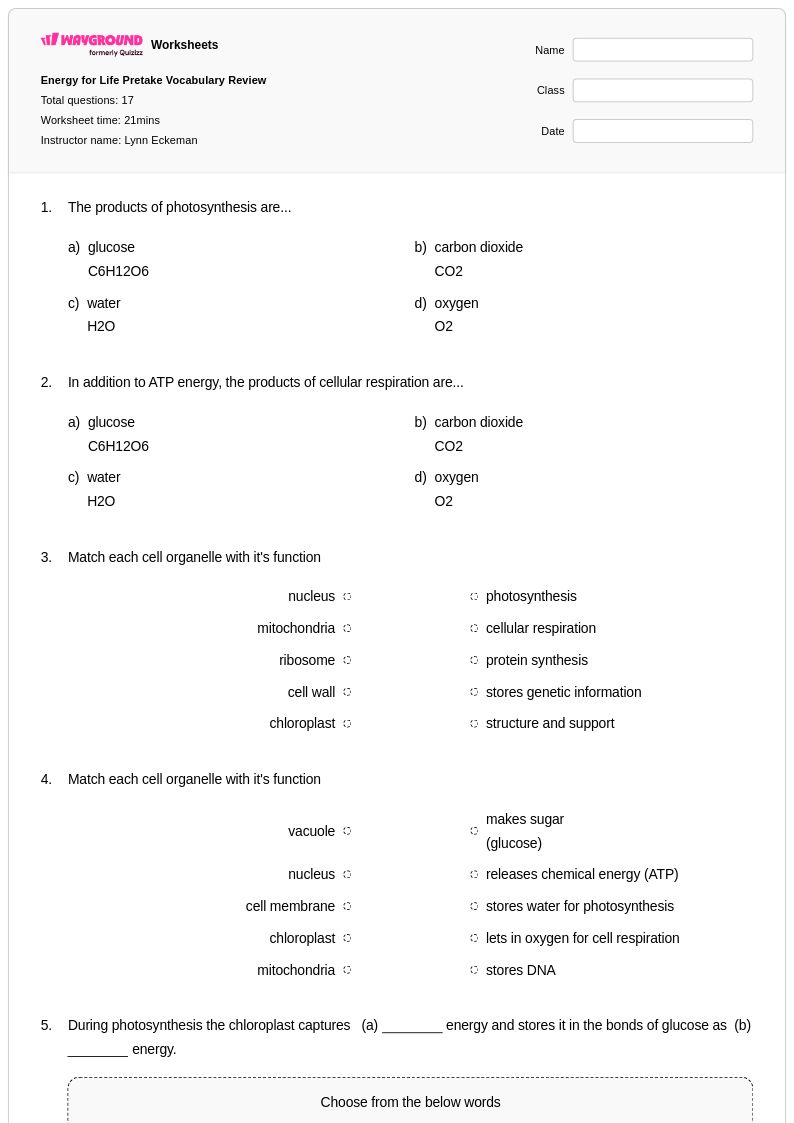
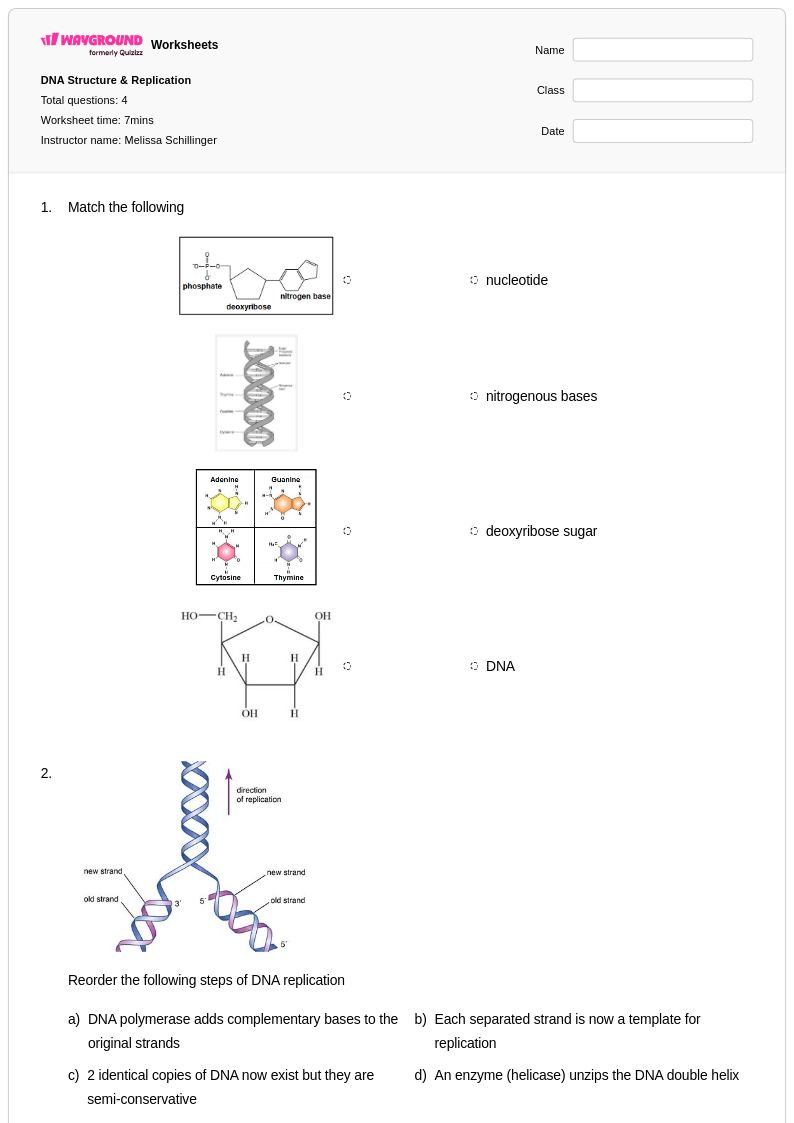
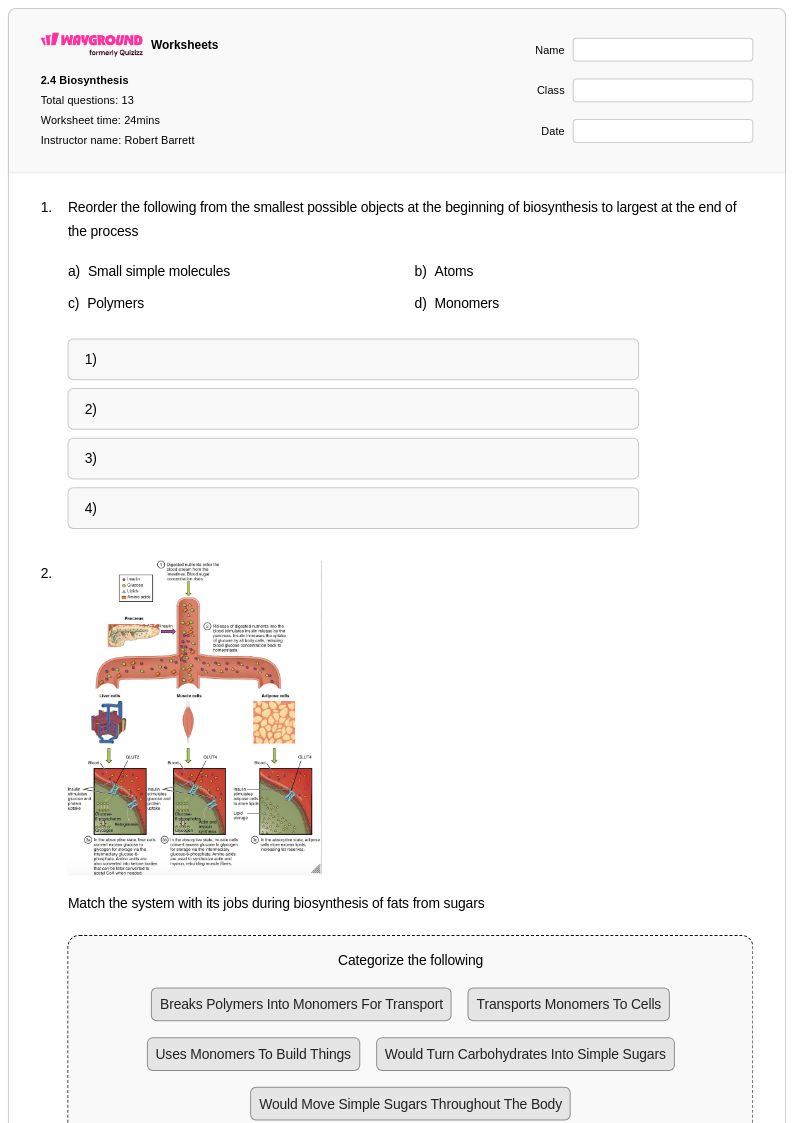
Explore Year 9 polymers worksheets and printables through Wayground that help students master polymer structures, properties, and applications with comprehensive practice problems, free PDF downloads, and detailed answer keys.
Polymers worksheets for Year 9 students through Wayground (formerly Quizizz) provide comprehensive coverage of macromolecular chemistry concepts essential for understanding how large molecules form and function in our world. These carefully designed practice problems guide students through the fundamental principles of polymerization, including addition and condensation reactions, while exploring the structural differences between thermoplastics, thermosets, and elastomers. Students strengthen critical analytical skills by examining polymer properties, identifying monomer units, and predicting how molecular structure influences material characteristics. The collection includes detailed answer keys and free printable resources that support both classroom instruction and independent study, ensuring students can master complex topics like cross-linking, crystallinity, and polymer degradation through systematic practice.
Wayground (formerly Quizizz) empowers educators with millions of teacher-created polymer worksheets that streamline lesson planning and enhance student understanding of macromolecular chemistry. The platform's robust search and filtering capabilities allow teachers to quickly locate materials aligned with specific learning standards, while differentiation tools enable customization for diverse learning needs and skill levels. These polymer worksheet collections are available in both printable pdf formats and interactive digital versions, providing flexibility for traditional classroom settings and modern learning environments. Teachers can effectively use these resources for targeted remediation of challenging concepts like molecular weight distribution, for enrichment activities exploring advanced polymer applications in biotechnology and engineering, and for ongoing skill practice that builds student confidence in predicting polymer behavior and properties.
FAQs
How do I teach polymers to high school chemistry students?
Start by grounding students in monomer structure before introducing polymerization reactions, since understanding the repeating unit is essential to grasping how macromolecules form. Use addition polymerization as the entry point because the mechanism is more straightforward, then progress to condensation polymerization where students must track the small molecules released. Connecting polymer properties to real materials — like nylon, polyethylene, and proteins — helps students see the relevance and retain the structural logic behind each reaction type.
What exercises help students practice polymerization reactions?
Effective practice includes drawing and identifying monomers from a given polymer structure, predicting the products of both addition and condensation polymerization reactions, and calculating molecular weights from degree of polymerization. Students also benefit from comparing structural diagrams of different polymer classes to evaluate how backbone composition affects physical properties. Worksheets that present these problems in sequence — from identification to synthesis to characterization — build the analytical skills needed for exam-level questions.
What mistakes do students commonly make when learning about polymers?
A frequent error is confusing addition and condensation polymerization, particularly failing to account for the loss of small molecules like water in condensation reactions. Students also struggle with correctly identifying the repeating unit in a polymer chain, especially when the monomer undergoes structural changes during reaction. Another common misconception is assuming that higher molecular weight always means greater strength, when in reality properties like crystallinity, cross-linking, and chain flexibility play equally important roles.
How can I use polymer worksheets to support students with different ability levels?
For struggling learners, focus on monomer identification and basic structural recognition before introducing mechanism-based problems. Advanced students can be challenged with structure-property relationship analysis and problems involving polymer characterization techniques like molecular weight distributions. On Wayground, teachers can apply accommodations such as reduced answer choices to lower cognitive load for selected students, or enable read-aloud features for students who need audio support, all without disrupting the experience for the rest of the class.
How do I use Wayground's polymer worksheets in my classroom?
Wayground's polymer worksheets are available as printable PDFs for traditional classroom use and in digital formats for technology-integrated or remote learning environments. Teachers can also host worksheets directly as a quiz on Wayground, enabling instant feedback and progress tracking. Each worksheet includes a complete answer key, supporting both independent student practice and teacher-led review sessions.
How do I assess student understanding of polymer structure and properties?
Effective assessment should move beyond recall and require students to explain the relationship between a polymer's molecular structure and its physical properties, such as why cross-linked polymers resist deformation or why amorphous regions affect transparency. Prompting students to compare two polymers and justify which would perform better for a specific application reveals deeper conceptual understanding. Common assessment gaps include students who can name polymerization types but cannot accurately draw the reaction mechanism or predict the structural outcome.