Free Printable Band of Stability Worksheets for Class 11
Explore Wayground's free Class 11 Band of Stability worksheets and printables that help students master nuclear chemistry concepts through practice problems and comprehensive answer keys in downloadable PDF format.
Explore printable Band of Stability worksheets for Class 11
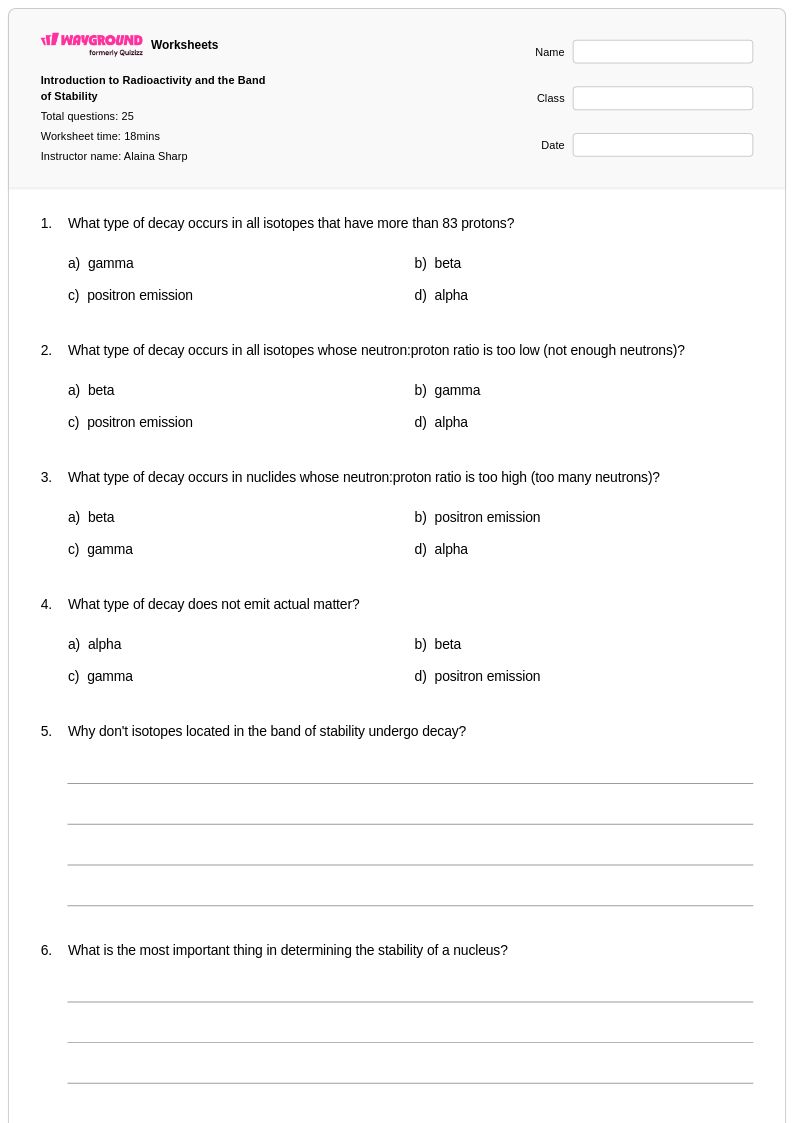
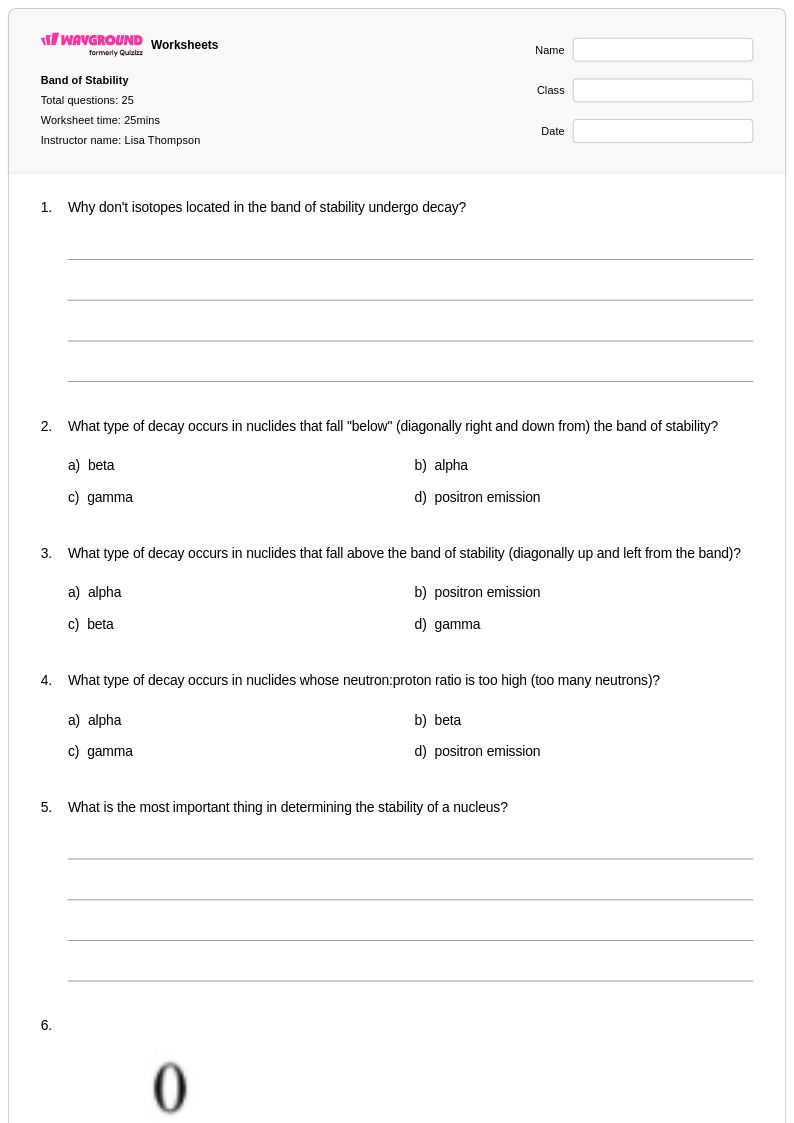
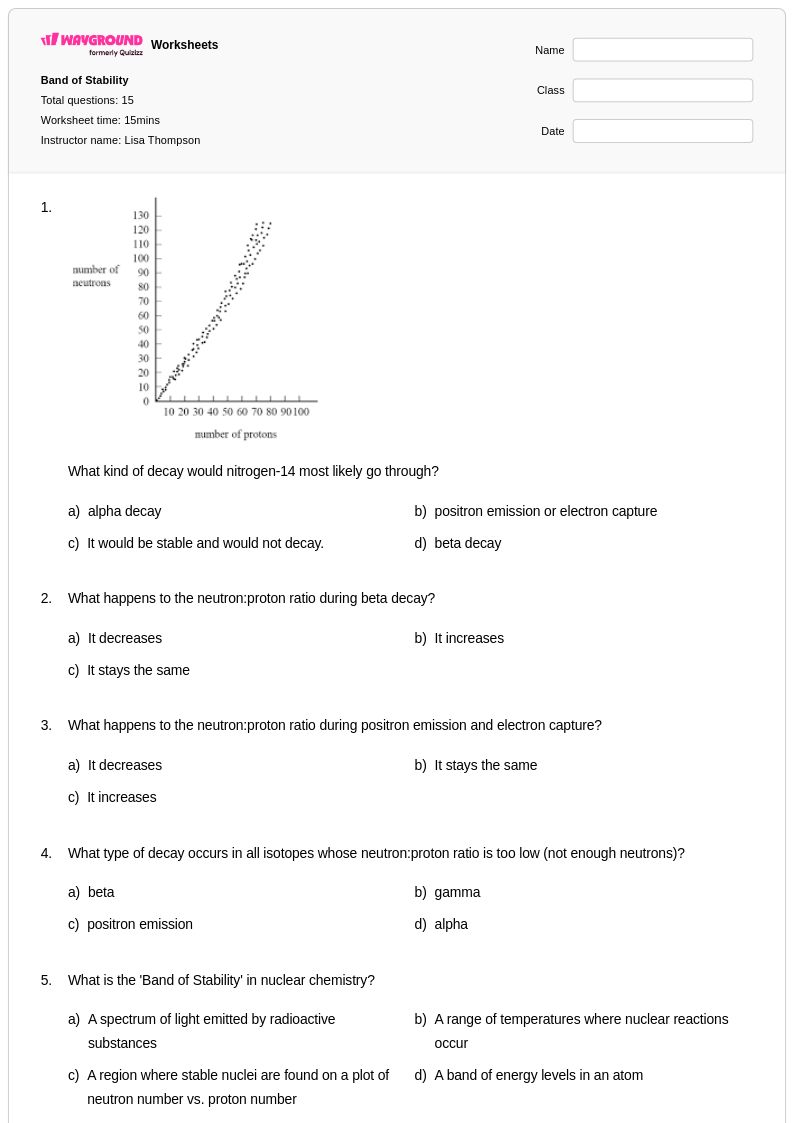
Band of Stability worksheets for Class 11 chemistry students available through Wayground (formerly Quizizz) provide comprehensive coverage of nuclear chemistry concepts essential for understanding radioactive decay and nuclear reactions. These expertly crafted resources help students master the relationship between proton and neutron ratios in atomic nuclei, enabling them to predict nuclear stability and identify decay pathways for unstable isotopes. The worksheets strengthen critical analytical skills as students learn to interpret the band of stability graph, calculate binding energy per nucleon, and determine whether specific nuclides will undergo alpha decay, beta decay, or other nuclear processes. Each worksheet collection includes detailed answer keys and is available as free printables in convenient pdf format, featuring practice problems that range from basic nuclear notation to complex stability predictions that challenge students to apply theoretical knowledge to real-world nuclear phenomena.
Wayground (formerly Quizizz) empowers chemistry educators with millions of teacher-created resources specifically designed for Class 11 nuclear chemistry instruction, including extensive Band of Stability worksheet collections that align with state and national science standards. The platform's advanced search and filtering capabilities allow teachers to quickly locate worksheets that match their specific curriculum requirements, whether focusing on nuclear equations, half-life calculations, or stability pattern recognition. These differentiation tools enable educators to customize content for diverse learning needs, offering both remediation support for struggling students and enrichment activities for advanced learners, while the flexible format options provide seamless integration into both traditional classroom settings and digital learning environments. Teachers can efficiently plan comprehensive nuclear chemistry units, assign targeted skill practice, and provide immediate feedback through these professionally developed resources that transform complex nuclear concepts into accessible, engaging learning experiences.
FAQs
How do I teach the band of stability in a nuclear chemistry unit?
Start by having students plot neutron number versus proton number for known stable isotopes to visualize the zone of stability before introducing formal rules. From there, teach the neutron-to-proton ratio as a predictive tool: elements with Z below 20 tend to be stable near a 1:1 ratio, while heavier elements require progressively more neutrons. Once students can locate isotopes relative to the band, introduce decay modes as corrections — beta-minus decay for neutron-rich isotopes above the band, beta-plus decay or electron capture for proton-rich isotopes below it, and alpha decay for elements beyond Z = 83.
What practice problems help students understand isotope stability and radioactive decay predictions?
Effective practice problems ask students to calculate neutron-to-proton ratios for specific isotopes, plot them relative to the band of stability, and justify which decay mode the isotope would most likely undergo. Problems that require students to write balanced nuclear equations for alpha decay, beta decay, and electron capture reinforce both the conceptual model and the quantitative skills simultaneously. Worksheets that combine stability chart interpretation with decay-mode prediction give students the full analytical workflow they need to master nuclear chemistry.
What mistakes do students commonly make when working with the band of stability?
The most common error is assuming that all isotopes of an element are equally stable, rather than recognizing that stability depends on the specific neutron-to-proton ratio of each nuclide. Students also frequently confuse the direction of beta-minus and beta-plus decay, misidentifying which type of instability each corrects. A third persistent misconception is conflating nuclear binding energy with chemical bond energy, which leads students to misinterpret why heavier nuclei are not simply more stable than lighter ones.
How can I use band of stability worksheets to assess student understanding?
Use stability chart interpretation tasks as formative assessments — if students can correctly identify whether an isotope sits above, below, or within the band and predict the resulting decay mode, they have demonstrated genuine conceptual understanding rather than memorization. Problems requiring balanced nuclear equations provide a reliable summative check because errors in mass number or atomic number conservation reveal specific gaps in understanding. Targeting misconceptions about neutron-to-proton ratios early through worksheet data allows for precise, topic-specific remediation before students encounter more advanced nuclear chemistry content.
How do I use Wayground's band of stability worksheets in my classroom?
Wayground's Band of Stability worksheets are available as free printable PDFs for traditional classroom use and in digital formats for technology-integrated environments, including the option to host them as a quiz directly on Wayground. The digital format allows teachers to assign worksheets remotely or in a blended learning setting, while the printable version works well for in-class problem sets or lab extensions. Each worksheet includes a detailed answer key, making it straightforward to provide targeted feedback on complex nuclear chemistry concepts immediately after practice.
How can I differentiate band of stability instruction for students at different readiness levels?
Begin with foundational tasks such as simple isotope identification and basic ratio calculation for students who are new to nuclear chemistry, then progress to multi-step problems involving nuclear equations and decay series for advanced learners. On Wayground, teachers can apply student-level accommodations including Read Aloud for students who need questions read to them, reduced answer choices to lower cognitive load for struggling learners, and extended time configurable per student. These settings are saved and reusable across future sessions, so differentiation does not require rebuilding each time the worksheet is assigned.