Free Printable Nuclear Changes Worksheets for Class 11
Explore Wayground's comprehensive collection of Class 11 nuclear changes worksheets featuring free printables, practice problems, and answer keys to help students master radioactive decay, nuclear reactions, and atomic transformations.
Explore printable Nuclear Changes worksheets for Class 11
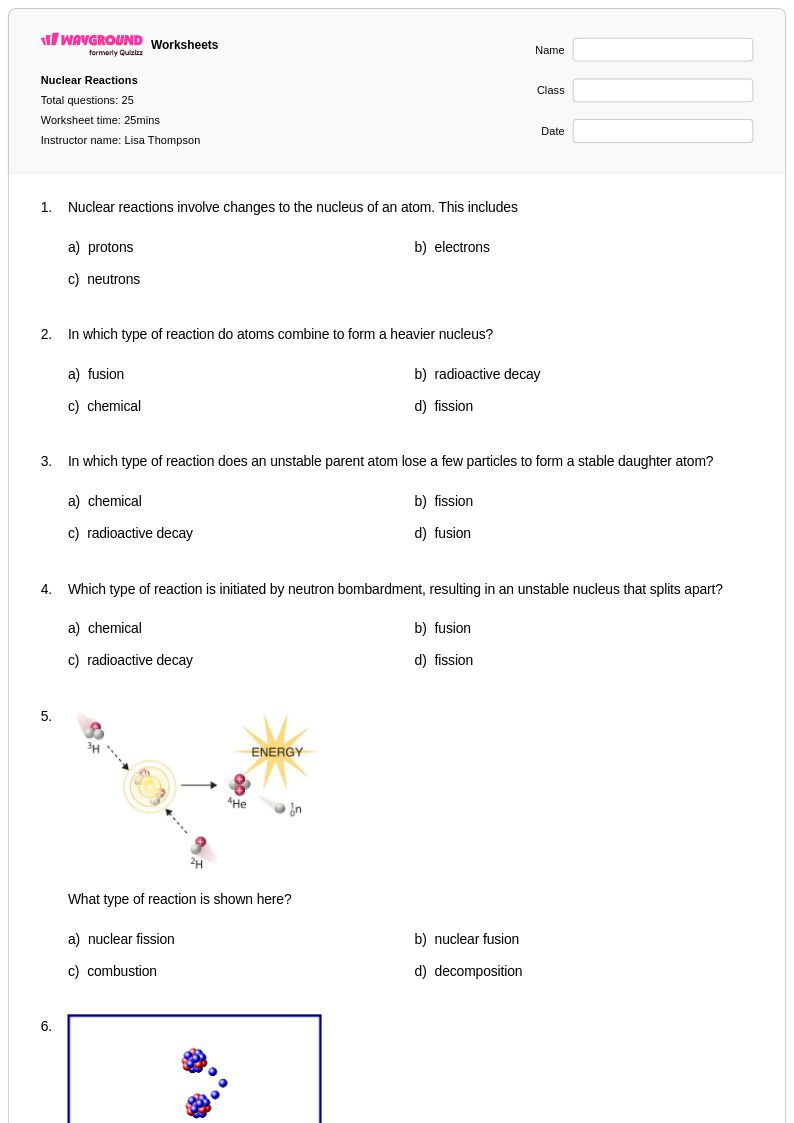
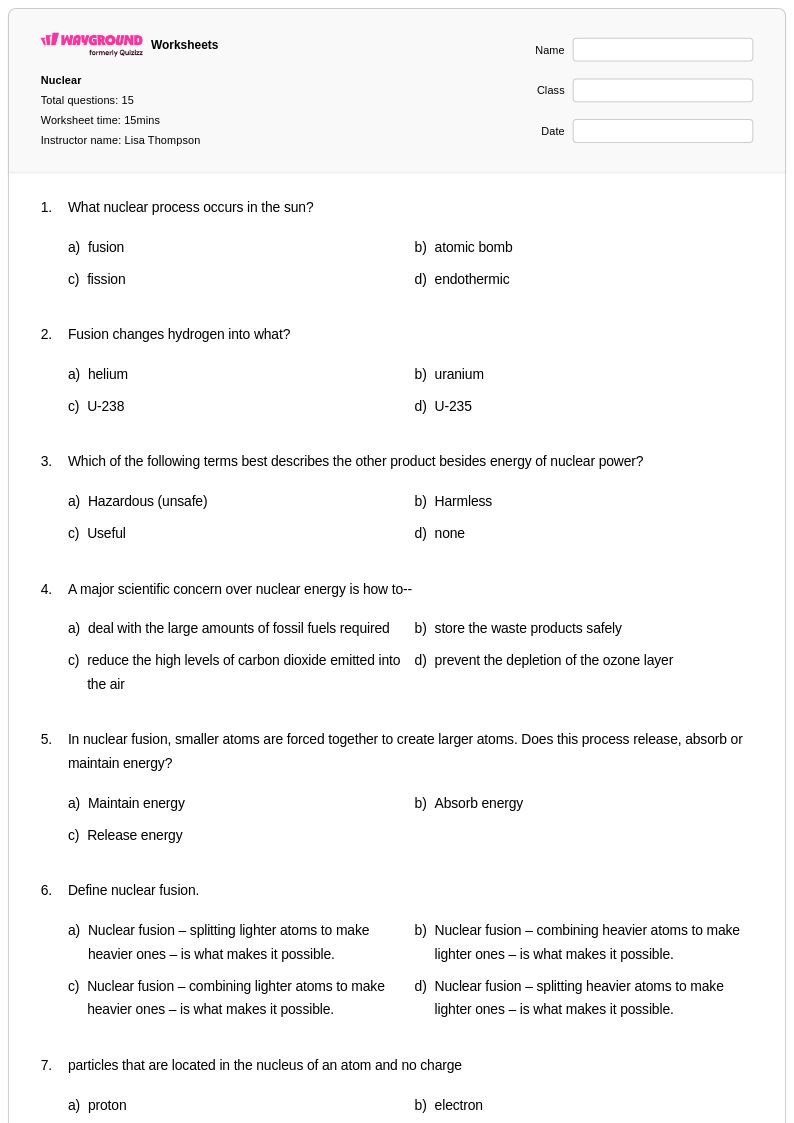
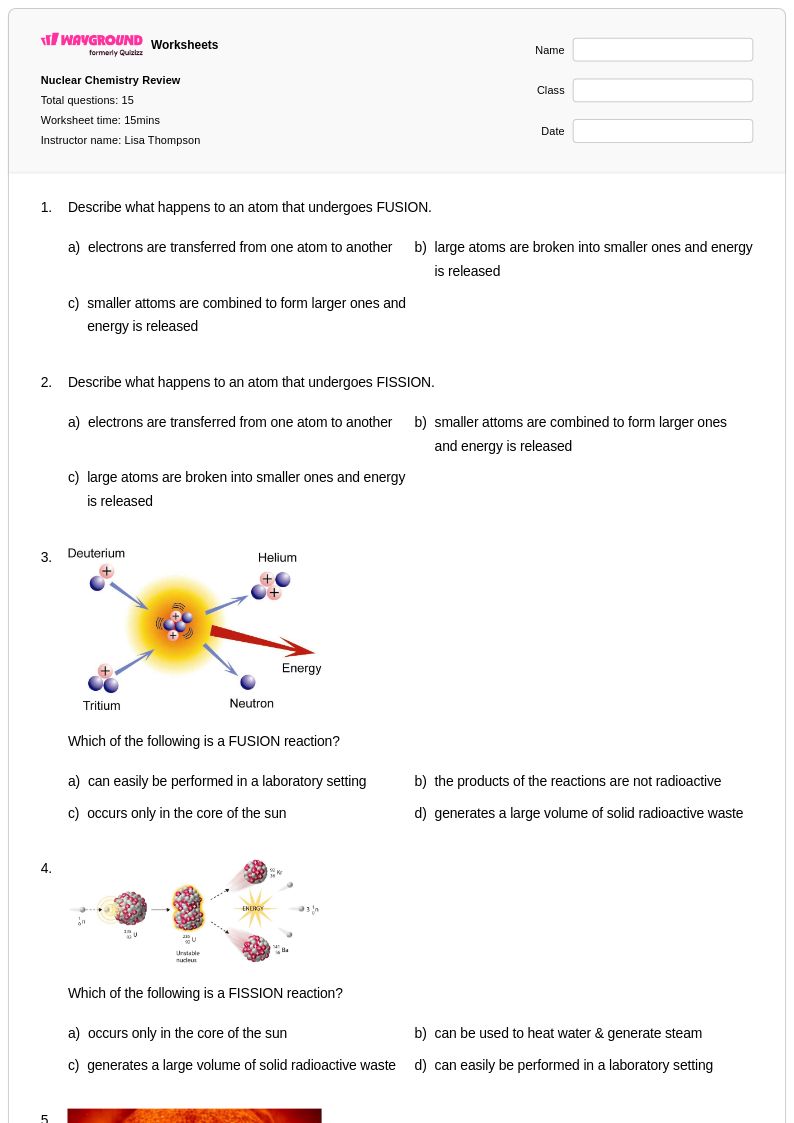
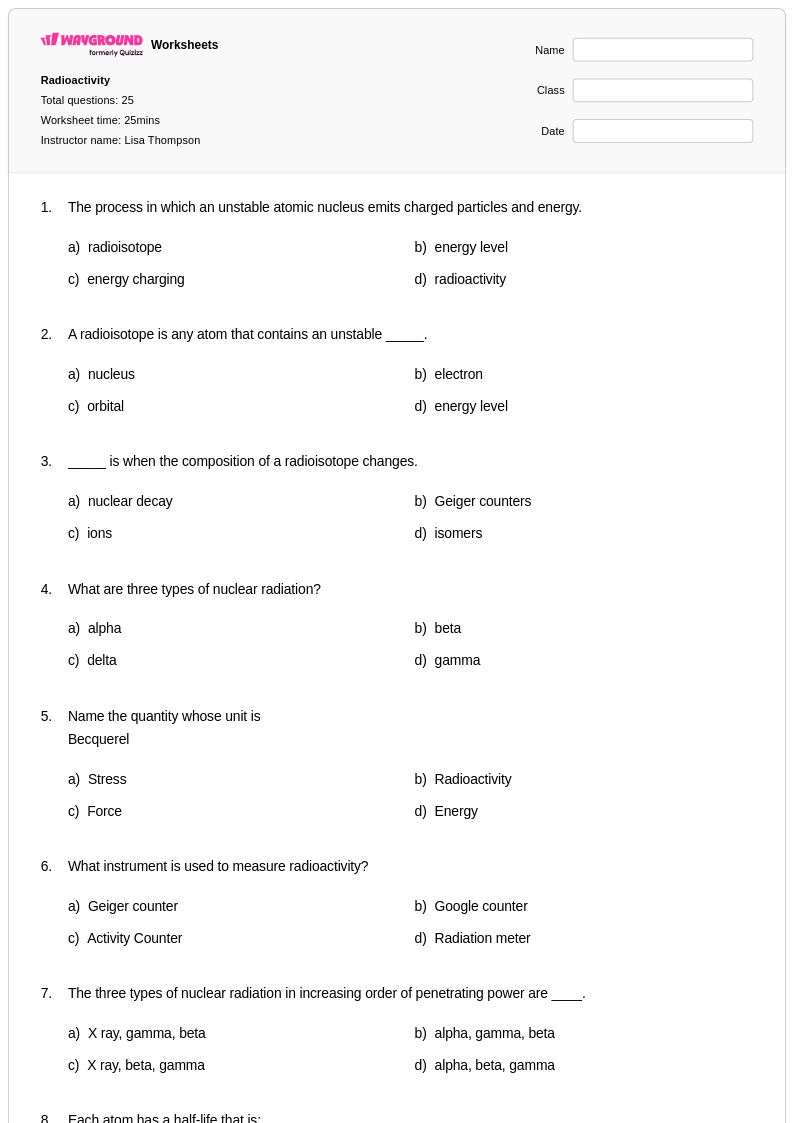
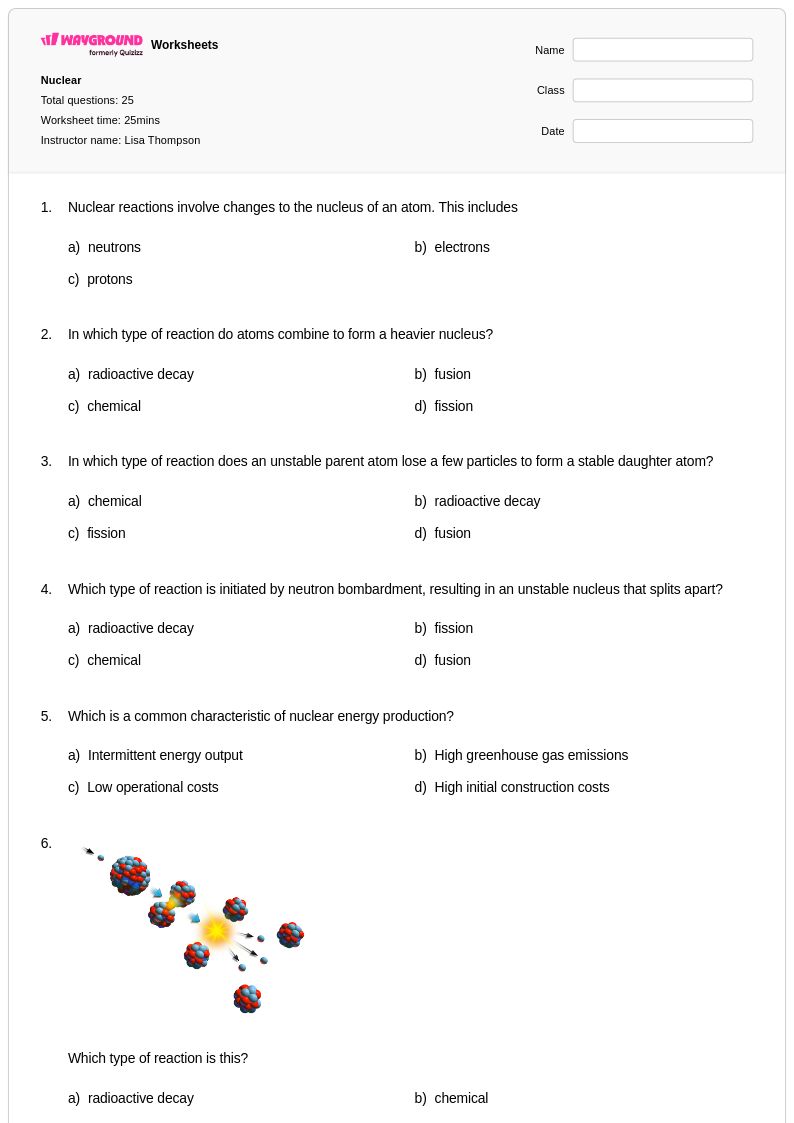
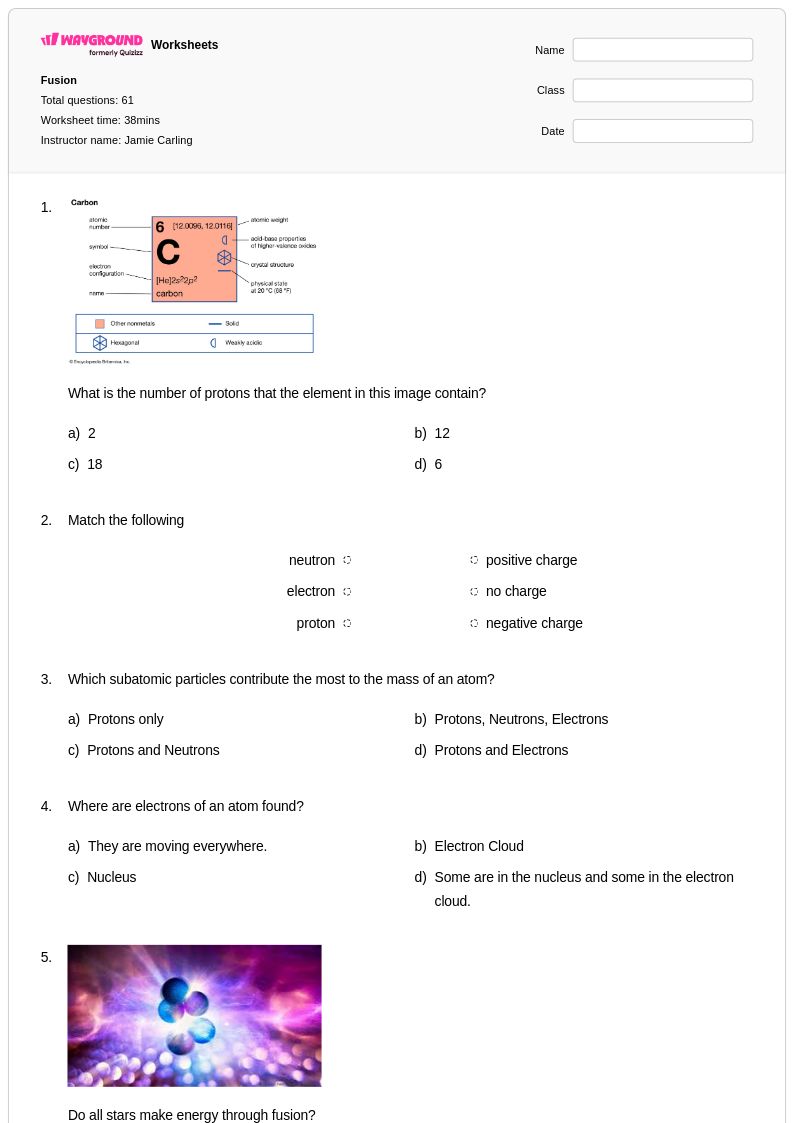
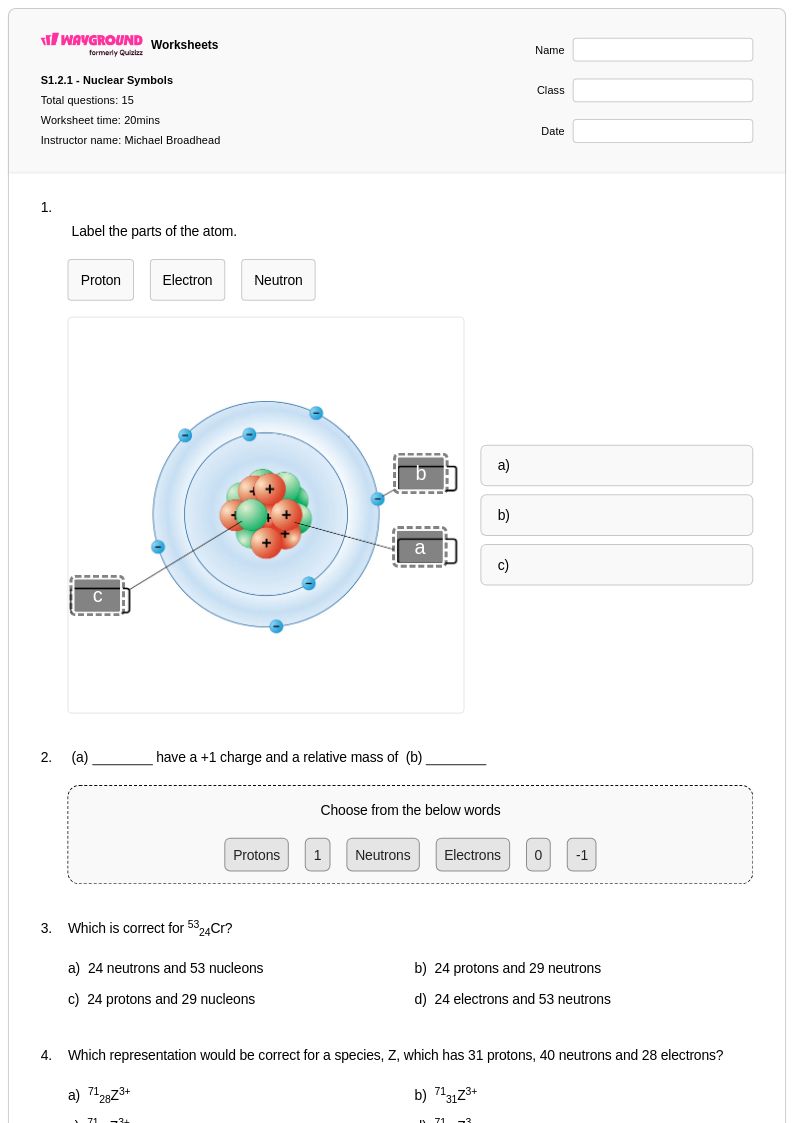
Nuclear changes worksheets for Class 11 chemistry students available through Wayground (formerly Quizizz) provide comprehensive coverage of radioactive decay, nuclear reactions, and atomic transformations that occur within atomic nuclei. These educational resources strengthen critical analytical skills as students explore alpha and beta decay processes, nuclear fission and fusion reactions, half-life calculations, and the fundamental principles governing nuclear stability. The practice problems systematically guide learners through complex concepts including radioactive dating techniques, nuclear equations balancing, and energy calculations associated with nuclear processes, while free printables and accompanying answer keys enable both independent study and classroom instruction to reinforce understanding of these advanced chemistry concepts.
Wayground (formerly Quizizz) empowers educators with access to millions of teacher-created nuclear changes resources that feature robust search and filtering capabilities, allowing instructors to quickly locate materials aligned with specific curriculum standards and learning objectives. The platform's differentiation tools enable teachers to customize worksheet difficulty levels and content focus areas, ensuring appropriate challenge levels for diverse student populations while supporting both remediation for struggling learners and enrichment opportunities for advanced students. Available in both printable pdf formats and interactive digital versions, these comprehensive worksheet collections streamline lesson planning by providing ready-to-use materials that facilitate systematic skill practice, formative assessment, and targeted review of nuclear chemistry principles essential for Class 11 mastery.
FAQs
How do I teach nuclear changes to high school chemistry students?
Start by grounding students in atomic structure before introducing the distinction between chemical and nuclear changes — emphasizing that nuclear reactions alter the nucleus itself, changing the element's identity. Sequence instruction from radioactive decay types (alpha, beta, gamma) through half-life calculations to fission and fusion, building complexity incrementally. Using balanced nuclear equations as a visual anchor throughout the unit helps students track mass and atomic numbers across reactions and reinforces the underlying conservation laws.
What practice problems help students get better at nuclear decay equations?
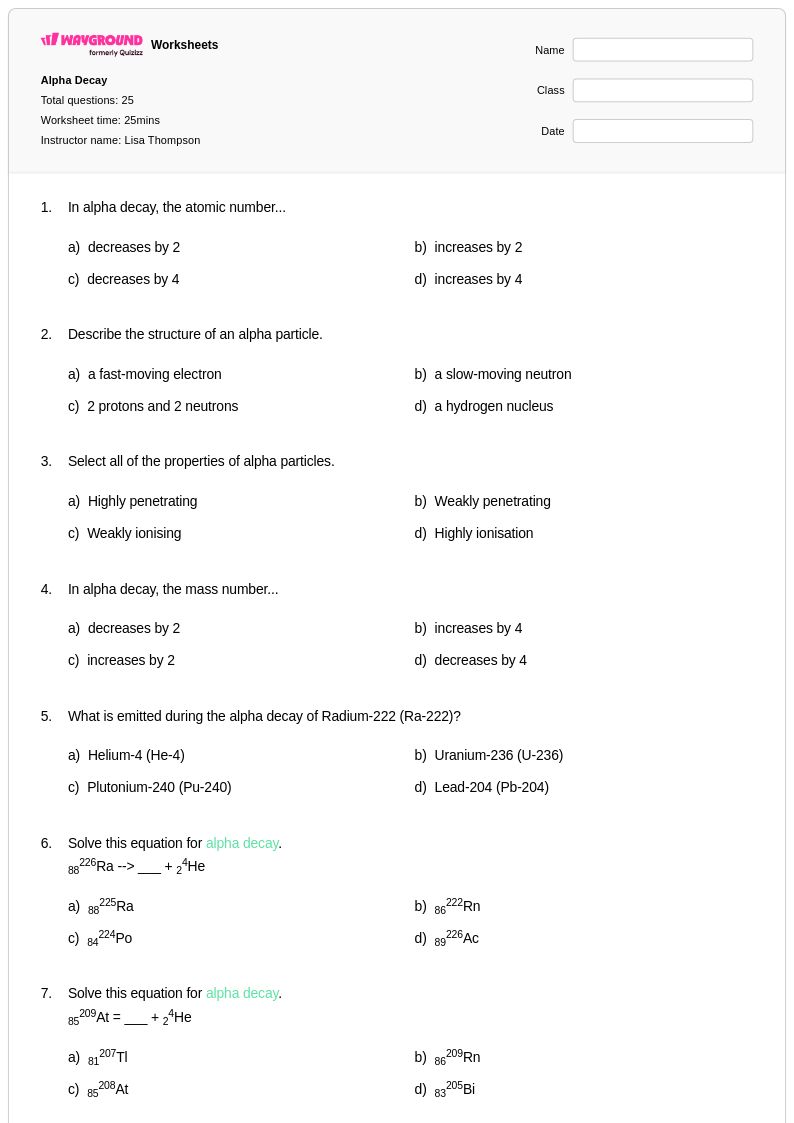
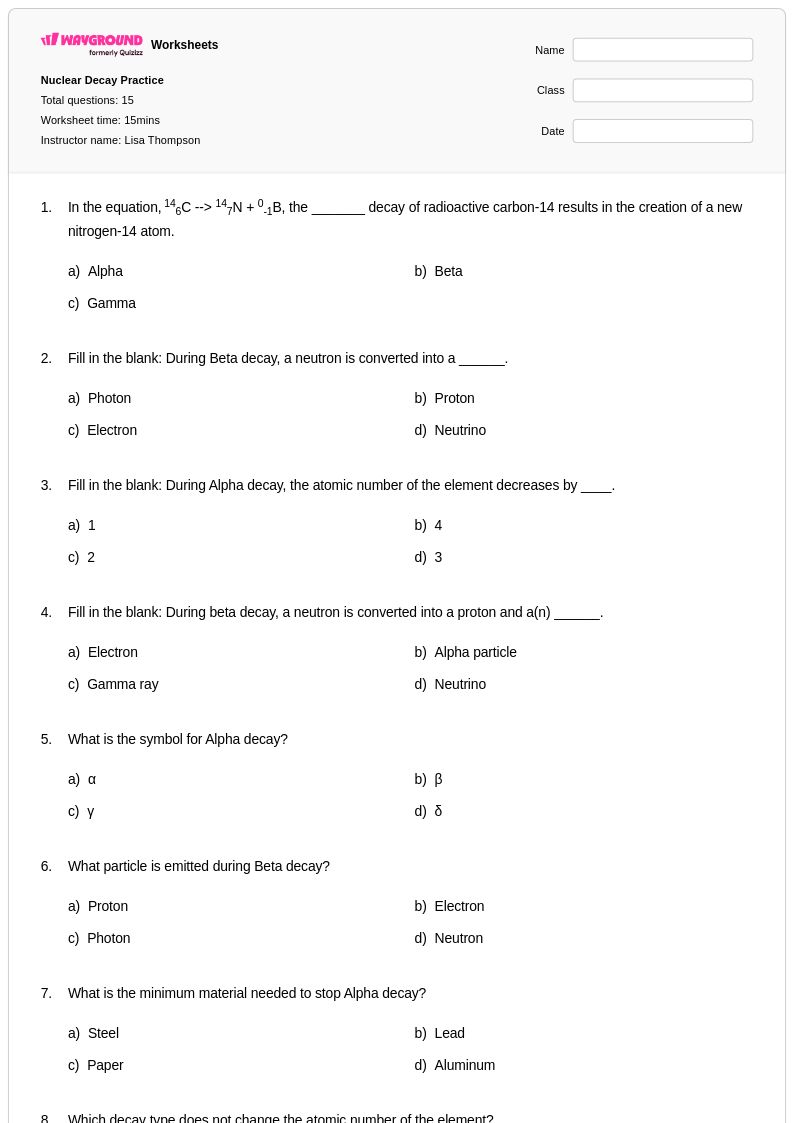
Students benefit most from writing and balancing nuclear equations for alpha and beta decay, where they must track changes to both mass number and atomic number to identify the daughter nuclide. Half-life calculation problems that require students to work forward (amount remaining after n half-lives) and backward (determining time elapsed from remaining mass) build procedural fluency. Mixing symbolic decay notation with decay series diagrams gives students multiple representations of the same process, deepening conceptual retention.
What mistakes do students commonly make when balancing nuclear equations?
The most common error is confusing mass number and atomic number when tracking changes during decay — students frequently subtract from the wrong value or forget to update both numbers simultaneously. In beta decay specifically, many students omit the beta particle or antineutrino and fail to recognize that atomic number increases by one while mass number stays the same. Students also regularly conflate nuclear fission and fusion, misassigning which process releases more energy per reaction or which applies to heavy versus light nuclei.
How do students typically struggle with half-life calculations?
Students most often struggle when a problem does not give a whole-number multiple of the half-life, requiring them to use the exponential decay formula rather than repeated halving. A second common misconception is interpreting half-life as the time for all radioactive material to decay rather than the time for half of a given sample to decay, which leads to errors in long-term decay estimation. Building fluency with both the repeated-halving method and the formula-based approach ensures students can handle the full range of problem types they will encounter.
How can I use Wayground's nuclear changes worksheets in my classroom?
Wayground's nuclear changes worksheets are available as printable PDFs for traditional classroom use and in digital formats for technology-integrated environments, giving teachers flexibility regardless of their instructional setup. Teachers can host worksheets directly as a quiz on Wayground, enabling real-time student response tracking and instant feedback. All worksheets include complete answer keys, making them practical for independent practice, guided review sessions, or formative assessment checkpoints within a nuclear chemistry unit.
How do I differentiate nuclear changes instruction for students at different levels?
For struggling learners, focus initial practice on single-step alpha or beta decay equations with a reference table for common particles before introducing decay series or half-life math. Advanced students can be challenged with multi-step decay chains, fission fragment identification, or binding energy calculations that extend beyond standard curriculum. On Wayground, teachers can apply accommodations such as reduced answer choices to lower cognitive load for individual students, or enable Read Aloud support for students who need auditory access to problem text, without affecting the experience of other students in the class.