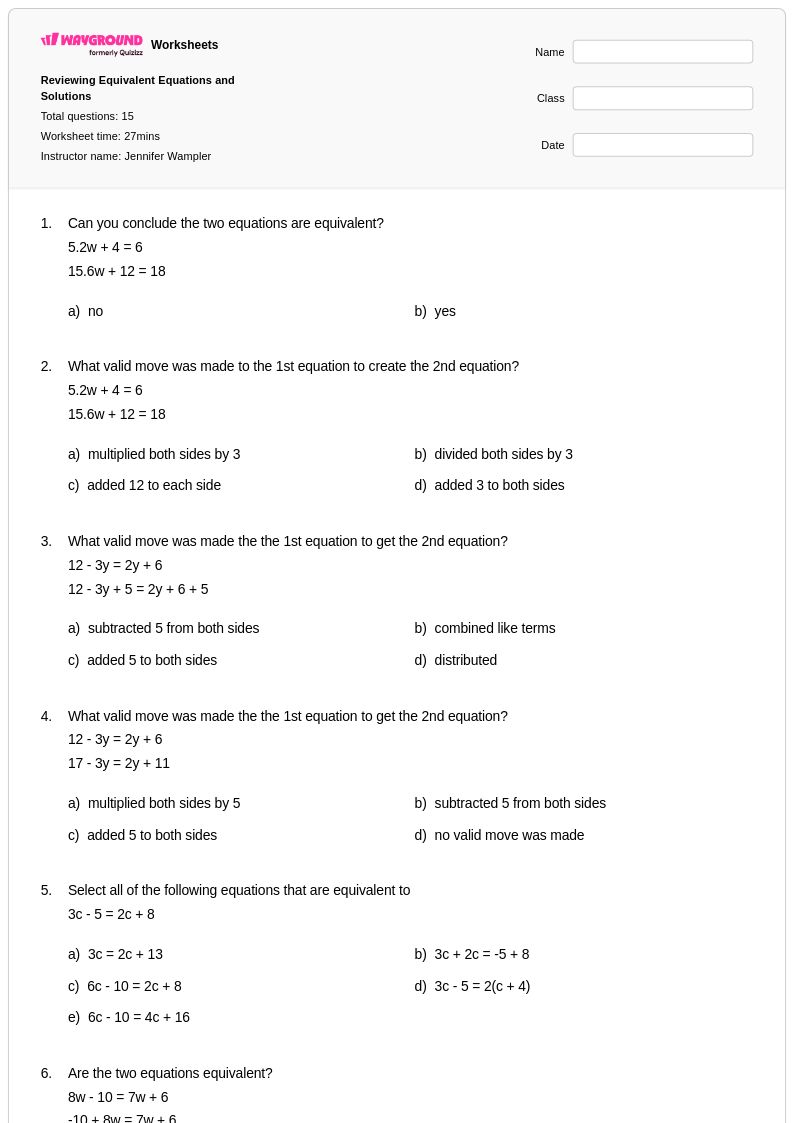
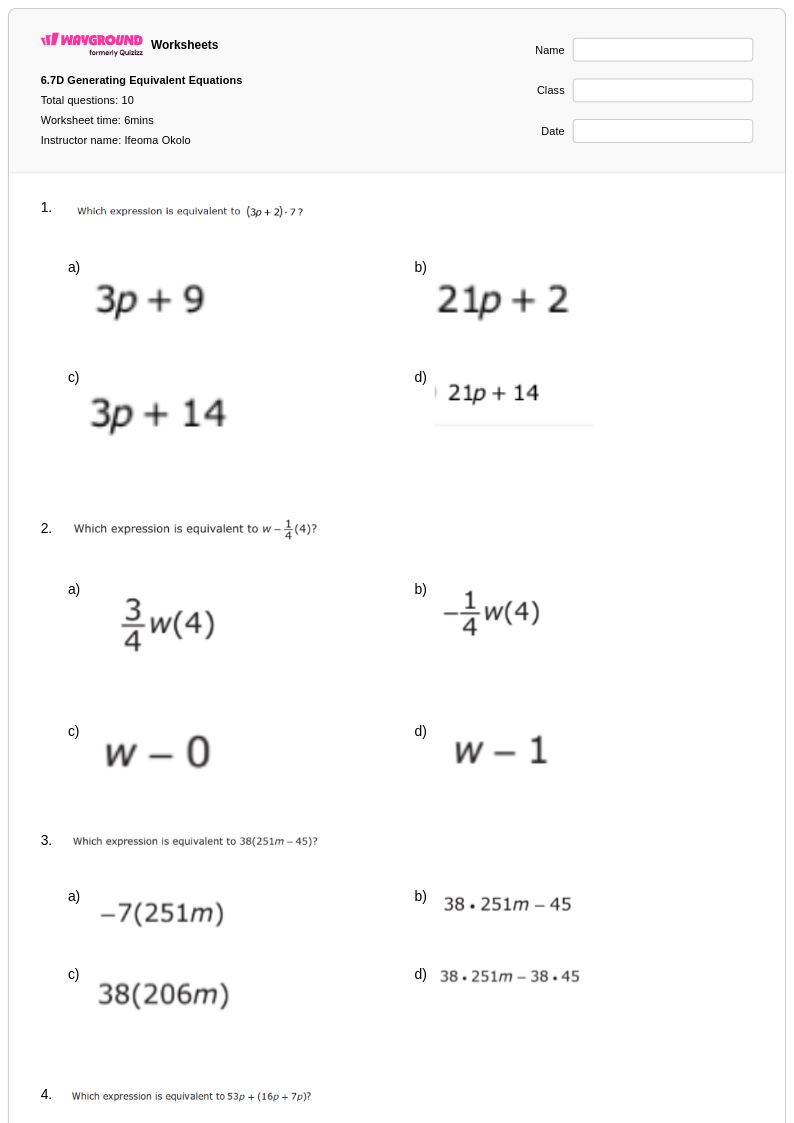
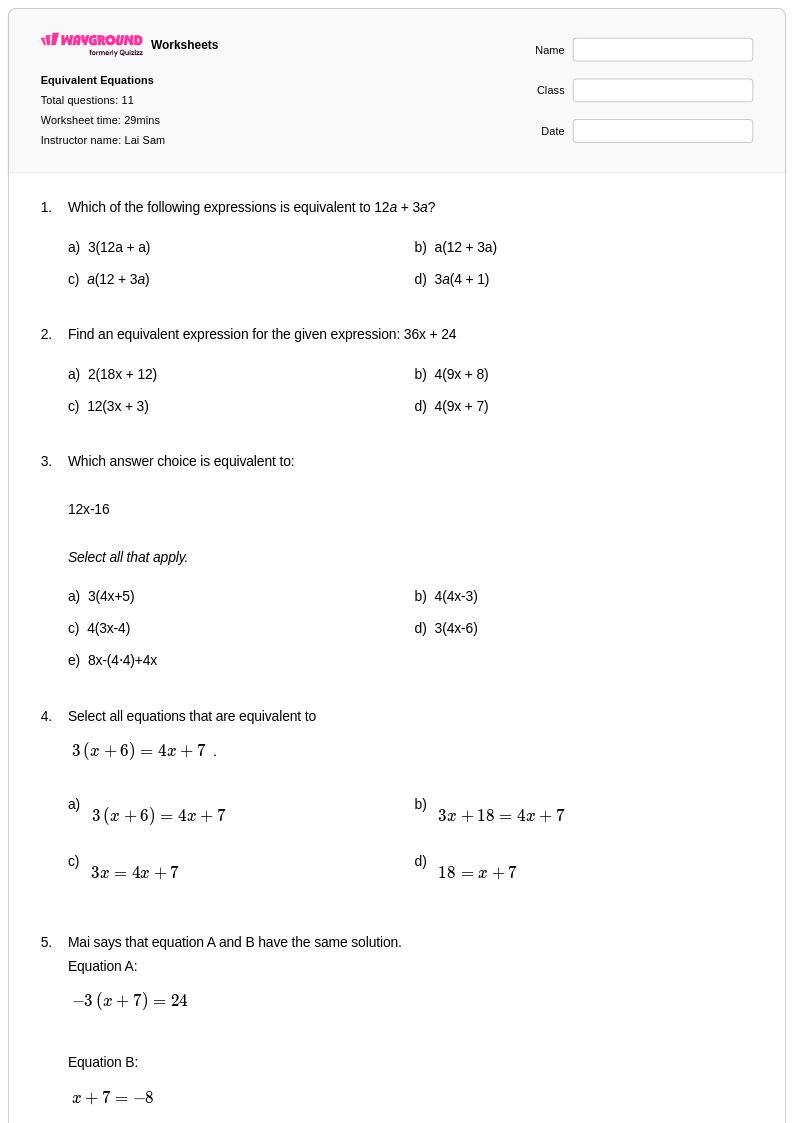
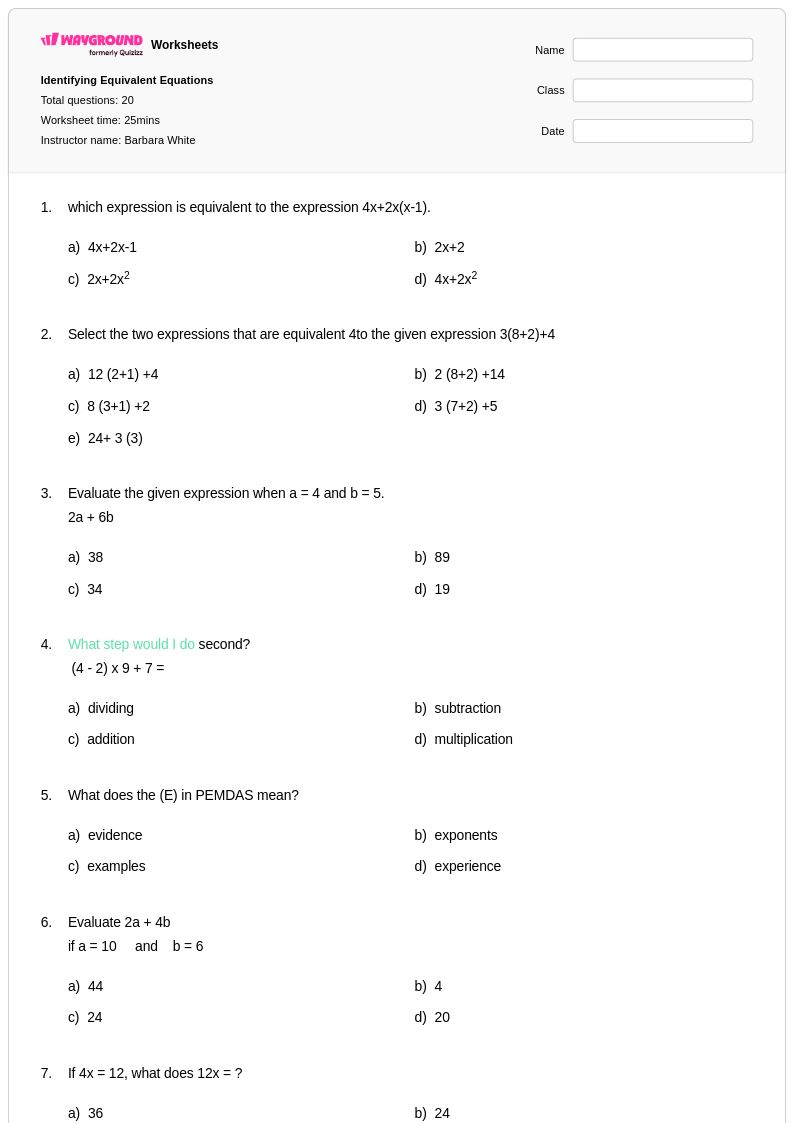
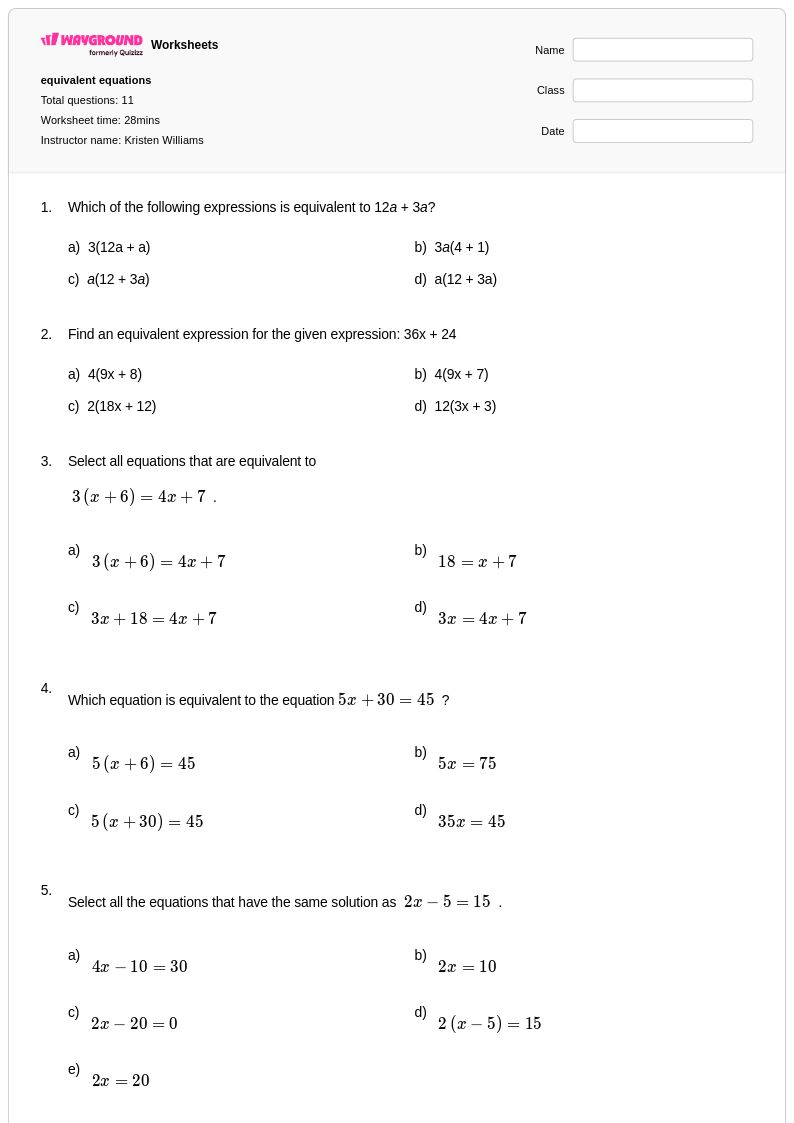
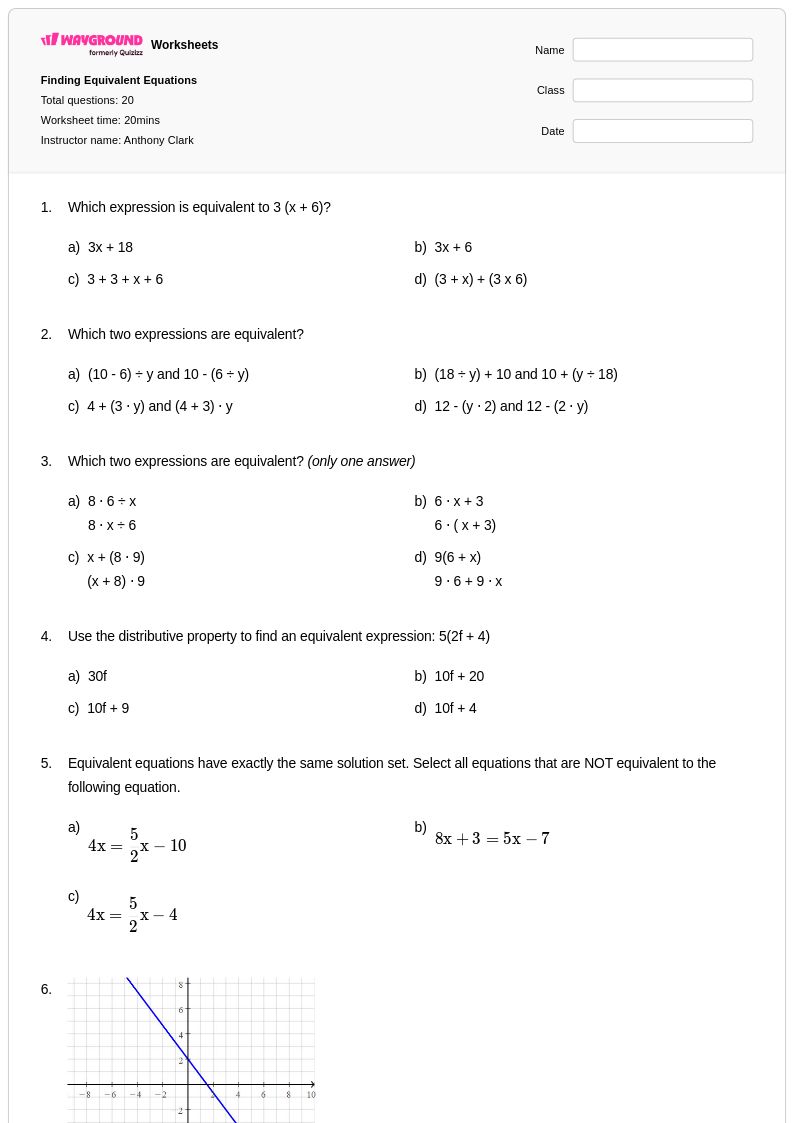
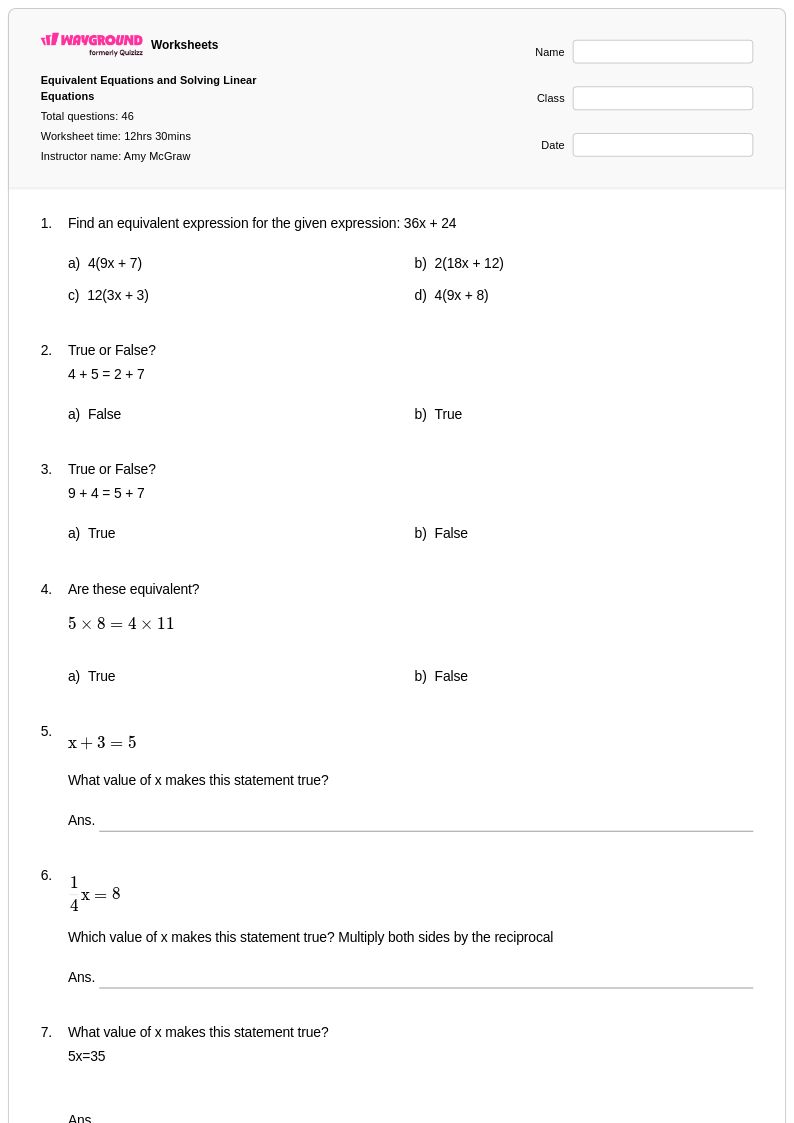
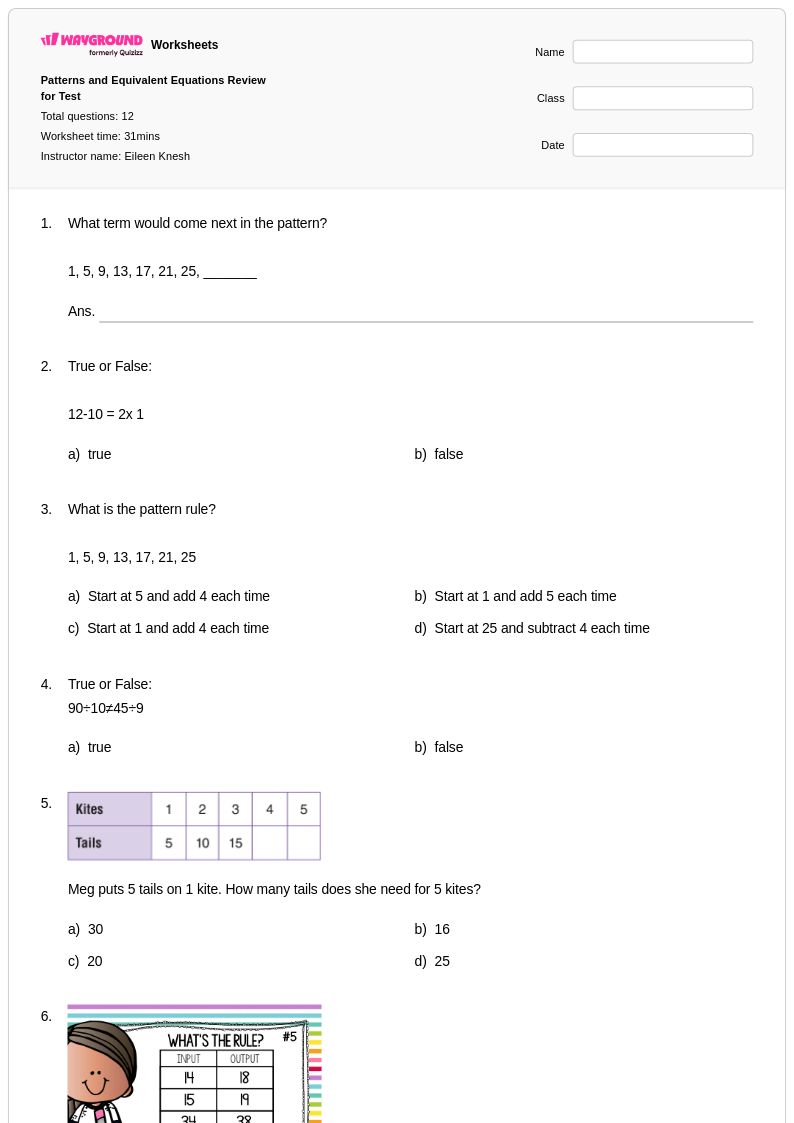
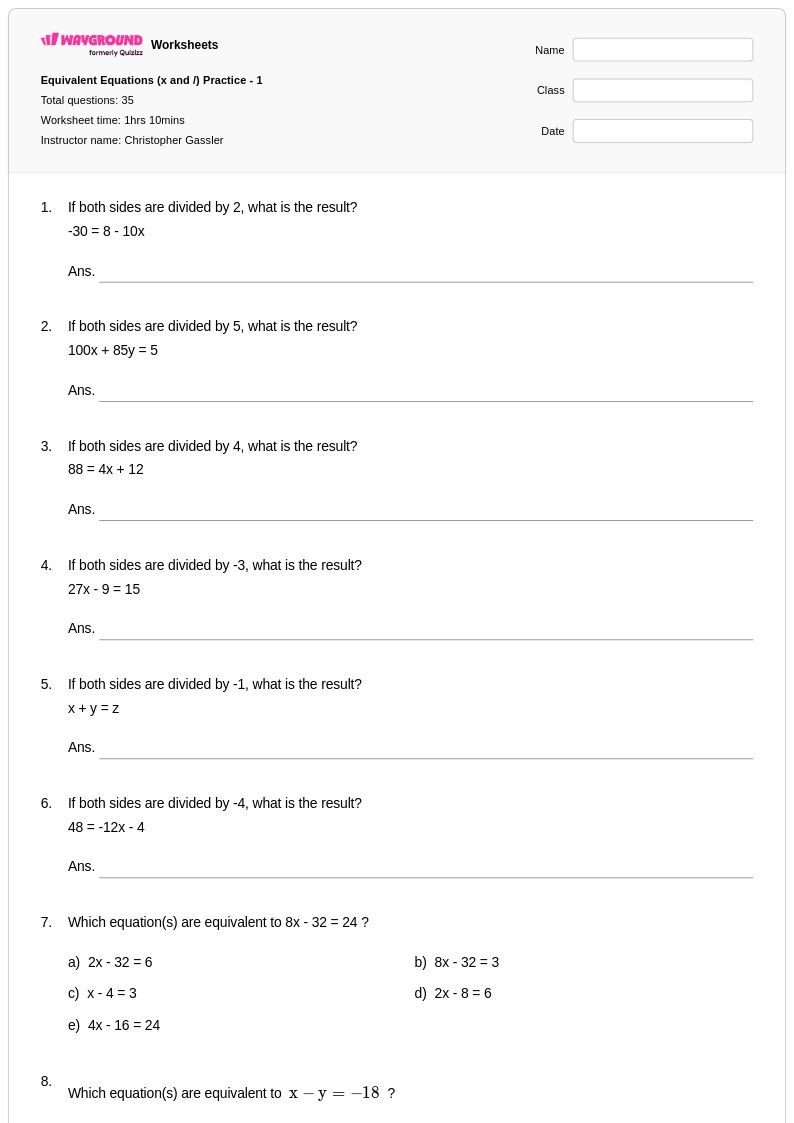
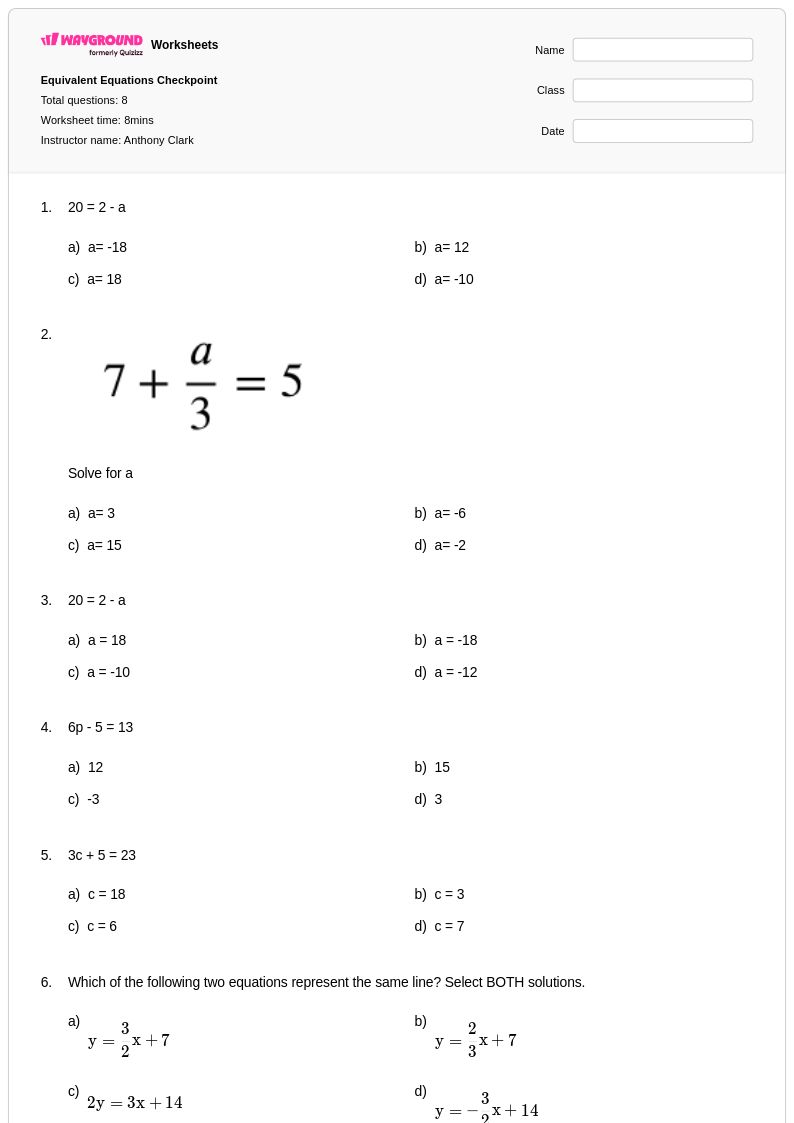
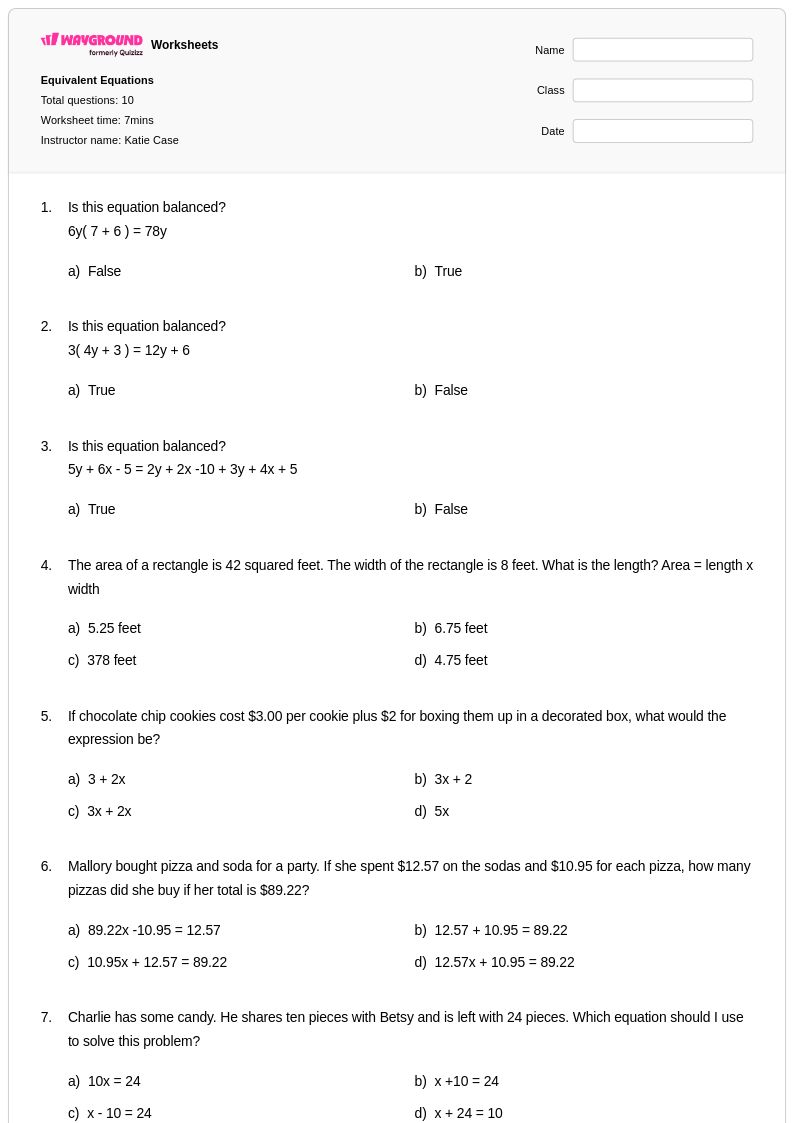
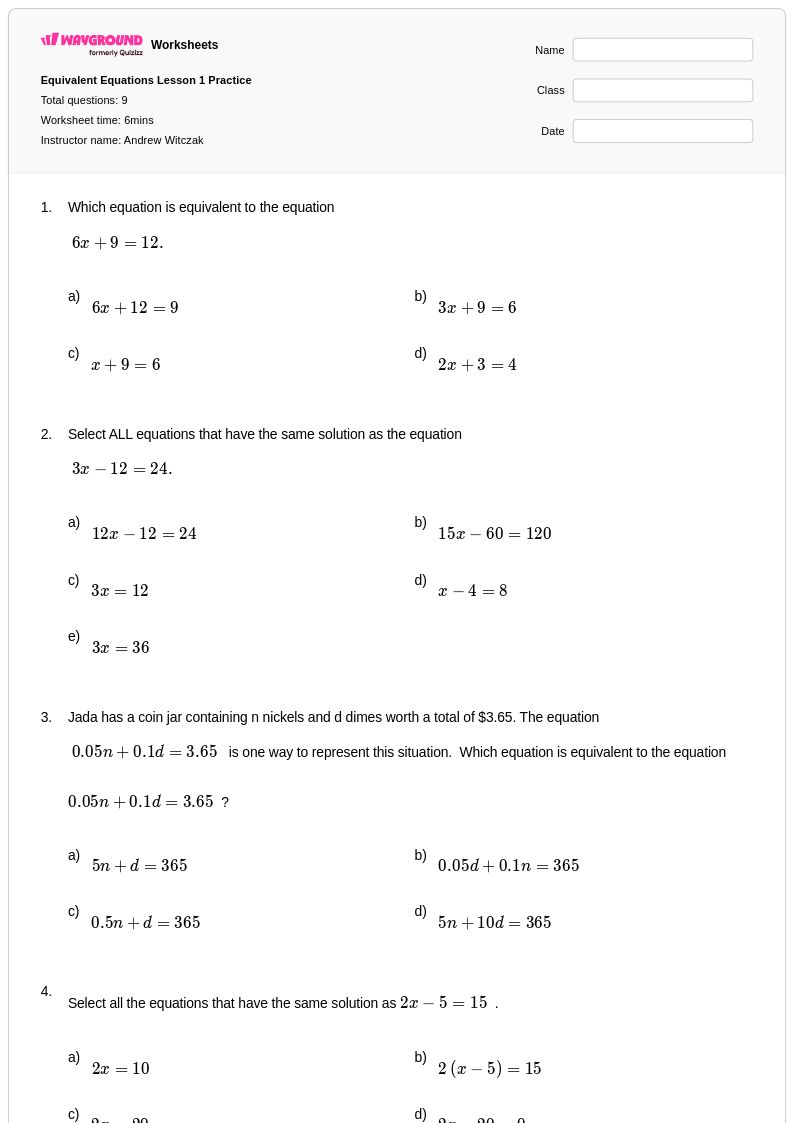
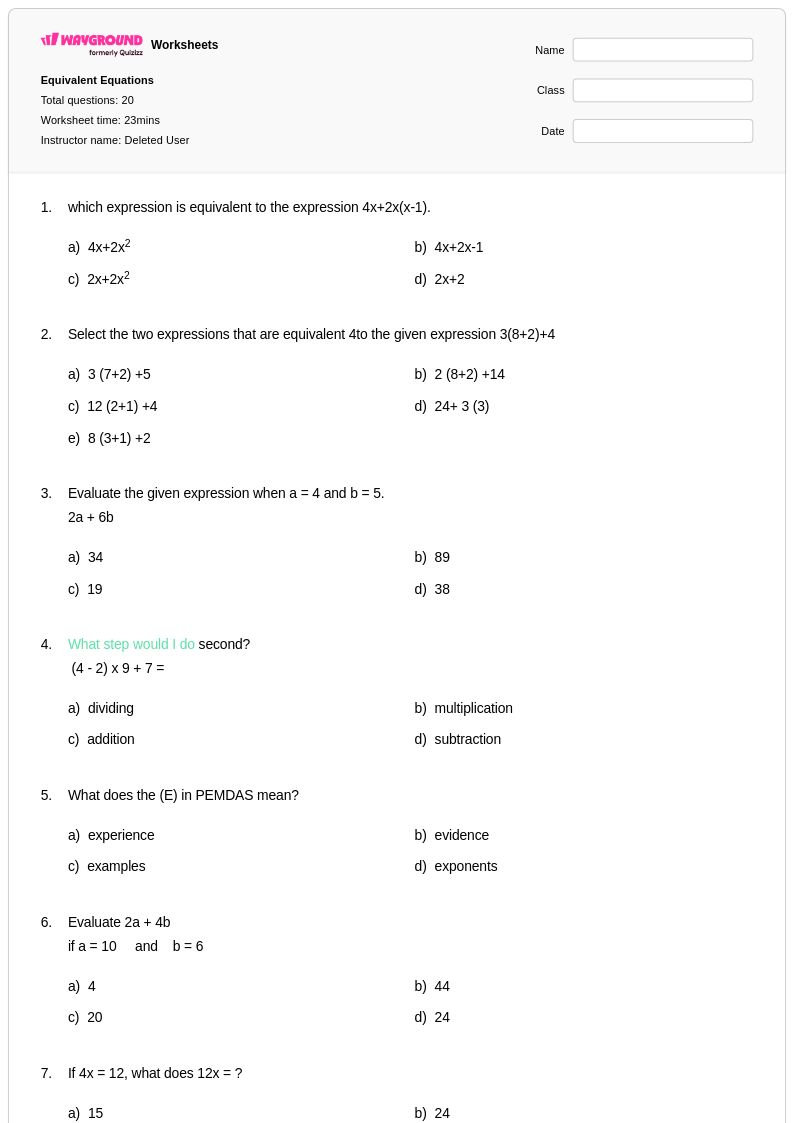
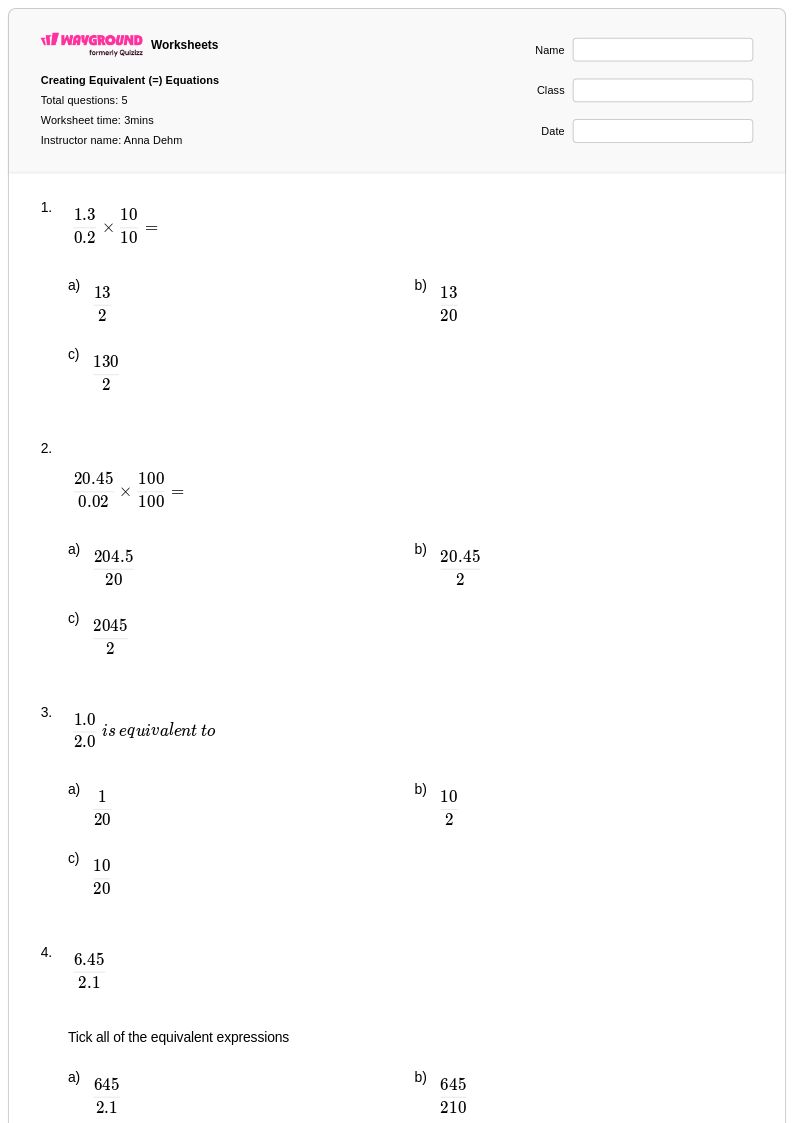
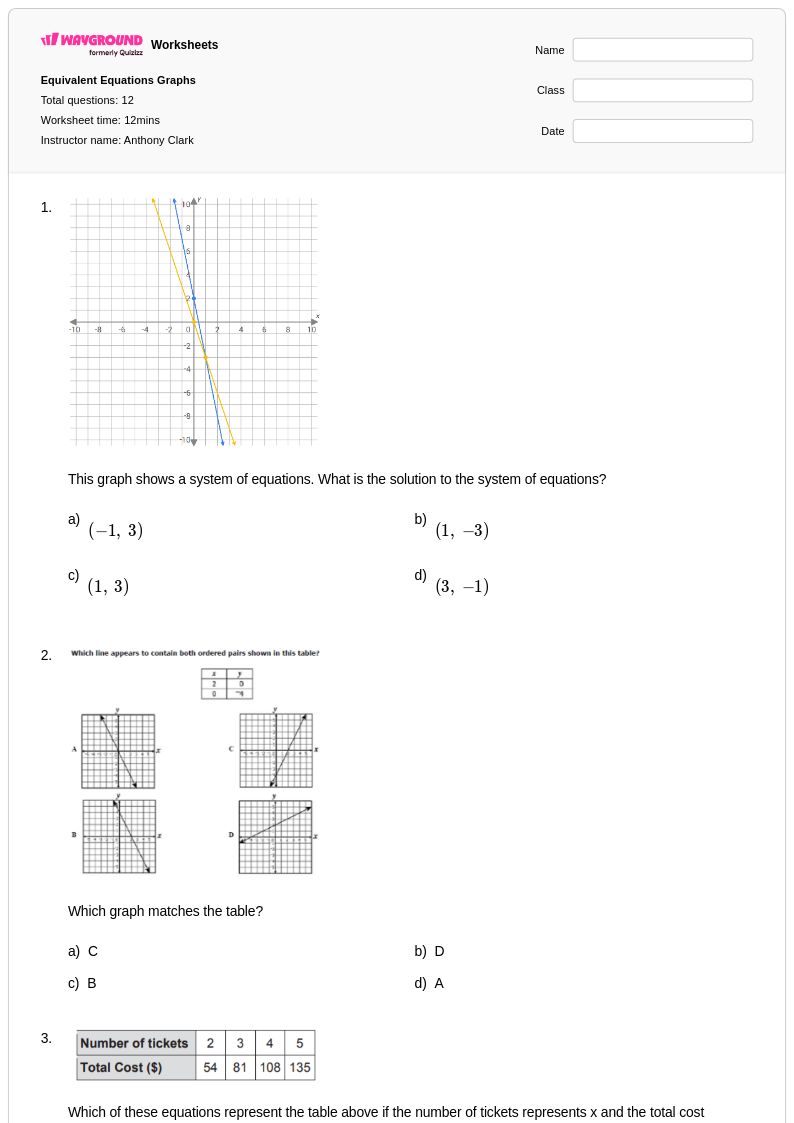
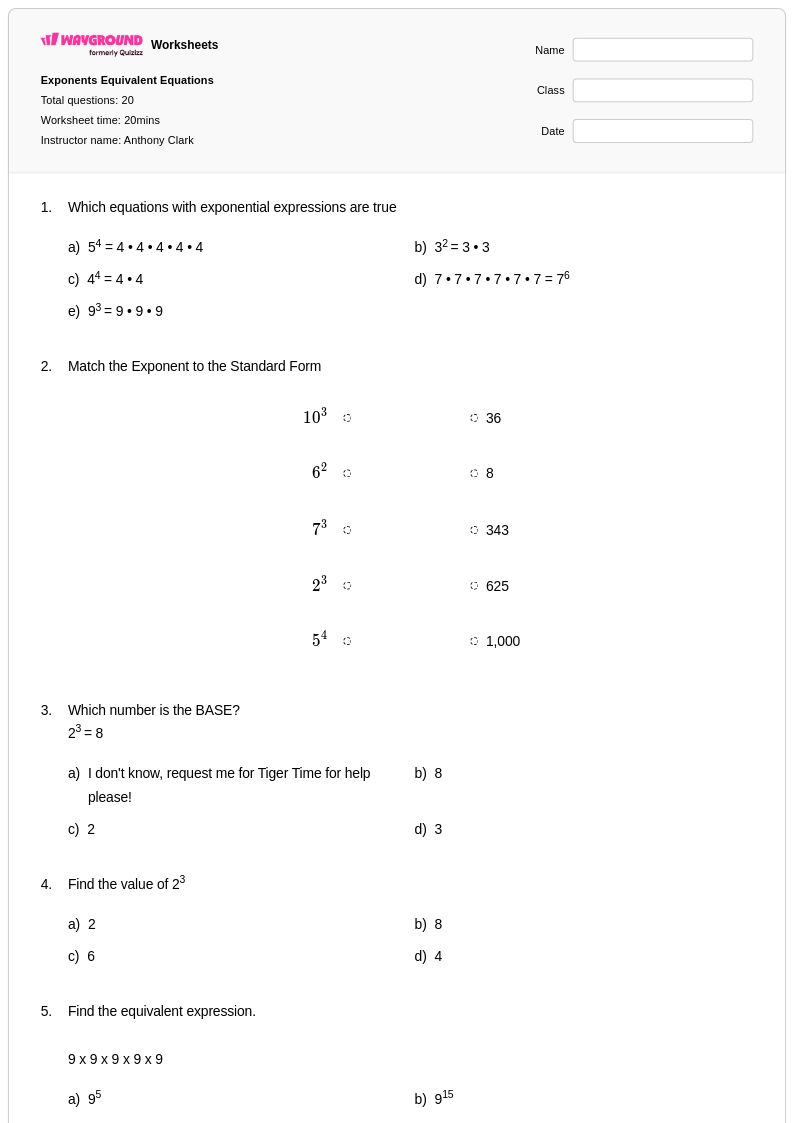
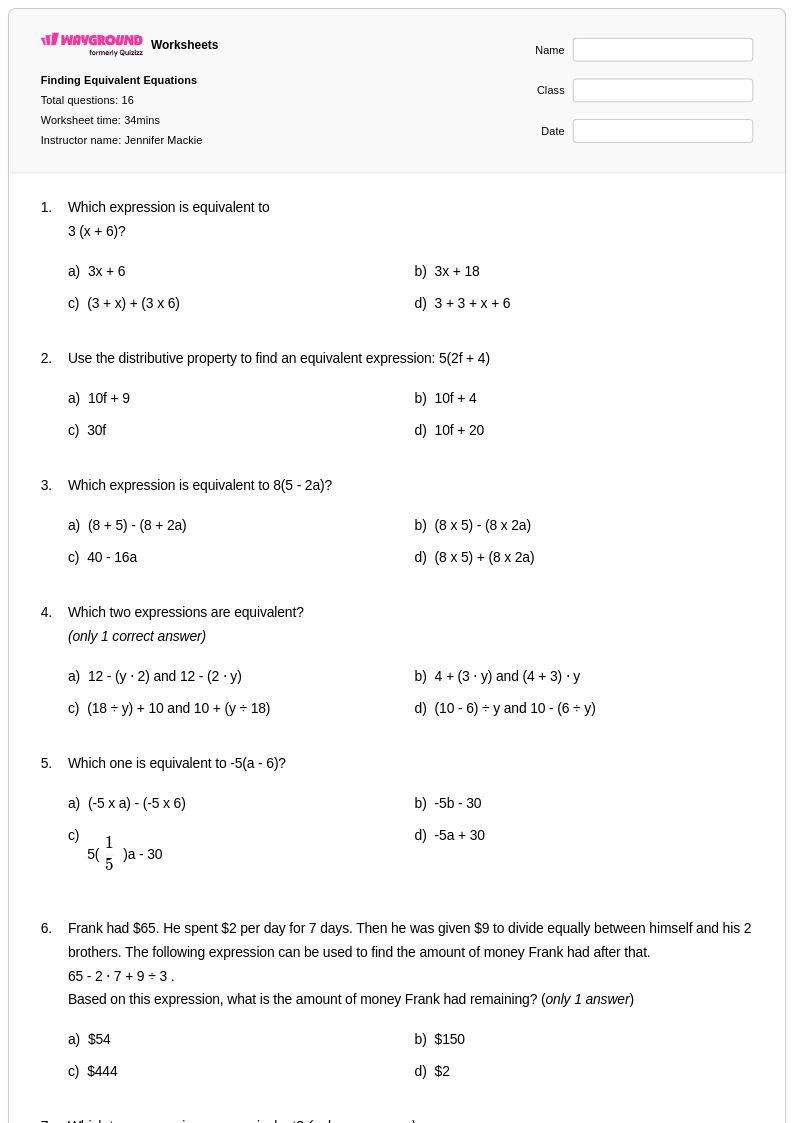
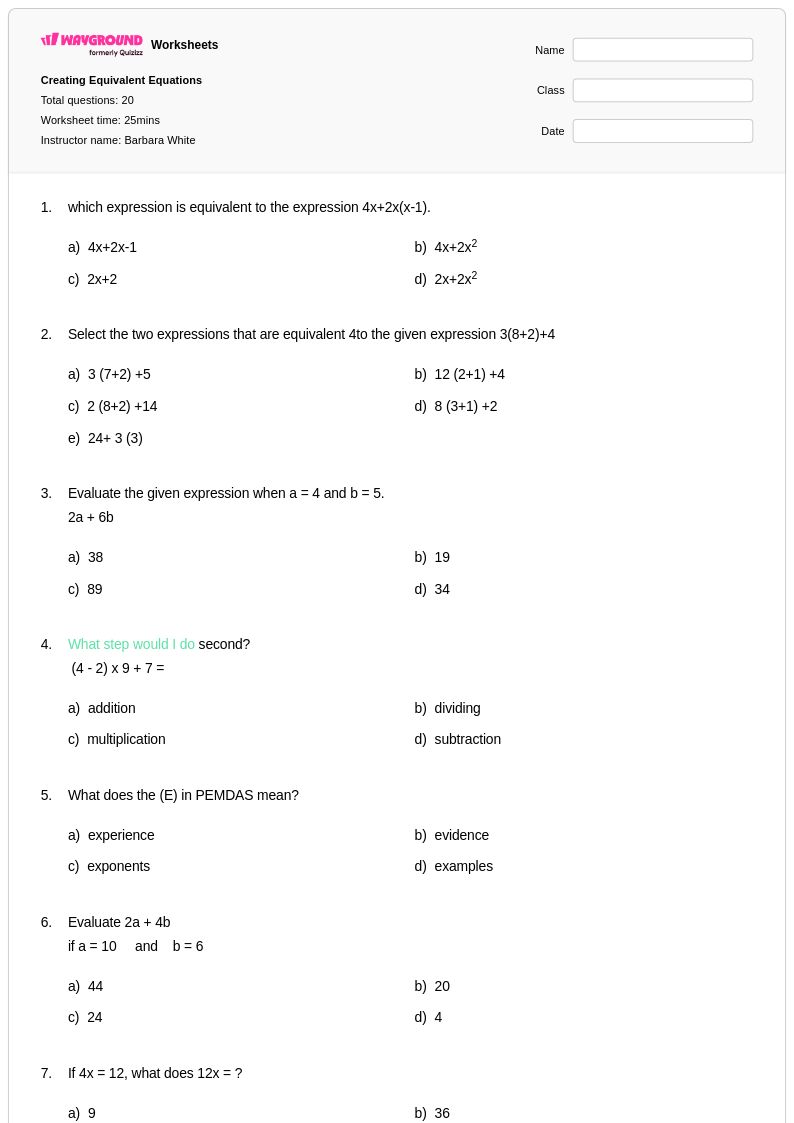
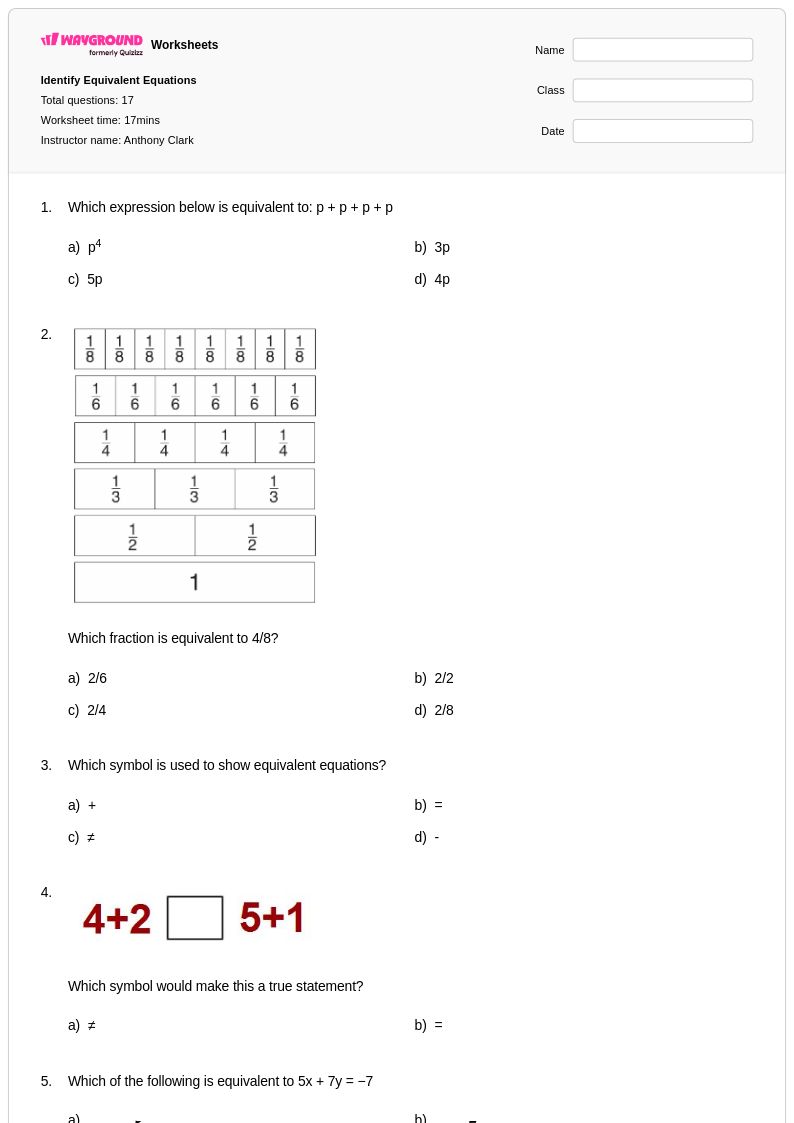
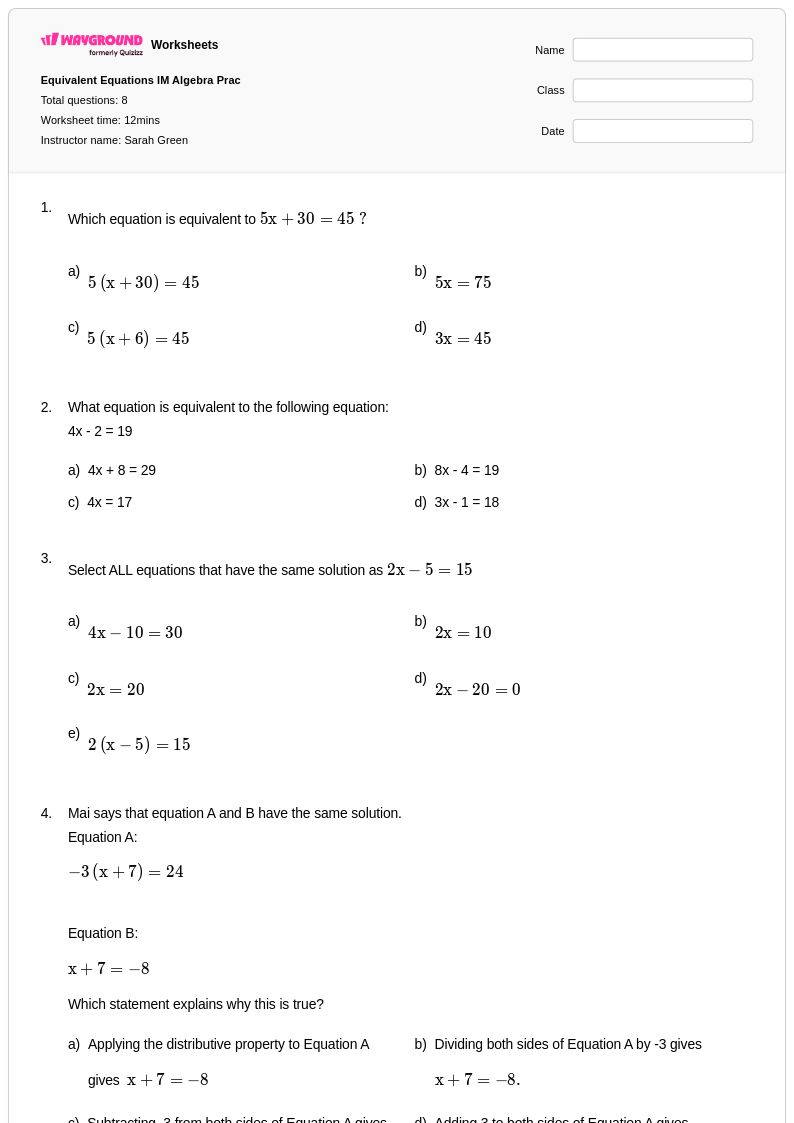
Master equivalent equations with Wayground's comprehensive collection of free algebra worksheets, featuring engaging practice problems, detailed answer keys, and printable PDF resources to help students understand equation transformations and solution methods.
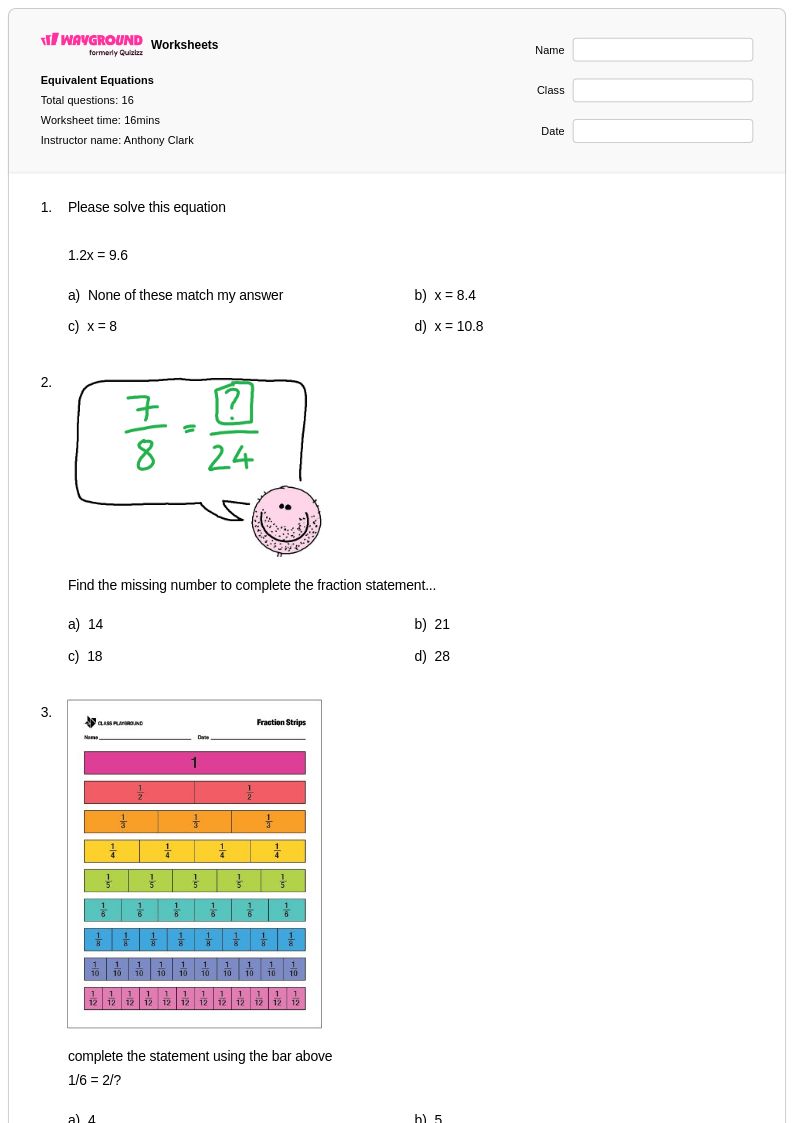
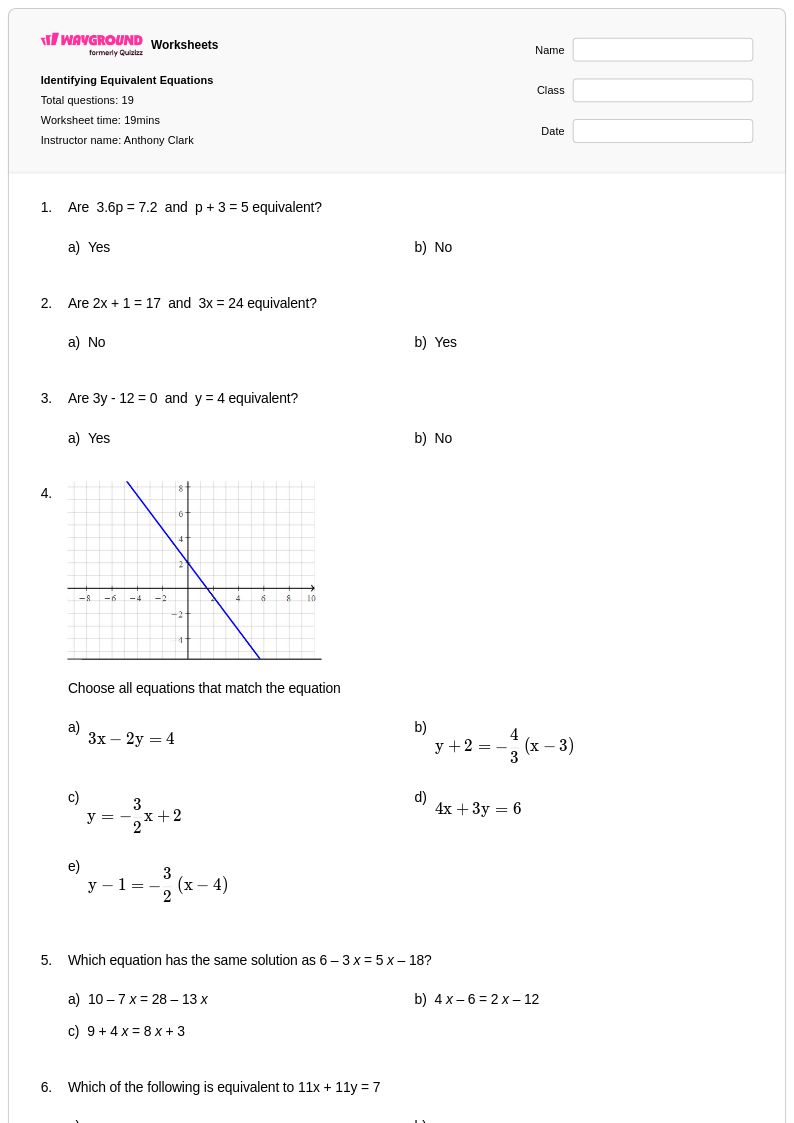
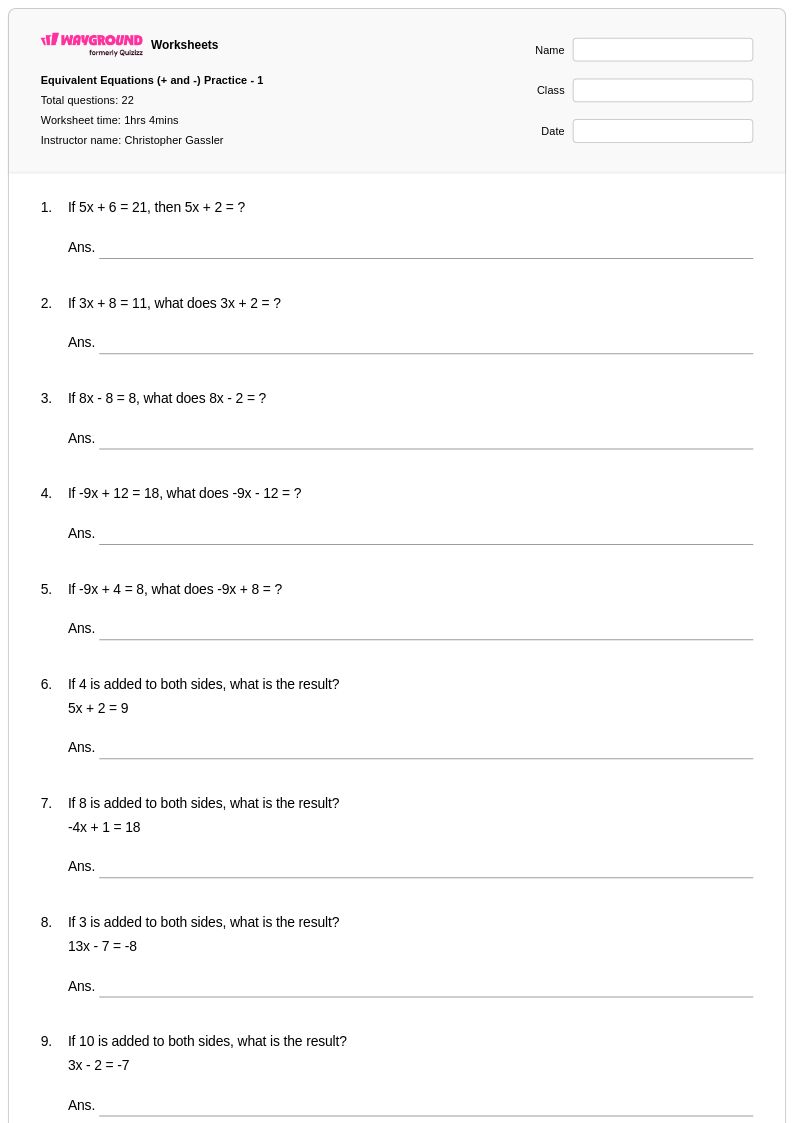
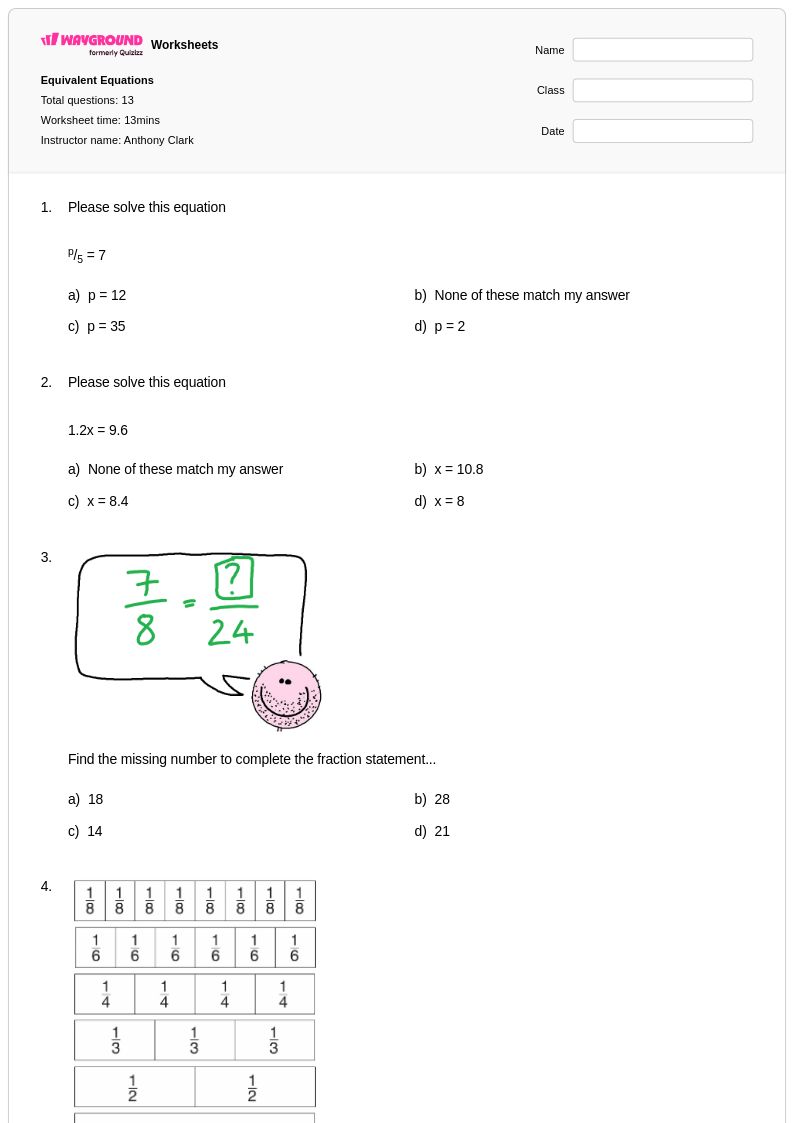
Equivalent equations worksheets available through Wayground (formerly Quizizz) provide comprehensive practice opportunities for students to master this fundamental algebraic concept. These carefully designed resources help students develop critical skills in recognizing when two equations represent the same mathematical relationship, understanding the properties that preserve equality, and applying transformation techniques such as adding, subtracting, multiplying, or dividing both sides of an equation by the same value. The worksheets feature diverse practice problems that range from basic equation manipulation to more complex multi-step transformations, with each resource including a complete answer key to support independent learning and self-assessment. Available as free printables in convenient pdf format, these materials strengthen students' algebraic reasoning abilities and build confidence in equation solving techniques.
Wayground (formerly Quizizz) empowers educators with an extensive collection of teacher-created equivalent equations resources, drawing from millions of high-quality materials that have been developed and refined by classroom professionals. The platform's robust search and filtering capabilities allow teachers to quickly locate worksheets that align with specific learning standards and match their students' skill levels, while built-in differentiation tools enable customization for diverse learning needs. These flexible resources are available in both printable and digital formats, including downloadable pdf versions, making them ideal for traditional classroom instruction, homework assignments, or remote learning environments. Teachers can seamlessly integrate these worksheets into their lesson planning for initial skill introduction, targeted remediation for struggling learners, or enrichment activities for advanced students, ensuring that every student receives appropriate practice with equivalent equations concepts.
FAQs
How do I teach equivalent equations?
Start with the balance model: an equation is a scale, and whatever you do to one side you must do to the other to keep it balanced. From there, walk students through the four transformation types — adding, subtracting, multiplying, and dividing both sides by the same value — and have them verify equivalence by checking that both equations share the same solution. The key conceptual hurdle is distinguishing between equations that look different but are equivalent versus equations that are genuinely different. Pairing symbolic manipulation with a quick substitution check helps students build that intuition early.
What exercises help students practice equivalent equations?
Three exercise types do the most work: (1) given two equations, determine whether they are equivalent by solving or substituting; (2) produce an equivalent equation by applying a specified transformation; (3) multi-step problems where students must perform a sequence of transformations to isolate a variable. Starting with one-step transformations and progressing to problems with variables on both sides gives students a clear ramp in difficulty.
What mistakes do students commonly make with equivalent equations?
The most common error is applying an operation to only one side — for example, adding 5 to the right side without adding it to the left. A close second is multiplying or dividing by zero without recognizing why that breaks equivalence. Students also frequently confuse equivalent equations with equivalent expressions, not realizing that equivalence for equations is defined by having the same solution set, not the same form.
How do I use Wayground's equivalent equations worksheets in my class?
You can run the worksheet as a digital quiz hosted on Wayground — students work through it on a device and results come back to you automatically — or download the PDF and assign it on paper. Every worksheet includes a complete answer key, so it works equally well for independent practice or homework. If you go the printable route, the Wayground for Teachers app lets you scan or photograph student submissions to grade them without manual re-entry.
How does Common Core sequence equivalent equations in the math curriculum?
Common Core introduces the properties of equality in the context of one-variable equations in grades 6 and 7, where students learn that adding, subtracting, multiplying, or dividing both sides by the same nonzero value produces an equivalent equation. By grade 8, students apply this understanding to linear equations with variables on both sides and begin connecting equivalent equations to the idea that a solution set is unchanged by these transformations. This progression builds directly toward high school algebra, where equivalent equations underpin solving systems and justifying algebraic steps formally.
How can I differentiate equivalent equations practice for mixed-ability classes?
For students who struggle with the symbolic manipulation, Wayground's Read Aloud accommodation reads question text aloud, and reduced answer choices can lower the cognitive load on multiple-choice items. For layout-based accessibility needs, you can generate an alternate version of the same worksheet with a dyslexia-friendly font or larger text — same problems, adjusted presentation. Advanced students can be directed to the multi-step transformation problems in the same worksheet set without needing a separate resource.