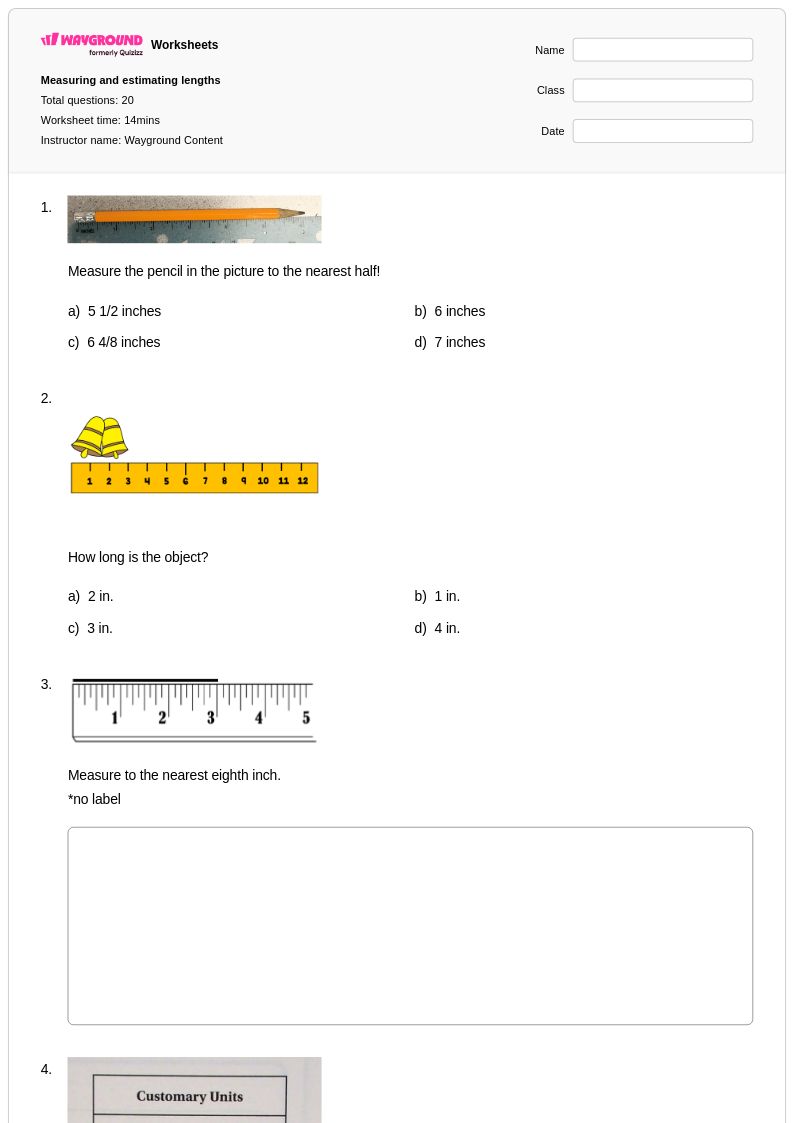
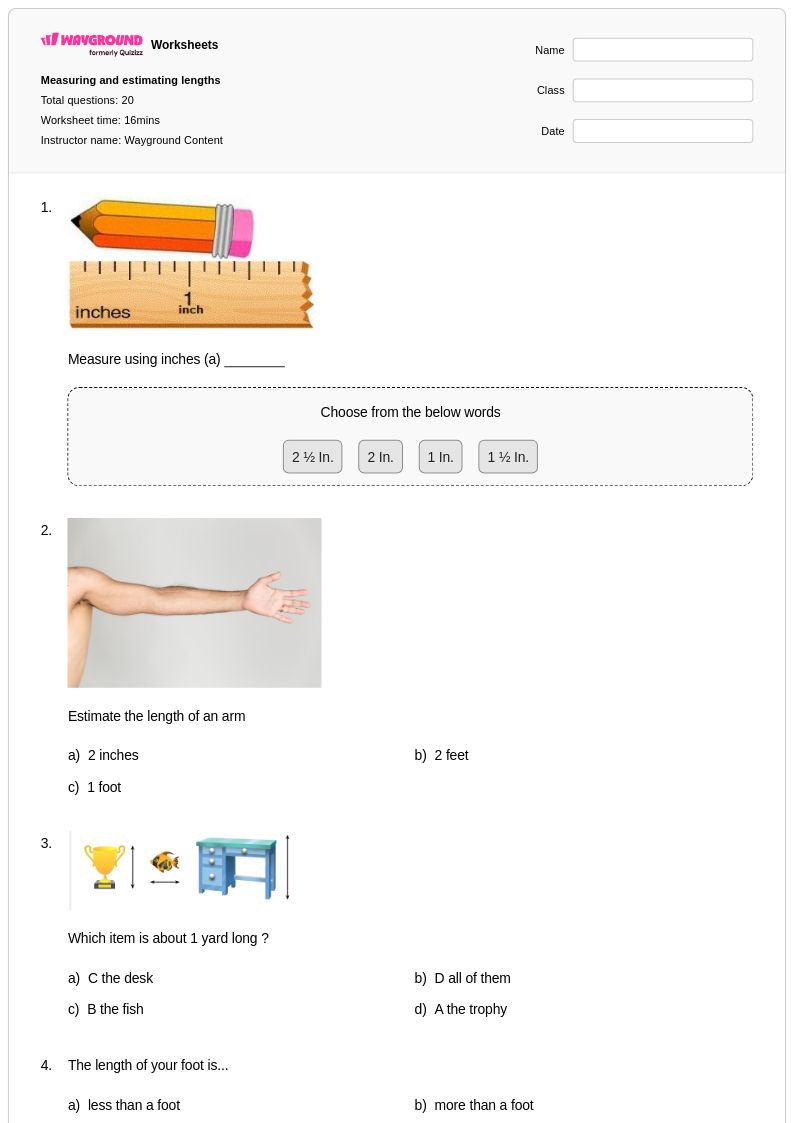
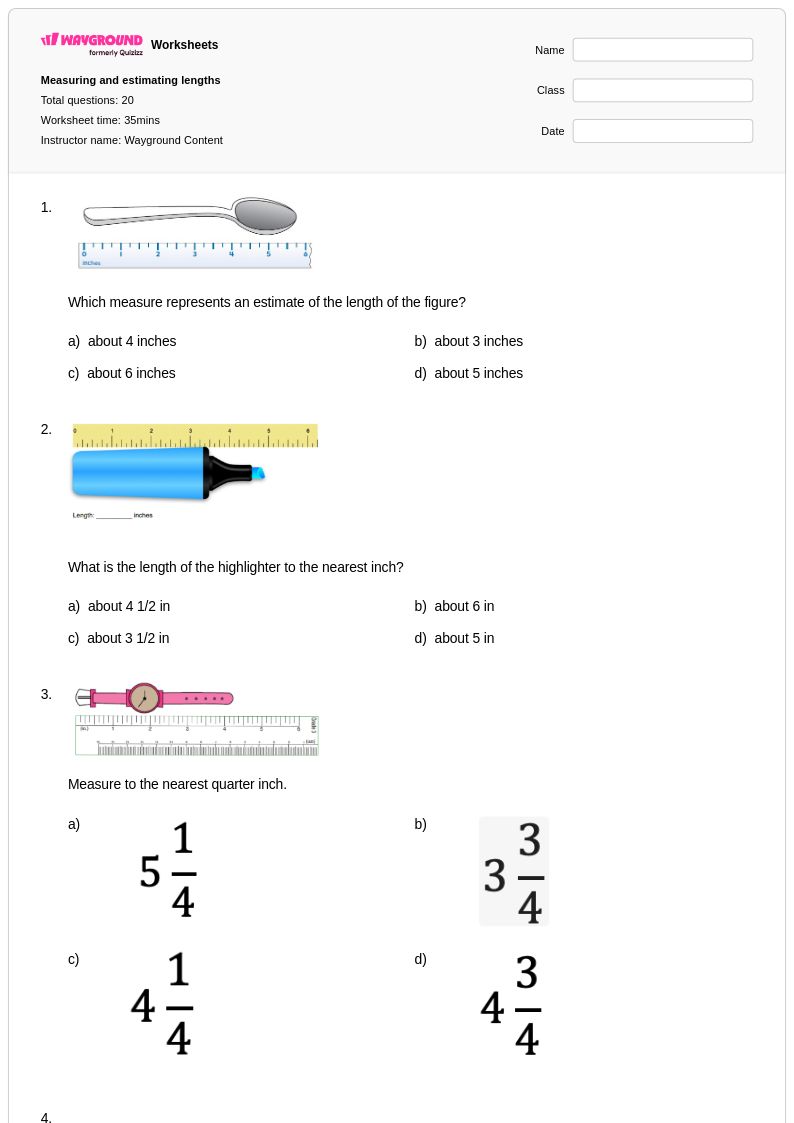
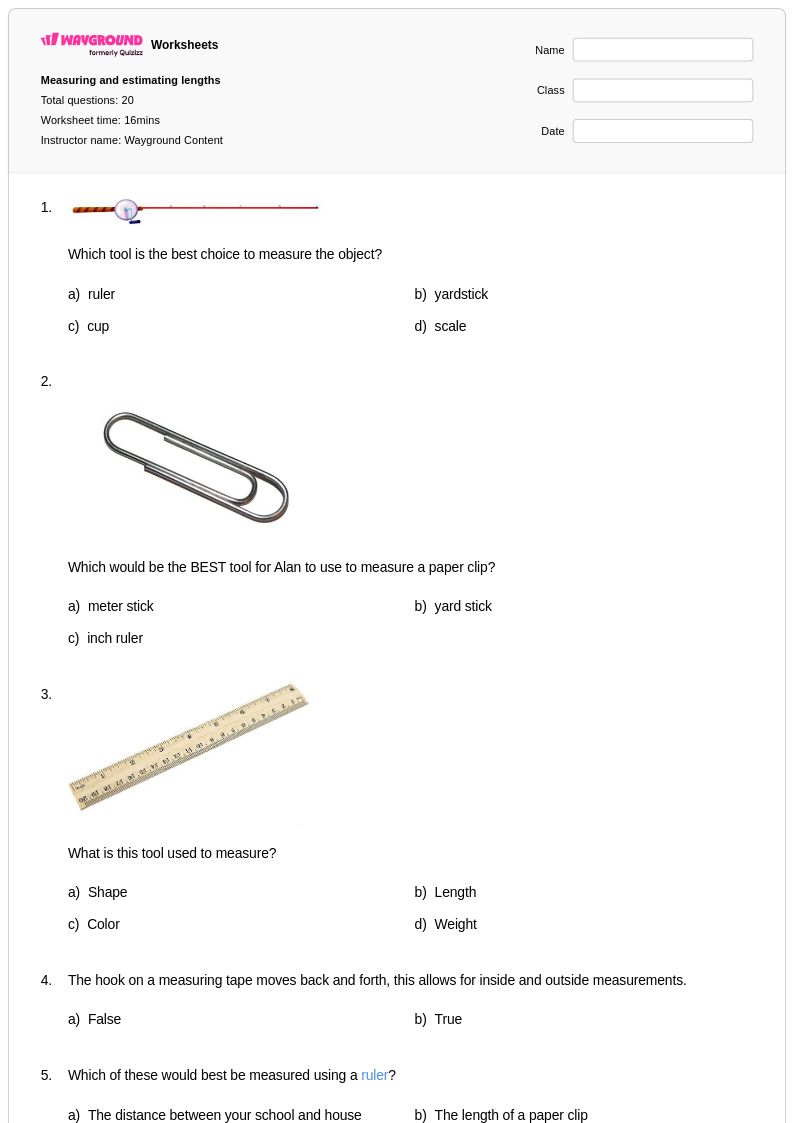
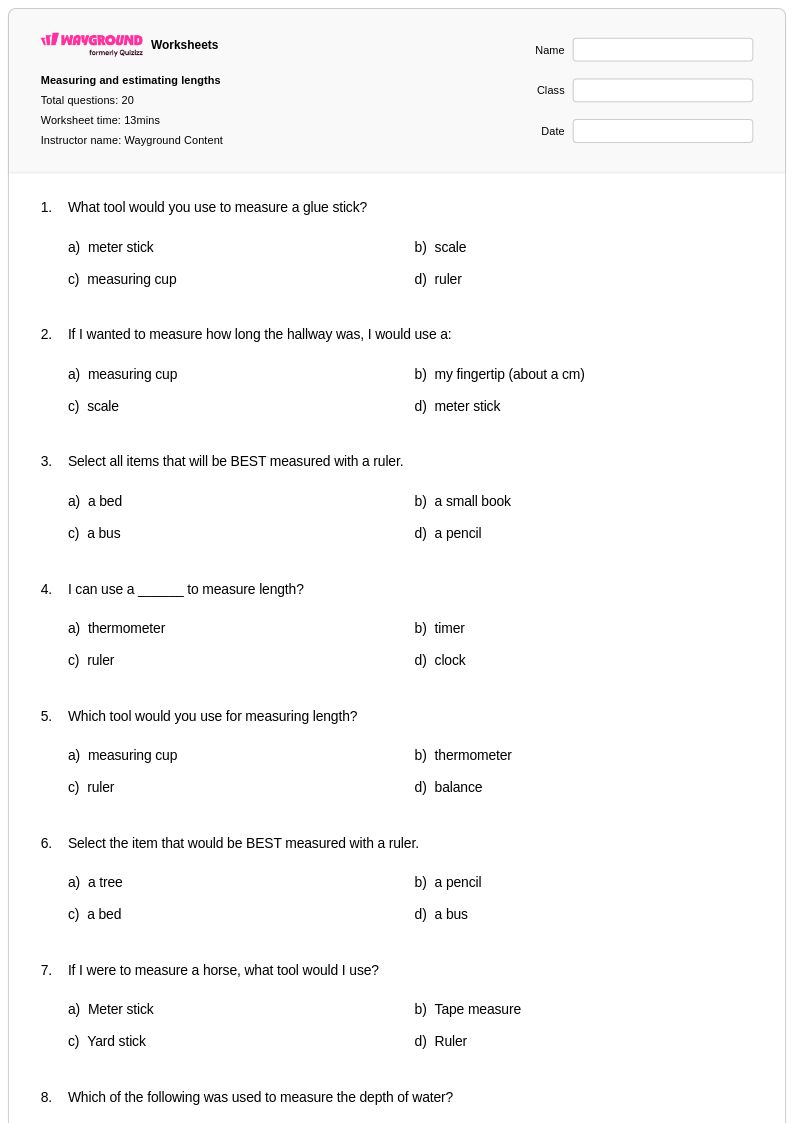
Develop essential measurement skills with Wayground's free estimating length worksheets featuring engaging practice problems, printable PDFs, and comprehensive answer keys to help students master distance and size approximation techniques.
Estimating length worksheets available through Wayground (formerly Quizizz) provide students with systematic practice in developing their spatial reasoning and measurement sense without relying on precise measuring tools. These comprehensive resources strengthen critical mathematical skills including visual approximation, benchmark comparison, and proportional thinking as students learn to gauge distances, heights, and dimensions using familiar reference points. The worksheet collections feature diverse practice problems that progress from estimating everyday objects to more complex real-world scenarios, with complete answer keys and explanations that help students understand the reasoning behind effective estimation strategies. Teachers can access these free printables in convenient pdf format, making it easy to supplement classroom instruction with targeted skill-building exercises that reinforce measurement concepts through hands-on estimation activities.
Wayground (formerly Quizizz) supports mathematics educators with an extensive library of millions of teacher-created estimating length resources that can be easily located through robust search and filtering capabilities designed specifically for measurement instruction. The platform's standards-aligned worksheet collections offer flexible customization options that allow teachers to differentiate instruction based on individual student needs, whether providing additional support for struggling learners or enrichment opportunities for advanced students. These versatile resources are available in both printable and digital formats, including downloadable pdf versions, enabling seamless integration into diverse learning environments and instructional approaches. Teachers can efficiently plan targeted lessons, design remediation activities, and create engaging skill practice sessions that help students master the fundamental concept of length estimation across various mathematical contexts and real-world applications.
FAQs
How do I teach estimating length?
Start with benchmarks students already know — a finger width is about 1 cm, a door is about 1 meter tall. Once students have a handful of reliable reference points, move them to comparing: 'Is this closer to 10 cm or 1 meter?' That comparison habit is the core of estimation. From there, practice with everyday objects before introducing more abstract or unfamiliar items.
What exercises help students practice estimating length?
The most effective practice combines prediction with verification: students estimate first, then measure, then reflect on the gap. Good exercise types include ordering objects by estimated length before measuring, matching objects to a given benchmark, and estimating lengths in real-world images or diagrams. These worksheets progress from familiar classroom objects to more complex scenarios, giving students repeated exposure across different contexts.
What mistakes do students commonly make when estimating length?
The most common error is anchoring to the wrong unit — a student who estimates a pencil at '15 meters' hasn't internalized what a meter actually looks like. A close second is ignoring benchmarks entirely and guessing randomly rather than reasoning from a known reference. Watch also for students who conflate estimation with rounding a precise measurement; estimation should happen before any tool comes out.
How do I use these estimating length worksheets in my classroom?
You can run these as a digital quiz hosted on Wayground — useful for instant feedback during a measurement unit — or print the PDF and assign it on paper, which works well when you want students away from screens and handling physical objects alongside the worksheet. Either way, every worksheet includes a complete answer key. If you go the print route, the Wayground for Teachers app lets you scan or capture student work to grade it without manual re-entry.
Is estimating length aligned to Common Core standards?
Yes. Common Core builds measurement estimation progressively: early grades focus on comparing and ordering objects by length using non-standard units, then shift to standard units (inches, centimeters) and the relationship between unit size and count. By the time students reach the upper elementary grades, they're expected to apply measurement reasoning to solve problems — so estimation fluency with benchmarks is a prerequisite skill, not a standalone topic.
How can I differentiate estimating length practice for mixed-ability students?
For students who struggle with unit sense, Wayground's reduced answer choices accommodation narrows the options so they can focus on reasoning rather than being overwhelmed by a wide range of plausible values. The Read Aloud feature helps students who have difficulty reading measurement vocabulary independently. At the worksheet level, you can also apply a larger font size or wider spacing for students who need a less cluttered visual layout — all without creating a separate assignment for the rest of the class.
What grade levels cover estimating length?
Estimating length appears across K–5, but the focus shifts by grade. Kindergarten and first grade use non-standard units and visual comparison. Second and third grade introduce standard units like inches and centimeters and expect students to use benchmarks. By fourth and fifth grade, estimation is applied within multi-step measurement problems. Wayground has grade-specific worksheet sets for each of these bands.