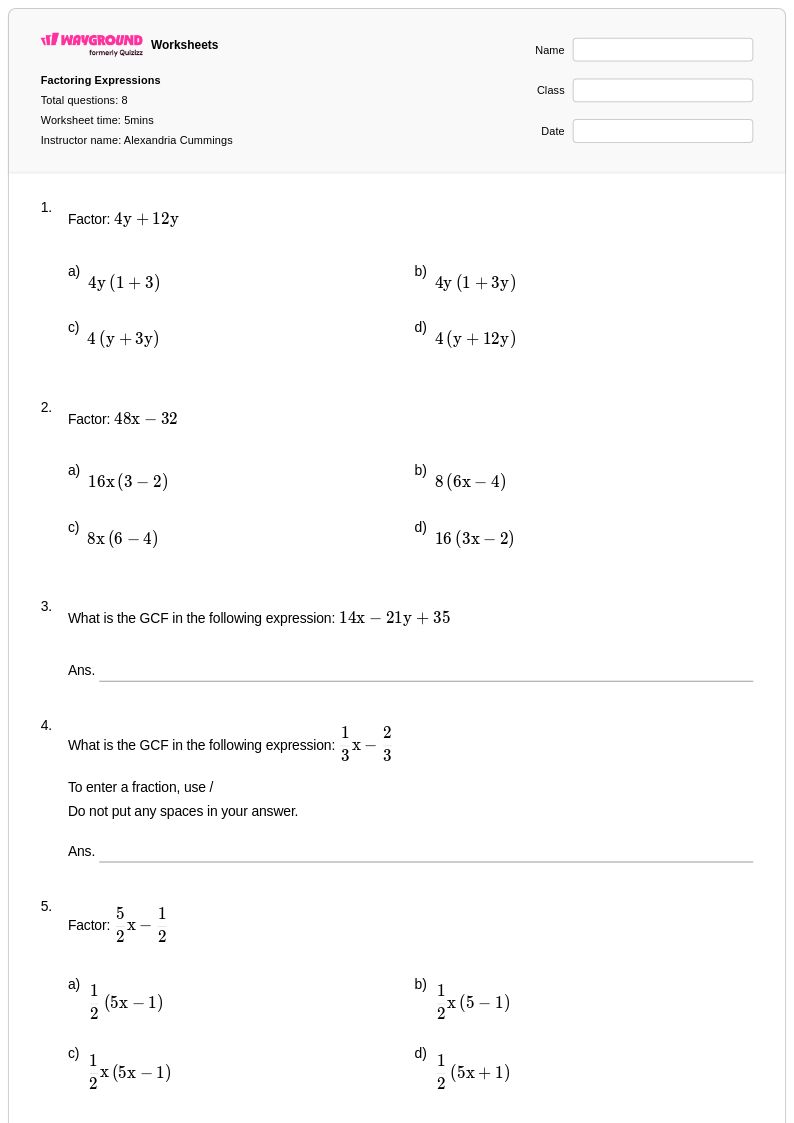
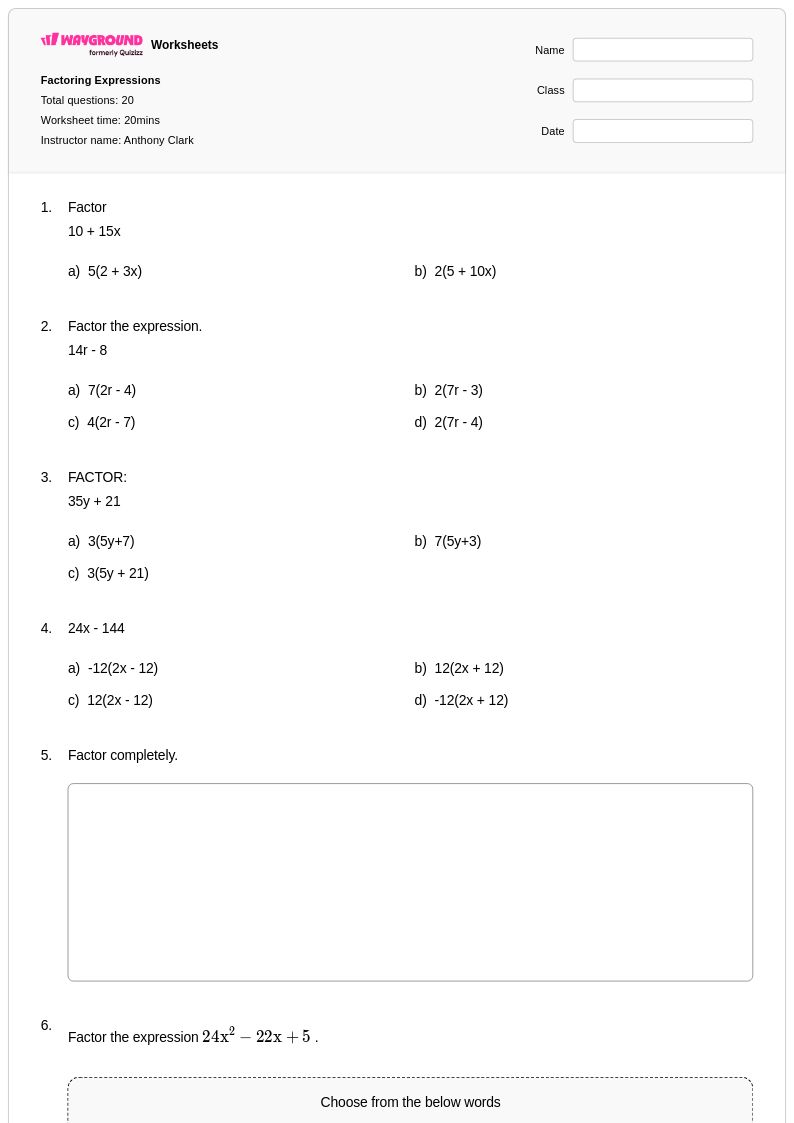
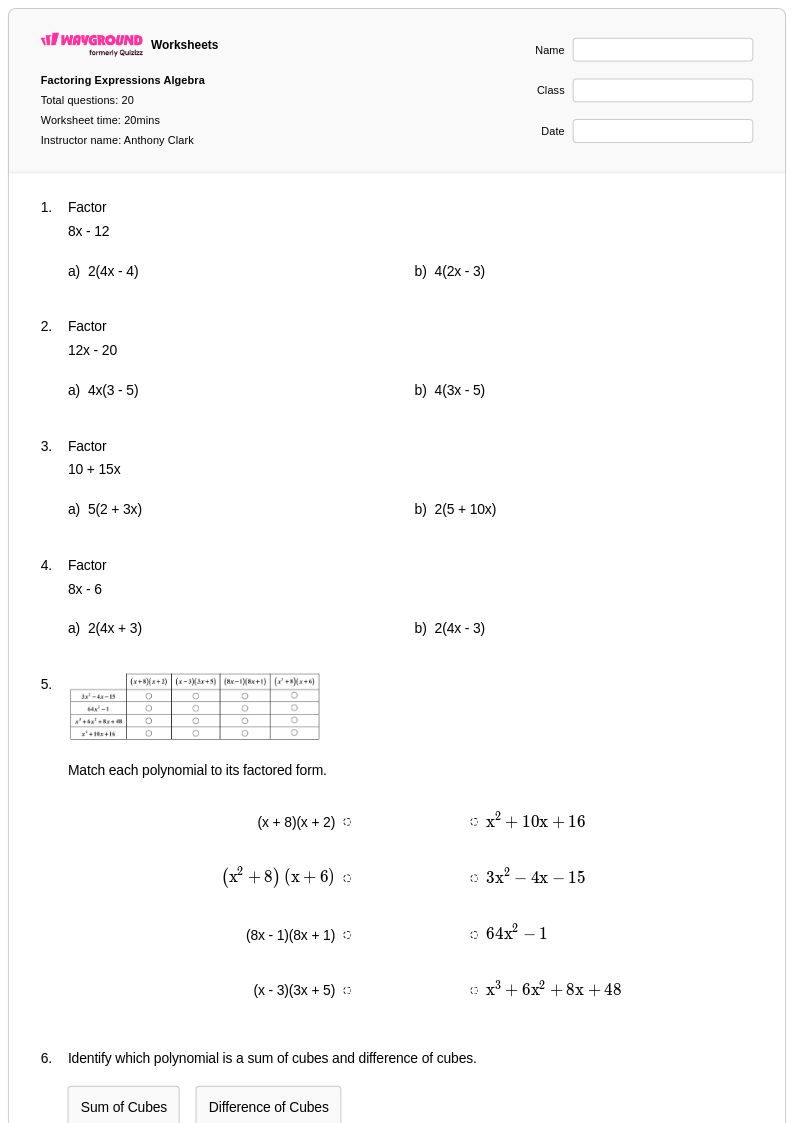
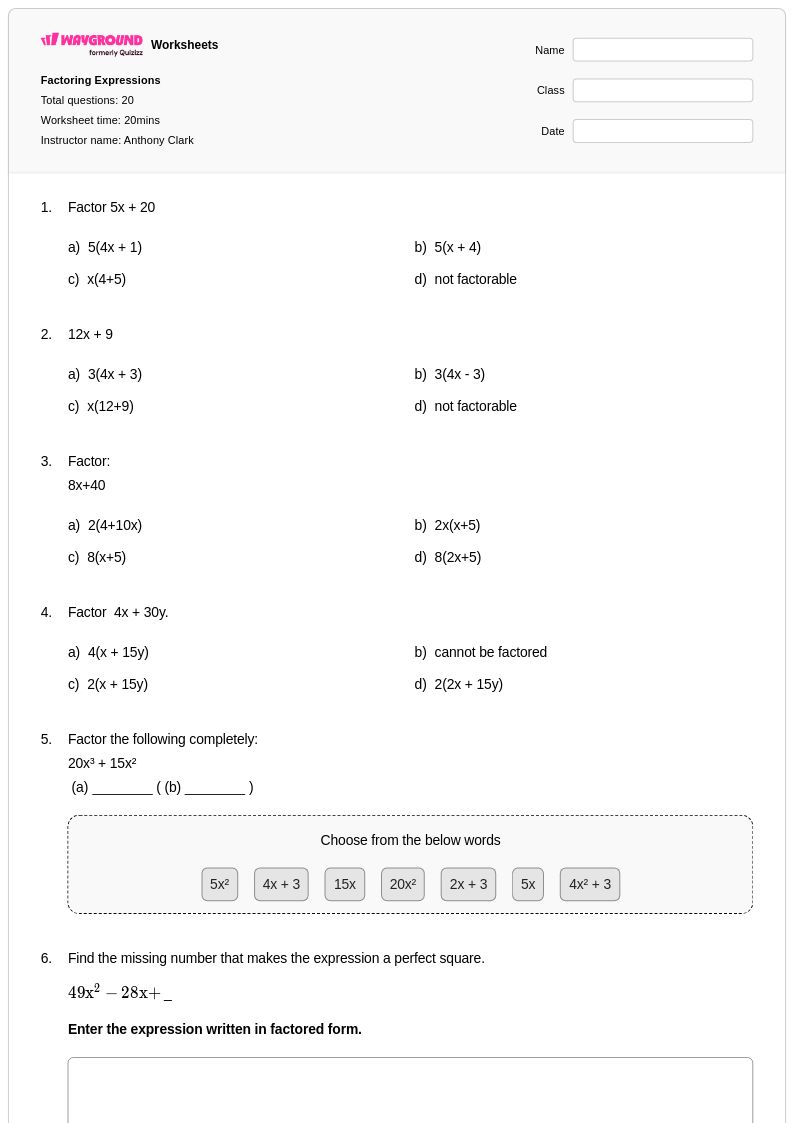
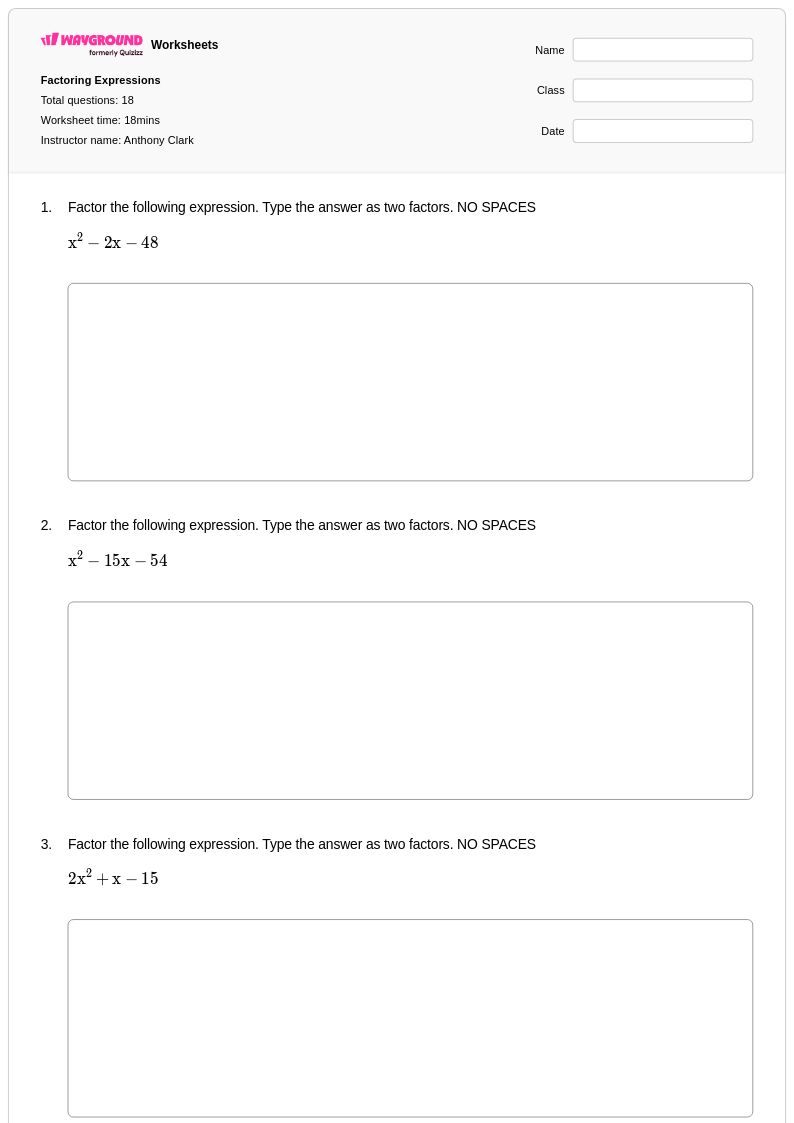
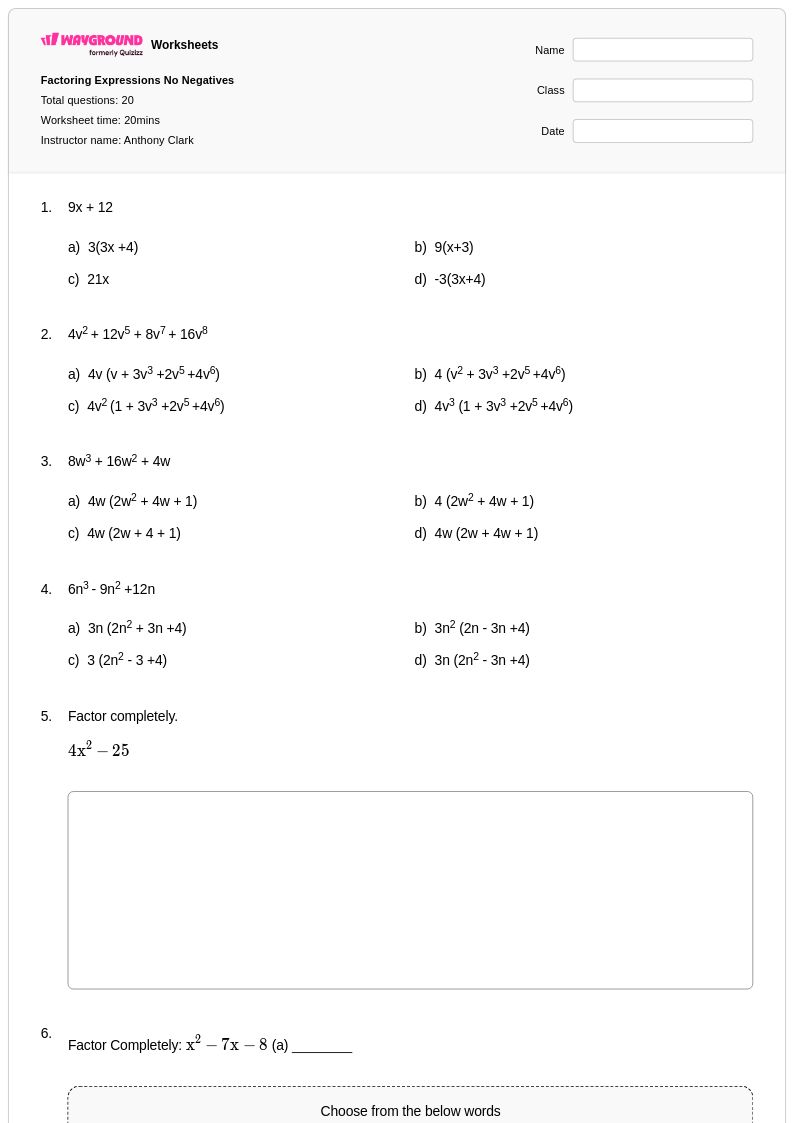
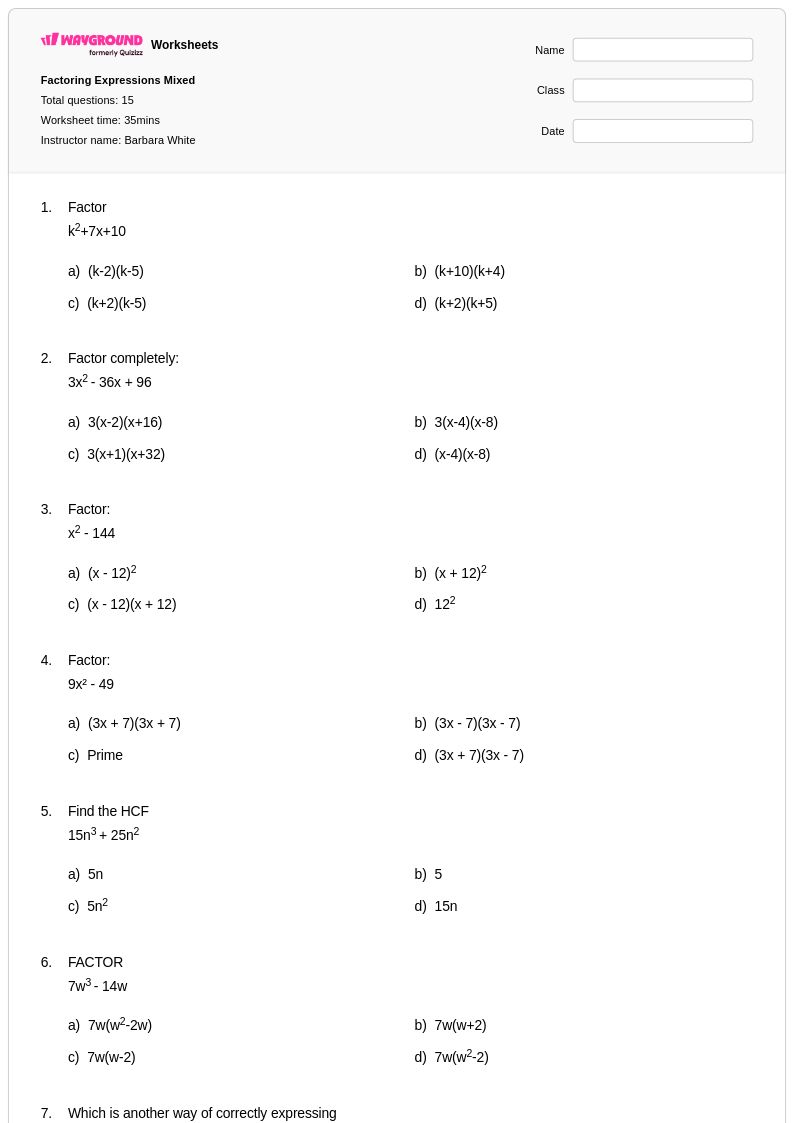
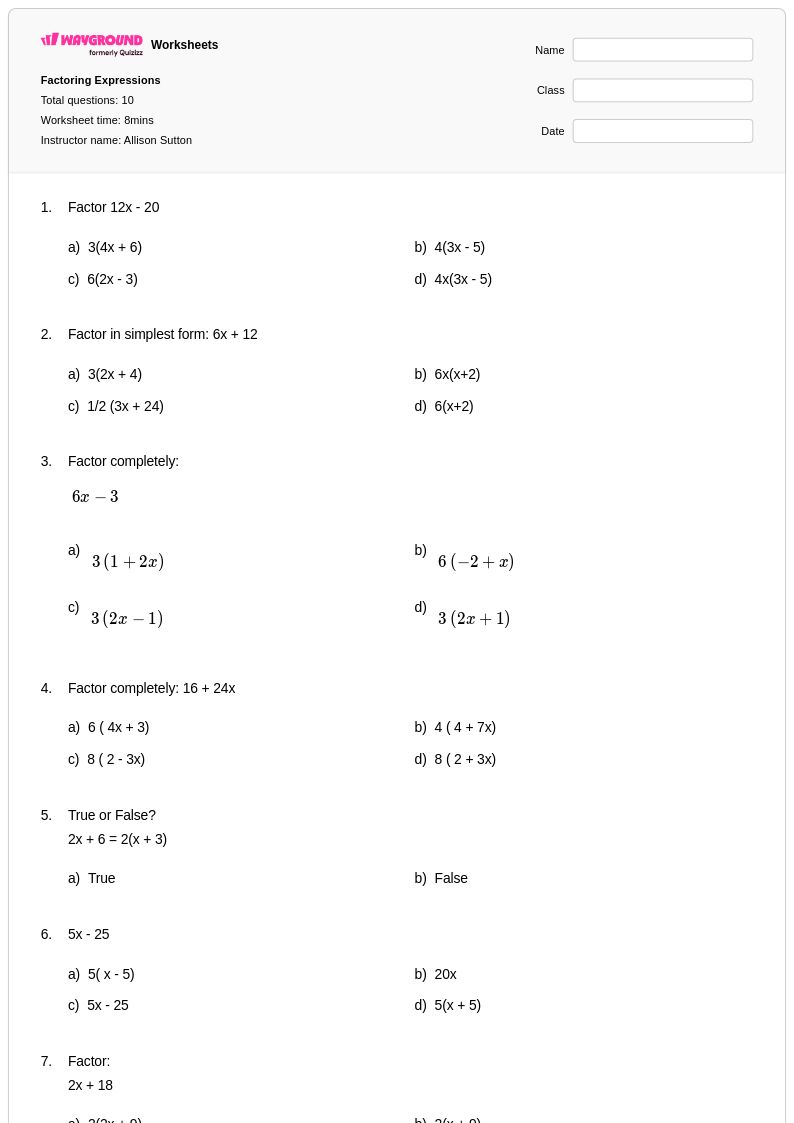
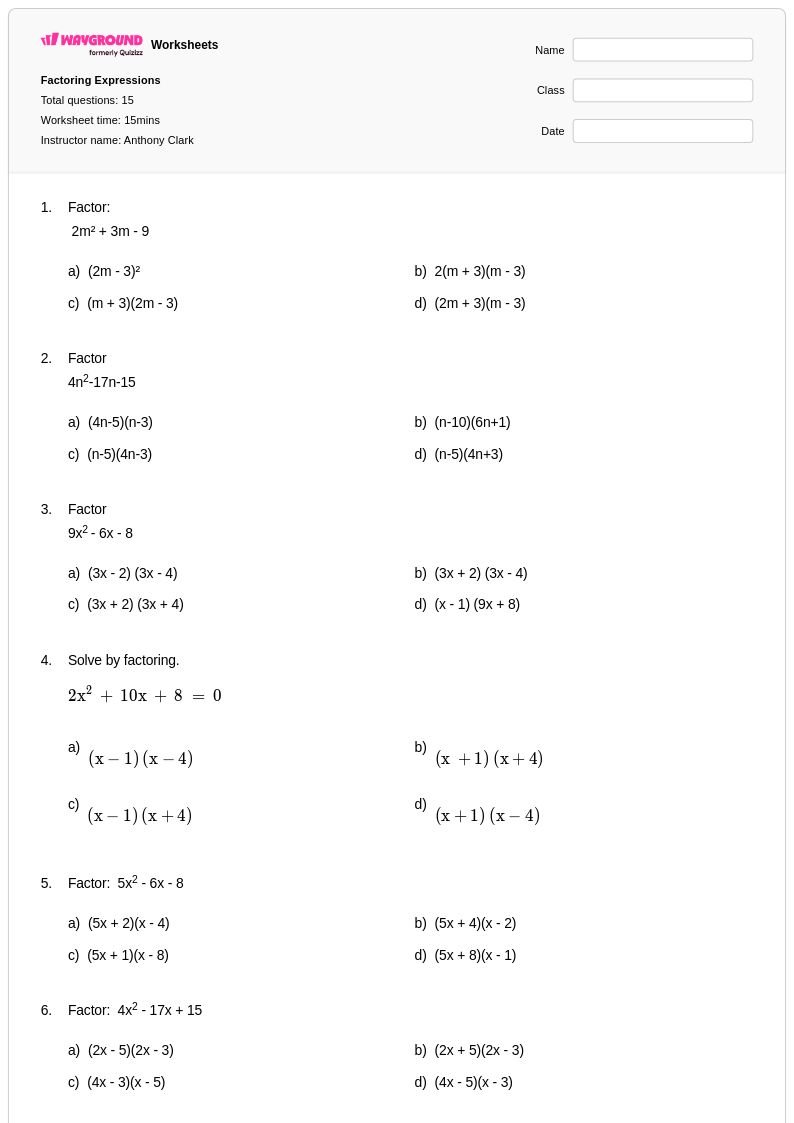
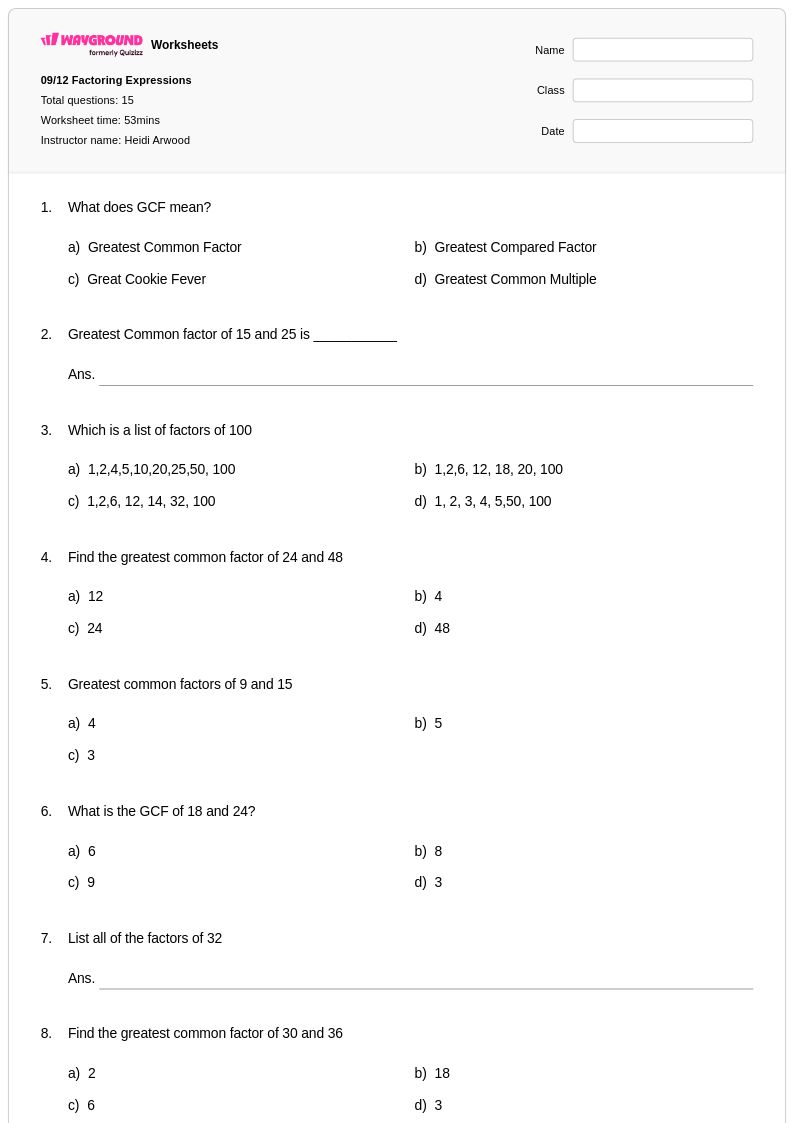
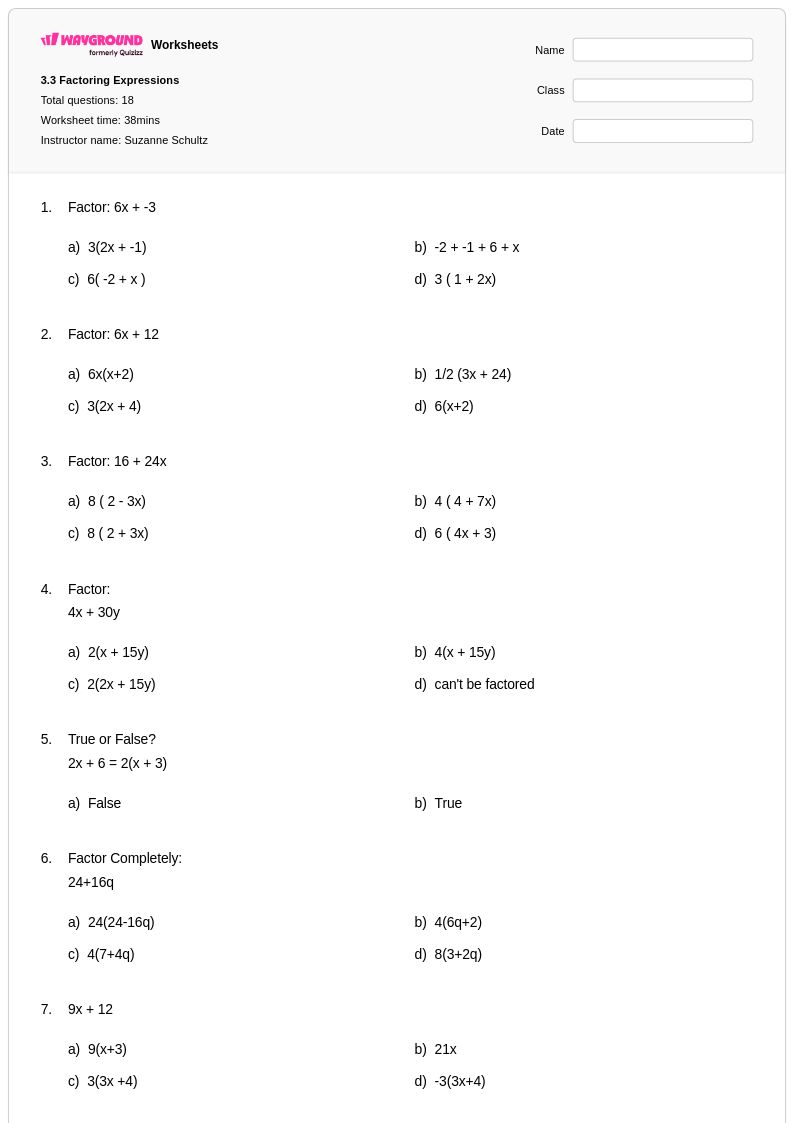
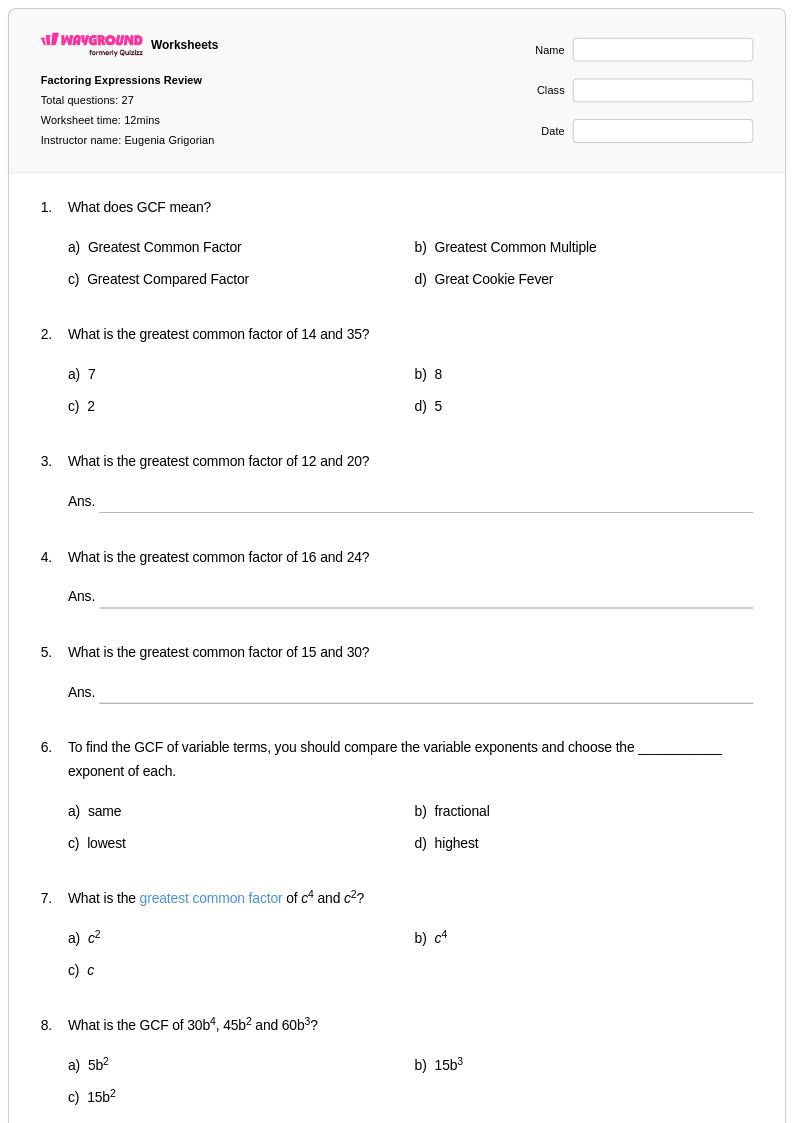
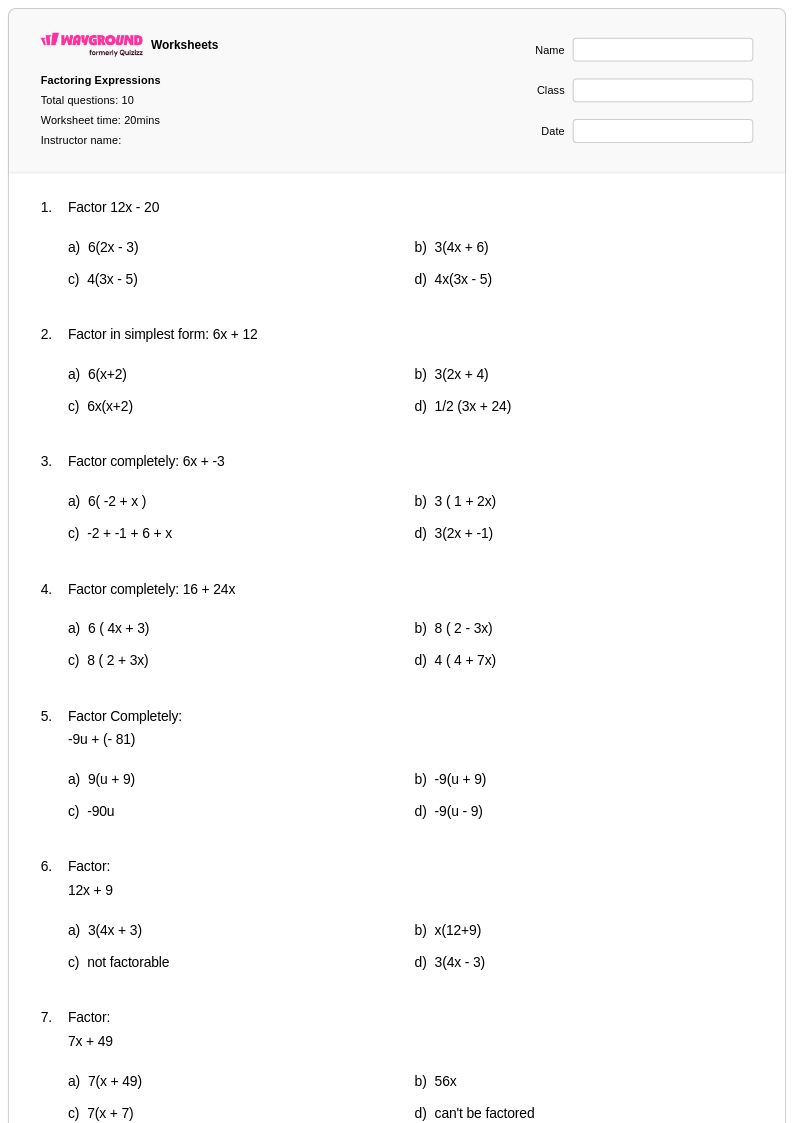
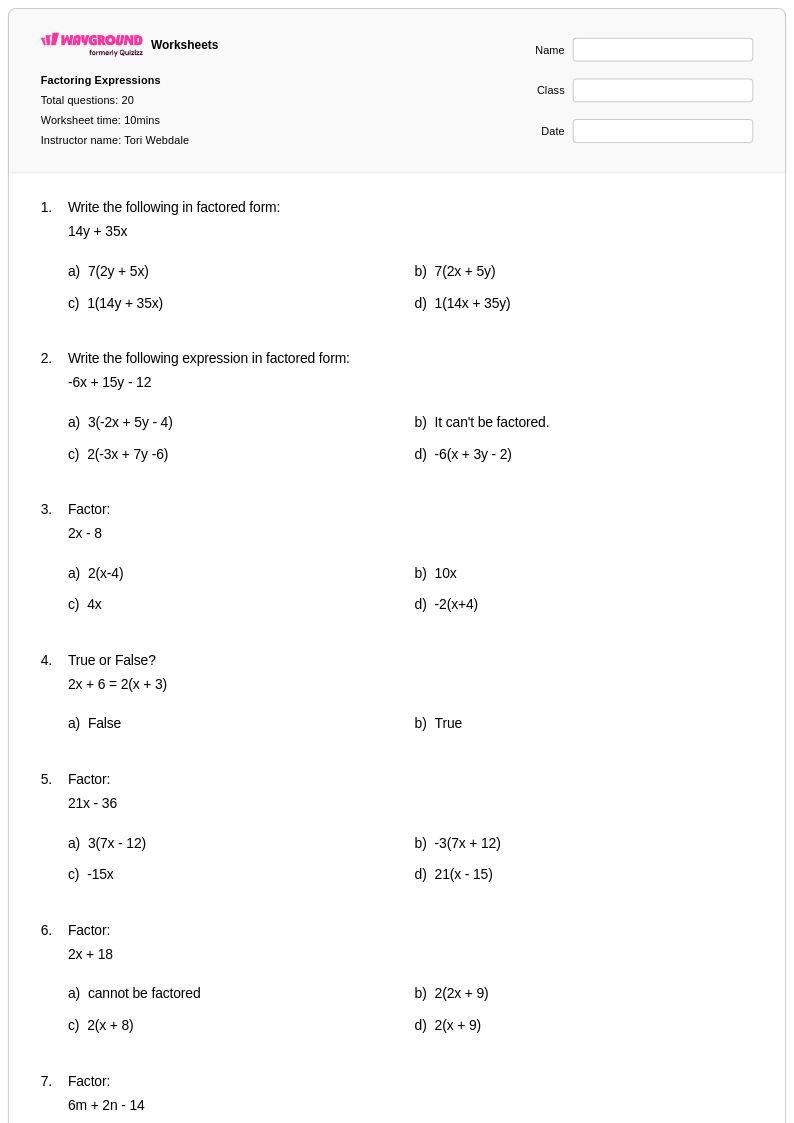
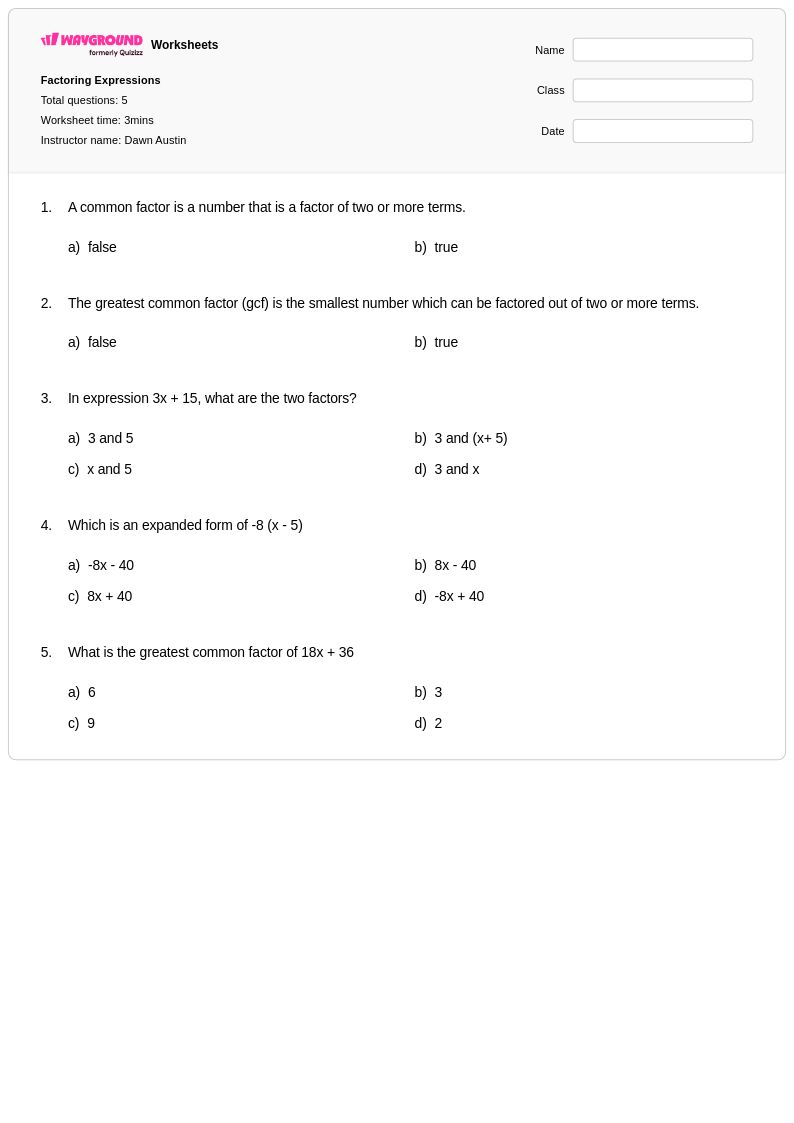
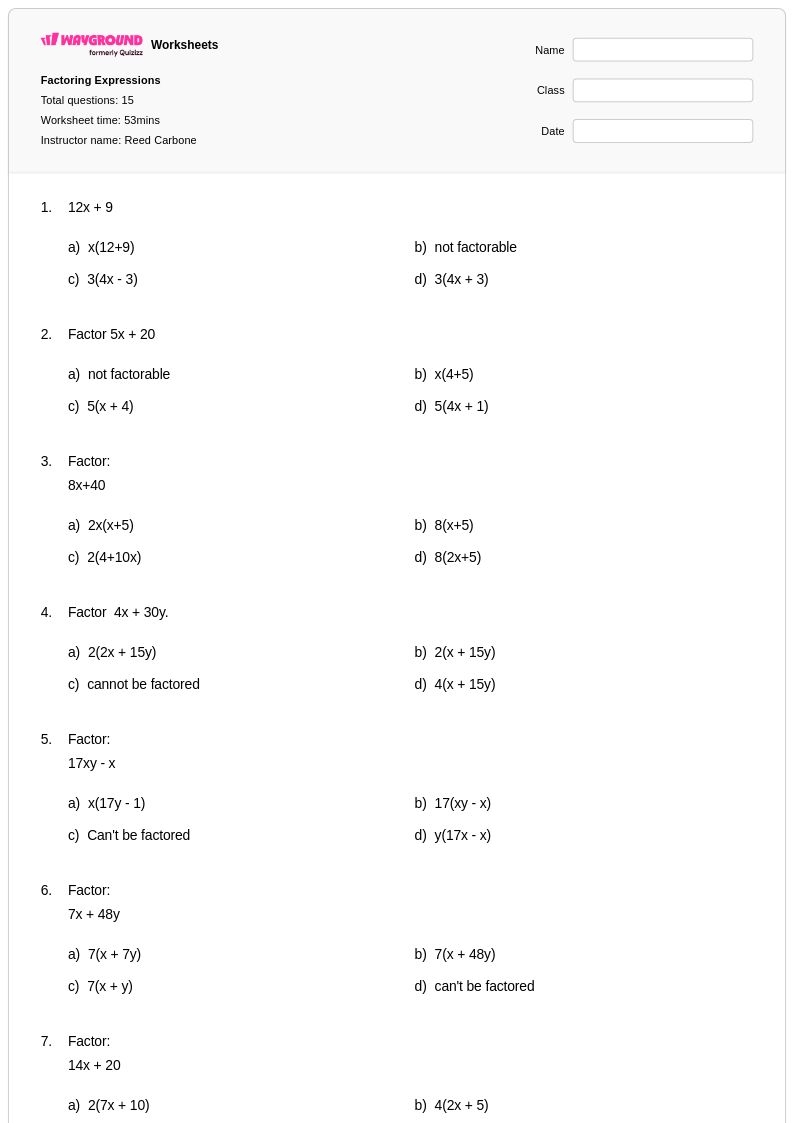
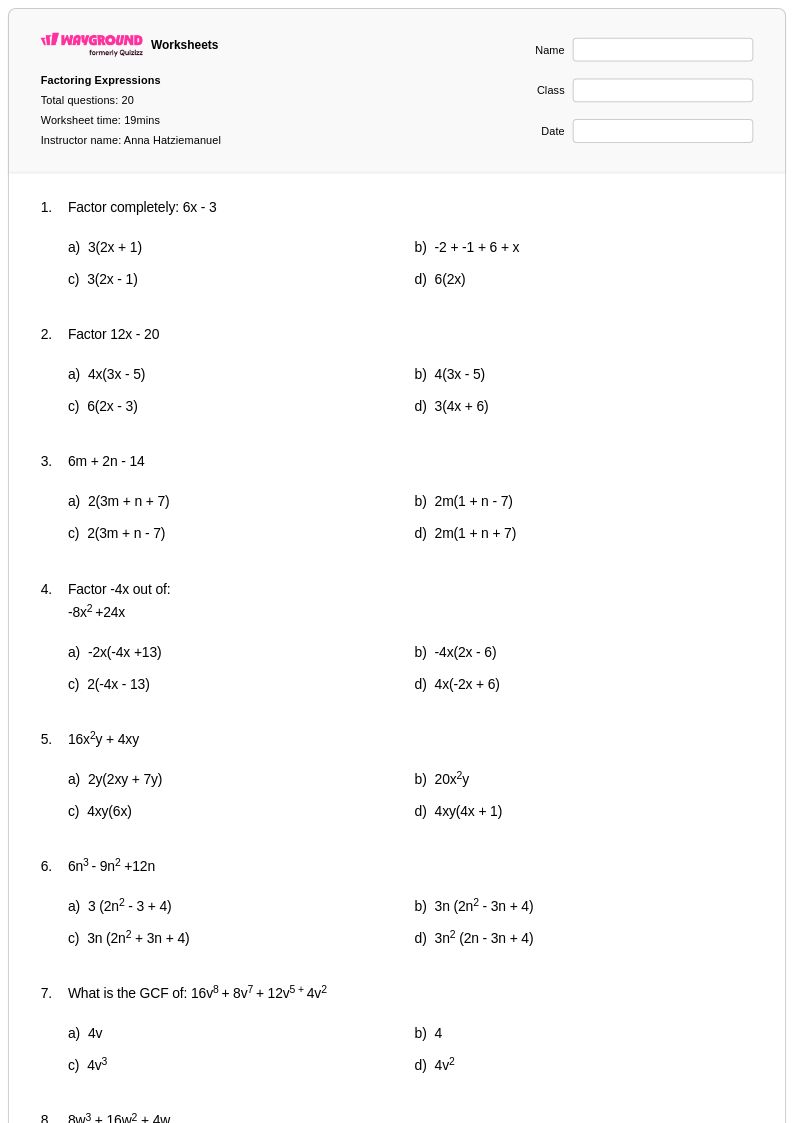
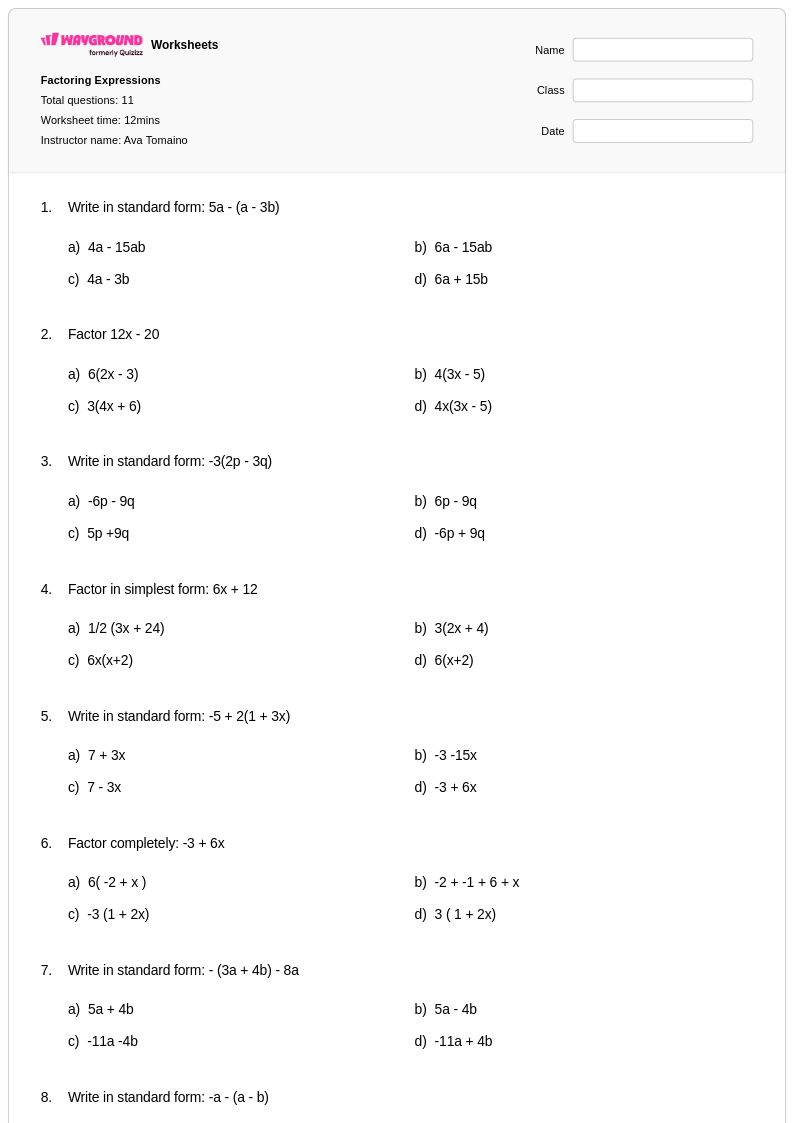
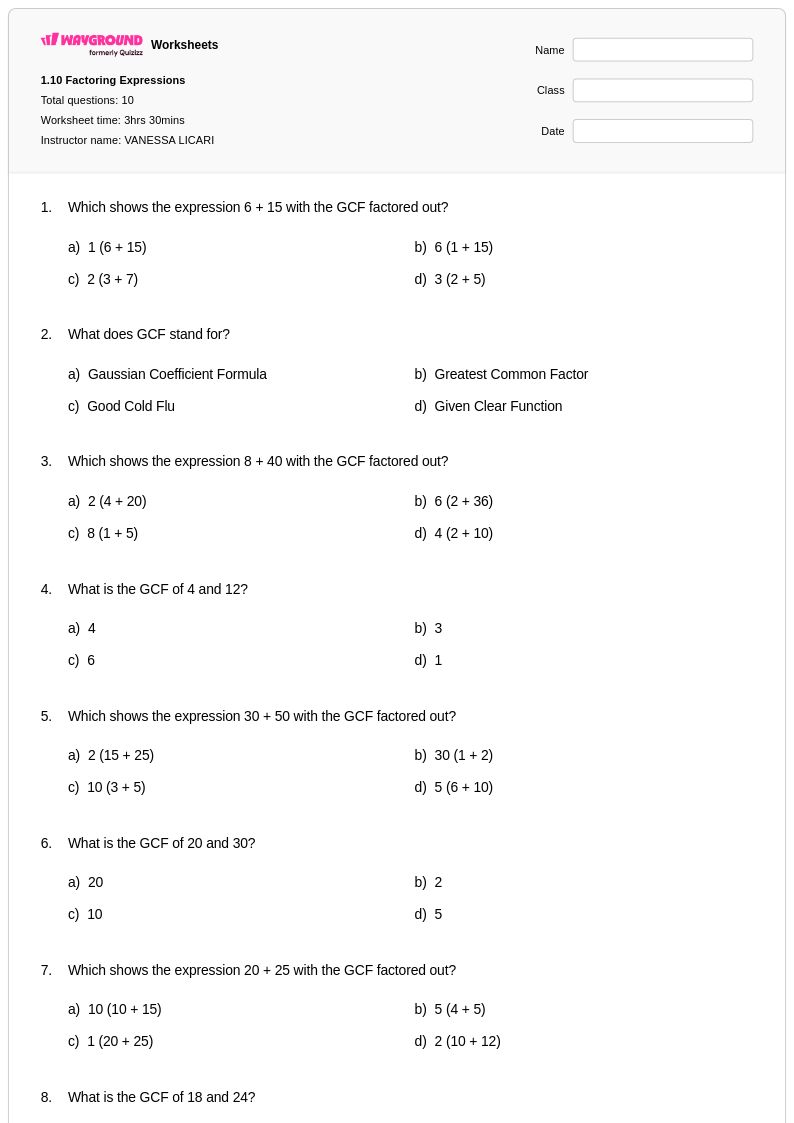
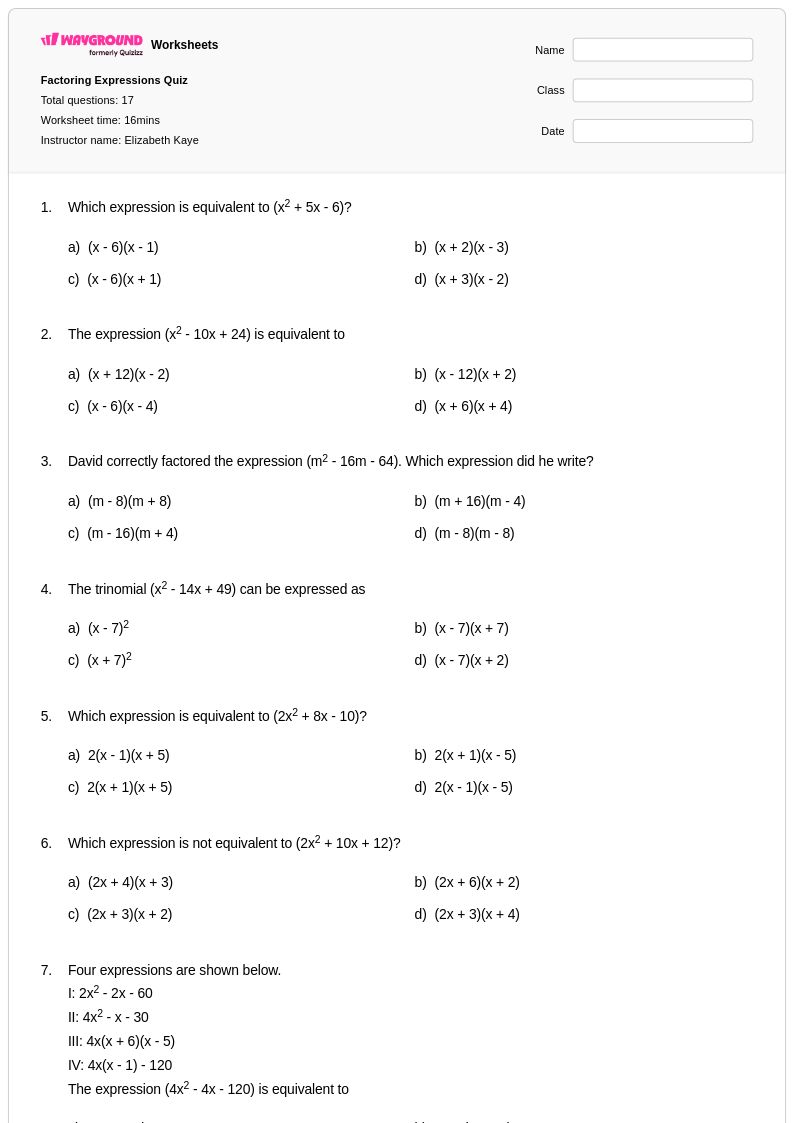
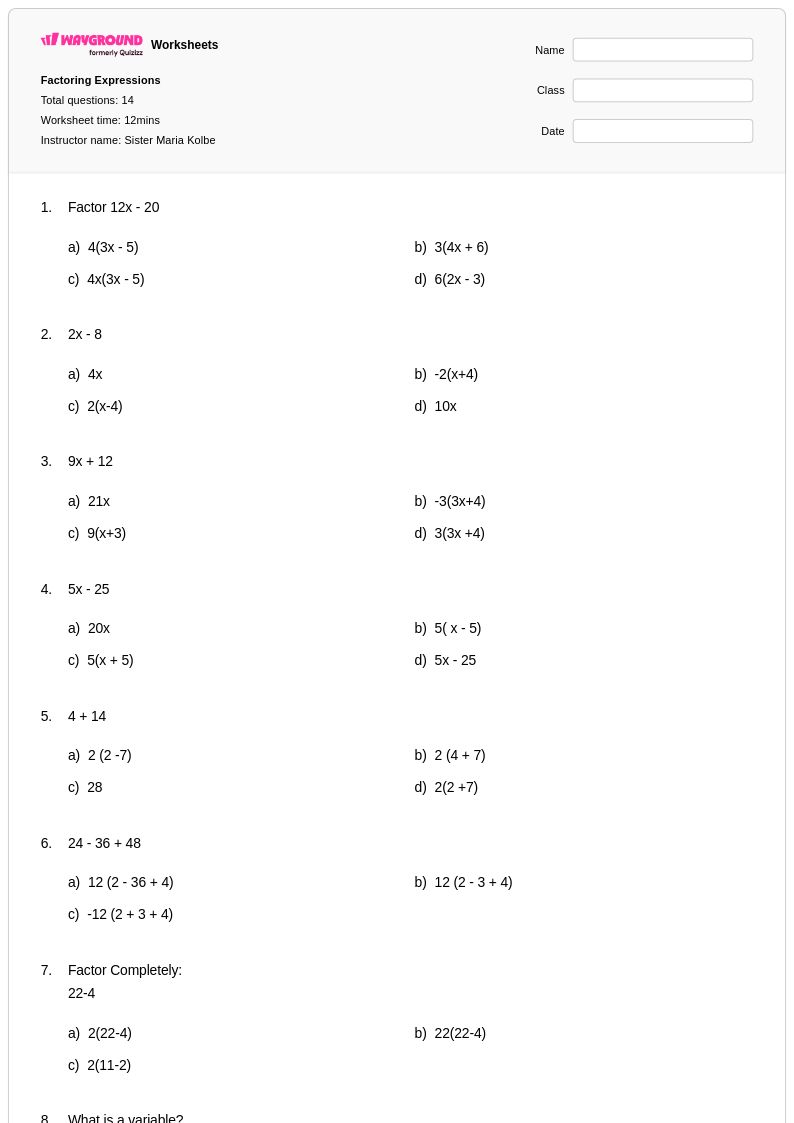
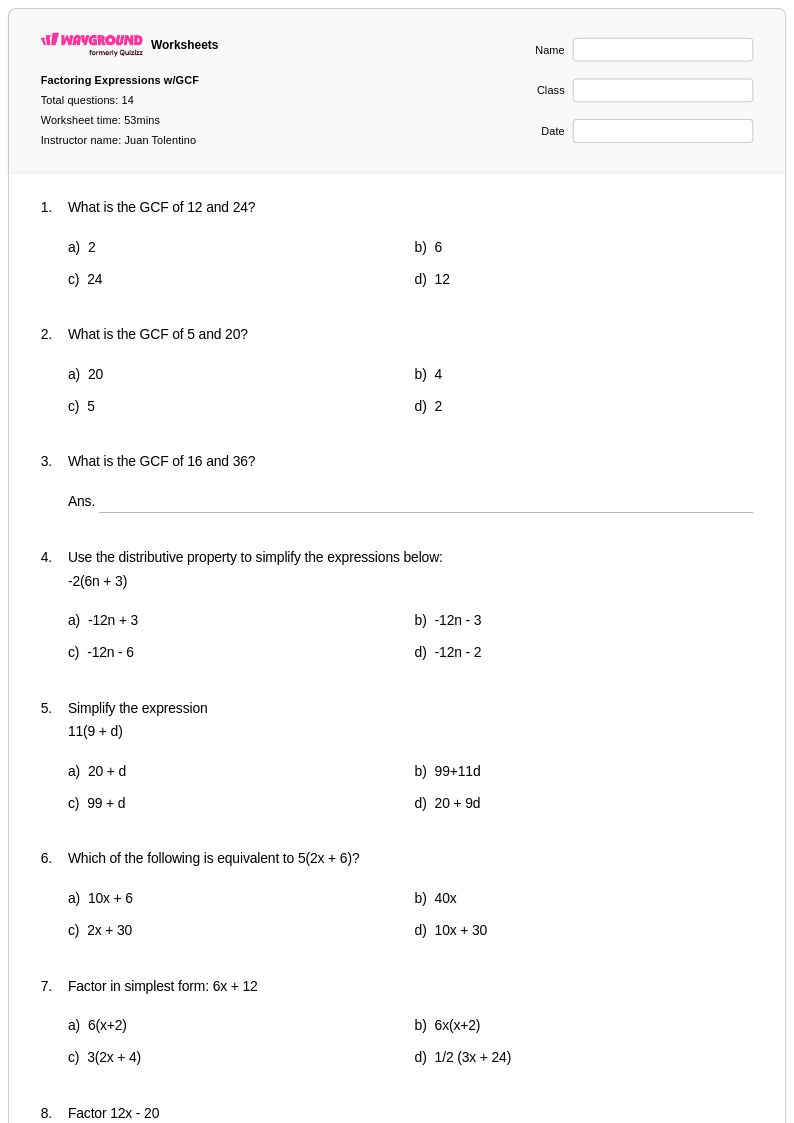
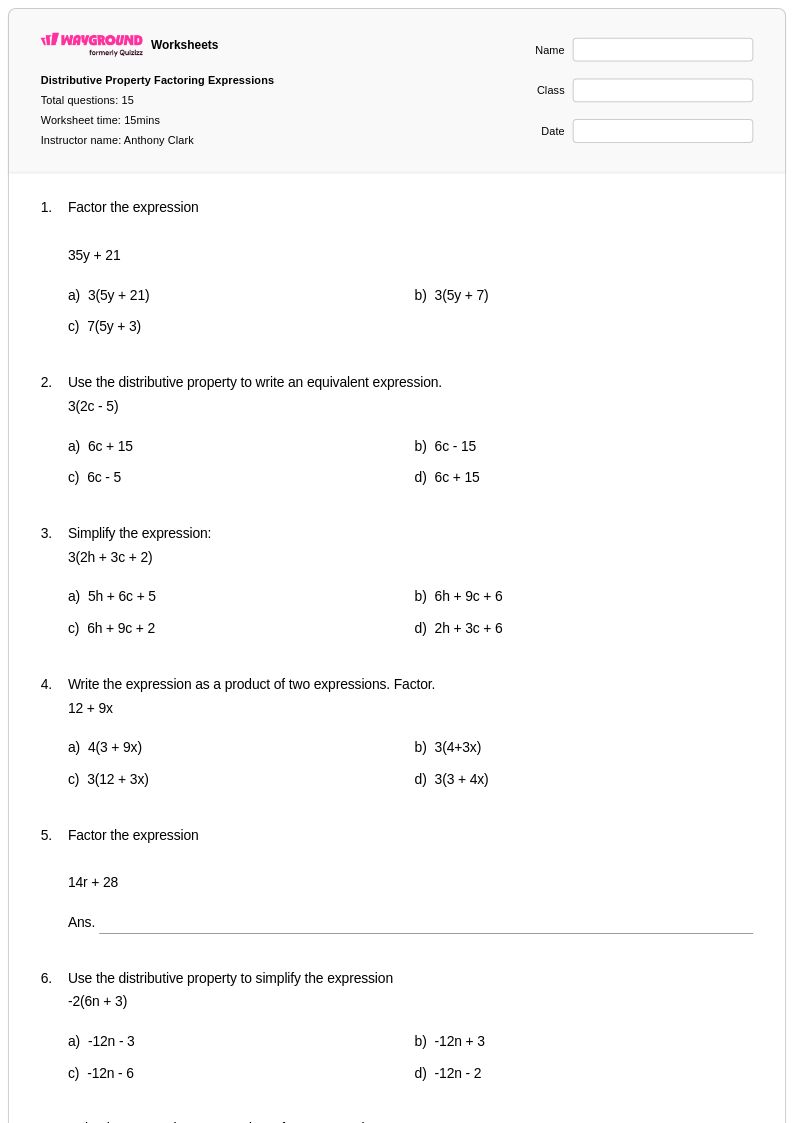
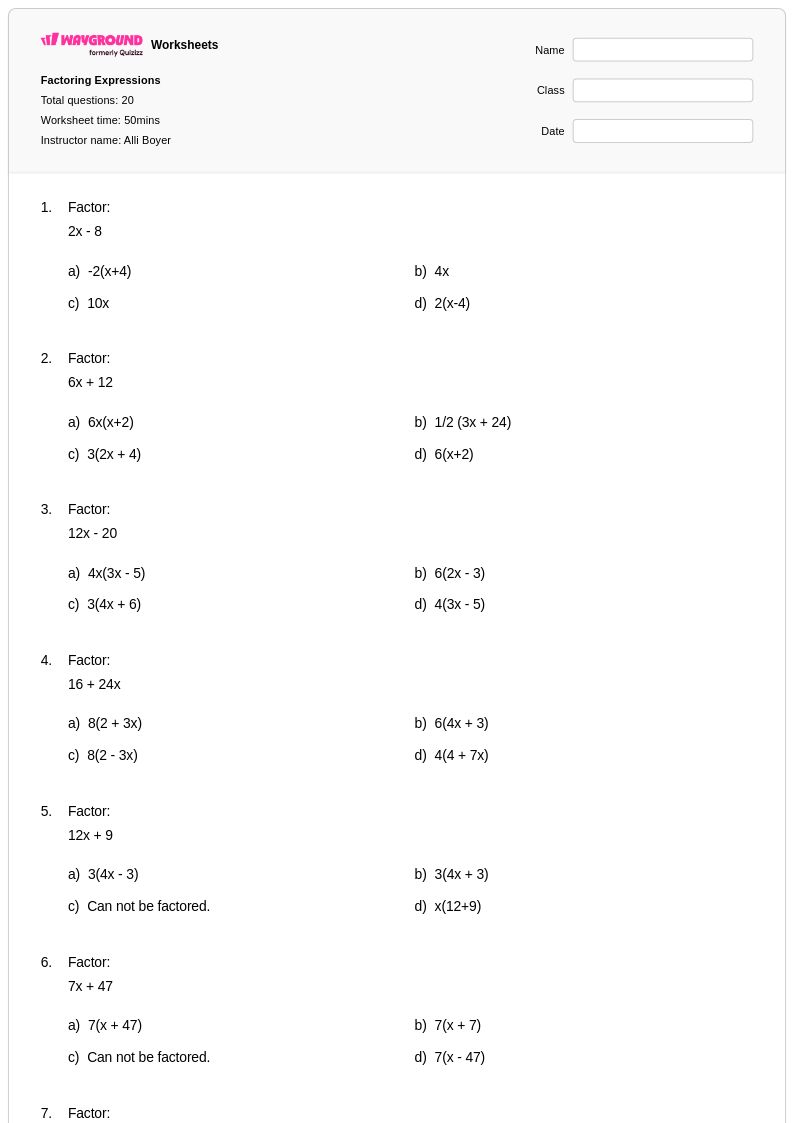
Master factoring expressions with Wayground's comprehensive collection of free worksheets, featuring printable PDFs with practice problems and answer keys to help students develop essential algebraic skills.
Factoring expressions worksheets available through Wayground (formerly Quizizz) provide comprehensive practice opportunities for students to master this fundamental algebraic skill. These carefully designed resources help students develop proficiency in breaking down complex algebraic expressions into their component factors, strengthening their understanding of mathematical relationships and preparing them for advanced problem-solving. Each worksheet collection includes detailed answer keys and is available as free printables in convenient pdf format, allowing educators to seamlessly integrate factoring practice into their mathematics curriculum. The practice problems progress systematically from basic factoring techniques like finding common factors to more sophisticated methods including factoring trinomials, difference of squares, and polynomial expressions.
Wayground (formerly Quizizz) empowers teachers with millions of educator-created factoring expressions worksheets that can be easily discovered through robust search and filtering capabilities. The platform's extensive collection supports differentiated instruction by offering resources aligned to various mathematical standards and skill levels, enabling teachers to customize materials for individual student needs. These versatile worksheets are available in both printable and digital formats, including downloadable pdf versions, making them ideal for classroom instruction, homework assignments, remediation sessions, and enrichment activities. Teachers can efficiently plan comprehensive factoring units while accessing tools that support targeted skill practice, helping students build confidence and mastery in manipulating algebraic expressions through systematic factorization techniques.
FAQs
How do I teach factoring expressions?
Start with the concept of multiplication in reverse: if students can expand 3(x + 4) into 3x + 12, they already have the intuition for factoring. From there, build systematically — greatest common factor first, then factoring trinomials, then special patterns like difference of squares. Students who skip GCF and jump straight to trinomials almost always struggle later, so don't rush that foundation.
What exercises help students practice factoring expressions?
The most effective practice moves from recognition to production. Start with exercises where students identify whether an expression is fully factored, then move to guided factoring with partial scaffolding (e.g., the GCF is given), and finally to open-ended problems where students choose the method. Mixing factoring with expansion problems in the same set also sharpens understanding — students have to decide which direction to go, not just follow a procedure.
What mistakes do students commonly make when factoring expressions?
Three errors come up constantly: forgetting to factor out the GCF before attempting trinomial factoring, sign errors when factoring expressions with subtraction, and stopping too early (leaving a factorable expression partially factored). The last one is especially common with difference of squares — students factor once and don't check whether either factor can be factored further.
How do I use Wayground's factoring expressions worksheets in my class?
You can run these as a digital quiz hosted on Wayground — students work through problems on their devices and results come back to you automatically, complete answer key included. If you'd rather go paper, print the PDF and distribute it; you can then grade submissions using the Wayground for Teachers app, which lets you scan or capture student work for quick turnaround. Both routes use the same problems, so the format choice is purely about what works for your classroom that day.
How does factoring expressions fit into the algebra curriculum?
Common Core treats factoring as the inverse of the distributive property, which students first encounter with numerical expressions before applying it to algebraic ones. Factoring out a GCF is the entry point; from there the progression moves through factoring trinomials with a leading coefficient of 1, then trinomials where the leading coefficient is greater than 1, and finally special forms like difference of squares. Mastering this sequence is what makes solving quadratic equations by factoring accessible — students who hit that unit without fluency in these patterns consistently stall.
How can I differentiate factoring expressions practice for mixed-ability classes?
For students who need more support, Wayground's reduced answer choices accommodation lowers the cognitive load on multi-step problems — useful when a student understands the concept but gets overwhelmed by options. For accessibility, you can generate an alternate version of the same worksheet with a larger font or dyslexia-friendly typeface without creating a separate assignment. Advanced students can be pointed toward problems involving multi-step or nested factoring while the rest of the class works on GCF and basic trinomials.