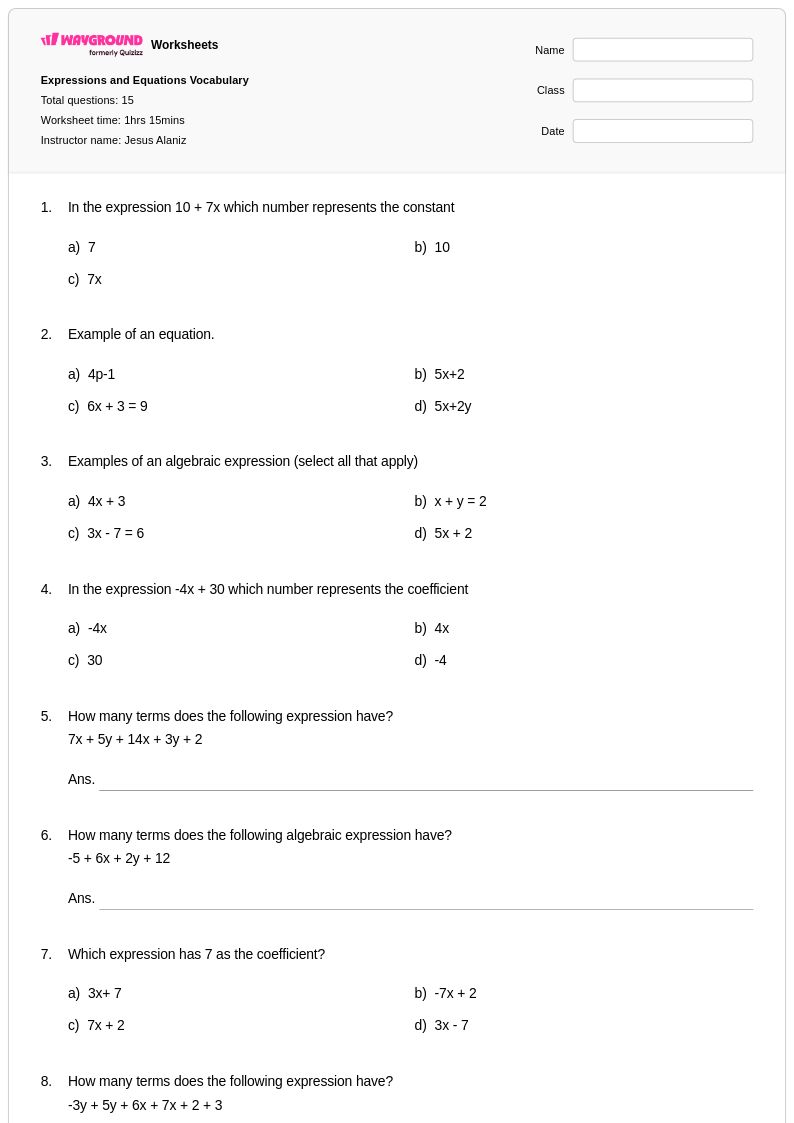
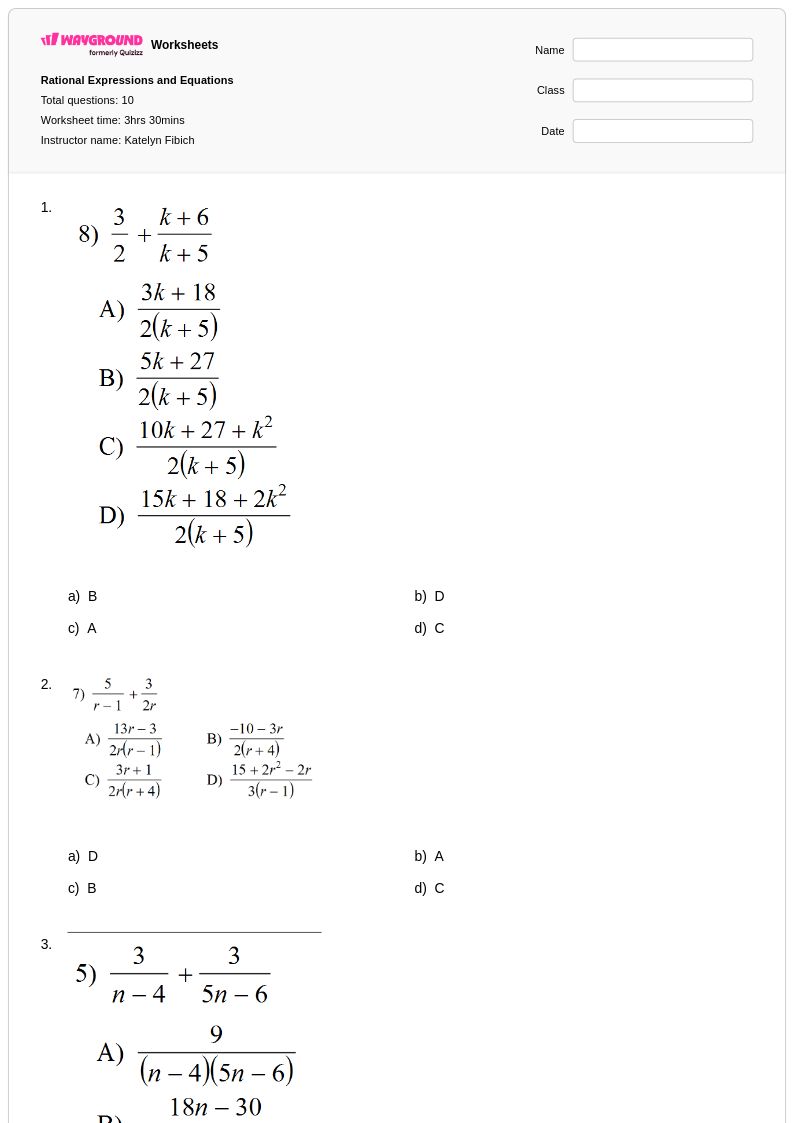
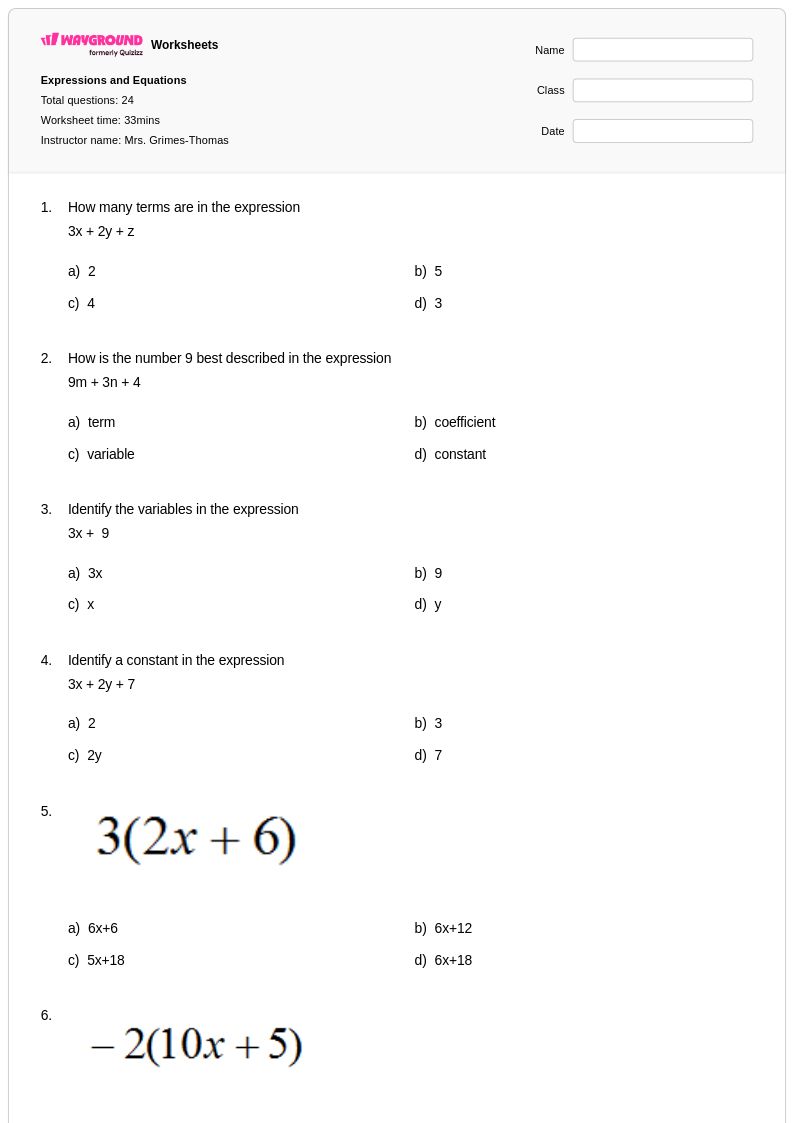
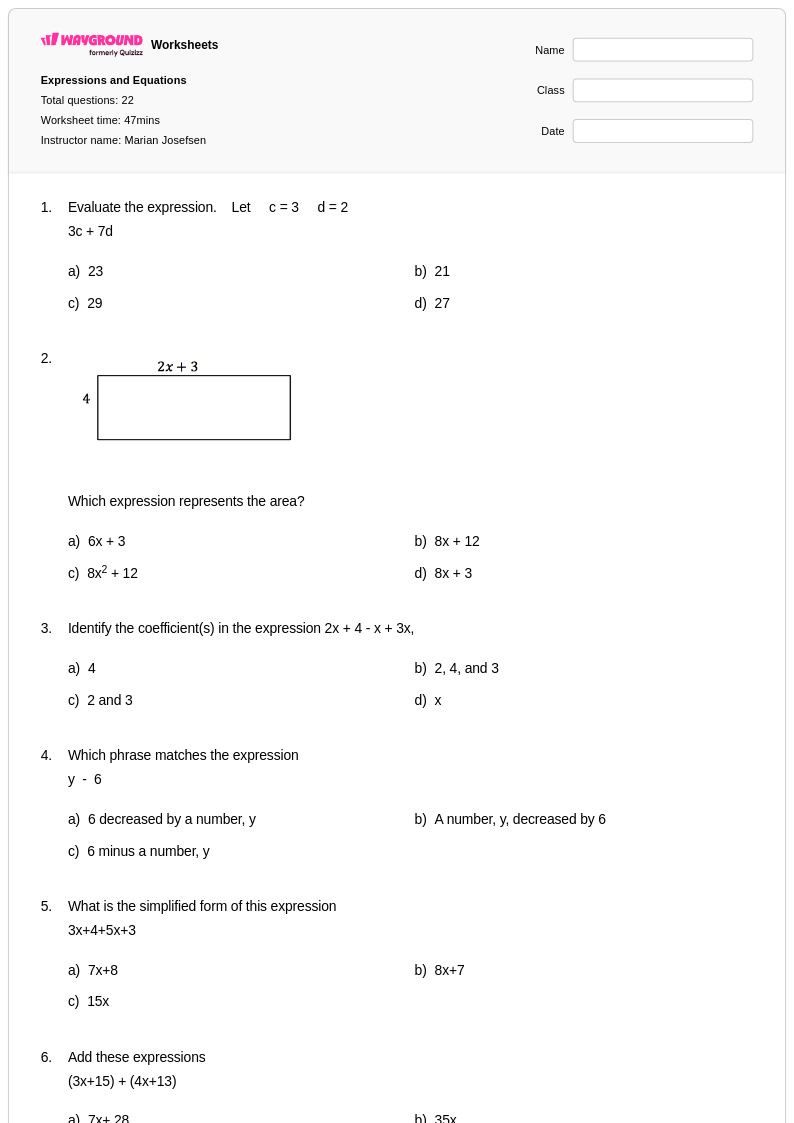
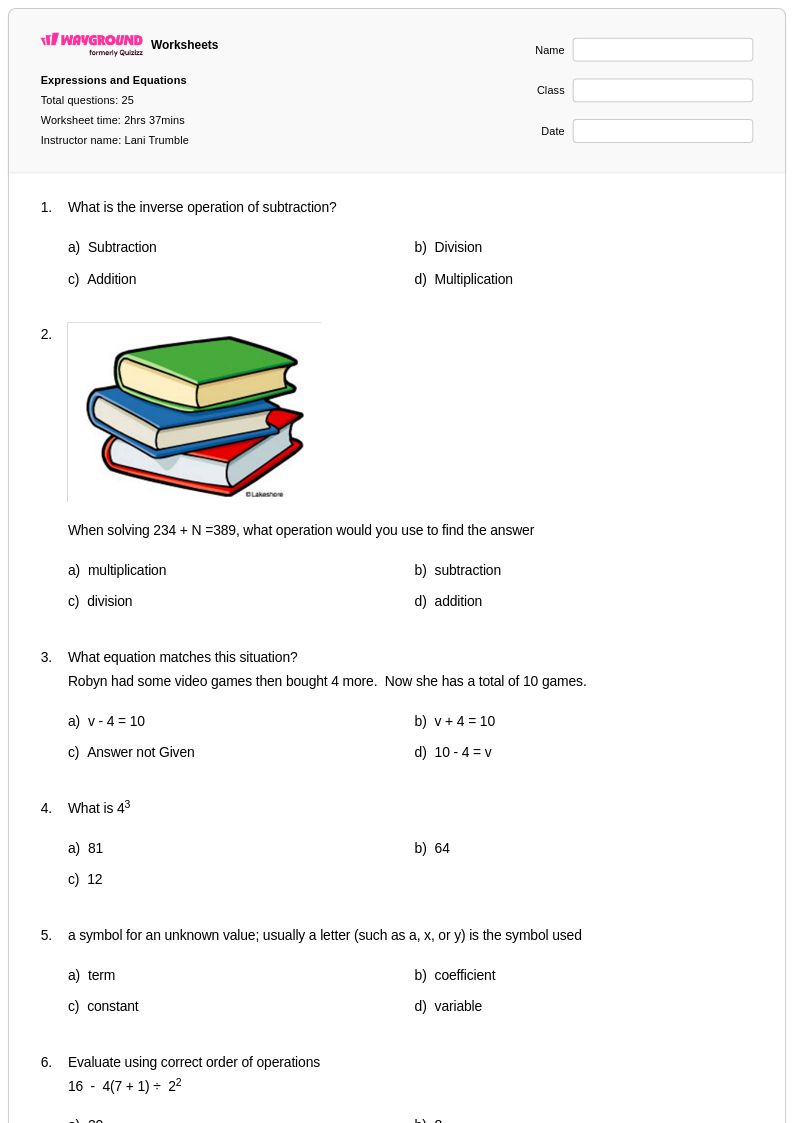
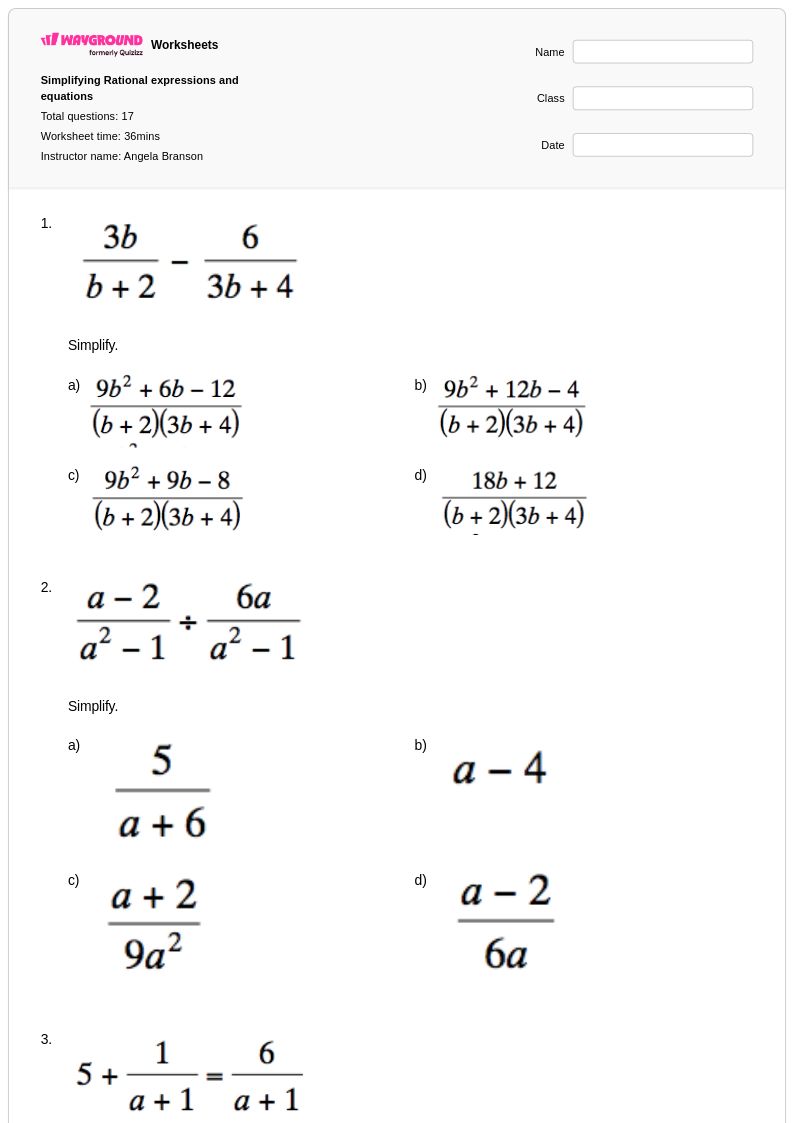
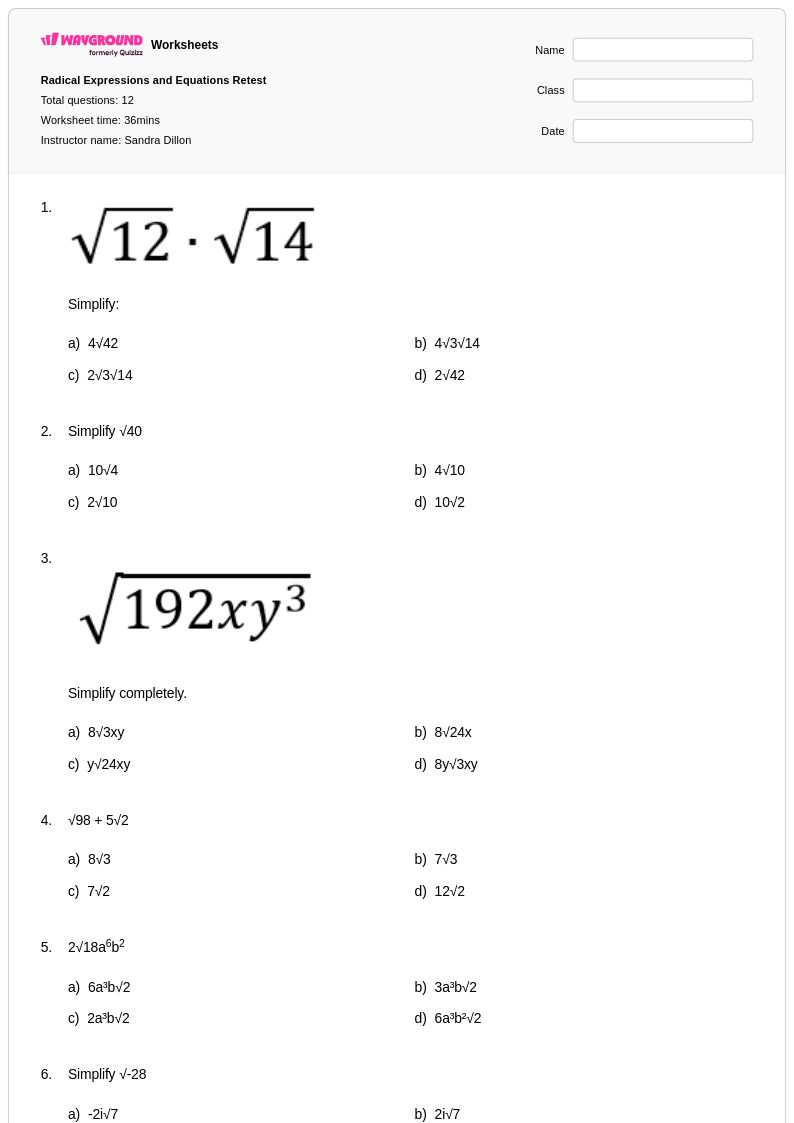
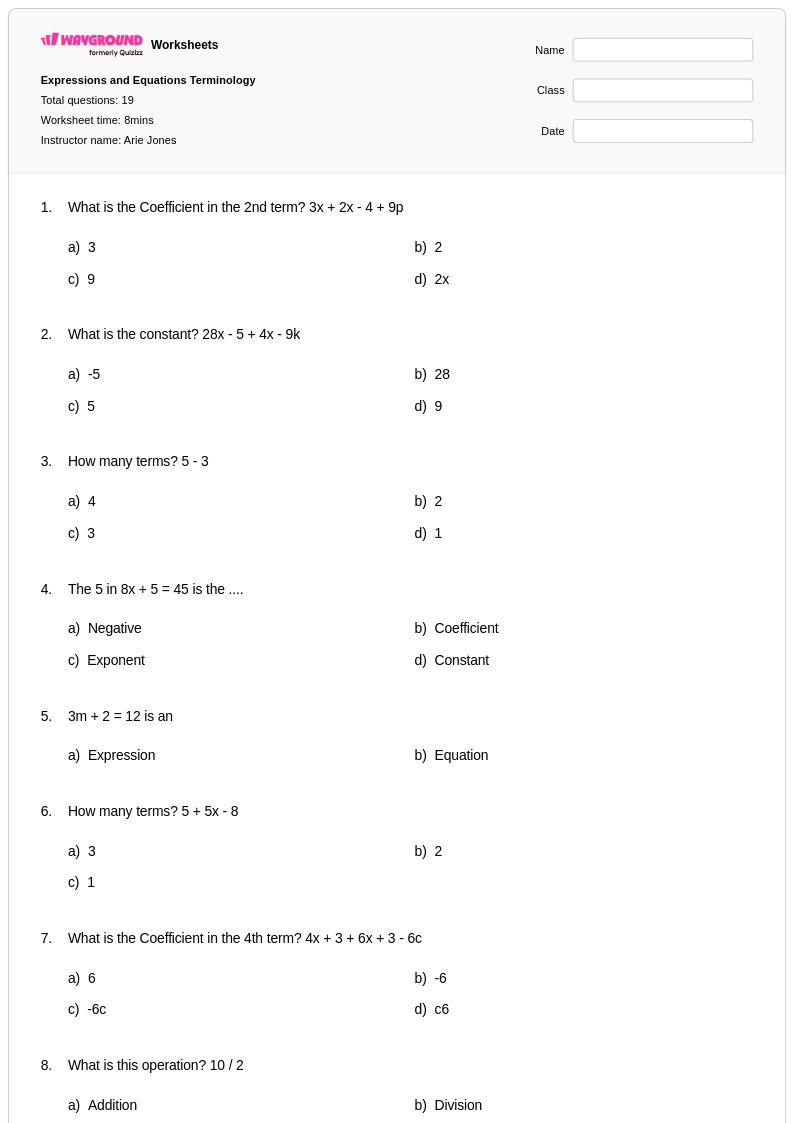
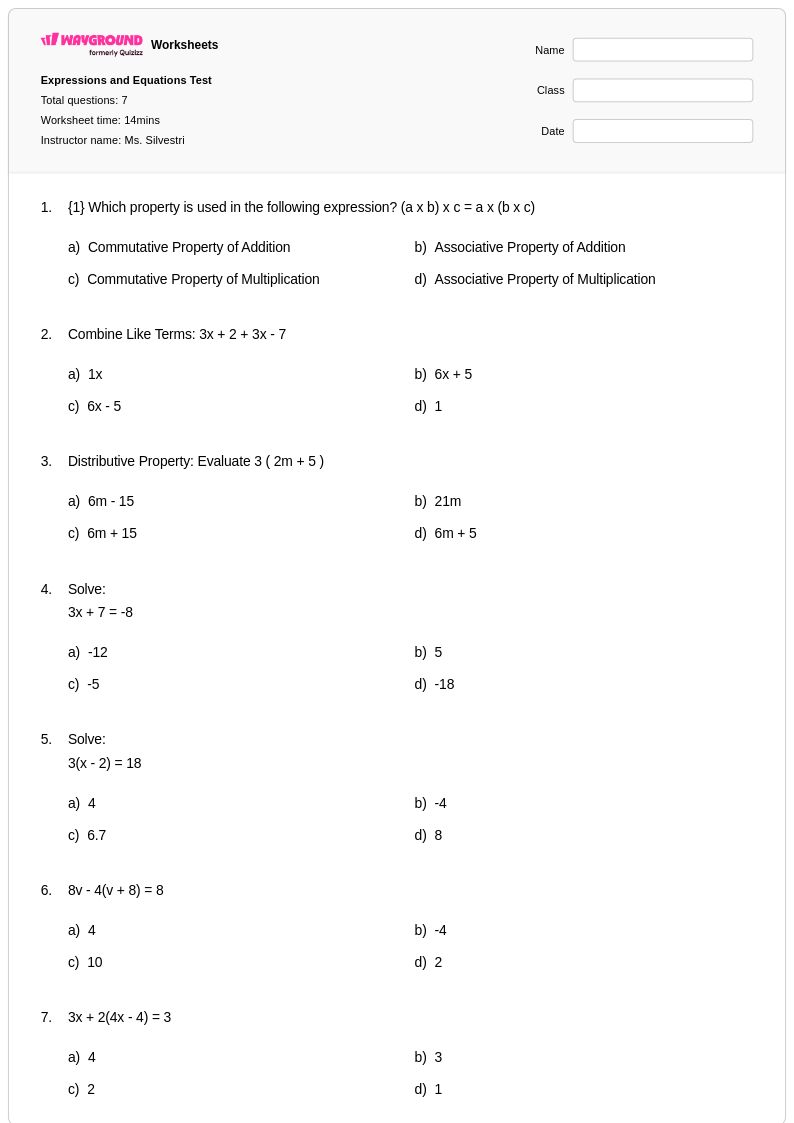
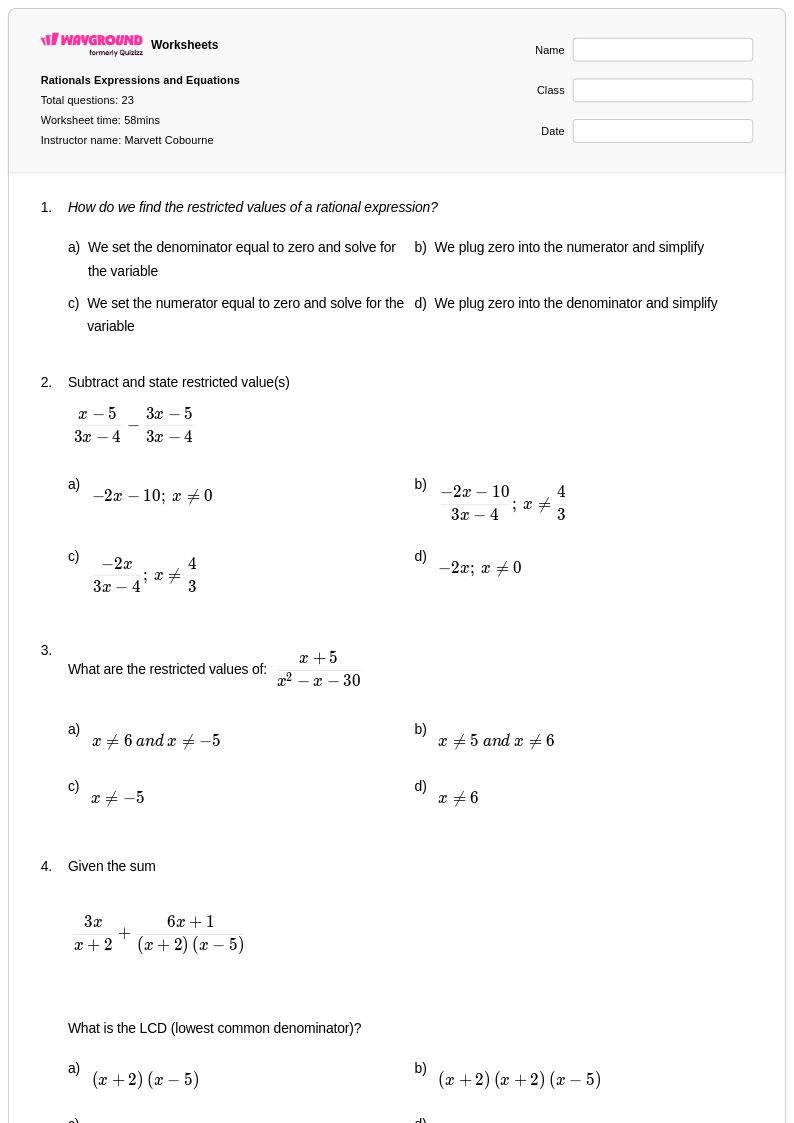
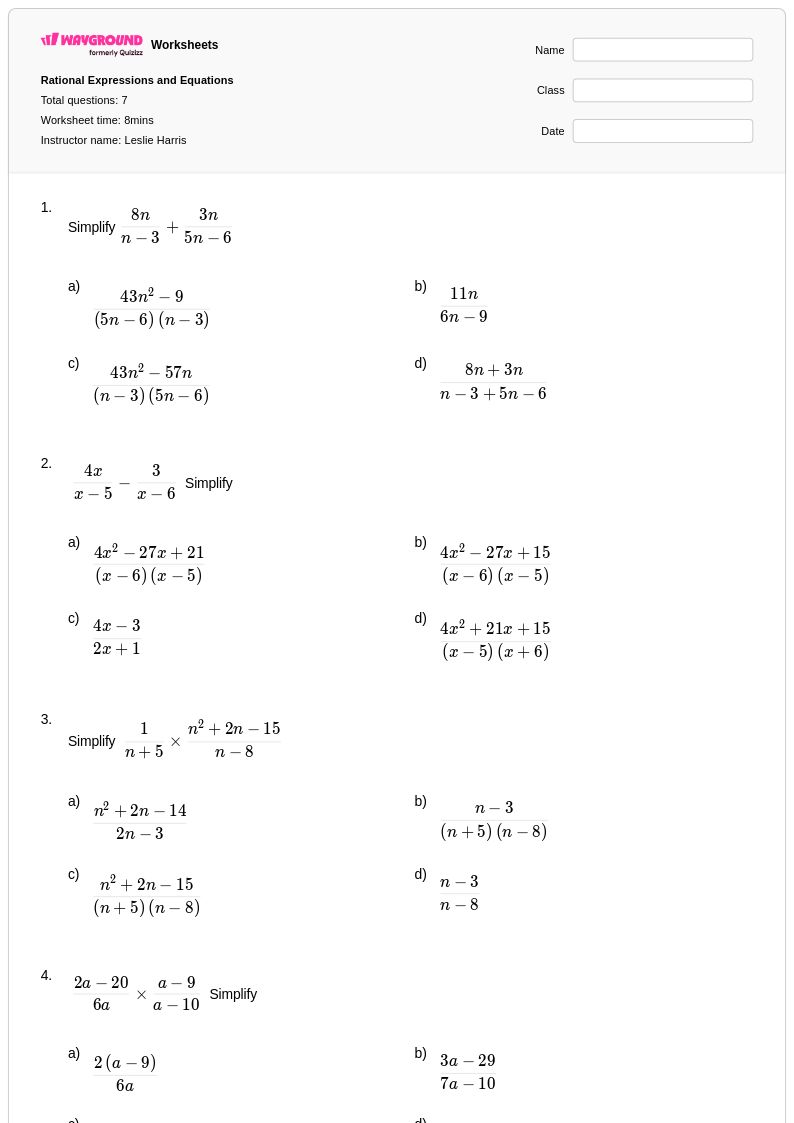
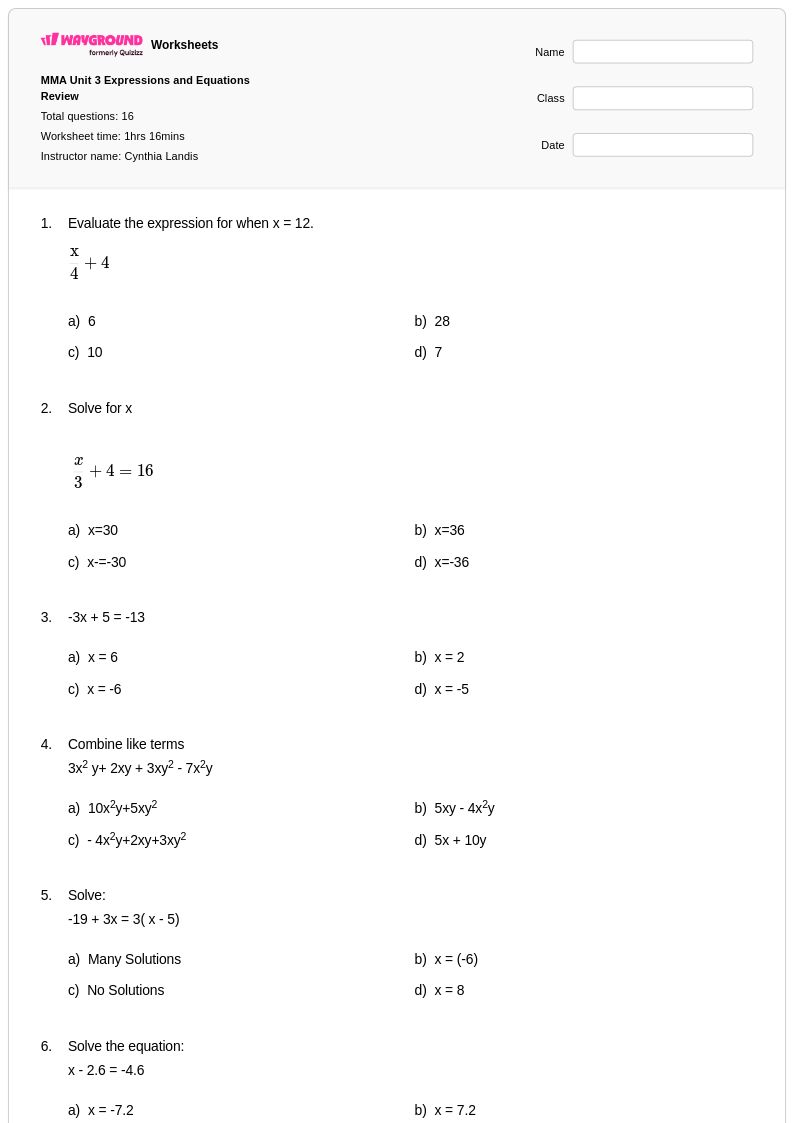
Free Printable Expressions and Equations worksheets
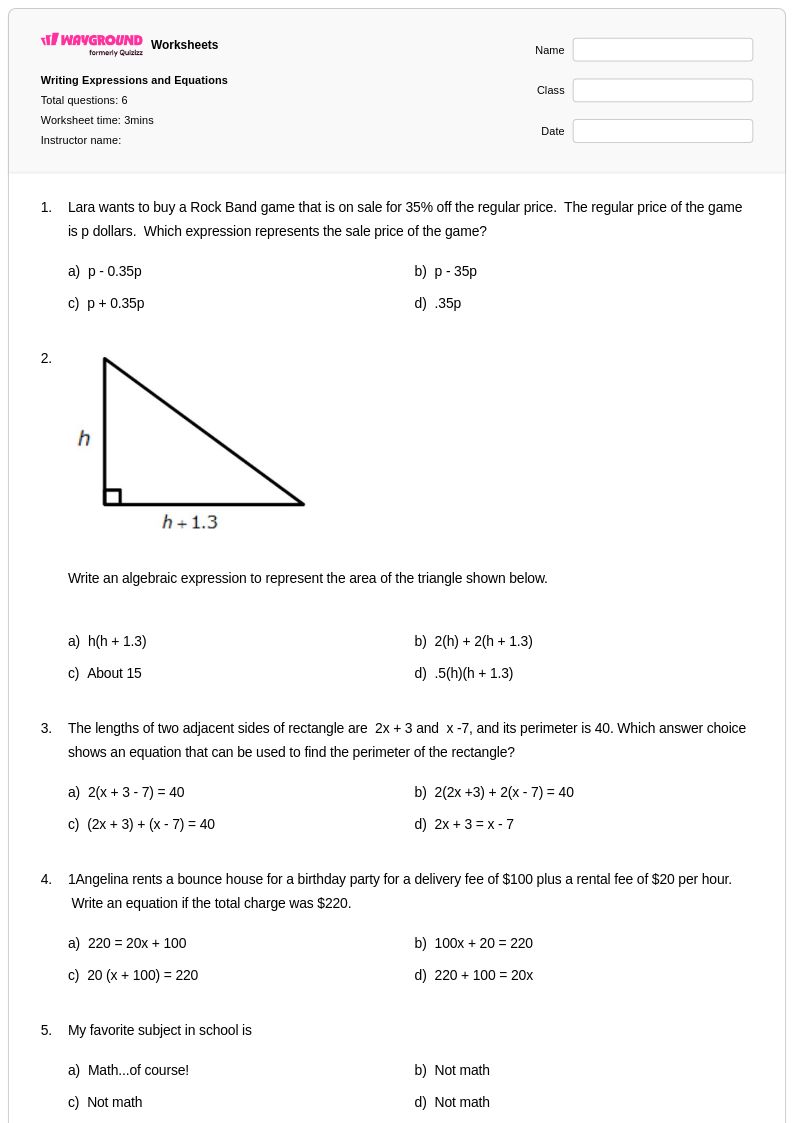
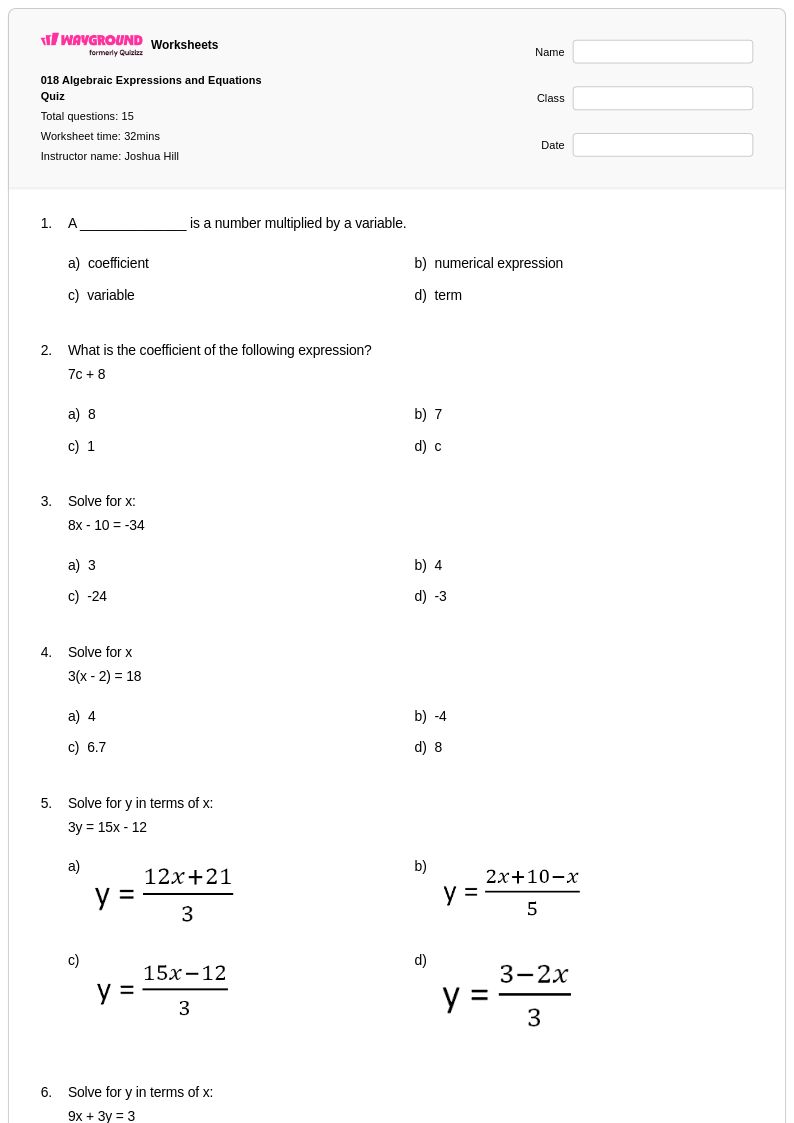
Master algebra expressions and equations with Wayground's comprehensive collection of free worksheets, featuring printable PDFs with practice problems and answer keys to help students build essential algebraic problem-solving skills.
Explore printable Expressions and Equations worksheets
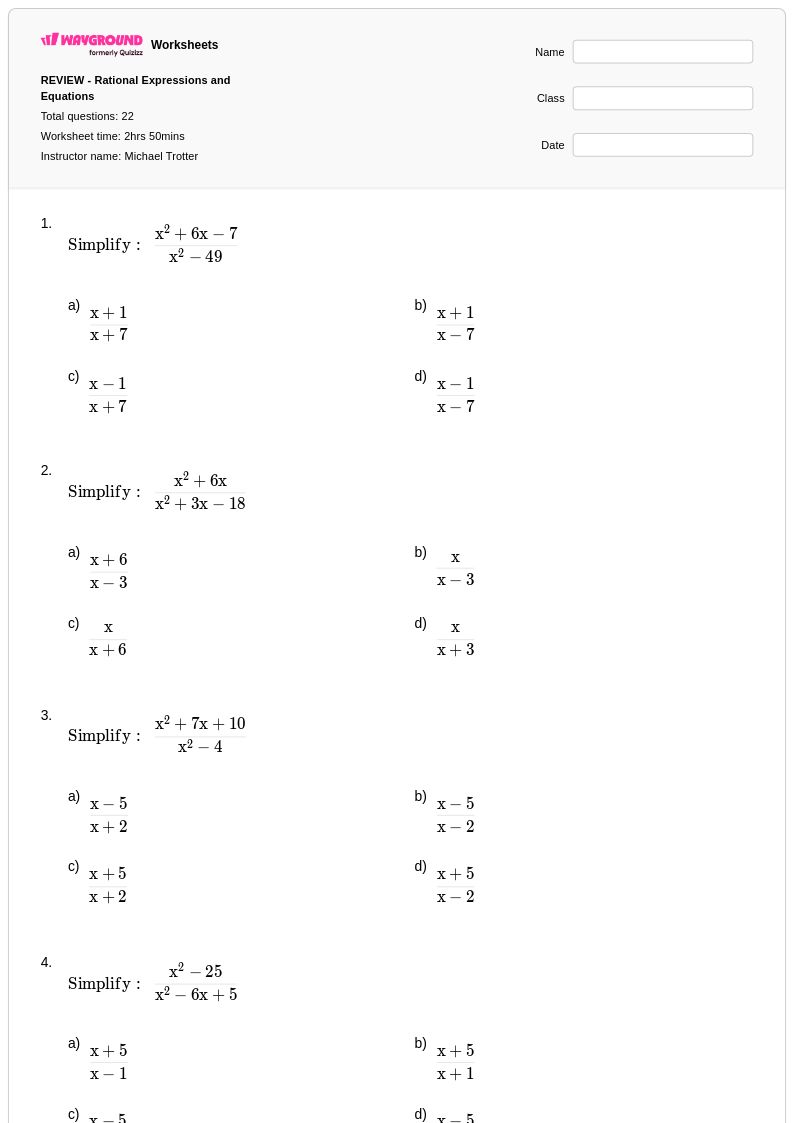
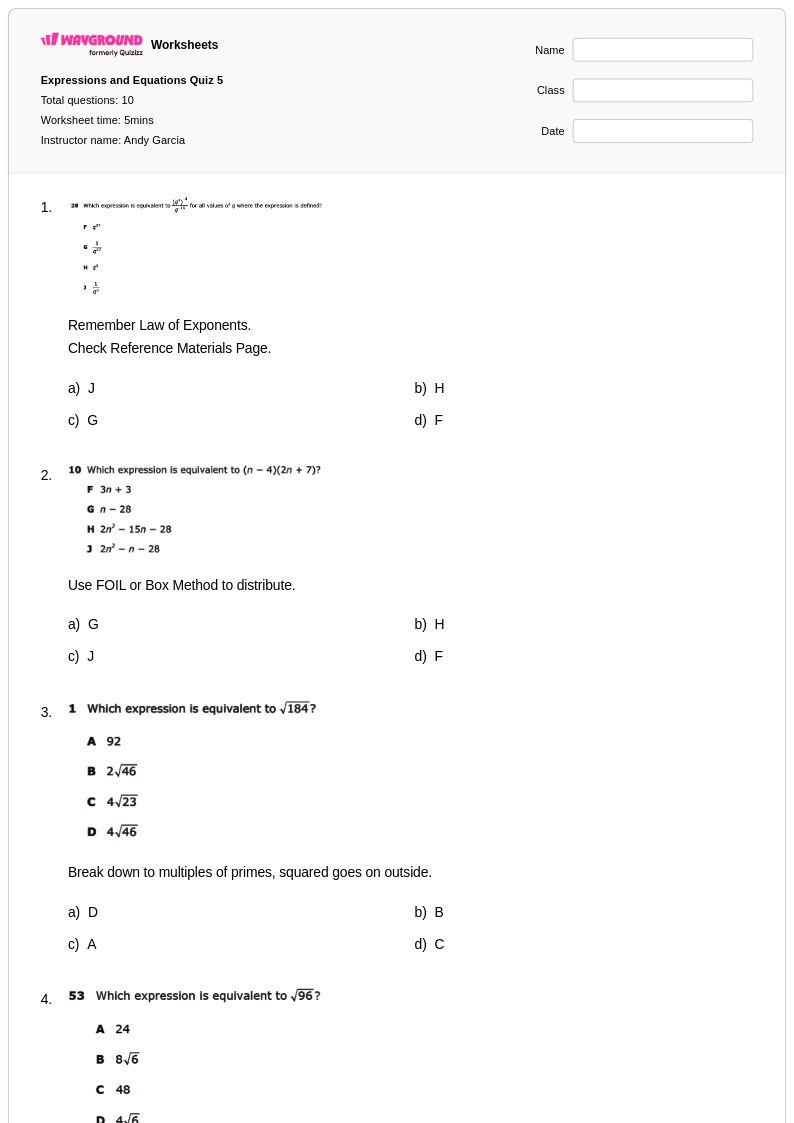
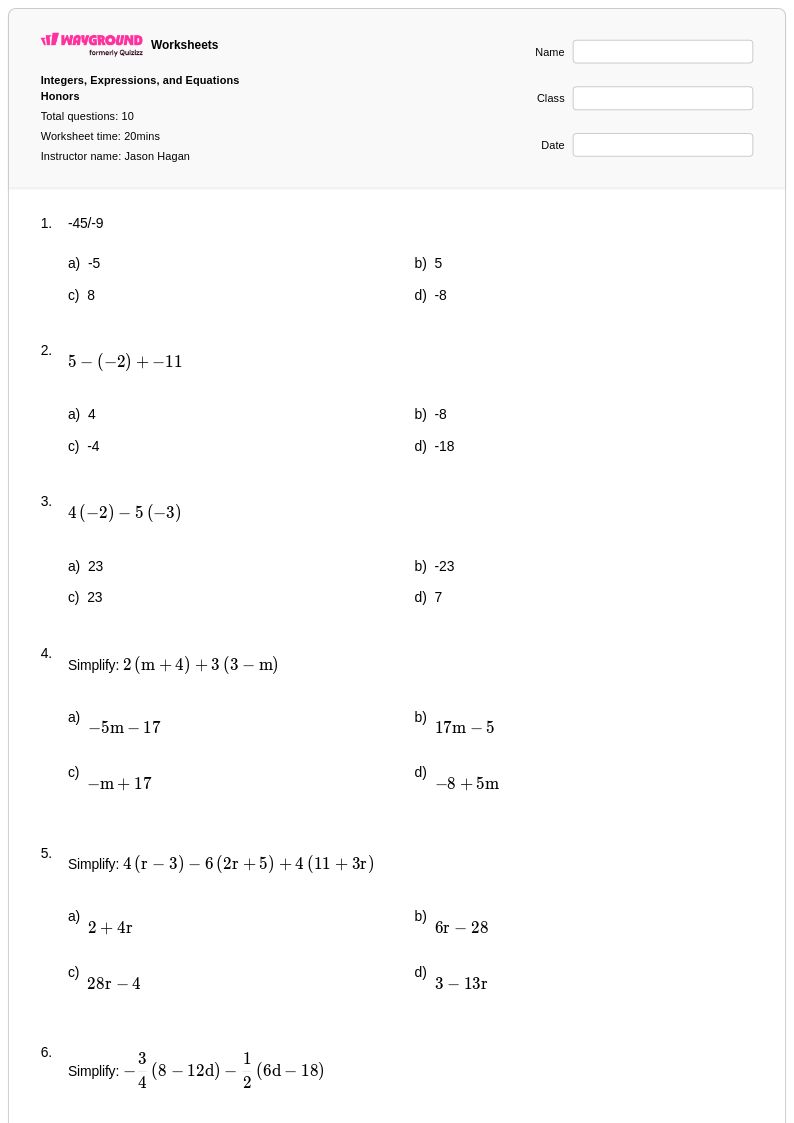
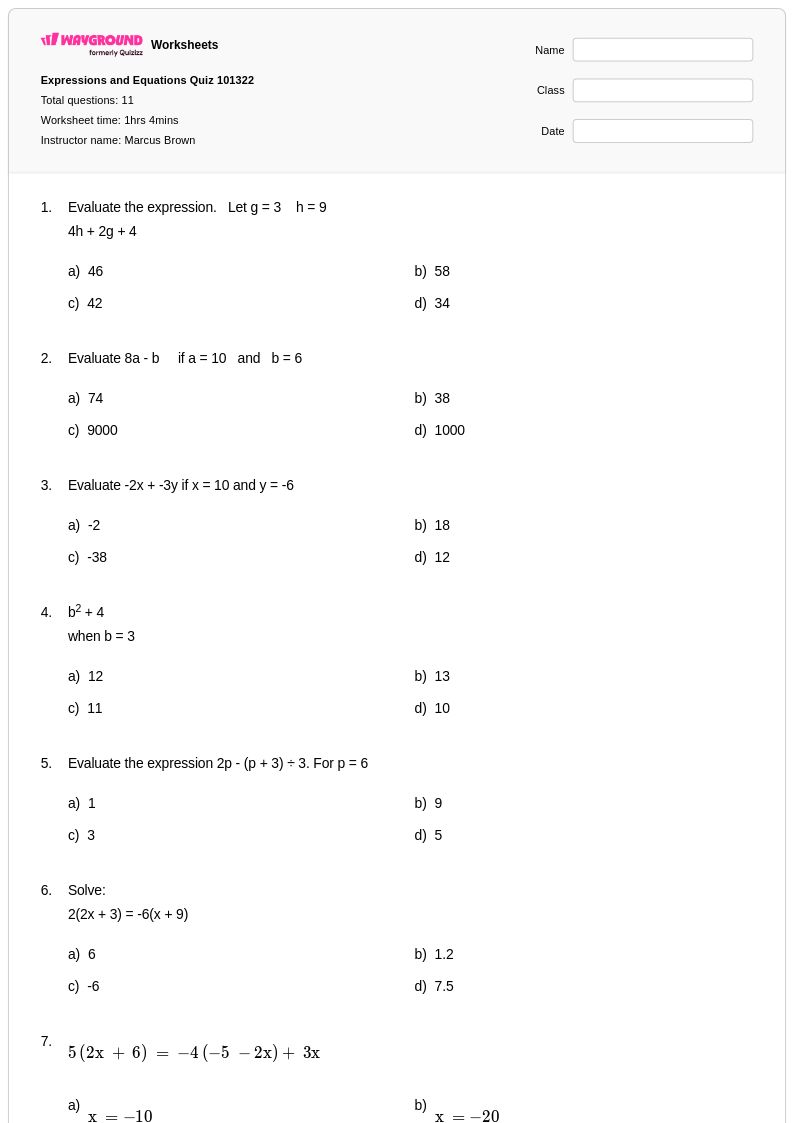
Expressions and equations worksheets available through Wayground (formerly Quizizz) provide comprehensive practice opportunities for students to master fundamental algebraic concepts including simplifying expressions, solving linear equations, and manipulating variables. These carefully designed resources strengthen critical mathematical reasoning skills by guiding students through systematic approaches to algebraic problem-solving, from basic variable substitution to complex multi-step equations. Each worksheet collection includes detailed answer keys and step-by-step solutions that help students identify common errors and reinforce proper algebraic techniques. Teachers can access these free printables in convenient pdf format, making it easy to distribute practice problems for homework assignments, classroom activities, or assessment preparation.
Wayground (formerly Quizizz) empowers educators with millions of teacher-created expressions and equations worksheets that can be easily searched, filtered, and customized to meet specific classroom needs. The platform's robust differentiation tools allow teachers to modify difficulty levels, adjust problem types, and align content with state mathematics standards, ensuring that every student receives appropriate challenge and support. Whether accessed as printable pdf worksheets for traditional paper-and-pencil practice or delivered through interactive digital formats, these resources seamlessly integrate into lesson planning for skill practice, remediation sessions, and enrichment activities. The comprehensive search functionality enables teachers to quickly locate worksheets targeting specific algebraic concepts, from basic expression evaluation to advanced equation-solving techniques, streamlining instructional preparation and maximizing student engagement with essential mathematical content.
FAQs
How do I teach expressions and equations effectively?
Start by making sure students understand what a variable actually represents before they touch an equation. A common entry point: have students write expressions for real situations ('a bag of apples costs $3 each — write an expression for the total cost of n bags') before moving to solving. From there, build toward one-step equations using inverse operations, and only introduce multi-step equations once students can reliably isolate a variable in simpler cases. Keeping expression work and equation work visually distinct early on helps students avoid conflating the two.
What exercises help students practice expressions and equations?
The most effective practice mixes problem types rather than drilling one skill in isolation. Useful exercise formats include: translating verbal phrases into algebraic expressions, evaluating expressions for given variable values, solving one- and two-step equations, and identifying equivalent expressions using the distributive property. Mixing these within a single worksheet session forces students to read each problem carefully rather than pattern-matching to a single procedure.
What mistakes do students commonly make with expressions and equations?
Three errors come up constantly. First, students treat the equals sign as a 'do something' signal rather than a balance relationship, which leads to incorrect inverse operations. Second, they confuse simplifying an expression with solving an equation — trying to 'find x' in an expression that has no equals sign. Third, sign errors when distributing a negative: students will correctly expand 2(x + 3) but write -(x + 3) as -x + 3. Targeted practice on each of these, with worked examples showing the error and the correction side by side, is more effective than general review.
How do I use Wayground's expressions and equations worksheets in my class?
Each worksheet comes with a complete answer key, so it works equally well for independent practice, homework, or in-class review. You can assign it as a digital quiz hosted on Wayground — students complete it on any device and you see results immediately — or download the PDF and print it for paper practice. If you go the print route, the Wayground for Teachers app lets you scan or photograph student submissions to grade them without manual data entry.
How do expressions and equations fit into the Common Core math progression?
Common Core introduces expressions and equations formally in Grade 6, where students move from purely arithmetic thinking to writing and evaluating expressions with variables. Grade 7 extends this to solving multi-step equations and inequalities, and Grade 8 pushes into linear equations in one variable and the beginnings of systems. The through-line is that each grade asks students to do more with the same core idea: a variable stands for an unknown quantity, and an equation is a statement of balance. Students who arrive at Grade 8 without fluency in isolating variables typically struggle with the linear functions work that follows.
How can I differentiate expressions and equations practice for mixed-ability classes?
Wayground lets you create alternate versions of the same worksheet with adjusted font size, wider spacing, or a dyslexia-friendly font — useful when the barrier is readability rather than algebra. For students who need cognitive support, the reduced answer choices accommodation limits the number of options displayed, which helps students who get overwhelmed by multi-step problems before they've built confidence. Students who need more time on equation-solving steps can be given extended time per question individually, while the rest of the class works under default settings.
Is there a difference between an expression and an equation, and why does it matter?
An expression is a mathematical phrase — like 3x + 5 — that represents a value but makes no claim about equality. An equation is a statement that two expressions are equal: 3x + 5 = 11. The distinction matters because you can simplify or evaluate an expression, but you solve an equation. Students who blur this line will attempt to 'solve' expressions or forget that solving an equation requires maintaining balance on both sides — two very different error patterns with different fixes.