Explore printable Hydrocarbons worksheets for Grade 9
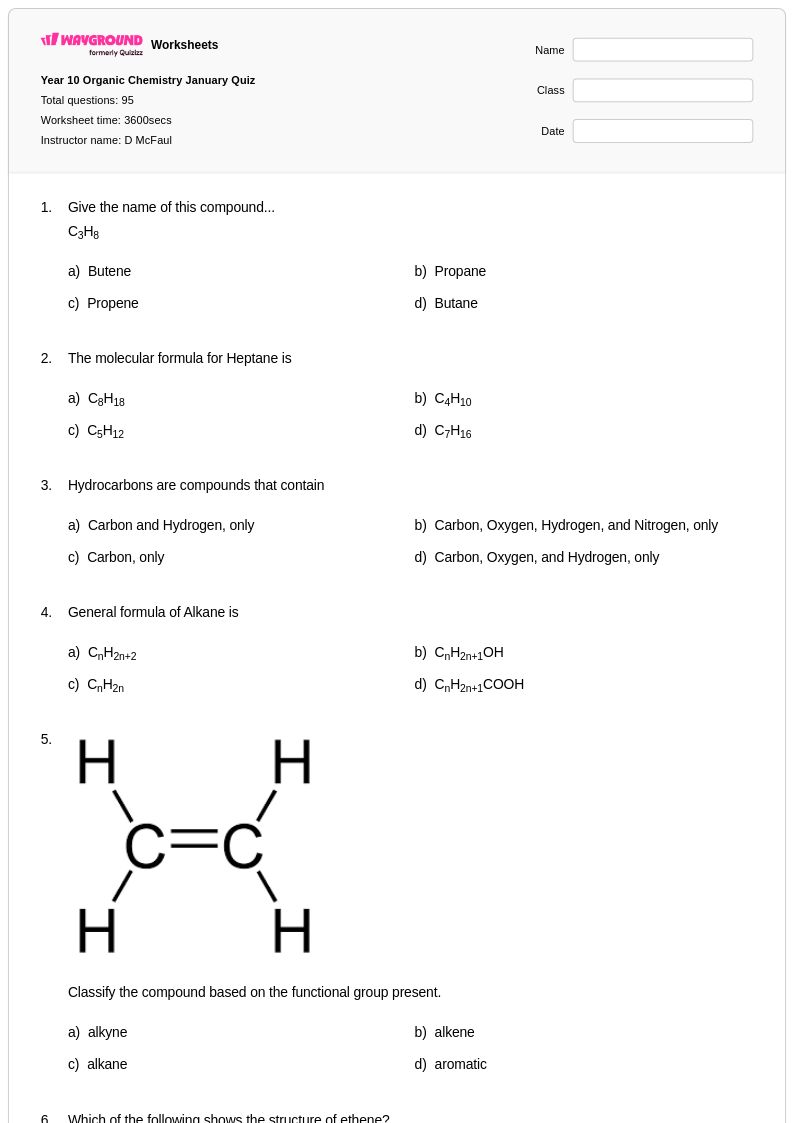
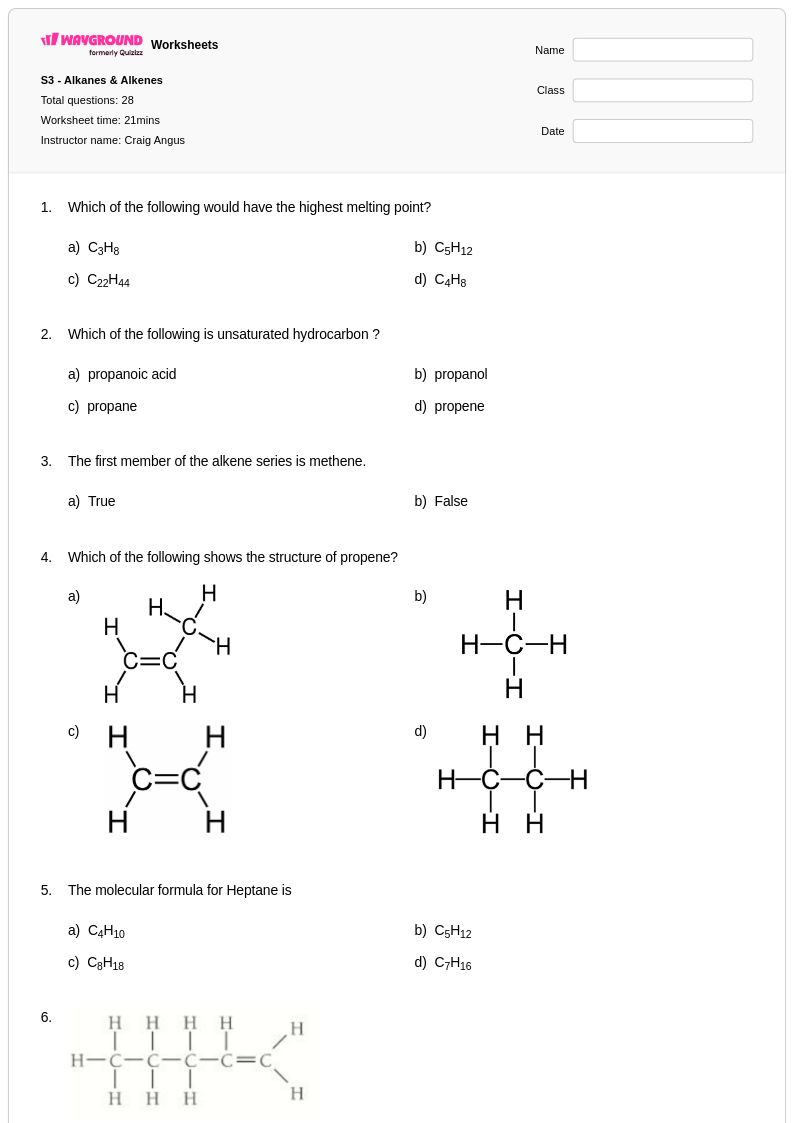
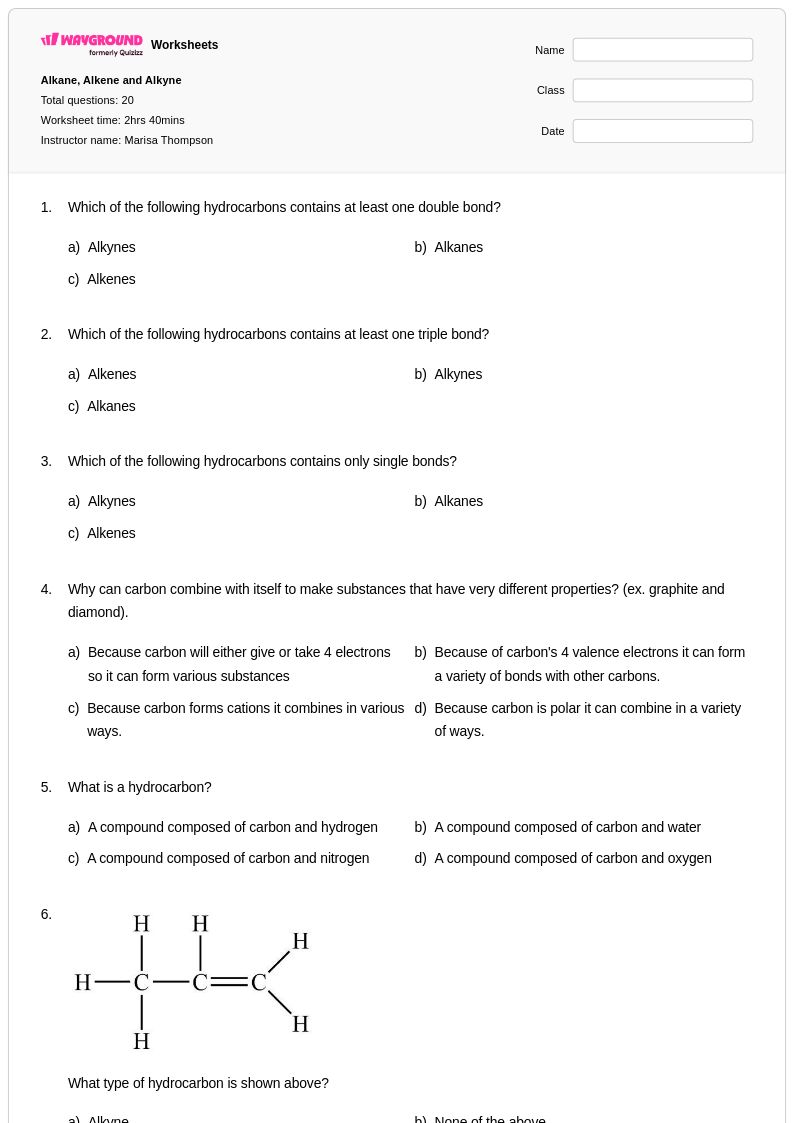
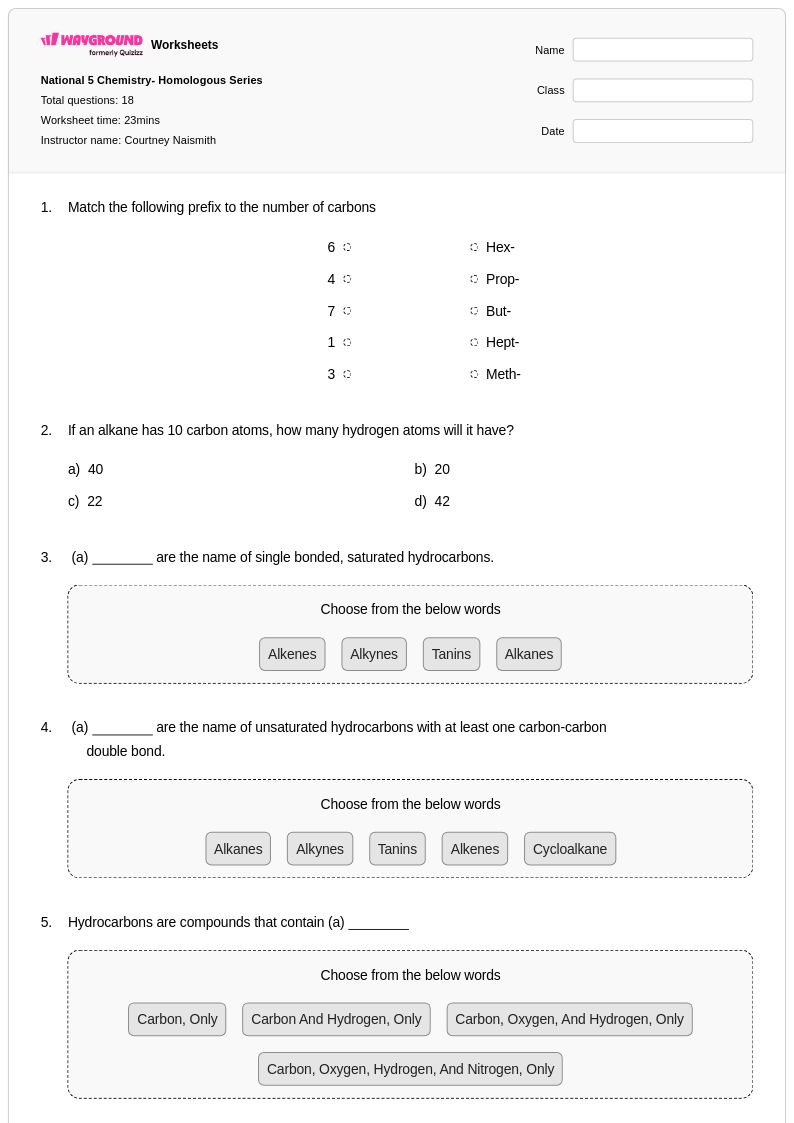
Hydrocarbons worksheets for Grade 9 students available through Wayground (formerly Quizizz) provide comprehensive coverage of organic chemistry fundamentals, focusing on the structure, properties, and classification of carbon-hydrogen compounds. These educational resources strengthen critical skills including molecular formula interpretation, structural drawing of alkanes, alkenes, and alkynes, nomenclature using IUPAC conventions, and understanding of hydrocarbon reactions and applications. Students engage with practice problems that reinforce concepts such as saturated versus unsaturated compounds, isomerism, and the relationship between molecular structure and physical properties. Each worksheet includes detailed answer keys to support independent learning and self-assessment, with free printables available in convenient pdf format to accommodate various classroom needs and homework assignments.
Wayground (formerly Quizizz) empowers educators with an extensive collection of millions of teacher-created hydrocarbon worksheets that align with established chemistry standards and Grade 9 curriculum requirements. The platform's robust search and filtering capabilities enable teachers to quickly locate resources targeting specific hydrocarbon concepts, from basic alkane structures to complex aromatic compounds, while differentiation tools support diverse learning needs within the classroom. These customizable worksheets are available in both printable and digital pdf formats, allowing for seamless integration into lesson planning, targeted remediation for struggling students, and enrichment opportunities for advanced learners. Teachers can efficiently modify content difficulty levels, select specific problem types, and adapt materials to match their instructional timeline, making hydrocarbon skill practice both systematic and personalized for optimal student comprehension and retention.
FAQs
How do I teach hydrocarbons to chemistry students?
Start by building students' understanding of carbon's bonding behavior before introducing the hydrocarbon families in order: alkanes, alkenes, alkynes, and aromatic compounds. Use structural formulas and molecular models to make the differences between single, double, and triple bonds concrete. Once students can distinguish the families, introduce IUPAC nomenclature rules progressively, applying them to increasingly complex molecules. Connecting each family to real-world examples like fuels, plastics, and pharmaceuticals helps students see why hydrocarbons are chemistry's foundational building blocks.
What exercises help students practice hydrocarbon nomenclature?
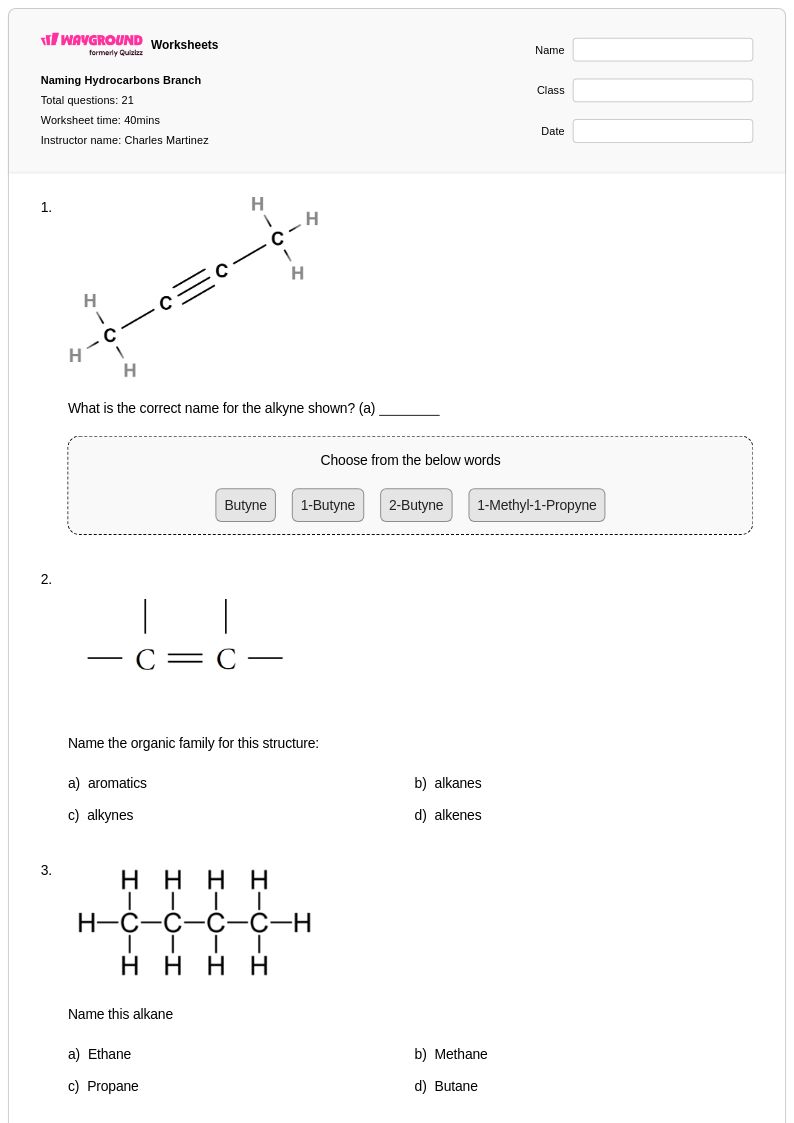
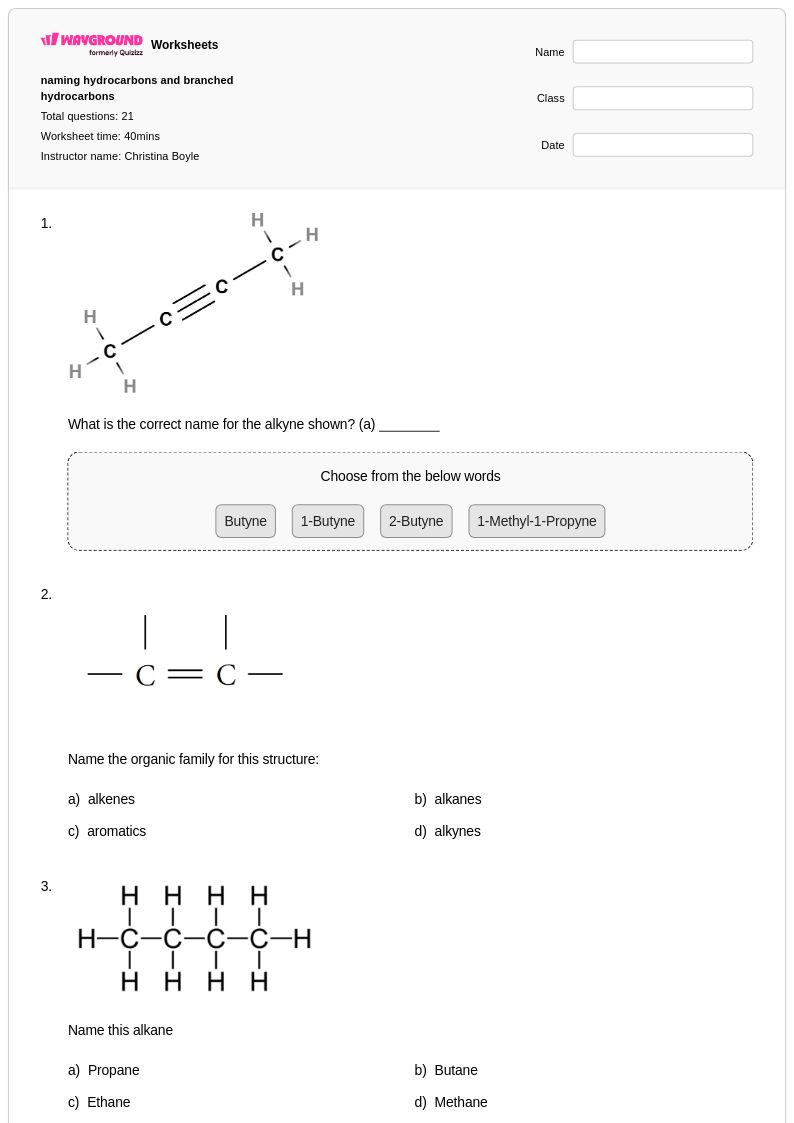
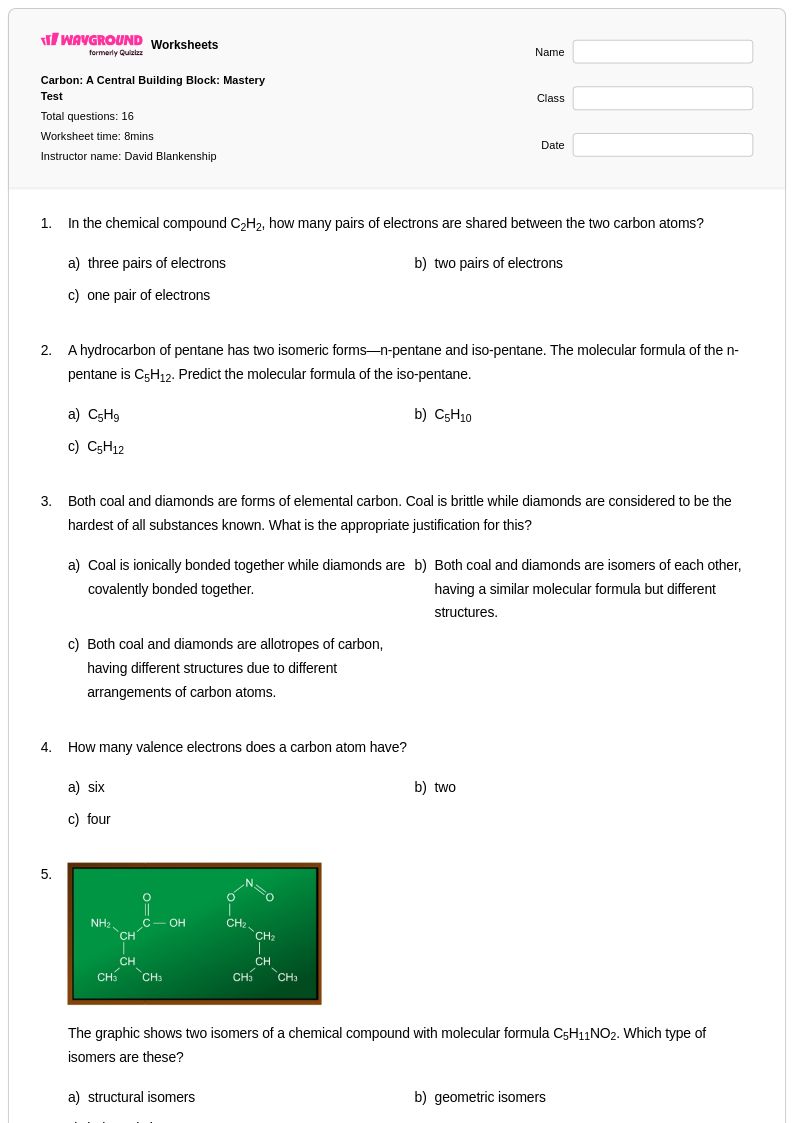
The most effective practice exercises ask students to name structural formulas and draw structures from IUPAC names, working in both directions to reinforce the rules. Isomer identification tasks are especially useful because they require students to apply nomenclature, count carbons systematically, and recognize branching patterns simultaneously. Hydrocarbon worksheets that progress from straight-chain alkanes to branched and cyclic structures give students the scaffolded repetition needed to internalize naming conventions before advancing to alkenes, alkynes, and aromatic rings.
What mistakes do students commonly make when learning about hydrocarbons?
One of the most common errors is confusing the naming rules across hydrocarbon families, particularly misidentifying the parent chain when branches are present or using the wrong suffix for alkenes versus alkynes. Students also frequently draw structurally identical isomers as though they are distinct molecules, failing to recognize when two representations are the same compound. Another persistent mistake is misapplying combustion reaction rules, especially when balancing equations with unsaturated hydrocarbons. Targeted practice identifying and correcting these specific errors during worksheet review can significantly reduce their recurrence on assessments.
How do I use Wayground's hydrocarbon worksheets in my classroom?
Wayground's hydrocarbon worksheets are available as printable PDFs for traditional classroom use and in digital formats for technology-integrated learning environments, making them adaptable for in-class practice, homework, or lab preparation. Teachers can also host worksheets as a quiz directly on Wayground, giving students an interactive experience while automatically collecting response data. Each worksheet includes a complete answer key, which reduces grading time and supports self-paced review. The platform's search and filtering tools make it straightforward to locate materials aligned with specific standards or learning objectives, whether you need a quick warm-up or a full assessment.
How do I differentiate hydrocarbon instruction for students at different skill levels?
For students who are still building foundational skills, start with straight-chain alkane naming before introducing branching, and use reduced answer choices to lower the cognitive load on initial tasks. More advanced students benefit from isomer drawing challenges, reaction mechanism analysis, and problems involving aromatic hydrocarbons. On Wayground, teachers can apply individual accommodations such as extended time, read-aloud support, and reduced answer choices to specific students without disrupting the rest of the class, making it practical to run a single assignment that meets multiple skill levels simultaneously.
What topics should a comprehensive hydrocarbons unit cover?
A thorough hydrocarbons unit should cover the structural and bonding characteristics of alkanes, alkenes, alkynes, and aromatic hydrocarbons, along with IUPAC nomenclature rules for each family. Students should practice identifying and drawing structural isomers, interpreting condensed and line-angle formulas, and predicting the products of combustion reactions. Functional group recognition and an introduction to addition versus substitution reactions round out the unit and prepare students for the broader study of organic chemistry.