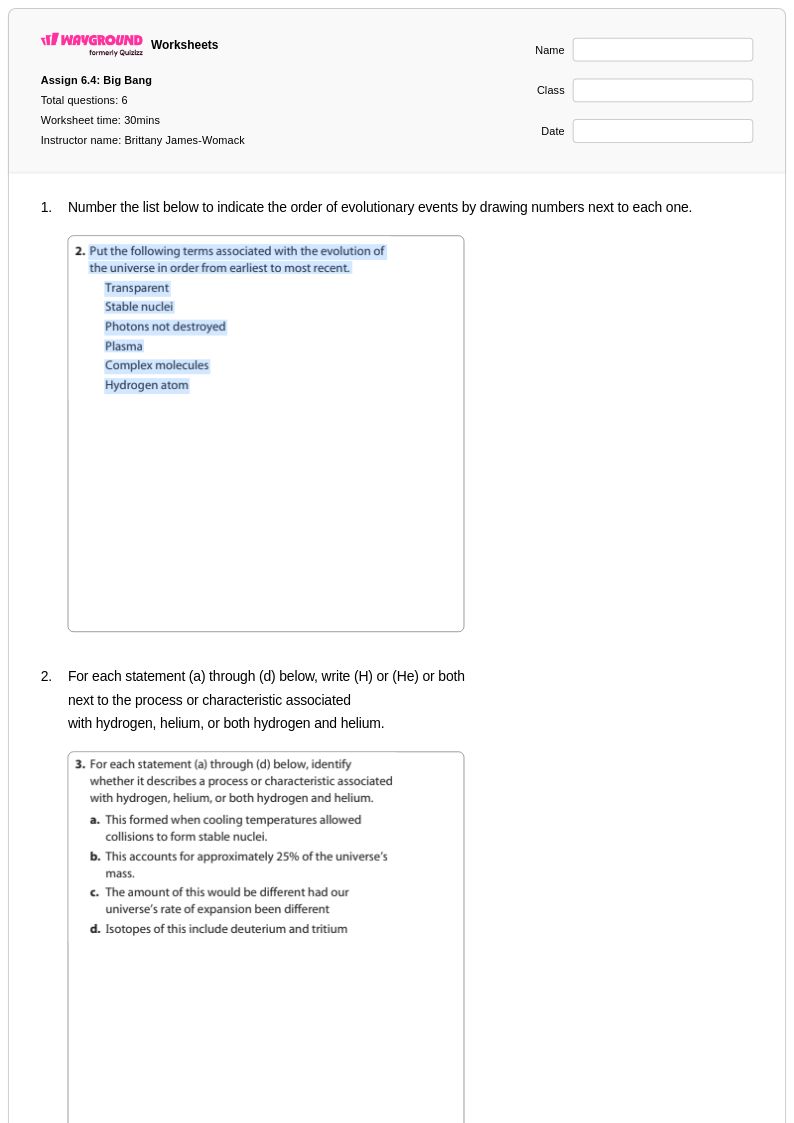
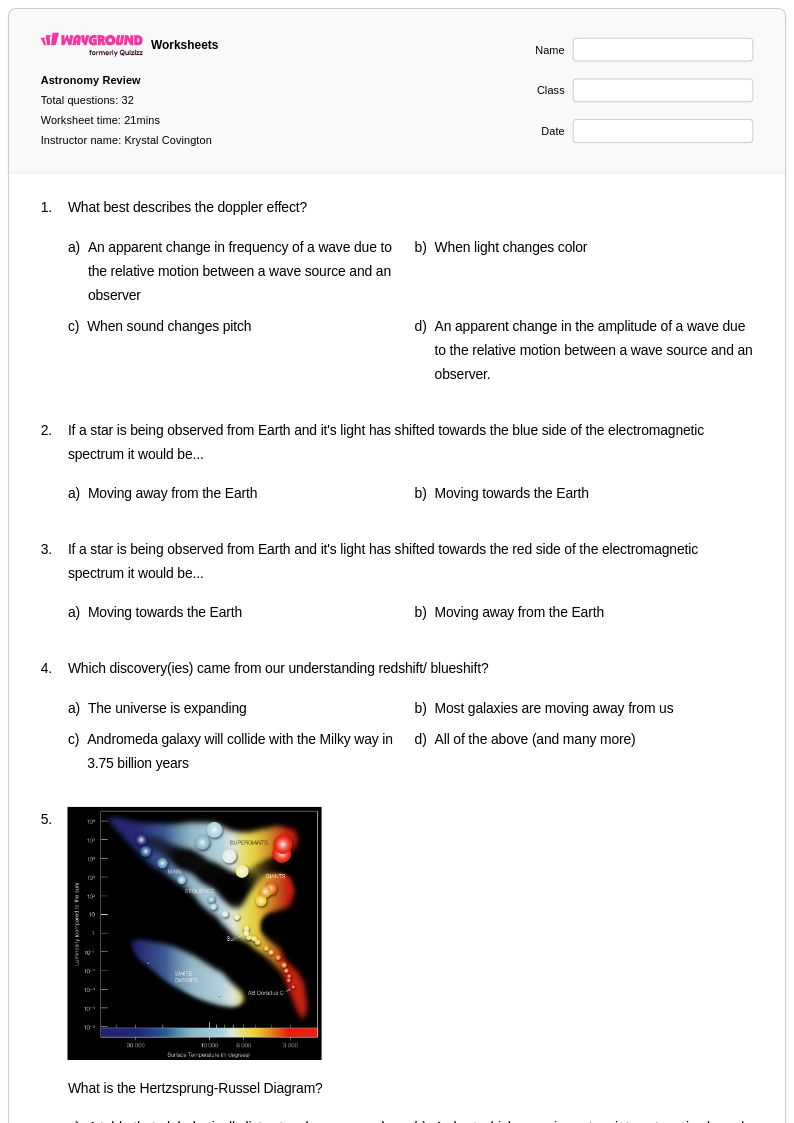
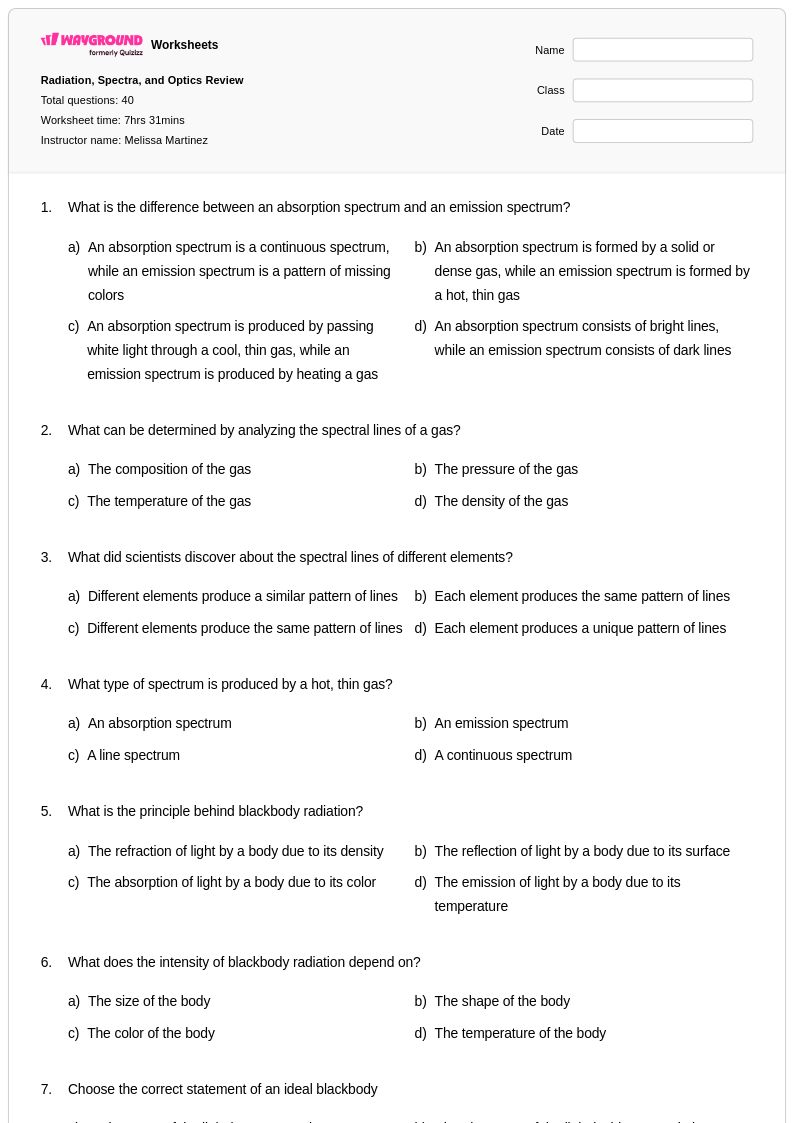
Free Printable Interpreting Spectra Worksheets for Grade 12
Grade 12 chemistry students can master interpreting spectra through Wayground's comprehensive collection of free worksheets, printables, and practice problems with detailed answer keys to develop essential spectroscopic analysis skills.
Explore printable Interpreting Spectra worksheets for Grade 12
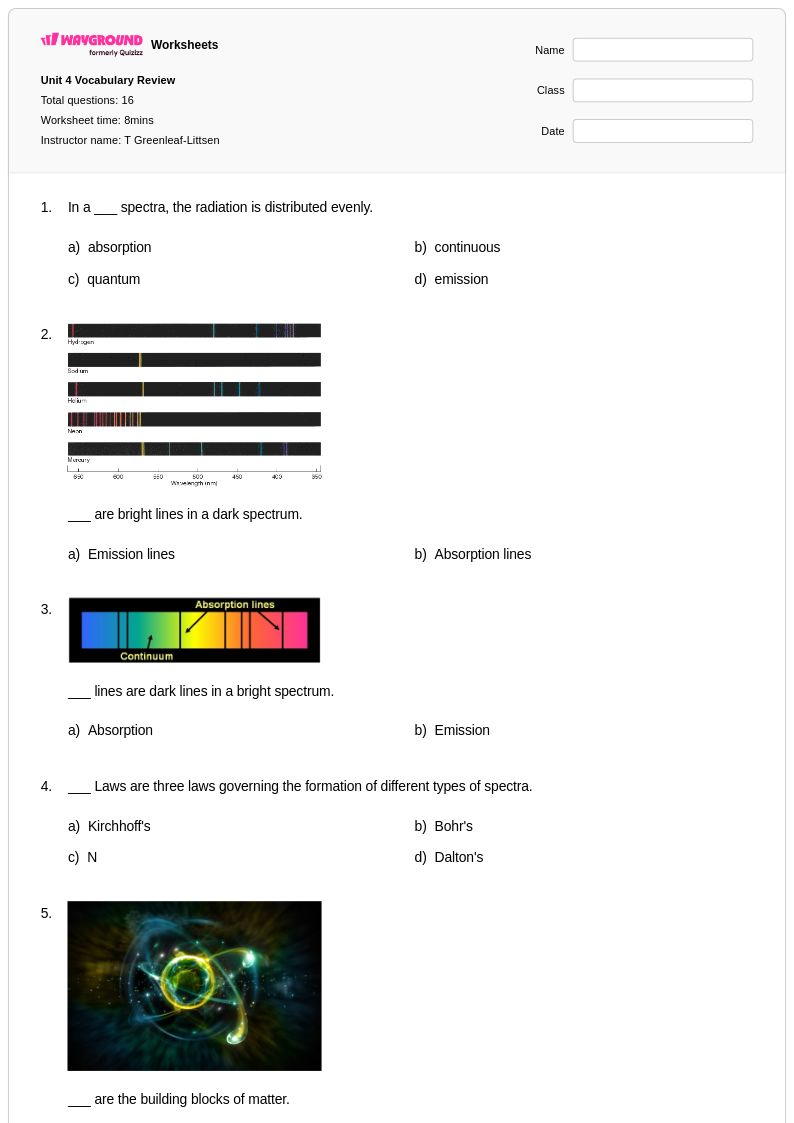
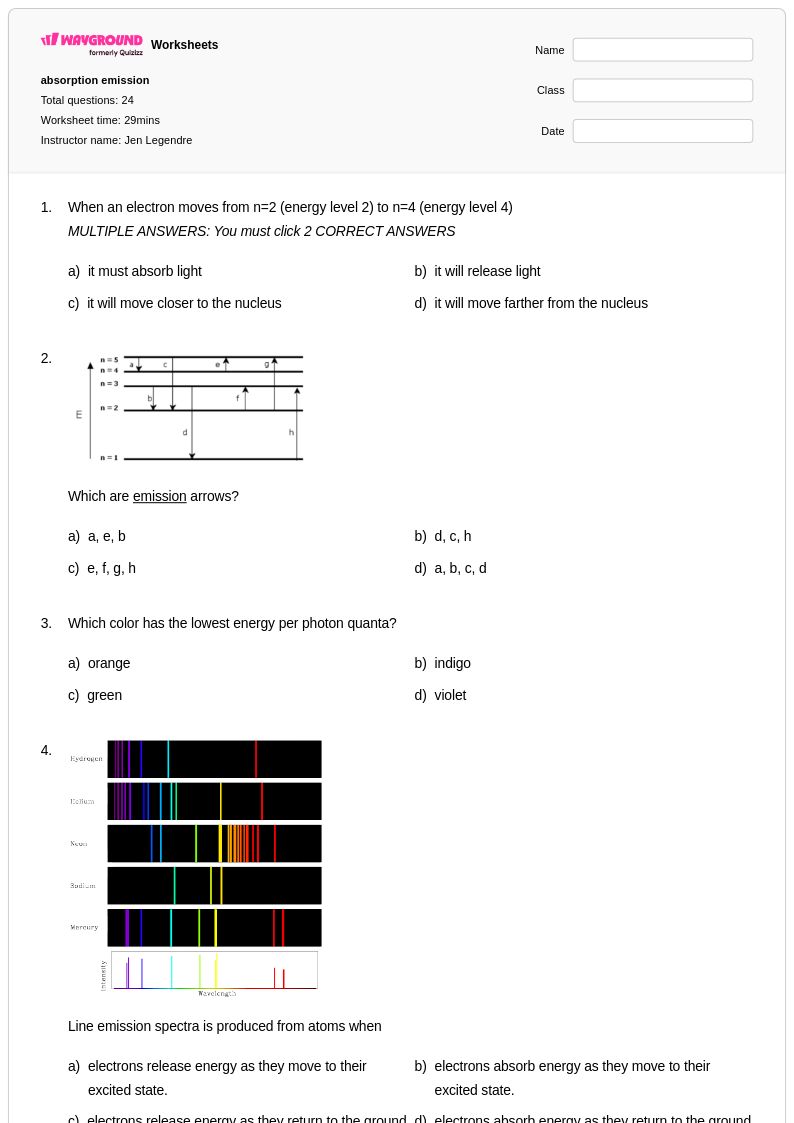
Interpreting spectra worksheets for Grade 12 students available through Wayground (formerly Quizizz) provide comprehensive practice in analyzing and understanding various types of spectroscopic data, including infrared, nuclear magnetic resonance, mass spectrometry, and ultraviolet-visible spectroscopy. These expertly crafted worksheets strengthen critical analytical skills by challenging students to identify functional groups, determine molecular structures, and correlate spectral features with chemical properties. Each worksheet collection includes detailed practice problems that guide students through systematic spectral interpretation, from recognizing characteristic peak patterns to drawing structural conclusions based on multiple spectroscopic techniques. Free printables come complete with answer keys and are available in convenient pdf format, allowing students to develop confidence in this essential analytical chemistry skill set.
Wayground (formerly Quizizz) supports chemistry educators with an extensive library of millions of teacher-created resources specifically designed for spectral interpretation instruction at the Grade 12 level. The platform's robust search and filtering capabilities enable teachers to quickly locate worksheets aligned with specific curriculum standards and learning objectives, whether focusing on individual spectroscopic techniques or integrated multi-spectral analysis problems. Advanced differentiation tools allow educators to customize difficulty levels and problem types to meet diverse student needs, while flexible formatting options provide both printable pdf versions for traditional classroom use and digital formats for online learning environments. These comprehensive worksheet collections facilitate targeted skill practice, enable efficient remediation of challenging concepts, and support enrichment activities for advanced students mastering the complexities of modern analytical chemistry techniques.
FAQs
How do I teach students to interpret infrared spectra?
Start by having students memorize a short list of diagnostic IR absorption regions — carbonyl stretches near 1700 cm⁻¹, broad O-H stretches around 2500–3300 cm⁻¹, and N-H peaks near 3300 cm⁻¹ — before applying them to unknowns. Teach a systematic approach: scan the spectrum from left to right, identify the most prominent peaks first, and eliminate functional groups before confirming candidates. Practice with real or simulated spectra helps students build pattern recognition faster than memorization alone.
What exercises help students practice NMR data interpretation?
Effective NMR practice exercises ask students to extract four pieces of information in sequence: the number of chemically distinct proton environments, chemical shift values, splitting patterns, and integration ratios. Worksheets that present ¹H NMR spectra alongside a molecular formula force students to use degrees of unsaturation as a constraint, which builds the systematic reasoning required for accurate structure determination. Scaffolded problems that start with simple two- or three-peak spectra and gradually increase complexity are particularly effective for building confidence.
What mistakes do students commonly make when interpreting mass spectra?
The most common error is misidentifying the molecular ion peak — students frequently confuse the base peak with M⁺, leading to incorrect molecular weight assignments. Students also struggle to recognize characteristic fragmentation losses such as 15 (CH₃), 29 (CHO or C₂H₅), and 45 (OEt), which are essential for narrowing down structural possibilities. A third common misconception is ignoring the M+1 and M+2 isotope peaks, which provide critical information about the presence of chlorine, bromine, or sulfur in the molecule.
How can I help students connect spectroscopic evidence from multiple techniques to determine an unknown structure?
Train students to use each technique as a filter rather than a solution: MS gives molecular weight and formula, IR confirms or rules out functional groups, and NMR reveals the carbon-hydrogen framework. Worksheets that present IR, MS, and NMR data together for a single unknown — and require students to reconcile all three before proposing a structure — develop the integrative reasoning that real spectral analysis demands. Requiring students to justify each structural decision with a specific spectral feature prevents guessing and reinforces evidence-based reasoning.
How do I use interpreting spectra worksheets in my chemistry class?
Interpreting spectra worksheets on Wayground are available as both printable PDFs and in digital formats, making them suitable for traditional lab-adjacent instruction, homework assignments, or technology-integrated classroom settings. Teachers can host them as a quiz directly on Wayground, enabling students to complete spectral interpretation problems online while teachers monitor responses in real time. The included answer keys explain the reasoning behind each spectral assignment, which makes these worksheets effective for self-paced review and independent study as well as guided classroom practice.
How do I differentiate spectra interpretation practice for students at different skill levels?
For students who are struggling, begin with single-technique problems using highly diagnostic spectra — for example, a carbonyl-containing compound with a clean IR — before introducing multi-technique or ambiguous cases. Advanced students benefit from problems that require them to distinguish between closely related structures, such as constitutional isomers with similar molecular formulas. On Wayground, teachers can apply accommodations such as reduced answer choices or read-aloud support for individual students, and can customize or create differentiated worksheet versions to address remediation and enrichment needs within the same class.

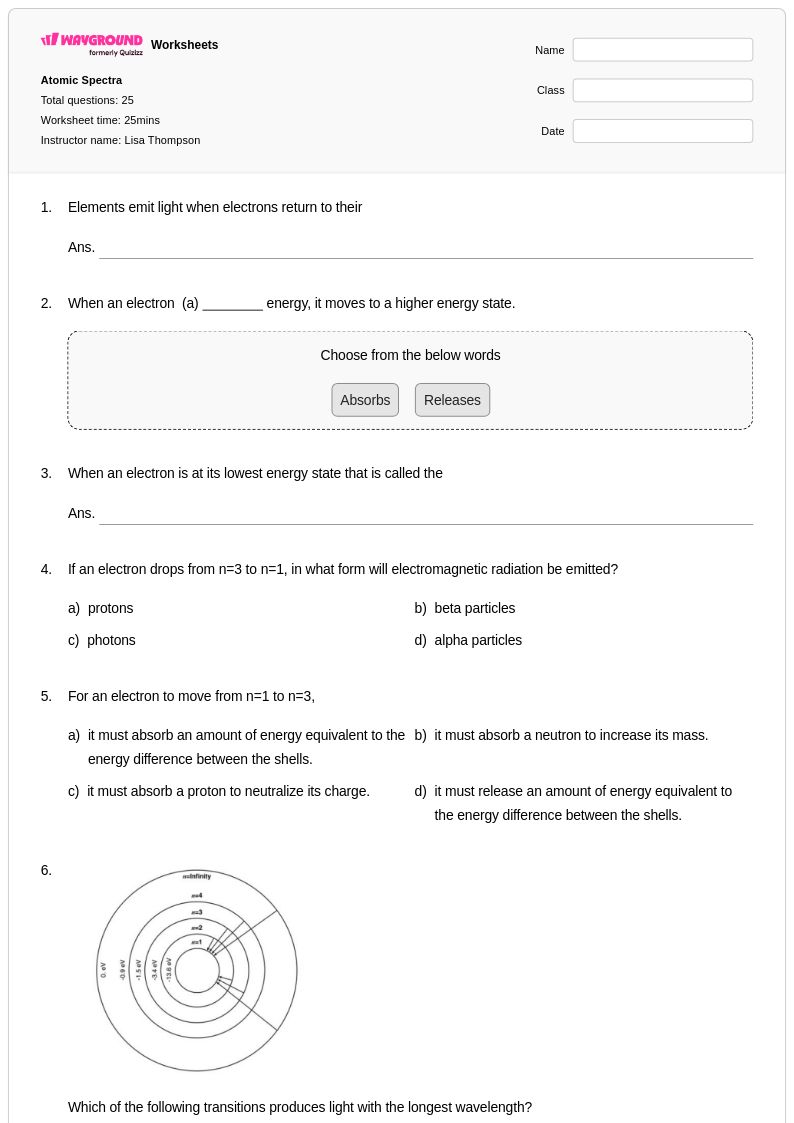
![[ASTRO] Unit 4 Review - Printable Interpreting-spectra Worksheets Grade 12 - Quizizz](https://quizizz-static.s3.amazonaws.com/_media/worksheets-new/624eb99463edd0001d5d6c30-astro-unit-4-review)