Free Printable Mass Spectroscopy Worksheets for Grade 9
Explore Wayground's free Grade 9 mass spectroscopy worksheets and printables that help students master spectral analysis, molecular identification, and isotope detection through comprehensive practice problems with detailed answer keys.
Explore printable Mass Spectroscopy worksheets for Grade 9
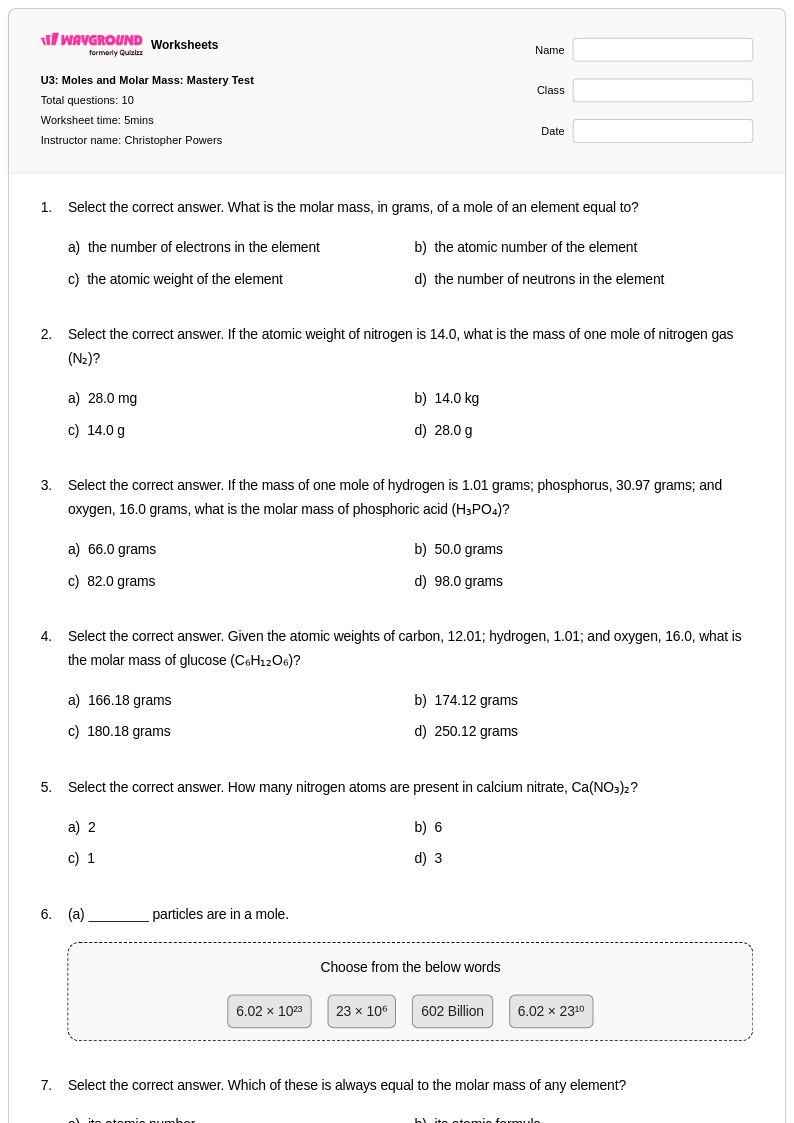
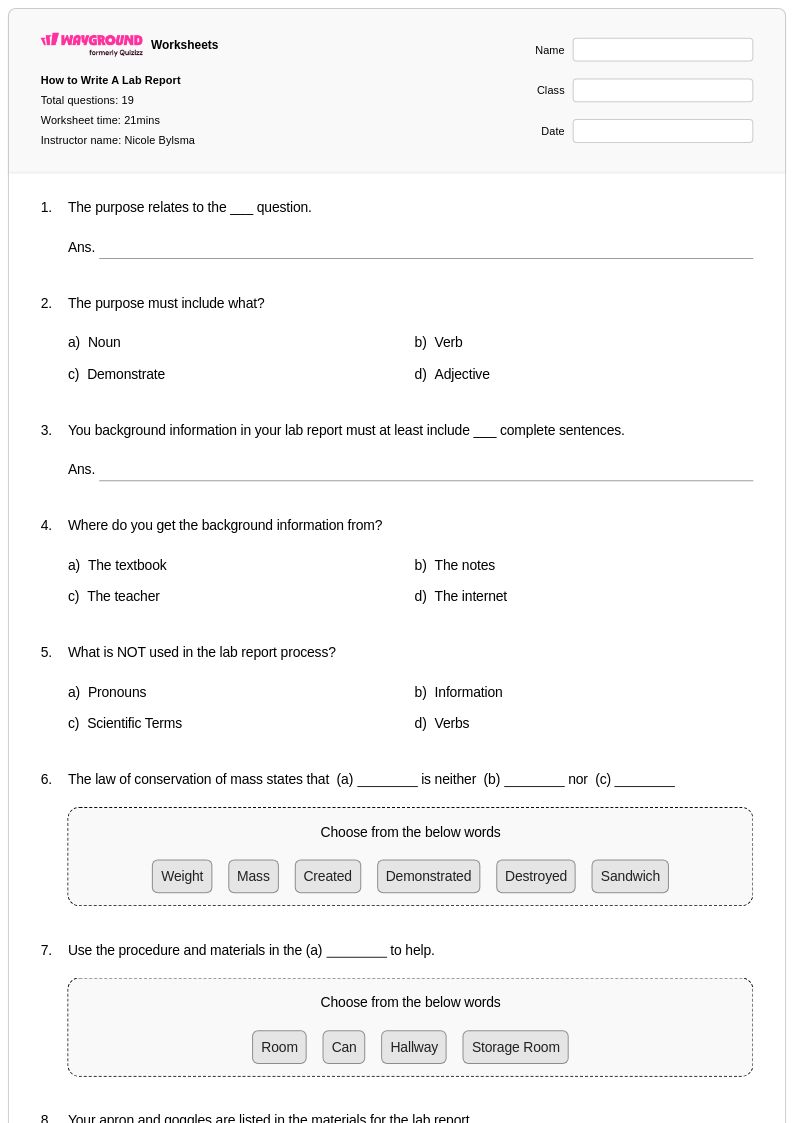
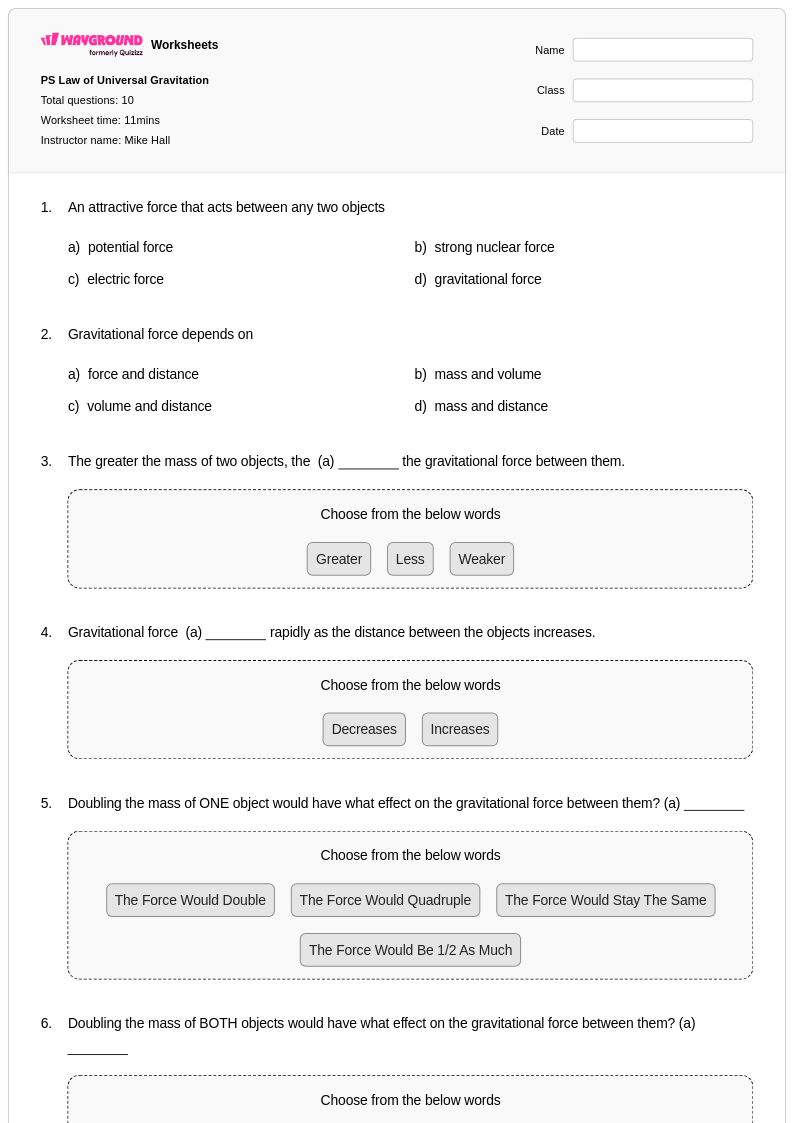
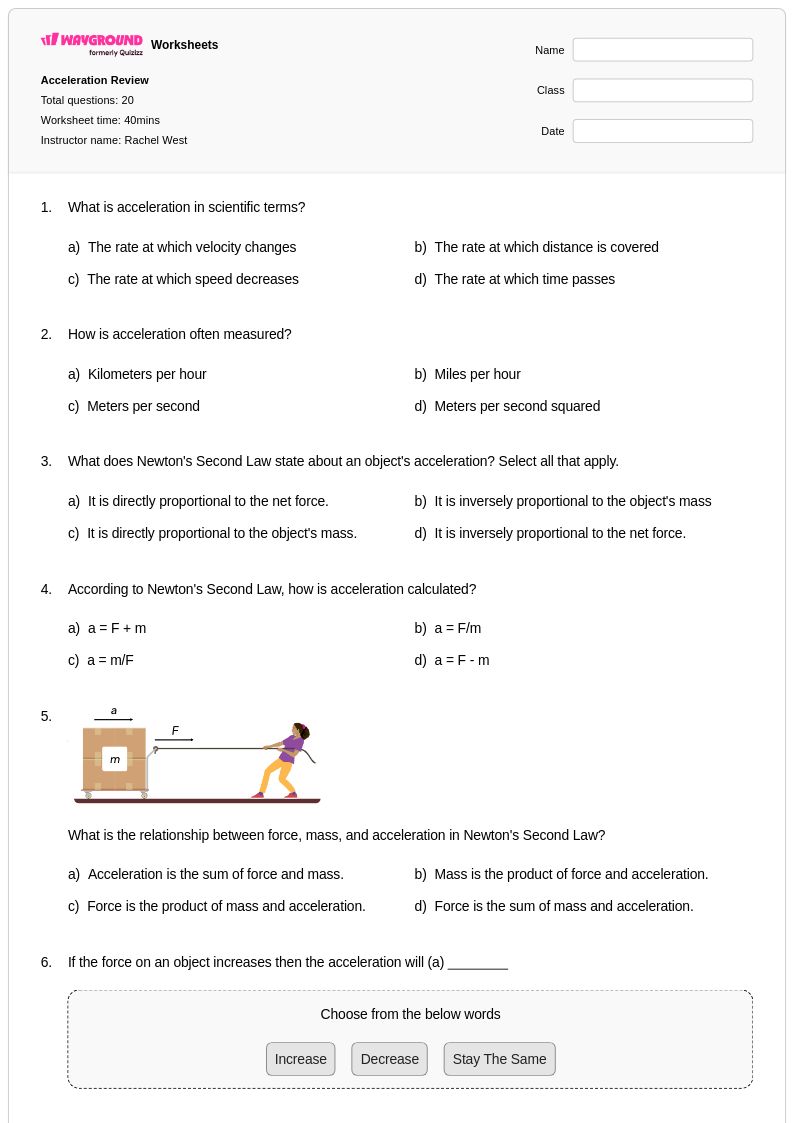
Mass spectroscopy worksheets for Grade 9 students available through Wayground (formerly Quizizz) provide comprehensive coverage of this fundamental analytical technique in chemistry. These educational resources focus on helping students understand how mass spectrometers identify and analyze chemical compounds by measuring the mass-to-charge ratio of ions. The worksheets strengthen critical skills including interpreting mass spectra, identifying molecular fragments, calculating molecular masses, and connecting spectral data to molecular structure. Students work through practice problems that range from basic spectrum reading to more complex molecular identification challenges, with each worksheet including a complete answer key to support independent learning and self-assessment. These free printables serve as essential tools for reinforcing classroom instruction and building confidence in analytical chemistry concepts.
Wayground (formerly Quizizz) supports chemistry educators with an extensive collection of millions of teacher-created mass spectroscopy resources that can be easily searched and filtered by specific learning objectives and difficulty levels. The platform's alignment with educational standards ensures that Grade 9 teachers can quickly locate worksheets that match their curriculum requirements, while differentiation tools allow for seamless customization to meet diverse student needs. These versatile materials are available in both printable pdf format for traditional classroom use and digital formats for interactive learning experiences. Teachers utilize these resources for lesson planning, targeted remediation for struggling students, enrichment activities for advanced learners, and regular skill practice sessions that help students master the interpretation of mass spectral data and develop proficiency in analytical problem-solving techniques essential for advanced chemistry studies.
FAQs
How do I teach mass spectroscopy to chemistry students?
Start by grounding students in the core principle: a mass spectrometer ionizes molecules and separates the resulting fragments by their mass-to-charge (m/z) ratio. Build conceptual understanding before introducing spectral interpretation by walking through the molecular ion peak, base peak, and common fragmentation patterns using real or simplified spectra. Connecting each peak to a structural fragment helps students move from pattern recognition to genuine analytical reasoning.
What practice exercises help students get better at interpreting mass spectra?
The most effective practice involves giving students an unknown mass spectrum and asking them to identify the molecular ion peak, calculate the molecular formula, and explain the fragmentation pattern step by step. Exercises that pair spectra with multiple possible structures and require students to eliminate incorrect options build stronger analytical skills than simple identification tasks. Practice problems that include isotope patterns, such as recognizing chlorine or bromine from M+2 peaks, add an additional layer of rigor.
What mistakes do students commonly make when analyzing mass spectra?
One of the most frequent errors is confusing the base peak with the molecular ion peak — students often assume the tallest peak represents the intact molecule, when in fact the molecular ion peak is typically the highest m/z value. Students also struggle with isotope patterns, particularly failing to recognize that the M+1 and M+2 peaks carry structural information about the number of carbon, chlorine, or bromine atoms present. Requiring students to justify every peak assignment, rather than just circling an answer, helps surface and correct these misconceptions.
How do I differentiate mass spectroscopy worksheets for students at different skill levels?
For students who are newer to spectral analysis, start with spectra that have fewer fragmentation peaks and provide a partial molecular formula as a scaffold. More advanced students can work with complex organic molecules where they must propose fragmentation mechanisms and defend their structural assignments. On Wayground, teachers can apply student-level accommodations such as reduced answer choices or read-aloud support for individual students, while the rest of the class works through standard problems without any disruption to the workflow.
How do I use Wayground's mass spectroscopy worksheets in my classroom?
Wayground's mass spectroscopy worksheets are available as printable PDFs for traditional classroom use and in digital formats for technology-integrated environments, including the option to host them as a quiz directly on Wayground. Printable versions work well for structured lab follow-ups or exam preparation, while the digital format allows for immediate feedback during in-class practice sessions. All worksheets include complete answer keys, making them equally effective for independent student review and teacher-led instruction.
How do I connect mass spectroscopy to other analytical techniques I'm already teaching?
Mass spectroscopy is most powerful when taught alongside infrared (IR) spectroscopy and nuclear magnetic resonance (NMR), as the three techniques provide complementary structural information. A common classroom approach is to present students with a set of spectra from all three methods for a single unknown compound and ask them to build a complete structural argument using all available data. This integrative practice mirrors how analytical chemists actually work and deepens students' understanding of why each technique exists.