Free Printable Resonance Structure Worksheets for Grade 12
Explore Grade 12 resonance structure worksheets and printables that help students master Lewis structures, electron delocalization, and formal charge calculations through comprehensive practice problems with detailed answer keys.
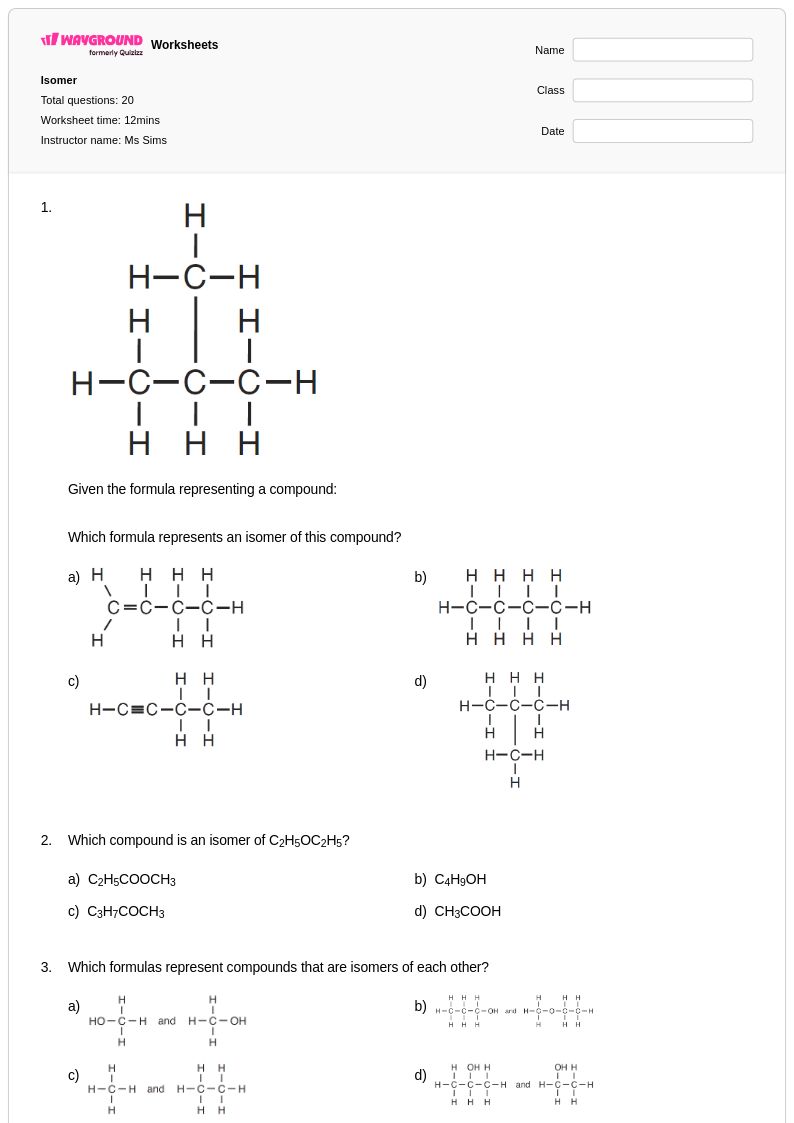
Explore printable Resonance Structure worksheets for Grade 12
Resonance structure worksheets for Grade 12 chemistry students available through Wayground (formerly Quizizz) provide comprehensive practice with one of organic chemistry's most fundamental concepts. These expertly designed worksheets guide students through the process of drawing multiple valid Lewis structures for molecules and ions where electron delocalization occurs, strengthening their understanding of how electrons are distributed across molecular frameworks. Students work through systematic practice problems that cover resonance in aromatic compounds, polyatomic ions, and complex organic molecules, with each worksheet including detailed answer keys that explain the step-by-step reasoning behind proper resonance structure formation. The free printable materials in pdf format allow students to master the rules governing formal charge calculations, electron movement arrows, and the identification of major versus minor resonance contributors.
Wayground (formerly Quizizz) supports chemistry educators with millions of teacher-created resonance structure resources that can be easily searched and filtered by specific learning objectives and difficulty levels. The platform's alignment with chemistry standards ensures that worksheets address key competencies including molecular stability prediction, bond order determination, and the relationship between resonance and molecular properties. Teachers can customize these digital and printable materials to differentiate instruction for diverse learners, incorporating additional scaffolding for students who need extra support with electron counting or creating enrichment activities that explore advanced topics like resonance energy calculations. This flexibility makes the worksheet collections invaluable for lesson planning, targeted skill remediation, and providing multiple practice opportunities that help students develop fluency in predicting and drawing accurate resonance structures across various chemical contexts.
FAQs
How do I teach resonance structures to chemistry students?
Start by ensuring students have a firm grasp of Lewis structures and formal charge before introducing resonance. Teach the concept that resonance structures are not real, interconverting forms but rather a human tool for representing delocalized electron density that cannot be captured by a single structure. Using the carbonate ion or ozone as introductory examples helps students see symmetry-driven delocalization before moving into asymmetric cases like nitrate or organic systems like benzene.
What exercises help students practice drawing resonance structures?
The most effective practice combines drawing tasks with evaluation tasks. Have students draw all valid resonance contributors for a given molecule, then rank them by stability using formal charge rules. Follow-up exercises that ask students to identify which structures are equivalent, which are minor contributors, and why stabilization occurs build the analytical reasoning that multiple-choice problems alone cannot develop.
What mistakes do students commonly make when drawing resonance structures?
The most frequent error is moving atoms rather than only electrons between resonance forms, which violates the foundational rule of resonance. Students also commonly misassign formal charges, especially on nitrogen and oxygen, or fail to recognize that a lone pair adjacent to a pi bond can participate in delocalization. Another persistent misconception is treating resonance structures as distinct molecules that exist in equilibrium rather than as mental models of a single, averaged electronic state.
How do I help students determine which resonance structure is most stable?
Teach students to apply formal charge rules systematically: structures with minimal formal charges are more stable, negative formal charges should reside on more electronegative atoms, and structures with adjacent like charges are destabilized. Practicing these criteria on a ranked set of resonance contributors for the same molecule, rather than isolated examples, helps students internalize the hierarchy. Carbonate, nitrite, and acetate are strong teaching cases because they offer clear comparisons between equivalent and non-equivalent contributors.
How do I use Wayground's resonance structure worksheets in my classroom?
Wayground's resonance structure worksheets are available as printable PDFs for traditional classroom use and in digital formats for technology-integrated or remote learning environments, and can also be hosted as a quiz directly on Wayground. Each worksheet includes a complete answer key, so students can self-check their work and teachers can use them efficiently for guided practice, independent review, or targeted remediation. The digital format supports Wayground's built-in accommodation tools, such as read aloud and extended time, which can be assigned to individual students without disrupting the rest of the class.
How do resonance structures connect to organic chemistry topics?
Resonance stabilization is foundational to understanding reactivity patterns throughout organic chemistry, including the acidity of carboxylic acids, the electrophilicity of carbonyl carbons, and the regioselectivity of electrophilic aromatic substitution. Students who struggle with resonance early tend to find reaction mechanisms in later units significantly harder because many mechanistic steps involve electron movement that is only predictable if students understand which sites are electron-rich or electron-poor due to delocalization. Establishing resonance fluency early is one of the highest-leverage investments in a chemistry course.