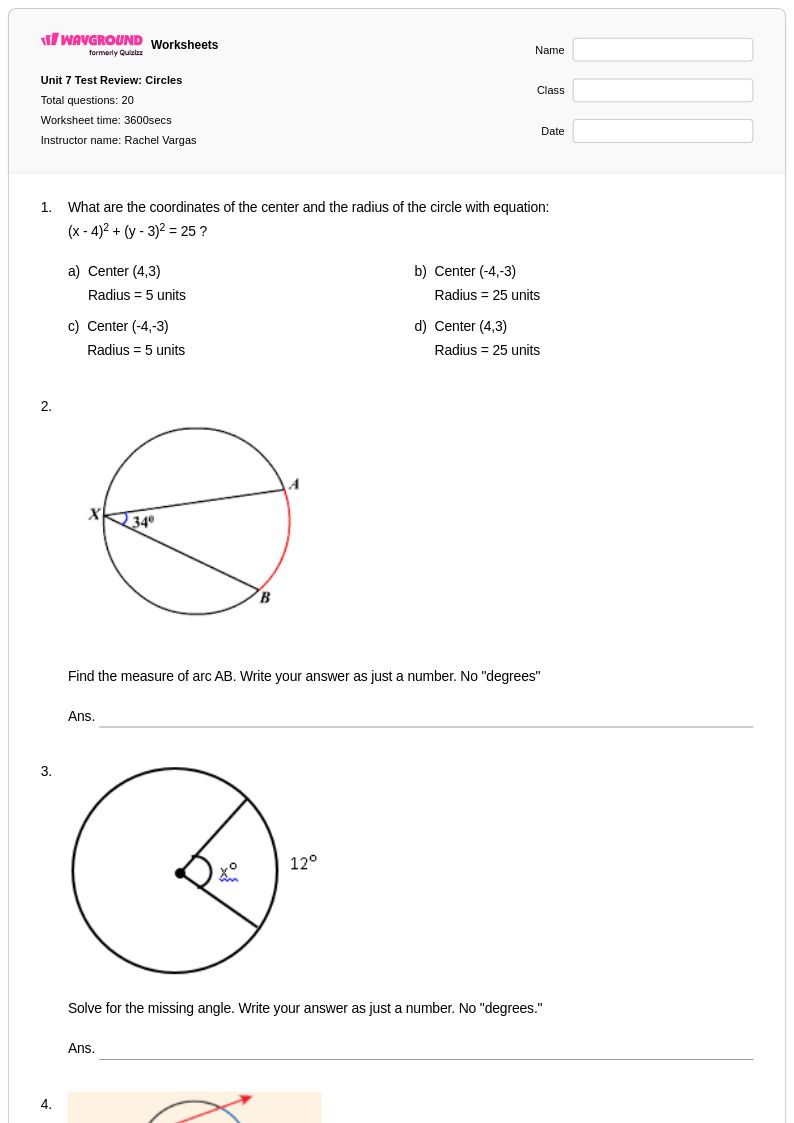
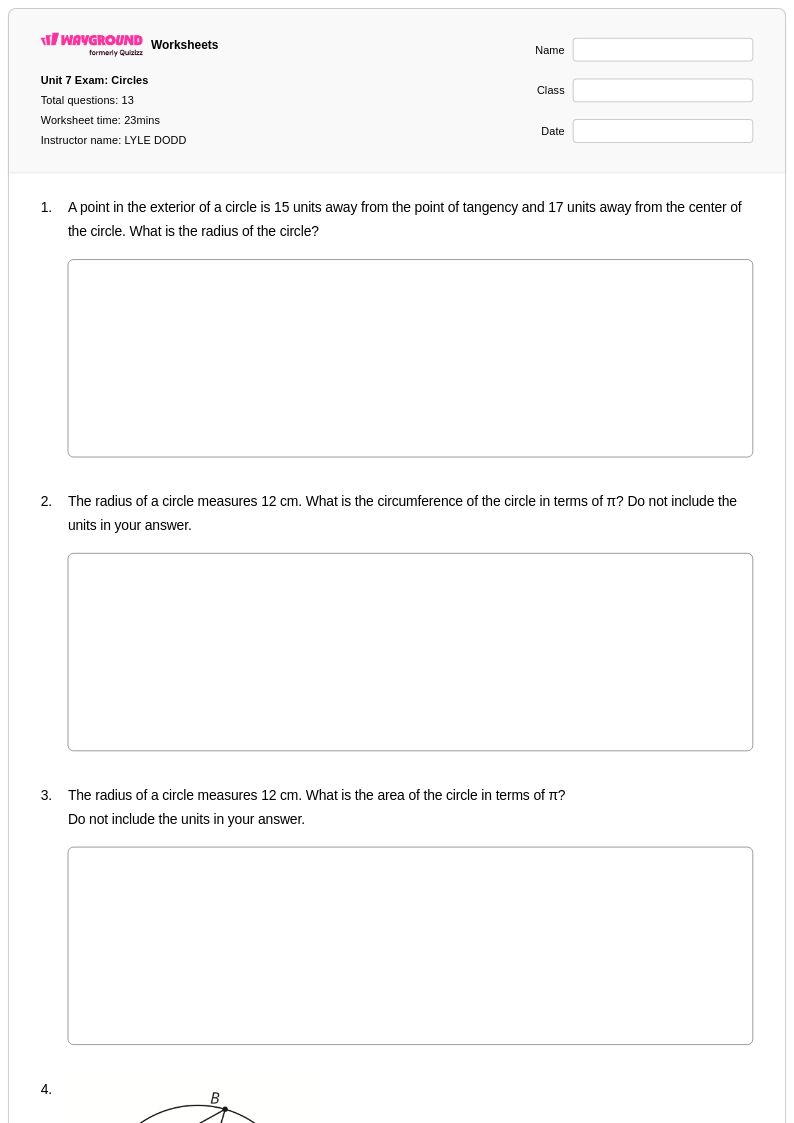
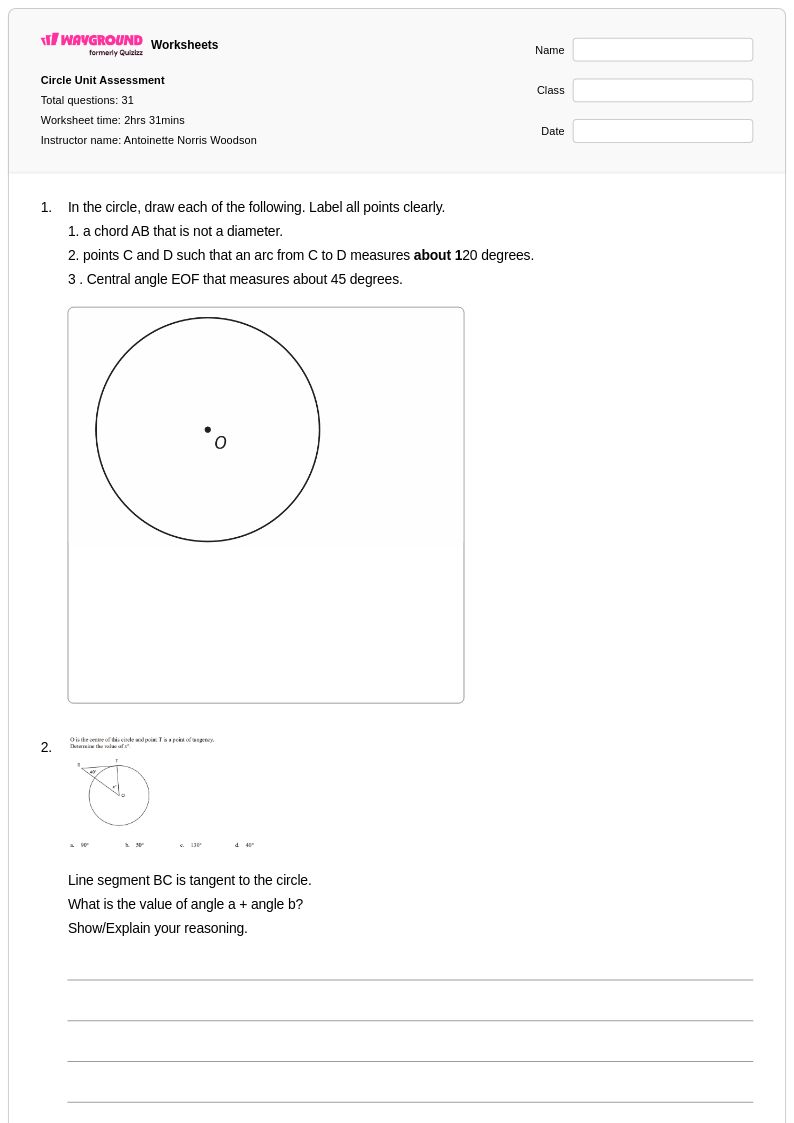
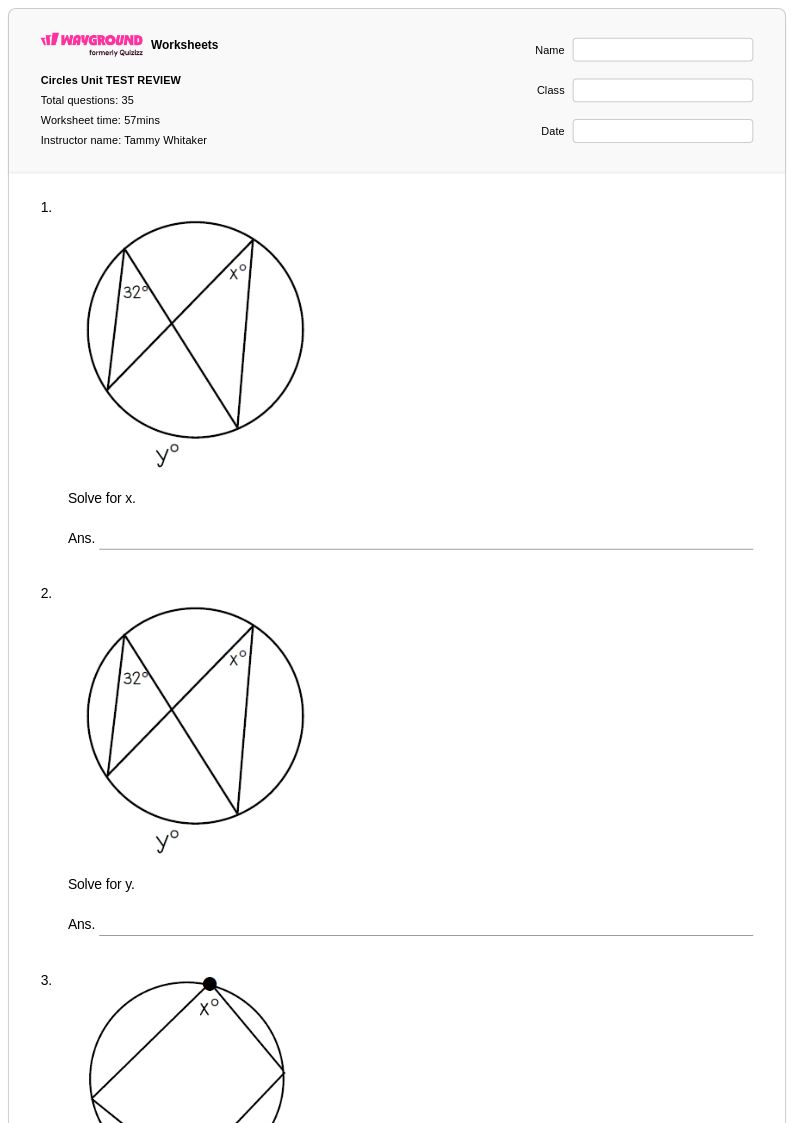
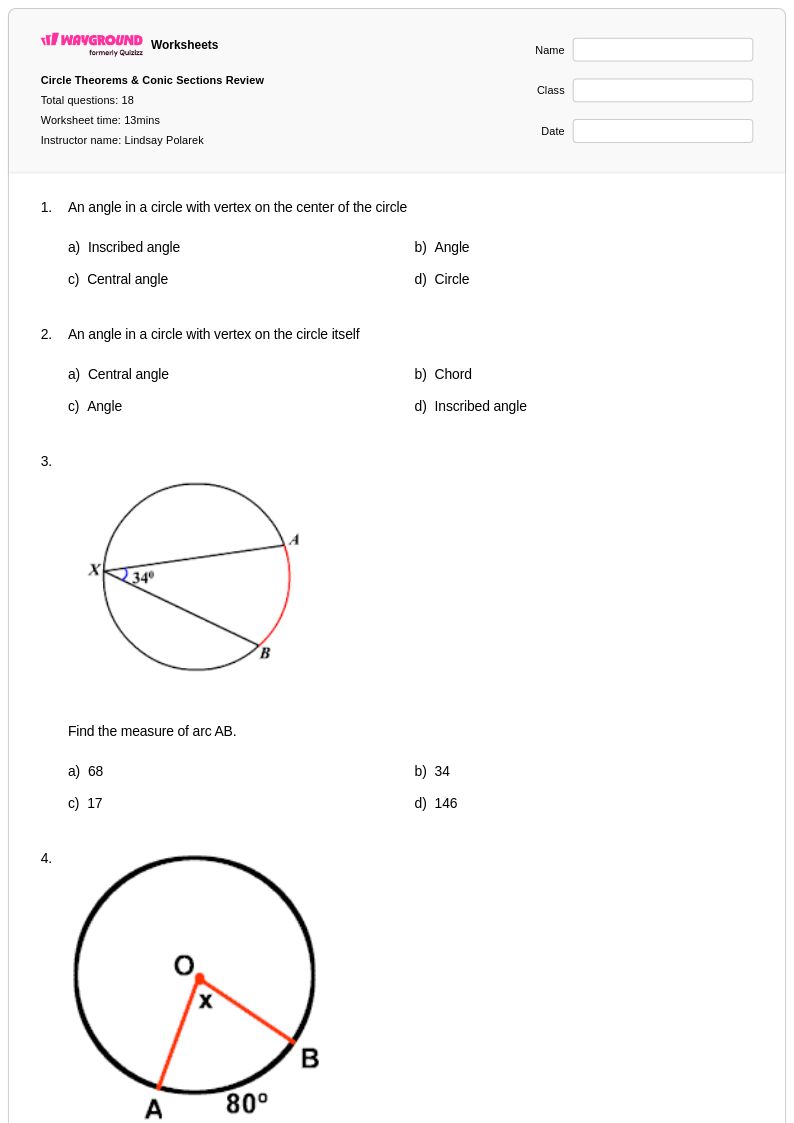
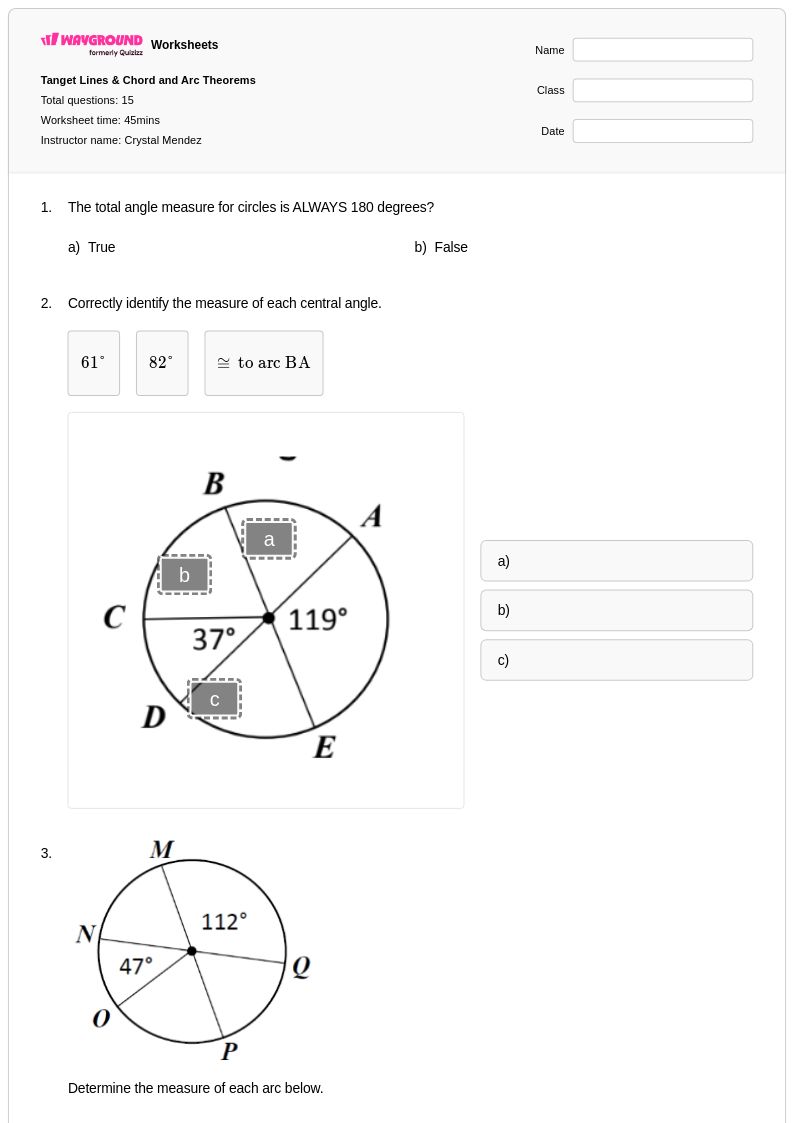
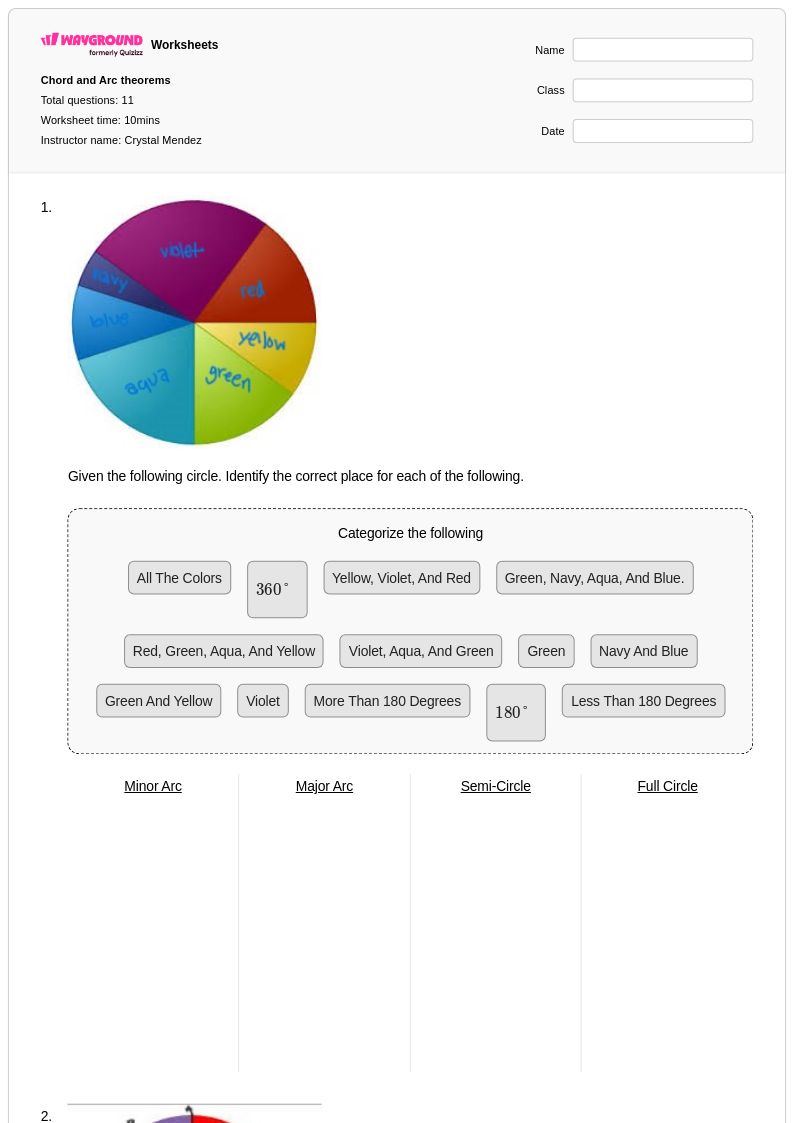
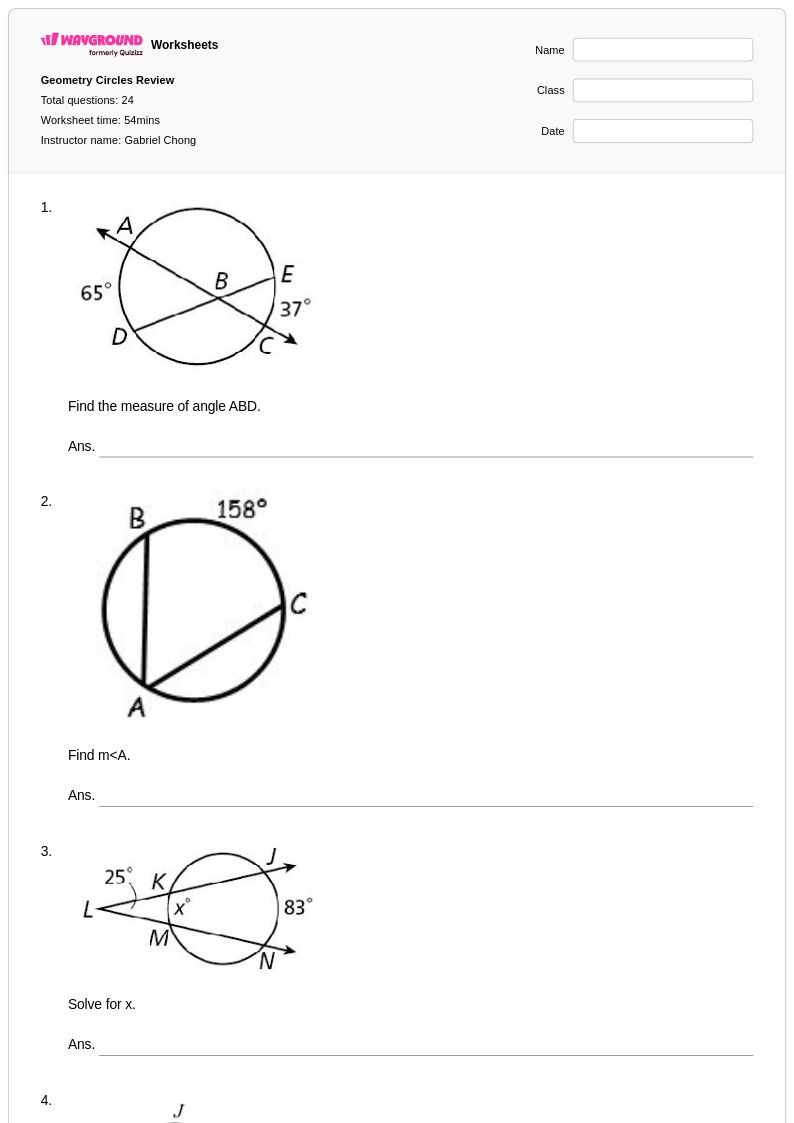
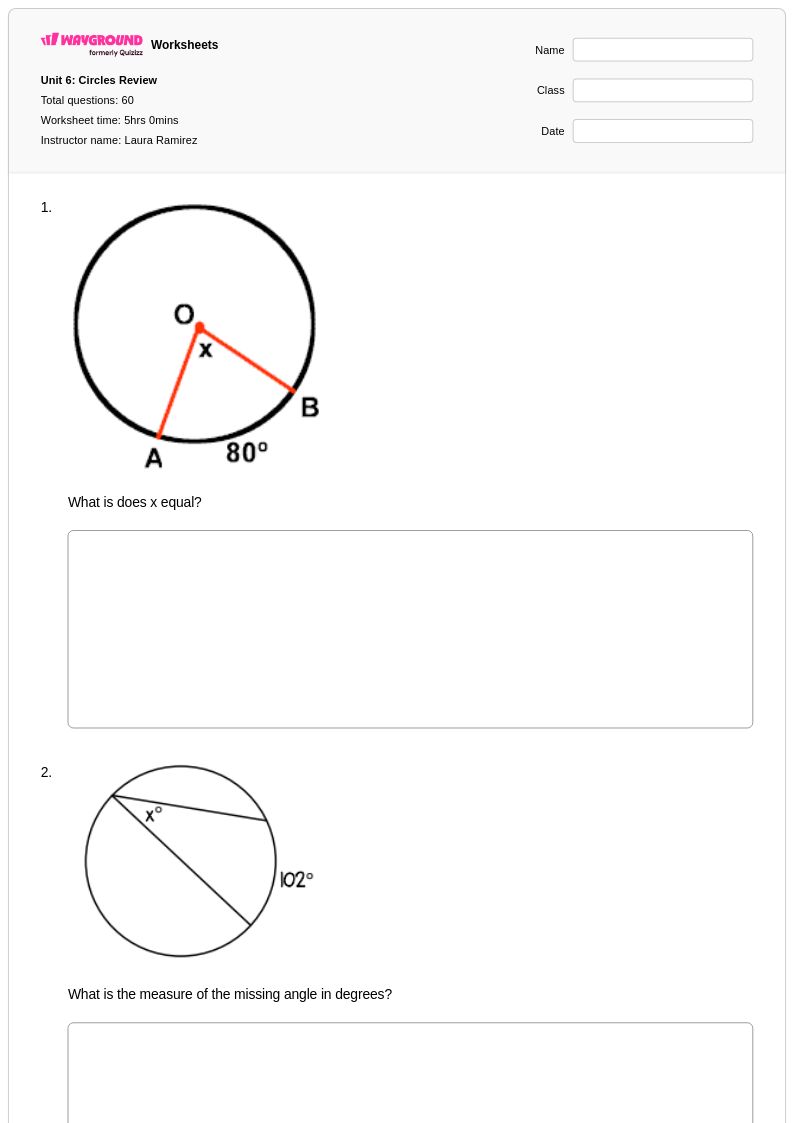
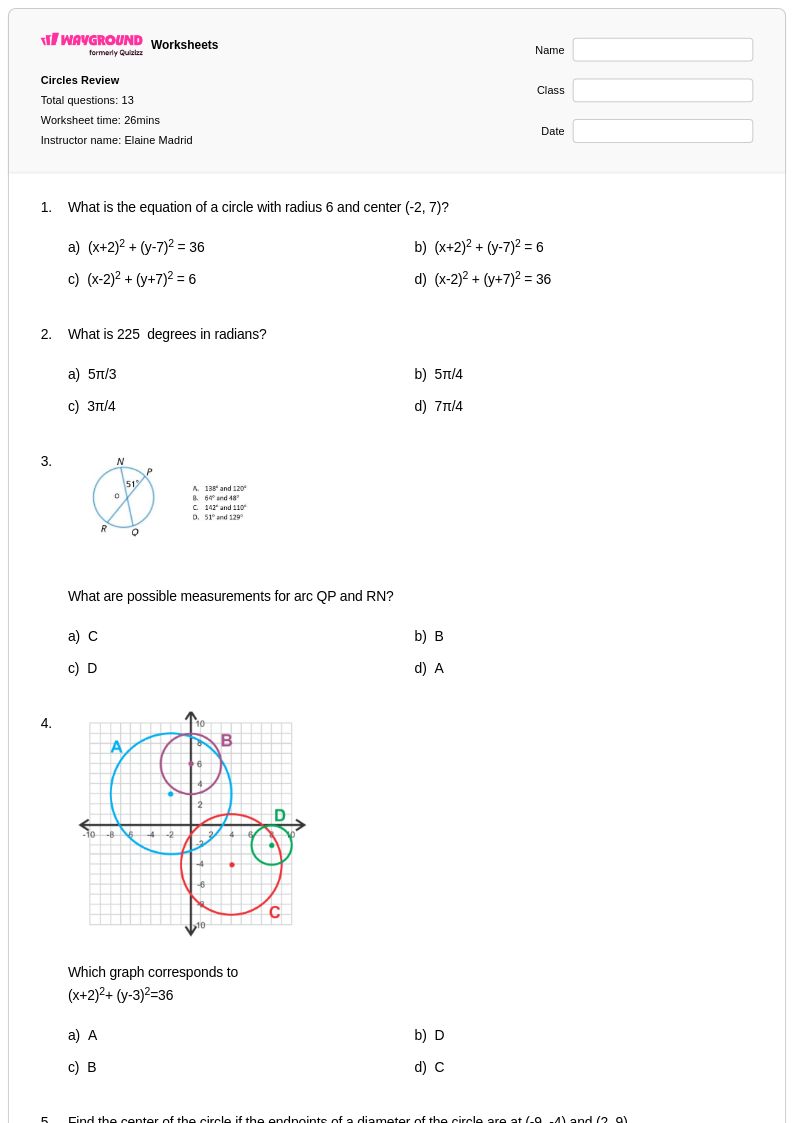
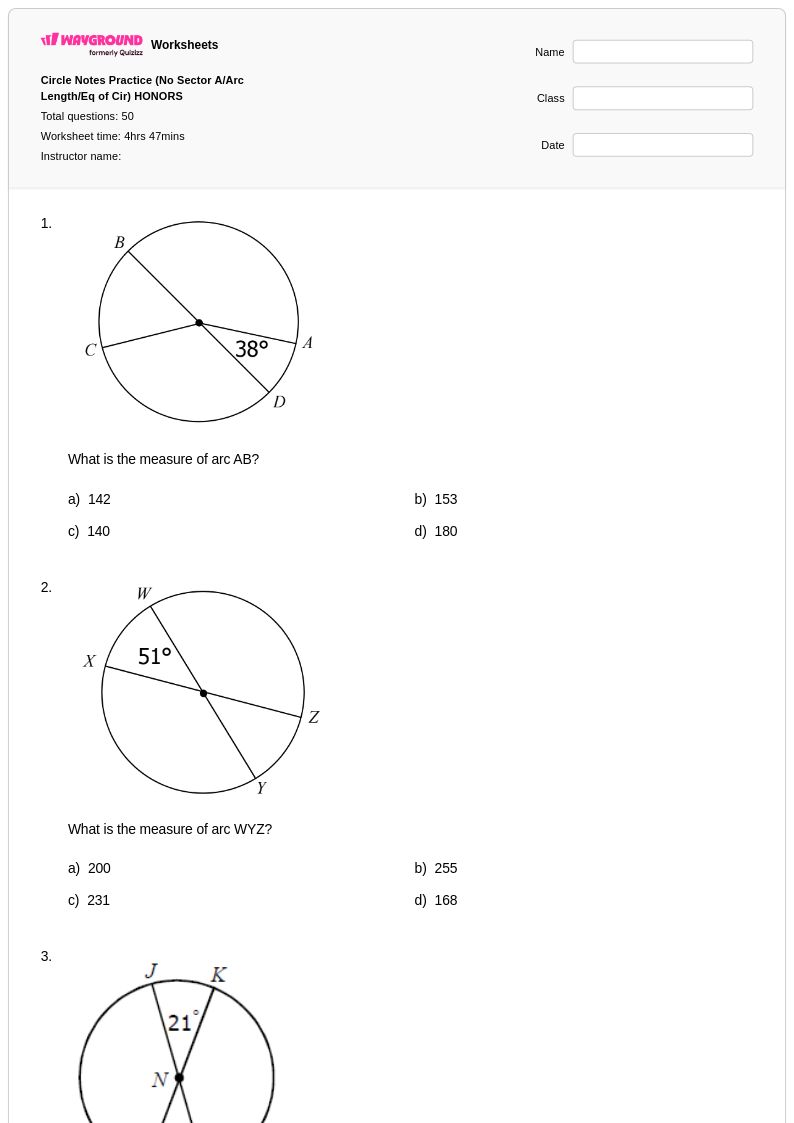
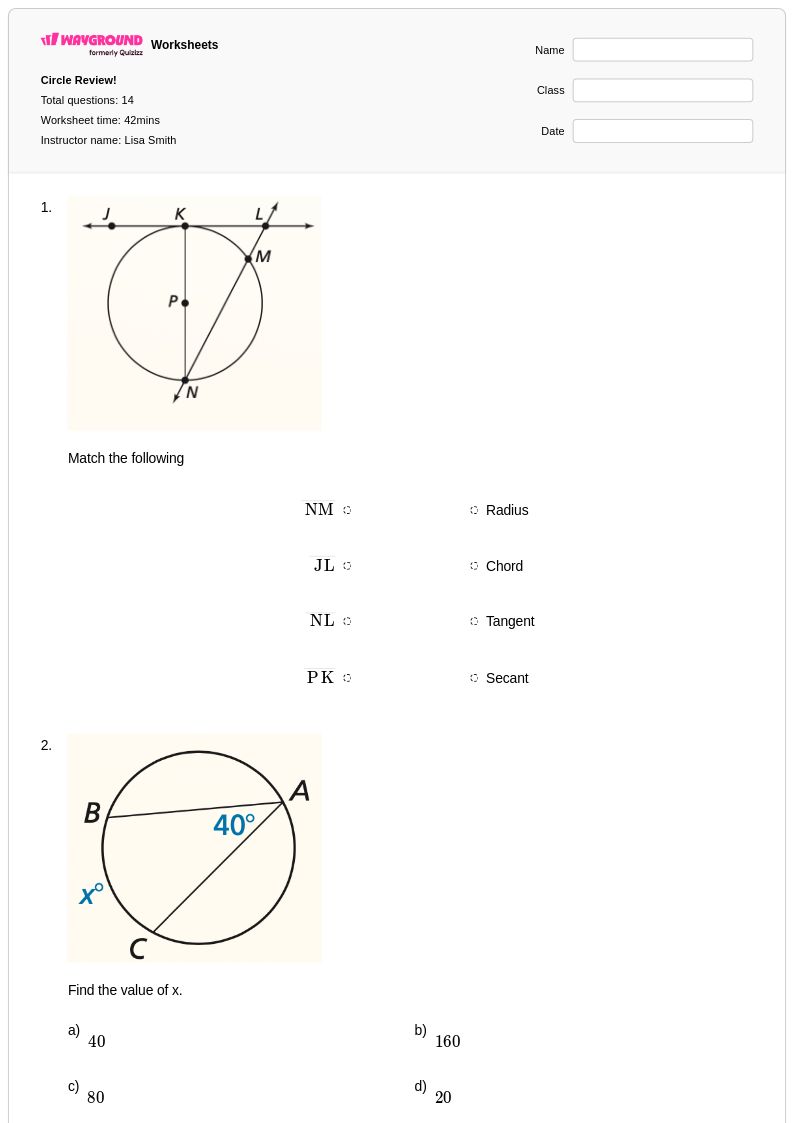
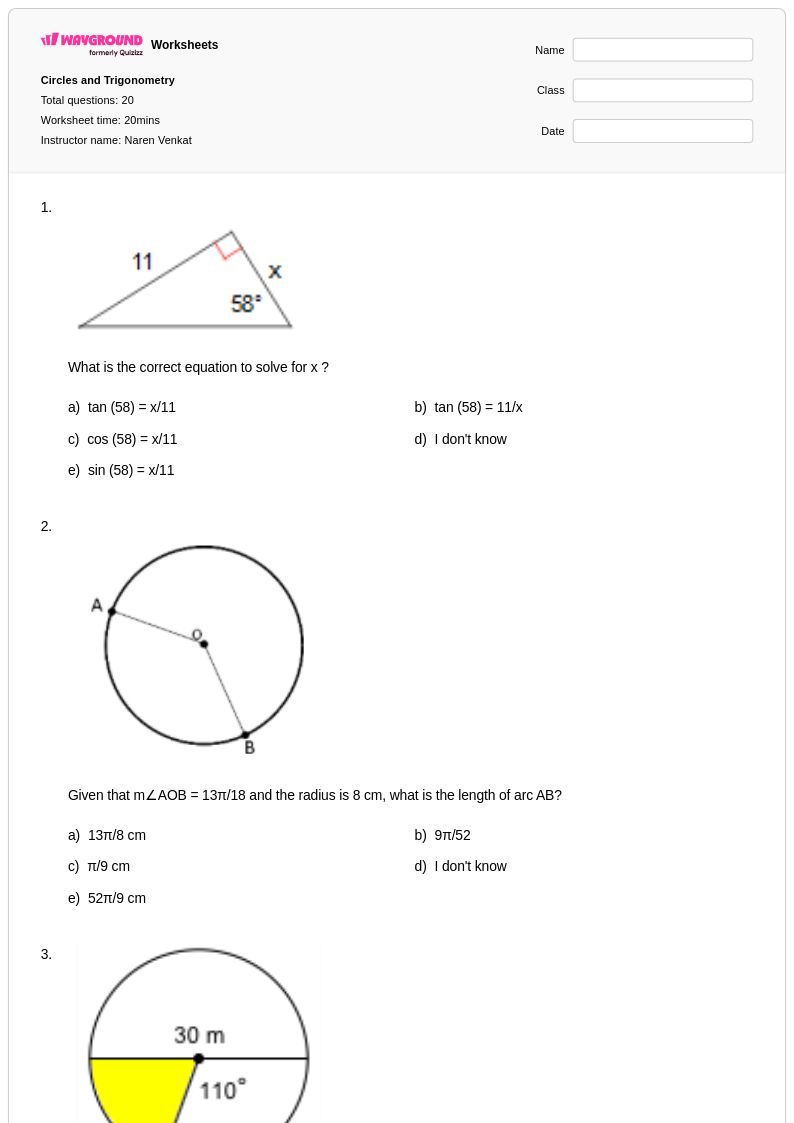
Master circle theorems with Wayground's comprehensive collection of free geometry worksheets, featuring printable PDFs with practice problems and answer keys to help students understand angle relationships and properties within circles.
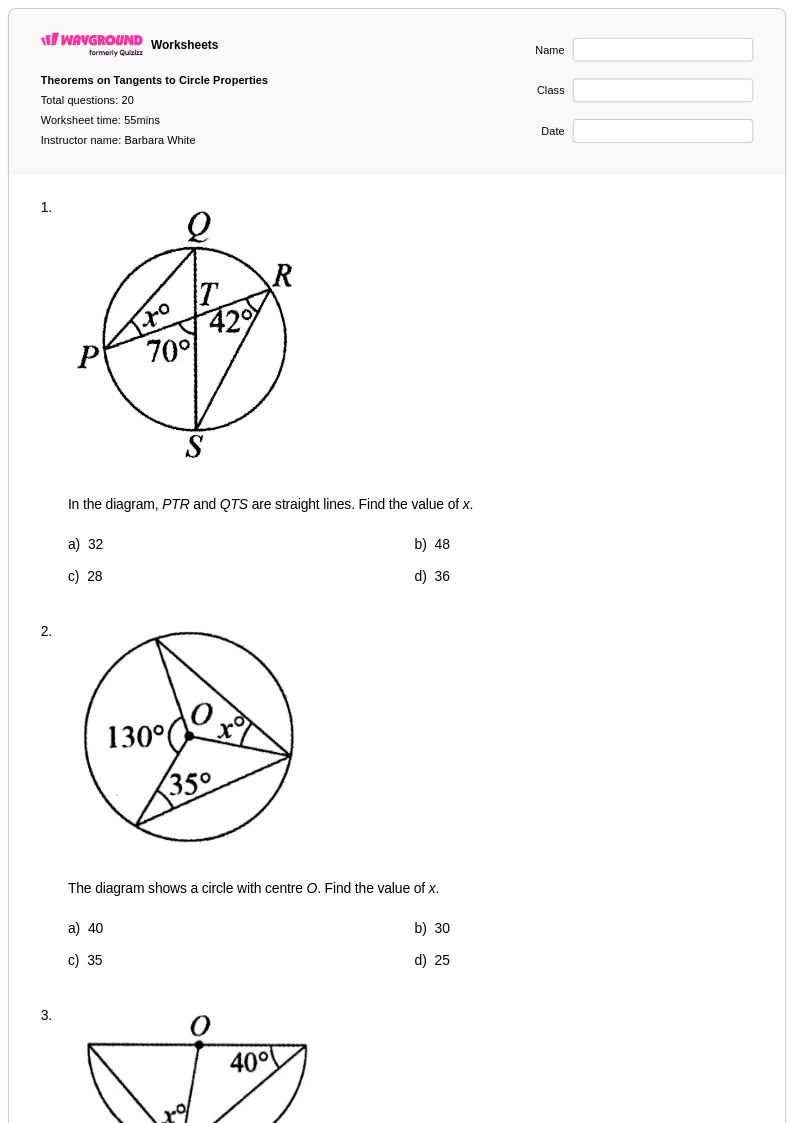
Circle theorems worksheets available through Wayground (formerly Quizizz) provide comprehensive practice opportunities for students to master the fundamental relationships and properties within circles. These expertly designed mathematics resources strengthen critical geometric reasoning skills by engaging learners with problems involving inscribed angles, central angles, tangent-secant relationships, and cyclic quadrilaterals. Each worksheet collection includes detailed answer keys and step-by-step solutions that guide students through complex theorem applications, while the free printable pdf format ensures easy classroom distribution and independent study. The practice problems systematically build understanding of essential concepts such as the angle in a semicircle theorem, alternate segment theorem, and the relationship between angles subtended by the same arc.
Wayground (formerly Quizizz) empowers mathematics educators with millions of teacher-created circle theorem resources that streamline lesson planning and support differentiated instruction. The platform's robust search and filtering capabilities allow teachers to quickly locate worksheets aligned with specific curriculum standards and skill levels, while customization tools enable modification of existing materials to match individual classroom needs. These comprehensive collections are available in both printable and digital formats, including downloadable pdf versions, making them ideal for traditional classroom settings, hybrid learning environments, and remote instruction. Teachers can effectively use these resources for targeted remediation of struggling students, enrichment activities for advanced learners, and regular skill practice that reinforces geometric theorem mastery across diverse learning contexts.
FAQs
How do I teach circle theorems effectively?
Begin by connecting central angles, inscribed angles, chords, tangents, secants, and arcs in the same diagram so students can see which elements determine each relationship. Model how to mark known information, name the relevant theorem, form an equation, and justify each step before moving to cyclic quadrilaterals and multi-theorem proofs.
What exercises help students practice circle theorems?
Use a sequence that moves from identifying applicable theorems to calculating missing angles and then completing multi-step proofs. Include problems on angles in semicircles, angles subtended by the same arc, inscribed and central angles, the alternate segment theorem, cyclic quadrilaterals, and tangent-secant relationships.
What mistakes do students commonly make with circle theorems?
Students often confuse central and inscribed angle measures, apply the alternate segment theorem without identifying the tangent and chord, or assume a quadrilateral is cyclic without sufficient evidence. They may also select a correct theorem but fail to connect it to the marked arc, chord, or angle, so require every calculation to include a geometric justification.
How can I use Wayground circle theorem worksheets in my class?
Wayground worksheets are available as printable PDFs and digital formats, so teachers can host a worksheet as a digital quiz or print it for paper-based classwork, homework, or off-screen practice. Every worksheet includes a complete answer key, and teachers can grade physical submissions by scanning or capturing student work with the Wayground for Teachers app.
How do circle theorems fit into the Common Core geometry curriculum?
Common Core geometry develops circle reasoning through relationships among angles, arcs, chords, secants, and tangents, alongside the construction and explanation of geometric arguments. Circle theorem practice should therefore progress from recognizing these relationships to using them in calculations and logical proofs rather than relying on memorized rules alone.
How can I differentiate circle theorem practice for mixed-ability students?
Create scaffolded versions that isolate one theorem at a time for developing learners and use composite diagrams or proof problems for students ready for greater challenge. Wayground also supports extended time, Read Aloud, reduced answer choices, reading mode, adjustable font size and spacing, a dyslexia-friendly font, and worksheet translation; accommodations can be saved per student for future sessions.