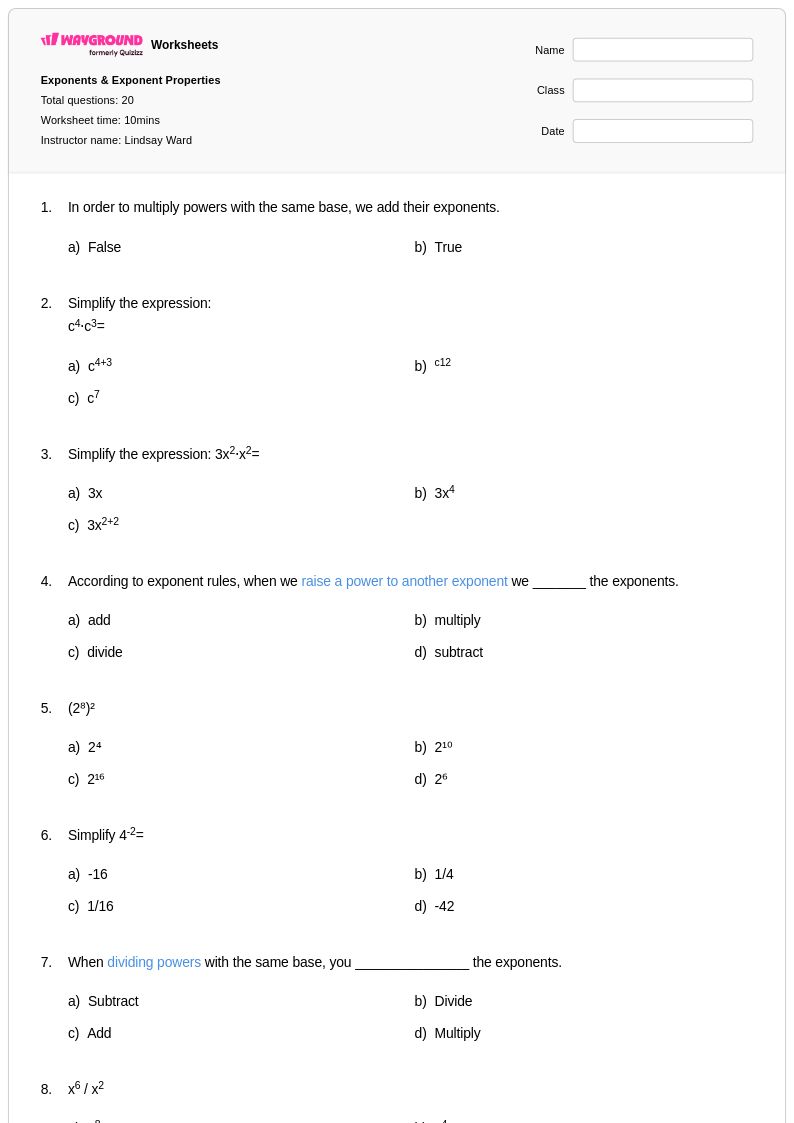
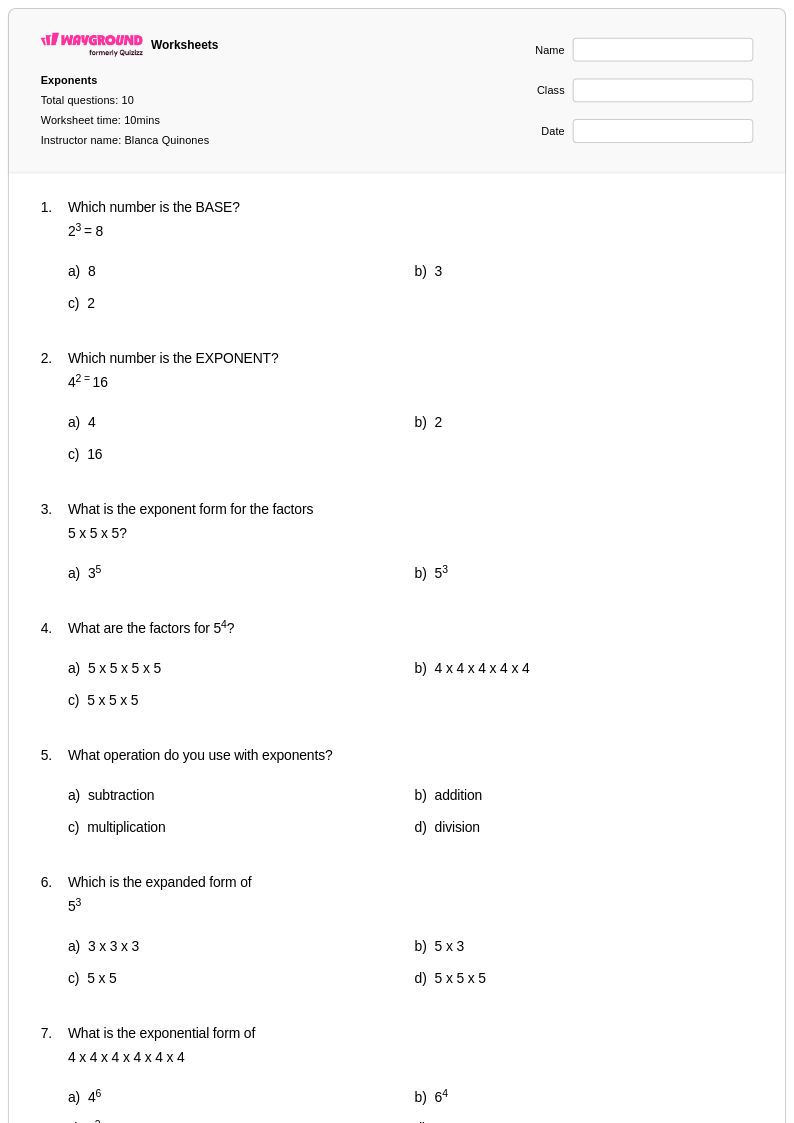
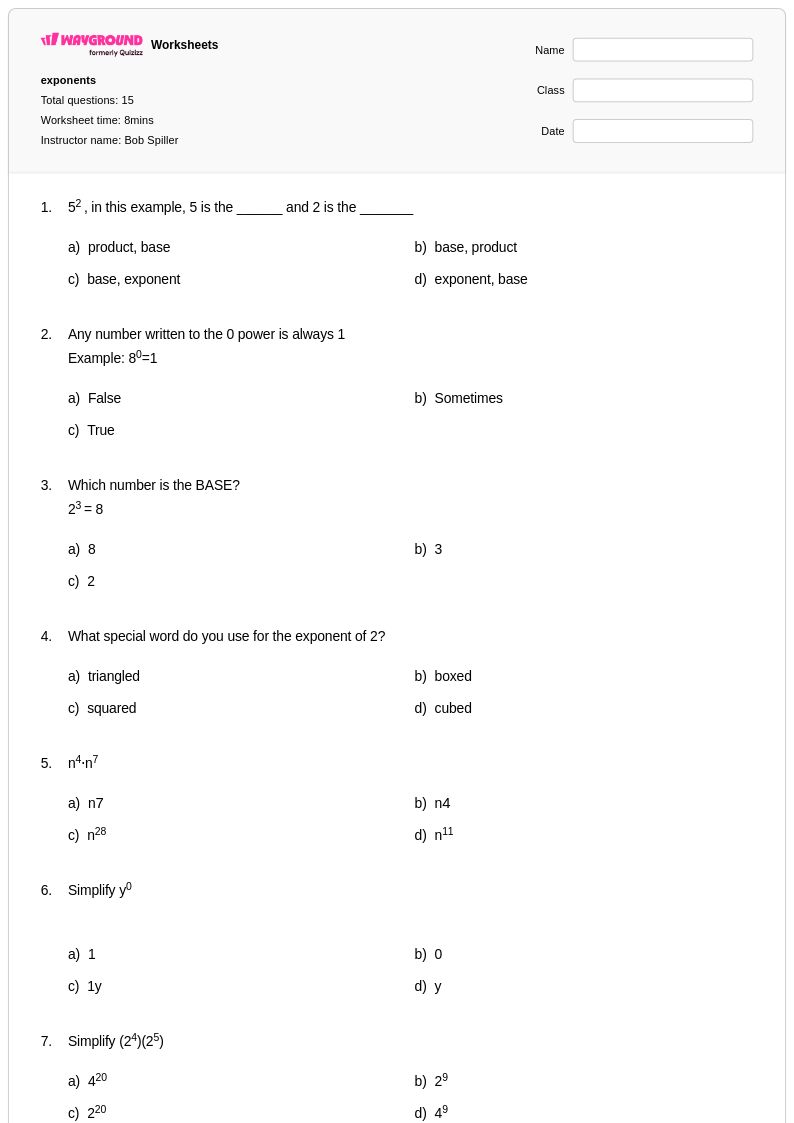
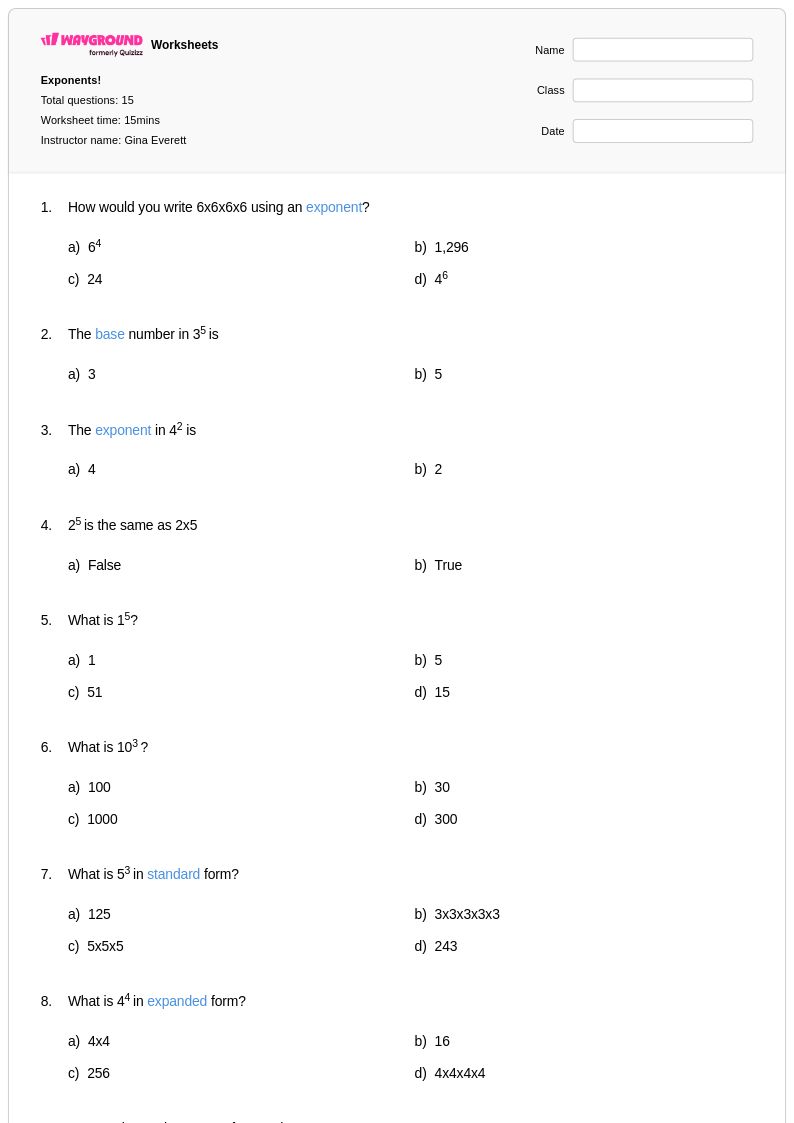
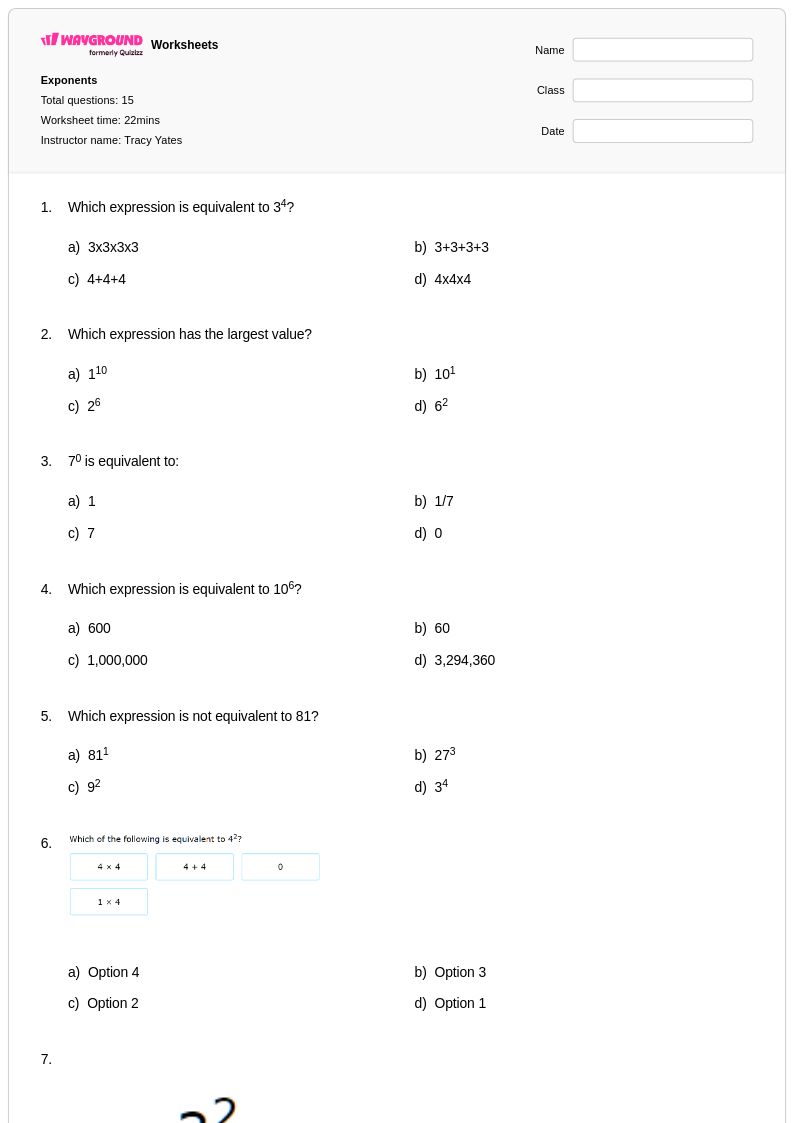
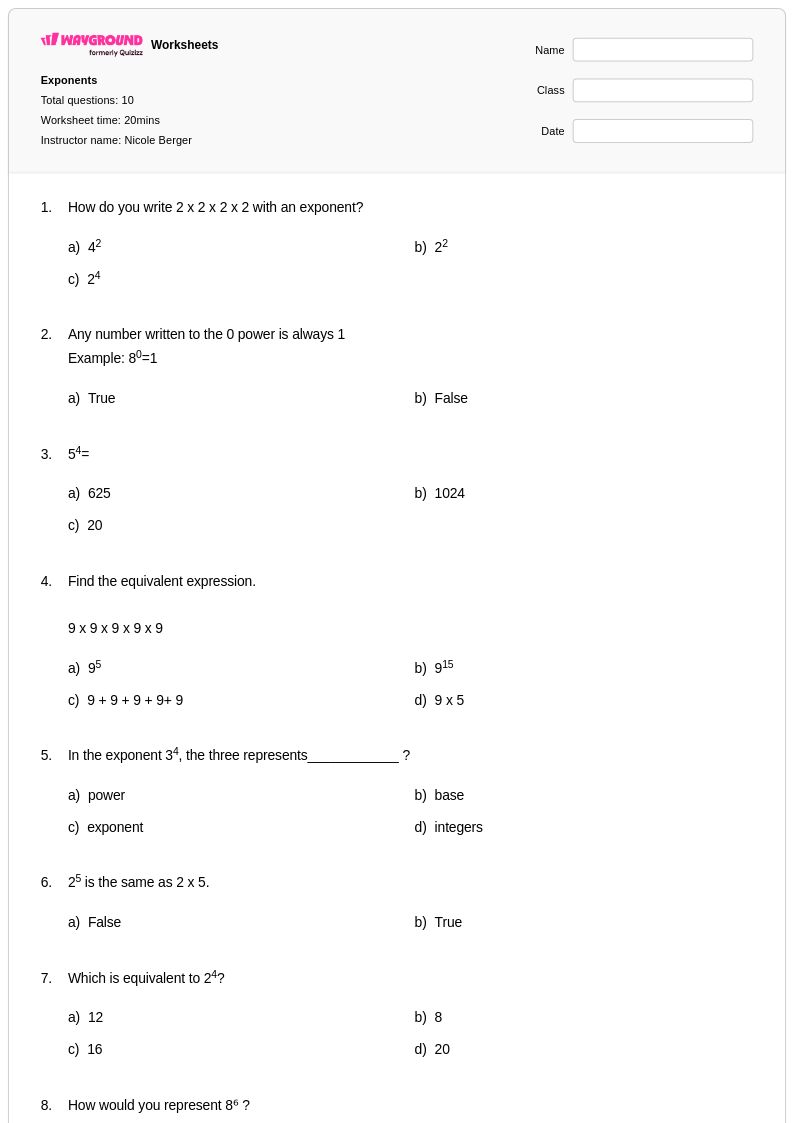
Enhance students' understanding of exponents with Wayground's comprehensive collection of free worksheets, printables, and practice problems that build essential mathematical skills through engaging PDF exercises complete with answer keys.
Exponents worksheets available through Wayground (formerly Quizizz) provide comprehensive practice opportunities for students to master the fundamental concepts of exponential notation, laws of exponents, and power calculations. These carefully designed resources strengthen critical mathematical skills including understanding base and exponent relationships, applying multiplication and division rules for powers, simplifying exponential expressions, and working with negative and zero exponents. The collection features diverse practice problems that progress from basic exponential notation to more complex applications, ensuring students develop both computational fluency and conceptual understanding. Each worksheet includes a complete answer key and is available as a free printable pdf, making it easy for educators to incorporate targeted exponents practice into their mathematics instruction.
Wayground (formerly Quizizz) supports mathematics educators with millions of teacher-created exponents worksheets that can be easily searched, filtered, and customized to meet specific classroom needs. The platform's robust differentiation tools allow teachers to modify difficulty levels, adjust problem types, and create personalized learning experiences that address individual student requirements. These resources align with mathematics standards and are available in both printable pdf format and interactive digital versions, providing flexibility for various instructional settings. Teachers can efficiently plan lessons, design targeted remediation activities, and create enrichment opportunities using the platform's extensive filtering system, which helps locate worksheets by specific exponent concepts, complexity levels, and mathematical focus areas, streamlining the process of delivering effective skill practice and assessment.
FAQs
How do I teach exponents to students who are new to the concept?
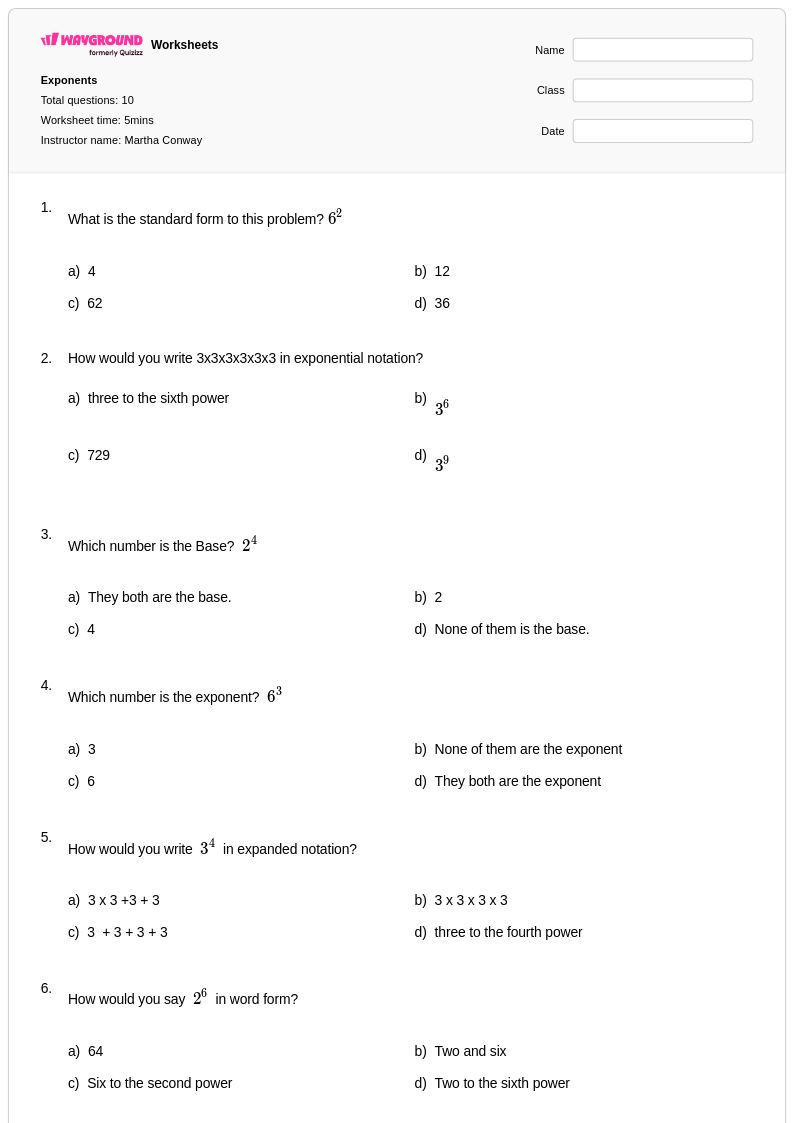
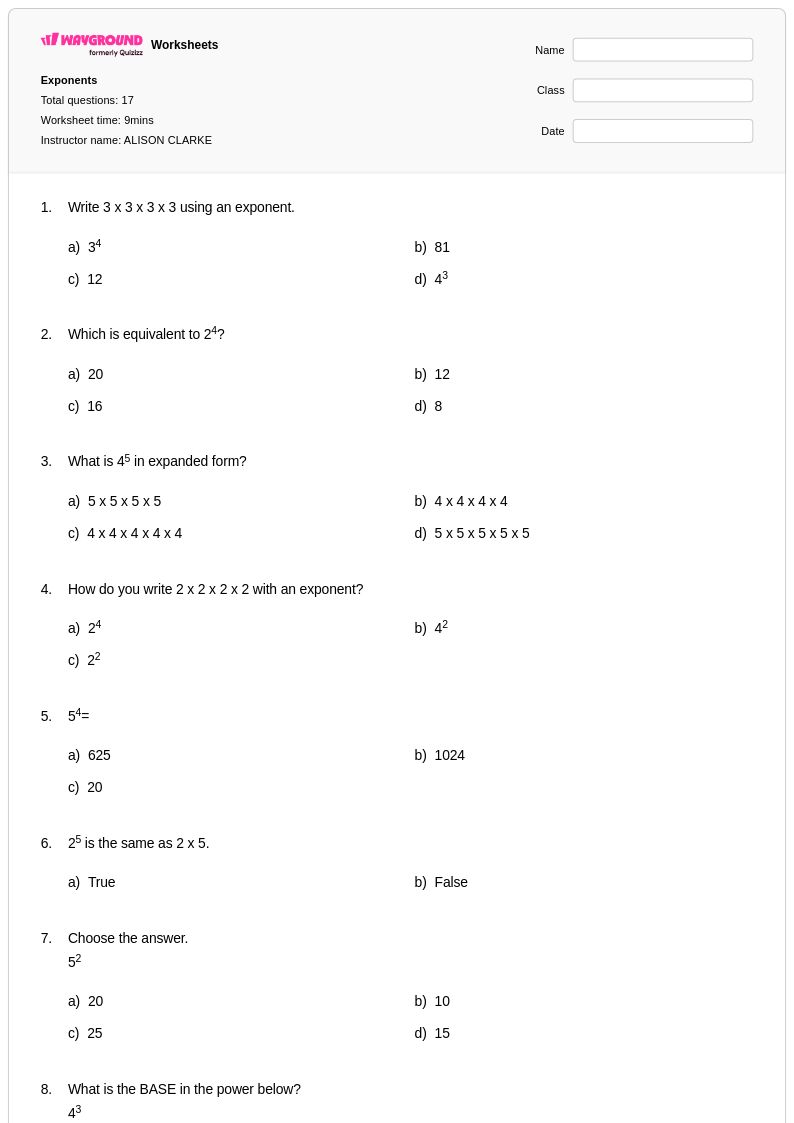
Start with the language: a base tells you what's being multiplied, and an exponent tells you how many times. Grounding that in repeated multiplication (3⁴ = 3 × 3 × 3 × 3) before introducing any rules prevents the most common early confusion. Once students are comfortable evaluating expressions, introduce the laws — product, quotient, power to a power — one at a time, with plenty of practice between each. Zero and negative exponents tend to land better after students have internalized the pattern of dividing by the base as the exponent decreases.
What exercises help students practice the laws of exponents?
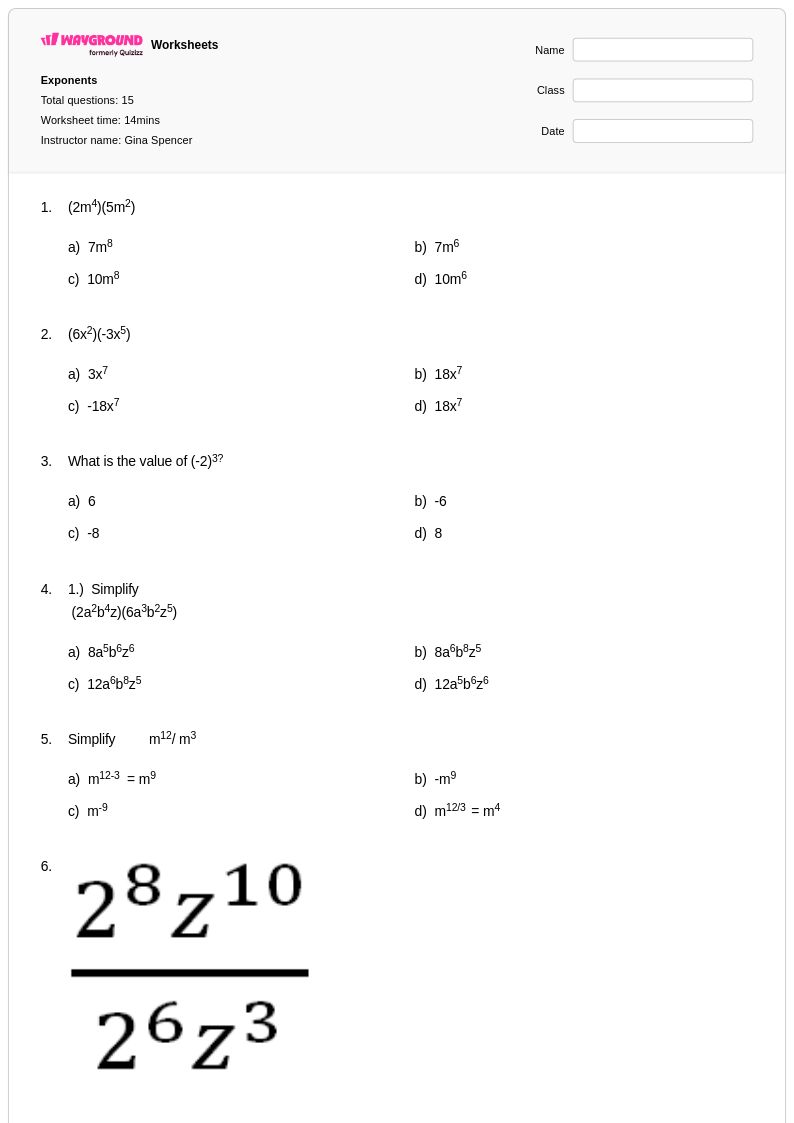
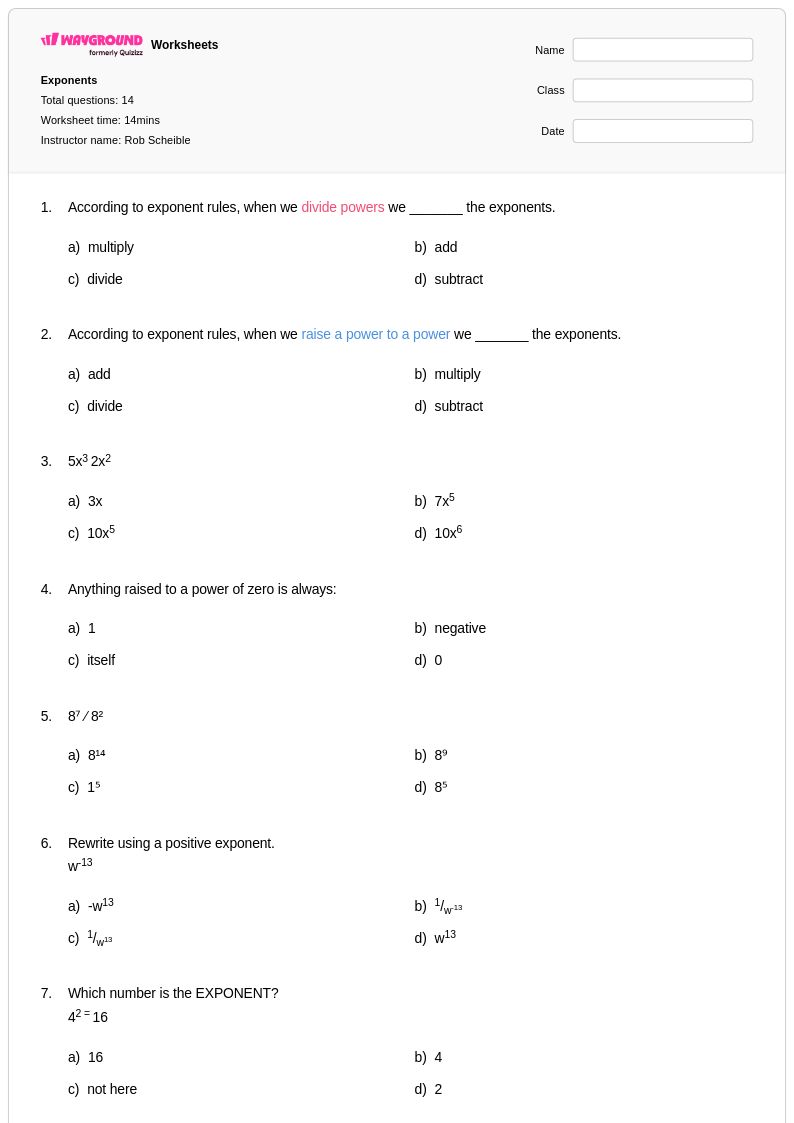
The most effective practice isolates one rule at a time before mixing them. Start with multiplying powers (same base, add exponents), then quotient of powers, then power to a power — each in isolation. Once students are solid on each rule individually, give them mixed simplification problems that require choosing the right rule. The subtopics in this collection — Product of Powers, Quotient of Powers, Power to a Power, Zero Exponent Rule, and Negative and Fractional Indices — follow exactly that progression.
What mistakes do students commonly make with exponents?
Three errors come up constantly. First, students multiply the base by the exponent instead of using repeated multiplication (writing 3⁴ = 12 instead of 81). Second, when multiplying powers with the same base, they multiply the exponents instead of adding them. Third, the zero exponent rule trips up nearly everyone at first — students expect x⁰ to equal 0, not 1. Negative exponents cause a similar instinct problem: students often write a negative result rather than a reciprocal.
How do I use Wayground's exponents worksheets in my classroom?
You can run any worksheet as a digital quiz hosted on Wayground — students work through it on their devices and you get results in real time. If you'd rather go paper, download the printable PDF and assign it in class or as homework; every worksheet includes a complete answer key. For grading paper submissions, the Wayground for Teachers app lets you scan or capture student work directly.
Are exponents aligned to Common Core, and how does the topic progress across grades?
Yes. Common Core introduces exponents as a way to express repeated multiplication in Grade 5, then deepens the work in Grade 6 with integer exponents and the full set of properties. By Grade 8, students apply those properties to scientific notation and work with integer and rational exponents more formally. This collection spans that full arc — from squaring numbers through negative and fractional indices — so it supports students at multiple points in that progression.
How can I differentiate exponents practice for mixed-ability classes?
For students who struggle with the abstract notation, Wayground's worksheet-level tools let you increase font size or apply a dyslexia-friendly font so the format itself isn't a barrier. For students who need more processing time on multi-step simplification problems, you can set extended time per question at the individual student level without affecting the rest of the class. On the content side, the collection's range — from squaring numbers up through negative and fractional indices — means you can assign different subtopics to different groups without building separate materials from scratch.
What topics does this exponents worksheet collection cover?
The collection covers the full range of exponent rules taught in middle school math: squaring numbers, multiplying and dividing powers, product and quotient of powers, power to a power, properties of exponents, the zero exponent rule, and negative and fractional indices.