
 Worksheets
Unit 3 Review
Total questions: 120
Worksheet time: 2hrs 54mins
Name
Class
Date
1.
Proteins are made of monomers called ___________
a)
Nucleotides
b)
Monosaccharides
c)
Amino Acids
d)
Glycerol and fatty acids
2.
_________ are composed out of carbon (C), hydrogen (H), oxygen (O), nitrogen (N), and phosphorus (P)
a)
Carbohydrates
b)
Lipids
c)
Proteins
d)
Nucleic Acids
3.
DNA and RNA are examples of
a)
Carbohydrates
b)
Lipids
c)
Proteins
d)
Nucleic Acids
4.
Nucleotides are monomers of
a)
Carbohydrates
b)
Lipids
c)
Proteins
d)
Nucleic Acids
5.
Monosaccharides are monomers of
a)
Carbohydrates
b)
Lipids
c)
Proteins
d)
Nucleic Acids
6.
Waxes, oils and fats are examples of
a)
Carbohydrates
b)
Lipids
c)
Proteins
d)
Nucleic Acids
7.
Glycerol and fatty acids are the monomers of
a)
Carbohydrates
b)
Lipids
c)
Proteins
d)
Nucleic Acids
8.
The organic compounds that have many structural purposes and are used in many processes within the
cell are called ____________________.
cell are called ____________________.
a)
Carbohydrates
b)
Lipids
c)
Proteins
d)
Nucleic Acids
9.

Which macromolecule is shown?
View Figure 1 (if not visible)
View Figure 1 (if not visible)
a)
lipid
b)
protein
c)
nucleic acid
d)
carbohydrate
10.

Which macromolecule is shown?
View Figure 2 (if not visible)
View Figure 2 (if not visible)
a)
lipid
b)
protein
c)
nucleic acid
d)
carbohydrate
11.

Which macromolecule is shown?
View Figure 3 (if not visible)
View Figure 3 (if not visible)
a)
lipid
b)
protein
c)
nucleic acid
d)
carbohydrate
12.

Which macromolecule is shown?
View Figure 4 (if not visible)
View Figure 4 (if not visible)
a)
lipid
b)
protein
c)
nucleic acid
d)
carbohydrate
13.
What type of macromolecule are enzymes?
a)
Protein
b)
Carbohydrate
c)
Lipid
d)
Nucleic Acid
14.
Carbohydrates are made of...
a)
C H O
b)
C H O N
c)
C H O N P
d)
C H O N S
15.
Which macromolecule stores energy, insulates us, and makes up the cell membrane?
a)
lipids
b)
proteins
c)
carbohydrates
d)
nucleic acids
16.
Lipids are made of...
a)
C H O
b)
C H O N
c)
C H O N P
d)
C H O N S
17.
Proteins are made of...
a)
C H O
b)
C H O N
c)
C H O N P
d)
C H O N S
18.
The monomer amino acid belongs to which macromolecule?
a)
Carbohydrates
b)
Lipids
c)
Proteins
d)
Nucleic Acid
19.
The following examples Glucose, Starch, Cellulose, and Glycogen belong to which macromolecule:
a)
Carbohydrates
b)
Lipids
c)
Proteins
d)
Nucleic Acid
20.
The function of energy storage goes with which macromolecule-
a)
Carbohydrates
b)
Lipids
c)
Proteins
d)
Nucleic Acids
21.
What is the purpose of an enzyme?
a)
give permission for the reaction
b)
raise activation energy
c)
speed up reactions
d)
control how many reactions occur
22.
Where do substrates bind on an enzyme?
a)
voltage-gated channels
b)
surface receptor
c)
calcium channels
d)
active site
23.

What is structure A?
a)
Substrate
b)
Active site
c)
Enzyme
d)
Products
24.

What is structure D?
a)
Substrate
b)
Active site
c)
Enzyme
d)
Products
25.

What is structure C?
a)
Substrate
b)
Active site
c)
Enzyme
d)
Products
26.

What is structure E, F, G?
a)
Substrate
b)
Active site
c)
Enzyme
d)
Products
27.
Enzymes are capable of increasing the rate of a chemical reaction within a living cell. Enzymes accomplish this through which of the following means?
a)
reducing the number of products
b)
reducing the activation energy
c)
increasing the temperature of the cell
d)
increasing the concentration of reactants
28.
What is a substance called if it speeds up a chemical reaction?
a)
reusable
b)
catalyst
c)
specific
d)
fragile
29.
Each enzyme only has 1 substrate that will fit its active site. What is this called?
a)
reusable
b)
catalyst
c)
specific
d)
fragile
30.
Changes in pH and temperature can damage an enzymes active site. What is this called?
a)
reusable
b)
catalyst
c)
specific
d)
fragile
31.
What 3 letters do enzymes typically end in?
a)
-ose
b)
-ase
c)
-ese
d)
-tic
32.
Once a new product leaves an enzyme, the enzyme is unchanged and ready for the next substrate. What is this called?
a)
reusable
b)
catalyst
c)
specific
d)
fragile
33.

The graph shows how enzymes affect reactions in cells. Which statement best summarizes the information shown in the graph?
a)
Enzymes increase the energy of the reactants.
b)
Enzymes decrease the energy level of the products.
c)
Enzyme decrease the activation energy of the reaction.
d)
Enzymes reverse the direction of the reaction.
34.

Which of the following conclusions can be drawn from this graph?
a)
The optimum pH of the enzyme is 6.6.
b)
The optimum pH of the enzyme is 5.8
c)
The enzyme’s activity increases as pH increases 5.0 to 9.0
d)
The enzyme’s activity is greater around pH of 8.0 .
35.
What is the name for the mechanism of enzyme activity?
a)
Lock and key
b)
jigsaw puzzle
c)
hammer and nail
d)
two hands pattern
36.
Any substance that is acted upon by an enzyme is called a(n)?
a)
Coenzyme
b)
Substrate
c)
Vitamin
d)
Polypeptide
37.
After the enzyme and substrate bind together and perform the reaction, what does the substrate become?
a)
a substrate
b)
an enzyme
c)
a product
d)
an active site
38.
The pH at which an enzyme is most efficient is called the _________ pH of an enzyme.
a)
neutral
b)
optimum
c)
minimum
d)
experimental
39.
Which is NOT true?
a)
Enzymes speed up chemical reactions.
b)
Enzymes react best at a specific temperature.
c)
Enzymes only control ONE type of reaction.
d)
Enzymes are made of fatty acids.
40.
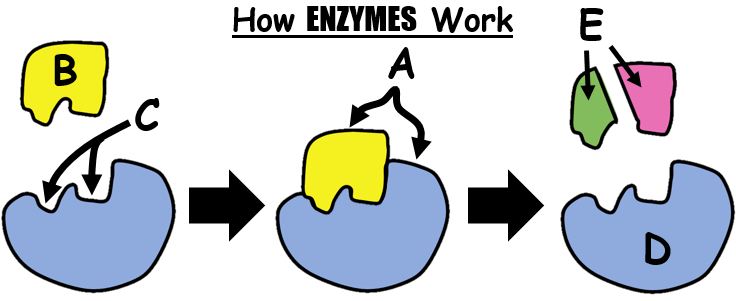
In the diagram, what is letter A?
a)
product
b)
substrate
c)
enzyme-substrate complex
d)
active site
41.
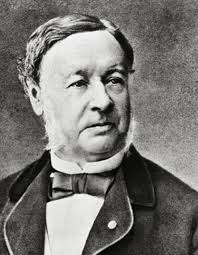
Which of the following scientists concluded that all animals are made of cells?
a)
Rudolf
Virchow
b)
Matthais
Schleiden
c)
Robert
Hooke
d)
Theodor
Schwann
42.

Which of the following scientists was the first to observe bacteria?
a)
Anton
van Leuwenhoek
b)
Matthais
Schleiden
c)
Robert
Hooke
d)
Theodor Schwann
43.
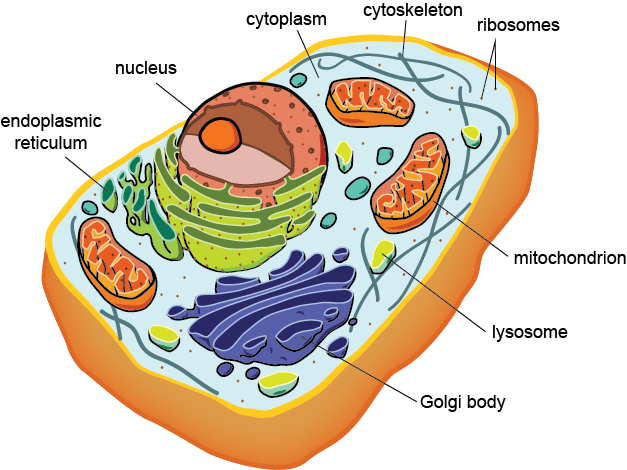
Which of the following statements is not part of the cell theory?
a)
Cells are the basic unit of structure and function in all living things.
b)
All cells are produced from other cells.
c)
Only animal cells are composed of cells.
d)
All living things are composed of cells.
44.

What is one way in which all living things on Earth are alike?
a)
All living things have hair.
b)
All living things are made of cells and come from other cells.
c)
The cells of all living things have chloroplast.
d)
All living things can move.
45.

Which of the following scientists contributed to the cell theory?
a)
Rudolf Virchow, Robert Hooke, Anton van Leuwenhoek
b)
Matthais Schleiden, Theodor Schwann, Rudolf Virchow
c)
Robert Hooke, Theodor Schwann, Anton von Leuwenhoek
d)
Theodor Schwann, Matthais Schleiden, Robert HookeOption 4 (optional)
46.
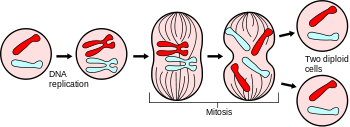
When cells are damaged, new cells are created by cell division. How does the cell theory support this fact?
a)
It states that all cells have a nucleus which divides.
b)
It states that all living things are made up of one or more cells.
c)
It states that cells come from previously existing cells.
d)
It states that the basic units of structure and function are cells.
47.

Cells are often called "the ____ of life."
a)
bread
b)
road map
c)
building blocks
d)
meaning
48.

Who was the "scientist" who observed pond water and teeth scrapings in his microscope?
a)
Hooke
b)
Leeuwenhoek
c)
Schleidian
d)
Virchow
49.
All plants are made of cells. This was discovered by....
a)
Matthias Schleiden
b)
Rudolf Virchow
c)
Robert Hooke
d)
Aristotle
50.
The Cell Theory states...
a)
atoms create all matter
b)
living things evolve
c)
the cell is the backbone of all matter
d)
cells are the basic unit of structure and organization of organisms
51.
What kingdoms do prokaryotes belong to?
a)
Archaebacteria
b)
Protista
c)
Animalia
d)
Fungi
52.
Which ONE of the following kingdoms do eukaryotes belong to?
a)
Animalia
b)
Eubacteria
c)
Archaebacteria
53.
The eukaryote cell has something the prokaryote does not. What is it?
a)
a cell wall
b)
a membrane
c)
a chloroplast
d)
a nucleus
54.
Has Mitochondria
a)
Prokaryote
b)
Eukaryote
c)
both
55.
Which has ribosomes?
a)
Prokaryote
b)
Eukaryote
c)
both
56.
Has cytoplasm
a)
Prokaryote
b)
Eukaryote
c)
both
57.
Has nucleus
a)
Prokaryote
b)
Eukaryote
c)
both
58.
more complex
a)
Prokaryote
b)
Eukaryote
c)
both
d)
both
59.
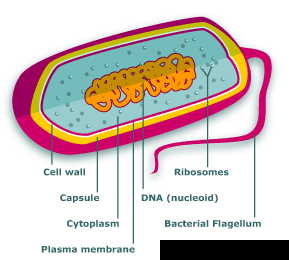
Which type of cell?
a)
Prokaryote
b)
Eukaryote
60.

Which type of cell?
a)
Prokaryote
b)
Eukaryote
61.

Which type of cell?
a)
Prokaryote
b)
Eukaryote
62.
A single-celled organism that lacks a membrane-bound nucleus, mitochondria, or any other membrane -bound organelle .
a)
Prokaryote
b)
Eukaryote
c)
Nucleus
d)
Single-celled organism
63.
Where is the DNA found in a prokaryotic cell?
a)
floating around in the cytoplasm
b)
in the nucleus
64.
Where is the DNA found in a eukaryotic cell?
a)
floating around in the cytoplasm
b)
in the nucleus
65.
Plants and animal cells are examples of ___ cells
a)
prokaryotic cells
b)
eukaryotic cells
66.
Has membrane bound organelles
a)
Prokaryote
b)
Eukaryote
c)
both
67.
Bacteria
a)
Prokaryote
b)
Eukaryote
c)
both
68.
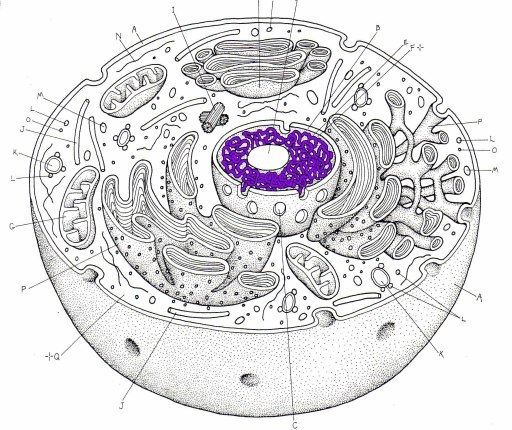
What kind of cell is this?
a)
Eukaryotic
b)
Prokaryotic
69.
Which of the following is not a characteristic of a Prokaryotic cell?
a)
unicellular
b)
floating DNA
c)
very small
d)
complex
70.
These cells have DNA surrounded by a nuclear membrane...
a)
Eukaryotic
b)
Prokaryotic
c)
Neither
d)
Both prokaryotic and eukaryotic
71.
Cell theory was first proposed in 1838. Evidence obtained through additional scientific investigations resulted in the current cell theory. Which statement describes a component of the original cell theory that was removed because of the new scientific knowledge?
a)
All living things are made of cells.
b)
All cells come from other preexisting cells.
c)
Cells form through spontaneous generation.
d)
Cells are the basic structural and functional units of life.
72.
A plant and an animal are both living things. According to the Cell Theory, what can you conclude about these two very different organisms?
a)
Plants have cells but animals do not.
b)
They are both made of one or more cells.
c)
They both come from the same kind of cell.
d)
They both come from a non-living organism.
73.
Rudolph Virchow's observations helped to disprove was commonly held belief of the time?
a)
evolution
b)
the existence of molecules
c)
spontaneous generation
d)
atomic models
74.
Unlike eukaryotes, prokaryotes do not have:
a)
DNA
b)
cytoplasm
c)
cell walls
d)
a membrane bound nucleus
75.
Who looked at cork and named the cell?
a)
Robert Hooke
b)
Van Leeuwenhoek
c)
Robert Brown
d)
Francesco Redi
76.
Which of the following is NOT one of the main components of the cell theory?
a)
cells must contain DNA
b)
all living things are made of cells
c)
cells can only come from other cells
d)
cells are the basic unit of life
77.
All organisms are made of:
a)
organelles
b)
cytoplasm
c)
DNA
d)
cells
78.
Anton van Leeuwenhoek made his own version of the microscope and discovered something very odd when he looked a the gunk on his teeth. What did he discover?
a)
Cells
b)
Bacteria
c)
Cavities
d)
Influenza
79.
What structures are common to all cells?
a)
cell wall, nucleus, tail, cytoplasm
b)
cytoplasm, DNA, cell wall, nucleus
c)
cell membrane, DNA, cytoplasm, ribosomes
d)
ribosomes, cell walls, DNA, cytoplasm
80.
Only Eukaryotes have genetic material.
a)
True
b)
False
81.
This organelle is a rigid outer layer that protects plant cells.
a)
Cell Membrane
b)
Cell Wall
c)
Nucleus
d)
Chloroplast
82.
The _____________ stores food, water, wastes, and other materials in both plant and animal cells.
a)
Vacuole
b)
Mitochondria
c)
Ribosomes
d)
Chromatin
83.
An organelle that captures energy from the sunlight in order to use it to produce food in plant cells is ______________.
a)
Chromatin
b)
Chloroplast
c)
Cytoplasm
d)
Cell Membrane
84.
________________ create proteins for plant and animal cells.
a)
Ribosomes
b)
Endoplasmic Reticulum
c)
Golgi Bodies
d)
Lysosomes
85.
The organelles that clean plant and animal cells by using chemicals to break down food and worn out cell parts are ______________.
a)
Lysosomes
b)
Mitochondria
c)
Nucleolus
d)
Cell Wall
86.
The _____________ holds the DNA, and controls the functions of plant and animal cells.
a)
Nucleus
b)
Nuclear Membrane
c)
Nucleolus
d)
New Moon
87.
This can be found in the nucleus, and are tiny strands that contain the instructions for directing the cell's functions.
a)
DNA/Chromatin
b)
Chloroplasts
c)
Golgi Bodies
d)
ER
88.
The _________ ____________ can be found in plant and animal cells, and receive proteins and materials from the ER, packages them, and distributes them.
a)
ER
b)
Golgi Bodies
c)
Cell Membrane
89.
The _____________ is like JELL-O, and is a gel-like fluid that fills plant and animal cells, and is where the organelles are found.
a)
Cytoplasm
b)
Cell Membrane
c)
Cell Wall
d)
JELL-O
90.

Using this image, what organelle is C?
a)
Cell Wall
b)
Mitochondria
c)
Large Cell Vacuole
d)
Chloroplast
91.
What is the function of the vacuole?
a)
Sac that stores water, nutrients, and waste products
b)
Sac filled with digestive chemicals
c)
Jelly-like substance within the plasma membrane
d)
stack of membranes that packages chemicals
92.
Where does photosynthesis occur?
a)
mitochondria
b)
stomata
c)
xylem
d)
chloroplast
93.
What can only be found in plant cells?
a)
Cell membrane
b)
Vacuole
c)
Chloroplast
d)
Mitochondrion
94.

What is the difference between rough and smooth ER?
a)
There is no difference.
b)
Plants have rough ER, animals have smooth ER.
c)
What type of injuries the Doctors treat.
d)
Rough has ribosomes, smooth does not.
95.

What organelle is labeled with "D"?
a)
Mitochondria
b)
Golgi Apparatus
c)
Nucleus
d)
Endoplasmic Reticulum
96.
The cytoplasm
a)
Is the gel-like fluid that holds other organelles in place.
b)
Breaks down food to produce energy for the cell.
c)
Is known as the "brain" of the cell.
d)
Is where photosynthesis takes place.
97.
Which of the following is directly involved in the transportation of materials inside/within the cell?
a)
Endoplasmic Reticulum
b)
Vacuole
c)
Lysosome
d)
Mitochondria
98.

Directs all cell activities through the DNA located there.
a)
Lysosomes
b)
Nucleus
c)
ribosomes
d)
Mitochondria
99.
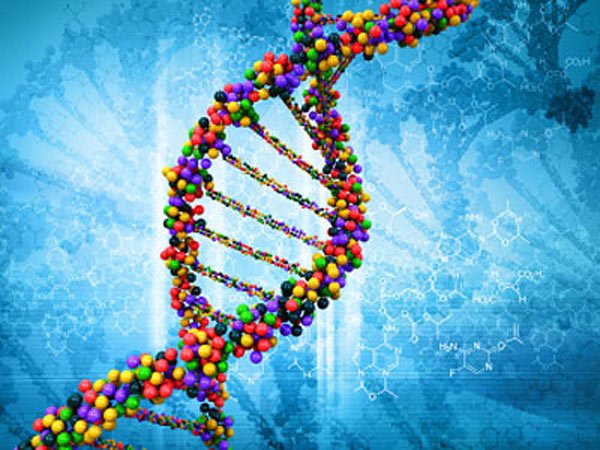
What is the name of the genetic material that is inside the nucleus?
a)
ER
b)
ATP
c)
YOLO
d)
DNA
100.

Which part of the cell is often called "the brain of the cell"?
a)
nuclear membrane
b)
endoplasmic reticulum
c)
nucleus
d)
mitochondria
101.
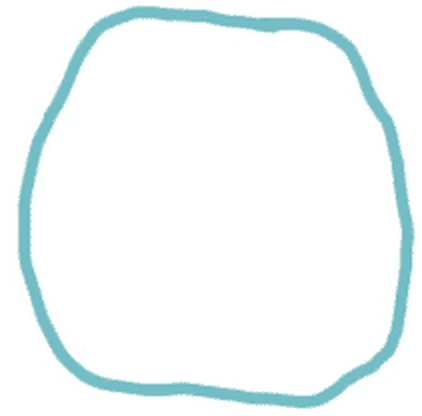
I am the outer most layer of an animal cell. What am I?
a)
cell wall
b)
nucleus
c)
cell membrane
d)
cell skin
102.
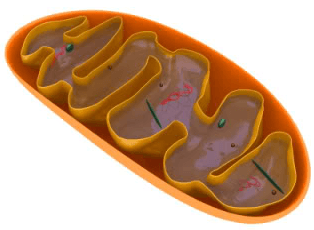
What are tiny organelles that convert glucose into ATP?
a)
Ribosomes
b)
Vesicles
c)
Cytoskeleton
d)
Mitochondria
103.
What organelle is called the "powerhouse" of a cell?
a)
Endoplasmic Reticulum
b)
Nucleus
c)
Mitochondria
d)
Nucleolus
104.
Main producer of ATP in all eukaryotes
a)
chloroplast
b)
mitochondria
c)
lysosome
d)
smooth er
105.
Animal cells DO NOT have ...
a)
Mitochondria
b)
Lysosomes
c)
Vacuoles
d)
Chloroplasts
106.
Which organelle is responsible for making proteins?
a)
Nucleus
b)
Nucleolus
c)
Lysosomes
d)
Ribosomes
107.

Number 1 is a (the) -
a)
Golgi Bodies
b)
Mitochondrion
c)
ribosome
d)
Nucleus
108.

Identify this structure that surrounds the entire cell.
a)
cell wall
b)
cell membrane
c)
sap vacuole
d)
cytoplasm
109.

Identify this structure that is green and makes food the plant cell.
a)
cytoplasm
b)
cell wall
c)
chloroplast
d)
cell membrane
110.
What is the function of the cell membrane?
a)
Supports and protects the cell
b)
Controls the cell
c)
Controls what enters and leaves the cell
d)
Metabolic reactions occur here
111.
What is the function of the cytoplasm?
a)
Stores water and mineral ions
b)
It holds all the organelles in place
c)
a.Controls what enters and leaves the cell
d)
Supports the cell
112.

Using this image, what organelle is G?
a)
Cell Wall
b)
Mitochondria
c)
Vacuole
d)
Chloroplast
113.
Which of the following organelles will you NOT find in an animal cell?
a)
Cell membrane
b)
Cell wall
c)
Golgi Apparatus
d)
Lysosome
114.
I am very present in muscles in order to provide massive amounts of ATP for movement and exercise. Who am I?
a)
Nucleus
b)
ER
c)
Mitochondria
d)
Ribosomes
115.
I am located in the leaves of plants, but NOT the roots. Who am I?
a)
Lysosomes
b)
Chloroplasts
c)
Vacuole
d)
Mitochondria
116.
Animal cells DO NOT have ...
a)
Mitochondria
b)
Lysosomes
c)
Vacuoles
d)
Chloroplasts
117.
What is a sac-like structure used to store water and nutrients? These are much larger in plant cells?
a)
Lysosomes
b)
Mitochondria
c)
Vacuoles
d)
Golgi Body
118.
What is the main function of the cell wall in a plant cell?
a)
to protect against disease
b)
to give structural support
c)
to contain the parts of the cell
d)
to help with cell division
119.

Look at the diagram. What does the diagram model?
a)
a virus
b)
a bacterium
c)
a plant cell
d)
an animal cell
120.

Look at the diagram modeling some parts of a plant cell. Which cell part missing from this model is found in plant cells but NOT in animal cells?
a)
a nucleus
b)
a choroplast
c)
a mitochondrion
d)
a cell membrane
100 %

