wayground logo

Free Printable Worksheets

Font size

S
M
L
XL
Worksheets

Evolution

Total questions: 165

Worksheet time: 3hrs 55mins

Name
Class
Date
1.
Who is the father of evolution?
a)
Darwin
b)
Mendel
c)
Newton
d)
Einstein
2.
What is another name for natural selection?
a)
survival of the smartest
b)
survival of the fastest
c)
survival of the biggest
d)
survival of the fittest
3.
What is a change in an organism that allows for it to survive in its environment?
a)
homologous
b)
vestigial
c)
variation
d)
adaptation
4.
When all of the organisms of a species have died it is called
a)
evolution
b)
extinction
c)
adaptation
d)
natural selection
5.
What is the study of organisms at the early stages of development?
a)
DNA studies
b)
embryology 
c)
extinction
d)
fossil record
6.
What is an organism that has similar characteristics and can reproduce?
a)
species
b)
organism
c)
embryology
d)
vestigial 
7.
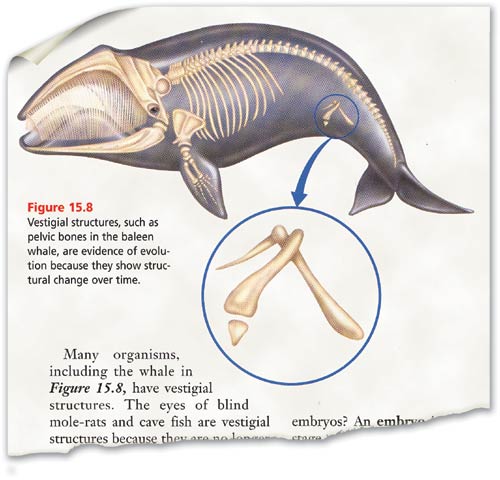
What is this an example of?
a)
diversity of species
b)
variation
c)
vestigial structures
d)
DNA studies
8.
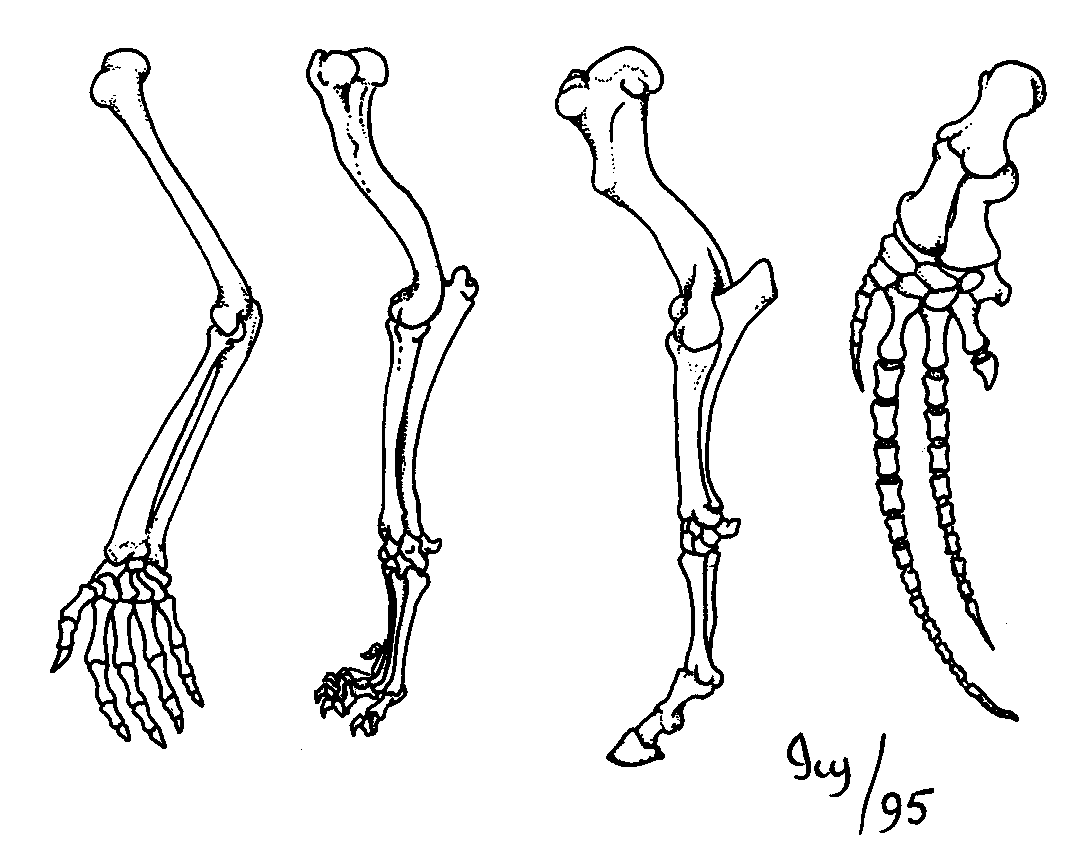
What is this an example of?
a)
vestigial structures
b)
embryology
c)
homologous structures
d)
fossil record
9.
Which layer is the oldest?
a)
1
b)
2
c)
3
d)
4
10.
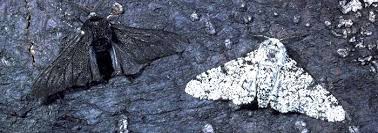
Predict which moth would increase in population
a)
light 
b)
dark
11.
When the DNA of an organism is altered it is referred to as…
a)
Mutation
b)
Gene Flow
c)
Genetic Drift
d)
Sexual Selection
12.
When individuals choose traits possessed by the opposite sex it is called…
a)
Mutation
b)
Gene Flow
c)
Genetic Drift
d)
Sexual Selection
13.
The cause of artificial selection is…
a)
The environment
b)
Humans
c)
Mutation
d)
Gene Flow
14.
Darwin wrote that organisms with traits that are best suited to the environment will ________________
a)
increase in number
b)
become extinct
15.
Which of the following is NOT an example of natural selection? 
a)
People selectively breeding hamsters.
b)
Insect populations developing resistance to certain pesticides.
c)
Bacteria becoming resistant to antibiotics.
d)
Male birds of certain species developing colorful feathers to attract female mates.
16.
Which term refers to the process by which individuals that are better suited to the environment survive and reproduce therefore passing down their genes to their offspring? 
a)
Evolution 
b)
Variation 
c)
Adaptation
d)
Natural Selection 
17.
Which species’ DNA is most similar to the DNA of the toothed whale? 
a)
Hippopotamus 
b)
Baleen Whale
c)
Grazing Mammals
d)
Camels
18.
The environment around Manchester, England, changed during the Industrial Revolution.  How did this change affect peppered moths living in the area?
a)
Natural selection favored moths with dark wings because predators could not see them on the soot-colored trees.
b)
Natural selection favored moths with white wings that were easy for predators to see.
c)
Natural selection favored moths with white wings because predators could not see them on the soot-colored trees.
d)
Natural selection caused moths with white wings to become extinct.
19.
A remnant or trace of an organism from the past is called a _______.
a)
Ancestor
b)
Skeleton
c)
Fossil
d)
Imprints
20.
Inherited trait that helps an organism survive is a(n) __________.
a)
Fossil
b)
Adaptation
c)
Ancestor
d)
Natural selection
21.
Structures with the same parts have different functions; suggests that organisms share a common ancestry
a)
vestigial structures
b)
homologous structures
c)
adaptive radiation
d)
fossil
22.
Which of the following is an example of a vestigial structure?
a)
the wings of a red-tailed hawk
b)
the hind limbs of a house cat
c)
the fins of sharks
d)
the tailbone of a human
23.
The diagram shows fossils in different rock layers. Which of these statements about the age of these fossils is most likely correct?
a)
Fossil A and C are the same age
b)
Fossil B is older than fossil C
c)
Fossils A is older than fossil B
d)
Fossil D is older than fossil C
24.
Which of the following is a term for a group of similar organisms that can reproduce fertile offspring?
a)
individual
b)
population
c)
species
d)
fossil
25.
Why are advantageous traits more likely to be passed onto offspring?
a)
Because they are more likely to survive and reproduce.
b)
Because they come from dominant alleles.
c)
Because they come from recessive alleles.
d)
Because the trait is an acquired phenotype.
26.
The ability of an organism to survive and reproduce in its specific environment 
a)
diversity.
b)
evolution
c)
adaptation
d)
 fitness
27.
Change over time...
a)
Evolution
b)
Nucleotide 
28.
To adjust to a changing environment
a)
Mutation
b)
Adapt
29.
Another word for adapt is ____________.
a)
change
b)
create
30.
Which of the following is NOT an example of natural selection? 
a)
People selectively breeding hamsters.
b)
Insect populations developing resistance to certain pesticides.
c)
Bacteria becoming resistant to antibiotics.
d)
Male birds of certain species developing colorful feathers to attract female mates.
31.
What characteristic did Darwin observe about the finches on the Galapagos Islands?
a)
Their feathers 
b)
Genotypes 
c)
Their beaks
d)
Their body sizes
32.
Which term refers to the process by which individuals that are better suited to the environment survive and reproduce therefore passing down their genes to their offspring? 
a)
Evolution 
b)
Variation 
c)
Adaptation
d)
Natural Selection 
33.
Which of the following is a fossil?
a)
a plant that has recently died
b)
a group of organisms that can reproduce
c)
a structure or organ that no longer functions
d)
a trace of an organisms that existed in the past
34.
In natural selection, the selective agent is the
a)
humans
b)
mutations
c)
breeders
d)
environment
35.
what did Charles Darwin observe in finch populations of the Galapagos Islands off the coast of South America?
a)
different species on different islands
b)
all species on one of the islands
c)
identical species on all the islands
d)
the same species as North America
36.
Mutations are important because they bring about
a)
death of the organism in which they develop
b)
genetic variation needed for a population to evolve
c)
benefits for the individual, not for the population
d)
Hardey-Weinberg equilibrium within a population
37.

What is the term for a feature that allows an organism to survive better in its environemtn?

a)

variation

b)

adaptation

c)

homologous structure

d)

vestigial structure

38.
Natural selection results in change over time by acting on traits that are
a)
heritable
b)
new
c)
mutated 
d)
better than the best
39.
Most of the species found in fossil form are _______________. 
a)
Alive
b)
Extinct
40.
Over time, adaptions can lead populations to experience 
a)
environmental changes
b)
genetic changes
c)
geological changes
d)
extinction
41.
a bird that can easily outcompete other birds for food and that can produce many eggs has a high
a)
life expectancy
b)
mutation rate
c)
fitness
d)
adaptability
42.

Which of the following describes natural selection?

a)

it acts on genetic material directly

b)

it acts on existing physical traits

c)

it forms new traits

d)

it forms new genetic material

43.
which of the folllowing is an exammple of a vestigial structure?
a)
the wings of a red-tailed hawk
b)
the hind limbs of a house cat
c)
the fins of sharks
d)
the wings of an ostrich
44.
What is the advantage of having different shaped beaks?
a)
To look different from other species.
b)
To be able to eat the food readily available in the environment.
c)
To protect itself against predators.
d)
To protect itself against prey.
45.
The theory of evolution by natural selection means that what is changing over time?
a)
The inherited traits of a population.
b)
The acquired traits of a population.
c)
Hair color and eye color
d)
Attractive features.
46.
Why are advantageous traits more likely to be passed onto offspring?
a)
Because they are more likely to survive and reproduce.
b)
Because they come from dominant alleles.
c)
Because they come from recessive alleles.
d)
Because the trait is an acquired phenotype.
47.
Mutations are a change in what?
a)
DNA
b)
tRNA
c)
genotype
d)
phenotype
48.
Since the 1800s humans have stopped burning coal, and the trees have returned to their original color. Which moth will be more successful in this environment?
a)
Dark moth
b)
Light moth
c)
Both will be equally successful
d)
Neither will be successful
49.
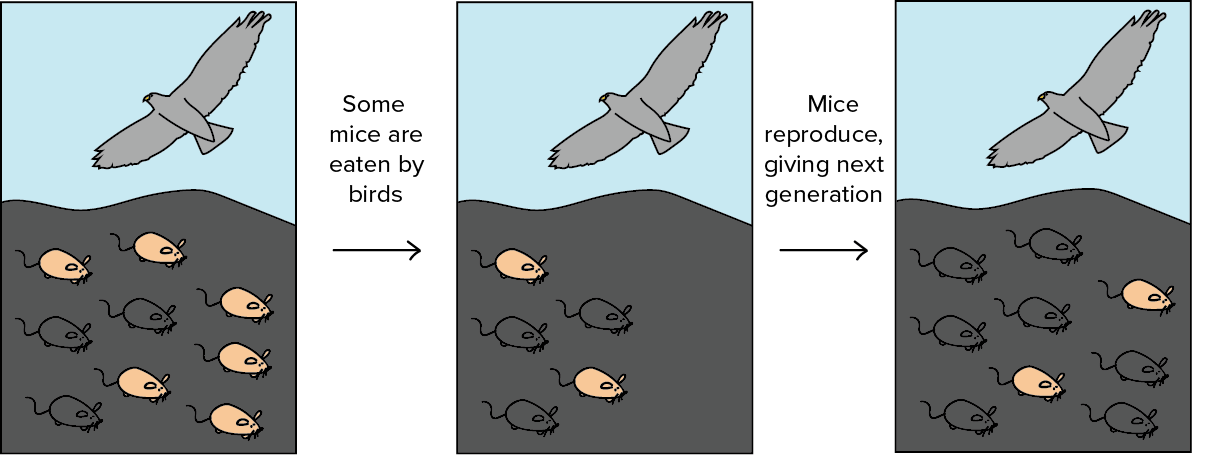
Why is the mouse population changing over time?
a)
The light mice can reproduce more successfully than the dark mice
b)
The hawks eat more dark mice than light mice because the dark mice taste better
c)
The hawks eat more light mice than dark mice because they can see the light mice more easily
d)
The hawks eat more dark mice than light mice because they can see the dark mice more easily
50.
A species is a group of similar organisms that
a)
can mate with each other and produce fertile offspring.
b)
can live together on an island.
c)
can migrate to an island from the mainland.
d)
all have exactly the same traits.
51.
What did Darwin infer from his observations of organisms in South America and the Galápagos Islands?
a)
The organisms on the Galápagos Islands were virtually identical to mainland organisms.
b)
A small number of different plant and animal species had come to the mainland from the Galápagos Islands.
c)
The organisms on the Galápagos Islands were completely unrelated to mainland organisms.
d)
A small number of different plant and animal species had come to the Galápagos Islands from the mainland.
52.
What is the role of genes in evolution?
a)
Only genes can be acted on by natural selection.
b)
Parents with recessive genes die from overproduction.
c)
The genes of most surviving parents have only dominant alleles.
d)
Only traits that are controlled by genes can be acted on by natural selection.
53.
Which of these is one of the main ways that a new species forms?
a)
Cross-breeding occurs within the species.
b)
A group is separated from the rest of the species.
c)
Competition occurs between members of the species.
d)
Mutations occur in the alleles of members of the species.
54.
What are fossils?
a)
molds and casts of organisms that live today
b)
drawings of ancient animals and other organisms
c)
footprints or burrows of small animals that live today
d)
the preserved remains or traces of organisms that lived in the past
55.
Which term refers to a species creating more offspring than can possibly survive?
a)
natural selection
b)
overproduction
c)
evolution
d)
variation
56.
How does natural selection lead to evolution?
a)
Stronger offspring kill weaker members of the species.
b)
Helpful variations accumulate among surviving members of the species.
c)
Overproduction provides food for stronger members of the species.
d)
Environmental changes favor weaker members of the species.
57.
Darwin concluded that organisms on the Galápagos Islands
a)
had changed over time.
b)
had remained the same.
c)
were the result of selective breeding.
d)
had no variations.
58.
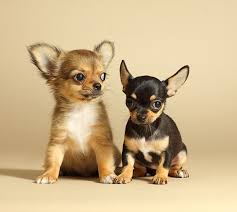
Dogs such as Chihuahuas are examples of....
a)
Artificial Selection 
b)
Natural Selection 
c)
Mutations 
59.
Farmers breed cows to produce high amounts of milk. This is an example of...
a)
Natural Selection 
b)
Variations in a species 
c)
Selective Breeding 
60.
What is the definition of natural selection?
a)
Genes that are chosen by humans such as farmers and ranchers
b)
Organisms that are chosen by environmental pressures such as climate, available food, predators and habitat.
c)
Dogs and Wolves
d)
Genes that are chosen by scientist and academics. 
61.
The Aztecs and Maya Tribes of Mexico where some of the first humans to slowly change wild corn to the corn we know today. What process did these tribes use?
a)
Natural Selection
b)
Artificial Selection "Selective Breeding"
c)
Mitosis
d)
Cell Membrane
62.
What is the definition of mutation?
a)
A random change in the genes of an organism
b)
Natural Breeding
c)
Natural Selection 
d)
Breeding two animals to create a new one
63.
What organisms only survive in the wild (Nature)?
a)
Handicap Organisms 
b)
White Mouse
c)
Only Fit organisms 
d)
Organisms that cannot adapt
64.
A German Shepard would probably not survive in the wild because...
a)
the dog is mixed.
b)
the dog is a product of artificial selection and not adapted for the wild.
c)
the dog is dumb.
d)
the dog is a product of natural selection and can survive in the wild.
65.
It is believed that domesticated pigs are descended from (are ancestors of) wild boars. Look at the two photographs below. A domesticated pig is pictured on the left, and a wild boar is pictured on the right. 
a)
A.  The domesticated pig has a large hump, and the wild boar does not have a hump. 
b)
The domesticated pig has more hair/fur than the wild boar
c)
 The domesticated pig has less hair/fur than the wild boar.
d)
 The domesticated pig does not have hooves, and the wild boar has hooves.
66.
Advantageous traits are likely to increase in future generations because
a)
A.  individuals with the traits are more likely to survive, passing their genes onto their offspring.
b)
only individuals who have the most dominant genes are allowed to reproduce
c)
A.  natural selection selects against unfavorable variations, removing individuals without the traits.
d)
A.  the offspring without the traits often do not survive into maturity to reproduce.  
67.
Whose theory included "acquired traits" such as a giraffe needing a long neck so they stretch it over time?
a)
Darwin
b)
Lamarck
68.
This salamander did not use its eyes so it lost its vision. Whose theory said if you don't use it, you lose it? 
a)
Darwin
b)
Lamarck
69.
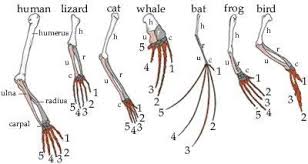
Humans, birds, whales, and lizards all have similar arm bones. What is the reason for this?
a)
The function of these bones is the same in all animals
b)
They live in similar environments
c)
They have a common ancestor
d)
All organisms resemble humans
70.
Bird wings and butterfly wings are an example of
a)
Homologous structure
b)
Analogous structure
c)
Mimicry
d)
Camoflague
71.
Shark fins and dolphin fins are examples of analogous structures.
a)
True
b)
False
72.

Evolved from the same ancestor, but have different functions

a)

Homologous structures

b)

Analogous structures

c)

Vestigial structures

d)

All of the above

73.

Penguin flipper and fish fin

a)

Homologous

b)

Vestigial

c)

Analogous

d)

None of the above

74.
Humans, birds, whales, and lizards all have similar arm bones. What is the reason for this?
a)
The function of these bones is the same in all animals
b)
They live in similar environments
c)
They have a common ancestor
d)
All organisms resemble humans
75.

Which of the following are vestigial structures humans have? Select all that apply.

a)

Appendix

b)

Tailbone

c)

Forearm bones

d)

Goosebumps

76.

Whales have pelvic bones. What type of structure does this best represent?

a)

Homologous structure

b)

Analogous structure

c)

Vestigial structure

d)

None of the above

77.

What is an example of artificial selection?

a)

Letting dogs choose their own mate

b)

Letting plants pollinate on their own

c)

Crossing a labrador and a poodle to create a labradoodle

78.

Which statement is true comparing natural selection and artificial selection?

a)

In natural selection, traits benefit humans and in artificial selection, the traits benefit the species

b)

In natural selection, traits benefit the species and in artificial selection, the traits benefit humans

c)

In natural and artificial selection, the process takes hundreds of years to occur

d)

In natural and artificial selection, nature determines what traits will be passed down to offspring.

79.

Artificial selection is also known as

a)

natural selection

b)

selective hearing

c)

genetic manipulation

d)

selective breeding

80.

What is this an example of?

a)

natural selection

b)

artificial selection

81.
When scientists compare the amino acid sequences for the red blood cell protein hemoglobin between various species, what can they determine about the evolutionary relationship between the species?
a)
It can be determined how efficient hemoglobin is for different species
b)
It can provide evidence about the relatedness of the different species: if they are more similar they have a more recent common ancestor.
c)
It cannot determine relatedness between different species, only individuals of the same species
d)
It can show which species evolved first
82.
When comparing amino acid sequences for hemoglobin in humans, horses and gorillas, which two were most closely related?
a)
horses and gorillas
b)
horses and humans
c)
humans and horses
d)
humans and gorillas
83.
The Table below shows the # of differences in amino acids in a protein called “Cytochrome C” when comparing humans to other organisms. The protein is used by many plants and animals to convert energy in cells.
List the 4 closest human relatives based on this biochemical comparison.
a)
chimpanzee, horse, rattlesnake, snapping turtle
b)
chimpanzee, gorilla, rhesus monkey, horse
c)
fruit fly, bread mold, tuna fish, snapping turtle
d)
gorilla, rhesus monkey, rattlesnake, gorilla
84.
List the 4 most distant relatives based on this biochemical comparison.
a)
bread mold, snapping turtle, gorilla, fruit fly
b)
bread mold, tuna fish, rhesus monkey, rattlesnake
c)
bread mold, gorilla, horse, chimpanzee
d)
bread mold, fruit fly, tuna fish, snapping turtle
85.
How do fossils provide evidence that evolution has happened on Earth?
a)
Fossils show how the sizes of certain animals has changed drastically over millions of years
b)
Fossils show that some species have gone extinct
c)
Fossils show how life forms present today are different than those from the past
d)
Different sedimentary rock layers provide evidence for how the environment has changed over time
86.
The forelimbs of vertebrates, like the ones pictured here, are similar in terms of number of bones and the orientation of bones. Which best describes how comparing homologous structures provides evidence of evolution?
a)
The genes for the body plan and forelimb layout were present in a common ancestral species vertebrates share, thus passed onto all vertebrates.
b)
Similar anatomical structures show how animals adapt to changing environments
c)
Homologous structures show that different species evolve at different rates
d)
Homologous structures don’t actually provide evidence for evolution
87.
A fossil of an extinct dinosaur is found and the anatomy of the fossil shows similarities to that of a bird. What could this mean?
a)
This is purely by chance and isn't significant
b)
The extinct dinosaur and modern bird share a common ancestor
c)
All dinosaurs evolved into birds and that's why there aren't any dinosaurs alive today
d)
Dinosaurs choose to fly, and evolved into birds to escape predation and capture food
88.
The diagram above shows an embryo of different vertebrates at different stages of development. Which field of study would support the similarities in development as evidence for evolution?
a)
comparative biochemistry
b)
paleontology
c)
comparative biogeography
d)
comparative anatomy
89.
When scientists compare animals currently living on different continents, they often find those with similar characteristics, who are not actually close relatives, living in similar environmental conditions even though they are geographically very distant. One example is the Anteater/Armadillos of the Americas and the Pangolin of Africa. What can we deduce from this evidence?
a)
Living things can adapt similarly to similar environments over time.
b)
Living things do not change over time
c)
They must all have the same recent common ancestor
d)
I don’t know
90.
What do scientists generally find when comparing the relationship of living things in different geographic areas?
a)
Species living further apart geographically typically share a more recent common ancestral species than those living closer together
b)
Species living closer geographically typically share a more recent common ancestral species than those living further apart
c)
The location of where an organism lives gives no insight into their evolutionary relationships to other species
d)
Their protein sequences depend on the protein intake from the local watering hole.
91.
Convert from meters to cm:  9 meters
a)
900 cm
b)
90 cm
c)
0.9 cm
d)
0.09 cm
92.
Convert 17 m to cm:
a)
0.17 cm
b)
0.017 cm
c)
1,700 cm
d)
170 cm
93.
Convert 300 meters to centimeters:
a)
3000 cm
b)
0.3 cm
c)
30,000 cm
d)
3 cn
94.
Convert 8 kilometers to meters
a)
800 m
b)
80,000 m
c)
8,000 m
d)
.008 m
95.
Convert 5 cm to mm:
a)
5,000mm
b)
0.5 mm
c)
0.05 mm
d)
50 mm
96.
Convert 300 cm to m:
a)
3 m
b)
30 m
c)
0.3 m
d)
0.03 m
97.
648 g = ____ mg
a)
6,480
b)
64,800
c)
648,000
d)
64.8
98.
1 L = _______ mL
a)
1
b)
10
c)
100
d)
1000
99.
285 kg = ____ g
a)
285,000
b)
285
c)
2,850
d)
28,500
100.
.79 Km = ______m
a)
79
b)
790
c)
0.79
d)
7,900
101.

Which best describes punctuated equilibrium?

a)

Speciation occurs due to natural selection

b)

Speciation occurs due to isolation

c)

Speciation occurs slowly in geologic time, followed by long periods with very fast evolutionary change.

d)

Speciation occurs suddenly and rapidly in geologic time, followed by long periods with little evolutionary change.

102.

Based on the image above, what type of Isolation is shown?

a)

Geographic Isolation

b)

Behavioral Isolation

c)

Temporal Isolation

103.

Fireflies make a pattern of flashes that attract mates of their own species. What type of isolation is this?

a)

Geographic Isolation

b)

Behavioral Isolation

c)

Temporal Isolation

104.

Two species of whales are divided by a physical barrier that connects two continents. What type of isolation is this?

a)

Geographic Isolation

b)

Behavioral Isolation

c)

Temporal Isolation

105.

One species of lizard breeds in the spring, one breeds in the summer. What type of isolation is this?

a)

Geographic Isolation

b)

Behavioral Isolation

c)

Temporal Isolation

106.

Is this image and description Gradualism or Punctuated Equilibrium?

a)

Gradualism

b)

Punctuated Equilibrium

107.

What are evolutionary trees called? (More than one answer)

a)

Punctuated Equilibrium

b)

Phylogenic Tree

c)

Gradualism

d)

Cladogram

108.

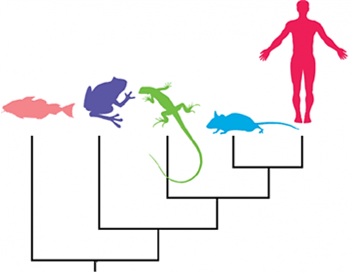
Which organism is most closely related to the cat?

a)

Fish

b)

Frog

c)

Salamander

d)

Goose

e)

Human

109.

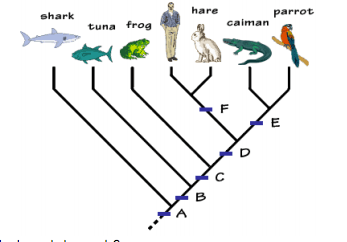
On the cladogram, which organism is the closest relative of the parrot?

a)

Frog

b)

Hare

c)

Caiman

d)

Parrot

110.

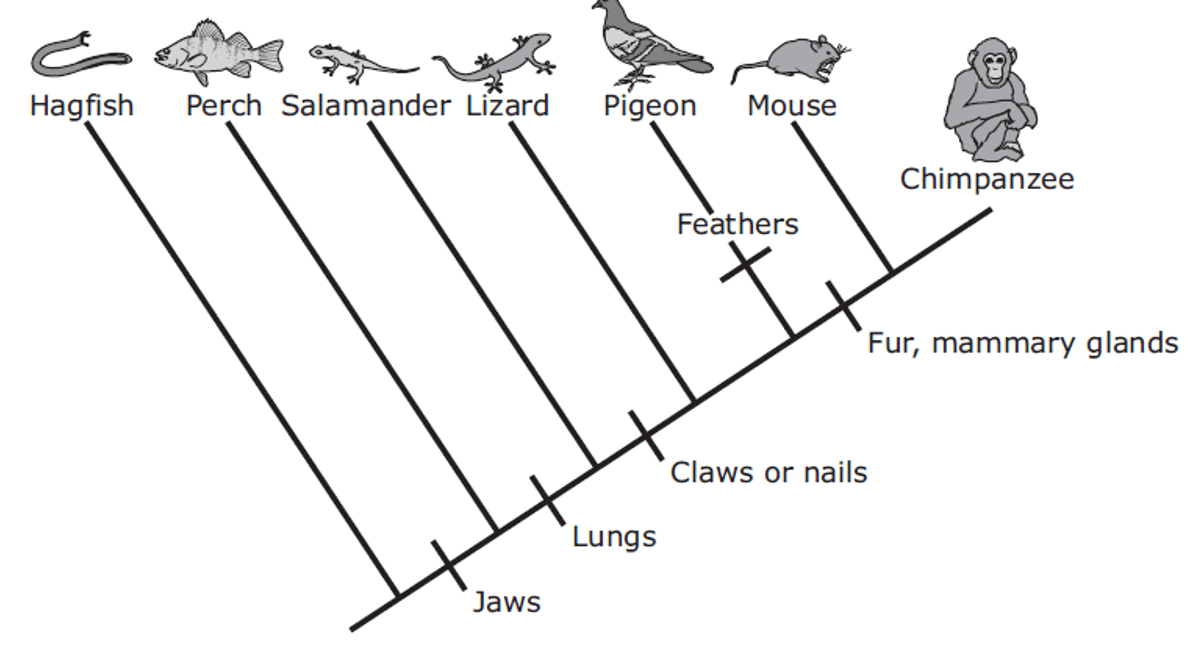
All the animals to the right of the salamander would have the common characteristic of...

a)

Fur

b)

Claws or nails

c)

Lungs

d)

Jaws

111.
Why are advantageous traits more likely to be passed onto offspring?
a)
Because they are more likely to survive and reproduce.
b)
Because they come from dominant alleles.
c)
Because they come from recessive alleles.
d)
Because the trait is an acquired phenotype.
112.
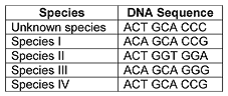
According to this data, the unknown bacterial species is most closely related to: 
a)
Species I
b)
Species II
c)
Species III
d)
Species IV
113.

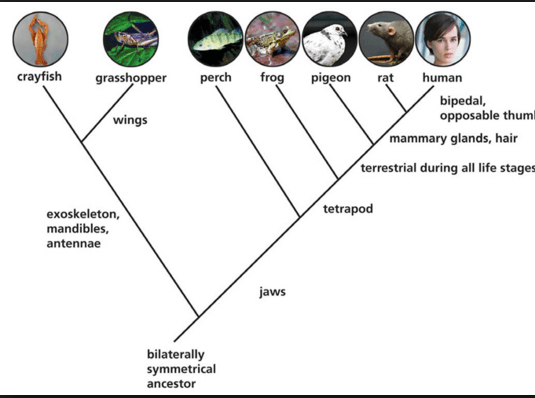
According to the cladogram, which organism is most distantly related to the human?

a)

crayfish

b)

grasshopper

c)

perch

d)

frog

114.

In a phylogenetic tree, the branching points represent common ancestors.

a)

Yes

b)

NO

115.

The lizard has all these derived characteristics EXCEPT

a)

Jaws

b)

Lungs

c)

Bipedal

116.

What is the common ancestor of Letters A, B, C, D, E?

a)

1

b)

2

c)

3

117.

Which group of animals on this tree are most closely related to birds?

a)

Saurischian dinosaurs

b)

Ornithischian dinosaurs

c)

Crocodiles

d)

None of these are related to birds

118.

According to this phylogenetic tree, which creature is the least related out of all pictured?

a)

Fish

b)

Frog

c)

Salamander

d)

Human

119.

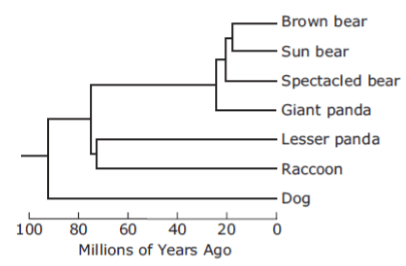
Based on this phylogenetic tree, which statement is true?

a)

Lesser pandas are more genetically similar to giant pandas than they are to raccoons

b)

Brown bears are more genetically similar to giant pandas than they are to sun bears

c)

Lesser pandas are more genetically similar to raccoons than they are to giant pandas

d)

The bear species are all more genetically similar to dogs than they are to giant pandas
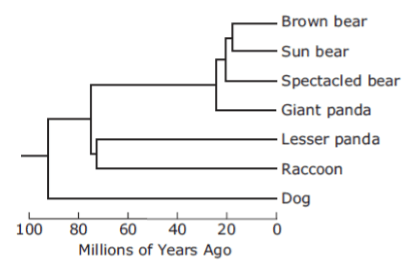
120.

Who is the closest relative to the brown bear?

a)

Giant panda

b)

Dog

c)

Lesser panda

d)

Sun bear

121.

Which is the most recent common ancestor for the giant panda and the raccoon?

a)

A

b)

B

c)

C

d)

None of these are correct

122.

Which organism is the most distantly related to all the others?

a)

Raccoon

b)

Dog

c)

Giant Panda

d)

Sun Bear

123.

The large-scale events of speciation are called...

a)

macroevolution

b)

simplification

c)

adaptation

d)

microevolution

124.

Which of the following lines of evidence shows that whales are descended from a land-dwelling, four-legged ancestor?

a)

Whales have bone structures in their forelimbs and pelvis that are similar to those of terrestrial mammals

b)

Whale embyros have similar structure to embryos of land-dwelling mammals, birds, and reptiles.

c)

An analysis of DNA shows that whales' closest living relatives are hippopotamuses.

d)

A, B, and C

125.

Which of the following statements accurately describes the role of mutations in evolution

a)

Mutations are the raw material for evolution, but most mutations do not result in evolution.

b)

Most mutations result in a species becoming more dangerous or aggressive.

c)

An organisms can decide to mutate if the environment makes a mutation necessary for survival.

d)

Mutations are almost always beneficial for an individual.

126.

Which of the following is required for a population to diverge into two separate species?

a)

The two populations must have evolved different physical appearances.

b)

The two populations must have mutated at least 10 times.

c)

The two populations must have become reproductively isolated.

d)

The two populations must have evolved analogous structures.

127.

The palmarus longus tendon, pictured here, no longer serves a purpose in humans, but provides evidence of our species descendance from tree-dwelling ancestors. The palmarus longus tendon is an example of:

a)

a vestigial structure

b)

a homologous structure

c)

bipedalism

d)

convergent evolution

128.

A new river forms and splits two populations, causing ______________ speciation

a)

Sympatric

b)

Allopatric

c)

Extreme

d)

Convergent

129.

A speciation in which new species evolve from a single ancestral species while inhabiting the SAME geographic region.

a)

Sympatric speciation

b)

Allopatric speciation

c)

Complex speciation

d)

Divergent speciation

130.

The emergence of new rivers or streams is a type of ____________ isolation.

a)

Temporal

b)

Mechanical

c)

Behavioral

d)

Geographic

131.
The hypothesis that evolution of a species occurs gradually over time as a slow and constant process is known as
a)
speciation
b)
punctuated equilibrium
c)
gradualism
d)
microevolution
132.

Which are causes of speciation? Choose all that apply

a)

Isolation caused by mountains, rivers and man-made structures

b)

preference for different foods

c)

change in environment

d)

different mating behaviors

133.

Speciation that caused by breeding occurring at different time of the day is called

a)

behavioral isolation

b)

temporal isolation

c)

ecological isolation

d)

habitat isolation

134.
The evolution of a new species from an existing species is ____.
a)
natural selection
b)
isolation
c)
speciation
d)
genetic variation
135.
a)

Stabilizing Selection

b)

Directional Selection

c)

Disruptive Selection

136.
a)

Stabilizing Selection

b)

Directional Selection

c)

Disruptive Selection

137.
a)

Directional Selection

b)

Stabilizing Selection

c)

Disruptive Selection

138.
a)

Stabilizing Selection

b)

Directional Selection

c)

Disruptive Selection

139.
a)

Directional Selection

b)

Stabilizing Selection

c)

Disruptive Selection

140.
a)

Directional Selection

b)

Stabilizing Selection

c)

Disruptive Selection

141.
a)

Stabilizing Selection

b)

Directional Selection

c)

Disruptive Selection

142.
a)

Stabilizing Selection

b)

Directional Selection

c)

Disruptive Selection

143.
a)

Stabilizing Selection

b)

Disruptive Selection

c)

Directional Selection

144.
a)

Stabilizing Selection

b)

Directional Selection

c)

Disruptive Selection

145.
a)

Directional Selection

b)

Disruptive Selection

c)

Stabilizing Selection

146.
a)

Stabilizing Selection

b)

Directional Selection

c)

Disruptive Selection

147.
a)

Directional Selection

b)

Stabilizing Selection

c)

Disruptive Selection

148.
a)

Directional Selection

b)

Disruptive Selection

c)

Stabilizing Selection

149.
a)

Directional Selection

b)

Stabilizing Selection

c)

Disruptive Selection

150.
a)

Directional Selection

b)

Stabilizing Selection

c)

Disruptive Selection

151.

Slight genetic change over a few generations in a population that does not result in the evolution of a new species is:

a)

Macroevolution

b)

Microevolution

152.

Detailing the evolution of birds from theropod dinosaurs would be an example of?

a)

Macroevolution

b)

Microevolution

153.
What are prezygotic isolating mechanisms?
a)
They prevent reproductive attempts and make it unlikely that fertilization will be successful if mating occurs.
b)
When animal genitalia or plant floral structures are incompatible, reproduction can not occur
c)
Courtship patterns used to allow male and female to recognize one another
d)
A biological trait evolves in two unrelated species as a result of exposure to similar environments
154.
What best defines Behavioral isolation?
a)
Courtship patterns used to allow male and female to recognize one another
b)
Even if the two gametes of two different species meet, they can not fuse to become a zygote
c)
When animal genitalia or plant floral structures are incompatible, reproduction can not occur
d)
Even if the two gametes of two different species meet, they can not fuse to become a zygote
155.
What choice answer best defines mechanic isolation?
a)
A biological trait evolves in two unrelated species as a result of exposure to similar environments
b)
Barriers that prevent the formation of a fertile offspring
c)
When animal genitalia or plant floral structures are incompatible, reproduction can not occur
d)
The mating between two species
156.

Some female peacocks prefer males with large, colorful tales while other female peacocks prefer males with no tail at all. Females are now mating only with the tail they prefer. What type of reproductive barrier is this?

a)

behavioral isolation

b)

hybrid sterility

c)

temporal isolation

d)

mechanical isolation

157.
Which is an example of temporal isolation?
a)
flowers that bloom in different months 
b)
birds that have different mating calls
c)
fruit flies that mate in different locations
d)
squirrels that have different fur colors
158.
What are Postzygotic isolating mechanisms?
a)
A diploid cell resulting from the fusion of two haploid gametes
b)
Barriers that prevent the formation of a fertile offspring
c)
They prevent reproductive attempts and make it unlikely that fertilization will be successful if mating occurs
d)
The mating between two species
159.
Which type of speciation occurred when maggot flies living on harthorns began to feed on apples?
a)
Allopatric
b)
Sympatric
160.
Which type of speciation occurred when a few finches were blown from the coast of South America to the Galapagos Islands and then evolved into 14 different finch species?
a)
Allopatric
b)
Sympatric
161.

What type of speciation involves isolation due to behavior such as sexual selection?

a)

Allopatric

b)

Sympatric

162.
What type of speciation involves geographic isolation?
a)

Allopatric

b)

Sympatric

163.
The hypothesis that evolution of a species occurs gradually over time as a slow and constant process is known as
a)
speciation
b)
punctuated equilibrium
c)
gradualism
d)
microevolution
164.

The hypothesis that evolution of a species occurs in periods of rapid change separated by periods of little or no change is called

a)

divergence

b)

gradualism

c)

punctuated equilibrium

d)

isolation

165.
Studying the similarities in organisms development 
a)
DNA
b)
Embryonic 
c)
Vestigial 
d)
Homologous