wayground logo

Free Printable Worksheets

Font size

S
M
L
XL
Worksheets

APES Midterm Review

Total questions: 133

Worksheet time: 2hrs 24mins

Name
Class
Date
1.

The population pyramid shown is most likely which country?

a)

Nigeria

b)

China

c)

Germany

d)

Japan

2.

The Population Pyramid shown is most likely which country?

a)

Canada

b)

Japan

c)

Zimbabwea

d)

Algeria

3.

What is the amount of average children needed for a population to achieve ZPG?

a)

2.1 per woman

b)

1 per woman

c)

3 per woman

d)

2.5 per woman

4.
Worldwide there were 20 births and 8 deaths per 1000 people in 2017. Calculate the growth rate of the world.
a)
1.1%
b)
2.8%
c)
1.2%
d)
1.6%
5.
The small town of West Fremont has a population of 50,000.  If the growth rate of West Fremont is 2%, then how long will it take for the population of West Fremont to double?
a)
70 years
b)
7 years
c)
35 years
d)
3.5 years
6.
Which of the following is a true statement about replacement-level fertility?
a)
It equals the average number of children a woman will give birth to during her child-bearing years
b)
It equals the annual number of live births per 1,000 people in a population
c)
It equals the natural increase of a population in one year
d)
It is greater in countries with high infant-mortality rates than in countries with low infant-mortality rates
7.
The increase in the size of Earth’s human population in the last century has been dramatic. Which of the following identifies two major contributors to this increase?
a)
New methods of agriculture and the identification of new food crops
b)
The Industrial Revolution and modern medicine
c)
New methods of birth control and decreased warfare
d)
Increased education for women and the development of new pesticides
8.
Which section would see exponential population growth?
a)
1
b)
2
c)
3
d)
4
9.
Canada has a total area of 9,984,670 km2, but 891,163 km2 of that are freshwater lakes. If Canada has a population of 30,750,087 people, what is its population density?
a)
1 person per km2
b)
2 people per km2
c)
3 people per km2
d)
4 people per km2
10.
Which of the following is NOT caused by anthropogenic activities?
a)
Forest fires
b)
Earthquakes
c)
Oil spills
d)
Overfishing
11.
The most critical factor in controlling human population growth is
a)
controlling reproductive lifespan.
b)
decreasing the age of first birth.
c)
decreasing the average number of births per woman.
d)
decreasing infant death.
12.
Which of the following characteristics are typical of r-selected species?
I. They produce many offspring in a short period of time.
II. They have very low survivorship early in life.
III. They take a long time to reach reproductive maturity.
a)
I only
b)
II only
c)
III only
d)
I and II
13.
Use Figure 7-1.  Population A would most likely be in which stage of demographic transition?
a)
Pre-Industrial
b)
Transitional
c)
Industrial
d)
Post-Industrial
14.
Represents the biotic potential of the species
a)
A
b)
B
c)
D
d)
E
15.
Represents the maximum number of individuals that can be supported by a particular ecosystem on a long-term basis
a)
A
b)
B
c)
D
d)
E
16.
A country with an age distribution like that shown in the figure above, is most likely a country that
a)
Is expecting rapid growth
b)
Is experiencing slow or no population growth
c)
Is experiencing a high death rate
d)
Is a less-developed country
17.
According to the theory of demographic transition, countries move through growth phases in which order?
a)
stable growth, rapid growth, slow growth, declining growth
b)
rapid growth, slow growth, stable growth, declining growth
c)
slow growth, declining growth, rapid growth, stable growth
d)
slow growth, rapid growth, stable growth, declining growth
18.
Which of the following have contributed to increased family planning worldwide?
  I. women's education
 II. increased income
III. advertising campaigns
a)
I, II, and III
b)
I and II only
c)
I and III only
d)
II and III only
19.
Which is not a density independent factor?
a)
Climate change
b)
Hurricanes
c)
Clear cutting forests
d)
Parasitism
20.
Which is not a density dependent factor?
a)
Competition
b)
Predation
c)
Volcanic Eruption
d)
Disease
21.
The graph on the right best represents which country?
a)
USA
b)
Mexico
c)
Nigeria
d)
India
22.
Individuals with favorable traits survive, reproduce, and pass their traits onto their offspring. This is called:
a)
Mutation
b)
Adaptation
c)
Evolution
d)
Natural Selection
23.
A population is...
a)
A group of species in one area
b)
Multiple species that live in one area
c)
All of the living and nonliving things in an area
d)
All biotic and abiotic factors in an ecosystem
24.
A population will most likely stop growing when it reaches its:
a)
Growth limit
b)
Exponential limit
c)
Carrying Capacity
d)
Metapopulation
25.
Carrying capacity is represented by which letter?
a)
r
b)
E
c)
K
d)
c
26.
Refer to the diagram of the survivorship curve.
Which curve best describes an organism that invests a lot of energy in parenting?
a)
A
b)
B
c)
C
d)
this is not a survivorship curve
27.
Which type of growth is best illustrated by this rabbit population?
a)
exponential
b)
logistic
c)
S-shaped
d)
boom-bust
28.
In this Food Web Pyramid Which type of consumer gets only 10% of the energy stored in plants?
a)
Herbivore
b)
Carnivore
c)
Omnivore
d)
Top carnivore
29.
What percentage of energy is passed on to each tropic level in an energy pyramid?
a)
10%
b)
50%
c)
90%
d)
100%
30.
Which process takes Carbon Dioxide from the air and converts it into a form of carbon used by living things?
a)
Precipitation
b)
Photosynthesis
c)
Respiration
d)
Bioremediation
31.
Gases such as carbon dioxide, methane and water vapor trap heat in the Earth's atmosphere causing global warming
a)
Global warming gases
b)
Hot house gases
c)
Greenhouse gases
d)
Thermal pollution
32.
Growing legumes such as alfalfa, peas or soy beans increases the process of 
a)
denitrification
b)
nitrogen fixation
c)
ammonification
d)
ammonium oxidation
33.
Which of the following describes the role of nitrogen-fixing bacteria in the nitrogen cycle? Nitrogen-fixing bacteria convert
a)
nitrates intro nitrogen gas
b)
ammonia into proteins
c)
nitrogen gas into ammonia
d)
proteins into nitrates
34.
Organisms use nitrogen to form
a)
carbohydrates and lipids
b)
proteins and lipids
c)
lipids and nucleic acids
d)
proteins and nucleic acids
35.
This a picture of the
a)
nitrogen cycle
b)
carbon cycle
c)
water cycle
d)
plant cycle
36.
What happens when organisms die and decay? 
a)
Their nitrogen moves to the air as nitrogen gas
b)
Their nitrogen returns to the soil as ammonium
c)
Their nitrogen becomes tapped in clay and is unusable
d)
They stay on earth forever
37.
Which of the following is a consequence of excess carbon building up in Earth’s atmosphere?
a)
The amount of breathable oxygen available to living things decreases
b)
Global temperatures change, affecting normal weather patterns.
c)
The amount of solar energy reaching the earth’s surface decreases.
d)
Global air pressure increases making it more difficult for plants and animals to breathe.
38.
Identify the cycle pictured.
a)
The Water cycle
b)
The Carbon cycle
c)
The Nitrogen cycle
d)
This is not a correct diagram of any cycle.
39.
The energy that drives the water cycle comes from 
a)
Solar Radiation
b)
Geothermal Heat
c)
Water Energy
d)
Advection
40.
Which nutrient is not cycled through the atmosphere?
a)
carbon
b)
nitrogen
c)
phosphorous
d)
water
41.
Ammonia not taken up by plants is converted by soil bacteria into nitrate ions NO3- which are easily taken up by the roots of plants
a)
Fixation
b)
Nitrification
c)
Ammonification
d)
Denitrification
42.
Which is the slowest to cycle?
a)
Nitrogen 
b)
Phosphorus
c)
Sulfur
d)
Nitrogen
43.
Take a look at the diagram and identify Zone A
a)
Littoral Zone
b)
Profundal Zone
c)
Limnetic Zone
d)
Benthic Zone
44.
Take a look at the diagram and identify zone B
a)
Littoral Zone
b)
Limnetic Zone 
c)
Profundal Zone
d)
Benthic Zone
45.
Take a look at the diagram and identify zone D
a)
Littoral Zone
b)
Limnetic Zone 
c)
Profundal Zone
d)
Benthic Zone
46.
Take a look at the diagram and identify zone E
a)
Littoral Zone
b)
Limnetic Zone
c)
Profundal Zone
d)
Benthic Zone
47.
The general word for an area of land that acts like a sponge and has wet soil and is underwater at some point during the year...
a)
Wetland
b)
Mangrove
c)
Taiga
48.
A type of wetland that is wet and spongy and has mostly grasses and reeds, but NO trees...
a)
Swamp
b)
Marsh
c)
Bog
49.
A type of wetland having a growth of TREES along with other vegetation..
a)
Swamp
b)
Marsh
c)
Bog
50.
A type of wetland where the soil is composed mainly of decayed plant matter and also forms a pool of water when the ice and snow melt in cold regions...
a)
Swamp
b)
Wetland
c)
Bog
51.
Tropical trees that grow in wetland areas and have roots with breathing pores...
a)
Coniferous
b)
Mangroves
c)
Tussocks
52.
A habitat in which the fresh water of a river meets the salt water of the ocean...thought of as the ocean's nursery...
a)
Headwaters
b)
Tributary
c)
Estuary
53.
Which biome is pictured below?
a)
ocean
b)
freshwater
c)
coral reef 
d)
wetland
54.
Which biome is pictured below?
a)
wetland
b)
coral reef
c)
ocean
d)
freshwater
55.
The intertidal zone of oceans
a)
surrounds continents
b)
is on the coastline
c)
has tides that rise and fall each day
d)
is the open ocean
56.
In what zone of the ocean does photosynthesis occur?
a)
Photic zone
b)
Aphotic zone
c)
Benthic Zone
57.
What are lakes that have low productivity due to low amounts of nutrients such as phosphorous and nitrogen in the water.
a)
cultural eutrophication lake
b)
mesotrophic lake
c)
oligotrophic lake
d)
eutrophic lake
58.
What are lakes that have high productivity due to sufficient amounts of nutrients such as phosphorous and nitrogen in the water.
a)
cultural eutrophication lake
b)
mesotrophic lake
c)
oligotrophic lake
d)
eutrophic lake
59.
Removal of which of the following will result in the greatest change(s) in an ecosystem?
a)
indicator species
b)
keystone species
c)
foundation species
d)
threatened species
60.
Pangolins are illegally hunted, decreasing the population. Their scarcity makes them more valuable, so hunting increases. This is a(n):
a)
negative feedback loop
b)
mutualistic relationship
c)
positive feedback loop
d)
commensalistic relationship
61.
Tigers living in warm climates have thinner coats of fur than tigers living in cool climates. This is a result of
a)
general diversity 
b)
species diversity
c)
ecosystem diversity
d)
genetic diversity
62.
What soil type is typically found on the top of soil?
a)
Humus because it made up of dead, organic matter
b)
Loam because it is lighter than the other layers
c)
Clay because it is not able to fit through the finer particles
d)
Rock because the other layers are more dense
63.
What was one of the major causes of the Dust Bowl?
a)
Cold and windy weather
b)
Increasing prices and demand for crops
c)
Removal of grasses and overfarming
d)
Sandy soil composition that would not stay in place
64.
The two main agents of erosion are...
a)
wind and flowing water
b)
gravity and frost wedging
c)
oxygen and water
d)
carbon dioxiede and wind
65.
Which of the following can result from soils that are too acidic?
a)
they create acid-mine drainage
b)
they can leach soluble heavy metals
c)
they can adversely affect aquatic life
d)
they can cause neurological damage in unborn children
66.
Which of the following is the correct order of soil particles in order of increasing particle size?
a)
clay-sand-silt
b)
sand-clay-silt
c)
silt-clay-sand
d)
clay-silt-sand
67.
Soil sample that is 60% clay, 30% silt, and 10% sand has which texture? 
a)
clay
b)
clay loam
c)
sandy loam
d)
silt 
68.
Which type of soil is best for growing plants?
a)
clay
b)
sand
c)
dirt
d)
loam
69.
Which statement BEST summarizes the Tragedy of the Commons?
a)
Self-interests outweigh public interest
b)
Public interests outweigh self-interest
c)
It is all right to be selfish as long as you think of the big picture.
d)
It is a tragedy when biodiversity disappears.
70.
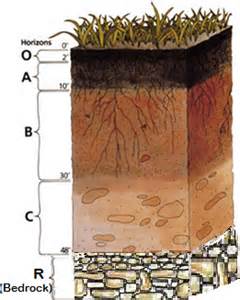
Which is the correct order of soil horizons starting at the surface?
a)
A, B, E,C, O
b)
O, A, B, C, E
c)
O, E, A, B, C
d)
O, A, E, B, C
71.
The deep, underlying non-soil materials
a)
B horizon
b)
E horizon
c)
O horizon
d)
Bedrock
72.
Globally, the leading cause of biodiversity loss is 
a)
invasive species
b)
poaching and overharvesting
c)
pollution
d)
habitat change and loss 
73.
 Characteristic or trait that helps an organism survive in its environment
a)
skills
b)
speciation
c)
natural instinct
d)
adaptation
74.
Which of the following describes the importance of biodiversity to an ecosystem?
a)
a. People like to be able to see all the different plants and animals
b)
b. If there aren�t all the different species, there will be resources that aren�t being used
c)
c. Biodiversity is not as important as many people think
d)
d. Biodiversity can help minimize the effects of losing a species.
75.
What is the main suspected environmental problem associated with the burning of fossil fuels?
a)
a. Depletion of fresh water
b)
b. Depletion of ozone
c)
c. Global cooling
d)
d. Global warming
76.
Which human activity would be most destructive to the biodiversity of the biosphere?
a)
a. The burning of wood and coal in rural areas
b)
b. The release of species of freshwater trout in lakes
c)
c. The removal of plants from the food webs they support
d)
d. The removal of erosion barriers from forest boundaries
77.
Why are invasive species such a problem in their new ecosystem?
a)
a. The new ecosystem isn�t adapted to their presence
b)
b. The new ecosystem is probably weaker than the native one
c)
c. They have mutations making them more adapted to the new ecosystem
d)
d. They cause mutations in the native species
78.
Which biome is characterized by low temperatures and low amounts of rainfall?
a)
tundra
b)
desert
c)
temperate deciduous forest
d)
tropical rain forest
79.
Which biome covers most of the land mass near the Earth's equator?
a)
tundra
b)
desert
c)
grassland
d)
tropical rainforest
80.
One characteristic feature of tundra is that only the surface thaws in the summer and refreezes in the winter, leaving a layer of permanently frozen subsoil.  This characteristic is known as
a)
glaciation
b)
permafrost
c)
crystallization
d)
soilfrost
81.
Primary succession would occur on a 
a)
meadow destroyed by flood
b)
meadow destroyed by overgrazing 
c)
newly created volcanic island
d)
section of a forest destroyed by an avalanche 
82.

The variety of ecosystems in within a given region is

a)

ecosystem diversity

b)

species diversity

c)

genetic diversity

d)

species richness

e)

species evenness

83.

The number of species in within a given area measures

a)

ecosystem diversity

b)

species diversity

c)

genetic diversity

d)

species richness

e)

species evenness

84.

The variety of genes in within a given species

a)

ecosystem diversity

b)

species diversity

c)

genetic diversity

d)

species richness

e)

species evenness

85.

The relative proportion of different species in a given area is a measurement of

a)

ecosystem diversity

b)

species diversity

c)

genetic diversity

d)

species richness

e)

species evenness

86.

A change in the genetic composition of a population over time as a result of human selecting which individuals breed is known as

a)

adaptation

b)

artificial selection

c)

fitness

d)

natural selection

87.

An individual's ability to survive and reproduce is known as

a)

adaptation

b)

artificial selection

c)

fitness

d)

natural selection

88.

A species that can only live in a certain habitat, or one that feeds on a small range of species

a)

background extinction

b)

generalist

c)

specialist

d)

realized niche

e)

fundamental niche

89.
The use of pesticides and fertilizers is carefully monitored 
because of the effect they can have on the environment. 
Which of the following is a possible negative effect of the use 
of these chemical on the environment?
a)
Runoff carries these chemicals into lakes and streams.
b)
Theses chemicals cannot be purchased in large bulk.
c)

These chemicals are expensive to produce.
d)
Storage space for these chemicals is limited.
90.
The illustration provided shows a river and four cities on that river. When the water from the river was sampled at location X, it was determined to be polluted with various chemicals. What would be the most likely source for this pollution?
a)
City 1 and City 2
b)
City 2 and City 3
c)
City 3 and City 4
d)
City 1 and City 4
91.
What is a watershed?
a)
Land that collects and channels water froma small body of water to a larger body of water
b)
the shape of the land determined by elevation
c)
A natural stream of water of considerable  volume
d)
a river and all its tributaries
92.
Why is gravity a factor in watersheds? 
a)
it causes the water to flow away from a watershed
b)
it causes the water to flow towards a watershed
93.
What is topography?
a)
a graph showing all the different topos
b)
A map of all the waterways in an area
c)
the shape of the land determined by the elevation
94.
What is a divide?
a)
a natural stream of water of considerable volume
b)
a continuous ridge that separates a watershed
c)
small rivers or streams that flow into a larger river or stream
d)
a body of fresh water found in low lying areas
95.

Short-term changes in the temperature, barometric pressure, humidity, precipitation, sunshine, cloud cover, wind direction and speed, and other conditions in the troposphere at a given place and time.

a)

weather

b)

climate

96.

An effect whereby a mass moving in a rotating system experiences a force acting perpendicular to the direction of motion and to the axis of rotation.

a)

prevailing winds

b)

Coriolis Effect

c)

atmospheric circulation cells

d)

orographic lifting

97.

An area having relatively little precipitation due to the effect of a topographic barrier, especially a mountain range, that causes the prevailing winds to lose their moisture on the windward side, causing the leeward side to be dry.

a)

orographic lifting

b)

rain shadow effect

98.

What is the difference between weather and climate?

a)

Weather is what we collected throughout the month of December. Climate is what google tells us.

b)

Climate includes only average temperature and average precipitation. Weather includes much more than that.

c)

Weather is the conditions at any particular time, while climate is the pattern of weather that occurs in an area over a long period of time.

d)

Weather is the patternof weather over a long period of time while climate is the current conditions.

99.

Why do we have seasons?

a)

The fact that the Earth is heated unevenly causes the seasons.

b)

The tilt of the Earth and its elliptical orbit around the sun cause the seasons.

c)

We have seasons because of the Earth's tilt.

d)

We have seasons because of plants.

100.

What is the primary reason that air above the equator is heated more than other places?

a)

The equator receives the most direct sunlight.

b)

Sunlight is more spread out at the equator.

c)

There is more land around the equator, so it heats quicker.

d)

It is summer year-round at the equator.

101.

Why is is cooler at the Earth's poles?

a)

Sunlight hits the poles less direct than other places on the Earth.

b)

It is more cloudy around the poles.

c)

The glaciers keep the climate cold.

d)

The North and South Poles are dark all year.

102.

Winds that blow mainly from west to east are _____________ _____________.

a)

Prevailing Easterlies

b)

Prevailing Southerlies

c)

Prevailing Westerlies

d)

Prevailing Northerlies

103.
The tropical winds running from 0 to 30 degrees latitude are called:
a)
subtropical westerlies
b)
polar westerlies
c)
trade winds
d)
polar winds
104.
The tropical winds running from 0 to 30 degrees latitude are called:
a)
subtropical westerlies
b)
polar westerlies
c)
trade winds
d)
polar winds
105.
Which season is taking place in the Northern Hemisphere in Position 3?
a)
Winter
b)
Spring
c)
Summer
d)
Fall
106.
What happens when the area in which you live tilts away from the sun?
a)
It is summer.
b)
It is spring.
c)
It is winter.
d)
It is fall.
107.

Which gas is most prominent in our atmosphere?

a)

oxygen

b)

hydrogen

c)

helium

d)

nitrogen

108.

How does the tilt of the Earth affect climate?

a)

It causes thunderstorms.

b)

It causes the Earth to heat unevenly.

c)

It drives the Global Conveyor Belt.

109.

Which are the 3 main climates on Earth?

a)

Subtropical, warm, tropical

b)

Desert, tropical, warm

c)

Polar, temperate, tropical

d)

Desert, tropical, polar

110.

What type of event will occur at this boundary?

a)

Earthquake

b)

Volcano Eruption

c)

Tornado

d)

Mountain Building

111.

The type of plate boundary where two plates come together is a .....

a)

Convergent Boundary

b)

Divergent Boundary

c)

Transform Boundary

d)

Plate Boundary

112.
Which is the correct order of the convection cells starting from the equator?
a)
polar, ferrell, hadley
b)
ferrell, hadley, polar
c)
polar, hadley, ferrell
d)
hadley, ferrell, polar
113.

A divergent boundary occurs when plates ....

a)

Pull apart

b)

Come together

c)

Slide past each other

d)

subducting

114.
Which horizon is made up of partially weathered rocks?
a)
Horizon A
b)
Horizon B
c)
Horizon C
d)
Horizon D or R
115.
_______ is the type of soil used most often with plants. It is a mixture of clay, sand, and silt.
a)
loam
b)
humus
c)
mud
d)
dirt
116.
Which soil component has the least capacity for holding water?
a)
silt
b)
clay
c)
sand
d)
humus
117.
You dig a small hole in the soil and the next day it rains. The hole fills with water, but does not empty even after several days of dry weather. What is the soil mostly made of?
a)
clay
b)
sand
c)
humus
d)
silt
118.

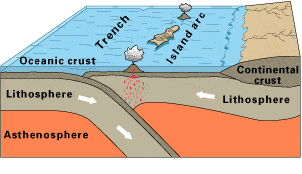
Observe this diagram of a plate boundary. One statement BEST describes what is happening. It is that

a)

the oceanic crust is melting.

b)

the denser ceanic crust is subducting under the less dense oceanic crust

c)

volcanic islands are forming.

d)

the tectonic plates are moving away from each other.

119.
What is "upwelling"?
a)
when wind near a shore pushes surface water away, nutrient rich cold water rises from the depths
b)
water rises from springs at the bottom of lakes
c)
it is when cold water sinks in the Norwegian Sea
d)
It is when the Coriolis effect makes currents go around in a circle
120.
This is the side of the mountain that is often drier and warmer.
a)
Leeward Side
b)
Wet Lapse Rate
c)
Windward Side
d)
Wild Side
121.

What are the proportions of sand, silt, and clay for the soil at point X ?

a)

5% Sand, 95% Silt, 5% Clay

b)

5% Sand, 20% Silt, 5% Clay

c)

65% Sand, 30% Silt, 10% Clay

d)

60% Sand, 30% Silt, 10% Clay

122.

What is the correct sequence of layers of the earth's atmosphere from earth's surface to space?

a)

troposphere, stratosphere, mesosphere, thermosphere.

b)

mesosphere, stratosphere, thermosphere, troposphere.

c)

troposphere, mesosphere, stratosphere, thermosphere.

d)

stratosphere, troposphere, mesosphere, thermosphere.

123.

Which is a direct result of the Coriolis Effect?

a)

Upwellings

b)

tides

c)

ocean conveyor belt

d)

Tsunami

e)

Ocean gyres

124.

What type of plate boundary is shown here?

a)

Convergent

b)

Subduction

c)

Divergent

d)

Transform

125.

What type of plate boundary is most likely to cause the formation of a new landform?

a)

Convergent

b)

Subduction

c)

Divergent

d)

Transform

126.

Which soil particle is largest in diameter?

a)

Clay

b)

Silt

c)

Sand

d)

Loam

127.

In which layer of the atmosphere does weather take place?

a)

Troposphere

b)

Stratosphere

c)

Mesosphere

d)

Thermosphere

e)

Exosphere

128.

Which wind system is closest to the equator?

a)

Doldrums

b)

Westerlies

c)

Polar easterlies

d)

Trade winds

129.

As altitude increases, what happens to temperature?

a)

Temperature increases

b)

Temperature decreases

c)

Temperature does not change with altitude

130.

Which gas is there the most of in the atmosphere?

a)

Oxygen

b)

Nitrogen

c)

Water vapor

d)

Carbon dioxide

131.

ENSO events take place in which ocean basin?

a)

Atlantic

b)

Indian

c)

Pacific

d)

Arctic

132.

Which month has the highest precipitation?

a)

July

b)

August

c)

September

d)

June

133.

Which of the following is the largest carbon sink?

a)

Atmosphere

b)

Plants

c)

Animals

d)

Ocean