Wayground logo

Free Printable Worksheets

Font size

S
M
L
XL
Worksheets

Sci 9 Unit A section 3

Total questions: 139

Worksheet time: 4hrs 35mins

Name
Class
Date
1.

The process by which the nuclear material is divided equally between two new cells

a)

mitosis

b)

cancer

c)

spindle

d)

centromere

2.
Why would it be important to replicate DNA before a cell divides in mitosis or meiosis?
a)
In order for genetic information to be transferred into daughter cells.
b)
In order for the cell to be able to increase in size.
c)
In order for the DNA to be contained in the nucleus.
d)
In order for the cell to re-order the DNA sequencing in the new cells.
3.
In mitosis, the two resulting cells are
a)
different from the starting cell and identical to each other.
b)
different from the starting cell and different from each other.
c)
identical to the starting cell and different from each other.
d)
identical to the starting cell and identical to each other.
4.
How many chromosomes do humans have?
a)
46
b)
21
c)
10
5.
A chromosome is a single, long DNA molecule in a compact formation
a)
True
b)
False
6.
Fruit fly body cells have 8 chromosomes. After mitosis, you would expect a resulting fruit fly daughter cell to have -
a)
16 chromosomes.
b)
46 chromosomes.
c)
8 chromosomes.
d)
4 chromosomes.
7.
Where does a cell contain it's genetic material?
a)
nucleus
b)
nucleolus
c)
cytoskeleton
d)
golgi
8.
These structures pull the spindle fibers and attached chromosomes to opposite ends of the cell.
a)
Spindle fiber
b)
Centriole
c)
Nucleus
d)
Centromere
9.
Structure (b) is a ____.
a)
chromosome
b)
chromatid
c)
centromere
10.
What process does a multi-cellular organism use to replace its damaged body cells?
a)
mitosis
b)
meiosis
c)
replication
d)
transcription
11.
Identify the stage.
a)
interphase
b)
metaphase
c)
anaphase
d)
telophase
12.
Identify the stage of mitosis.
a)
interphase
b)
prophase
c)
metaphase
d)
anaphase
13.
Identify the stage of mitosis.
a)
interphase
b)
prophase
c)
anaphase
d)
cytokinesis
14.
Structure (c) is a ____.
a)
chromosome
b)
chromatid
c)
centromere
15.
Structure (a) is a ____.
a)
chromosome
b)
chromatid
c)
centromere
16.
What is the next phase of mitosis?
a)
Prophase
b)
Metaphase
c)
Anaphase
d)
Telophase
17.
Name the previous phase.
a)
Prophase
b)
Metaphase
c)
Anaphase
d)
Telophase
18.
What is the next phase of mitosis?
a)
Prophase
b)
Metaphase
c)
Anaphase
d)
Telophase
19.
What is the next phase of mitosis?
a)
Prophase
b)
Metaphase
c)
Anaphase
d)
Telophase
20.
The stages of mitosis in order
a)
Metaphase, Anaphase, Prophase, Telophase
b)
Prophase, Anaphase, Metaphase, Telophase
c)
Prophase, Metaphase, Anaphase, Telophase
d)
Anaphase, Prophase, Telophase, Metaphase
21.
The cells produced via meiosis are called:
a)
sex cells
b)
somatic cells
c)
body cells
d)
skin cells
22.
If a body cell in a butterfly contains 24 chromosomes, a butterfly egg would contain
a)
3
b)
6
c)
12
d)
24
23.
The chromosomes that pair up during meiosis, are called __________ chromosomes.  
a)
homozygous 
b)
asexual
c)
homologous
d)
genes
24.
How many daughter cells are produced from meiosis ?
a)
10
b)
6
c)
4
d)
2
25.
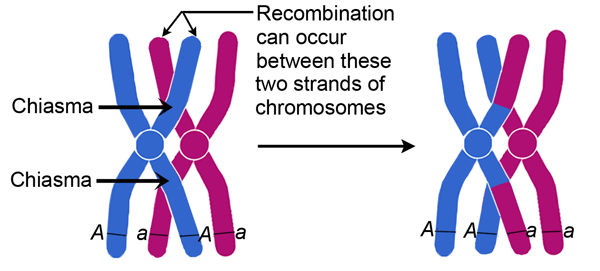
This image shows chromosomes during Prophase 1. Which of the following correctly describes the process shown?
a)
segregation of sister chromatids
b)
condensation and segregation of alleles
c)
mutationin which the DNA content of the gene is altered
d)
crossing - over in which alleles are exchanged
26.
Why do we need meiosis?
a)
To double the number of chromosomes going into sex cells
b)
To halve the number of chromosomes going into sex cells
c)
To triple the number of chromosomes going into sex cells
d)
To not change the number of chromosomes going into sex cells
27.
A human zygote should have _____ chromosomes inside.
a)
46
b)
23
c)
92
d)
64
28.

At the end of mitosis you have _____ cells

a)

identical

b)

different

c)

identical twins

d)

variety

29.
products of meiosis are genetically
a)
different
b)
identical
30.
This picture shows which process? 
a)
mitosis
b)
meiosis
c)
the cell cycle
31.
What process, and which type of resulting cells are represented?
a)
mitosis, gametes
b)
mitosis, body cells
c)
meiosis, gametes
d)
meiosis, body cells
32.
Meiosis makes sperm and egg cells. In humans, sperm and egg cells each have _____ chromosomes. Therefore a fertilized human egg cell (sperm and egg cell combined) would create a cell with _____ chromosomes.
a)
23, 46
b)
46, 23
c)
2, 4
d)
50, 100
33.
What is one of the advantages, why is it better to reproduce sexually versus asexually?
a)
survival of the fittest
b)
overproduction
c)
genetic variation
d)
cloning
34.
What is it called when a sperm and egg meet?
a)
meiosis
b)
fertilization
c)
cell division
d)
mitosis
35.
Goes through P.M.A.T two rounds 
a)
Mitosis
b)
Meiosis
c)
Osmosis
d)
Transcription
36.
Which of these cells would be produced through meiosis?
a)
skin cells
b)
liver cells
c)
brain cells
d)
sperm cells
37.
A male shark has 40 chromosomes in each of its sex cells. How many would be present in its body cells?
a)
20
b)
40
c)
80
d)
160
38.
The male part of the flower is known as the _____.
a)
stamen
b)
pistil
c)
ovary
d)
petal
39.
The female part of the flower is known as the ____.
a)
stamen
b)
anther
c)
filament
d)
pistil
40.
In which part of the flower is pollen found?
a)
Filament
b)
Anther
c)
Ovary
d)
Xylem
41.

What part is sticky and catches pollen?

a)

stigma

b)

ovary

c)

petal

d)

Pistil

42.

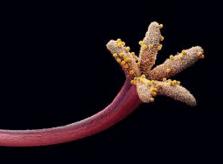
This is the male part of the flower that produces pollen

a)

petals

b)

pistil

c)

stamen

d)

anther

43.

Pistil

a)

Contains one or more ovules

b)

contains: Stigma, Style, and Ovary

c)

Transfers pollen from stigma to ovule

d)

contains: Filament, and Pollen

44.
Which of these are both male reproductive structures?
a)
Stigma and Style
b)
Anther and Filament
c)
Style and Ovary
d)
Stigma and Anther
45.
What part of a flower produces female reproductive cells (OVULES)?
a)
anther
b)
ovary
c)
sepal
d)
filament
46.
The part of the flower on which the pollen grains land.
a)
pistil
b)
stamen
c)
sepals
d)
stigma
47.
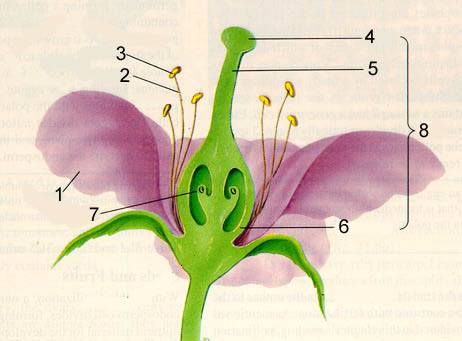
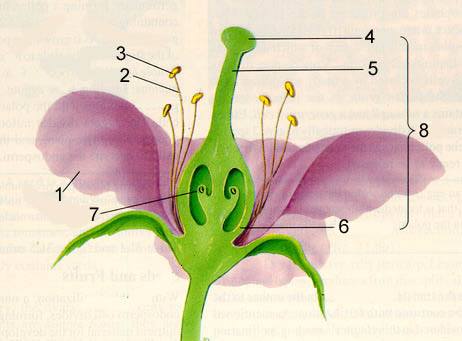
What is #1 pointing to?
a)
ovary
b)
petal
c)
stigma
d)
stamen
48.
What is #8 pointing to?
a)
petal
b)
stamen
c)
pistil
d)
ovary
49.
What is #2 pointing to?
a)
anther
b)
filament
c)
ovary
d)
style
50.
What is #3 pointing to?
a)
stigma
b)
filament
c)
ovary
d)
anther
51.
What is #4 pointing to?
a)
anther
b)
style
c)
stigma
d)
ovary
52.
What is #5 pointing to?
a)
anther
b)
filament
c)
stigma
d)
style
53.
What is #6 pointing to?
a)
stigma
b)
style
c)
ovary
d)
petal
54.
What is #7 pointing to?
a)
anther
b)
ovary
c)
ovule
d)
petal
55.
How does pollen reach the ovule?
a)
Stigma --> Style
b)
Style --> stigma
c)
Ovary --> stigma
d)
Ovary --> style
56.
Fertilization is....
a)
Egg and Sperm cells join
b)
Sperm Cells
c)
Egg Cells
d)
Pollination
57.
After fertilization the ovule will....
a)
Be carried away by a pollinator
b)
Be blown away by the wind
c)
Will grow into a new plant
d)
Develop into a fruit that contains seeds
58.
Which type of reproduction creates genetically identical offspring? 
a)
Asexual Reproduction
b)
Sexual Reproduction
59.
When a starfish grows a new body off a broken arm, what kind of reproduction is this?
a)
Sexual
b)
Differentiation
c)
Asexual 
d)
Specialization
60.
Where does an off spring get its traits in asexual reproduction?
a)
From both parents
b)
From only one parent
c)
From neither parent
d)
There are no traits handed down
61.
What percentage of chromosomes are handed down by a sperm cell?
a)
75%
b)
25%
c)
50%
d)
100%
62.
Sexual reproduction requires _____ parents and asexual reproduction requires ___ parents
a)
1,1
b)
2,2
c)
2,1
d)
1,2 
63.
What is an advantage of sexual reproduction?
a)
Allows genetic variation
b)
Only needs one parent
c)
Happens very quickly
d)
Offspring are exact copies of parent
64.
What is one disadvantage of sexual reproduction?
a)
Only one parent needed
b)
Off spring are exact copies of parents
c)
Happens very quickly
d)
Needs two parents
65.
Which is a type of Asexual Reproduction
a)
Sexual 
b)
Binary fission
c)
Cells 
d)
organism 
66.

All of the offspring of an organism have the same genetic material, which is identical to the parent organism. From this, we can conclude that this organism -

a)

makes its own food

b)

is unicellular

c)

live in a marine habitat

d)

reproduces asexually

67.
What are some of the facts about sexual reproduction?
a)
Takes two mates to reproduce and takes a longer time to reproduce
b)
Takes one mate to reproduce and takes a shorter amount of time to reproduce
c)
Takes two mates to reproduce and takes a shorter amount of time to reproduce
d)
Takes one mate to reproduce and takes a shorter amount of time to reproduce
68.
What are some of the facts about asexual reproduction?
a)
Takes only one mate to reproduce and takes a longer time to reproduce
b)
Takes a shorter amount of time to reproduce and it takes two mates to reproduce
c)
Reproduces diverse offspring and takes a longer time to reproduce
d)
Takes only one mate to reproduce and takes a shorter time to reproduce
69.
If two organisms reproduce sexually, then their offspring will exhibit a genetic makeup that is -
a)
identical to only one parent
b)
identical to all of its siblings
c)
a unique combination of traits
d)
the recessive traits of each parent
70.
Which of the following best describes a DNA molecule?
a)
double helix
b)
contains ribose
c)
made of amino acids
d)
contains Uracil
71.
Adenine bonds with ______________.
a)
Guanine
b)
Thymine
c)
Cytosine
d)
Adenine
72.
Guanine bonds with ______________.
a)
Adenine
b)
Guanine
c)
Cytosine
d)
Thymine
73.
Why is DNA important?
a)
it is very small and very complicated
b)
it's in everything
c)
it serves as the blueprint for traits of all living things
d)
because we eat it every day for energy
74.
What are the 4 nitrogen bases?
a)
adenine, thymine, cytoplasm, and guanine
b)
adenine, thymine cytosine, and guanine
c)
adenine, thymine, cytosine, and gylcerol
d)
adenine, thymine, cytosine, and glucose
75.
Which organelle is DNA usually found in?
a)
cell membrane
b)
vacuole
c)
chloroplast
d)
nucleus
76.

Where are chromosomes found in a cell?

a)

In the neutron of the cell.

b)

In the nucleus of the cell.

c)

In the proton of the cell.

d)

In the cell membrane of the cell.

77.

Two identical copies of a single replicated chromosome that are connected by a centromere.

a)

Chromatin

b)

Homologous chromosomes

c)

Sister chromatid

d)

Centromere

78.

The number of chromosomes _____ in different species

a)

vary

b)

are the same

79.

How many pairs of homologous chromosomes do humans have?

a)

23

b)

46

c)

2

d)

44

80.
A homozygous dominant dog with brown fur is crossed with a heterozygous dog with brown fur. What are the percentages of the possible genotypes?
a)
100% BB
b)
75% BB and 25%Bb
c)
50 % BB and 50% Bb
d)
50% Bb and 50% bb
81.
Squidward has light blue skin, and his genotype for this trait is Bb. Would Squidward be considered a purebred or hybrid for light blue skin?
a)
Purebred
b)
Hybrid
82.
An offspring will receive how many alleles from each parent to determine a specific trait?
a)
one
b)
two
c)
three
d)
five
83.
the passing of genetic traits from parent to offspring.
a)
heredity
b)
trait
c)
gene
d)
allele
84.
having two of the same genes for the trait (sometimes called purebred).
a)
homozygous
b)
hetrozygous
c)
protein
d)
chromosome
85.
having two different genes for a trait (sometimes called hybrid).
a)
protein
b)
homozygous
c)
heterozygous
d)
genotype
86.
Two brown eyed parents (Bb) have a baby. What is the chance the baby is blue eyed?
a)
0 %
b)
25%
c)
50%
d)
75%
87.
Two heterozygous (Tt) tall pea plants are crossed. Which describes their offspring?
a)
50% tall and 50% short
b)
75%tall and 25% short
c)
100%short
88.
Which of the following genotypes would be considered heterozygous?
a)
BB
b)
gg
c)
Ff
d)
TT
89.
Dominant alleles are represented by a:
a)
Male gene
b)
lowercase letter
c)
recessive trait
d)
capital letter
90.
An allele that is hidden when the dominant allele is present.
a)
Dominant Allele
b)
Gene
c)
Recessive Allele
d)
Probability
91.
How many boxes would say BB?
a)
1
b)
2
c)
4
d)
0
92.
What is the genotypic ratio here
a)
TT = 25% Tt= 50% tt=25%
b)
all tall
c)
TT= 75% tt = 25%
d)
Tt = 100%
93.

G = green, g = yellow

The offspring for a yellow plant is...

a)

GG

b)

Gg

c)

gg

d)

all of the choices result in yellow

94.
What allele combination should go in the missing box?
a)
AA
b)
Aa
c)
aa
d)
none of these
95.
A man, who has red-green colorblindness, and his wife, who is a carrier for colorblindness, have a colorblind son. What is the probability that their next son will also be colorblind?
a)
0%
b)
25%
c)
50%
d)
100%
96.
A woman heterozygous for A blood marries a man heterozygous for B blood. What is the probability that they will produce offspring with AB blood?
a)
0%
b)
25%
c)
50%
d)
75%
97.

Black hair color is dominant to white hair color in mice. Determine the offspring ratio of a heterozygous black mouse and a white mouse.

a)

4 Black: 0 White

b)

3 Black: 1 White

c)

2 Black: 2 White

d)

0 Black: 4 White

98.
When a man has an allele combination Ww for a trait, what percentage of his gametes will have a dominant allele for that trait?
a)
25%
b)
50%
c)
75%
d)
100%
99.

What does a punnet square show us?

a)

The age of the offspring

b)

The chance of a genotype (trait) showing up in offspring

c)

Numbers

d)

Blue eyes

100.

Which is Heterozygous?

a)

Tt

b)

BB

c)

ff

d)

Dominant

101.

Which is homozygeous?

a)

Tt

b)

BB

c)

Ff

d)

Blue

102.

What are the chances that the offspring will have homozygous recessive traits?

a)

1 in 4

b)

3 out of 4

c)

75%

d)

50%

103.

What are the chances of heterozygous genotypes in offspring?

a)

50%

b)

25%

c)

1 in 4

d)

75%

104.

If the father's genotypes are SS and the mothers are ss, the offspring will have:

a)

All Ss

b)

Half will be SS, half ss

c)

Mostly SS

d)

Only recessive genes

105.
Each identical side of a chromosome is the 
a)
centromere
b)
chromatin
c)
centriole
d)
chromatid
106.

If we were to look inside a normal male bone cell, how many total chromosomes would we find?

a)

1

b)

2

c)

23

d)

46

107.
What percentage of chromosomes are handed down by a sperm cell?
a)
75%
b)
25%
c)
50%
d)
100%
108.

Every cell in your body other than sex cells has ____ chromosomes

a)

23

b)

46

c)

48

109.

The diagram shows the process of mitosis.What is the purpose of this process?

a)

It helps the cell function efficiently.

b)

It helps the cell form energy molecules.

c)

It helps the cell make an exact copy of itself.

d)

It helps the cell increase its genetic material.

110.

Adenine, thymine, guanine, and cytosine are ____________.

a)

the four different bases that make up nucleotides

b)

the three different bases that make up nucleotides

c)

the four different bases that make up protiens

d)

the four different sugars that make up nucleotides

111.

If a snake's sex cell has 116 chromosomes. How many chromosomes will be in each body cell?

a)

116

b)

58

c)

232

d)

348

112.

If a mouse has 42 chromosomes in their skin cells. How much will be in their brain cells?

a)

21

b)

84

c)

11

d)

42

113.

The process shown is:

a)

asexual reproduction

b)

sexual reproduction

114.

Sperm and egg cells have _____ number of chromosomes as other body cells.

a)

the same

b)

twice the

c)

half the

115.

The process shown is called:

a)

meiosis

b)

binary fission

c)

budding

d)

spore production

116.

The process shown is called:

a)

meiosis

b)

binary fission

c)

budding

d)

spore production

117.

The process shown is called:

a)

meiosis

b)

binary fission

c)

budding

d)

spore production

118.

Which trait is influenced by genetics only?

a)

scars

b)

mass

c)

blood type

d)

skin colour

119.

What are the chances that a child will have the recessive trait of blonde hair?

a)

75%

b)

25%

c)

0%

d)

100%

120.

What are the chances that a child will have the recessive trait of blonde hair?

a)

75%

b)

25%

c)

0%

d)

100%

121.

Problems with _______ can lead to offspring with the wrong number of chromosomes.

a)

meiosis

b)

mitosis

c)

cell division

122.

Zygotes are formed in this type of reproduction:

a)

sexual reproduction

b)

asexual reproduction

c)

both sexual and asexual reproduction

123.

Genetic information is passed on to the offspring:

a)

sexual reproduction

b)

asexual reproduction

c)

both sexual and asexual reproduction

124.

What is inherited from parents?

a)

eggs

b)

genes

c)

punnett squares

d)

sperm

125.
A male and female united reproductive cell?
a)
spore
b)
seed
c)
embryo
d)
zygote
126.
The male reproductive structure.
a)
pollen
b)
zygote
c)
embryo
d)
spores
127.
The joining of a sperm cell and an egg cell is called...
a)
Fertilization
b)
Labor
c)
Zygote
d)
STOP ASKING ME THESE IMPOSSIBLE QUETSIONS!!
128.

A skunk has 16 chromosomes in its gametes. How many chromosomes would be in its body cells?

a)

4

b)

8

c)

16

d)

32

129.
Which of the following would be categorized as a gamete?
a)
skin cell
b)
blood cell
c)
sperm cell
d)
liver cell
130.
What does the prefix homo- in homozygous mean?
a)
same
b)
different
c)
dating
d)
humans
131.
What does the prefix hetero- in heterozygous mean?
a)
same
b)
different
c)
dating
d)
human
132.
Which of the following is heterozygous
a)
Ww
b)
ii
c)
DD
d)
kk
133.
Which of the following is homozygous dominant?
a)
Jj
b)
Rr
c)
MM
d)
ee
134.

Mark is heterozygous. If B is for brown hair, and b is for blonde hair, what is Mark's observed trait?

a)

Brown Hair

b)

Blonde Hair

c)

Brown and Blonde Hair

d)

Black Hair

135.

Mark is heterozygous. If B is for brown hair, and b is for blonde hair, what is Mark's alleles?

a)

BB

b)

bb

c)

Bb

d)

bB

136.

Chris is homozygous dominant. If W for widow's peak, and w is for no widow's peak, what is Chris' alleles?

a)

WW

b)

ww

c)

Ww

d)

wW

137.
rr
a)
Homozygous Dominant
b)
Homozygous Recessive
c)
Heterozygous
d)
Heterozygous Recessive
138.
A male shark has 40 chromosomes in each of its sex cells. How many would be present in its body cells?
a)
20
b)
40
c)
80
d)
160
139.

A carrot starts with 18 chromosomes and under goes meiosis how many chromosomes will each daughter cell end up with?

a)

18

b)

9

c)

27

d)

36