wayground logo

Free Printable Worksheets

Font size

S
M
L
XL
Worksheets

7th Grade Honors Science Midterm

Total questions: 115

Worksheet time: 3hrs 55mins

Name
Class
Date
1.

What is it made of: Hydroxyl group

a)

Hydrogen

b)

Carbon

c)

Nitrogen

d)

Oxygen

2.

What is it made of: Amino group

a)

Hydrogen

b)

Carbon

c)

Nitrogen

d)

Oxygen

3.

What is it made of: Carboxyl group

a)

Hydrogen

b)

Carbon

c)

Nitrogen

d)

Oxygen

4.

What is it made of: Amino Acid

a)

Hydrogen

b)

Carbon

c)

Nitrogen

d)

Oxygen

5.

Identify C2H5OH

a)

Ethanol

b)

Methanol

c)

Isopropyl Alcohol

d)

Ethane

6.

Identify C3H7OH

a)

Ethanol

b)

Methanol

c)

Isopropyl Alcohol

d)

Butane

7.

Identify CH3OH

a)

Ethanol

b)

Methanol

c)

Isopropyl Alcohol

d)

Methene

8.

CH4

a)

Methane

b)

Ethane

c)

Methene

d)

Ethene

9.

C4H6

a)

Propane

b)

Propene

c)

Butyne

d)

Butene

e)

Butane

10.

C7H16

a)

Pentane

b)

Hexane

c)

Heptane

d)

Octane

e)

Nonane

11.

C9H20

a)

Pentane

b)

Hexane

c)

Heptane

d)

Octane

e)

Nonane

12.

C3H6

a)

Propane

b)

Propene

c)

Propyne

d)

Butene

e)

Butane

13.
a)

Ethane

b)

Ethene

c)

Ethyne

d)

Huh?

14.
a)

Methanol

b)

Ethanol

c)

Methene

d)

Isopropyl Alcohol

15.
a)

Ethene

b)

Ethanol

c)

Isopropyl Alcohol

d)

Methanol

16.
All organic compounds contain the element
a)
carbon
b)
nitrogen
c)
phosphorus
d)
sulfur
17.
what kind of molecule is this?
a)
alkane
b)
alkene
c)
alkyne
d)
cycloalkane
18.
What is the prefix for four carbons?
a)
meth-
b)
but-
c)
prop-
d)
eth-
19.

Which compound belongs to the alkene family?

a)

C2H2

b)

C2H4

c)

C6H6

d)

C6H14

20.
Which of the following compounds is an example of hydrocarbon?
a)
CO2
b)
C2H6
c)
C2H5OH
d)
CH3COOH
21.
What type of hydrocarbon is this?
a)
Alkane
b)
Alkene
c)
Alkyne
22.
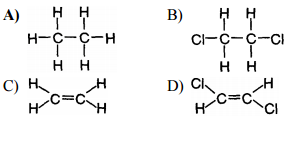
Which formula represents a saturated hydrocarbon?
a)
A
b)
B
c)
C
d)
D
23.
The name of the structure shown is :
a)
methane
b)
butane
c)
ethane
d)
propane
24.
Are the compounds shown isomers
a)
Yes
b)
No
25.
Are the following molecules isomers?
a)
Yes
b)
No
26.
Are the following molecules isomers?
a)
Yes
b)
No
27.
Are the following molecules isomers?
a)
Yes
b)
No
28.

What is an isomer?

a)

Atoms that are connected, or bonded, in different ways

b)

Molecules that have the same molecular formula but different molecular geometries

c)

the carbon that are in a "straight chain" whereas in the other the chain is branched

d)

In one of them the bromine atom is on the end of the chain, whereas in the other it's attached in the middle.

29.
Melting and boiling points of alkanes
a)
increase with the number of carbon atoms in the chain
b)
decrease with the number of carbon atoms in the chain
c)
increase with branching
d)
are determined by the bonding between the carbons and hydrogens
30.
Carbon can bond with how many other atoms?
a)
1
b)
2
c)
3
d)
4
31.
What is a hydrocarbon that contains only single bonds called? 
a)
organic  
b)
saturated
c)
unsaturated
d)
fully bonded
32.

UP and DOWN columns on the periodic table are

a)

groups

b)

periods

33.

SIDE TO SIDE rows on the periodic table are

a)

groups

b)

periods

34.

Which elements have properties in common?

a)

elements in a group

b)

elements in a period

35.

The group number tells you the number of

a)

protons

b)

valence electrons

c)

energy levels

36.

The period number tells you the number of

a)

protons

b)

energy levels

c)

valence electrons

37.

Which two elements have properties in common?

a)

Nitrogen and Phosphorous

b)

Oxygen and Nitrogen

c)

Sulfur and Nitrogen

38.

How many protons does Lithium have?

a)

3

b)

4

c)

7

39.

How many electrons does Lithium have?

a)

3

b)

4

c)

7

40.

How many neutrons does Lithium have?

a)

3

b)

4

c)

7

41.

These elements are in a:

a)

group

b)

period

42.

Do these elements have properties in common?

a)

yes

b)

no

43.

These elements are in a:

a)

group

b)

period

44.

Do these elements have properties in common?

a)

yes

b)

no

45.

Which elements are stable?

a)

Group 1

b)

Group 8

c)

Group 18

46.

Which elements have 1 valence electron?

a)

period 1

b)

group 1

c)

group 4

47.

which elements have 4 valence electrons?

a)

group 3

b)

group 4

c)

group 14

48.
What is this tool to get volume?
a)
triple beam balance
b)
ruler
c)
thermometer
d)
graduate cylinder
49.
What is this tool to get mass?
a)
triple beam balance
b)
ruler
c)
thermometer
d)
graduate cylinder
50.
True or False:  The density of a specific type of material never changes.  
a)
True
b)
False
51.
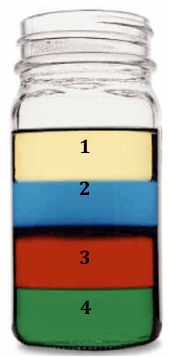
Put the liquids in order from most dense to least dense?
a)
4, 3, 2, 1
b)
1, 2, 3, 4
c)
3, 4, 2, 1, 
d)
4, 3, 1, 2
52.
Why does ice float?
a)
Liquid water is less dense than solid water.
b)
Solid water is less dense than liquid water.
c)
Gaseous water is less dense than solid water.
d)
Liquid water is less dense than gaseous water.
53.
What do we know about the density of lamp oil, rubbing alcohol, and vegetable oil?  
a)
The density is greater than 1.0 g/mL
b)
The density is less than 1.0 g/mL
c)
The density is equal to 1.0 g/mL
d)
The density can not be determined
54.
In general what is the most dense form of matter?
a)
solid
b)
liquid
c)
gas
d)
plasmas
55.
If an object has a density of .6 g/cm^3 and you put it into water, will it sink or float?  
a)
sink
b)
float
56.
If an object has a density of 3.6 g/cm^3 and you put it into water, will it sink or float?  
a)
sink
b)
float
57.
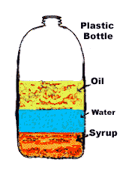
Which liquid is the least dense?
a)
oil
b)
water
c)
syrup 
d)
plastic bottle
58.
Jack has a rock. The rock has a mass of 14 g and a volume of 2 cm3. What is the density of the rock?
a)
7 mL
b)
7 g/cm3
c)
28 g/cm3
d)
1/7 g/cm3
59.
What is the formula for density?
a)
density = mass x volume
b)
density = mass / volume
c)
density = mass + volume
d)
density = mass - volume
60.
Frank has an eraser. It has a mass of 4 g, and a volume of 2 cm3. What is its density?
a)
8 g/cm3
b)
2 g/cm3
c)
1/2 g/cm3
d)
24 g/cm3
61.
Frank has a liquid. It has a mass of 6 g and a volume of 9 mL. What is its density?
a)
3 g/mL
b)
.66 g/mL
c)
1.33 g/mL
d)
54 g/mL
62.
Calculate the density of the cube.
a)
2 g/cm3
b)
4 g/cm3
c)
6 g/cm3
d)
8 g/cm3
63.
Calculate the density of the cube.
a)
.33 g/cm3
b)
.4 g/cm3
c)
.6 g/cm3
d)
.5 g/cm3
64.
Which substance is the MOST dense?  ** Use the key
a)
A
b)
B
c)
C
d)
Cannot be determined by the data provided.
65.
Valence electrons are: 
a)
Electrons farthest away from the nucleus
b)
Electrons closest to the nucleus
c)
Electrons that just come and go - they don't stay with the atom
66.
Ions are: 
a)
atoms with a positive or negative charge
b)
atoms with no charge
c)
atoms with ONLY a positive charge
d)
atoms with ONLY a negative charge
67.
When an atom loses a valence electron, it becomes a(n) _____________ ion.
a)
positive
b)
negative
c)
neutral
d)
polyatomic
68.
Negative ions form when atoms _________ valence electrons.
a)
lose
b)
gain
c)
share
69.
all matter is made of what 
a)
energy 
b)
atoms 
c)
electrons 
d)
compounds 
70.
The positive particles of an atom are 
a)
electrons 
b)
positrons 
c)
neutrons 
d)
protons 
71.
the central region of an atom where its neutrons and protons are is its 
a)
nucleus 
b)
electron cloud
c)
core 
d)
center 
72.
an atom with atomic number 6 would have how many protons 
a)
6
b)
12
c)
3
d)
cannot be determined 
73.
Particles in an atom that are neutral and have no charge are 
a)
negatrons 
b)
electrons 
c)
neutrons 
d)
protons 
74.
True or False? Neutrons have a negative charge
a)
True
b)
False
75.
A series of steps used by scientists to solve a problem or answer a question. 
a)
scientific method
b)
recipe
c)
data collection
d)
metric system
76.
A testable explanation to a problem that has not yet been tested. 
a)
data
b)
theory
c)
hypothesis
d)
fact
77.
This variable in an experiment is the one being changed by the scientist. 
a)
dependent variable
b)
independent variable
c)
data
d)
control group
78.
Testing a hypothesis often involves a(n):
a)
answer
b)
experiment
c)
problem
d)
safety check
79.
The summary at the end of an experiment that explains the results. 
a)
conclusion
b)
procedures
c)
materials
d)
responding variable
80.
The name of the information that you get from your experiment (you organize it into charts and graphs).
a)
observations
conclusion
b)
data
c)
variables
d)
hypothesis
81.
Dependent variable means
a)
the scientist controls what to test
b)
educated guess
c)
ask a question
d)
what is being measured
82.
If you increase the amount of spinach you eat, then you will increase the iron in your blood. 
What's the dependent variable?
a)
increase the amount of iron in your blood
b)
spinach you eat
83.
If I ride my bike to school instead of walking, then I will get to school faster. What is the dependent variable?
a)
True
b)
How fast you get to school
c)
Riding a bike or walking
d)
False
84.
Will a construction paper air plane fly faster than an airplane made from notebook paper? Choose the best hypothesis.
a)
If I make a paper airplane from notebook paper, then it will fly faster than construction paper.
b)
Yes.
c)
No.
d)
I think the construction paper air plane will fly faster.
85.
If I study for my scientific method test, then I will have a better test score. What is the dependent variable?
a)
Scientific Method
b)
Studying
c)
Independent variable
d)
Test score
86.
Which of the following would be considered quantitative data?
a)
Color
b)
Smell
c)
6.84 cm
d)
texture
87.
Explaining the color of a chemical would be what kind of observation?
a)
Qualitative 
b)
Quanitative
88.
What is the part of the experiment that is left alone or “natural", and is used to compare back to?
a)
Independent Variable
b)
Dependent Variable
c)
Control Group
d)
Experimental Group 
89.
You will want your experiment to have ____ independent variable(s) in it for the experiment to be valid.
a)
1
b)
2
c)
3
d)
4
90.
What is a factor that changes because of what the experimenter does?
a)
Dependent Variable
b)
Independent Variable
c)
Control Group
d)
Hypothesis
91.
What is a factor that the experimenter has full control over and changes to see what happens?
a)
Dependent Variable
b)
Independent Variable
c)
Control group 
d)
Hypothesis
92.
Who stipulated that electrons orbit the nucleus at fixed energies and distances?
a)
Albert Einstein
b)
Max Planck
c)
Ernest Rutherford
d)
Niels Bohr
93.
The current model of the atom, where electrons exist within a range of possible locations, is called _____
a)
the chocolate chip cookie model
b)
the plum pudding model
c)
the quantum model
d)
the planetary model
94.
These elements are ductile
a)
Metals
b)
Nonmetals
c)
Metalloids
95.
An element has an atomic number of 76.  The number of protons and electrons in a neutral atom of the element are
a)
152 p+, 76 e-
b)
76 p+, 0 e-
c)
38 p+, 38 e-
d)
76 p+, 76 e-
96.
Contributes basically no mass to an atom.
a)
protons
b)
neutrons
c)
electrons
d)
protons and neutrons
97.
An atom has 5 protons, 7 neutrons and 5 electrons. What is the mass number of the atom?
a)
5
b)
7
c)
2
d)
12
98.
An atoms overall charge is 
a)
positive 
b)
depends on its mood 
c)
neutral 
d)
negative 
99.
How many of these substances are elements?
a)
2
b)
3
c)
4
d)
5
100.
How are elements and compounds different?
a)
A compound is a combination of two or more types of matter, an element is one type.
b)
Compounds are represented by chemical symbols of one letter, elements by two.
c)
There are an infinite number of elements, but a limited number of compounds.
d)
Elements are always larger units of matter, and compounds are smaller.
101.

What percentage of rubidium-87 atoms will be left after four half lives?

a)

25.0%

b)

12.5%

c)

6.25%

d)

3.125%

102.

What is an isotope?

a)

one of several forms of the same atoms; same number of protons but have different number of neutrons

b)

a particle that has no charge and is located in the nucleus of an atom.

c)

energy in the form of waves or particles that is emitted from an object and travels through space or air

103.

If one has 12 kg of Polonium and it undergoes two half-lives, how much do you have left?

a)

12 kg

b)

3 kg

c)

6 kg

104.

After every half-life, a radioactive atom is

a)

reduced by 50%

b)

decreased by 1/4

c)

increased by 1/2

105.
The half-life of Zn-71 is 2.4 minutes. If one had 100.0 g at the beginning, how many grams would be left after 7.2 minutes has elapsed?
a)
100.0g
b)
50.0g
c)
12.5g
d)
8.5g
106.
Pd-100 has a half-life of 3.6 days. If one had 620,310,740 atoms at the start, how many atoms would be present after 21.6 days?
a)
9.7x10⁶ atoms remain
b)
97.0x10⁶ atoms remain
c)
0.97x10⁶ atoms remain
d)
9.7x10⁵ atoms remain
107.
a)
40 mL
b)
38 mL
c)
36 mL
d)
34 mL
108.
Measurement is an example of which type of observation?
a)
Qualitative
b)
Quantitative
109.
In science, the _________ system is used as the primary unit of measurement.
a)
Customary
b)
Metric
c)
English
110.
a)
265.7 g
b)
165.6 g
c)
266.7 g
d)
266.6 g
111.
Which unit of measurement would be used to measure mass?
a)
grams
b)
mililiters
c)
millimeters/centimeters/meters
d)
Celsius/Fahrenheit
112.
a)
241 g
b)
143 g
c)
144 g
d)
142 g
113.

What is the metric unit for measuring distance?

a)

Meters

b)

Liters

c)

Grams

d)

Feet

114.

What is the metric unit for measuring volume?

a)

Liters

b)

Meters

c)

Grams

d)

Gallons

115.

Which of the following distances is largest?

a)

10 m

b)

10 cm

c)

10 mm

d)

10 dm