
 Worksheets
Biology STAAR EOC Review
Total questions: 166
Worksheet time: 2hrs 26mins


From left to right, what is the sequence of the complementary strand of DNA in this molecule?

Which of these organisms are in a trophic level that receives a larger percentage of the energy captures by the producers than the percentage received at the bats' trophic level?


ACT GCT TGA CGA
to
ACT GCT TAC GA
Which mutation most likely occurred?



What are two ways we increase carbon in the atmosphere?
soil bacteria can fix nitrogen in the soil and lightning can fix nitrogen and then rain water carries it to the soil
respiration and photosynthesis
burning fossil fuels and deforestation
volcanic eruptions and increasing fertilizers
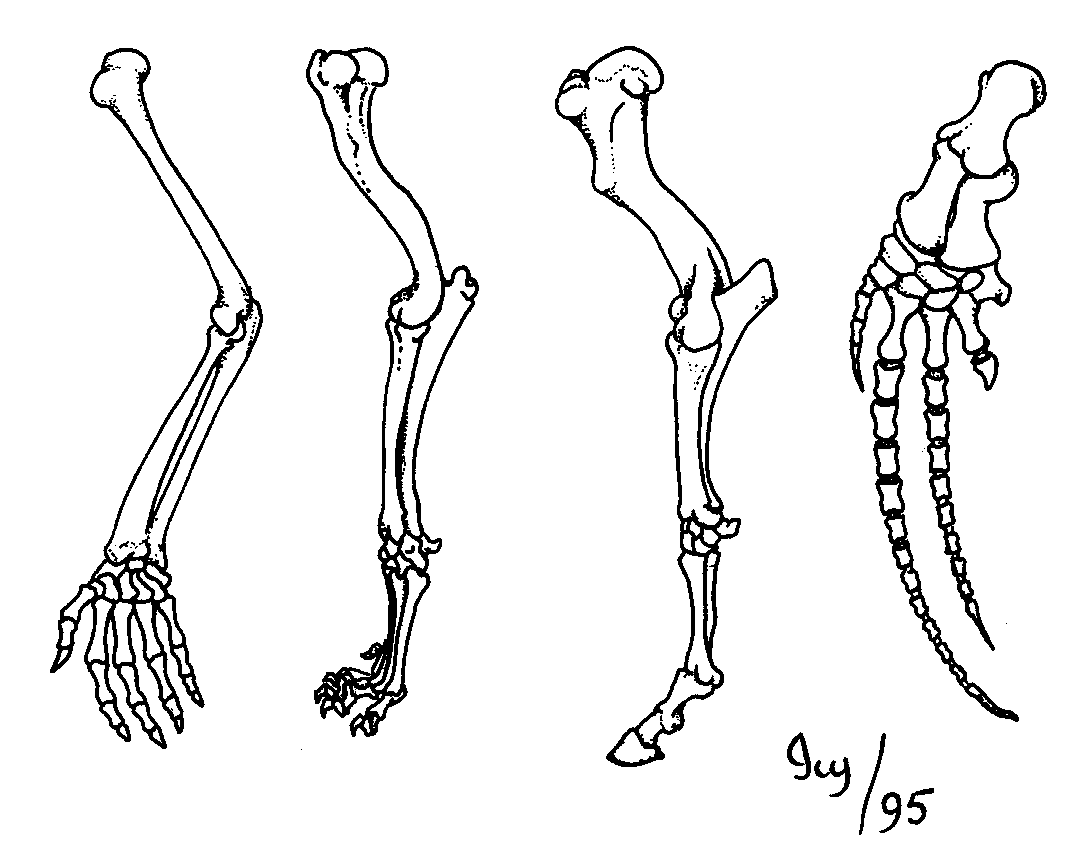
What can be used for evidence for evolution (common ancestry)?
the fossil record
homologous structures (comparing structures)
DNA comparisons
all of the above


What is this process and what is the product of it?
translation, (chain of amino acids) protein
transcription, mRNA
replication, DNA
respiration, ATP

During meiosis, chromosomes exchange genetic material during a process called crossing over? What is the significance of crosssing over?
allows there to be half the number of chromosomes
increases genetic variation
eliminates mutations
allows there to be twice the number of chromosomes

Which process produces ATP, carbon dioxide and water?
Fermentation
Protein Synthesis
Cellular Respiration
Photosynthesis
Which process produces glucose and oxygen?
Anaerobic Respiration
Protein Synthesis
Aerobic Respiration
Photosynthesis
What are three nitrogen bases grouped together that are code for an amino acid called?
protein
codon
adenine
guanine
What is osmosis?
The movement of oxygen from areas of higher concentration to lower concentration
The movement of water from areas of higher concentration to lower concentration
The movement of carbon dioxide from areas of higher concentration to lower concentration
The movement of sodium from areas of higher concentration to lower concentration
What are the first species in an ecosystem that break down bare rock?
grasses
shrubs
trees
lichens
evidence of evolution in which body features of different organisms are similar in structure but different in function
vestigal structures
homologous structures
analogous structures
biochemical similarities
genotype made up of one dominant and one recessive allele
heterozygous
homozygous
cringey
extra
genotype made up of both of the same allele (both dominant or both recessive)
heterozygous
homozygous
legit
lit
Why are the biomolecules important to organisms?
They are magical molecules man
They aren't important
They contain all the materials needed by organisms for life processes
They contain some of the materials needed by organisms for life processes
What are the functions of proteins?
They play many critical roles in the body. They are required for the structure, function, and regulation of the body’s tissues and organs.
They provide energy, as they are the body's main source of fuel, needed for physical activity, brain function and operation of the organs.
They store energy, signaling, and acting as structural components of cell membranes.
They make up genetic information in living things.
What are the functions of carbohydrates?
They play many critical roles in the body. They are required for the structure, function, and regulation of the body’s tissues and organs.
They provide energy, as they are the body's main source of fuel, needed for physical activity, brain function and operation of the organs.
They store energy, signaling, and acting as structural components of cell membranes.
They make up genetic information in living things.
What are the functions of lipids?
They play many critical roles in the body. They are required for the structure, function, and regulation of the body’s tissues and organs.
They provide energy, as they are the body's main source of fuel, needed for physical activity, brain function and operation of the organs.
They store energy, signaling, and acting as structural components of cell membranes.
They make up genetic information in living things.
What are the functions of nucleic acids?
They play many critical roles in the body. They are required for the structure, function, and regulation of the body’s tissues and organs.
They provide energy, as they are the body's main source of fuel, needed for physical activity, brain function and operation of the organs.
They store energy, signaling, and acting as structural components of cell membranes.
They make up genetic information in living things.
What elements are in all biomolecules?
Carbon, Hydrogen, Chlorine
Carbon, Hydrogen, Oxygen
Carbon, Hydrogen, Oxygen, Nitrogen
Carbon, Hydrogen, Oxygen, Nitrogen, Phosphorus
What elements are in proteins and nucleic acids only?
Carbon, Hydrogen, Chlorine
Carbon, Hydrogen, Oxygen
Carbon, Hydrogen, Oxygen, Nitrogen
Carbon, Hydrogen, Oxygen, Nitrogen, Phosphorus
What elements are in nucleic acids?
Carbon, Hydrogen, Chlorine
Carbon, Hydrogen, Oxygen
Carbon, Hydrogen, Oxygen, Nitrogen
Carbon, Hydrogen, Oxygen, Nitrogen, Phosphorus

What is lost to the environment at each of the trophic levels of this ecosystem?
nutrients from the soil
living space for the organisms
food sources
heat

Based on this model, how much of the energy was provided to secondary consumer?
53,460 J
5,400 J
540 J
54 J

Which theory is represented in this diagram?
The theory that all living organisms are made of cells
The theory that all living organisms share the same basic genetic components
The theory that organisms function best when their internal conditions are maintained within narrow limits
The theory that complex cells evolved after primitive cells engulfed bacterial cells that continued functioning
Which of the following statements correctly describes the long-term outcome of humans eliminating natural predators of deer from an ecosytem?
The deer that are the fastest and most agile will survive and reproduce.
The deer population will be too lare to be supported by producers.
Other browsing species will thrive and outcompete the deer.
The deer will evolve into human-like creatures where they will be able to walk upright on two legs, talk, and drive cars. Whoa man, this would be awesome ;)


What happens in the stage labeled "process 2"?

From left to right, what is the sequence of the complementary strand of DNA in this molecule?

If a sequence of DNA reads AGTGGGTCT, for what sequence of amino acids does it code?
An organism that can make it's own food (autotroph)
Ex) green plants, phytoplankton, algae
Producer
Consumer
Predator
Heterotroph
An organism that eats other organisms for food (heterotroph)
Ex) Cows, insects, humans
Producer
Consumer
Autotroph
Parasite
Organism that breaks down dead organisms
Ex) Fungi, bacteria, dung beetles
Producer
Consumer
Scavenger
Decomposer
An organism that kills and eats other animals for food
Producer
Predator
Scavenger
Prey
An animal that a predator feeds upon
Prey
Carrion
Host
Producer
Cell organelle that provides structure and support for PLANT cells only
Cell Wall
Cell Membrane
Nucleus
Cytoplasm
Cell organelle that controls what enters or leaves the cell
Cell membrane
Cytoplasm
Vacuole
Nucleus
Cell organelle that stores food and water for the cell
Vacuole
Nucleus
Cell membrane
Mitochondria
Cell organelle that is the 'control center' of a cell that tells it what to do
(Contains DNA called chromatin)
Nucleus
Cytoplasm
Mitochondria
Chloroplasts
The jelly-like fluid substance that helps move nutrients around the cell
Cytoplasm
Nucleus
Cell membrane
Vacuole
Cell organelle that changes sunlight into usable energy for a PLANT through a process called photosynthesis
Mitochondria
Chloroplast
Nucleus
Cytoplasm
Cell organelle that is considered the 'Powerhouse' of the cell. (Provides energy)
Chloroplast
Mitochondria
Cytoplasm
Nucleus

• Requires two parents to combine genetic material to produce a new offspring
• Offspring are genetically unique/different
Ex) Humans
Sexual reproduction
Asexual reproduction
• Requires only one parent
• Produces offspring that are genetically identical to the parent
Ex) Hydra, Bacteria, Airplane plants
Sexual reproduction
Asexual reproduction
Small organisms that are unicellular with NO NUCLEUS or membrane bound organelles
Ex) Bacteria
Prokaryoytes
Eukaryotes
Multi-cellular organism with a 'true' nucleus and memebrane bound organelles
Ex) Animals, Plants, Fungi, Protista
Prokaryotes
Eukaryotes


The diagram illustrates the activity of vesicles during a cellular process.
Which statement best explains the function of the vesicles?
Delivering packaged materials to the Golgi apparatus for protein synthesis
Exchanging genetic information between the Golgi apparatuses of separate cells
Extracting portions of the Golgi apparatus to be regenerated for growth within the cell
Transporting packaged molecules from the Golgi apparatus to be released out of the cell

The graphs show the reaction rate for an enzyme across a range of temperatures and pH.
Based on these data, this enzyme functions best at what temperature and pH?
Temperature of 27°C and a pH of 4
Temperature of 37°C and a pH of 6
Temperature of 40°C and a pH of 8
Temperature of 50°C and a pH of 10
What is the role of mRNA in expressing specialized structures?
Making energy available for cellular activities
Creating bonds to form biomolecules
Producing sugars that assist with replication
Providing information to form proteins
The ability to maintain a stable internal environment is called ________________.
Metabolism
Mitosis
Heterozygous
Homeostasis

Which of the following activities occur in the S phase?

