wayground logo

Free Printable Worksheets

Font size

S
M
L
XL
Worksheets

Human Body System, part 2

Total questions: 137

Worksheet time: 2hrs 48mins

Name
Class
Date
1.

What carries food from the pharynx to the stomach?

a)

larynx

b)

trachea

c)

esophagus

d)

bronchioles

2.

What type of digestion takes place in the stomach?

a)

mechanical

b)

chemical

c)

both mechanical and chemical

3.

Where does the process of digestion begin?

a)

mouth

b)

esophagus

c)

stomach

d)

small intestine

4.

What enzyme is found in saliva that starts digesting carbohydrates?

a)

amylase

b)

chyme

c)

pepsin

d)

bile

5.

Where does the absorption of nutrients from food take place?

a)

stomach

b)

liver

c)

small intestine

d)

large intestine

6.

What makes the small intestine have such a large surface area?

a)

21 feet long

b)

villi

c)

microvilli

d)

all answers contribute

7.

What part of the digestive system mechanically and chemically breaks down food?

a)

mouth

b)

stomach

c)

both the mouth and stomach

8.

What chemically breaks down food into smaller molecules?

a)

teeth

b)

muscles of the stomach

c)

enzymes

9.

What are the rhythmic muscular contractions of your esophagus called to help food move along?

a)

swallowing

b)

peristalsis

c)

inertia contractions

d)

paralysis

10.

What does the pancreas do?

a)

produces digestive enzymes to break down proteins and fats

b)

produces sodium bicarbonate to neutralize stomach acid

c)

regulates our blood sugar levels

d)

all answers are correct

11.

What are the rhythmic muscular contractions of your esophagus called to help food move along?

a)

swallowing

b)

peristalsis

c)

inertia contractions

d)

paralysis

12.

Where does the digestion of proteins take place?

a)

Mouth and stomach

b)

Stomach and small intestine

c)

Mouth and small intestine

d)

Mouth, stomach and small intestine

13.

What is the aim of the digestion?

a)

Obtain matter and energy

b)

Obtain nutrients from food and break it down into small molecules, which are then absorbed

c)

Break down food into inorganic nutrients

d)

Obtain nutrients form food and transport it to the cells

14.

Where does the absorption take place?

a)

Oesophagus

b)

Stomach

c)

Small intestine

d)

Large intestine

e)

Digestive tract

15.

What are the two components of the gastric juice?

a)

Pepsine and hydrochloric acid

b)

Saliva and bile

c)

Bile and hydrochloric acid

d)

Amyase and hydrochloric acid

16.

Which are the three juices released in the duodenum (small intestine)?

a)

Bile, pancreatic juice and gastric juice

b)

Bile, pancreatic juice and intestinal juice

c)

Bile, gastric juice and saliva

d)

Bile, intestinal juice and pancratic juice

17.

Which are the nutrients digested in the mouth?

a)

Carbohydrates and proteins

b)

Proteins

c)

Carbohydrates

d)

Fats

e)

All the abov

18.

What is the enzyme contained in the saliva?

a)

Amylase

b)

Pepsine

c)

Hydrochloride acid

d)

Lipase

19.

Where is the bile stored?

a)

Liver

b)

Gall bladder

c)

Pancreas

d)

Small intestine

20.

Where is the pancreatic juice released?

a)

Small intestine

b)

Stomach

c)

Large intestine

d)

Mouth

21.

Where is the gastric juice released?

a)

Stomach

b)

Small intestine

c)

Mouth

d)

Large intestine

22.

What is the function of the villi?

a)

To increase the absorption surface

b)

To digest the last nutrients

c)

To form feces

d)

To comb the small intestine

23.

What is the function of the large intestine?

a)

The absorption of water and some vitamins, formation and storage of faeces

b)

The absorption of nutrients

c)

The digestion of fats

d)

Transport the nutrients to the blood stream

24.

What is the function of the villi?

a)

To increase the absorption surface

b)

To digest the last nutrients

c)

To form feces

d)

To comb the small intestine

25.
The tube that carries urine from the kidney into the bladder is called the:
a)
Ureter
b)
Urethra
c)
Proximal Tubule
d)
Collecting Duct
26.
Blood flows into the kidney along the:
a)
Renal Venule
b)
Renal Artery
c)
Glomerulus
d)
Hepatic Artery
27.
Mammals get rid of Nitrogenous waste by producing:
a)
Urea
b)
Ammonia
c)
Uric Acid
d)
NO2 gas
28.
What organ is C pointing to?
a)
Ureters
b)
Bladder
c)
Kidney
d)
Urethra
29.
Which excretory organ filters the blood to remove excess water, urea, and cell wastes?
a)
Kidney
b)
Bladder
c)
Urethra
d)
Ureters
30.
A short tube where urine is released from the body is the _______.
a)
Ureter
b)
Kidney
c)
Bladder
d)
Urethra
31.
Which organ of the excretory system stores urine until the body is ready to eliminate it?
a)
ureters
b)
urethra
c)
urinary bladder
d)
urea
32.
What is the main function of the excretory system?
a)
to collect and remove wastes from the body
b)
to strengthen skeletal muscles
c)
to protect the nervous system
d)
to bring oxygen to body cells
33.
Under normal conditions, which of the following substances is found in urine?
a)
blood cells
b)
protein
c)
glucose
d)
urea
34.
Which excretory organ eliminates water and some chemical wastes in perspiration?
a)
lungs
b)
skin
c)
liver
d)
kidneys
35.
What function do the kidneys perform?
a)
eliminate carbon dioxide
b)
supply oxygen to body cells
c)
remove urea and excess water
d)
play a role in gas exchange
36.
These organs are responsible for what?
a)
storing urine
b)
storing water
c)
filtering blood
d)
they don't have a particular job 
37.

What are the filtering units of the kidneys?

a)

nephrons

b)

ureters

c)

nuerons

d)

alveloi

38.
Water and Salt re-absorption into the circulatory system is mostly done by:
a)
Proximal Tubule
b)
Distal Tubule
c)
Loop of Henle
d)
Glomerulus
39.
Which one is correct about the Urinary System?
a)
The Urine passes from the intestine through the ureter into the urinary bladder, where it is stored.
b)
The Urine passes from the lungs through the ureter into the urinary bladder, where it is stored.
c)
The Urine passes from the kidneys through the ureter into the urinary bladder, where it is stored.
d)
The Urine passes from the spleen through the ureter into the urinary bladder, where it is stored.
40.

What are kidney stones?

a)

crystallized bile

b)

crystallized urine

c)

crystallized saliva

41.
What is an Hormone?
a)
Substance produced in one part of an organism that affects another part of the organism
b)
Cells that has an receptor for a particular hormone
c)
Cells that pick up on a particular hormones through receptor
d)
Steroids that cause the abnormal actions in hormones
42.
What are the functions of the Pancreatic hormones?
a)
Reduce or increase blood sugar levels
b)
Increase blood calcium levels
c)
Increase blood pressure
d)
Decrease rate of metabolism
43.
Function of pancreas:
a)
control blood pressure
b)
produces hormones that control BSL (blood sugar level)
c)
control female characteristics
d)
control sperm production
44.
What is the endocrine system?
a)
senses the hormone levels in the blood
b)
controls all other endocrine glands
c)
A group of glands that work together with the nervous system to coordinate all body functions
d)
decreases bone calcium levels
45.

Endocrine glands secrete _

a)

Hormones

b)

Neurotransmitters

c)

A wide range of chemical substances

46.

Which term refers to the body's use of energy for energy and growth?

a)

Excretion

b)

Metabolism

c)

Digestion

d)

Respiration

47.
If the environment gets cold, we will often shiver in order to:
a)
keep body temperature the same as the external temperature
b)
decrease body temperature
c)
increase body temperature
d)
regulate blood pressure
48.

Feedback loops are important because they allow organisms and the environment to

a)

change based on new inputs

b)

fall apart

c)

change based on new outputs

d)

maintain balance

49.

Hormone regulation operates under which type of feedback mechanism?

a)

positive feedback

b)

negative feedback

c)

zero feedback

d)

Hormones are not regulated

50.
Cells that ingest pathogens are
a)
plasma cells
b)
phagocytic cells
c)
helper T cells
d)
antibodies
51.
T cells are made in the___________
a)
bone marrow
b)
spleen
c)
thymus
d)
tonsiles
52.
Anything that triggers an immune response is a/n
a)
lymph cell
b)
antigen
c)
antibody
d)
neutrop
53.
What do scientists call bacteria and viruses that can make people sick?  
a)
diseases
b)
vaccines
c)
antibodies
d)
pathogens
54.
 Like all other body systems, the immune system helps the body maintain homeostasis.  Which statement best describes how the immune system does this?  
a)
it protects other organs and tissues from infection and disease
b)
it breaks down food to provide cells with nutrients
c)
it gathers information through the senses and controls all other body systems
d)
 it transports oxygen and carbon dioxide
55.
Jorge has a cold but feels well enough to study with his friends Lisa and Jin. Lisa and Jin become sick. Which term describes Jorge’s condition when he was studying with his friends?  
a)
noninfectious
b)
contagious
c)
immune
d)
deadly
56.
Diseases are passed from human to human by these four types of germs: 
a)
Viruses, influenza, HIV, and vaccines
b)
Viruses, bacteria, fungi, and parasites
c)
Viruses, cancers, mutagens, and DNA
d)
Viruses, blood, pollutants, and symptoms
57.
What do B cells produce?
a)
antigens
b)
macrophages
c)
T cells
d)
antibodies
58.
Where do T cells mature?
a)
lymph node
b)
bone marrow
c)
thymus
d)
liver
59.
Which one of these options makes lymphocytes?
a)
Blood Cells
b)
Bone Marrow
c)
Bacteria
d)
The Heart
60.
What are Lymphocytes?
a)
A type of red blood cell
b)
A nucleus 
c)
A type of white blood cell
d)
Bone Marrow
61.
What is the Immune system?
a)
 The body's defense system
b)
A system that gives support and structure 
c)
A system that helps you breathe
d)
None of the above
62.
Pathogens are recognized by their...
a)
antigens
b)
antibodies
c)
killer t-cells
d)
B-cells
63.
Out of t-cells and b-cells which is the helper cell?
a)
b-cells
b)
t-cells
c)
neither
d)
both
64.
Which of the following is a non-specific response?
a)
Fever
b)
Red, itchy eyes that may be crusted shut
c)
Signs that is related to one antigen
65.
First recognizes foreign body and eats it and displays it to the other cells
a)
Macrophage
b)
T Cells
c)
B Cells
66.
Which is an example of passive immunity?
a)
You have been infected
b)
You have been vaccinated
c)
You made antibodies
d)
You got your mother's antibodies
67.
What do memory cells do?
a)
Kills the virus
b)
Eats the virus
c)
Patrol the area and make the immune system work faster next time.
d)
Makes antibodies
68.
Which of the following is an example of active immunity?
a)
You get a vaccination
b)
You create antibodies
c)
You get infected
d)
All of these are correct
69.
What is the first barrier against disease?
a)
White blood cells
b)
Red blood cells
c)
the skin
d)
leucocytes 
70.
If you are feeling ill and the doctor prescribes you some antibiotics to help you feel better, you are infected with a _______
a)
Virus
b)
Bacteria
71.
The chicken pox is spread via contact from person to person. In order to prevent getting the chicken pox, you can get a vaccination. Is chicken pox caused by a virus or a bacterium?
a)
Bacterium
b)
Virus
72.
How do human diseases caused by bacteria and diseases caused by viruses react to antibiotics? 
a)
Neither responds to antibiotics.
b)
Both respond to antibiotics.
c)
 Viral diseases respond to antibiotics; bacterial diseases do not.
d)
Bacterial diseases respond to antibiotics; viral diseases do not.
73.

What is the term for a strong response to a harmless antigen in the environment?

a)

An allergy

b)

Cell-mediated immunity

c)

An autoimmune disease

d)

Inflammatory response

74.

White blood cells are an important part of the human immune response. Two types of white blood cells, neutrophils and macrophages, act as phagocytes. Phagocytes perform which of the following functions in the human body?

a)

They produce antibodies.

b)

They bind to antigens and develop into plasma cells

c)

They form a barrier against pathogens.

d)

They engulf and destroy bacteria

75.

Many species of bacteria have become resistant to antibiotics because antibiotics have been so widely used. Now, bacteria that used to be killed by antibiotics are more difficult to treat. What is the best way to proceed in dealing with this public health problem?

a)

Antibiotics should no longer be used.

b)

Antibiotics should be made available to anyone without a prescription.

c)

Antibiotics should only be prescribed to people with bacterial infections.

d)

Anti-viral medications should now be used instead of antibiotics.

76.

In what domain should this organism be classified?

a)

Eukarya

b)

Bacteria

c)

Prokaryote

d)

Protista

77.
Which is NOT considered FIRST line of defense?
a)
White Blood Cells
b)
Skin
c)
Hair
d)
Mucous Membranes
78.
What are the two types of immune systems?
a)
Acquired & Adaptive
b)
Innate & Acquired
c)
Innate & Autoimmune
d)
Red & White Blood Cells
79.
Which is an autoimmune disease?
a)
Leukemia
b)
Asthma
c)
Dermatitis
d)
HIV
80.

Which Immunity is involved with remembering specific pathogens?

a)

Innate Immunity

b)

Adaptive Immunity

81.

What is an example of Artificial active immunity?

a)

Vaccination

b)

Natural infection

82.

What is the difference between Adaptive Immunity and Innate Immunity?

a)

Innate is non specific and Adaptive is specific

b)

Innate has several barriers

c)

Innate uses several lymphocytes while Adaptive uses 2 types

d)

All of the above

83.

If you go to your doctor and get flu shot, what type of immunity is this an example of?

a)

Innate Immunity

b)

Artificial Immunity

c)

Passive Immunity

d)

Natural Immunity

84.

Why does the Adaptive Immune System keep a memory of the pathogens they fight off, but Innate System does not?

a)

Adaptive immunity is present at birth and needs to keep a memory of these pathogens over time, but Innate immunity is temporary so it does not a memory of pathogens.

b)

Adaptive immunity is short lived, it keeps a memory of pathogens for future reference, whereas Innate immunity is present at birth so it does not need to keep a memory.

c)

Innate immunity does not fight off pathogens so it cannot keep a record, while Adaptive immunity only fights off pathogens, therefore needing to keep a memory of them.

85.

What role do mucus and stomach acid have in common?

a)

Acting as barriers to pathogens

b)

Stopping particles from being transmitted further into your body

c)

Fighting off and/or trapping bacteria to prevent infections

86.

What are the major types of cells of Adaptive (Specific) Immunity?

a)

Natural Killer Cells

b)

Neutrophils and Basophils

c)

T cells and B cells

d)

Eosinophils and Macrophages

87.
Which of the following states that a specific microorganism causes a specific disease?
a)
cell theory
b)
germ theory
c)
miasma theory
d)
gross theory
88.
Who developed a set of postulates to show a specific microbe caused a specific disease?
a)
Pasteur
b)
Snow
c)
Koch
d)
Lister
89.

Which of the following is true for both bacteria and viruses?

a)

both contain genetic material

b)

can be killed using antibiotics

c)

have a cell membrane

d)

have a protein coat

90.

Which statement is true about viruses?

a)

Viruses can eat and metabolize food.

b)

Viruses can reproduce only using a host cell.

c)

Viruses can reproduce on their own at any time.

d)

Viruses contain DNA, so they are alive.

91.

The use of what modern technology has cause the rise in resistant bacteria

a)

vaccines

b)

antibiotics

c)

fertilizers

d)

solar panels

92.

One important way to control the spread of viruses in through

a)

the use of vaccines

b)

drinking a lot of tea

c)

the use of other types of bacteria

d)

the use of antibiotics

93.

What type of cells contain a nucleus?

a)

bacterial cells

b)

virus cells

c)

prokaryotic cells

d)

eukaryotic cells

94.

A bacterium reproduces asexually by dividing to form two new bacterial cells. What is the name of the process by which bacteria reproduce?

a)

meiosis

b)

mitosis

c)

budding

d)

binary fission

95.

Which of the following is a risk of overusing antibiotics to treat infections>

a)

Bacteria may become resistant to antibiotics.

b)

Antibiotics increase the rate of infection.

c)

Antibiotics cause other diseases to develop.

d)

Antibiotics only work once.

96.

Bacteria come in which of the following shapes?

a)

rod, cone, spiral

b)

rod, sphere, spiral

c)

rod, sphere, cone

d)

sphere, cone, spiral

97.

What do viruses need to reproduce?

a)

Genetic material

b)

A host cell

c)

Bacteria

d)

Insulin

98.
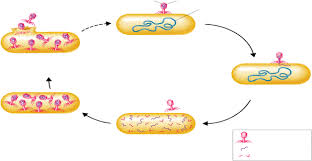
What process is this?
a)
phagocytosis
b)
lytic cycle
c)
lysogenic cycle
d)
formation of antibodies
99.

Which viral life cycle kills its host cell by lysing (bursting)?

a)

Lysogenic Cycle

b)

Lytic Cycle

c)

Binary Fission

d)

Conjugation

100.
What helps prevent viral diseases?
a)
Vaccines
b)
Antibiotics
c)
Herbal tea
d)
Gene Therapy
101.

Which of the following is a viral infection?

a)

cholera

b)

influenza

c)

strep throat

d)

tuberculosis

102.

A viral infection that weakens a person's immune system for the rest of their life is..

a)

strep throat

b)

HIV/AIDS

c)

tuberculosis

d)

the plague

103.
A person with AIDS is likely to develop infectious diseases because the virus that causes AIDS
a)
destroys cancerous cells
b)
damages the immune system
c)
increases the rate of antibody production
d)
increases the rate of microbe destruction
104.
What does invading the host cell enable the virus to do?
a)
increase its size
b)
synthesize needed oxygen
c)
obtain nutrients
d)
reproduce
105.
When a new viral infection appears in a population, scientists usually try to develop a vaccine against the virus. Which substances would most likely be contained in the new vaccine?
a)
live bacteria that ingest viruses
b)
white blood cells from an infected individual
c)
weakened viruses associated with the infection
d)
a variety of microbes that will attack the virus
106.
The substance being transferred into the bacterial cell in B is
a)
a nucleic acid
b)
a protein
c)
an enzyme
d)
a hormone
107.
Atmospheric nitrogen can only be used by most living things after it has been
a)
converted to nitrates with the help of nitrogen-fixing bacteria
b)
taken in by plants through the lenticels
c)
converted to ammonia by bacteria of decay
d)
combined with carbon dioxide to form protein
108.
Atmospheric nitrogen can only be used by most living things after it has been
a)
converted to nitrates with the help of nitrogen-fixing bacteria
b)
taken in by plants through the lenticels
c)
converted to ammonia by bacteria of decay
d)
combined with carbon dioxide to form protein
109.
Which type of bacteria performs the first step in recycling nitrogen compounds from the bodies of plants and animals?
a)
nitrogen-fixing bacteria
b)
bacteria of decay
c)
nitrifying bacteria
d)
denitrifying bacteria
110.
Nitrogen-fixing bacteria live on the roots of leguminous plants in swellings called nodules. The bacteria synthesize nitrogen compounds that are used by the plants, and the plants provide moisture and nutrients for the bacteria. The interaction between the nitrogen-fixing bacteria and the leguminous plants is known as
a)
parasitism
b)
mutualism
c)
saprophytism
d)
commensalism
111.
A student investigated the effectiveness of four different mouthwashes in destroying bacteria. He inoculated the nutrient agar in four petri dishes with bacteria. Each of four paper disks, 1 centimeter in diameter, was soaked in a different mouthwash sample and placed on a different agar surface. Sterile procedures were used throughout the experiment. Each petri dish was placed in an incubator at a temperature of 37ºC for a 24-hour period. The diagram below represents the sequence of events in this investigation. The shaded areas in the petri dishes represent regions of bacterial growth. Which petri dish contains the most effective mouthwash?
a)
A
b)
B
c)
C
d)
D
112.
To what would the phrase "is not a cell but has the ability to reproduce within a living cell" best describe?
a)
an alga
b)
a yeast
c)
a bacterium
d)
a virus
113.
A(n) _____ is a virus that enters a bacterial cell.
a)
endospore
b)
decomposer
c)
plasmid
d)
bacteriophage
114.
Reasons that viruses are considered to be nonliving is because
a)
They are not cellular
b)
They cannot reproduce on their own
c)
They cannot make proteins
d)
all of the above
115.

What are rod shaped bacteria called?

a)

Bacili

b)

Cocci

c)

Spirilla

d)

Coccus

116.

What are spherical shaped bacteria called?

a)

Bacili

b)

Spirilla

c)

Cocci

d)

Spirochete

117.

What is spiral shaped bacteria called?

a)

Cocci

b)

Corksrew

c)

Spirilla

d)

Bacili

118.

Bacteria that use light energy to convert carbon dioxide and water to carbon compounds and oxygen as a way to obtain energy is...

a)

Photoheterotrophs

b)

Chemoheterophs

c)

Chemptrophic autotroph

d)

Phototrophic autotroph

119.

Bacteria that obtain energy by taking in organic molecules for both energy and a source of carbon to obtain energy are called...

a)

Photoheterotrophs

b)

Chemoheterophs

c)

Chemotrophic autotrophs

d)

Phototrophic autotrophs

120.

Which is not a method of respiration for bacteria?

a)

Obligate aerobes

b)

Facultative aerobes

c)

Obligate anaerobes

d)

Facultative anaerobes

121.

Bacteria reproduce by means of what?

a)

Binary Fission

b)

Splitting

c)

Conjugation

d)

Transformation

122.

What is the name of the scientist that developed the first antibiotic (penicillin)?

a)

Charles Darwin

b)

Louis Pasteur

c)

James Watson

d)

Alexander Fleming

123.

Which is the correct order of the steps of the lytic cycle?

a)

Adsorption; replication; entry; assembly; release

b)

Attachment; entry; replication; assembly; release

c)

Attachment; entry; assembly; replication; exit

d)

Entry; adsorption; replication; assembly; release

124.

Which of the following is NOT an environment factor that prompts a virus to move from the lytic cycle to the lysogenic cycle?

a)

Illness and/or disease

b)

Lack of sleep; change in diet

c)

Stress; too much or too little UV radiation

d)

All of these are external factors that trigger this to happen

125.

Viruses that copy backwards - from RNA to DNA instead of DNA to RNA - are called:

a)

anti-virals

b)

prophage

c)

lytic viruses

d)

retroviruses

126.

scientists discovered microorganisms and the first one who demonstrated that microorganisms from the air are able to grow in nutrient solutions was …..

a)

John snow

b)

Koch

c)

Louis Pasteur

127.

Scientists were not able to clearly demonstrate germ theory, the first one who managed to develop a technique to demonstrate this theory was…..

a)

Louis Pasteur

b)

Koch

c)

John snow

128.

Koch established and published experimental steps known as Koch’s postulates, which are rules for demonstrating that an organism causes a disease. How many are Koch’s postulates?

a)

3

b)

5

c)

6

d)

4

129.

Scientists were not able to clearly demonstrate germ theory, Koch was the first scientist who managed to develop a technique to demonstrate this theory. This theory can be applied to all pathogens.

a)

True

b)

False

130.

The set of criteria used to link a disease to a specific pathogen is known as

a)

Pasteur's Postulates

b)

Lister's Premises

c)

Koch's Postulates

d)

Trump's Postulates

131.
Viruses are made of
a)
Nucleic Acids and DNA
b)
Nucleic Acids and Proteins
c)
Proteins and Bacteriophages
d)
Proteins and Capsids
132.
Obligate Anaerobes _____
a)
need oxygen
b)
prefer nitrogen
c)
can only survive in an oxygen free environment
d)
are endospores
133.
During Lysogenic Infections..
a)
the host cell is copied many times over
b)
the host cell is destroyed
c)
the host cell is unaffected
d)
the virus dies
134.
Retroviruses are made of
a)
RNA only
b)
Proteins Only
c)
DNA and a protein coat
d)
RNA and a protein coat
135.
What cycle involves newly formed viruses being released from a bursting host cell?
a)
Lytic Cycle
b)
Lysogenic Cycle
c)
Bacterial Cycle
d)
Nitrogen Cycle 
136.

Layers of membrane surrounding the genetic material inside of a cell

a)

Endospore

b)

Free spore

137.
Reasons that viruses are considered to be nonliving is because
a)
They are not cellular
b)
They cannot reproduce on their own
c)
They cannot make proteins
d)
all of the above