wayground logo

Free Printable Worksheets

Font size

S
M
L
XL
Worksheets

Biology 9 LT1 Revision A

Total questions: 83

Worksheet time: 1hrs 23mins

Name
Class
Date
1.

Which levels of hierarchy form the scientific name?

a)

Class and species

b)

Order and genus

c)

Phylum and species

d)

Genus and species

2.

You would find mushrooms in which kingdom?

a)

Plant

b)

Protists

c)

Fungi

d)

Animal

3.
What is the most specific level of classification?
a)
Family
b)
Domain
c)
Species
d)
Carolus Linnaeus
4.

Biologists who classify living things into groups are called

a)

Biologroupist

b)

Dichotomous

c)

Taxonomists

d)

Binomial

5.

What is binomial nomenclature?

a)

system of 3 names

b)

system of 2 names

c)

the names of the kingdoms

d)

the levels of classification

6.

Scientists group similar organisms together through a process called .....

a)

identification

b)

Estimation

c)

Classification

d)

Organization

7.

Which of the following organisms is a vertebrate?

a)

insect

b)

sponge

c)

monkey

d)

earthworm

8.

Which term describes an animal without a

backbone?

a)

chordate

b)

invertebrate

c)

protozoan

d)

vertebrate

9.

Which organisational tool allows you to group and identify organisms based on similar traits?

a)

Dichotomous key

b)

Cladogram

10.

Biologists who classify living things into groups are called

a)

Biologroupist

b)

Dichotomous

c)

Taxonomists

d)

Binomial

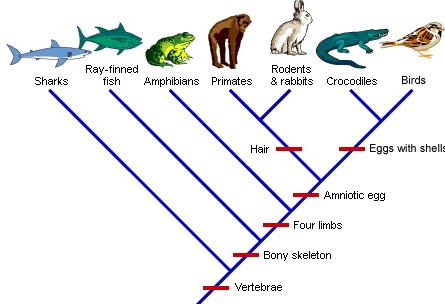
11.
Which two orgainsms have hair? 
a)
Sharks & Ray Finned Fish
b)
Primates & Rodents
c)
Birds & Crocodiles
d)
Rabbits & Birds
12.
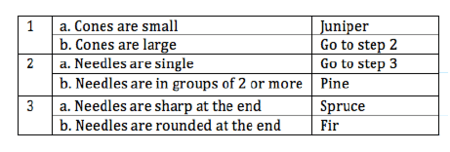
A dichotomous key for trees is provided. Hikers found a tree that has large brown cones and single sharp needles. What species of tree have the hikers found?
a)
Juniper
b)
Pine
c)
Spruce
d)
Fir
13.

Which leaf is shown in the drawing?

a)

Magnolia

b)

Redbud

c)

Sweetgum

d)

None of the above

14.
a rigid supporting layer that surrounds the cells of plants and some other organisms
a)
cell membrane
b)
cell wall
c)
 nucleus
d)
cytoplasm
15.
the thick fluid region of a cell located inside the cell membrane or between the cell membrane and nucleus
a)
cytoplasm
b)
cell wall
c)
organelle
d)
golgi apparatus
16.
a sac like organelle that stores water, food, and other matter
a)
vacuole
b)
lysosome
c)
cytoplasm
d)
cell wall
17.
a small grain shaped organelle found in the cytoplasm of a cell or on the R-ER that produced proteins
a)
cytoplasm
b)
ribosome
c)
cell membrane
d)
mitochondria
18.
The ___ is the basic unit of sturucture and function of organisms
a)
atom
b)
cell
c)
matter
d)
all other answers are correct
19.

What is the function of a chloroplast?

a)

makes proteins for animal cells

b)

allows materials in and out of the cell

c)

provides structure and support

d)

absorbs sunlight for photosynthesis

20.
What are the products of photosynthesis?
a)
water and carbon dioxide
b)
oxygen and glucose
c)
oxygen and carbon dioxide
d)
oxygen and water
21.

Which organelle is responsible making food (Glucose) using sunlight?

a)

Cell Membrane

b)

Nucleus

c)

Chloroplast

d)

Mitochondria

22.
How does carbon dioxide get into the leaves of a plant?
a)
It's absorbed by the roots
b)
It's made in a chemical reaction in the stem
c)
It enters through the stomata
d)
It goes through the flowers
23.

Which part of the microscope is labeled 8?

a)

Fine adjustment knob

b)

Coarse adjustment knob

c)

light source

d)

objective lenses

24.

Which part of the microscope is labeled 10?

a)

Ocular Lens

b)

Fine adjustment knob

c)

base

d)

light source

25.

Which part of the microscope is labeled 11?

a)

Coarse adjustment knob

b)

Fine adjustment knob

c)

base

d)

body tube

26.

What does it mean to make the object appear larger than it actually is?

a)

magnification

b)

resolution

27.

The spherical structured organelle that contains the genetic material is

a)

Mitochondria

b)

Golgi complex

c)

Nucleus

d)

Endoplasmic reticulum

28.

Which organelle is called as "Power House Of The Cell" ?

a)

Golgi Apparatus

b)

Ribosomes

c)

Chloroplast

d)

Mitochondria

29.

All the living things are made up of structural and functional units called _____

a)

Organelles

b)

Elements

c)

Compounds

d)

Cell

30.

What surrounds the cytoplasm of all cells and controls what goes in and out of the cell?

a)

Cell Membrane

b)

Cell Wall

c)

Cellophane

d)

Cellulose

31.

Name the outermost layer of a plant cell that protects and supports it.

a)

Cell Membrane

b)

Cell Wall

c)

Golgi Apparatus

d)

Cytoplasm

32.

What fluid can be found in cells that holds organelles?

a)

Blood

b)

Plasma

c)

Chlorine

d)

Cytoplasm

33.
A tiny, nonliving particle that invades and then reproduces inside a living cell.
a)
Bacteria
b)
Virus
c)
Protist
d)
Fungi
34.
A preparation of weakened or killed pathogens.
a)
Bacteria
b)
Antibiotic Resistance
c)
Vaccine
d)
Capsid
35.
A eukaryotic organism that cannot be classified as an animal, plant, or fungus.
a)
Protist
b)
Virus
c)
Bacteria
d)
Capsid
36.
A large group of one-celled organisms that sometimes cause disease .
a)
Virus
b)
Protist
c)
Fungi
d)
Bacteria
37.
Yogurt contains harmful bacteria.
a)
True
b)
False
38.
Which two examples below are helpful bacteria?
a)
Medicine and Cherry Coke
b)
Yogurt and bread
c)
Salmonella and E. Coli
d)
Water and germs
39.
Mold helps dead things (plants, animals)...
a)
Grow
b)
Decay
c)
Sleep
d)
Reproduce
40.
Microorganisms can be found:
a)
The the ocean, inside and outside your body
b)
On plants and animals
c)
In medicine and your food
d)
All of the above
41.
Some bacteria is known as ________________ and cause disease.
a)
pathogens
b)
flagella
c)
influenza
d)
ebola
42.
Fungi is benefical to us because of the following reason:
a)
They are a source of oxygen
b)
They can clean up pollution
c)
They are a source of antibiotics
d)
They help to clean run off from waste
43.

_____ kill or stop the growth of germs

a)

Antibodies

b)

Vaccines

c)

Antibiotics

44.
Bacteria is known as ______________ in an ecosystem when feeding on dead organisms.
a)
decomposers
b)
herbivores
c)
pathogens
d)
infections
45.
What are these images?
a)
Shapes of viruses
b)
Shapes of bacteria
c)
Shapes of protists
d)
Shapes of fungi
46.
What is part 1?
a)
eye piece
b)
body tube
c)
arm
d)
coarse adjust
47.
The smallest unit of life is a(n)
a)
atom
b)
cell
c)
snail
48.
Living things respond to heat, light, and sound.  This means they respond to:
a)
stimuli/ environment
b)
suction
c)
Dr. Suess
d)
digestion
49.
How many microns (µm)
= 1 mm?
a)
1,000
b)
1,000,000
c)
10,000
d)
100,000
50.
To calculate magnification we use......
a)
image size x actual size
b)
image size ÷ actual size
c)
actual size ÷ image size
51.
If the image measures 100 mm and the scale bar is is 50 µm, what is the magnification?
a)
2,000 x
b)
150 x
c)
5,000 x
d)
20 x
52.
If a scale bar measures 32 mm and it states it's length is 100 µm, what is the magnification?
a)
320 x
b)
3,200 x
c)
0.32 x
d)
32,000 x
53.
If a bacteria image measures 450 mm and the magnification is 15,000x, what is the actual size of the bacteria?
a)
30 µm
b)
0.3 µm
c)
300 µm
d)
3,000 µm
54.
An ant measures 2 mm in length.  If it is observed at 20x magnification, what length should the scale bar be drawn at?
a)
40 mm
b)
10 mm
c)
4 mm
d)
0.1 mm
55.

In order for an organism to be alive it must have the universal genetic code known as....

a)

cells

b)

DNA

c)

Proteinss

d)

homeostasis

56.

Living organisms are designed to ensure that there will be more of themselves in the future, this trait is known as...

a)

reproduction

b)

responding

c)

evolving

d)

having DNA

57.

Living things must become larger which is known as ___.

a)

developing

b)

growth

c)

metabolizing

d)

evolving

58.
A camel has eyelashes that work to keep the dust and sand out of its eyes.
a)
All living things adapt to their environment
b)
All living things grow and develop
c)
All living things have cells
d)
All living things display organization
59.
A caterpillar hibernates in a cocoon and emerges as a butterfly.
a)
All living things adapt to their environment
b)
All living things use energy
c)
All living things respond to their environment
d)
All living things grow and develop
60.
A pill bug (roly poly) eats a carrot.
a)
All living things contain cells
b)
All living things use energy
c)
All living things maintain homeostasis
d)
All living things grow and develop
61.
An amoeba is a unicellular organism. 
a)
All living things reproduce
b)
All living things contain a cell or cells
c)
All living things respond to their environment
d)
All living things grow and develop
62.
A tulip opens in the morning at sunrise and closes in the evening at sunset.
a)
All living things have cells
b)
All living things use energy
c)
All living things respond to their environment
d)
All living things grow and develop
63.
The roots of a plant grow towards a source of ground water.
a)
All living things use energy
b)
All living things reproduce
c)
All living things respond to their environment
d)
All living things grow and develop
64.

A cactus shows all of the following characteristics EXCEPT:

a)

need water

b)

growth

c)

movement

d)

respond to environment

65.
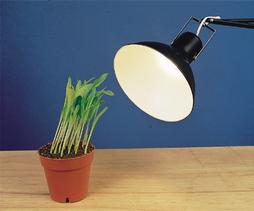
A plant growing towards the light is an example of 
a)
reproduction.
b)
responding to a stimuli.
c)
metabolism.
d)
homeostasis.
66.
The "cause" for something to happen is the
a)
response
b)
effect
c)
stimulus
d)
homeostasis
67.
An amoeba is a unicellular organism. Which characteristic of life is this?
a)
All living things use energy
b)
All living things contain cells
c)
All living things respond to their environment
d)
All living things grow
68.
What is the main source of energy on Earth?
a)
stars
b)
moon
c)
water
d)
sun
69.

Which part of the microscope is labeled 5?

a)

Ocular Lens

b)

Objective Lenses

c)

Diaphragm

d)

Light Source

70.

Which type of cell is this?

a)

Animal

b)

Plant

c)

Bacterial

d)

Virus

71.

What is the function of the cell membrane?

a)

To control what comes in and out of the cell

b)

To break down food inside the cell

c)

to serve as a barrier

d)

to eat the cells food

72.

What are the function and fun way of remembering what the cell wall does

a)

Rigid outer layer of a plant cell

b)

"Im a brick wall"

c)

Rigid outer layer of an animal cell

d)

" Im a clay wall"

73.

The cytoplasm can be remembered by saying " Sail through my (a)   "

74.

Which organelle produces the energy a cell needs to carry out its function

a)

Mitochondria

b)

Golgi Bodies

c)

Cytoplasm

d)

Nucleus

75.

Which organelle is found inside the nucleus and produces ribosomes

a)

Nucleolus

b)

Cell Membrane

c)

Lysosome

d)

Golgi Bodies

76.

What is a fun way to remember what lysosomes do?

a)

I clean things up!

b)

Make something sweet

c)

The control center

d)

Tin of information

77.

What is the function of the Vacuoles

a)

Store food, water and waste

b)

Receive proteins

c)

Assembles amino acids

d)

Found inside the nucleus

78.

Which organelle receives proteins and materials from the ER, packages them and distributes them

a)

Vacuoles

b)

Golgi Bodies

c)

Nucleus

d)

Chromatin

79.

Which cell contains Chloroplasts?

a)

Animal

b)

Plant

80.

What is a fun way to remember what the Endoplasmic Reticulum does?

a)

transportER

b)

I am a mighty powerhouse

c)

Im the control center

81.

what is the function of ribosomes

a)

to assemble amino acids to create proteins

b)

to pack proteins

c)

to clean proteins

82.

The control center of cell is

a)

the nucleus

b)

ribosomes

c)

chromatin

83.

Chromatin is

a)

tiny strands inside the nucleus that contain the instructions for directing the cell's function

b)

found inside the nucleus

c)

needed to make proteins