Wayground logo

Free Printable Worksheets

Font size

S
M
L
XL
Worksheets

Honors Biology 1st nine week REVIEW: Ch. 1-5 and 6 part 1

Total questions: 139

Worksheet time: 3hrs 53mins

Name
Class
Date
1.
Which of the following is NOT a goal of science?
a)
to investigate and understand the natural world
b)
to explain events in the natural world
c)
to use data to support a particular point of view
d)
to use derived explanations to make useful predictions
2.
Information gathered from observing a plant grow 3 cm over a two week period results in
a)
inferences
b)
variables
c)
hypotheses
d)
quantitative and qualitative data
3.
A hypothesis
a)
can be completely proven
b)
may be disproved by a single experiment
c)
does not have to be tested to be accepted as probably correct
d)
is a proven fact
4.
Which of the following is a valid hypothesis for why a plant appears to be dying?
a)
The plant is not being watered enough
b)
The plant is being watered too much
c)
The plant is receiving too much sunlight
d)
All of these are correct
5.
A controlled experiment allows scientists to isolate and test:
a)
a conclusion
b)
a mass of information
c)
several variables
d)
a single variable
6.
A theory
a)
is always true
b)
is the opening statement of an experiment
c)
may be revised or replaced
d)
is a problem to be solved
7.
A well-tested explanation that unifies a broad range of oberservations is a(an)
a)
hypothesis
b)
inference
c)
theory
d)
controlled experiement
8.
Biology is the study of
a)
the land, water, and air
b)
the living world
c)
animals and plants only
d)
the environment
9.
Which of the following is NOT a characteristic of all living things?
a)
growth and development
b)
ability to move
c)
response to the environment
d)
ability to reproduce
10.
Which of the following characteristics of living things BEST explains why birds fly south for the winter?
a)
Living things respond to their environment
b)
Living things maintain internal balance
c)
Living things are made of units called cells
d)
Living things are based on a universal genetic code
11.
The process by which organisms keep internal conditions fairly constant is called
a)
homeostasis
b)
evolution
c)
metabolism
d)
photosynthesis
12.
What is the term for land, water, and air on Earth
a)
population
b)
community
c)
biosphere
d)
environment
13.
What is the term for a group of organisms of one type living in the same place?
a)
biosphere
b)
ecosystem
c)
population
d)
community
14.
Which level of organization includes all of the other levels listed?
a)
organism
b)
ecosystem
c)
population
d)
community
15.
All of the interacting populations in an area.
a)
Organism
b)
Population
c)
Community
d)
Ecosystem
16.
The diagram below shows the cycling of nutrients in an ecosystem.
The removal of which of the following groups would cause an immediate decrease in the amount of energy flowing through the system?
a)
Producers
b)
Consumers
c)
Decomposers
d)
Inorganic nutrients
17.
Green plants are
a)
producers
b)
consumers
c)
herbivores
d)
omnivores
18.
What is the original source of almost all energy in most ecosystems?
a)
carbohydrates
b)
sunlight
c)
water
d)
carbon
19.
An organism that produces its own food supply from inorganic compounds is called a(an)
a)
heterotroph
b)
consumer
c)
detritivore
d)
autotroph
20.
What is the term for each step in the transfer of energy and matter within a biological community?
a)
energy path
b)
food web
c)
trophic level
d)
food pyramid
21.

Which symbiosis is this? (Tick on a dog.)

a)

parasitism

b)

mutualism

c)

commensalism

d)

nonalism

22.
symbiotic relationship in which both organisms benefit
a)
competition
b)
Mutualism
c)
nitrogen fixation
d)
energy pyramid
23.
The energy at each trophic level in the pryamid of energy decreases by a factor of ____.
a)
10
b)
1
c)
100
d)
2
24.
What does a food web represent?
a)
All connections of energy flow throughout all organisms in a habitat.
b)
The specific ways that mutualism is carried out.
c)
A single pathway or energy flow between organisms. 
d)
How carnivores get their food. 
25.
diagram that shows the energy available to each trophic level in an ecosystem; 10% is passed on to upper levels, the rest is lost as heat
a)
succession 
b)
cellular respiration
c)
energy pyramid
d)
biochemical cycle
26.
a relationship between two in which one species, the predator, feeds on the other species, the prey
a)
chemosynthesis
b)
predation
c)
cellular respiration 
d)
commensalism
27.
symbiotic relationship in which one organisms benefits and the other organism is not affected
a)
invasive (non-native) species
b)
mutualism 
c)
nitrogen fixation
d)
commensalism
28.
Study of interactions between organisms and their environment 
a)
niche
b)
community 
c)
ecology
d)
ecosystem
29.
Members of a species in a defined area
a)
Ecosystem
b)
community
c)
biodiversity
d)
population
30.
Where an organism lives
a)
habitat
b)
niche 
c)
heterotrogh
d)
biosphere
31.
Non-living factor that affects an ecosystem
a)
biotic factor
b)
abiotic factor
c)
food chain 
d)
biome
32.
Non-living factor that affects an ecosystem
a)
biotic factor
b)
abiotic factor
c)
food chain 
d)
biome
33.
Organisms that breaks down and absorbs nutrients from dead organisms 
a)
consumer
b)
trophic level
c)
decomposer
d)
species
34.
A pond ecosystem is shown in the diagram below. Which statement describes an interaction that helps maintain the dynamic equilibrium of this ecosystem?
Which statement describes an interaction that helps maintain the dynamic equilibrium of this ecosystem?
a)
The frogs make energy available to this ecosystem through the process of photosynthesis.
b)
The algae directly provide food for both the rotifers and the catfish.
c)
The green-backed heron provides energy for the mosquito larvae.
d)
The catfish population helps control the populations of water boatman and waterfleas.
35.

What are the swellings found on the roots of legumes called? What type of bacteria are found there?

a)

noodles; denitrifying bacteria

b)

nodularisms; nitrifying bacteria

c)

nodules; n-fixing bacteria

d)

tubers; n-fixing bacteria

36.
The process of plants losing water through their leaves is called ____.
a)
condensation
b)
evaporation
c)
transpiration
d)
exhaling
37.
Respiration is the process by which ____________ is consumed and _______________ is produced.
a)
Carbon, Oxygen
b)
Oxygen, Carbon dioxide
c)
H20, oxygen
d)
Carbon, H2O
38.
This process is responsible for most environmental problems of excess nitrogen and phosphorus entering streams, lakes and oceans.
a)
decomposition
b)
emissions from automobiles
c)
agriculture and house hold runoff
d)
photosynthesis
39.
Which of the following is known as the "sedimentary" cycle because its reservoir is sedimentary rock?
a)
Sulfur cycle
b)
Nitrogen cycle
c)
Phosphorus cycle
d)
Carbon cycle
40.
Identify the cycle pictured.
a)
The Water cycle
b)
The Carbon cycle
c)
The Nitrogen cycle
d)
The Phosphorus cycle
41.
Identify the cycle pictured.
a)
The Water cycle
b)
The Carbon cycle
c)
The Nitrogen cycle
d)
The Phosphorus cycle.
42.
What is condensation?
a)
The part of the water cycle when the sun heats up water, turning it from a liquid into water vapor or steam. It rises from the ground into the air.
b)
The part of the water cycle when the water vapor in the air gets cold. The water turns back into a liquid and forms clouds.
c)
The part of the water cycle when clouds get heavy and can no longer hold the liquid water. This causes the water to fall from the sky to the earth as rain, snow, sleet, or hail.
43.

Which cycle are fossil fuels (oil, coal, natural gas) part of?

a)

carbon

b)

water

c)

nitrogen

d)

phosphorus

44.

The lionfish is a venomous fish found primarily in the Red Sea and the Indian Ocean. In the 1990s, lionfish were accidentally released into the Atlantic Ocean, where they found abundant resources and favorable environmental conditions. Which of the following scenarios is most likely to result in the lionfish having a major impact on the communities into which they were introduced?

a)

With no natural predators, the lionfish population will become very large.

b)

Some native species of invertebrates will develop a resistance to lionfish venom.

c)

Random mating will allow the lionfish population to reach Hardy-Weinberg equilibrium.

d)

A virus that specifically infects lionfish will become more prevalent.

45.

There is strong evidence that two species of

cliff-dwelling birds have nested in the same

environment and fed in the same water for

thousands of years, with each having stable

population sizes. Based on this information,

which of the following statements is the best

conclusion?

a)

The two birds compete for food.

b)

One species will displace the other.

c)

The two birds have different ecological niches that allow coexistence.

d)

One species eats a more diverse diet than the other does.

46.
What is formed during primary succession that doesn't need to be formed during secondary succession?
a)
pioneer species
b)
soil
c)
climax community
d)
lichens
47.
What type of succession is shown going from figure A to figure B?
a)
primary succession
b)
eutrophication
c)
secondary succession
d)
intermediate
48.
After a forest fire, an ecosystem would start regrowth through -
a)
primary succession
b)
secondary succession
c)
climax community
d)
limiting factors
49.
Which catastrophic event will most likely have the effect of returning an ecosystem to primary succession?
a)
A tornado
b)
A volcanic eruption
c)
A flood
d)
A drought
50.

Which would result in primary succession?

a)

volcano destroying habitat leaving only soil and ash

b)

Tornado destroying a crop leaving very little soil

c)

Glacier retreating exposing bare rock

d)

limiting factors

51.

If you visited a forest in 2015 and there was only small plants there when revisited in 2019, what likely happened?

a)

passing of a glacier

b)

preservation of a habitat

c)

occurrence of a forest fire

d)

development of a parking lot

52.
the first organisms that appear in an ecological community
a)
ecological succession 
b)
primary succession 
c)
secondary succession
d)
pioneer speciles
53.
a stable ecological community that has reached equilibrium
a)
ecological succession 
b)
climax community
c)
secondary succession
d)
pioneer speciles
54.

a)

A

b)

B

c)

C

d)

D

55.

a)

A

b)

B

c)

C

d)

D

56.

a)

A

b)

B

c)

C

d)

D

57.

a)

A

b)

B

c)

C

d)

D

58.

a)

A

b)

B

c)

C

d)

D

59.
Environmental factor, such as predation, disease, and competition, that depends on the number of members in a population per unit area.
a)
density-independent factor
b)
density-dependent factor
c)
emigration
d)
immigration
60.
Environmental factor, such as storms and extreme heat or cold, that affects populations regardless of their density.
a)
density-independent factor
b)
density-dependent factor
c)
emigration
d)
immigration
61.
Movement of individuals from a population
a)
density-independent factor
b)
density-dependent factor
c)
emigration
d)
immigration
62.

Movement of individuals into a population

a)

density-independent factor

b)

density-dependent factor

c)

emigration

d)

immigration

63.
Largest number of individuals in a species that the environment can support long-term.
a)
population delpunsity
b)
dispersion
c)
population growth rate
d)
carrying capacity
64.

Arrangement of a population in its environment

a)

population density

b)

dispersion

c)

population growth rate

d)

carrying capacity

65.

Arrangement of a population in its environment

a)

population density

b)

dispersion

c)

population growth rate

d)

carrying capacity

66.

How fast a specific population grows.

a)

population density

b)

dispersion

c)

population growth rate

d)

carrying capacity

67.

Number of organisms per unit of living area

a)

population density

b)

dispersion

c)

population growth rate

d)

carrying capacity

68.
Habitat loss from separation of an ecosystem into small pieces of land.
a)
Edge Effect
b)
Habitat Fragmentation
c)
Biological Magnification
d)
Eutrophication
69.
Habitat loss from separation of an ecosystem into small pieces of land.
a)
Edge Effect
b)
Habitat Fragmentation
c)
Biological Magnification
d)
Eutrophication
70.
Increasing concentration of toxic substances, such as DDT, in organisms as trophic levels increase in food chains or food webs
a)
Edge Effect
b)
Habitat Fragmentation
c)
Biological Magnification
d)
Eutrophication
71.
Process by which lakes become rich in nutrients from the surrounding watershed, resulting in a change in the kinds of organisms in the lake.
a)
Edge Effect
b)
Habitat Fragmentation
c)
Biological Magnification
d)
Eutrophication
72.
Any different environmental condition occurring along an ecosystem's boundaries.
a)
Edge Effect
b)
Habitat Fragmentation
c)
Biological Magnification
d)
Eutrophication
73.
Gradual process of a species becoming extinct
a)
genetic diversity
b)
species diversity
c)
ecosystem diversity
d)
background extinction
74.
In a biological community, the number and abundance of different species.
a)
genetic diversity
b)
species diversity
c)
ecosystem diversity
d)
background extinction
75.
Variety of inheritable characteristics or genes in an interbreeding population.
a)
genetic diversity
b)
species diversity
c)
ecosystem diversity
d)
background extinction
76.
Variety of ecosystems in the biosphere.
a)
genetic diversity
b)
species diversity
c)
ecosystem diversity
d)
background extinction
77.
Overuse of species with economic value.
a)
overexploitation
b)
introduced species
c)
eutrophication
d)
edge effect
78.
Non-native species deliberately or accidentally introduced into a new habitat.
a)
overexploitation
b)
introduced species
c)
eutrophication
d)
edge effect
79.
If the number of births in a population is the same as the number of deaths in a population, what will happen to the growth of the population?
a)
It will increase.
b)
It will decrease.
c)
It will stay the same.
d)
It will fluctuate.
80.
Largest number of individuals of a population that the environment can support...  
a)
carrying capacity
b)
population crash
c)
lag phase
d)
mutualism
81.
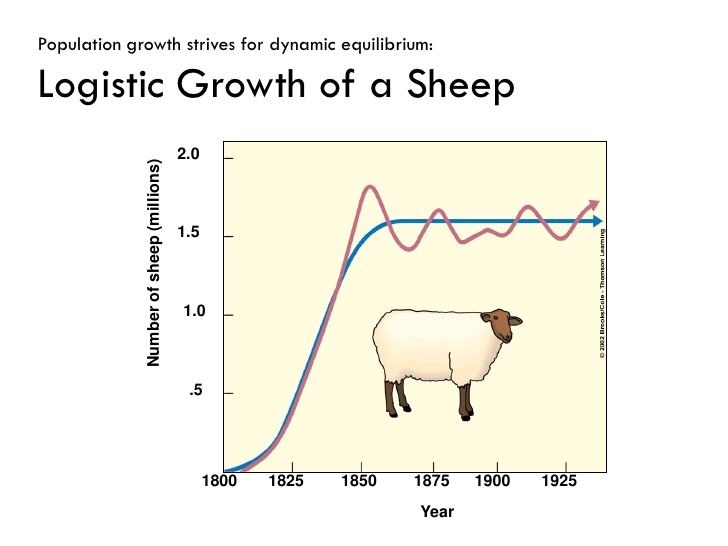
What is the carrying capacity for this sheep population?
a)
1.8 million
b)
1.25 million
c)
1.6 million
d)
1.o million
82.
When a population grows past the ecosystem's carrying capacity, what happens to the population?
a)
Continues to grow
b)
The population starts to die off to return to carrying capcity
c)
The population will go extinct due to lack of resources
d)
The population grows then finds a new carrying capacity
83.
Food, water, sunlight, shelter, and space are resources that are often __________.
a)
limiting factors
b)
wet
c)
messy
d)
found in rocks
84.
Any thing or organism that regulates the size of a population of another organism is known as __________.
a)
a limiting measure
b)
a limiting factor
c)
factorization
d)
materialization of precipitation
85.
Which kind of growth does the human population follow? It is described as a J-shaped curve.
a)
Exponential Growth
b)
Logistic Growth
c)
Outstanding Growth
d)
Minimal Growth
86.
What type of growth is represented behind?
a)
exponential
b)
logistics
c)
a good kind
d)
representative
87.
What point on the graph represents the carrying capacity?
a)
A
b)
B
c)
C
d)
D
88.

Which of the following are density dependent factors?

a)

competition for resources

b)

predation

c)

disease

d)

natural disasters

89.

Which of the following are examples of a density independent factors?

a)

forest fire

b)

seasonal cycles

c)

storms

d)

disease

90.

This graph shows ....

a)

When one population increases, the other decreases.

b)

When one population decreases, the other increases.

c)

When one population increases, the other increases instantly.

d)

When one population increases, it causes the other to increases shortly after.
91.
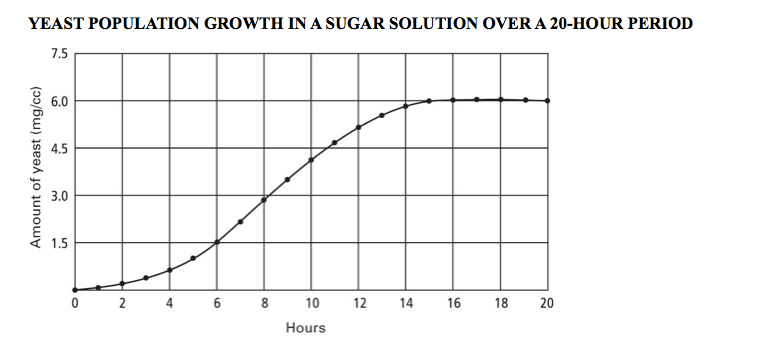
What type of growth is shown on this graph?
a)
logistic
b)
exponential
c)
average
d)
density-independent
92.

An organisms population growth is shaped by its reproductive pattern. Which combination of traits characterizes a rapid life history pattern (r-species)?

a)

short life span, produces many offspring, small body size

b)

short life span, live in more stable environments, small body size

c)

long life span, produces many offspring, grows into adults slowly

d)

long life span, large body size, grows into adults slowly

93.

An organisms population growth is shaped by its reproductive pattern. Which combination of traits characterizes a rapid life history pattern (r-species)?

a)

short life span, produces many offspring, small body size

b)

short life span, live in more stable environments, small body size

c)

long life span, produces many offspring, grows into adults slowly

d)

long life span, large body size, grows into adults slowly

94.

A species that plays a critical role in the health, maintenance, growth, or definition of an ecosystem.

a)

keystone

b)

invasive

c)

engineer

d)

predator

95.

Why are bees considered a keystone species?

a)

The honey they make supports the bear population

b)

They pollinate flowers that produce fruit which supports the ecosystem

c)

They sting when threatened

d)

They live in hives

96.

Which one of the following keystone examples play a vital role in the health of coastal kelp forests?

a)

starfish

b)

sea otters

c)

beavers

d)

wolves

e)

elephants

97.

9 meters = ___________cm

a)

900 cm

b)

90 cm

c)

0.9 cm

d)

0.09 cm

98.
Convert 5 cm to mm:
a)
5,000mm
b)
0.5 mm
c)
0.05 mm
d)
50 mm
99.
Convert 5 cm to mm:
a)
5,000mm
b)
0.5 mm
c)
0.05 mm
d)
50 mm
100.
Convert 300 cm to m:
a)
3 m
b)
30 m
c)
0.3 m
d)
0.03 m
101.
1000 grams = _____ kilograms
a)
0.0001
b)
1,000,000
c)
10
d)
1
102.
5,000 mg = ____ g
a)
50
b)
5
c)
500
d)
5,000
103.
1 L = _______ mL
a)
1
b)
10
c)
100
d)
1000
104.
Which unit is the smallest?  
a)
km
b)
mm
c)
m
d)
cm 
105.

What is the basic unit of mass in the metric system?

a)

Liter

b)

Meter

c)

Gram

d)

Kilometer

106.
What is labeled "a"
a)
proton
b)
neutron
c)
electron
d)
molecule
107.
What is labeled "b"
a)
proton
b)
neutron
c)
electron
d)
molecule
108.
What is labeled "c"
a)
proton
b)
neutron
c)
electron
d)
molecule
109.
What is labeled "F"?
a)
Ionic Bond
b)
Covalent Bond
c)
Hydrogen Bond
d)
Van der Waals Force
110.
What is labeled "G"?
a)
Ionic Bond
b)
Covalent Bond
c)
Hydrogen Bond
d)
Van der Waals Force
111.
What is labeled "a"
a)
enzyme
b)
substrate
c)
active site
d)
product
112.
What is labeled "b"
a)
enzyme
b)
substrate
c)
active site
d)
product
113.
What is labeled "c"
a)
enzyme
b)
substrate
c)
active site
d)
product
114.
What is labeled "d"
a)
enzyme
b)
substrate
c)
active site
d)
product
115.
Vinegar would best be classified as ______.
a)
acidic
b)
basic
c)
neutral
d)
water
116.
Bleach would best be classified as ______.
a)
acidic
b)
basic
c)
neutral
d)
water
117.
Blood would best be classified as ______.
a)
acidic
b)
basic
c)
neutral
d)
water
118.
Which is the strongest acid
a)
lemons
b)
orange juice
c)
baking soda
d)
ammonia
119.
Which is the strongest base
a)
lemons
b)
orange juice
c)
baking soda
d)
ammonia
120.
What represents the reactant?
a)
A + B
b)
C + D
c)
d
d)
e
121.
What represents the product?
a)
A + B
b)
C + D
c)
d
d)
e
122.
What represents the energy released?
a)
b
b)
c
c)
d
d)
e
123.
What represents the activation energy WITHOUT the enzyme?
a)
b
b)
c
c)
d
d)
e
124.
What represents the activation energy WITH the enzyme?
a)
b
b)
c
c)
d
d)
e
125.
The building block of matter
a)
electron
b)
cell
c)
atom
d)
proton
126.
Which of these represents a chemical compound?
a)
H
b)
C
c)
P
d)
H2O
127.
A chemical reaction is a process by which atoms or groups of atoms in substances are
a)
dissolved in other substances
b)
ionized by the loss of protons
c)
mixed together with atoms in other substances
d)
reorganized into different substances
128.
Which equation satisfies the law of conservation of matter?
a)
CH4 + 2O2 = CO2 + 2H2O
b)
2CH4 + 2O2 = 2CO2 + 2H2O
c)
4CH4 + 2O2 = CO2 + 2H2O
d)
CH4 + 2O2 = 4CO2 + 2H2O
129.
What cannot take place during a chemical reaction?
a)
formation of new atoms
b)
bonds breaking between atoms
c)
formation of new molecules
d)
bonds forming between atoms
130.
Which is the best description of activation energy?
a)
heat added to initiate a reaction
b)
heat released as the reaction proceeds
c)
heat stored within the reactant molecules
d)
heat stored within the porduct molecules
131.
Which is true in a covalent bond?
a)
The bond forms between ions
b)
The bond forms when electrons are shared
c)
The bond holds atoms weakly
d)
The bond is caused by van der Waals forces
132.
Consider this energy diagram for a chemical reaction.  Overall, is energy released or absorbed?
a)
released, because the reaction is initiated by the addition of heat
b)
released, because the energy level of the reactants is greater than that of the products
c)
absorbed, because the energy level decreases during the reaction
d)
absorbed, because the energy level of the products is greater than that of the reactants
133.
A catalyst used during biochemical processes is known as a __________.
a)
antibody
b)
enzyme
c)
ion
d)
inorganic compound
134.
Which is true about enzymes?
a)
They act on nonspecific, randomly chosen substrates
b)
After a reaction, they cannot be reused
c)
They can speed up metabolic processes in the body
d)
They cannot change shape
135.
What makes a water molecule polar?
a)
Water has the ability to be frozen
b)
The pH of pure water varies with the temperature
c)
A water molecule has a slight charge on each end
d)
A water molecule is made up of three atoms
136.
A molecule of water has which bonds?
a)
1 covalent bond
b)
2 covalent bonds
c)
1 ionic bond
d)
2 ionic bonds
137.
Adhesion is the aspect of water that causes ....
a)
polar covalent bonds to join water molecules to other substances
b)
nonpolar covalent bonds to enable water to dissolve other substances
c)
ionic bonds to cause electrons to flow through water
d)
hydrogen bonds to form between water and another substance
138.
Which is an example of a solute?
a)
soil suspended in water
b)
sugar dissolved in water
c)
water that dissolves salt
d)
water with undissolved soil
139.
When making chocolate milk with milk and chocolate powder, what would the solvent be?
a)
chocolate powder
b)
spoon
c)
milk
d)
glass