
 Worksheets
1st nine weeks
Total questions: 132
Worksheet time: 5hrs 3mins


The ability to maintain a stable internal environment is called ________________.
Metabolism
Mitosis
Heterozygous
Homeostasis

Cell have several mechanisms for regulating their internal environments. Which of these mechanisms involved in maintaining homeostasis requires energy?
osmosis
diffusion
active transport
passive transport

Diffusion, a form of passive transport, is the movement of
particles from high to low concentration
particles from low to high concentration
The flu is caused by a virus.

DNA replication occurs in the -
mitochondira
nucleus
endoplasmic reticulum
cell membrane
Which of the following is NOT in a prokaryotic cell?
cell membrane
cell wall
nucleus
DNA
What is the function of a ribosome?
To transform energy
To make proteins
To hold DNA
To make fats
What is function of the mitochondria
To make protein
To hold genetic information
To transform energy
To transport molecules
What is the function of the cell membrane?
To give the cell shape
To make proteins
To send messages
To allows molecules to enter and leave
Which is NOT an example of a eukaryotic cell?
bacteria
plants
fungi
protists
Which has a nucleus and membrane bound organelles?
prokaryote
eukaryote
bacteria
archeabacteria
Which does not have a nucleus and membrane-bound organelles?
prokaryotes
eukaryotes
animal
protist
Which is an example of a prokaryote?
fungi
plant
protist
bacteria
Which is an example of a eukaryote?
plant
animal
fungi
all of these
Which has a nucleus and membrane bound organelles?
prokaryote
eukaryote
bacteria
archeabacteria
Which does not have a nucleus and membrane-bound organelles?
prokaryotes
eukaryotes
animal
protist
Which is an example of a prokaryote?
fungi
plant
protist
bacteria
Which is an example of a eukaryote?
plant
animal
fungi
all of these
What do animal cells have the plant cells do not have?
centrioles
cell wall
chloroplast
ribosome
What do plant cells have that animal cells do not have?
centrioles
cell wall
chloroplast
cell wall & chloroplast
Which organelle makes proteins?
chloroplast
mitochondria
ribosome
nucleus
Which organelle is the site of photosynthesis?
ribosome
mitochondria
chloroplast
nucleus
Which organelle is the site of cellular respiration?
nucleus
mitochondria
chloroplast
ribosome
What type of transport requires energy?
passive transport
active transport
diffusion
osmosis
What is an example of active transport?
osmosis
diffusion
endocytosis
facilitated diffusion
What type of transport does not require energy?
endocytosis
active transport
passive transport
exocytosis
What is an example of passive transport?
osmosis
endocytosis
exocytosis
sodium-potassium pump
Which is not an example of passive transport?
osmosis
diffusion
facilitated diffusion
endocytosis
What would a cell do if it was placed in a hypotonic solution?
swell
shrink
stay the same
What would the cell do if it was placed in a hypertonic solution?
swell
shrink
stay the same
What would the cell do if it was placed in an isotonic solution?
swell
shrink
stay the same
The diffusion of water is...
endocytosis
exocytosis
osmosis
diffusion
Specialized cells that work together in a cell are
ribosomes
organelles
organs
tissues
Which organelle is the site for protein synthesis?
nucleus
cell membrane
ribosomes
mitchondira
What does synthesis mean?
to break down
to make
to die
to disintegrate
Which organelle contain enzymes to break down cell parts?
ribosome
lysosome
cell membrane
nucleus
Which structure is used for mobility and looks like a tail?
cell wall
cell membrane
flagella
cilia
Which of the following represents the levels of organization from least complex to most complex?
cell- organ- tissue- system
system- cell- tissue- organ
cell- tissue- organ- system
tissue- cell- organ- system
According to the Endosymbiotic Theory, scientists believe that a larger cell engulfed a smaller prokaryote. What evidence do scientists have that support this theory?
All of the prokaryotes are extinct
Mitochondria and Chloroplasts have their own DNA
Cells no longer have a cell membrane
Some cells do not contain DNA
Which type of transport goes from low to high concentration?
passive transport
active transport
Which type of transport goes from high to low concentration?
passive transport
active transport
A unicellular organism that lacks a nucleus and membrane-bound organelles is
prokaryote
eukaryote
fungi
protist
A cell that contains a nucleus and membrane-bound organelles
prokaryote
eukaryote
bacteria
archeabacteria
A tiny, nonliving particle that invades and then reproduces inside a living cell is a
bacteria
virus
fungus
protist
A harmless variant of a pathogen that stimulates a host's immune system to defend itself against the pathogen is a
virus
vaccine
antibiotic
prokaryote
A part of the cell containing DNA and RNA and responsible for growth and reproduction is a
ribosome
nucleus
cell membrane
mitochondria
Where are proteins made?
nucleus
mitochondria
chloroplast
ribosome
Which organelle is the site of ATP production?
mitochondria
chloroplast
nucleus
cell membrane
An organelle found in plant and algae cells where photosynthesis occurs is a
chloroplast
mitochondria
cell wall
cell membrane
A cell structure that forms a maze of passageways in which proteins are carried from one part of the cell to another is the
endoplasmic reticulum
nucleus
mitochondria
ribosome
An organelle containing digestive enzymes is the
lysosome
endoplasmic reticulum
ribosome
Golgi bodies
A cell structure that controls which substances can enter or leave the cell is a
cell membrane
lysosome
endoplasmic reticulum
nucleus
A rigid layer of non-living material that surrounds the cells of plants and some other organisms is a
cell wall
cell membrane
ribosome
endoplasmic reticulum
A complex molecule containing the genetic information that makes up the chromosomes is
DNA
a ribosome
a cell membrane
mitochondria
The fluid inside the cell in which the organelles are suspended is the---
chloroplast
cytoplasm
cell membrane
centrioles
Something that causes disease is a
cell membrane
pathogen
organelle
cell
A system of membranes that packages proteins for export by the cell is the
mitochondria
chloroplast
golgi bodies
endoplasmic reticulum
The organelle that stores water, salts and proteins is the --
vacuole
cell membrane
nucleus
golgi bodies
Which viral cycle causes cell destruction?
lytic cycle
lysogenic cycle
Which viral cycle causes the viral DNA to be copied along with the host cell's DNA
lytic cycle
lysogenic cycle


What is the function of the cell membrane?
To control what comes in and out of the cell
To break down food inside the cell
to serve as a barrier
to eat the cells food

Which cell contains Chloroplasts?
Animal
Plant
What does the DNA look like in a Prokaryotic cell?
Linear
Circular
There is no DNA
An organism that is made of a prokaryotic cell is called ....
mold
mushrooms
plants
bacteria
Tiny membrane-bound structures inside a cell that function like organs of a body are called....
cell wall
cell membrane
organelle
organ

Which of the following is a characteristic of both eukaryotic and prokaryotic cells?
contains ribosomes
contains a nucleus
contains several membrane bound organelles
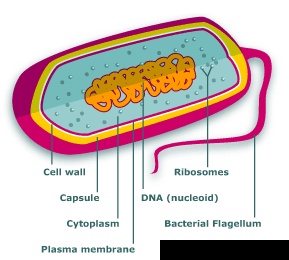
What type of cell is in the diagram?
Prokaryote
Eukaryote
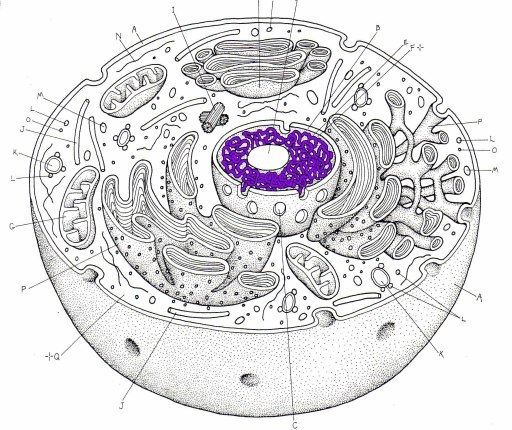
What kind of cell is in the diagram?
Eukaryotic
Prokaryotic
What does the DNA look like in a Eukaryotic cell?
Linear
Circular
There is no DNA


The flu is caused by a virus.


