
 Worksheets
Unit 8 Exam: Ecology and evolution
Total questions: 82
Worksheet time: 1hrs 28mins

Which of the following describes a population?
the wild dogs and cats that live in the city
four different species of fish living in a pond
a group of Canadian Geese living in a pond in Ijams
roses and sun flowers in a garden

Speciation can occur as a result of geographic isolation because _________.
members of a species can no longer find mates
populations that live in different environments may be exposed to different selection pressures
exchange of genes during recombination
movement of genes within a population because of interbreeding

The dolphin and the shark are similar because they have
Both adapted to a marine (ocean) environment and they both have a similar body shape but they do not share a recent common ancestor. This is known as ___________.
coevolution
ancestral breeding
artificial selection
convergent evolution

These structures exist in the body but are no longer needed. Examples include wisdom teeth and the appendix.
Vestigial
Homologous
Niche
Analogous

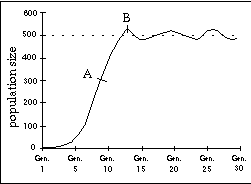
Which type of population growth is shown in this graph?
Exponential growth
Logistic growth
Logarithmic growth
Linear Growth
Which of the following is NOT a density dependent factor?
Disease
Predation
Limited Resources (food, water, etc.)
Hurricanes
This level of ecological organization includes BOTH abiotic and biotic factors such as animals and water.
Population
Community
Organism
Ecosystem
Songbirds like Eastern Towhees defending territories from which they exclude their neighbors in an effort to secure resources and mating opportunities. Which type of competition is this?
Intraspecific
Interspecific
Xenospecific
Intensive

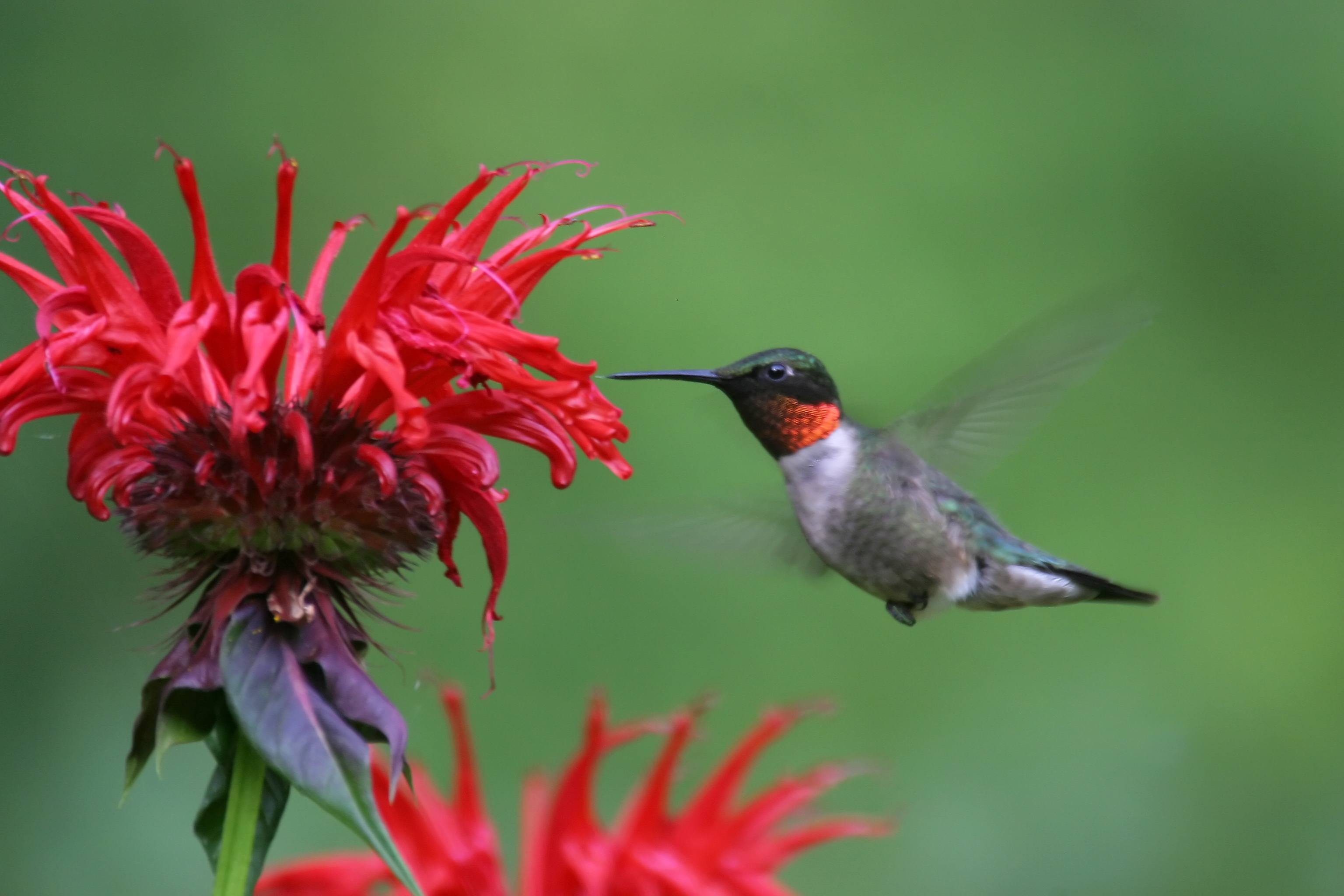

Aphids are tiny insects that live on and eat the leaves of plants, removing vital nutrients from the plants.
Predation
Parasitism
Commensalism
Mutualism
What is an invasive species?
An organism that is new to an environment that has positive effects on the environment.
An organism that is native to an environment that has negative effects on the environment.
An organism that is new to an environment that has negative effects on the environment.
An organism that is native to an environment that has positive effects on the environment.

Click on the map to help answer this question: What can we predict about the population of Feral Swine for the year 2016?
There will be less feral swine in 2016 than there were in 1982.
There will be more feral swine in 2016 than there were in 2010
There were fewer feral swine in 2004 than 1982.
There will be no change in feral swine population.
It's hard to reduce lionfish numbers because _______.
they often live in spots where divers can't reach them.
they have spines that keep predators from eating them.
they reproduce quickly.
all of the above.
What caused the lionfish to end up in the Atlantic Ocean?
The lionfish swam there from The Pacific Ocean.
Pet owners dumped their unwanted fish into the ocean.
Pet owners lost them and found them in the Atlantic Ocean.
The lionfish migrate there every winter.
The change in an ecological community over time.
ecological succession
Climax community
pioneer species
eutrophication
When an ecological community has undergone succession and has become stable, no longer changing.
ecological succession
Climax community
pioneer species
eutrophication
When human use fertilizer, the runoff can end up bodies of water such as a lake or pond. This causes an excess of nutrients to be added to the body of water. What is this called?
ecological succession
Climax community
pioneer species
eutrophication
A pioneer species that breaks down rock in order to form a more compatible substrate for other, larger plants to grow. They spread their spores in order to reproduce.
lichens and mosses
primary succession
secondary succesion
aquatic succession
Succession that begins with rocks.
lichens and mosses
primary succession
secondary succesion
aquatic succession
Succession that begins with dirt.
lichens and mosses
primary succession
secondary succesion
aquatic succession

Which image shows a climax community?
A
B
C
D


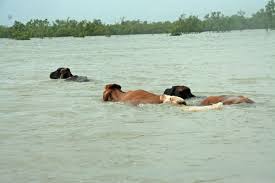
A lion and a cheetah attempt to occupy the same niche. The more aggressive lion survives; the cheetah does not.
Density-Dependent: Competition
Density-Independent: Competition
Density-Dependent: Predator-Prey
Density-Independent: Predator-Prey
Coyotes cross the winter pack ice and enter Newfoundland. The moose population starts to decline.
Density-Dependent: Competition
Density-Independent: Competition
Density-Dependent: Predator-Prey
Density-Independent: Predator-Prey
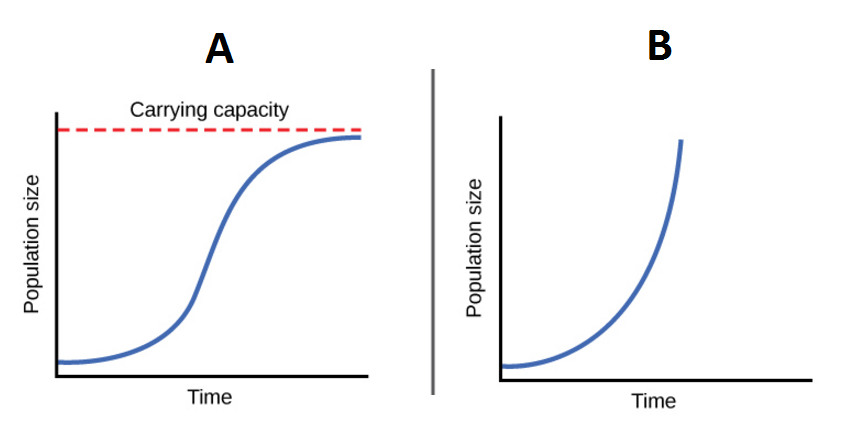
What type of growth model is shown in image B?
Exponential
Logistic

Which group is not represented in the food web?
producers
primary consumers
secondary consumers
decomposers

What do the arrows in the food chain indicate about the flow of energy in an ecosystem?
Energy is continuously recycled by the organisms in an ecosystem.
Energy flows in one direction in an ecosystem, from producers to consumers.
More of the available energy in an ecosystem is given to large animals than to small animals.
Organisms at the end of the food chain receive more energy than those at the beginning.

In this energy pyramid, which organism would most likely be in level 2?
bird
fox
caterpillar
tree
Which one of the following is true of grass in an ecosystem?
It converts oxygen to glucose.
It produces carbon dioxide from oxygen and water.
It produces glucose from carbon dioxide and water.
It converts water to energy.

How would the removal of earthworms from the food chain affect the other organisms?
The number of bass will increase.
The number of crayfish will decrease.
The crayfish will get their energy directly from the sun.
The number of bass and ospreys (bird) will increase.
Which group is not represented in the food web?
producers
primary consumers
secondary consumers
decomposers
What do the arrows in the food chain indicate about the flow of energy in an ecosystem?
Energy is continuously recycled by the organisms in an ecosystem.
Energy flows in one direction in an ecosystem, from producers to consumers.
More of the available energy in an ecosystem is given to large animals than to small animals.
Organisms at the end of the food chain receive more energy than those at the beginning.
In this energy pyramid, which organism would most likely be in level 2?
bird
fox
caterpillar
tree
Which one of the following is true of grass in an ecosystem?
It converts oxygen to glucose.
It produces carbon dioxide from oxygen and water.
It produces glucose from carbon dioxide and water.
It converts water to energy.
How would the removal of earthworms from the food chain affect the other organisms?
The number of bass will increase.
The number of crayfish will decrease.
The crayfish will get their energy directly from the sun.
The number of bass and ospreys (bird) will increase.

Interactions in an ecosystem result from the transfer of matter and energy from producers to consumers and eventually decomposers. What are the forms of energy transfer from numbers 1 through 4?
Chemical energy to chemical energy
Light energy to chemical energy
Chemical energy to heat energy
Heat energy to mechanical energy

The diagram shows part of an aquatic food web for a stable lake ecosystem in Connecticut. What is the source of energy for the algae?
waves
sunlight
bacteria
rotifers, water fleas and tadpoles

Suppose that a new predator of the rabbit migrated to this ecosystem. What is the most likely initial effect on the other organisms?
More competition among the mice for food
More competition among the hawks for food
Less competition among snakes for food
Less grass available for food

For the food chain shown, which of the following changes would have the most severe consequences?
a drastic decrease in rainfall, causing a drought
the poaching of predatory hawks by game hunters
the introduction of a second predator that eats field mice
a parasitic infestation that reduces the cricket population

The diagram provided shows a marine food chain. In this food chain, the zooplankton are
primary producers.
primary consumers.
secondary consumers.
tertiary consumers.

The picture provided shows an ocean bay food chain. Sea otters move into the ocean bay. They eat all of the sea urchins. This change will cause the
kelp to have less food.
crabs to have more food.
sea ducks to have less food.
arctic foxes to have more food.

The picture shows an energy pyramid. What will most likely happen to the foxes and the wolves if the rabbits are removed?
The foxes will eat more wolves.
The foxes will eat fewer wolves.
There will be more foxes and wolves.
There will be fewer foxes and wolves.

The diagram provided shows a simple food web. Which group of organisms is not represented in the diagram?
prey
decomposers
consumers
producers

A student examines the information in the table. The student concludes that Organism W should be placed at the base of the food web to represent the feeding relationships in the marine ecosystem. However, the student later learns that Organism W's cells do not contain chloroplasts. Based on the new information, which conclusion would be appropriate?
Another organism in the marine ecosystem is a producer.
Organism W is a secondary consumer in the marine ecosystem.
The role of Organism T in the marine ecosystem changes during its life.
This marine ecosystem does not have any producers.
Which of these organisms would most likely be found at the top of an energy pyramid?
clams
sardines
sharks
kelp (seaweed)
A chemical pesticide was applied to an area of this ecosystem by a landowner to control the mouse population. There was a decrease in the mouse population due to the presence of this pesticide. Which one of the following would most likely occur due to this change in the ecosystem?
The amount of grass would decrease.
The snake population would increase.
The rabbit food supply would increase.
The snake food supply would increase.

The picture shows the energy flow through a meadow community. Which of the following would most likely occur to the populations within the community of organisms immediately after a wildfire burns the environment?
Hawks would increase and foxes would increase.
Hawks would decrease and foxes would increase.
Meadow plants would increase and rabbits would decrease.
Meadow plants would decrease and rabbits would decrease.
Which of these organisms would most likely be found at the bottom of a biomass pyramid?
giant squids
sand sharks
sea cucumbers
green algae
All consumers could also be called ____________________.
Producers
Autotrophs
Apex Predators
Heterotrophs
If the producers in an ecosystem generate 25000 Joules of energy, how much energy will be available for the Secondary Consumers in this ecosystem?
2500 Joules
50000 Joules
250 Joules
250000 Joules
Producers such as plants and some bacteria are able to make their own food, so they can also be called _________________.
Autotrophs
Heterotrophs
Chloroplasts
Joules
Foxes, Lynxes, and Rabbits live in Alaska and Canada. A fox likes to eat rabbits. A lynx also likes to eat rabbits. What type of interaction or relationship does the Fox have with the Lynx?
Survival
Competition
Natural Selection
Symbiotic
If the Law of Conservation of Energy tells us that energy cannot be created or destroyed, then how can energy be "lost" from an ecosystem?
Whenever an organism eats another one, that organism gets all the energy that was inside the one it ate, so energy is not lost.
Living things must expend energy to move & grow. This creates friction, which creates heat, so that energy is "lost" to the ecosystem because it can no longer be used by the next organism as food.
The producers in an ecosystem bring the energy into the ecosystem, but all the energy is lost after being eaten by a primary consumer.
Living things do not have to follow the Law of Conservation of Energy. Life is an exception to this Law.
What term do we use to describe an organism that balances an entire ecosystem? If this creature is lost, the entire ecosystem may collapse.
Keystone Species
Primary Consumer
Energy Controller
Adaptable Species
If the secondary consumers have 90 Joules of energy, how much energy must have been brought into the ecosystem by the producers?
900 Joules
180 Joules
9000 Joules
45 Joules
How does carbon dioxide return to the atmosphere?
Photosynthesis
Combustion and Cellular Respiration
Consumption
Decomposition
What is the main thing that carries out Nitrogen Fixation?
Lightning
Bacteria
Plants
Humans
What part of the water cycle needs a living organism to occur?
Evaporation
Condensation
Transpiration
Precipitation
Describe how human's negatively impact the water cycle (short answer- need detail)
Pollution
Deforestation
Building on and paving areas
All of the above
Why don't populations grow indefinitely?
limiting factors
only biotic factors
only abiotic factors
none of the above
One of the factors that can change the size of population is....
Name of schools
Number of dezs
Jobs
Numbers of births

This graph shows ....
When one population increases, the other decreases.
When one population decreases, the other increases.
When one population increases, the other increases instantly.
When one population increases, it causes the other to increases shortly after.
What is a community?
A habitat with abiotic factors
A very small habitat
All the abiotic factors in a specific area
All the different populations that live together in an area

Which level of organization is depicted in this image?
Population
Community
Ecosystem
Biome
Biosphere

Which of the following organism above are considered "Heterotrophic"?
Deer
Fern Plant
Apple Tree
Owl
Skunk
Which of the following organism above are considered "Autotrophic"?
Lemongrass
Fox
Apple Tree
Rose Plant
Sunlight

