
Font size
 Worksheets
Biology 1 Study guide
Total questions: 137
Worksheet time: 2hrs 55mins
How would you define 2n
steroid
diploid
pyrethroid
haploid
How would you define n
diploid
haploid
steroid
paraboloid
What parts make up mitosis
Metaphase, Prophase, Anaphase, Cytokinesis.
Interphase, Metaphase, Prophase, Anaphase, Telophase, Cytokinesis.
Interphase, Prophase, Anaphase, Telophase,
Interphase, Metaphase, diplophase, Anaphase, Telophase, Cytokinesis.

What does number 3 represent
Chromatin
Centromere
Centriole
chromosome


Each chromosome contains two identical _____.
chromotids
chromosomes
first
meiosis
second
Which of the following is considered DNA in its normal, non dividing state, sometimes looks like spaghetti?
Chromatin
Chromatids
Centromere
Chromosome
Centriole
DNA that has been wound up into a tight pattern. Seen during Cell division.
Chromatin
Chromosome
Centormere
Centriole
The centromere is in the center of a chromosome.
true
false

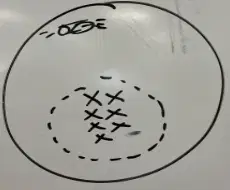
What is this cell undergoing? (2n=14)
Prophase
anaphase
metaphase
telophase
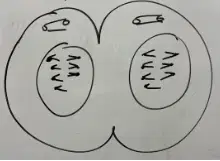
What is this cell undergoing
Metaphase
Prophase
Anaphase
Telophase
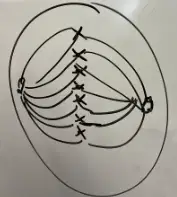
What is this cell undergoing?
Prophase
Anaphase
Metaphase
telephase
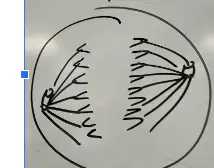
What is this cell undergoing
telophase
anaphase
metaphase
prophase
Chromosomes cannot condense during the cell cycle. In what part of the cell cycle will the cell be found in?
anaphase
prophase
metaphase
telophase
In which phase of Mitosis do the chromosomes pull apart?
Metaphase
Prophase
Anaphase
Telophase
What is the purpose of Mitosis?
Growth of an organism and repair of damaged tissue
To help the body get rid of extra cells
To increase the amount of classwork you have to do
To get rid of the nucleus
The following describes ________ during mitosis. The chromosomes line up along the center of the cell and the spindle fibers attach to each chromosome at the centromere.
prophase
metaphase
anaphase
telophase
When the CYTOPLASM splits in two at the very end of Mitosis...
Metaphase
Cytokinesis
Interphase
Prophase
If there are 20 chromosomes in the nucleus before mitosis, how many will there be in each new daughter cell after cytokinesis?
20
10
40
200

What stage of mitosis is depicted here where 2 new nuclei have formed?
Prophase
Metaphase
Anaphase
Telophase

What stage of mitosis is depicted here?
Prophase
Metaphase
Anaphase
Telophase

What stage of mitosis is depicted here?
Prophase
Metaphase
Anaphase
Telophase

During what phase of Mitosis do the chromosomes line up in the middle?
Metaphase
Prophase
Telophase
Anaphase

Metaphase
Anaphase
Telophase
Prophase


How many chromosomes are normally found in human body cells?
46
23
26
44

A mutation that causes a cell not to be able to go through S phase of the cell cycle occurs. What would happen to the chromosome number of the daughter cells if they were able to go through mitosis without first going through S phase?
The chromosome number of the daughter cell would be that same as the parent cells
The chromosome number of the daughter cell would be double that of the parent cells
The chromosome number of the daughter cell would be half that of the parent cells.
The chromosome number of the daughter cell would be two-thirds of the parent cells
A viral core may contain either DNA or RNA. To identify which nucleic acid [DNA or RNA] is present, a biochemist could analyze the virus for the presence of:
phosphate groups.
ribose sugar.
adenine.
cytosine.

Based on the cell micrograph [picture], which phase of mitosis would be next to occur?
Prophase
Metaphase
Anaphase
Telophase
The nuclear envelope begins to disappear during mitosis:
in prophase.
in cytokinesis.
in metaphase.
in telophase.
What must a cell do before it can carry out mitosis?
Duplicate its centromeres.
Replicate its DNA.
Undergo cytokinesis.
Separate chromatin fibers.
At the end of telophase of mitosis how many chromosomes must there be as compared to the beginning of mitosis?
double
triple
same
/2
The fusion of egg and sperm cells will make a haploid zygote. Answer and explain if false.
True
False The fusion of egg and sperm cells will make a diploid zygote because both the egg and sperm cells are haploid, and their fusion results in a diploid combination of chromosomes.

What phase of meiosis is labeled G?
Anaphase II
Prophase II
Metaphase II
Telophase II
Telophase I
What phase of meiosis is labeled F?
Anaphase II
Prophase II
Metaphase II
Telophase II
Telophase I
What phase of meiosis is labeled E?
Anaphase II
Prophase II
Metaphase II
Telophase II
Telophase I
What phase of meiosis is labeled D? (This is the 1st phase of Meiosis II)
Anaphase II
Prophase II
Metaphase II
Telophase II
Telophase I
What is the last phase of the 1st division of meiosis? This is the stage where the cell membrane pinches in and two cells start to form from the one original cell.
Anaphase II
Prophase II
Metaphase II
Telophase II
Telophase I
What phase of meiosis is labeled A?
Anaphase I
Prophase I
Metaphase I
Telophase II
Telophase I
What phase of meiosis is labeled B?
Anaphase I
Prophase I
Metaphase I
Telophase II
Telophase I
What phase of meiosis is labeled C?
Anaphase I
Prophase I
Metaphase I
Telophase II
Telophase I
In which phase of meiosis does crossing-over occur?
Anaphase I
Prophase I
Metaphase I
Telophase II
Telophase I
In which phase of meiosis are sister chromatids or chromosomes lining up at the equator?
Anaphase I
Prophase I
Metaphase I
Metaphase II
Telophase I
In which phase of meiosis are homologous chromosomes being pulled to the poles?
Anaphase I
Prophase I
Metaphase I
Telophase II
Telophase I
In which phase of meiosis are homologous chromosomes lining up at the equator?
Anaphase I
Prophase I
Metaphase I
Telophase II
Telophase I
In what phase of meiosis does the following occur?
Chromosomes are segregated at opposite poles, one group on each side of the cell. Each chromosome consists of two chromatids. (sister chromatids) Cytokinesis begins, forming two daughter cells.
Prophase I
Anaphase I
Metaphase I
Telophase I
Prophase II
In what phase of meiosis does the following occur?
Homologous chromosomes separate and are pulled to opposite sides of the cell by spindle fibers. The sister chromatids of each chromosome remain attached.
Prophase I
Anaphase I
Metaphase I
Telophase I
Prophase II
In what phase of meiosis does the following occur?
Chromosomes are pulled by spindle fibers to the mid-line of the cell. Each chromosome is paired with its homologue.
Prophase I
Anaphase I
Metaphase I
Telophase I
Prophase II
In what phase of meiosis does the following occur?
Chromosomes are condensed, such that they are visible in the cell. Synapsis (crossing over) occurs; homologous chromosomes pair up. The nuclear membrane dissolves.
Prophase I
Anaphase I
Metaphase I
Telophase I
Prophase II
In what phase of meiosis does the following occur?
Chromosomes become attached to spindle fibers. Each cell contains one chromosome(sister chromatid) of each type; there are no homologous pairs. 1st phase of Meiosis II
Prophase I
Anaphase I
Metaphase I
Telophase I
Prophase II
In what phase of meiosis does the following occur?
Spindle fibers align the chromosomes (sister chromatids) at the mid-line, or equator, of the cell. The chromosomes are not in pairs.
Prophase I
Anaphase II
Metaphase II
Telophase II
Prophase II
In what phase of meiosis does the following occur?
By the end of meiosis, 4 haploid cells are formed. Each cell has a unique genetic make-up. A nucleus surrounds each set of chromosomes, and the cell carries out normal metabolic activities.
Prophase I
Anaphase II
Metaphase II
Telophase II
Prophase II
In what phase of meiosis does the following occur?
Chromatids (sister chromatids) of the chromosomes separate and are pulled to opposite sides of the cell by spindle fibers.
Prophase I
Anaphase II
Metaphase II
Telophase II
Prophase II
In which phase of meiosis are sister chromatids or chromosomes lining up at the equator?
Anaphase I
Prophase I
Metaphase I
Metaphase II
Telophase I
In which phase of meiosis are homologous chromosomes being pulled to the poles?
Anaphase I
Prophase I
Metaphase I
Telophase II
Telophase I
In which phase of meiosis are homologous chromosomes lining up at the equator?
Anaphase I
Prophase I
Metaphase I
Telophase II
Telophase I
In what phase of meiosis does the following occur?
Chromosomes are segregated at opposite poles, one group on each side of the cell. Each chromosome consists of two chromatids. (sister chromatids) Cytokinesis begins, forming two daughter cells.
Prophase I
Anaphase I
Metaphase I
Telophase I
Prophase II
In what phase of meiosis does the following occur?
Chromosomes are pulled by spindle fibers to the mid-line of the cell. Each chromosome is paired with its homologue.
Prophase I
Anaphase I
Metaphase I
Telophase I
Prophase II
In what phase of meiosis does the following occur?
Chromosomes are condensed, such that they are visible in the cell. Synapsis (crossing over) occurs; homologous chromosomes pair up. The nuclear membrane dissolves.
Prophase I
Anaphase I
Metaphase I
Telophase I
Prophase II
In what phase of meiosis does the following occur?
Chromosomes become attached to spindle fibers. Each cell contains one chromosome(sister chromatid) of each type; there are no homologous pairs. 1st phase of Meiosis II
Prophase I
Anaphase I
Metaphase I
Telophase I
Prophase II
In what phase of meiosis does the following occur?
Spindle fibers align the chromosomes (sister chromatids) at the mid-line, or equator, of the cell. The chromosomes are not in pairs.
Prophase I
Anaphase II
Metaphase II
Telophase II
Prophase II
In what phase of meiosis does the following occur?
By the end of meiosis, 4 haploid cells are formed. Each cell has a unique genetic make-up. A nucleus surrounds each set of chromosomes, and the cell carries out normal metabolic activities.
Prophase I
Anaphase II
Metaphase II
Telophase II
Prophase II
In what phase of meiosis does the following occur?
Chromatids (sister chromatids) of the chromosomes separate and are pulled to opposite sides of the cell by spindle fibers.
Prophase I
Anaphase II
Metaphase II
Telophase II
Prophase II
What does helicase do?
Unwinds the double-stranded DNA helix by breaking hydrogen bonds between the nucleotide base pairs, allowing replication to proceed.
Relieves the tension ahead of the replication fork by breaking, swiveling, and rejoining DNA strands, preventing supercoiling.
Synthesizes short RNA primers that provide a starting point for DNA synthesis by DNA polymerase
Main enzyme responsible for synthesizing new DNA strands by adding complementary nucleotides to the growing DNA chain during replication.
What is Topoisomerase function
Synthesizes short RNA primers that provide a starting point for DNA synthesis by DNA polymerase.
Removes RNA primers and fills the resulting gaps with DNA nucleotides, repairing any mismatches in the process.
Main enzyme responsible for synthesizing new DNA strands by adding complementary nucleotides to the growing DNA chain during replication.
Relieves the tension ahead of the replication fork by breaking, swiveling, and rejoining DNA strands, preventing supercoiling.
What is primase function
Removes RNA primers and fills the resulting gaps with DNA nucleotides, repairing any mismatches in the process.
Synthesizes short RNA primers that provide a starting point for DNA synthesis by DNA polymerase.
Main enzyme responsible for synthesizing new DNA strands by adding complementary nucleotides to the growing DNA chain during replication.
Joins the Okazaki fragments on the lagging strand by catalyzing the formation of phosphodiester bonds, creating a continuous DNA strand.
What is DNA Polymerase function
Main enzyme responsible for synthesizing new DNA strands by adding complementary nucleotides to the growing DNA chain during replication.
Joins the Okazaki fragments on the lagging strand by catalyzing the formation of phosphodiester bonds, creating a continuous DNA strand.
Removes RNA primers and fills the resulting gaps with DNA nucleotides, repairing any mismatches in the process.
Unwinds the double-stranded DNA helix by breaking hydrogen bonds between the nucleotide base pairs, allowing replication to proceed.
What is DNA POlymerase I function
Main enzyme responsible for synthesizing new DNA strands by adding complementary nucleotides to the growing DNA chain during replication.
Joins the Okazaki fragments on the lagging strand by catalyzing the formation of phosphodiester bonds, creating a continuous DNA strand.
Removes RNA primers and fills the resulting gaps with DNA nucleotides, repairing any mismatches in the process.
Topoisomerase: Relieves the tension ahead of the replication fork by breaking, swiveling, and rejoining DNA strands, preventing supercoiling.
What is ligase function
Unwinds the double-stranded DNA helix by breaking hydrogen bonds between the nucleotide base pairs, allowing replication to proceed.
Main enzyme responsible for synthesizing new DNA strands by adding complementary nucleotides to the growing DNA chain during replication.
Synthesizes short RNA primers that provide a starting point for DNA synthesis by DNA polymerase.
Joins the Okazaki fragments on the lagging strand by catalyzing the formation of phosphodiester bonds, creating a continuous DNA strand.
Compare and contrast the amount of DNA present in a cell before replication and after replication.
Before replication, there is a single copy of DNA in the cell, while after replication, there are two identical copies of DNA.
After replication, there is a single copy of DNA in the cell, while before replication, there are two identical copies of DNA.
Before replication, there is a double copy of DNA in the cell, while after replication, there is a singular copy of DNA.
Understand and apply Chargaff’s Rules (A-T and C-G) - the base pairing rules that dictate how DNA Polymerase works and adds new nucleotides.
Chargaff's Rules: A-T and C-G base pairing rules ensure supplementary base pairing between DNA strands, guiding DNA polymerase during replication to add the correct nucleotides.
Chargaff's Rules: A-T and C-G base pairing rules ensure complementary base pairing between DNA strands, guiding DNA polymerase during replication to add the correct nucleotides.
Explain the significance of one strand being the “leading strand” and the other being the “lagging strand.”
The leading strand is synthesized continuously in the 5' to 3' direction, while the lagging strand is synthesized discontinuously in short fragments called Okazaki fragments, which are later joined together by DNA ligase.
The lagging strand is synthesized continuously in the 5' to 3' direction, while the leading strand is synthesized discontinuously in short fragments called Okazaki fragments, which are later joined together by DNA ligase.

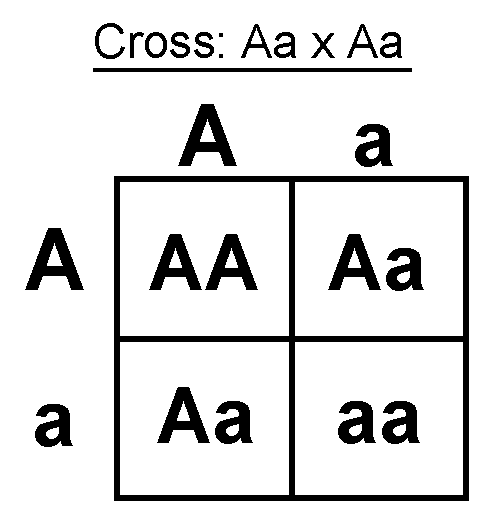
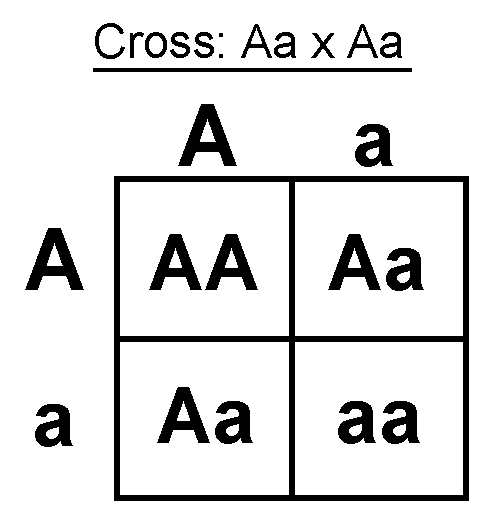
In the punnett square below, what belongs in the missing square
In the punnett square below, what belongs in the missing square


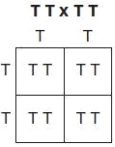
The genotype for a yellow plant is...




Identify and explain how the enzyme responsible for transcription works.
Enzyme responsible for transcription: RNA polymerase binds to the DNA template strand and synthesizes a complementary mRNA strand by adding RNA nucleotides.
hdhdh
Explain how the process of transcription begins at a specific spot on the DNA strand.
Transcription begins at a specific spot on the DNA strand called the promoter region, which is recognized by the RNA polymerase and associated transcription factors.
Transcription begins at a specific spot in the RNA strand called the promoter region, which is recognized by the DNA polymerase I and associated transcription factors.
Understand how base pairing rules apply when synthesizing mRNA strands.
The base pairing rules (A-U and C-G) are followed during transcription, with RNA polymerase adding RNA nucleotides that are complementary to the template DNA strand.
j
Explain how the RNA Polymerase “knows” when to stop transcribing a gene.
DNA polymerase recognizes specific termination signals on the DNA template strand, causing it to detach and release the newly synthesized mRNA molecules
RNA polymerase recognizes specific termination signals on the DNA template strand, causing it to detach and release the newly synthesized mRNA molecule.
DNA polymerase recognizes specific termination signals on the RNA template strand, causing it to detach and release the newly synthesized mRNA molecule
RNA polymerase recognizes specific termination signals on the RNA template strand, causing it to detach and release the newly synthesized mDNA molecule.
Identify three modifications that are done to the mRNA after the process of transcription ends.
addition of a 5' cap (a modified guanine nucleotide) for stability and ribosome recognition
addition of a poly-A tail (a string of adenine nucleotides) for mRNA stability and export
removal of non-coding introns through RNA splicing to produce a mature mRNA transcript.
removal of poly-b tail(a string of adenine nucleotides) for mRNA stability and export.
Identify the organelle responsible for the production of amino acid sequences.
Ribosomes
mitochondria
rough er
smooth er
silent mutation
A mutation that changes a single nucleotide, resulting in the premature termination of protein synthesis.
A mutation that does not result in a change in the amino acid sequence due to the degeneracy of the genetic code.
A mutation that changes a single nucleotide, leading to the substitution of one amino acid for another in the protein sequence.
missense mutation
A mutation that changes a single nucleotide, resulting in the premature termination of protein synthesis.
A mutation that changes a single nucleotide, leading to the substitution of one amino acid for another in the protein sequence.
A mutation that does not result in a change in the amino acid sequence due to the degeneracy of the genetic code.
nonsense mutation
A mutation that does not result in a change in the amino acid sequence due to the degeneracy of the genetic code.
A mutation that changes a single nucleotide, leading to the substitution of one amino acid for another in the protein sequence.
A mutation that changes a single nucleotide, resulting in the premature termination of protein synthesis.
fossils
Preserved remains or traces of ancient organisms that provide evidence of past life forms and evolutionary processes.
Study of similarities and differences in early developmental stages among different species to understand evolutionary relationships.
Comparison of anatomical structures in different organisms to reveal common ancestry and functional adaptations.
Study of biological processes at the molecular level, focusing on DNA, RNA, proteins, and their interactions to understand genetics and evolution.
Study of species distribution patterns and their relationship to geography and environmental factors, providing insights into evolutionary history and ecological processes
comparitive embryology
Preserved remains or traces of ancient organisms that provide evidence of past life forms and evolutionary processes.
Study of similarities and differences in early developmental stages among different species to understand evolutionary relationships.
Comparison of anatomical structures in different organisms to reveal common ancestry and functional adaptations.
Study of biological processes at the molecular level, focusing on DNA, RNA, proteins, and their interactions to understand genetics and evolution.
Study of species distribution patterns and their relationship to geography and environmental factors, providing insights into evolutionary history and ecological processes
comparitive anatomy
Preserved remains or traces of ancient organisms that provide evidence of past life forms and evolutionary processes.
Study of similarities and differences in early developmental stages among different species to understand evolutionary relationships.
Comparison of anatomical structures in different organisms to reveal common ancestry and functional adaptations.
Study of biological processes at the molecular level, focusing on DNA, RNA, proteins, and their interactions to understand genetics and evolution.
Study of species distribution patterns and their relationship to geography and environmental factors, providing insights into evolutionary history and ecological processes
molecular biology
Preserved remains or traces of ancient organisms that provide evidence of past life forms and evolutionary processes.
Study of similarities and differences in early developmental stages among different species to understand evolutionary relationships.
Comparison of anatomical structures in different organisms to reveal common ancestry and functional adaptations.
Study of biological processes at the molecular level, focusing on DNA, RNA, proteins, and their interactions to understand genetics and evolution.
Study of species distribution patterns and their relationship to geography and environmental factors, providing insights into evolutionary history and ecological processes
biogeography
Preserved remains or traces of ancient organisms that provide evidence of past life forms and evolutionary processes.
Study of similarities and differences in early developmental stages among different species to understand evolutionary relationships.
Comparison of anatomical structures in different organisms to reveal common ancestry and functional adaptations.
Study of biological processes at the molecular level, focusing on DNA, RNA, proteins, and their interactions to understand genetics and evolution.
Study of species distribution patterns and their relationship to geography and environmental factors, providing insights into evolutionary history and ecological processes
stabilizing
Favors individuals with extreme traits at both ends of the spectrum, leading to the divergence of a population into two or more distinct phenotypes; for example, the selection for both large and small beak sizes in a bird population with different food sources.
Favors individuals with traits at one extreme end of the spectrum, leading to a shift in the average phenotype over time; for example, the selection for darker moth coloration in industrial areas with increased pollution.
Favors individuals with intermediate traits, reducing variation in a population; for example, the selection against extremely large or small birth weights in human babies.
disruptive
Favors individuals with extreme traits at both ends of the spectrum, leading to the divergence of a population into two or more distinct phenotypes; for example, the selection for both large and small beak sizes in a bird population with different food sources.
Favors individuals with traits at one extreme end of the spectrum, leading to a shift in the average phenotype over time; for example, the selection for darker moth coloration in industrial areas with increased pollution.
Favors individuals with intermediate traits, reducing variation in a population; for example, the selection against extremely large or small birth weights in human babies.
directional
Favors individuals with extreme traits at both ends of the spectrum, leading to the divergence of a population into two or more distinct phenotypes; for example, the selection for both large and small beak sizes in a bird population with different food sources.
Favors individuals with traits at one extreme end of the spectrum, leading to a shift in the average phenotype over time; for example, the selection for darker moth coloration in industrial areas with increased pollution.
Favors individuals with intermediate traits, reducing variation in a population; for example, the selection against extremely large or small birth weights in human babies.
biotic factors
Refers to living components of an ecosystem, such as plants, animals, fungi, and microorganisms.
Refers to non-living components of an ecosystem, such as temperature, sunlight, soil composition, and water availability.
abiotic factors
Refers to living components of an ecosystem, such as plants, animals, fungi, and microorganisms.
Refers to non-living components of an ecosystem, such as temperature, sunlight, soil composition, and water availability.
ecosystem ecology
Studies the interactions between living organisms and their physical environment, including energy flow and nutrient cycling.
Focuses on the study of individual organisms and their adaptations to the environment.
Examines the dynamics of populations, including population size, density, and interactions between individuals of the same species.
Explores the interactions among different species within a given area or community.
community ecology
Studies the interactions between living organisms and their physical environment, including energy flow and nutrient cycling.
Focuses on the study of individual organisms and their adaptations to the environment.
Examines the dynamics of populations, including population size, density, and interactions between individuals of the same species.
Explores the interactions among different species within a given area or community.
population ecology
Studies the interactions between living organisms and their physical environment, including energy flow and nutrient cycling.
Focuses on the study of individual organisms and their adaptations to the environment.
Examines the dynamics of populations, including population size, density, and interactions between individuals of the same species.
Explores the interactions among different species within a given area or community.
organismal ecology
Studies the interactions between living organisms and their physical environment, including energy flow and nutrient cycling.
Focuses on the study of individual organisms and their adaptations to the environment.
Examines the dynamics of populations, including population size, density, and interactions between individuals of the same species.
Explores the interactions among different species within a given area or community.
temp biome
exhibit different levels of precipitation, such as the heavy rainfall in tropical rainforests and the low rainfall in deserts.
vary in temperature, from the freezing temperatures of tundra to the scorching heat of deserts
differ in their biodiversity, with rainforests being highly diverse while deserts have lower biodiversity.
biodiversity biome
exhibit different levels of precipitation, such as the heavy rainfall in tropical rainforests and the low rainfall in deserts.
vary in temperature, from the freezing temperatures of tundra to the scorching heat of deserts
differ in their biodiversity, with rainforests being highly diverse while deserts have lower biodiversity.
preditation
A lion hunting and consuming a zebra.
A rabbit feeding on grass in a meadow.
Two bird species competing for limited nesting sites in a forest.
Bees and flowers benefiting from the exchange of nectar and pollen.
Barnacles attaching to a whale's skin and benefitting from the movement and resources provided by the host.

