
 Worksheets
BIO 189 practice midterm
Total questions: 93
Worksheet time: 1hrs 25mins
Variable that stays the same between all groups in an experiment
Controlled variable
Independent variable
Dependent variable
Variable that is changed by the researcher during an experiment;
usually graphed on the x-axis
Controlled variable
Independent variable
Dependent variable
What kind of data is least susceptible to bias?
Quantitative data (ex: blood pressure in mm Hg)
Qualitative data (ex: asking a participant "how are you feeling?")
Retrospective data (ex: investigating patient data from 10 years ago)
All of the individuals of one species in an area
Population
Community
Ecosystem
Biome
All of the different species in one area
Population
Community
Ecosystem
Biome
Order the terms from most inclusive to least inclusive
Community
Population
Organism
Tissue
Cell
Animal
Plant
Fungi
Protist
Bacteria
Archaea
The scientific name for the domestic cat is felis catus.
Cats belong to which genus?
Felis
Catus
Animalia
Eukaryota
The smallest unit of life
Atom
Electron
Organelle
Cell
By sensing and adjusting to change, all organisms keep conditions in their internal environment within ranges that favor cell survival.
All living organisms use (a) as the genetic material passed from parents to offspring during reproduction.
Which of the following are required characteristics for something to be considered alive? (select ALL correct answers)
Made of one or more cells
Ability to maintain homeostasis
Contains a nucleus
DNA used as genetic material
Requires nutrients
Prokaryotic life forms (a) have DNA, but they (b) have a nucleus.
Select ALL the structures that are found in BOTH prokaryotic and eukaryotic cells
Nucleus
Mitochondria
Cell membrane
Ribosomes
DNA

A community of single-celled organisms that stick to each other and a hard surface.
For example: dental plaque build up on teeth.
(a)
The image shows Carbon as depicted on the period table. Label the information.
atomic number
atomic mass
chemical symbol
The number of protons plus neutrons in an atom
Atomic number
Atomic mass
Chemical symbol
Charge
Oxygen has 6 valence electrons.
How many covalent bonds will oxygen form, in order to have a full octet?
(a)
What is the pH range for an acidic solution?
Less than 7
(0-7 pH)
Greater than 7
(7-14 pH)
A solution that prevents pH changes
An acidic solution has a (a) pH, which means it has a (b) concentration of H+ ions.
If a H+ ions are added to a solution, it will become more (a)
Type of chemical reaction that breaks down polymers into monomers
condensation
dehydration synthesis
hydrolysis
photosynthesis
Type of chemical reaction that joins monomers together to form polymers
Hydrolysis
Condensation
Glycolysis
Photosynthesis
What are the monomers of proteins?
(a)
Match the macromolecule with its monomer
Carbohydrate
Monosaccharde
Protein
Amino acid
Lipid
Fatty acid
Nucleic acid
Nucleotide
Match the macromolecule with its polymer
Carbohydrate
Polysaccharde
Protein
Polypeptide
Lipid
Triglyceride
Nucleic acid
RNA
Categrorize these molecules as monomers or polymers
Glucose
Amino acid
Nucleotide
Simple sugar
Complex sugar
DNA
Glycogen
Fatty acids
Protein
Name of the bond that links amino acids to form a protein polymer
Disulfide bond
What are amino acids?
The monomers of proteins
The monomers of nucleic acids
The monomers of lipids
The monomers of carbohydrates
Part of an amino acid that make each one unique.
R-group
Nitrogenous base
Phosphate group
Fatty acid tails
What are nucleotides?
The monomers of proteins
The monomers of nucleic acids
The monomers of lipids
The monomers of carbohydrates
Label the parts of the nucleotide
phosphate group
pentose sugar
nitrogenous base
This is a type of carbohydrate polymer that is used for short-term energy storage in animal cells
This is a type of carbohydrate polymer that builds plant cell walls;
many animals (including humans) are unable to digest this molecule

There are 20 different types of amino acids. Each amino acid is defined by its unique (a) .
What best describes the relationship between nucleic acids and proteins?
Proteins are the monomers of nucleic acids
Nucleic acids are found in prokaryotes, but proteins are found in eukaryotes
Nucleic acids are the instructions for how to make proteins
Proteins are the instructions for how to make nucleic acids
Select ALL of the examples of lipids
Glycogen
Insulin
Cholesterol
Steroids
Triglyceride
What class of macromolecules is the most abundant energy storage in animal cells?


C-C single bonds only
At least one C-C double bond
Solids at room temp
Liquids at room temp
Mainly from animals

Saturated fats tend to be (a) at room temperature.

Unsaturated fats tend to be (a) at room temperature.
Match the type of carbohydrate with its description
Glycogen
Short-term energy storage in animals
Glucose
A monosaccharide
Cellulose
Main component of plant cell walls
Starch
Short-term energy storage in plants
A membrane-bound compartment inside a eukaryotic cell that carries out a specific function.
(a)
Why is the rough endoplasmic reticulum called "rough"?
Because it is hard to break down
Because it is coated with ribosomes
Because it is made of carbohydrates
Because it produces free radicals
System that synthesizes and transports proteins and lipids through the cell
Integumentary system
Endomembrane system
Circulatory system
Metabolic system
Select ALL of the structures that can be found in animal cells.
Plasma membrane
Cell wall
Mitochondria
Chloroplasts
Flagella
Select ALL of the structures that can be found in plant cells.
Plasma membrane
Cell wall
Mitochondria
Chloroplasts
Flagella
Organelle where most of the ATP (energy) is produced in eukaryotic cells
Mitochondria
Nucleus
Chloroplast
Lysosom
Jelly-like fluid inside of a cell
(a)
Match the cell structure with its function
Ribosome
Protein synthesis
Golgi body
Export of proteins
Nucleus
Stores DNA in eukaryotic cells
Chloroplast
Site of photosynthesis
Cilia
Bristle-like structures used in movement
What is the best explanation for why small cells have more efficient nutrient exchange?
Small cells have greater surface area than volume
Small cells have greater volume than surface area
Small cells have equal surface area and volume
Label the parts of the phospholipid bilayer
Hydrophobic
Hydrophilic
Protein catalysts that speed up chemical reactions
(a)
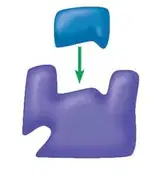
Where a substrate binds to an enzyme
Substrate spot
Reaction nook
Active site
Binding zone
Requires energy
Moves solutes from low to high concentration
Moves solutes from high to low concentration
Down concentration gradient
Against concentration gradient
Happens spontaneously
Osmosis
Diffusion
Molecule that acts as chemical energy for cellular reactions
(a)
How does ATP transfer energy to other molecules?
Through reducing activation energy
By transfering one of its phosphate groups
Regulates which molecules can enter and exit the cell
Cell wall
Plasma membrane
Mitochondria
Cytoplasm
Movement of water across a membrane is (a) .
Water will move towards the (b) solution.
A red blood cell is placed in a hypertonic saline solution.
What will happen to the cell?
Water will leave the cell, causing it to shrivel
Water will enter the cell, causing it to burst
A red blood cell is placed into pure water (solute concentration = 0).
What will happen to the cell?
Water will leave the cell, causing it to shrivel
Water will enter the cell, causing it to burst
What carbohydrate is a polysaccharide that build plant cell walls?
What kinds of cells have cytoskeleton? Select ALL correct answers.
Animal cells
Plant cells
Prokaryotes
Eukaryotes
What organelle modifies proteins and lipids, and then sends them to their final destination?
Which would NOT be present in animal cells?
Cell wall
Plasma membrane
Mitochondria
Nucleus
What organelle holds and protects DNA?
(a)
What organelle modifies, sorts, and packages proteins and lipids?
Endoplasmic reticulum
Golgi apparatus
Nucleus
Mitochondria
A cell has solute concentration of 5%, and the fluid surrounding the cell has a solute concentration of 1%. Which way will water move by osmosis?
Water will move into the cell, because the cell has a higher solute concentration
Water will move out of the cell, because the cell has a lower solute concentration
Water is not able to freely move into/out of cells
A cell is hypotonic, and the fluid surrounding the cell is hypertonic. What will happen?
Water moves out of the cell
Water moves into the cell
It is impossible to tell
Sort the steps of aerobic cellular respiration in order
Glycolysis
Acetyl Co-A Formation
The Citric Acid Cycle
Electron Transport Chain/ Oxidative Phosphorylation
The purpose of cellular respiration is breaking down monomers from food to make ____.
water
ATP
glucose
electrons
Which step of cellular respiration is being described?
Reactants: Glucose
Products: Pyruvate and 2 ATP
Glycolysis
Acetyl-CoA formation
Citric acid cycle
Electron transport chain/ oxidative phosphorylation
Which step of cellular respiration is being described?
Reactants: Pyruvate
Products: Acetyl-CoA
Glycolysis
Acetyl-CoA formation
Citric acid cycle
Electron transport chain/ oxidative phosphorylation
Which step of cellular respiration is being described?
Reactants: Acetyl-CoA
Products: NADH, FADH2, CO2, and ATP
Glycolysis
Acetyl-CoA formation
Citric acid cycle
Electron transport chain/ oxidative phosphorylation
Which step of cellular respiration is being described?
Reactants: NADH, FADH2, and oxygen
Products: Water and 32-36 ATP
Glycolysis
Acetyl-CoA formation
Citric acid cycle
Electron transport chain/ oxidative phosphorylation
Which step of aerobic cellular respiration directly requires oxygen?
Glycolysis
Acetyl-CoA formation
Citric acid cycle
Electron transport chain
Which step of cellular respiration directly requires oxygen?
Glycolysis
Acetyl-CoA formation
Citric acid cycle
Electron transport chain/ oxidative phosphorylation
What type of cellular respiration does NOT require oxygen?
(a)
Lactate fermentation produces what molecule as a byproduct?
(a)
What kind of fermentation occurs in humans?
Lactate fermentation
Cellular respiration that can occur in the absence of oxygen
Aerobic respiration
Transcription
Anaerobic respiration
The electron transport chain creates a concentration gradient of H+ ions, which is a source of (a) energy.
What products are made during glycolysis? Select ALL correct answers.
H2O
2 ATP
2 Pyruvate
2 Acetyl-CoA
Electrons
Enzymes speed up chemical reactions by (a) the (b) required to start a reaction.
What is pseudoscience?
Select all of the types of organisms that are made of cells that contain a nucleus
Bacteria
Fungi
Archaea
Plant
Animal
All of the geese that live in a park is an example of what level of organization?
Carbon is an important molecule because it tends to form (a) covalent bonds, allowing for geometric flexibility.
What is feedback inhibition?
A change that results from some activity decreases or stops the activity
The final product of a metabolic pathway enhances the activity of that pathway
A change that makes all metabolism in a cell stop completely
When the end product of a metabolic pathway is in short supply
Match the macromolecule with the chemical component it contains
Amino acid
Carboxyl group
Nucleotide
Nitrogenous base
Phospholipid
Phosphate group
Triglyceride
Fatty acid
Label the chemical components of the amino acid
(some choices will not be used)
Nitrogenous base
Phosphate group
Amino group
Carboxyl group
R group
Label the chemical components of the nucleotide
nitrogenous base
phosphates
5-carbon sugar

