wayground logo

Free Printable Worksheets

Font size

S
M
L
XL
Worksheets

25/26 final review semester 1

Total questions: 60

Worksheet time: 31mins

Name
Class
Date
1.
To learn about Earth's interior, scientists:
a)
drill into the Earth
b)
study seismic waves from earthquakes
c)
use optical technologies to see into Earth
d)
read science fiction
2.
What are the two types of seismic waves? (check 2 only)
a)
Surface Waves
b)
Ocean Waves
c)
Body Waves
d)
Microwaves
3.

What are types of plate boundaries? (check all that apply)

a)

Convergent boundary

b)

Transform boundary

c)

Continent boundary

d)

Divergent Boundary

e)

Reverse Boundary

4.
A magma's viscosity is directly related to its ____________.
a)
depth
b)
age
c)
color
d)
silica content
5.

Which factor DOES NOT influence whether an eruption will be violent or relatively quiet?

a)

amount of dissolved gases

b)

temperature

c)

composition (what it is made of)

d)

what country is nearby

6.
A caldera is _______________.
a)
an explosion
b)
a large depression that forms when the ground above an empty magma chamber collapses
c)
a type of volcano
d)
an island
7.
The seafloor spreads along underwater mountain ranges called _______________.
a)
craters
b)
mid-ocean ridges
c)
trenches
d)
continents
8.
The Hawaiian islands were created when the Pacific Plate moved over ______________.
a)
a subduction zone
b)
a hotspot
c)
the Aleutian plate
d)
an ocean ridge
9.
A substance's viscosity is ______________.
a)
the ability for a substance to become rock
b)
the ability for a substance to flow
c)
the hardness of rock
d)
a type of lava
10.
The most common types of gases found in magma are: (check 2)
a)
Water
b)
Ethylene
c)
Boron
d)
Carbon dioxide
11.
_________________ are particles made in volcanic eruptions that are classified by size, such as volcanic ash, dust, lapilli.
a)
calderas
b)
craters
c)
pyroclastic material
d)
the Easter Bunny's eggs
12.
Earthquake activity in Southern California is primarily caused by?
a)
Tidal waves along the coast.
b)
Volcanic activity.
c)
High-pressure air masses colliding.
d)
Plates grinding past each other along active faults.
13.
How does a tsunami form?
a)
A big boat falls into the ocean.
b)
A Kaiju comes up from the bottom of the ocean.
c)
There is an earthquake in the ocean and it moves the water toward the land.
d)
The winds create a very big wave that crashes on land.
14.
What causes the movement of tectonic plates?
a)
heat from the sun
b)
very heavy winds coming from space
c)
Earth's internal heat
15.
Which of the following has a wavelength that is visible to humans?
a)
infrared
b)
an X-ray
c)
a gamma ray
d)
visible light
16.
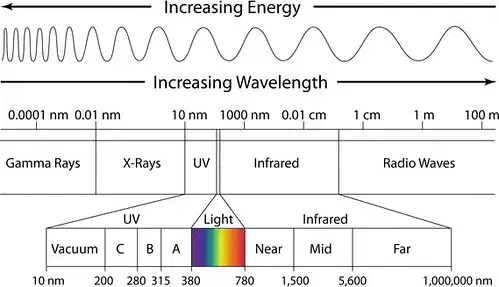
Electromagnetic Spectrum: Use the diagram to answer the question: What type of wave has a wavelength of 1 m?
a)
Gamma Rays
b)
UV Waves
c)
Infrared Waves
d)
Radio Waves
17.
Stars can stay "alive" for billions of years*
a)
True
b)
False
18.
How does an average star's life begin?
a)
red Sequence
b)
A cloud of dust and gas
c)
It's the size of 13 Jupiters
19.
Which elements are involved in fusion inside a star? (check all that apply)
a)
Hydrogen
b)
Uranium
c)
Helium
d)
Lithium
20.
How are distances between the stars measured?
a)
AU
b)
Km
c)
Miles
d)
Light Years
21.
The most abundant (common) elements in the universe are _____________. (Check all that apply)
a)
Hydrogen
b)
Lead
c)
Platinum
d)
Helium
22.
Scientists use index fossils to
a)
determine the time period during which rocks formed
b)
tell when the earth's atmosphere formed
c)
determine the age of igneous rock
23.
Using your geologic timescale answer the following question: Which period are we currently in?
a)
Tertiary
b)
Devonian
c)
Jurassic
d)
Quarternary
24.
Which epoch are we currently in?
a)
Pleistocene
b)
Quarternary
c)
Halocene
25.
Which Era had dinosaurs?
a)
Paleozoic
b)
Mesozoic
c)
Cenozoic
26.
Which of these are examples of mass movement? (check all that apply)
a)
landslides
b)
tsunamis
c)
lahars
d)
mudflows
e)
earthquakes
27.
What are the two types of body waves? (check 2 only)
a)
S-Waves
b)
Ocean Waves
c)
Microwaves
d)
P-Waves
28.
What do you think is happening if you are at the beach and see the ocean receding far away from you?
a)
A tidal wave is coming.
b)
A Kaiju comes up from the bottom of the ocean.
c)
There was an earthquake in the ocean and a tsunami is coming.
d)
Climate change is drying up the ocean.
29.
Electromagnetic Spectrum: Use the diagram to answer the question: What type of wave has a wavelength of 0.0001 m?
a)
Gamma Rays
b)
UV Waves
c)
Infrared Waves
d)
Radio Waves
30.
Using your geologic timescale answer the following question: Which era are we currently in?
a)
Mesozoic
b)
Cenozoic
c)
Paleozoic
31.
Which Era is the Age of Mammals?
a)
Paleozoic
b)
Mesozoic
c)
Cenozoic
32.

which is the correct order of the layers of the earth from a-d?

a)

crust, mantle, outer core, inner core

b)

crust, mantle, inner core, outer core

c)

mantle, crust, inner core outer core

d)

inner core, outer core, mantle, crust

33.

which planet has the biggest rings

a)

saturn

b)

uranus

c)

neptune

d)

pluto

34.

which planet is called earth's evil twin

a)

netpune

b)

venus

c)

saturn

d)

jupiter

35.

which planet is called the windy planet?

a)

saturn

b)

pluto

c)

uranus

d)

neptune

36.

which is the largest planet?

a)

neptune

b)

jupiter

c)

saturn

d)

uranus

37.

what type of current happens in the mantle?

a)

cells

b)

convection current

c)

ocean current

d)

seismic current

38.

Which type of plate boundary has 2 plates moving away from each other?

a)

divergent

b)

convergent

c)

transform

39.

Which type of plate boundary has 2 plates has 2 plates coming together

a)

divergent

b)

convergent

c)

transform

40.

Which type of plate boundary has 2 plates sliding past each other?

a)

divergent

b)

convergent

c)

transform

41.

which type of plate boundary is crust destroyed?

a)

divergent

b)

convergent

c)

transform

42.

which type of plate boundary is crust created?

a)

divergent

b)

convergent

c)

transform

43.

What type of fault is the San Andreas?

a)

convergent

b)

divergent

c)

transform

44.
Which process is shown in letter C?
a)
seafloor spreading
b)
rifting
c)
subduction
45.
Which layer of the earth is shown in letter D?
a)
Mantle
b)
Lithosphere
c)
Core
46.
Each ocean at locations A (Pacific Ocean) and B (Atlantic Ocean) have been spreading for the same amount of time. Which ocean is spreading faster?
a)
A (Pacific Ocean)
b)
B (Atlantic Ocean)
47.
How many times did the magnetic field reverse polarity between d and f?
a)
2
b)
3
c)
4
d)
5
48.
Which feature is shown in letter A?
a)
seafloor spreading
b)
mid ocean ridge
c)
subduction
49.
Which feature of the earth is shown in letter A?
a)
Island
b)
canyon
c)
volcanic arc
50.
Each ocean at locations A (Pacific Ocean) and B (Atlantic Ocean) have been spreading for the same amount of time. Which ocean is spreading slower?
a)
A (Pacific Ocean)
b)
B (Atlantic Ocean)
51.

what are the 3 types of volcanoes?

a)

shield

b)

composite

c)

cinder cone

d)

kilauea

52.

As the temperature of lava increases, what happens to viscosity?

a)

increases

b)

decreases

53.

high explosive volcanoes have ___ check all that apply

a)

high silica

b)

low silica

c)

high gas

d)

low gas

54.

As you go away from mid ocean ridges the rick gets ____

a)

younger

b)

older

55.

what determines how fast a river flows?

a)

how wide it is

b)

how many rocks there are

c)

temperature

d)

steepness of the slope

56.

which are examples of mass movement? check all that apply

a)

tsunami

b)

lahars

c)

landslides

d)

mudflows

57.

sediment is deposited at the mouth of a river becuase

a)

it enters a large body of water and slows down

b)

speeds up due to water action along the coast

c)

evaporates due to temperature

58.

which is labeled A?

a)

soil

b)

silt

c)

gravel

d)

sand

59.

which is labeled B?

a)

soil

b)

silt

c)

gravel

d)

sand

60.

which is labeled C?

a)

soil

b)

silt

c)

gravel

d)

sand