
 Worksheets
KS3 Chemistry Quiz
Total questions: 138
Worksheet time: 2hrs 36mins
New are made substances made.
Energy transferred to or from surroundings.
Speeds up a slow reaction.
New substances are not made.
Must be kept to the LEFT of the arrow.
Must be kept to the LEFT of the arrow.
Must be kept to the RIGHT of the arrow.
Risk - A possible source of danger.
Risk - The chance of damage or injury from a hazard.
Oil
Natural gas
They take millions of years to form.
Simpler compounds and/or elements formed.
Temperature of the reaction decreases (feels cooler)
The particles are arranged regularly and packed closely in a/an (choose all)
solid
liquid
gas
The temperature at which a liquid freezes is called as
(a)
The particles in which of the three would have the highest kinetic energy? Choose one.
solid
liquid
gas
Choose all correct options:
Evaporation occurs only at boiling point
Boiling occurs only at boiling point
There is no substance that can directly go from a solid to a gas
The reverse of sublimation is deposition
Dry ice is solid (choose one)
CO2
He
O2
N2
A substance whose boiling point is 50C is currently at 75C. Which state(s) could it be at? Choose all.
solid
liquid
gas
The spreading out of particles in a gas or liquid is known as
(a)
If salt is dissolved in water, then (choose all):
salt is the solute
water is the solute
salt is the solvent
water is the solvent
salt is the solution
Assume that you want to dissolve salt in water and you've mixed as much as possible, but there is still some salt left. Which of the following would dissolve the salt? Choose one.
Doing nothing
Boiling the water
Freezing it
Drinking the water
For which of the following temperatures in Celsius would the solubility of NaCl be the most? Choose one.
-100
30
70
100

Given the below graph, if x axis is the temperature in C and y axis is the solubility/g per 100 g of water, what is the solubility at 40 C? Enter an integer from 0 to 100.
(a)
Which of the following is/are compounds?
H2O
silicon dioxide
Mg (magnesium)
diamond
Sugar in water is a (choose one)
element
atom
compound
mixture
Salt is often used to quickly melt frozen roads in cold temperatures. This means that (choose all)
salt reduces the melting point of water
salt increases the meting point of water
salt reduces the boiling point of water
salt increases the boiling point of water
Which of the following can be separated by filtration? Choose all.
salt and water
oil and water
sand and water
water and air
Rock salt is (choose one)
pure salt
impure salt
fake salt
liquid salt
A mixture of ethanol and water is best separated by (choose one)
fractional distillation
paper chromatography
crystallisation
filteration
Choose all correct options:
The mass of a proton and neutron is the same
Neutron has no charge
The charge of an electron is negative
1836 electrons weigh the same as a neutron
Carbon-12, Carbon-13 and Carbon-14 are (choose one)
isotopes
isobars
isoclines
nullclines
Chlorine naturally occurs in two isotopes, Cl1735 and Cl1737 . If a naturally occurring sample of chlorine has 75% of the isotope with smaller atomic mass, then the relative atomic mass of chlorine is
(Enter a number from 0.00 to 50.00)
(a)
The mass number of Cobalt is 59. Then the number of protons of cobalt is (write a number from 1 to 50), if there are 32 neutrons,
(a)
Given the chemical equation C2 H6+O2→CO2+H2O , if it is balanced as aC2 H6+bO2→ xCO2+yH2O , then (choose all)
a=2
b=3.5
x=6
y=5
In the balanced chemical equation 2K(s)+2H2O(l)→2KOH(aq)+H2(g) , how many of them are gases? Enter a number from 1 to 100.
(a)
How many H1 atoms are required to have the same mass as one C12 atom? Enter a number from 1 to 50.
(a)
The (a) of an element is the weighted average mass of the isotopes of the element.
The temperature at which a solid melts is called as
(a)
Nitrogen is a gas at 25C. Then (choose all)
Its melting point if it exists is < 25 C
Its boiling point if it exists is < 25 C
Its freezing point if it exists is < 25 C
It is a liquid at 60 C.
Which of the following does not exist? Choose all
liquid oxygen
liquid helium
liquid water
liquid carbon dioxide
Let S be the solubility/g per 100 g of water for temperature t in Celsius. Which of the below equations cannot be the solubility curve for a solid? Choose all.
S=50+t
S=2t−100
S=50−t
S=60
What is the outer layer of the Earth called?
inner core
outer core
crust
mantle
Which two gases are most common in the atmosphere today?
carbon dioxide
oxygen
nitrogen
argon
Which type of rock are porous?
igneous
metamorphic
sedimentary
When sediments stop moving and settle in one place what is this called?
deposition
erosion
transport
cementation
What is the term for liquid rock underground?
lava
magma
granite
basalt
Different rock types, and the processes that change one rock type into another, are linked in the __________ ________
(a)
Magma moves upwards and forces it's way to the surface and erupts from a volcano. When the liquid rock cools and solidifies what type of rock is formed?
(a)
Name the two processes which put carbon dioxide back into the atmosphere in the carbon cycle.
Combustion
Dissolving
Photosynthesis
Respiration
Which is NOT a store of carbon?
the atmosphere
oceans
ponds
soil
Some gases in the atmosphere absorb some of the radiation reflected by the Earth so that it does not go back into space. What is this known as?
climate change
global warming
greenhouse effect
greenhouse gas
Carbon dioxide and methane are two examples of
climate change
global warming
greenhouse effect
greenhouse gas
An increase in the global average temperature is known as
climate change
global warming
greenhouse effect
greenhouse gas
What is a block of metal called? (e.g. formed when recycling aluminium.)
(a)
When is the term for water loss from plants in the water cycle?
evaporation
condensation
precipitation
transpiration
What is the technical term for rain?
evaporation
condensation
precipitation
transpiration

How many atoms are there in this molecule?
2
3
4
5
Suggest the pH value of lemon juice?
1
3
7
10
Suggest the pH value of hydrochloric acid?
1
3
7
10
Suggest the pH value of soap?
1
3
7
10
When magnesium is added to hydrochloric acid, what gas is produced?
carbon dioxide
oxygen
chlorine
hydrogen

Name the hazard…
irritant
corrosive
flammable
toxic to the environment
poisonous

Name the hazard…
irritant
corrosive
flammable
toxic to the enviroment
poisonous

Name the hazard…
irritant
corrosive
flammable
toxic to the environment
poisonous
Universal indicator is added to a solution. The solution turns purple. The solution contains
citric acid
hydrochloric acid
sodium hydroxide solution
only water
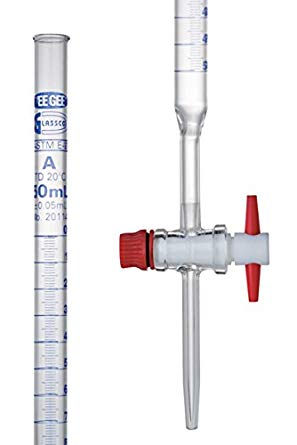
What is this piece of apparatus called
Pipette
Burette
Janette
Cuvette

What is the reading on this burette?
24.0cm3
25.8cm3
24.2cm3
23.9cm3
An endothermic reaction...
Releases energy to the surrounding area.
Boils the chemicals.
Evaporates the chemicals.
Takes in energy from the surrounding area.
An exothermic reaction...
Releases energy to the surrounding area.
Boils the reacting chemicals.
Evaporates the reacting chemicals.
Takes in energy from the surrounding area.
___________ reactions feel cold.
Exothermic
Endothermic
Chemical
___________ reactions feel warm.
Chemical
Endothermic
Exothermic
What equipment would you use to determine whether a reaction is endothermic or exothermic?
Balance (scales)
Ruler
Universal Indicator
Thermometer

A fizzy sweet, when eaten feels cold. Why?
They are made of ice.
It is dissolving.
There is an endothermic reaction.
There is an exothermic reaction.
The reactivity series describes how (a) common metals are, relative to each other.

Two reactive metals are placed inside a lemon. These are connected to a lightbulb. The lightbulb lights up, why?
The reaction between metals in the acidic lemon transfers charge between them.
The metals reacting causes electrons to appear.
The metals complete the circuit.
Acidic lemons are batteries.

Using the image. Determine why Gold, Silver and Platinum are metals used for Jewellery.
They react with skin.
They are valuable.
They are unlikely to react with skin.
They are rare and therefore profitable.
Zinc + Iron Sulphate → Zinc Sulphate + Iron
Zn + FeSO4 → ZnSO4 + Fe
Which kind of reaction is this?
Displacement Reaction
Condensation Reaction
Potato Reaction
Reactivity Reaction
Zn + FeSO4 → ZnSO4 + Fe
In this reaction Zinc displaces Iron. Is Iron higher (more) or lower (less) on the reactivity series than Zinc?
Higher (more reactive)
Lower (less reactive)
The same
Not enough information to confirm.
Al +HCl → AlCl3+H2
Balance this equation.
It is already balanced.
2Al +6HCl → 2AlCl3 + 3H2
Al + 6HCl → AlCl3 +3H3
What is meant by the 'conservation of mass'?
The overall mass of reactants changes during a reaction.
The overall mass of reactants stays the same before and after a reaction.
Chemicals have mass.
Potatoes
Magnesium is burned in a crucible to form magnesium oxide.
The mass before being burned is 1.5g.
The mass afterwards is 1.8g.
The mass in the crucible has increased. Pick 2 answers that best explain the reaction.
Oxygen from the air has bonded with the magnesium...
...mass is conserved and the air now has less oxygen.
Magnesium has been released into the air...
... The air has more oxygen than before, mass has increased and therefore is not conserved.
What is a neutralisation reaction and what do they produce?
An acid and an alkali react to neutralise each other...
...this produces a metal.
Neutrons are exchanged between metals...
...this produces a salt and water.
What is a physical change?
When a substance changes state.
When a substance changes size.
When a substance changes shape.
When a substance chemically reacts.
Which of these is not the name of a process for physical change.
Freezing/Fusion
Vaporisation
Melting
Neutralisation
What is the name given for a burning a fuel?
Combustion (Oxidation)
Neutralisation
Displacement Reaction
Precipitation
What is a composite material?
MDF
A material made from 2 or more other materials.
A material made up of 1 element.
Kevlar
What are the names given for the different materials in a composite?
Solid & Liquid
Reinforcement & Structure
Structure & Liquid
Reinforcement & Matrix

This image shows reinforced concrete being made with steel and cement. Which answer describes reinforced concrete?
Composite
Matrix: Cement
Reinforcement: Steel
Polymer
Matrix: Cement
Reinforcement: Steel
Ceramic
Matrix: Steel
Reinforcement: Cement
Composite
Matrix: Steel
Reinforcement: Cement
What best describes polymers?
2 different materials combined.
More than 2 materials combined.
Long chains of smaller joined molecules.
Synthetic
What is meant by the term 'plastic'?
PET
A material that won't change shape after it is moulded.
A material that returns to its original shape when stretched.
An environmentally friendly resource.
What is meant by the term 'elastic'?
A material that returns to its original shape when stretched.
A material that maintains its shape once it is moulded.
PET
Rubber
Synthetic polymers are...
made by humans.
made from trees.
made by bees.
Made through photosynthesis.
Natural polymers...
are found to be naturally occurring.
are created by humans.
are created by bees.
are delicious.
Rubber, DNA, Hair, Finger Nails, Wool, Starch and Cellulose are examples of...
Natural Composites.
Natural Polymers.
Natural Ceramics.
Synthetic Polymers.

Vulcanised rubber is...
Rubber extracted from the Vulcana Tree.
Rubber extracted from the igneous rock of a volcano.
Rubber heated with Sulfur to make it elastic.
Rubber heated to make it brittle.

Why would you use polymers for an electrical plug coating? Choose all that apply.
It can be moulded into a shape.
It can be made to be flexible.
It is an electrical conductor.
It is an electrical insulator.

Why would you choose to make a teapot out of a ceramic material? Choose all that apply.
It is an insulator of heat.
It is hard wearing.
It is a conductor of heat.
It is soft and flexible.
Which of the following is not an environmental/pollution issue from fuel combustion?
Acid Rain
Not energy efficient.
Greenhouse Gases.
Smog.

What Pokemon is this?
Pikachu
Kangaskhan
Voltorb
Mewtwo
Which of these elements makes up the name of a metal band?
IRON
Maiden
GOLD
Pistachio
Neil
DIAMOND
HYDROGEN
Panther
Which of these is not a safety requirement in a chemistry experiment?
Eye-Protection (Goggles).
Hair tied back.
Clear walkways.
Removing Glasses.
Which of these is the odd one out?
British Short-Hair
Labrador
Irish Water Spaniel
Italian Spinone
When does incomplete combustion occur?
Too much oxygen supplied.
Not enough oxygen supplied.
Too much Carbon.
Poor quality fuel combusted.
hydrocarbon + oxygen → carbon dioxide + water
Is the chemical word formula for...
Incomplete Combustion.
Displacement Reaction.
Complete Combustion.
Acid Rain.
When a metal tarnishes it reacts with which gas in the air?
Sulfur
Nitrogen
Hydrogen
Oxygen
What sort of compound is formed when a metal becomes tarnished in air?
Metal Sulphate
Metal Oxide
Metal Hydrate
Metal Nitrate

