
 Worksheets
Waves Practice
Total questions: 171
Worksheet time: 5hrs 23mins
What are waves?
Repeating pattern of motion that transfers energy
The thing that you surf on
What are the different properties of waves?
Amplitude
Frequency
Swells
Wavelength
What happens when sound waves are reflected?
Echo
No echo
Sound is heard in another room
What causes color to be seen?
Transmittance
Reflection
Refraction
Absorption

What do all waves transfer?
Matter
Heat
Electricity
Energy

Which of the following can waves transfer energy through?
solid
liquid
gas
empty space
all of the above

What are the two types of waves?
longitudinal and transverse
sound and light

What is the number of complete waves passing a fixed point in a given amount of time?
Amplitude
Intensity
Wavelength
Frequency

What is the frequency of this wave? You must count the number of complete waves.
1 Hz
5 Hz
10 Hz

What is frequency measured in?
Milliseconds
Miles
Hertz
Kilograms

Period of a wave refers to...
how long it takes for the event to repeat.
how strong a wave is.
how long a wave is.
how much energy a wave has.

Which type of waves have the longest wavelength?
Visible light
Radio waves
X-rays
Gamma-Rays

Wavelengths are usually measured in ....
seconds
Hz
inches
meters

Shorter wave lengths can carry more energy. Which of these probably carries the MOST energy:
Infrared light
Visible light
X-rays
UV light

What is the distance between the calm sea and the highest wave called?
Wave
Frequency
Amplitude
Magnitude

What does #1 represent?
Period
Frequency
Wavelength
Amplitude

What does #2 represent?
Period
Frequency
Wavelength
Amplitude

What does #3 represent?
Period
Frequency
Wavelength
Amplitude

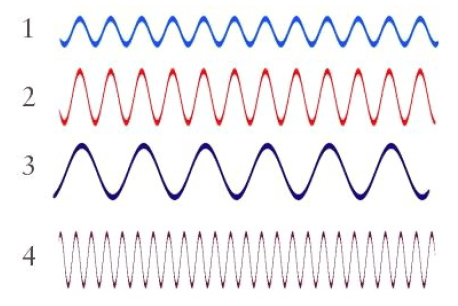
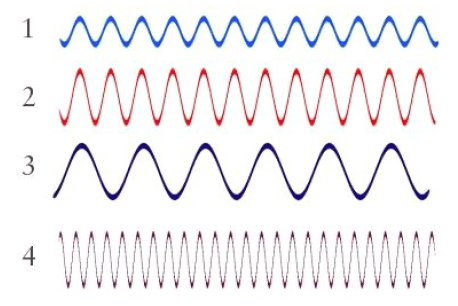
Which transverse wave has the highest frequency?
1
2
3
4
Which diagram shows the wavelength of a wave?


What does a wave carry from place to place?
energy
matter
people
The highest point on a transverse wave is the
compression
crest
rest position
trough
The lowest point on a transverse wave is the
compression
crest
rest position
trough
If the wavelength of a wave increased, what would happen to the frequency?
decrease
increase
stay the same
A wave that can travel through matter and empty space is a:
electromagnetic wave
longitudinal wavy
transverse wave
mechanical
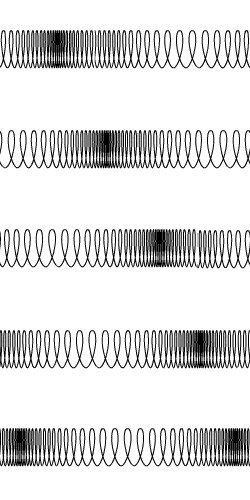
What type of wave is this?
Longitudinal
Transverse
Electromagnetic
x ray


You can't hear sounds in outer space because there is no
medium
light
energy
heat
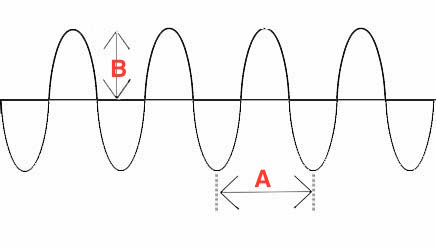
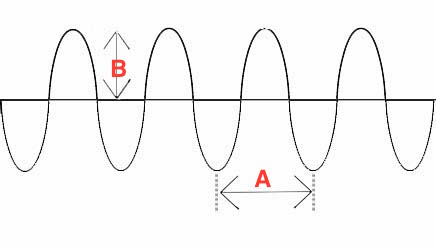

What is the equation for calculating the wavelength of a wave?
Wavelength = speed x frequency
Wavelength = speed/frequency
Wavelength = frequency/speed
The symbol for wavespeed is
v
f
m/s
𝝺
The symbol for frequency is
v
Hz
f
𝝺
The unit for speed is
m/s or cm/s
Hz
m or cm
Which is the following is true
Wavespeed is measured in m and has the symbol 𝝺
Wavelength is measured in m and has the symbol 𝝺
Frequency has the symbol f and is measured in Hz
Wavespeed is measured in m and has the symbol v
A wave has a frequency of 5 Hz and a speed of 25 m/s. What is the wavelength of the wave?
25 m
125 m
5 m
25 m/s

If the frequency of the wave below is 10 Hz, what is its speed?
Type your answer as in:
67 m/s
(a)

Determine the period and frequency of the following wave.
Type the answer like in this example:
65 s; 97 Hz
(a)
What does LIGO detect?
Visible Light
X-rays
Radio Waves
Gravitational Waves
What does LIGO stand for?
Laser Interferometer Gravity Outhouse
Let's Integrate Good Objects
Light is Going On
Laser Interferometer Gravitational-Wave Observatory
The first signal that LIGO detected was from a...
black hole merger
neutron star merger
plane flying overhead
rabbit on the ground
What are some possible applications of LIGO (select all that apply)?
measuring the expansion of the universe
studying how large stars die
looking back to the Big Bang
finding planets around distant stars
What do all waves transfer?
Matter
Heat
Electricity
Energy
Which of the following can waves transfer energy through?
solid
liquid
gas
empty space
all of the above
What are the two types of waves?
longitudinal and transverse
sound and light
What is the number of complete waves passing a fixed point in a given amount of time?
Amplitude
Intensity
Wavelength
Frequency
What is the frequency of this wave? You must count the number of complete waves.
1 Hz
5 Hz
10 Hz
What is frequency measured in?
Milliseconds
Miles
Hertz
Kilograms
Period of a wave refers to...
how long it takes for the event to repeat.
how strong a wave is.
how long a wave is.
how much energy a wave has.
Which type of waves have the longest wavelength?
Visible light
Radio waves
X-rays
Gamma-Rays
Wavelengths are usually measured in ....
seconds
Hz
inches
meters
Shorter wave lengths can carry more energy. Which of these probably carries the MOST energy:
Infrared light
Visible light
X-rays
UV light
What is the distance between the calm sea and the highest wave called?
Wave
Frequency
Amplitude
Magnitude
What does #1 represent?
Period
Frequency
Wavelength
Amplitude
What does #2 represent?
Period
Frequency
Wavelength
Amplitude
What does #3 represent?
Period
Frequency
Wavelength
Amplitude
What do all waves transfer?
(a)
Waves transfer _______.
particles
matter
energy
_____ waves have vibrations that run parallel to the direction the wave travels, and _____ waves have vibrations that run perpendicular to the direction the wave travels.
transverse, longitudinal
longitudinal, transverse
Examples of this type of waves include water waves, waves on a string/jump rope, and light waves.
transverse
longitudinal
Examples of _____ waves include sound waves and earthquake P-waves.
transverse
longitudinal
_______ is the distance between waves, measured from one crest to the next crest.
Wavelength
Frequency
Amplitude
The _______ is the highest point on a transverse wave, and the ____ is the lowest point.
Trough, Crest
Crest, Trough
Compression, Rarefaction
Rarefaction, Compression
The _______ is the size or height of a wave, measured from the equilibrium to the crest or trough.
Amplitude
Wavelength
Frequency

The _______ of a wave is how many waves pass a given point every second.
Frequency
Wavelength
Amplitude
Frequency is measured in _______.
Hertz (Hz)
Meters per second
Meters
Newtons
Frequency is how many waves pass a point in 1 second. If 100 waves pass a given point in 4 seconds, what is the wave's frequency?
25 Hz
100 Hz
4 Hz
400 Hz

In a longitudinal wave, a ____ is an area where the particles are spread apart and a ____ is an area where the particles are close together.
crest, trough
compression, rarefaction
rarefaction, compression
trough, crest

Examples of ________ waves include visible light, xrays, ultraviolet, and radio waves.
transverse
longitudinal
Waves that can travel through empty space are called _____ waves. Waves that require a medium to travel, such as air or water, are called _____ waves.
mechanical, electromagnetic
electromagnetic, mechanical
crest, trough
compressional, rarefactional

In the diagram of a compressional wave, A is showing a ___ while B is showing a ___.
compression, rarefaction
trough, crest
rarefaction, compression
crest, trough

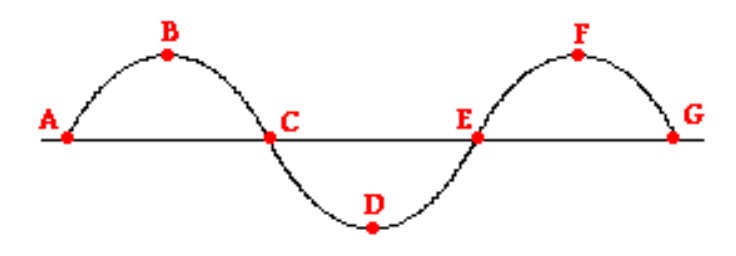
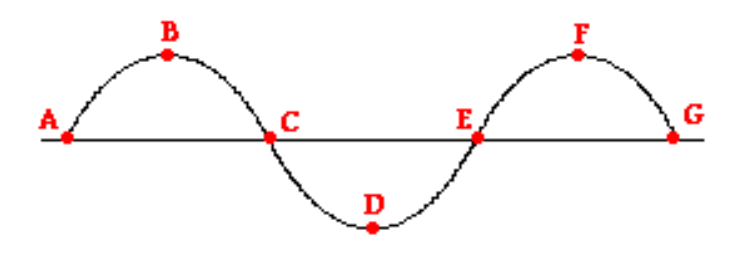
In this diagram of a transverse wave, A is showing the wave's _____ and B is showing the wave's _____.
amplitude, trough
amplitude, crest
wavelength, trough
wavelength, crest

In this diagram of a transverse wave, C is showing the wave's _____ and D is showing the wave's _____.
crest, amplitude
trough, amplitude
crest, wavelength
trough, wavelength

Which number identifies the tympanic membrane?
(a)
Which number identifies the stapes?
(a)
Which number identifies the cochlea?
(a)

Which number identifies the hair cells?
(a)
Which part of the ear is a tube that looks like a snail and it changes sound into nerve impulses that are sent to the brain?
pinna
anvil
cochlea
The part of the ear that carries sound from the pinna to the ear drum is called the
cochlea
ear canal
hammer
The three bones that amplify sound in the ear are called the hammer, anvil, and
cochlea
oval window
stirrup
The part of the ear that catches sound is called the
pinna
ear drum
cochlea
Which part of the ear can we see?
cochlea
ear drum
pinna
the sense organ involved in receiving sound waves
ear
ear canal
eardrum
membrane
a tube-like structure connecting the external ear to the eardrum.
ear
ear canal
eardrum
membrane
the membrane separating the outer ear from the inner ear.
ear
ear canal
eardrum
membrane
tiny hairs that line the cochlea and help turn vibration into nerve impulses.
cilia
cochlea
oval window
stirrup
a spiral tube that makes up the part of the inner ear responsible for hearing.
cilia
cochlea
oval window
stirrup
the first in a series of three small bones in the middle ear.
cilia
anvil
hammer
stirrup
the second in a series of three small bones in the middle ear.
cilia
anvil
hammer
stirrup
the third in a series of three small bones in the middle ear.
cilia
cochlea
oval window
stirrup

What is this?
Ear Drum
Ear Canal
Pinna
Cochlea
Hearing Nerve
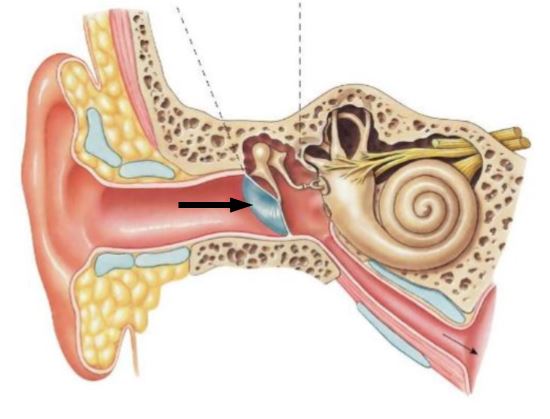
What is this?
Ear Drum
Ear Canal
Pinna
Hammer
Cochlea
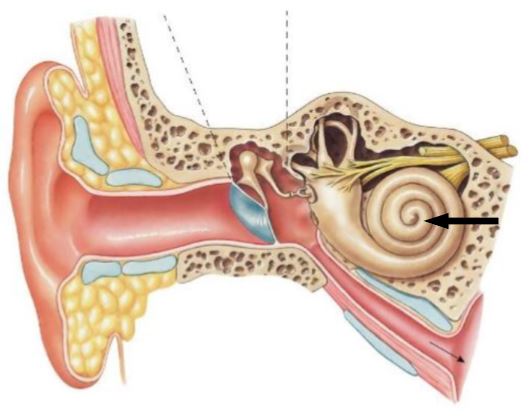
What is this?
Pinna
Hearing Nerve
Cochlea
Ear Drum
Anvil

What is this?
Anvil
Hammer
Stirrup
Cochlea
Ear drum

What is this?
Anvil
Hammer
Stirrup
Cochlea
Ear drum

What is this?
Hearing Nerve
Cochlea
Pinna
Stirrup
Hammer

What is this?
Anvil
Hammer
Stirrup
Ear Canal
Ear drum
Select the THREE bones found in the middle ear. You may select multiple answers.
eardrum
hammer
anvil
cochlea
stirrup
Select ALL the part(s) of the ear found in the inner ear. You may select multiple answers.
ear canal
cochlea
anvil
auditory nerve
hammer
Name the section of the ear where the eardrum is located.
outer
middle
inner
Which section of the ear is responsible for capturing the sound waves?
Inner Ear
Middle Ear
Outer Ear
Which section of the ear transfers sound into electrical impulses, which are then sent to the brain ?
Outer Ear
Inner Ear
Middle Ear
Cochlea
Which section of the ear do vibrations push up against the structures in order to hear the sound?
Outer Ear
Middle Ear
Inner Ear
Which structure contains 15,000 tiny little hairs?
Anvil
Hammer
Stirrup
Cochlea
Ear drum
Which section of the ear helps control the body's balance?
Outer Ear
Inner Ear
Middle Ear
Cochlea

What letter is pointing to the cochlea?
(a)
What letter is pointing to the stapes?
(a)
What letter is pointing to the tympanic membrane?
(a)
What structure separates the outer and middle ear?
Eustachian tube
Ossicles
Tympanic Membrane
Cochlea
Semicircular Canal
What else does our ears do besides help us to hear?
Smell
Balance
Sight
Fight off sickness
The three main parts of the ear include in the outer, middle, and inner ear.
True
False

