
 Worksheets
PHY Force and Motion
Total questions: 120
Worksheet time: 2hrs 30mins
What do you call a push or pull on an object?
Chemical
Force
Magnet
Which force holds us to earth's surface?
Friction
Mass
Gravity
The amount of matter in an object is known as?
Mass
Weight
Volume
At which location would your mass be the greatest?
Earth
Moon
Your mass stays the same everywhere.
Gravity affects which of the following?
Mass
Weight and Mass
Weight
What force keeps the moon in orbit around the Earth?
weight
mass
gravity
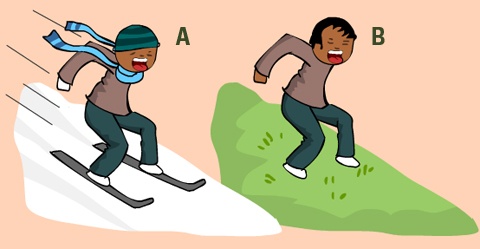
Which surface would cause the greatest friction?
carpet
ice
snow
Which force acts on an object by touching the object?
Electricity
Friction
Gravity
When sand is poured on an icy road, what force are we increasing to help cars stay on the road?
Electricity
Friction
Gravity
On which surface would a toy car travel the furthest when pushed?
Ice
Carpet
Snow
Which of these objects would be attracted to a magnet?
nails
wood
paper
The north pole of one magnet will be attracted to the _________ pole of another.
east
south
north
What will happen if you try to put the south pole of one magnet and the south pole of another magnet together?
The magnets will attract or move together
The magnets will repel or move away.
The magnets will not attract or repel
The amount of matter in an object.
mass
volume
density
Anything that has mass and takes up space.
mass
matter
volume
The force of attraction between two objects that depends on the masses of the objects and the distance between the objects
friction
pull
gravity
Gravitational force exerted on an object.
gravity
weight
mass
The level of the surface of the ocean
sea level
mountain level
water level
Objects in motion tend to stay in motion, objects at rest tend to stay at rest, unless acted upon by a force.
gravity
friction
inertia
To make an object move you must first apply ---
an opposing force
an unbalanced force
a stationary force
a vertical force
What happens to an object when a balanced force is applied?
It moves in the direction of the force
It remains stationary
It accelerates
Which of the following materials is a good conductor of electricity?
Plastic
Wood
Copper
What is the term for the resistance of an object to change its state of motion?
Friction
Inertia
Gravity
In which direction and with how much force will an object move if you push to the left with 15N of force and your friend pushes to the right with 5N of force?
up with 10N of force
down with 5N of force
left with 10N of force
right with 10N of force
What is a force?
A push or a pull
The constant motion of an object
The acceleration of an object
The mass of an object
Which of these is evidence that an unbalanced force is acting on an object?
The mass of the object is changing
The object continues moving in a straight line
The object remains at rest
The motion of the object is changing
Newton's First Law States........
Objects at rest tend to stay at rest unless acted on by an outside force.
Objects accelerate often and it is difficult to know when or how they will accelerate.
Objects in motion tend to stay in motion unless acted on by an outside force.
Both A & C
What is inertia?
An object that is accelerating
Gravitational force
An objects tendency to stay at rest or in motion
An unbalanced force
Inertia depends on __________.
Weight
Velocity
Mass
Acceleration
Newton's second law states.....
If there is more mass then there is more acceleration
An object at rest wants to be in motion
Force = Mass x Acceleration
The force exerted on an object is not related to mass or acceleration
What formula is used to calculate force?
Acceleration = Force x Mass
Force = Mass x Acceleration
Work = Force x Distance
Mass = Force + Acceleration
An object with a mass of 100 kg is observed to accelerate at the rate of 5 m/s2. Calculate the force required to produce this acceleration.
20N
500 M/S
500 Kg
500N
A force of 40 N acts upon a 2 kg block. Calculate the acceleration of the object.
20 m/s2
20 m/s
80 m/s2
80 m/s
Newton's third law states.......
For each action there is a larger reaction associated with it.
None of these choices
For each action there is an equal and opposite reaction.
For each action there is a smaller reaction associated with it.
Stacy is rowing a boat. She wants the boat to move forward. According to Newton's Third Law, in which direction should she move her paddle in the water?
Backwards
Above her head
Forward
East
When an object is falling and the force of gravity is equal to the force of air resistance
Terminal Velocity
Top Speed
Parachute Level
Free Fall
A hockey puck sliding across the ice is an example of this type of friction.
Air Resistance
Sliding
Rolling
Static
When you stick your hand out of the window of a moving car you feel the air pushing on your hand. This is an example of ______________.
Static
Rolling
Sliding
Fluid
My file cabinet stays in the corner of the room as a result of this type of friction.
Static
Rolling
Sliding
Fluid (Air Resistance)
my science chair is on wheels and moves easily across my floor as a result of this type of friction.
Static
Sliding
Rolling
Fluid
Forces that are equal in size but in opposite directions are called ______________ forces.
Strong
Crazy
Balanced
Unbalanced
The sum of all forces acting on an object.
Added forces
Net force
forcey force
Equation force
The tendency of an object to just keep doing what it is doing.
Laziness
F=MA
No Clue
Inertia
Force is.....
The combining of forces when two or more forces act on an object
the push or pull that one object exerts on another
forces that are equal in size and opposite in direction
forces that are not equal in size and opposite in direction
Net force is.....
The combining of forces when two or more forces act on an object
the push or pull that one object exerts on another
forces that are equal in size and opposite in direction
forces that are not equal in size and opposite in direction
Unbalances forces are.....
The combining of forces when two or more forces act on an object
the push or pull that one object exerts on another
forces that are equal in size and opposite in direction
forces that are not equal in size and opposite in direction
Balances forces are.....
The combining of forces when two or more forces act on an object
the push or pull that one object exerts on another
forces that are equal in size and opposite in direction
forces that are not equal in size and opposite in direction
Forces can cause a change in an object's motion
True
False
What kinds of forces change an object's motion?
Friction
Air resistance
Gravity
All of the above
What factors does friction depend on?
The roughness of the surface
The greater the force pushing the two objects together
The greater the surface area of the two objects touching
all of the above
Match the following
An object will move at constant velocity until a net force acts on it
Newton's 1st Law
A net force acting on an object causes the object to accelerate in the direction of the net force
Newton's 2nd Law
Every action as an equal and opposite reaction
Newton's 3rd Law
All moving objects have momentum. Momentum is transferred between objects in a collision
Law of Conservation of Momentum
Match the following types of frication
Forces between two surfaces that are NOT moving past each other
Static Friction
Force between two surfaces that are sliding past each other
Sliding Friction
Force between a rolling object and the surface it rolls on
Rolling Friction
Newton's 1st law is also known as the Law of (a)
The tendency of an object to resist a change in motion is called...?
friction
air resistance
inertia
gravity
Air resistance can be determined by.....
Speed
Size
Shape
All of the above
The Law of Universal Gravitation is
any two masses exert an attractive force on each other
the force that causes all falling objects to have an acceleration of 9.8 m/s2
the force of gravity
The law of universal gravitation depends on what 2 things?
mass
velocity
distance
acceleration
Is there any acceleration in terminal velocity?
Yes
No
(a) is the amount of matter in an object
The rougher the surface, the greater the friction
The greater the force pushing the two objects together, the greater the friction
The greater the surface area of the two objects touching, the greater the friction
speed
size
shape
Net force
balanced forces
unbalanced forces
static friction
sliding friction
rolling friciton
Acceleration is defined as an object's
changing position.
changing velocity.
net force.
changing forces.
Which of the following would be considered an acceleration?
An object speeding up
An object moving with a constant velocity
An object slowing down
An object standing still
An object changing direction

Which of the following describes the car traveling in this graph
The car is moving in the positive direction
The car is moving in the negative direction
The car is slowing down
The car is speeding up
The car is moving with a constant velocity

Which of the following describes the car traveling in this graph
The car is moving in the positive direction
The car is moving in the negative direction
The car is slowing down
The car is speeding up
The car is moving with a constant velocity

Which of the following describes the car traveling in this graph
The car is moving in the positive direction
The car is moving in the negative direction
The car is slowing down
The car is speeding up
The car is moving with a constant velocity

Which of the following describes the car traveling in this graph
The car is moving in the positive direction
The car is moving in the negative direction
The car is slowing down
The car is speeding up
The car is moving with a constant velocity

What is happening at the green circle?
The car is changing direction
The car is slowing down
The car comes to a stop
The car crosses the reference point

Which graph is best described by the motion map here?


A cart starts from rest and reaches a speed of 30 m/s in 3 s. What is the acceleration?
Label your answer with m/s/s.
Don't forget + or - on your answer!
(a)
A sprinter crosses the finish line with a velocity of 9 m/s. It takes him 6 s to come to a stop. Find his acceleration.
Label your answer with m/s/s.
Don't forget + or - on your answer!
(a)

Which part(s) of the graph show an increasing velocity?
A-B
B-C
C-D
D-E
E-F
Which part(s) of the graph show a decreasing velocity?
A-B
B-C
C-D
D-E
E-F
Where on the graph is the object at rest?
A-B
B-C
C-D
D-E
E-F

Which part of the graph shows a decreasing velocity?
A-B
B-C
C-D
None of these
Which part(s) of the graph shows a negative velocity?
A-B
B-C
C-D
None of these
What is the displacement of the object from C to D?
0 m
-8 m
+ 8 m
+ 16 m
None of these
What is the acceleration of the object from C to D?
+8 m/s/s
+4 m/s/s
+2 m/s/s
None of these
What is the velocity of the object from A to B?
8 m/s
-4 m/s
0 m/s
-2 m/s
What is the acceleration of the object from A to B?
+8 m/s/s
+4 m/s/s
+2 m/s/s
None of these
What is the displacement of the object from A to B?
0 m
-8 m
+ 8 m
+ 16 m
None of these
Acceleration is defined as an object's
changing position.
changing velocity.
net force.
changing forces.
Which of the following would be considered an acceleration?
An object speeding up
An object moving with a constant velocity
An object slowing down
An object standing still
An object changing direction
Which of the following describes the car traveling in this graph
The car is moving in the positive direction
The car is moving in the negative direction
The car is slowing down
The car is speeding up
The car is moving with a constant velocity
Which of the following describes the car traveling in this graph
The car is moving in the positive direction
The car is moving in the negative direction
The car is slowing down
The car is speeding up
The car is moving with a constant velocity
Which of the following describes the car traveling in this graph
The car is moving in the positive direction
The car is moving in the negative direction
The car is slowing down
The car is speeding up
The car is moving with a constant velocity
Which of the following describes the car traveling in this graph
The car is moving in the positive direction
The car is moving in the negative direction
The car is slowing down
The car is speeding up
The car is moving with a constant velocity
What is happening at the green circle?
The car is changing direction
The car is slowing down
The car comes to a stop
The car crosses the reference point
Which graph is best described by the motion map here?
A cart starts from rest and reaches a speed of 30 m/s in 3 s. What is the acceleration?
Label your answer with m/s/s.
Don't forget + or - on your answer!
(a)
A sprinter crosses the finish line with a velocity of 9 m/s. It takes him 6 s to come to a stop. Find his acceleration.
Label your answer with m/s/s.
Don't forget + or - on your answer!
(a)
Which part(s) of the graph show an increasing velocity?
A-B
B-C
C-D
D-E
E-F
Which part(s) of the graph show a decreasing velocity?
A-B
B-C
C-D
D-E
E-F
Where on the graph is the object at rest?
A-B
B-C
C-D
D-E
E-F
Which part of the graph shows a decreasing velocity?
A-B
B-C
C-D
None of these
Which part(s) of the graph shows a negative velocity?
A-B
B-C
C-D
None of these
What is the displacement of the object from C to D?
0 m
-8 m
+ 8 m
+ 16 m
None of these
What is the acceleration of the object from C to D?
+8 m/s/s
+4 m/s/s
+2 m/s/s
None of these
What is the velocity of the object from A to B?
8 m/s
-4 m/s
0 m/s
-2 m/s
What is the acceleration of the object from A to B?
+8 m/s/s
+4 m/s/s
+2 m/s/s
None of these
What is the displacement of the object from A to B?
0 m
-8 m
+ 8 m
+ 16 m
None of these

